




If you have access to recycling channels for “giant tires” from mines and engineering projects but are worried that “ordinary equipment can’t handle them” or “there’s no way to profit from large tires”, this article will explain how a 3-ton-per-hour production line turns 2.5-meter mine tires into “high-value finished products”.
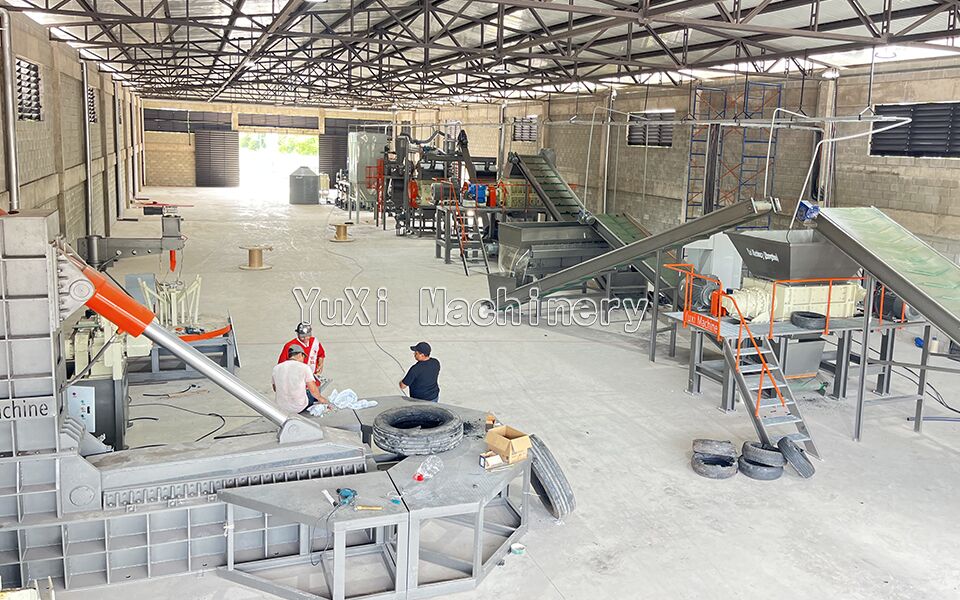
I. First, Understand: A 3-Ton-per-Hour Production Line Is Not Just a “Larger Version of Small Equipment”
Many people think “a 3-ton line is just faster than a 2-ton line”, but it is actually a heavy-duty customized system—not only can it process 3 tons of tires per hour (60-70 tons per day), but it can also directly “swallow” 2.5-meter-diameter mine truck tires, and even 15cm-thick engineering tires can be crushed in one go. It is fully tailored for “heavy-duty tire recycling”.
Core Information (2025 Paraguay Project On-Site Data)
- Raw Material Coverage: Car tires, truck tires, and 2.5-meter-diameter mine truck tires
- Finished Product Specifications: 2mm, 4mm particle sizes; 30-mesh, 50-mesh
- Downstream Applications: Floor tiles, shoe sole materials, asphalt improvement
- Service Support: One-on-one technical guidance from vacant land planning to project operation
II. 3 Irreplaceable Values of a 3-Ton-per-Hour Production Line
Handles “Hard Bones”: Turns 2.5-Meter Mine Tires into “Hot Commodities”
Ordinary production lines require “cutting first then crushing” to process mine tires, but the heavy-duty double-shaft shredder (5cm-thick blades, 12000N·m torque) of a 3-ton line can directly cut 2.5-meter mine tires into 10cm blocks without extra processes—this allows you to obtain “raw materials that others can’t collect”, with a purchase price 30% lower than ordinary tires, directly expanding profit margins.
Finished Products “Meet Demand”: Matches “High-requirement Orders” from Shoe Sole and Floor Tile Factories
The graded screening system of a 3-ton line can precisely control finished product precision:
- 2mm/50-mesh fine powder is the “core material” for shoe sole factories, selling for 25% more than ordinary rubber powder
- 4mm/30-mesh medium powder can be directly used for “high-grade asphalt modification”, and highway projects specifically require this type of material
- Separated steel wire can be pressed into “150kg steel cakes”, which steel mills purchase at “high-quality scrap steel” prices—15% more than ordinary steel wire
Thinner Cost Spreading: 12% Lower Per-Ton Cost Than 2-Ton Lines
- Electricity: Only 65-85 kWh per ton of tires; the frequency conversion system automatically adjusts power according to tire hardness
- Labor: 2 people can manage the entire production line, keeping per-ton labor costs at 28 yuan
- Blade Life: Uses SKD11 alloy steel blades, which can process 1500 tons of tires before replacement, with per-ton blade costs only 3.5 yuan
III. Actual Profit Calculation for a 3-Ton-per-Hour Production Line
Taking 2025 Paraguay project operation data as an example:
- Raw Material Costs:
◦ Ordinary car/truck tires: 650-850 yuan/ton
◦ 2.5-meter mine tires: 500-700 yuan/ton (many recyclers are unwilling to collect them because they are hard to process)
- Output Revenue:
◦ 0.5 tons of 2mm/50-mesh fine powder (2200 yuan/ton) → 1100 yuan
◦ 0.3 tons of 4mm/30-mesh medium powder (1900 yuan/ton) → 570 yuan
◦ 0.18 tons of steel wire (2300 yuan/ton) → 414 yuan
◦ 0.02 tons of fiber (220 yuan/ton) → 4.4 yuan
- Per-Ton Cost: 650+65+28+3.5=746.5 yuan
- Per-Ton Profit: 1100+570+414+4.4-746.5=1341.9 yuan
- Annual Profit: 60 tons/day × 300 days × 1341.9 yuan/ton=24,154,200 yuan
IV. Key Details for Implementing a 3-Ton-per-Hour Production Line
The Site Must “Withstand Heavy Loads”
- The total weight of the equipment exceeds 50 tons; the workshop floor needs “20cm-thick concrete hardening” and pre-embedded load-bearing steel beams
- A total area of 500-550㎡ is required; the raw material warehouse must have a separate “mine tire storage area” with a height ≥6 meters
Store Raw Materials in Separate Warehouses
- Store car tires, truck tires, and mine tires in 3 separate warehouses; the production line can automatically identify raw material types and adjust parameters
- Sign “long-term recycling agreements” with mines and engineering teams in advance to lock in a stable supply of 2.5-meter mine tires
Negotiate with Customers in a Targeted Manner
- Connect with shoe sole factories and high-grade highway project departments 6 months before commissioning to confirm “customized finished product standards”
- Bring “finished product samples” from the production line to customer factories for testing, and start production only after obtaining “qualification certification”
V. Frequently Asked Questions
Q1: Can a 3-ton-per-hour production line process 2.5-meter mine tires?
A: Yes. Its heavy-duty shredder has a 1.8-meter-wide feed inlet, which can directly accommodate 2.5-meter-diameter mine tires.
Q2: Will the production line’s noise affect the surrounding area?
A: No. It is equipped with a “fully enclosed sound insulation cover”, and the noise outside the workshop is ≤70 decibels, meeting industrial zone environmental protection requirements.
Q3: Will equipment failures affect production?
A: No. The technical supplier will set up a “spare parts warehouse” locally, and faulty parts can be replaced within 24 hours.
VI. Conclusion: Who Is a 3-Ton-per-Hour Production Line For?
If you:
- Are a recycler with “50+ tons per day” of tires, including 2.5-meter mine tires
- Want to do “high-value finished product customization” instead of selling “bulk rubber powder”
- Have resources to connect with shoe sole factories and high-grade highway projects
A 3-ton-per-hour tire recycling production line is your “heavy-duty profit engine”—it handles “hard bones” that others can’t, turns large tires into “high-profit finished products”, and transforms your recycling business from “earning money from volume” to “earning money from quality”.