




Tire Rubber Crumb Plant
A configurable tire rubber crumb plant for turning prepared tire material into graded rubber granules, with staged steel recovery, textile-fiber removal, screening and oversize return.
The Tire Rubber Crumb Plant is a key stage in the waste tire recycling process. It processes wire-free tire chips from the Rubber Mulch Plant into high-purity rubber granules, ensuring fiber removal and uniform particle size.
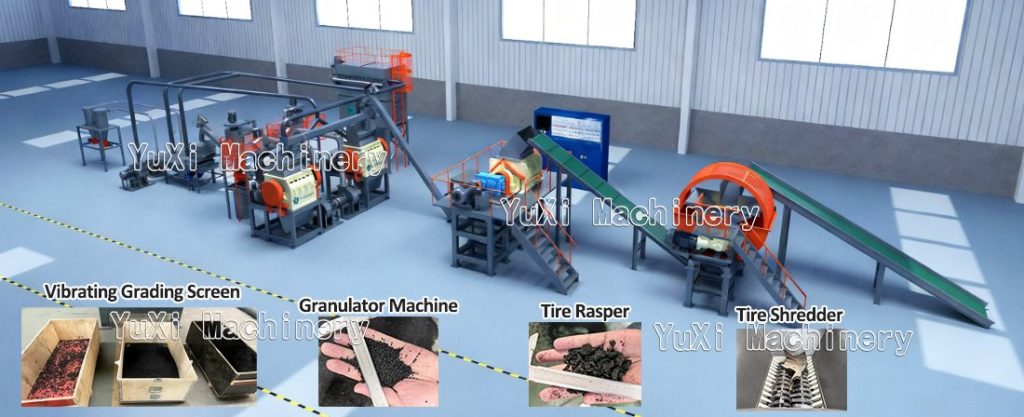
Two practical configurations, one finished-product target
The plant can be supplied as a complete line from whole tires or as a downstream granulation module for an existing rubber mulch system. Defining the feed point first keeps the equipment scope, layout and quotation clear.
Whole tires to graded crumb rubber
For a new waste tire recycling plant, the system can begin with tire preparation and primary shredding, then continue through steel liberation, magnetic recovery, rubber granulation, screening and textile separation.
- Suitable when the customer does not already own tire-processing equipment.
- Quotation includes front-end feeding, shredding and downstream finishing.
- Workshop planning must reserve space for raw tires, return material and recovered by-products.
Wire-free tire chips to rubber granules
For an existing rubber mulch plant, the tire crumb rubber machine can start from 10–20 mm wire-free chips and add granulation, grading, secondary magnetic separation and fiber removal.
- Lower project scope when primary shredding and steel liberation are already available.
- Existing chip size, residual steel and fiber condition must be sampled before final machine selection.
- Interfaces, feed height, electrical load and control signals should be confirmed before fabrication.
Tire rubber crumb production process
The complete route uses controlled size reduction rather than one aggressive grinding step. Each stage prepares the material for the next, while screening and recirculation prevent oversized rubber from entering the finished-product stream.
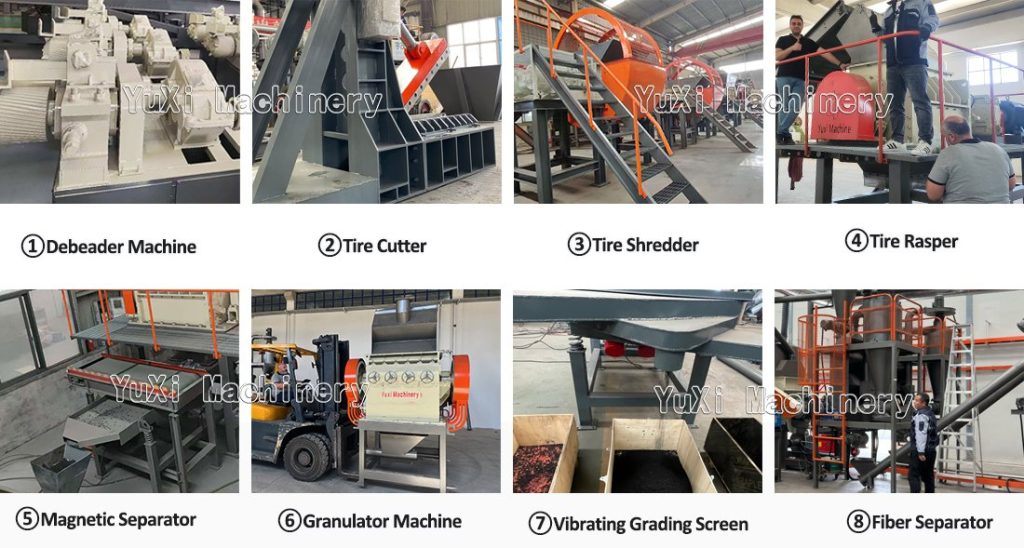
Debeader Machine
Debeader Machine: to remove the bead steel. Removing the bead section before shredding reduces heavy steel entering the cutting system.
Tire Cutter
Tyre Cutter Machine: to cut the whole tyre into 4-5 pieces. Pre-cutting is used when tire dimensions or the selected shredder feed opening require smaller sections.
Tire Shredder
Tire Shredder: Output size: 50mm rubber block. Stable block size gives the rasper a more even load and improves continuous material flow.
Tire Rasper
Tire Rasper Machine: Output size: 10-20mm rubber chips. The rasper opens the rubber around embedded steel so the following magnetic stage can recover it.
Magnetic Separator
NO.1 Magnetic Separator: to separate steel wire, sorting rate 97%. No.2 Magnetic Separator: to separate steel wire, Sorting rate 99% after granulation.
Granulator Machine
Rubber Granulator Machine: Output size: 1-6mm rubber granular. Screen selection, knife condition and return load are then balanced to produce the highlighted 0-5mm finished range.
Vibrating Grading Screen
Vibrating Grading Screen: screening of appropriate size granules into the grinding mill. Collector: Return material is collected here and crushed again.
Fiber Separator
Fiber Separator: to separate the fiber material. Airflow is adjusted to remove loosened textile without carrying excessive fine rubber into the fiber stream.
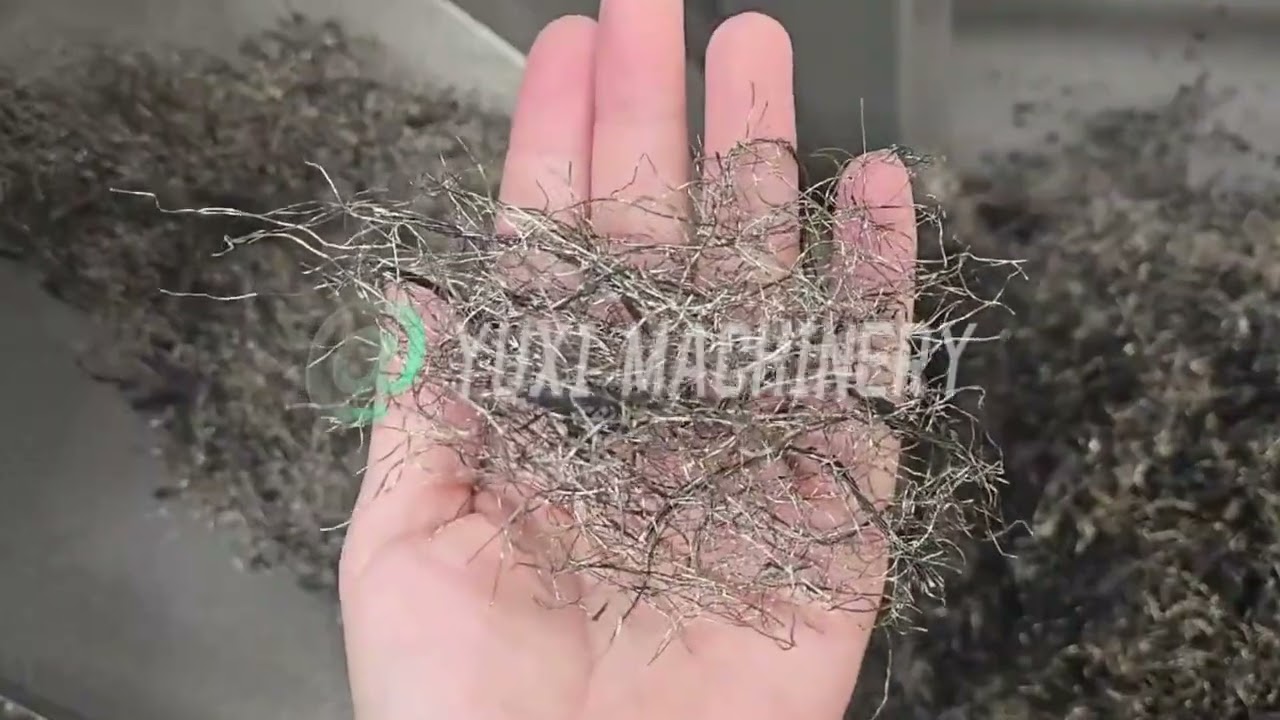
Do not judge the line from one short cutting shot
A useful working video should show continuous material movement, not only an empty-machine test. Ask to see representative feed, discharge size, separated steel, extracted fiber, screen return and the finished crumb sample.
Choose rubber granule size by confirmed end market
“0–5 mm,” “1–6 mm” and “1–8 mm” may all appear in project discussions, but they do not describe the same product distribution. The buyer should define the accepted screen range, oversize limit, fines limit and cleanliness test before the rubber granule production line is finalized.
| Target fraction | Typical use direction | Engineering consequence | What the buyer should confirm |
|---|---|---|---|
| 0–5 mm high-purity granules | Primary finished-output direction for this plant, subject to the agreed screen and buyer specification. | Requires controlled grading, oversize return, staged magnetic recovery and fiber separation. | Required percentage within 0–5 mm, permitted fines, visible metal and textile limits. |
| 1–6 mm / 1–8 mm granulator output | Intermediate or broader crumb range before final grading, or saleable feedstock where accepted. | Usually provides higher practical throughput than a tighter 0–5 mm finished specification. | Whether this is an intermediate stream or the final product, plus maximum piece size and cleanliness. |
| 1–3 mm or 3–5 mm fraction | Application-specific products after controlled grading. | More screening, separate collection and possible multiple product bins. | Whether one product or several saleable fractions are required. |
| Below 1 mm / fine powder | Fine rubber powder and specialist compounding feedstock. | Usually requires an additional rubber powder grinding stage, not only this crumb plant. | Mesh specification, heat control, moisture and downstream mill capacity. |
What “high-purity crumb rubber” should mean in a real contract
Purity is produced by the complete separation chain. A number alone is not useful unless the material basis, sampling method, impurity type and acceptance test are written down.
Production targets and separation controls
High-purity rubber granules, 99.9% free from impurities.
Uniform particle size, adjustable 0-5mm.
Highly automated, recirculation ensures consistent quality.
Recommended acceptance method
- State the feed condition. Passenger tires, truck tires and mixed feed do not contain the same steel and textile proportions.
- Separate the impurity limits. Define maximum metal content and maximum fiber content independently instead of one vague purity number.
- Use a representative sample. Sample after stable operation and combine material from several collection times.
- Run a sieve analysis. Record the percentage retained on each selected screen rather than checking only the largest particle.
- Check moisture and fines. Wet or dusty crumb may be rejected even when visible steel is low.
- Agree the test before shipment. FAT conditions, sample weight, test tools and pass/fail criteria should be written into the order.
For particle-size verification, buyers can review the principles described in industry crumb-rubber guidance and confirm the exact standard required by their downstream customer.
Common production problems and how the line should address them
A high-conversion production-line page should not stop at advantages. These are the problems that determine whether the tire recycling plant can produce a saleable crumb every shift.
Output contains visible steel wire
Do not increase magnet claims first. Check whether the rasper has liberated the wire, whether the magnetic belt is overloaded, whether its height and speed are correct, and whether a second magnetic pass is installed after granulation.
Textile fiber remains in the finished crumb
Fiber separation becomes unstable when feed rate surges, rubber is too moist, air volume is poorly adjusted or screen fractions are mixed. Use steady metering, staged aspiration and separate grading before final collection.
Real capacity is below the quoted number
Compare accepted feed throughput with finished-product throughput. Finer screens create more return material, while truck-tire content, dull knives and excess contamination increase load per tonne.
Granulator knives wear or heat too quickly
Keep oversize feed out of the granulator, remove liberated steel before cutting, prevent tramp metal entry, control knife clearance and prepare a sharpening and rotation plan before commissioning.
Conveyors and screens block during continuous production
Install stable metering, surge capacity and load interlocks. Oversize return should have enough conveyor capacity so recirculated material does not accumulate at the grading screen.
Dust escapes around transfer points
Enclose high-drop transfers, connect the granulator, screens and fiber separator to a correctly sized extraction system, and leave safe access for duct and filter cleaning.
The plant produces crumb but no buyer accepts it
Confirm the local product specification before ordering equipment. Application names alone are not enough; obtain the required particle distribution, metal, fiber, moisture, packaging and regulatory conditions from a real downstream buyer.
Future powder expansion requires rebuilding the workshop
Reserve discharge interfaces, electrical capacity, dust-control space and floor area for a later rubber powder grinding system, even when the first phase stops at 1–8 mm crumb.
Main equipment in the tire crumb rubber machine line
The exact equipment list changes with the agreed feed point. The machines below show the main size-reduction and separation stages, with the supplied input and output data placed beside the engineering explanation.
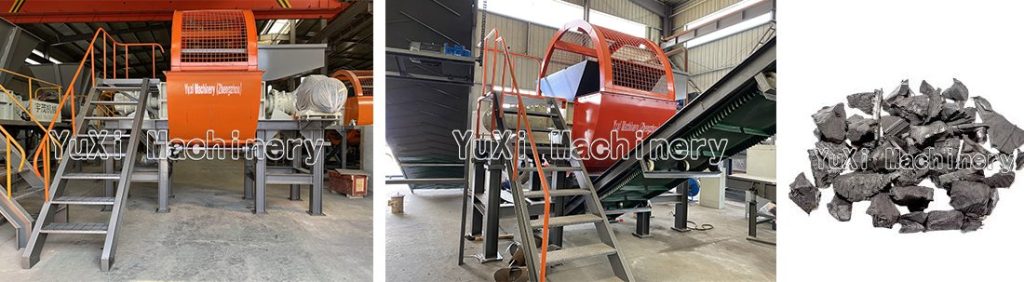
1.Tire Shredder
Tire shredders is designed to help you turn bulky, used tires into manageable materials for recycling or disposal, saving you both time and disposal costs. Whether you need a high-capacity, heavy-duty shredder or a compact unit for smaller operations, we have solutions to fit your workflow and budget.
The shredder configuration should be selected around the largest approved tire, desired block size, return system and downstream rasper feed opening—not only motor power.
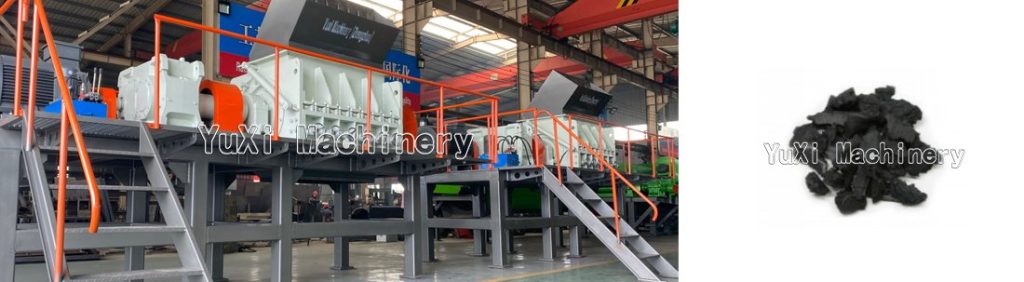
2.Tire Rasper Machine
Output:Wire free rubber mulch 10-20mm, 99% liberated steel
The rasper performs secondary size reduction and, more importantly, opens the rubber around the embedded steel. Stable steel liberation is necessary before magnetic separation can work effectively.
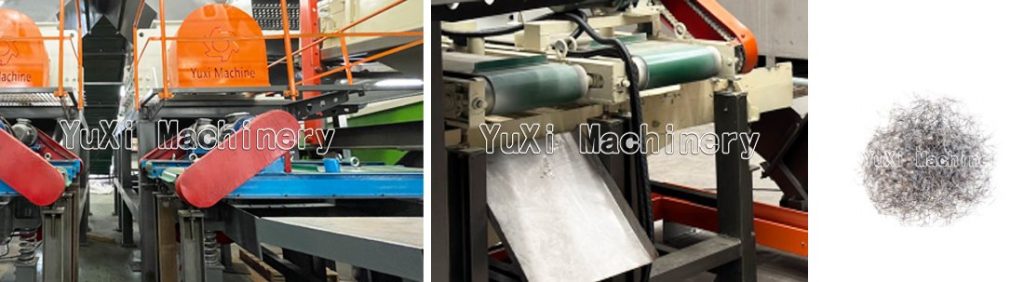
3.Magnetic Separator
Output: 97-98% steel wire, rubber with fiber to next stage
Magnet performance depends on prior liberation, material depth, belt speed, magnet position and cleaning frequency. A second magnetic stage after granulation captures finer steel released later.
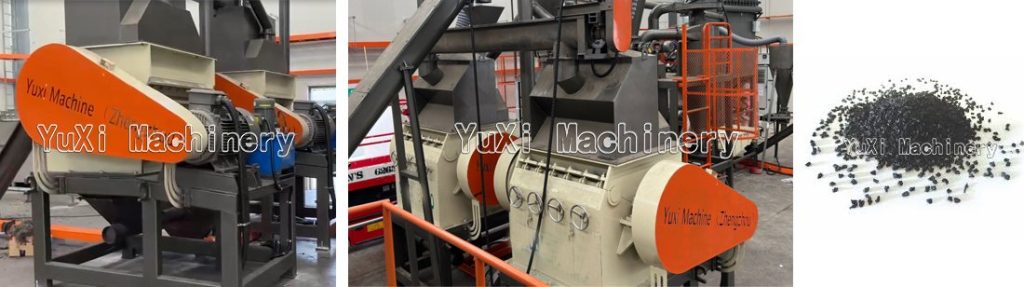
4.Tire Granulator Machine
Output: Wire free rubber pellet 1-8mm, fiber separated
The rubber granulator machine should receive well-prepared chips with low metal carryover. Screen opening, knife condition, knife gap and feed rate determine particle distribution, temperature rise and practical throughput.
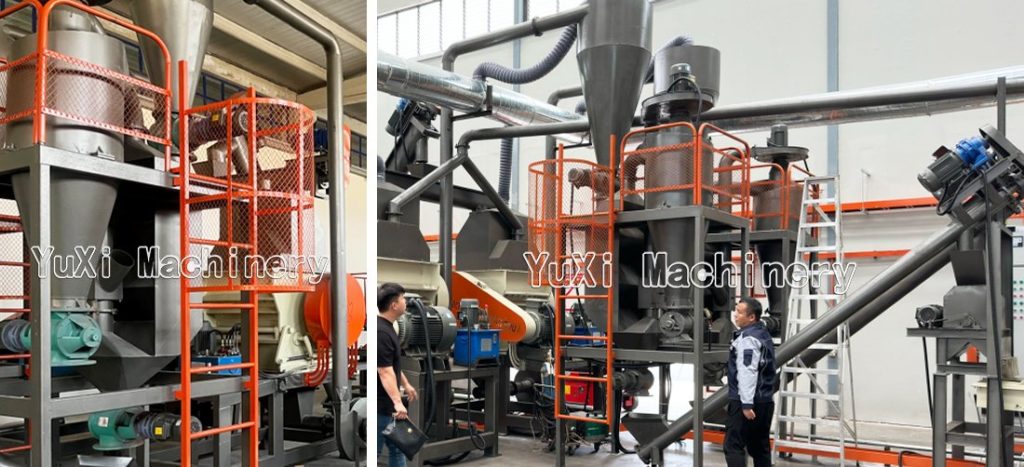
5.Fiber Separator
Output: Textile free rubber granulate, 99.9% textile
The textile fraction is a residual fraction including nylon,polyester,rayon,aramid and little rubber.
Air separation must be adjusted to the particle fraction and feed density. Too little air leaves fiber in the crumb; too much air may carry valuable fine rubber into the textile stream.
Sell a specification, not only “rubber crumb”
Each market purchases a defined material. Before configuring the rubber crumb plant, obtain written requirements from local asphalt producers, flooring manufacturers, molded-product factories or surface contractors.
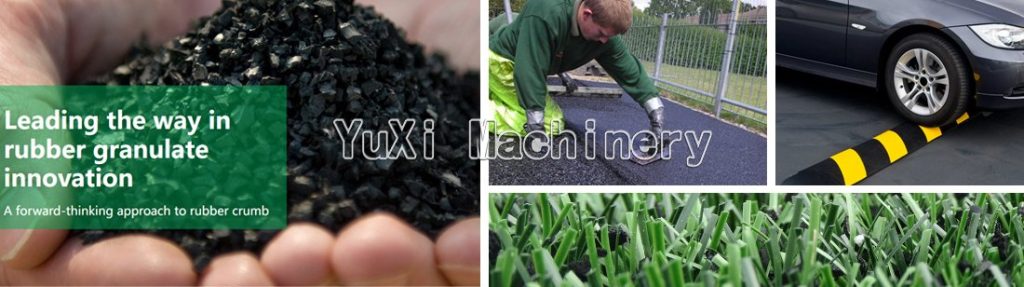
Rubberized asphalt
Confirm required grind size, gradation, moisture, metal and fiber limits with the asphalt technology provider or road authority.
Rubber tiles, mats and flooring
Molders may require a narrow fraction, consistent bulk density and low textile content for stable binder demand and surface finish.
Sports and impact surfaces
Product requirements vary by system and local regulation. Confirm permitted material, fraction and test documentation before production.
Molded rubber products
Speed bumps, protective products and industrial components may use selected crumb fractions blended with binder or other rubber.
Construction products
Selected granules may be used in resilient layers, acoustic products, waterproofing systems or rubber-containing composites.
Feedstock for rubber powder
Clean 1–8 mm granules can become feed for a separate fine-grinding stage when the market requires mesh-size rubber powder.
Additional product directions to confirm with local buyers
Construction: Rubberized asphalt for roads and driveways, bumpers, floor tile and foundation waterproofing.
Geotechnical and asphalt applications: Drainage pipes, soil conditioner, porous irrigation pipes, road building and repair.
Rubber and plastic products: Pipe insulation and lining, garbage cans, shoe soles and heels, wire and cable insulation.
Suitability depends on local regulations, the buyer’s formulation and the required particle-size and cleanliness specification.
Site and operating information needed before layout design
A turnkey tire recycling plant quotation should connect machinery with the actual workshop, material flow and maintenance route.
Feedstock survey
Record passenger, truck, agricultural or other tire proportions; maximum diameter and width; dirt, water and foreign material; and daily supply stability.
Capacity basis
State target finished tonnes per hour, working hours per shift, shifts per day, expected utilization and the exact granule fraction to be collected.
Electrical supply
Confirm voltage, frequency, transformer capacity, motor-starting method, local electrical standard and space for control cabinets.
Workshop flow
Reserve raw-tire storage, feeding access, equipment footprint, maintenance clearance, finished-product bins and steel/fiber collection.
Dust and fire planning
Review extraction, housekeeping, hot-work control, material storage and fire-protection requirements with qualified local professionals.
Wear-part strategy
Prepare spare knives, screens, belts, bearings and magnetic-cleaning procedures, plus sharpening and replacement intervals based on actual feed.
Why two tire rubber crumb plant quotations can differ widely
The price of a crumb rubber production line is determined by the agreed process boundary and performance requirements. Compare quotations line by line rather than comparing only the final total.
Information to send before selecting the line
These details let the manufacturer recommend an actual production line instead of sending a generic catalog model.
- Tire types and approximate percentage of each type
- Maximum tire diameter, width and weight
- Starting material: whole tires, shreds or wire-free chips
- Required finished granule range and size distribution
- Acceptable metal, fiber, moisture and fines limits
- Target finished tonnes per hour and annual operating plan
- Available workshop length, width and clear height
- Voltage, frequency and available transformer capacity
- Required dust-control, packaging and storage scope
- Destination country and required documentation
- Future expansion plan for rubber powder or extra grading
- Photos or samples of the actual tires and expected product
Plant features supported by practical engineering controls
High-purity rubber granules
High-purity rubber granules, 99.9% free from impurities.
Support this target with feed control, staged steel liberation, repeated magnetic recovery, grading, return crushing and final fiber separation.
Controlled particle size
Uniform particle size, adjustable 0-5mm.
Confirm the selected screen, actual particle distribution and finished throughput for the requested grade.
Automated return loop
Highly automated, recirculation ensures consistent quality.
Use conveyor-load interlocks and adequate return capacity so recirculation improves quality without causing a bottleneck.
Recoverable by-products
Byproducts (steel and fiber) can be recycled or used efficiently.
Evaluate local acceptance, contamination, packaging and legal conditions for each recovered fraction.
Multiple end markets
Wide range of applications, including sports fields, road construction, and eco-friendly building materials.
Design around one or more confirmed buyer specifications rather than assuming every crumb fraction fits every market.
Modular expansion
A rubber crumb plant can be installed after an existing mulch system or built as part of a complete automatic tire recycling plant, with space reserved for later fine grinding.
Tire rubber crumb plant questions
Does this plant start from whole tires or wire-free rubber chips?
It can be quoted in either scope. A complete line includes tire preparation, primary shredding, rasping and steel recovery. A downstream granulation module starts from project-confirmed wire-free chips, normally around 10–20 mm.
What output size can the crumb rubber production line make?
The main finished-product target is 0–5 mm. Depending on screen configuration and process stage, the granulator may also be specified around 1–6 mm or 1–8 mm. Final selection should define the accepted fraction, oversize and fines limits, and finished-product throughput at that exact specification.
Can the plant guarantee 99.9% clean rubber crumb?
That figure should be treated as a project target supported by the agreed feedstock, equipment configuration and sample test. The contract should define separate metal and fiber limits, sample method and pass/fail criteria.
Why does capacity fall when producing smaller granules?
Smaller screen openings increase cutting work and oversize recirculation. Tire mix, knife condition, feed contamination and the required product distribution also affect finished throughput.
How is steel wire removed?
Bead steel may be removed before shredding, while the rasper liberates embedded steel from rubber. Magnetic separators then recover the liberated steel before and after granulation.
How is textile fiber removed?
The granulation process loosens textile material, and air-based fiber separation removes it from the graded rubber stream. Stable feed rate, moisture and air adjustment are important for consistent results.
Can 1–8 mm crumb be ground into rubber powder later?
Yes. Clean rubber granules can feed a separate rubber powder production stage. Reserve electrical capacity, floor space, dust collection and material-transfer interfaces during the first-phase layout.
What affects tire rubber crumb plant price?
Main factors include the starting material, tire type, capacity basis, output grade, purity target, equipment depth, conveyors, automation, dust collection, electrical standard, spare parts and installation scope.
What should be checked during a factory acceptance test?
Use representative feed and verify the full operating cycle, stable throughput, motor loads, granule distribution, separated steel, fiber stream, oversize return, dust-control points and shutdown interlocks.
Get a tire rubber crumb plant matched to your real feed and market
Send tire type, starting material, target granule size, finished capacity, purity requirement, local power and workshop dimensions. YUXI can compare a complete line with a downstream granulation module and prepare the correct equipment boundary.