A practical way to turn “clean 0–5 mm crumb” into measurable contract language for particle size, residual steel, textile fiber, moisture and representative sampling.
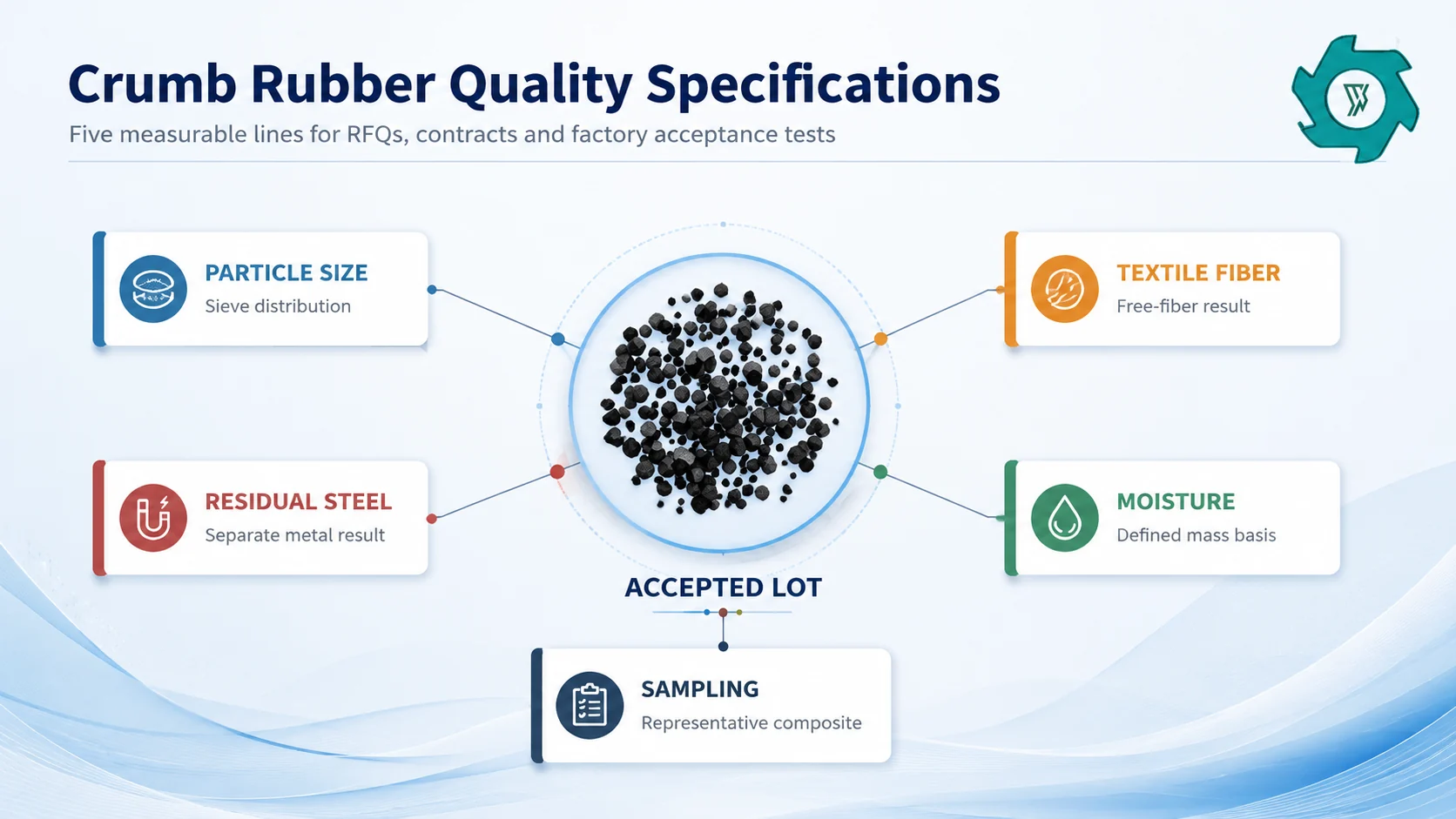
A usable quality specification separates five questions.
Two bags of crumb rubber can both be labeled “0–5 mm” and still behave very differently at the customer’s plant. One may carry more fines. Another may contain short magnetic fragments, visible textile fluff or enough moisture to make the material clump during screening.
That is why crumb rubber quality is better written as a set of measurable properties than as one purity percentage. The current YUXI tire rubber crumb plant page already asks buyers to define size distribution, metal, fiber, moisture and fines before the line is finalized.
Start With a Specification Sheet, Not a Purity Claim
“99% clean,” “99.9% pure” and “wire-free” sound precise because they contain numbers or strong adjectives. They are not complete specifications. The missing information is usually the denominator: clean of what, measured on what sample, by which method, and under which moisture basis?
ASTM D8268 is useful here because it treats evaluation of recycled vulcanizate particulate rubber as a quality-control and classification problem rather than a single-machine claim.1 The practical procurement lesson is simple. Each property needs its own line in the contract.
Property
What the contract should state
Why vague wording fails
Particle size
Sieve designations/openings, percentage passing or retained, oversize and fines limits, test method.
“0–5 mm” does not define the distribution inside that range.
Residual steel
What counts as steel, mass basis, magnetic or other test method, sample mass and maximum acceptable result.
“Wire-free” may be interpreted as no visible long wire while short fragments remain.
Textile fiber
Free-fiber definition, collection method, dry/as-received basis and maximum result.
Fiber is nonmagnetic, so a strong magnet does not prove low textile content.
Moisture
As-received or dry basis, drying method, endpoint and maximum acceptable result.
Wet material changes shipment weight and can affect screening, storage and aspiration.
Sampling
Lot size, sampling point, increment frequency/locations, composite method, split method and retained sample.
A test can be repeatable and still be meaningless if the sample is unrepresentative.
Specification rule: write the test method and the acceptance value together. “Fiber ≤ buyer limit by agreed dry-basis method” is a real contract item. “Low fiber” is a sales description.
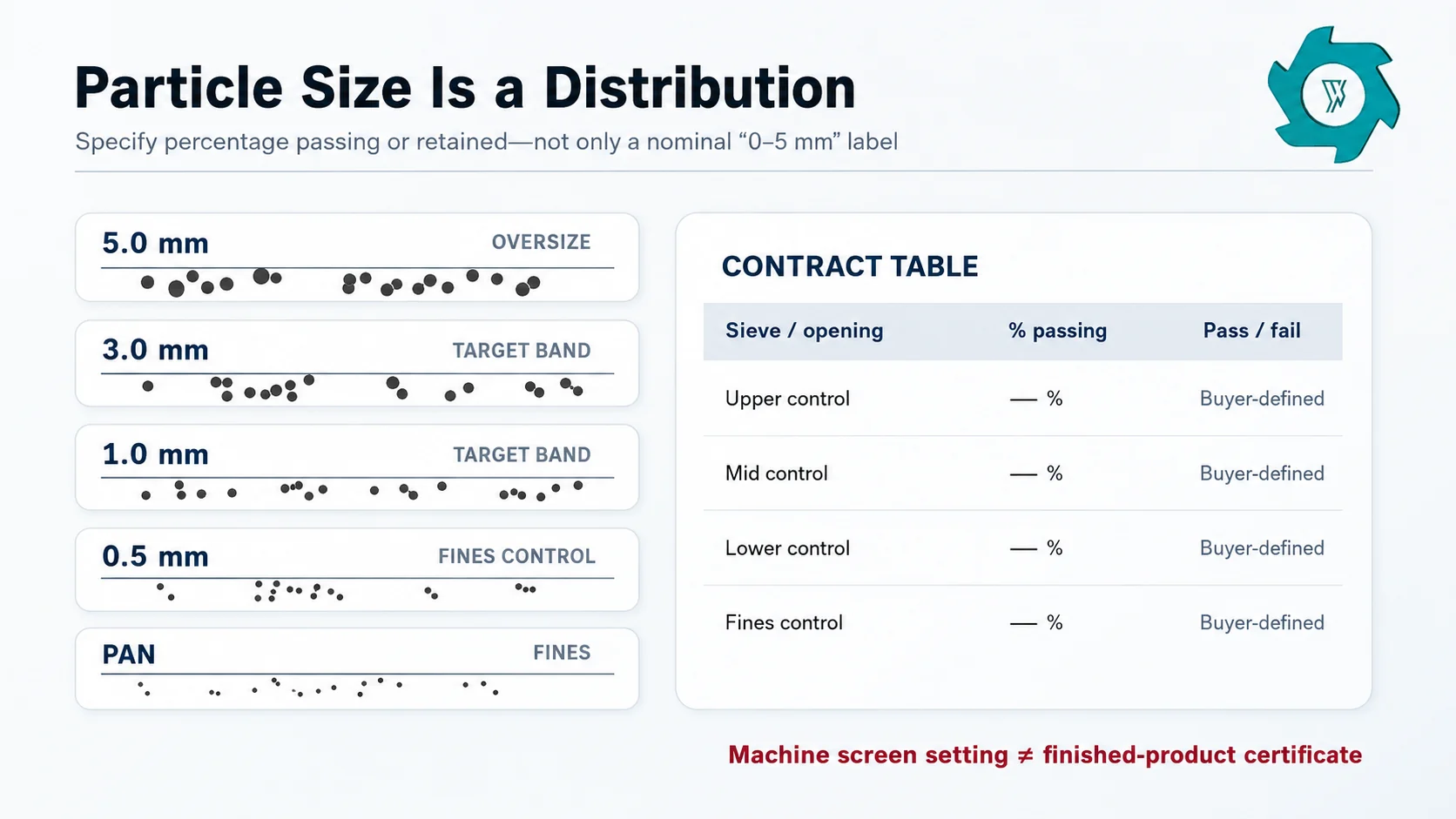
Particle Size: Specify a Distribution, Not Just “0–5 mm”
A granulator screen is a process control. It is not a certificate of the finished product. Irregular rubber pieces orient differently as they pass a screen, external grading may use a different aperture, and oversize can circulate through the line more than once. The accepted product therefore needs to be checked after final classification.
ASTM D5603 defines recycled vulcanizate particulate rubber as material processed to obtain a desired particle-size distribution. ASTM D5644 then describes mechanical sieve-shaker testing for the particle-size distribution of recycled vulcanizate particulate rubber at 90 µm (170 mesh) and larger.23 That distinction matters: the product is a distribution, not one nominal diameter.
For acceptance, record how much material is retained or passes at each relevant sieve. The machine screen setting belongs in the process record, not in place of the finished-product test.
What to put on the particle-size line
A useful specification names the sieves and gives permitted mass percentages. If the market buys a narrow 1–3 mm fraction, the sheet should show the upper cut, lower cut and allowed leakage on both sides. If the market buys a broad 0–5 mm product, define how much oversize is tolerated above the top sieve and whether very fine material below the smallest control sieve is limited.
Do not turn a mesh label into a false conversion. A buyer asking for “20 mesh” may mean a commercial grade around a sieve designation, not particles that all measure one diameter. The adjacent rubber mulch vs crumb rubber guide is useful when the project has not yet decided whether it needs a coarse direct-use product or a finer classified crumb stream.
Residual Steel: Define the Failure You Are Trying to Prevent
Steel contamination is not one visual condition. A crumb sample may contain a long exposed strand, short sharp fragments, rubber-coated wire or steel still trapped inside an oversized rubber piece. Those defects do not have the same visibility, and they do not all respond equally to a quick pass beneath a magnet.
The EPA’s process description separates the two jobs correctly: magnets remove wire and other metal contaminants, while screens return oversize material for more reduction.4 In practice, a magnet cannot recover steel that the preceding cutting stage has not sufficiently liberated. That is why the accepted-product test belongs after the full liberation and magnetic-recovery sequence.
For a contract, steel can be written as a mass percentage recovered by a specified magnetic test, a visual/sharp-metal criterion, or both. If exposed fragments are a safety or downstream-equipment concern, relying only on a bulk mass percentage can miss a small but unacceptable piece.
Caltrans CT 385 shows what a measurable steel test looks like
California Test 385 is specifically for crumb rubber modifier used in asphalt-rubber binder, so it should not be copied as a universal requirement. It is still a useful example of method discipline. The July 2022 method splits a 300–350 g portion from the combined sample, passes a magnet over and through the material for 60 seconds, weighs the recovered metal and calculates wire as a percentage of the CRM mass.5
Notice what makes that procedure useful: sample mass, tool, exposure time, weighing precision and calculation basis are all stated. A generic tire-recycling contract can use the same principle even when it adopts a different test method or acceptance limit.
For coarse upstream material, “wire-free” also needs careful language. The existing wire-free rubber mulch guide distinguishes loose, exposed and embedded steel. That distinction remains useful when diagnosing why metal later appears in fine crumb.
Textile Fiber Needs Its Own Limit and Its Own Test
Fiber is light, nonmagnetic and easily redistributed by airflow. A line can produce excellent steel recovery and still leave visible textile fluff in the crumb. The reverse can also happen: aggressive aspiration can make the product look cleaner while carrying small saleable rubber particles into the fiber reject stream.
That trade-off is why “steel + fiber contamination ≤ X%” is often a poor operating specification. If the combined number rises, the operator cannot tell which separator needs attention. If it falls, the plant may still be losing rubber into the fiber side stream.
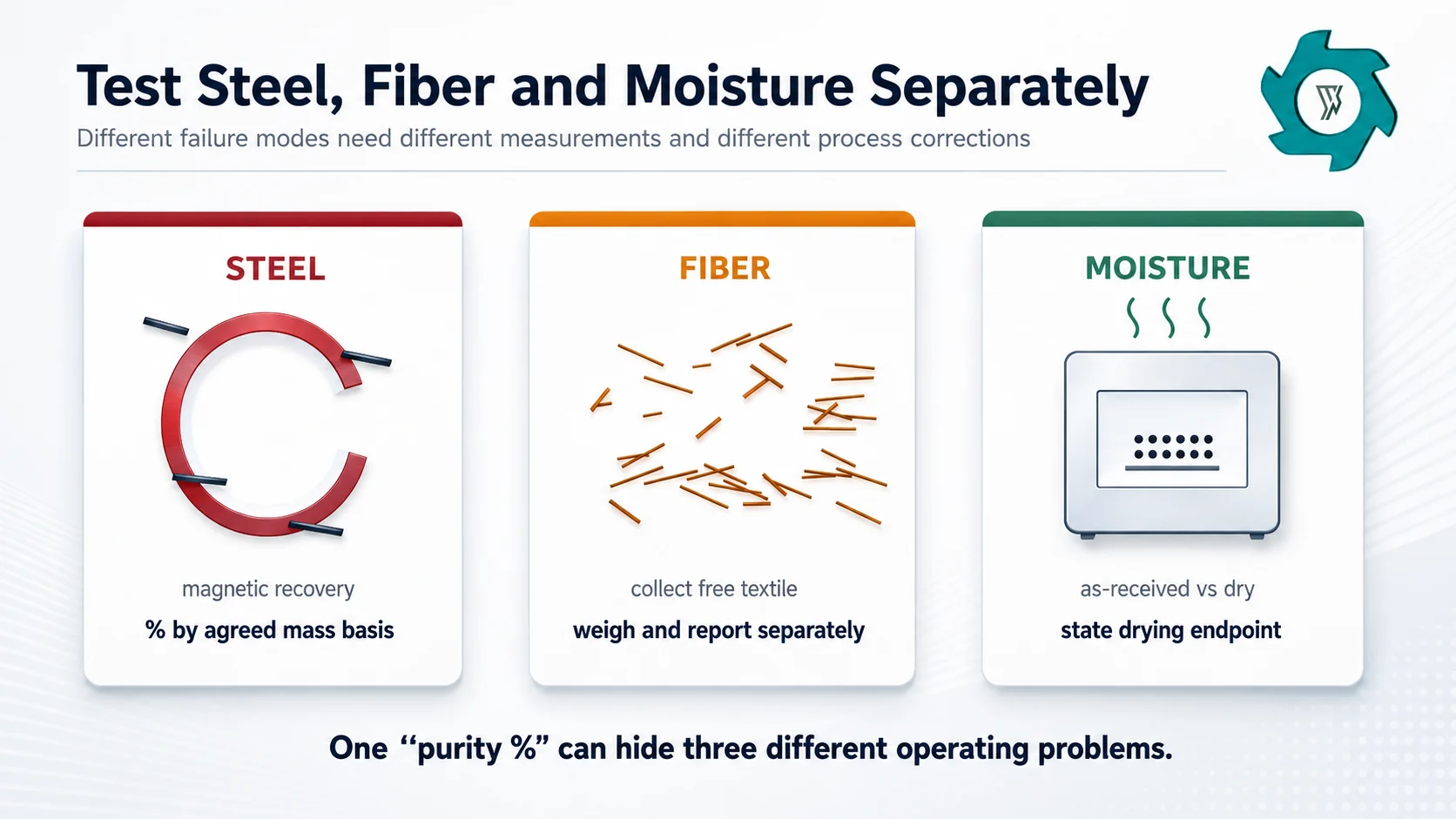
Steel, textile and moisture are different properties. Test and report them separately so a failed lot points to a real process correction.
CT 385 again provides a useful asphalt-CRM example. After sieve analysis, observed free fabric is collected from the sieves, weighed and reported as a percentage by mass of the dry test material.5 That method does not create a universal allowable percentage, but it demonstrates an important quality-control principle: define what “fiber” means, isolate it and weigh it on a known basis.
Moisture: Small on the Spec Sheet, Large in Daily Operation
Moisture is easy to overlook because it is not a visible contaminant in the same way as steel or white textile. It still changes the commercial product. Water adds shipment mass, can make fine particles stick together, may alter sieve behavior, and can narrow the operating window of airflow-based fiber separation.
The test basis matters as much as the numerical limit. Is moisture reported on the material as received? Is the steel or fiber percentage calculated before or after drying? Are samples sealed immediately so they do not gain or lose water before testing? If the contract is silent, two laboratories can report different numbers from the same lot without either making an arithmetic error.
In the current CT 385 gradation procedure, a 100–150 g portion is dried initially for 90 ± 5 minutes at 140 ± 5°F, then dried to constant mass; the original and dry masses can be used to calculate moisture if desired.5 Again, that is an asphalt-specific method, not a universal moisture limit. It shows why the drying temperature, time/endpoint and mass basis belong in the written procedure.
Where moisture problems usually enter the line
Rain-soaked feedstock, outdoor chip storage, wet housekeeping, condensation and product stored before it has cooled can all move moisture into the finished material. Fines make the effect more noticeable because wet fine crumb tends to agglomerate. If the project starts from whole tires, the upstream storage and preparation route described in the industrial tire-to-rubber process guide is worth checking before blaming the final granulator.
Sampling Is the Part That Decides Whether Every Other Test Means Anything
A laboratory can measure to two decimal places and still report the wrong answer for the lot if the sample came from one convenient scoop. Crumb rubber segregates. Coarser particles can roll, fines can settle, loose textile can move with air, and a bag or storage bin can develop different material zones.
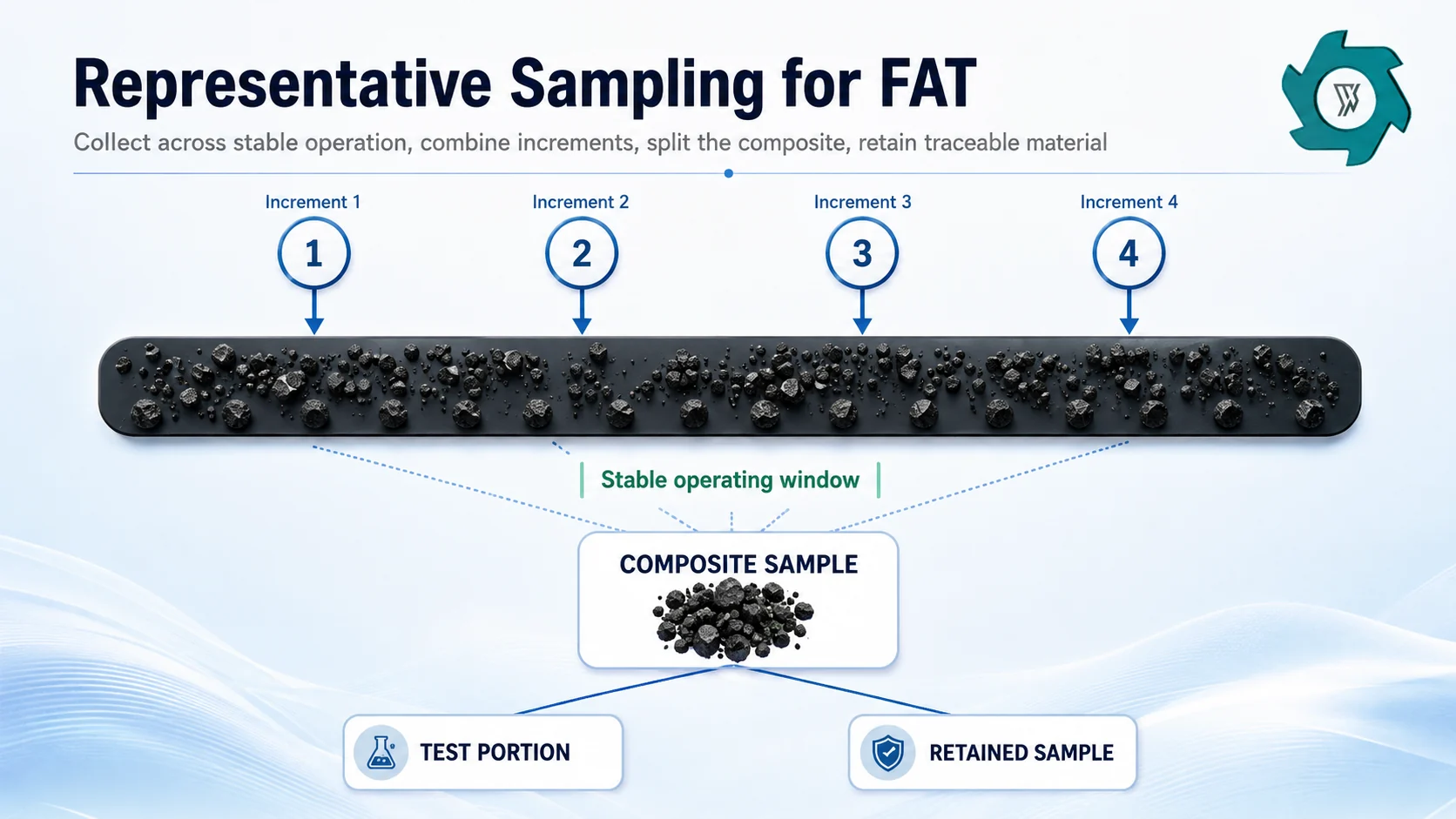
The sampling plan therefore needs to be written before the FAT. It should define the lot, where increments are taken, how many are taken, whether they are combined, how the combined sample is reduced to test portions and what material is retained for dispute resolution.
Multiple increments are combined into a representative composite. Test portions are then split from that composite rather than hand-picked from the cleanest-looking material.
Bulk-bag sampling: a useful example of representativeness
CT 385’s bulk-bag procedure takes 12 increments from a selected bag: three vertical positions on each of four sides. The increments are combined into one sample before test specimens are split.5 This is a strong illustration of why “take one scoop from the top” is weak quality control.
Continuous-line sampling needs a different geometry
During a factory acceptance test, the product is moving rather than sitting in a finished bulk bag. A practical plan is to wait until the granulator, screen return, magnets and fiber separator are at stable load, then collect increments at several agreed times from the final accepted-product stream. Combine those increments, mix them, and reduce the composite with an agreed splitter or other unbiased method.
Keep at least one sealed retained sample with the lot number, date, line setting, feed description, sampling point and signatures or witness names. If the buyer’s laboratory later reports a failure, both sides can work from traceable material rather than arguing over different handfuls of crumb.
Weak sampling
One top scoop, collected before steady state, hand-picked to remove obvious steel, no lot ID, no retained sample.
Defensible sampling
Named lot, stable operating window, multiple increments, composite sample, unbiased split, sealed retained sample and recorded chain of custody.
Which Plant Settings Move Each Quality Result?
A specification is useful only if the production team can respond when a result drifts. The five quality lines point to different parts of the crumb process.
A larger lab number is automatically more representative.
This is also why quality and capacity cannot be separated completely. A tighter size fraction increases return load. A fiber separator pushed beyond its stable feed depth may leave more textile or carry away more rubber. A production target should therefore be stated as accepted finished tonnes per hour at the agreed quality specification, not only as fresh feed through the first machine.
Turn the Quality Specification Into a Factory Acceptance Test
The FAT is where the quotation becomes evidence. It should use representative feed, run long enough for recirculation and separators to reach steady behavior, and test the product that the buyer will actually receive.
Lock the feed basis.
Lock the product recipe.
Reach steady state.
Measure throughput at the accepted-product point.
Collect a composite sample.
Test each property separately.
Record operating context.
Seal retained samples.
Accepted crumb t/h = mass of product that passes the agreed quality specification ÷ measured net production time
RFQ Language You Can Send to a Crumb Rubber Line Supplier
The RFQ does not need to prescribe every laboratory detail on day one. It does need to make the supplier answer the correct questions. The following structure is usually enough to move the discussion away from generic brochure claims.
Finished product: Tire-derived crumb rubber, target commercial range ______.
Particle-size acceptance: State the proposed sieve set and guaranteed percentage passing/retained at each control sieve. Include maximum oversize and fines.
Residual steel: State the guaranteed maximum and the test method, including sample mass and calculation basis. Add a visible/sharp-metal rule if required by the end user.
Textile fiber: State the guaranteed maximum free-fiber result and the collection/weighing method. Report fiber separately from steel.
Moisture: State the guaranteed maximum, whether it is as-received or dry basis, and the drying/test method.
Sampling: Propose the lot definition, stable-run sampling point, increment plan, composite procedure, sample splitter and retained-sample procedure.
Capacity: Guarantee accepted finished-product tonnes per hour at the above specification, with normal oversize return included.
FAT: Agree the feed, test duration, measuring equipment, witness procedure, report format and pass/fail rules before shipment.
Six Specification Mistakes That Cause Avoidable Disputes
1. Treating “0–5 mm” as the whole size specification
It leaves oversize, fines and the internal distribution undefined.
2. Combining steel and fiber into one purity number
It hides which separation stage actually failed.
3. Reporting impurity percentages without a moisture basis
Wet and dry material can produce different mass-based results.
4. Testing a convenient hand sample
High measurement precision cannot rescue biased sampling.
5. Accepting capacity before quality is checked
Fast production of off-spec crumb is not the capacity the business can sell.
6. Copying an asphalt specification into another market
Agency CRM methods are valuable examples, but sports, molded products and other buyers may set different limits and tests.
Frequently Asked Questions
What should a crumb rubber quality specification include?
At minimum, define the accepted particle-size distribution, residual steel criterion, textile-fiber criterion, moisture basis, lot definition, sampling location, sample-compositing method, test method and pass/fail rule. Fines and other foreign material can be added when the end user requires them.
Is 0–5 mm enough to specify crumb rubber particle size?
No. A nominal 0–5 mm label does not state how much material may be above 5 mm, how much may be very fine, or how the distribution is measured. A purchase specification should name the sieve set and the permitted percentage passing or retained at the relevant sieves.
Should steel and textile fiber be combined into one purity percentage?
They are better treated as separate acceptance properties. Ferrous steel is normally evaluated with magnetic recovery or another agreed metal test, while loose textile fiber requires a different collection and weighing method. Combining them into one purity figure can hide the failure mode.
Why does moisture belong in a crumb rubber specification?
Moisture changes shipment mass, can promote agglomeration, affects sieving and airflow-based fiber separation, and may matter to downstream processes. The contract should define whether results are reported as received or on a dry basis and state the agreed drying or moisture test method.
How should crumb rubber be sampled during a factory acceptance test?
Sample only after the plant has reached stable operation. Take increments from several times or positions, combine them into a representative composite, split test portions without hand-picking, label the lot and sampling point, and keep a sealed retained sample. The exact increment count and sample mass should be agreed before the test.
Can one crumb rubber quality limit be used for asphalt, sports surfaces and molded rubber?
No universal limit fits every market. ASTM standards provide useful classification and particle-size test frameworks, but the downstream buyer, project specification or agency requirement controls the actual acceptable gradation, contamination and moisture limits.
Define the Product Before You Size the Crumb Rubber Line
Send your tire mix, target particle-size distribution, steel and fiber limits, moisture requirement, finished capacity and intended market. YUXI can configure the granulation, screening, magnetic recovery and fiber-separation stages around a measurable finished-product specification.
External Engineering References
ASTM International — ASTM D8268-19(2023). Standard Practice for Evaluation of Recycled Vulcanizate Particulate Rubber. ASTM D8268-19(2023).
ASTM International — ASTM D5603-23. Standard Classification for Rubber Compounding Materials—Recycled Vulcanizate Rubber. ASTM D5603-23.
ASTM International — ASTM D5644-23. Standard Test Method for Determination of Particle Size Distribution of Recycled Vulcanizate Particulate Rubber. ASTM D5644-23.
U.S. Environmental Protection Agency. Tire Crumb Questions and Answers — production, steel/fabric removal and ASTM references. EPA Tire Crumb Q&A.
California Department of Transportation — California Test 385, July 6, 2022. Method of Test for Crumb Rubber Modifier; an asphalt-rubber-specific example covering sampling, wire, gradation, moisture calculation and fabric testing. California Test 385.
Marie has 8+ years of experience in tire shredding and recycling equipment,with a focus on tire shredders,rubber recycling machines,TDF production,rubber crumb processing,and complete tire recycling systems.