




When buyers ask whether a tire rubber granule plant can reach 99.9% purity, they are usually not asking about one machine. They are asking a more practical question: can the whole line remove steel wire, textile fiber, oversized pieces and dust well enough for downstream users such as sports surface contractors, rubber tile factories, asphalt plants and rubber powder producers?
The answer is yes in the right conditions—but purity is not created by grinding alone. It depends on staged size reduction, proper steel liberation, repeated magnetic separation, controlled screening, return crushing and final fiber separation. In daily production, “99.9% purity” should be treated as a target supported by equipment configuration, raw material control and sample testing, not as an automatic claim.
YUXI’s Tire Rubber Crumb Plant is designed to process wire-free tire chips into high-purity rubber granules, with common output around 0–5 mm or 1–8 mm depending on configuration. The line combines shredding, rasping, magnetic separation, granulation, grading, return collection and fiber separation to remove steel and textile impurities while keeping particle size more uniform.
What Does “99.9% Purity” Mean in Rubber Granules?
For crumb rubber, purity usually refers to how much of the final material is usable rubber rather than residual steel, fiber, dust, stone, glass or other contaminants. EPA describes tire crumb production as reducing scrap tires to different sizes, removing 99% or more of the steel and fabric, and using screens that return oversize pieces back into the reduction process.
This matters because different buyers have different tolerance levels. A molded rubber product factory may reject granules with visible fiber. An asphalt rubber supplier may focus more on particle size distribution, moisture and steel contamination. A sports flooring buyer may care about cleanliness, color consistency, dust level and odor.
Practical framing: Do not write “99.9% purity guaranteed” without context. A stronger and safer message is: a complete line can be configured and operated to approach or achieve 99.9% clean rubber crumb when input material, separation settings and inspection are controlled.
Why a 10-Step Process Is Needed
Waste tires are composite materials. A tire contains elastic rubber, bead steel, steel belts, textile cords, carbon black, additives and sometimes yard contamination. If a plant tries to jump directly from whole tires to fine granules, several problems appear: blade overload, high wear, poor steel separation, uneven granule size, excessive fiber and unstable output.
That is why a complete rubber granule line breaks the job into smaller stages. Each stage removes one problem before it becomes harder to control downstream.
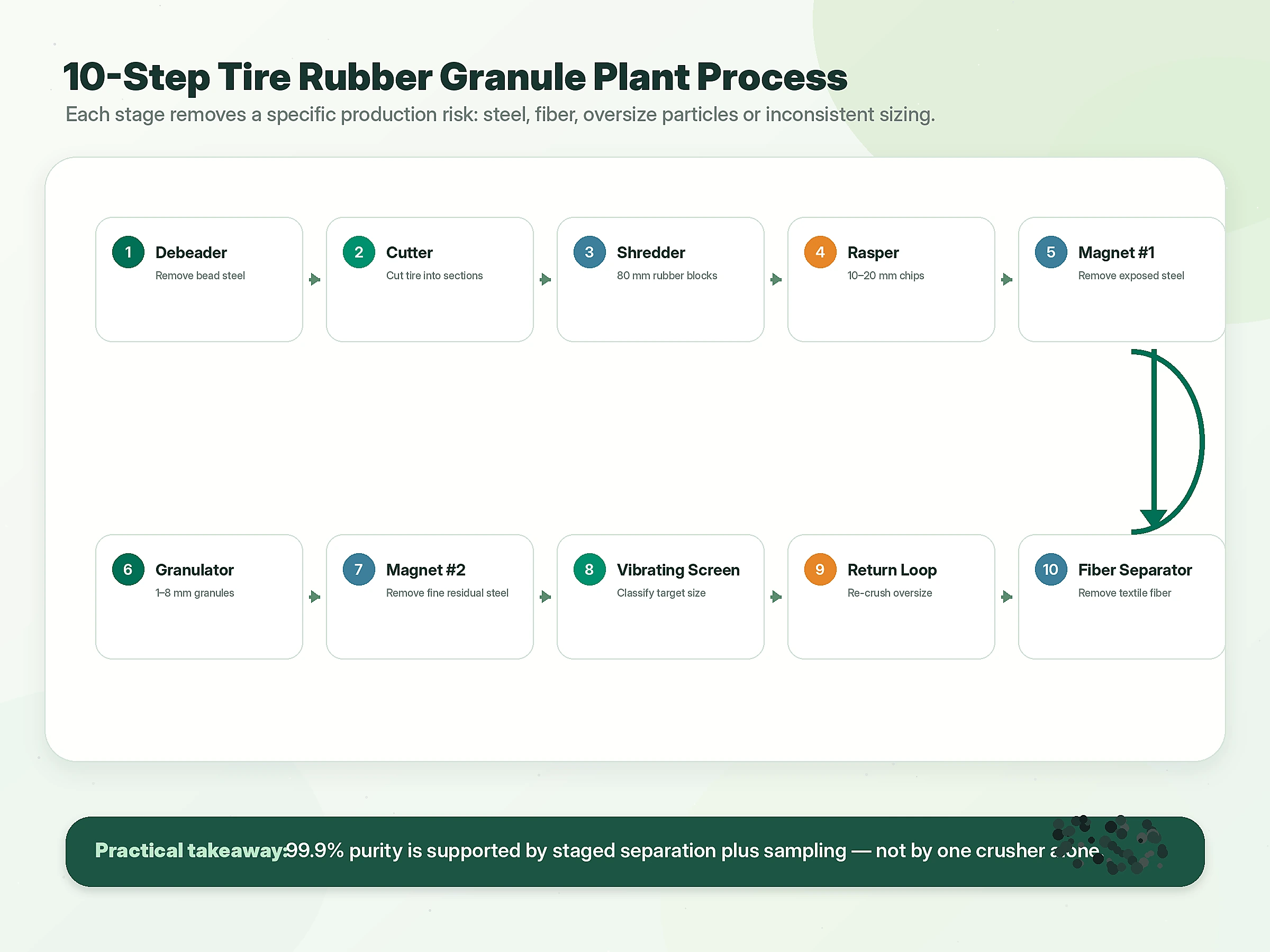
Bead Wire Removal
The bead area contains thick steel wire that can damage blades, increase load and reduce downstream separation efficiency. Removing bead wire first is especially important for truck and bus tires.
Tire Cutting
Cutting whole tires into smaller sections makes feeding easier and helps the shredder work more evenly instead of forcing a whole tire into the cutting chamber.
Primary Shredding
The Tire Shredder Machine reduces tire sections into rough rubber blocks. The goal here is stable size reduction, not final purity.
Rasping
The rasper reduces shredded material into smaller chips and starts liberating rubber from steel wire. This stage decides how well the first magnet can work.
Primary Magnetic Separation
The first magnetic separator removes larger exposed steel after rasping, protecting the granulator and creating a recyclable steel byproduct.
Granulation
The granulator reduces wire-free chips into smaller rubber granules, commonly around 1–8 mm or 0–5 mm depending on screens and line configuration.
Secondary Magnetic Separation
The second magnet removes fine residual wire exposed during granulation. This is important because one magnet pass is rarely enough for high-purity crumb rubber.
Vibrating Screening
The screen separates finished granules by target size and prevents oversized particles from entering the final product stream.
Oversize Return
Unqualified material is collected and crushed again. This automatic return loop improves consistency and reduces manual reprocessing.
Fiber Separation
The air separator removes textile fiber from the rubber granule stream, which is critical for buyers that require clean granules for flooring, mats, sports surfaces or further powder grinding.
Steel and Fiber Removal: The Real Purity Engine
High-purity granules are not created at the end of the line. They are built gradually. The rasper exposes steel, the first magnet removes larger wire, the granulator exposes hidden fine wire, the second magnet removes that residual metal, and the fiber separator handles textile contamination.
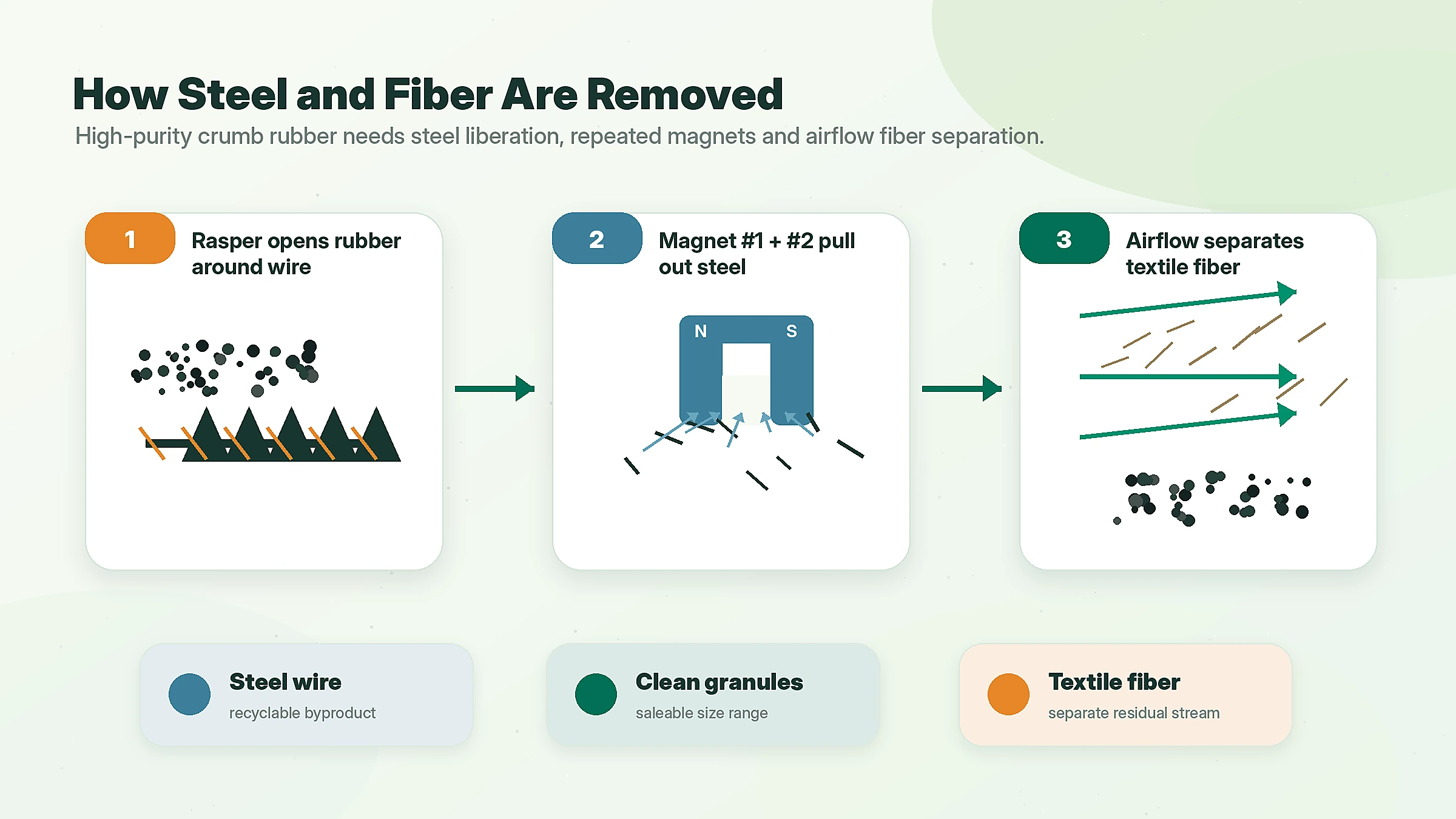
EPA’s tire crumb explanation matches this logic: magnets are used throughout the process to remove wire and metal contaminants, while air separators are used to remove fabric. That is why a complete plant performs better than a basic crusher when the buyer’s main concern is final cleanliness.
Can the Process Really Ensure 99.9% Purity?
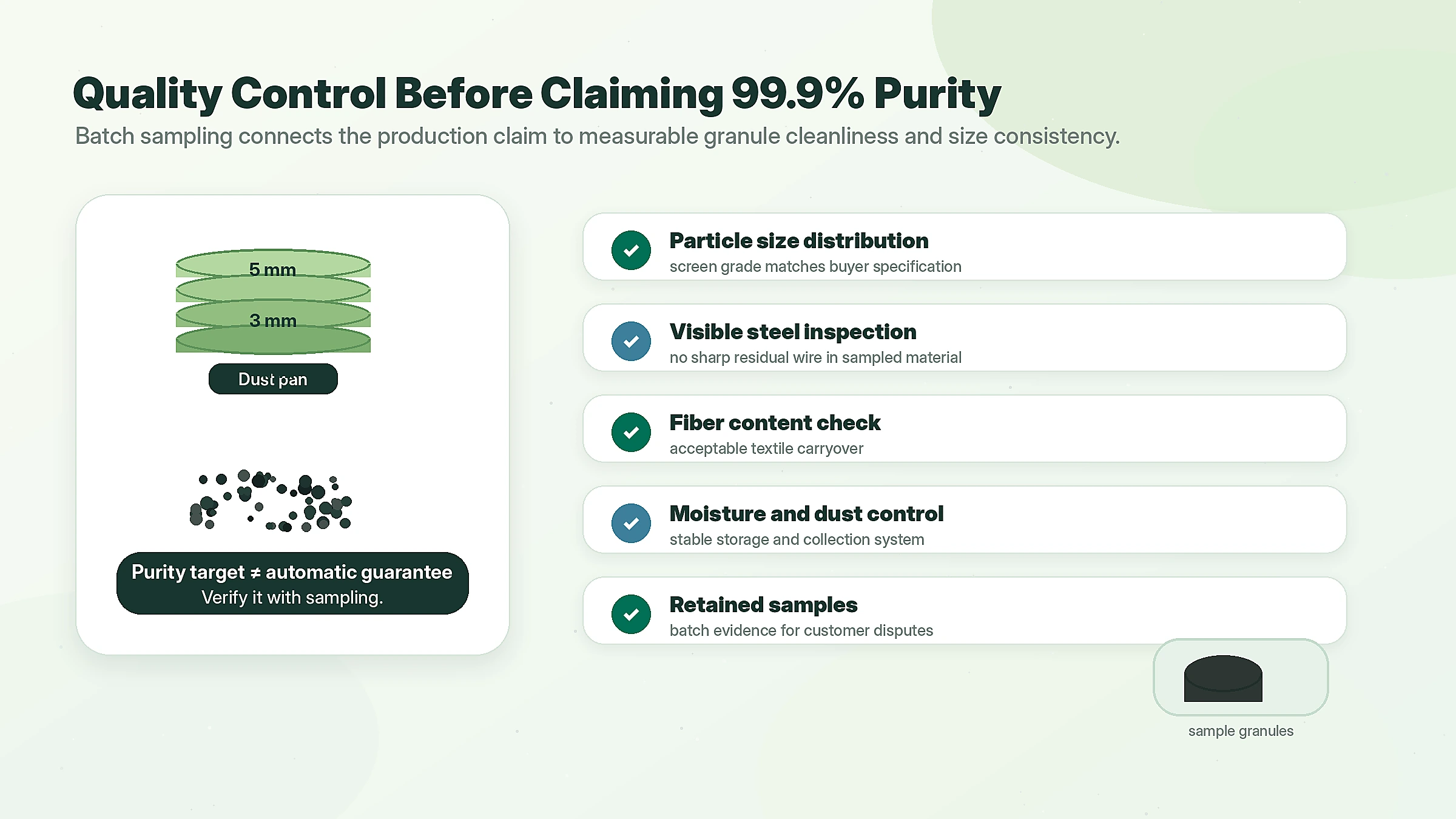
A 10-step tire rubber granule plant can support a 99.9% purity target, but only when five conditions are controlled: suitable feedstock, line configuration matched to tire type, correct magnetic and airflow settings, screen sizes matched to the target grade, and routine sample testing.
| Quality point | Why it matters | Practical control |
|---|---|---|
| Particle size distribution | Buyers purchase by grade, not just by weight. | Use screens, return oversize and retain batch samples. |
| Residual steel | Visible wire can damage downstream equipment and cause rejection. | Use two magnetic stages and inspect sampled product. |
| Textile fiber | Fiber affects surface quality and product appearance. | Adjust airflow and feed rate in the fiber separator. |
| Dust and moisture | Too much dust or moisture can reduce storage and product value. | Add collection, housekeeping and dry storage controls. |
| Feedstock variation | Passenger, truck and OTR tires behave differently. | Confirm input tire type before choosing motor power and blade design. |
Engineering answer: 99.9% purity is achievable as a controlled production target, but it should be verified by samples. The plant owner should connect the claim to actual separation stages, screen control and customer acceptance testing.
Where High-Purity Rubber Granules Are Used
Clean rubber granules can serve several downstream markets. ASTM D5603 notes that recycled vulcanizate particulate rubber is used in synthetic turf infill, asphalt-rubber, molded rubber products, tire-derived fuel and other tire and non-tire products. EPA also describes ground tire rubber applications in asphalt rubber binder, seal coats, crack sealants and rubber-modified asphalt concrete.
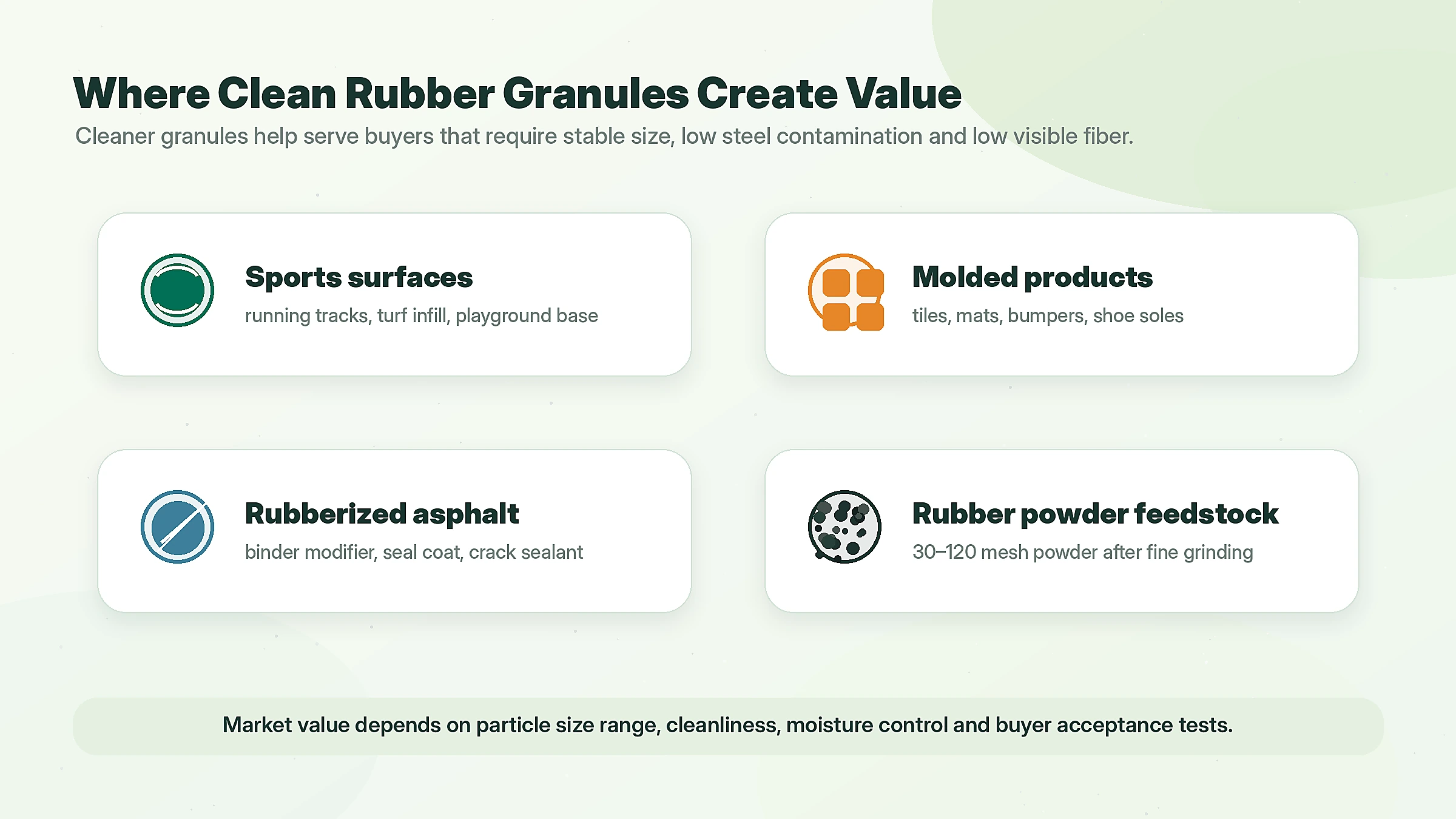
Sports and Playground Surfaces
Rubber granules are widely used in running tracks, playground surfaces, rubber mats and artificial turf systems. These buyers usually care about clean appearance, consistent size and low fiber contamination.
Rubberized Asphalt
Ground tire rubber can be blended with asphalt to modify pavement materials. This market is sensitive to particle size, moisture and specification compliance.
Molded Rubber Products
Rubber tiles, mats, bumpers, shock-absorbing products, soles and other molded products often require cleaner granules because impurities can affect surface quality and product strength.
Feedstock for Rubber Powder
Granules can also be used as feedstock for finer powder production. YUXI’s Tire Rubber Powder Plant is designed to grind rubber granules into fine rubber powder, so clean granules are an important intermediate product.
Equipment Configuration Buyers Should Confirm
Before investing in a tire rubber granule plant, buyers should confirm more than the headline capacity. Ask what tire types the plant will process: passenger tires, truck tires, bus tires, OTR tires or mixed tire waste. Confirm whether bead wire removal is included, what input size is required before the granulator, and what final granule sizes can be produced continuously.
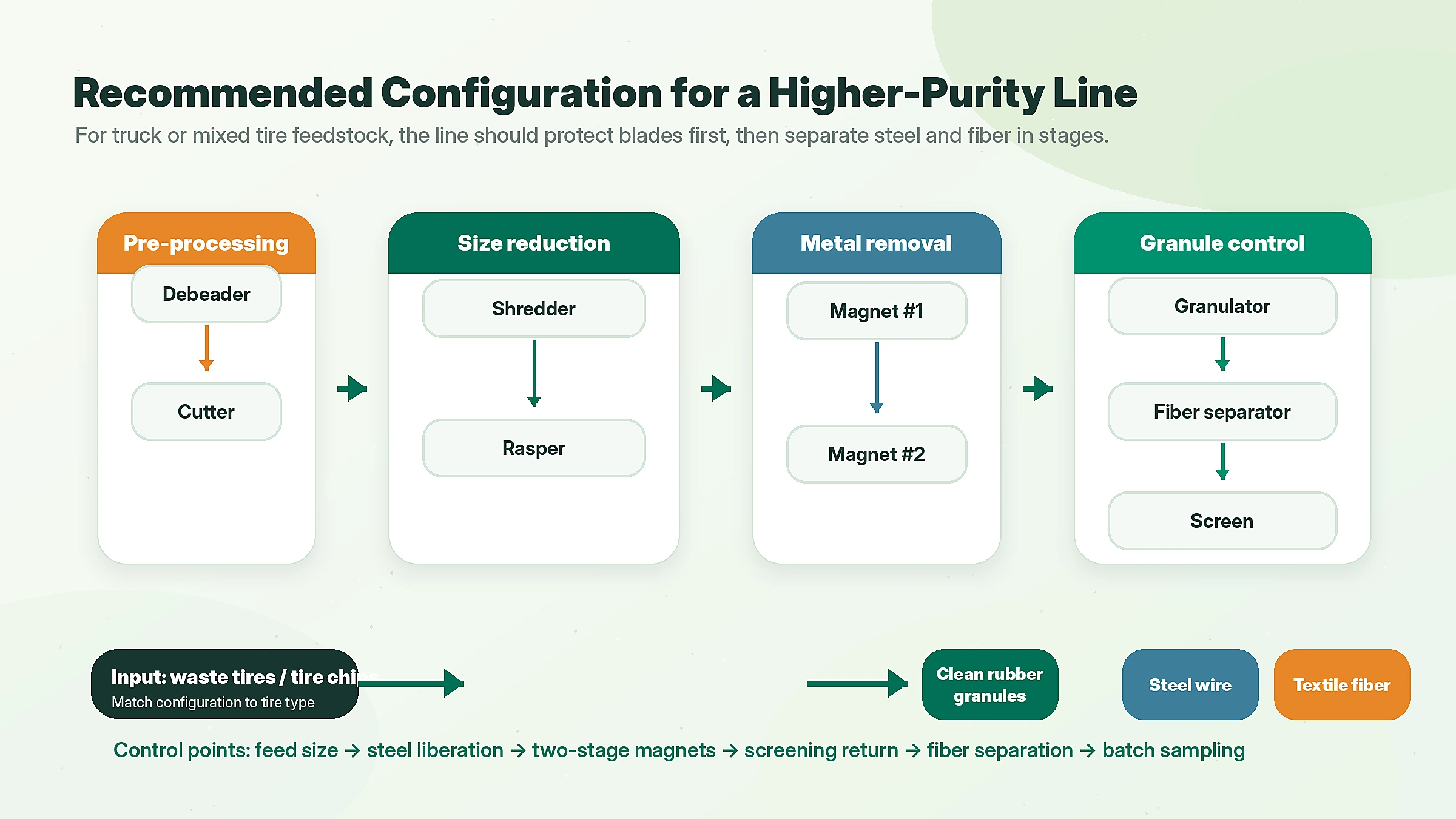
Also confirm the number of magnetic separation stages, screen configuration, return material route, fiber separation method, dust collection system, spare blade plan and maintenance access. For overseas projects, layout drawings, container loading plans and test-running videos are often more useful than a generic equipment list.
Need a tire rubber granule plant layout?
Send tire type, target capacity, final granule size, required purity, workshop space and local power conditions. YUXI can recommend a practical configuration instead of only quoting a standard model.
FAQ
Is 99.9% purity always guaranteed?
No. It depends on raw material quality, equipment configuration, operating settings and inspection. A complete line with two-stage magnetic separation, screening, recirculation and fiber separation is much more capable of reaching high purity than a basic crusher, but purity should still be verified by sample testing.
What output size can a tire rubber granule plant produce?
Common finished granule sizes include 0–5 mm, 1–3 mm, 3–5 mm or 1–8 mm depending on screens and customer requirements. If the target is rubber powder, the granules can be sent to a grinding mill for further processing.
Why are two magnetic separators needed?
The first magnetic separator removes larger exposed steel after rasping. The second removes smaller residual steel after granulation, when more hidden wire has been exposed.
What should buyers send before requesting a quotation?
A useful inquiry should include tire type, maximum tire size, desired capacity, target final granule size, required purity, available workshop space, local power conditions and intended downstream market.
References and Source Notes
- YUXI Tire Rubber Crumb Plant: capacity range, output size, process flow and equipment details. Source
- US EPA Tire Crumb Questions and Answers: tire crumb production, steel/fabric removal, screening, magnets and air separators. Source
- ASTM D5603: recycled vulcanizate particulate rubber classification, particle size distribution and end uses. Source
- US EPA Ground Rubber Applications: asphalt rubber binder, seal coats, crack sealants and rubber-modified asphalt concrete. Source
- USTMA 2023 End-of-Life Tire Management Report: ground rubber market uses including rubber-modified asphalt, athletic fields, automotive parts and industrial materials. Source