For waste tire recyclers, collection yards and TDF producers, the right answer usually sits between machine structure and line design. This guide explains how a whole tire shredder works, when whole tires can be fed directly, when pre-cutting or bead wire removal is safer, and how YUXI configures tire shredding equipment around output size and downstream use.
A whole tire shredder is selected around tire size, steel content, output size and the downstream recycling route—not the shredder body alone.
What is a whole tire shredder machine?
A whole tire shredder machine is a heavy-duty size-reduction machine designed to cut complete scrap tires, or prepared tire sections, into smaller rubber-and-steel pieces for TDF production, rubber chip production, transport volume reduction or further recycling. In most tire recycling plants, it works as the primary heavy cutting stage after feeding, tire cutting or bead wire removal.
The practical difference between a whole tire shredder and a light crusher is the cutting method. Tires are elastic, round, uneven and reinforced with steel wire and fabric cord. Tire shredders usually use low-speed,high-torque shafts to grab and cut tires instead of relying on high-speed impact. This gives the cutting chamber more pulling force and better tolerance for tire wire and sudden load changes.
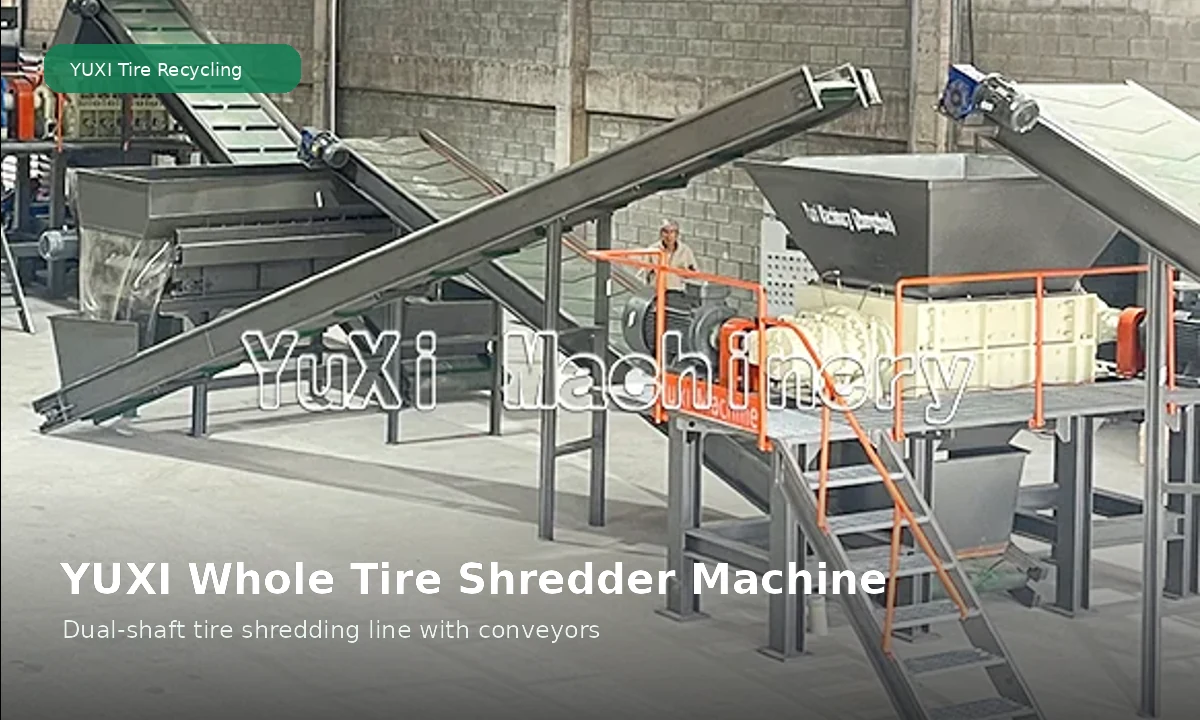
On YUXI’s tire shredder machine page, the machine is described for whole tire pre-shredding, truck tire size reduction, TDF chip preparation and rubber recycling lines. The important engineering point is the combination of twin-shaft cutting and a disc screen return system: oversized pieces are separated and sent back automatically rather than being sorted by hand.
Why whole tire shredding is harder than ordinary rubber crushing
A buyer who only compares motor power may miss the real problem. A whole tire is not a flat rubber sheet. It has curved sidewalls, bead bundles, tread steel, textile cord, air gaps and uneven thickness. When a tire folds inside the hopper, the shredder has to pull it down without bridging. When the bead area reaches the blades, the machine needs torque reserve and blade strength. When the discharge leaves the chamber, the system still has to control size and remove oversized pieces.
Field observation: many output problems start before the shredder. Unstable feeding, oversized truck tires, unremoved bead wire and a missing return screen can make a strong shredder look weak in operation.
This is why a whole tire shredder is normally evaluated as part of a line. The front-end can include tire wire drawing, bead cutting and tire cutting equipment. The back-end can include screening, return conveying, magnetic separation, granulation and dust-control equipment. YUXI’s tire recycling equipment category page explains this front-end logic: pre-processing equipment prepares tires, primary shredding reduces them into chips, and downstream equipment turns the material into TDF, wire-free mulch, crumb rubber or rubber powder.
How YUXI configures a whole tire shredder machine
YUXI’s tire shredder layout is built around four practical questions: what tire type enters the hopper, what size must come out, how much oversize can the downstream process tolerate, and whether the buyer needs a standalone machine or a complete tire recycling line.
1. Dual-shaft low-speed cutting
The dual-shaft structure uses two counter-rotating shafts to draw the tire into the cutting chamber and shear it into pieces. This structure is better suited to elastic tire rubber than high-speed impact crushing because it creates pulling force and controlled tearing rather than simply striking the tire surface.
2. Disc screen and return conveyor
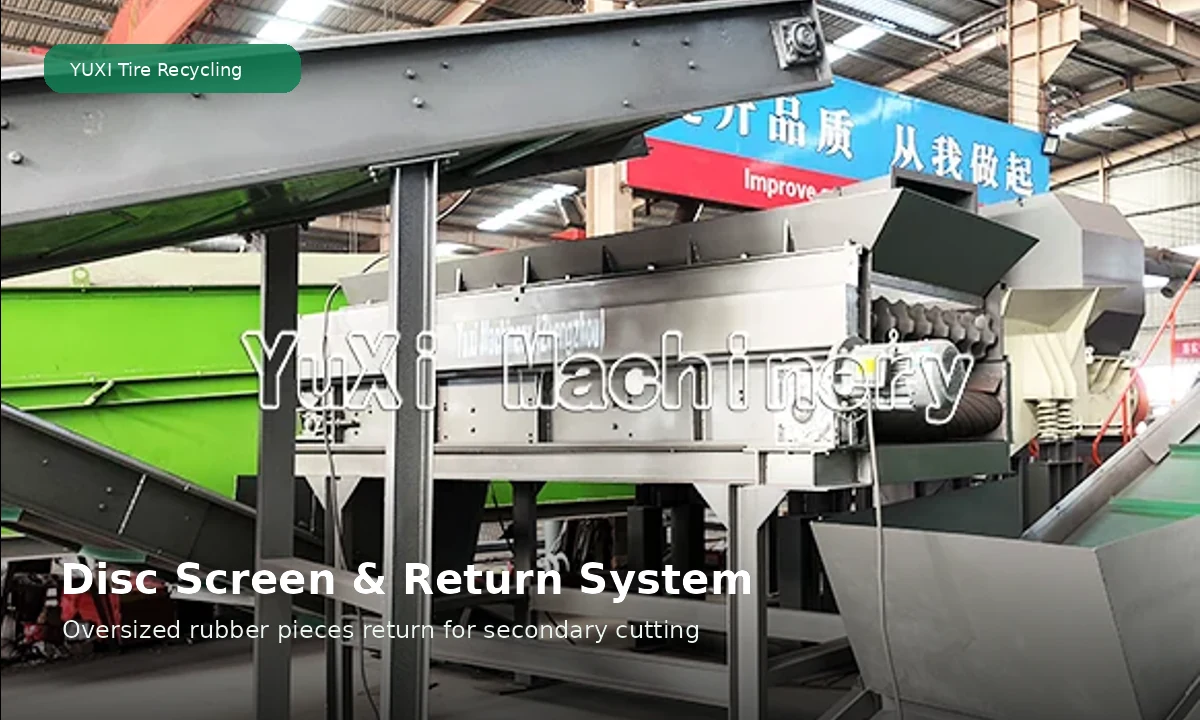
The screen-and-return system is especially important when the target is TDF chips or relatively consistent rubber chip output. Qualified material passes through the screen. Oversized pieces stay on the screen and are routed back to the shredder for another cut. This reduces manual sorting and helps keep discharge more stable.
3. Front-end matching for truck and OTR tires
Passenger tires may be easier to feed directly, depending on the selected shredder opening and line design. Truck, bus and OTR tires usually need more attention because bead wire and rubber section thickness are much stronger. In those cases, bead wire removal, sidewall cutting or tire section cutting may reduce cutting load and improve blade life.
4. Output-oriented line planning
The same primary shredder can point to different business routes. For fuel applications, the layout may focus on chip size control and material handling. For mulch or crumb rubber, the layout usually needs more steel liberation, magnetic separation, granulation and screening. This is where the line should be selected by final product, not by machine name alone.
Working principle: from whole tire to controlled chips
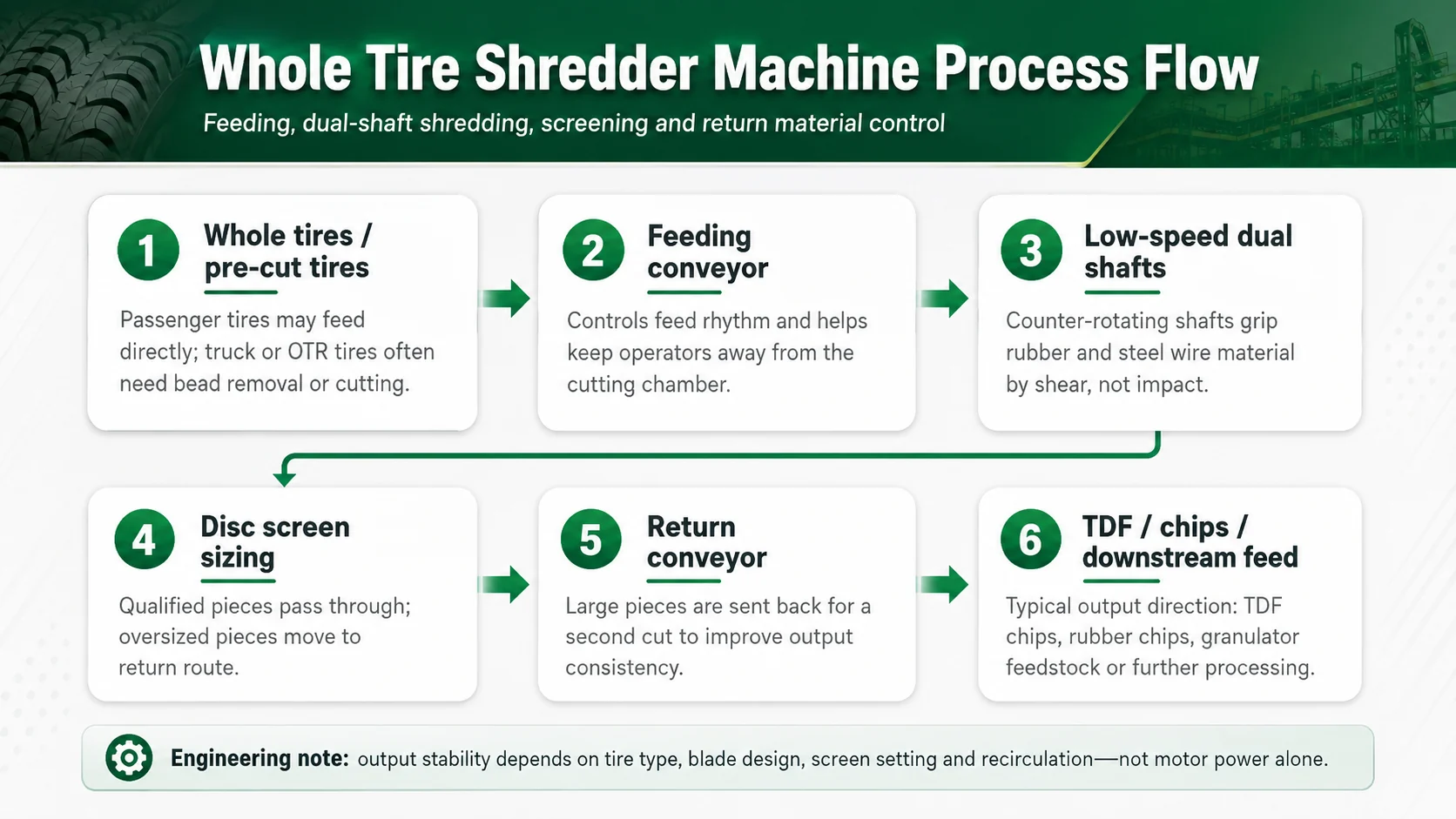
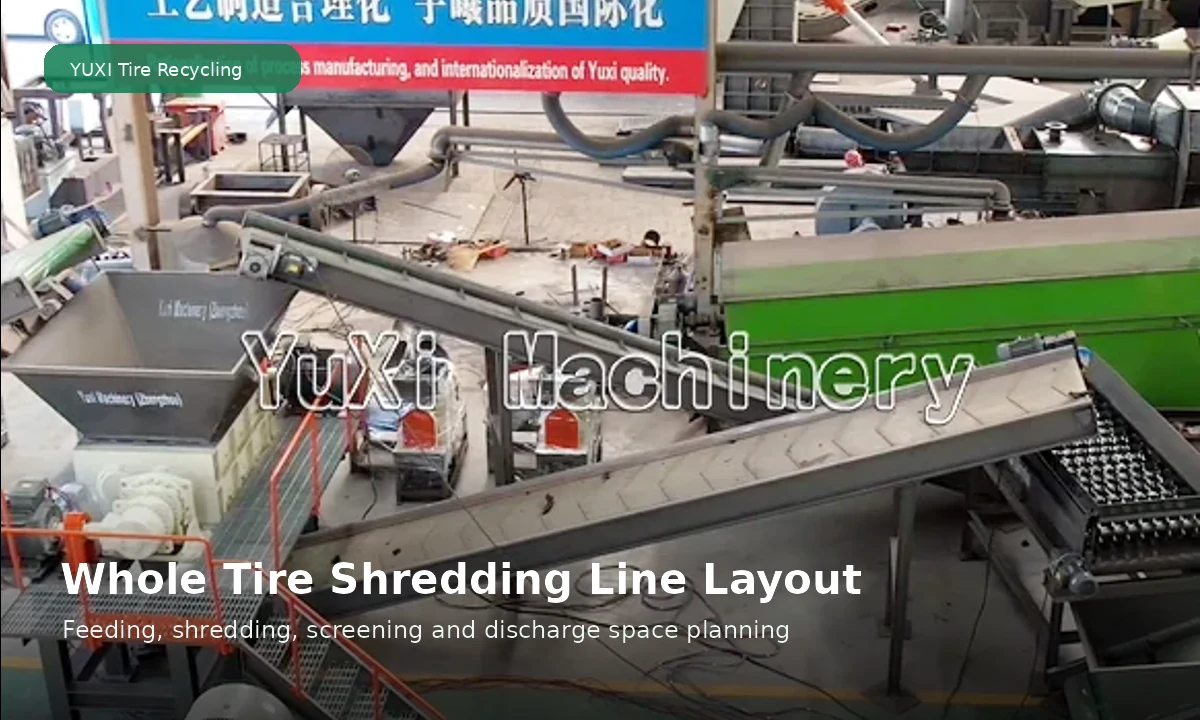
A whole tire shredding line is easiest to understand as a loop rather than a single machine. The main stages are feeding, shredding, screening, return and discharge.
Feeding
Whole tires or pre-cut tire sections are delivered by conveyor or loader into the hopper. A conveyor gives the operator better feeding rhythm and helps reduce unsafe manual handling near the cutting chamber. For mixed tire streams, the feeding method should be planned around the largest tire size, not the average tire size.
Primary shredding
In the cutting chamber,the two shafts rotate in opposite directions. The knives hook the tire, pull it inward and cut the rubber-and-steel structure by shear force. The aim is stable pulling and controlled cutting, not high-speed crushing. This is why shaft design, blade thickness, alloy material, reducer selection and overload protection matter.
Screening and return
After the first cut, the material moves to the screen. Pieces that meet the size requirement pass forward. Oversized pieces return to the shredder automatically. This return loop is one of the main reasons a configured tire shredding line can produce more consistent output than a standalone shredder without screening.
Discharge and downstream processing
The shredded material can be discharged as rough shreds, TDF chips or rubber chip feedstock. If the next step is fuel use, the buyer should confirm the fuel user’s chip size, metal exposure and handling requirements. If the next step is wire-free mulch or crumb rubber, the line normally continues into magnetic separation, granulation and screening.
The screen-and-return loop helps reduce oversize discharge before the material moves to TDF, rubber chip or downstream granulation steps.
Output size: rough shreds, TDF chips or granulator feed?
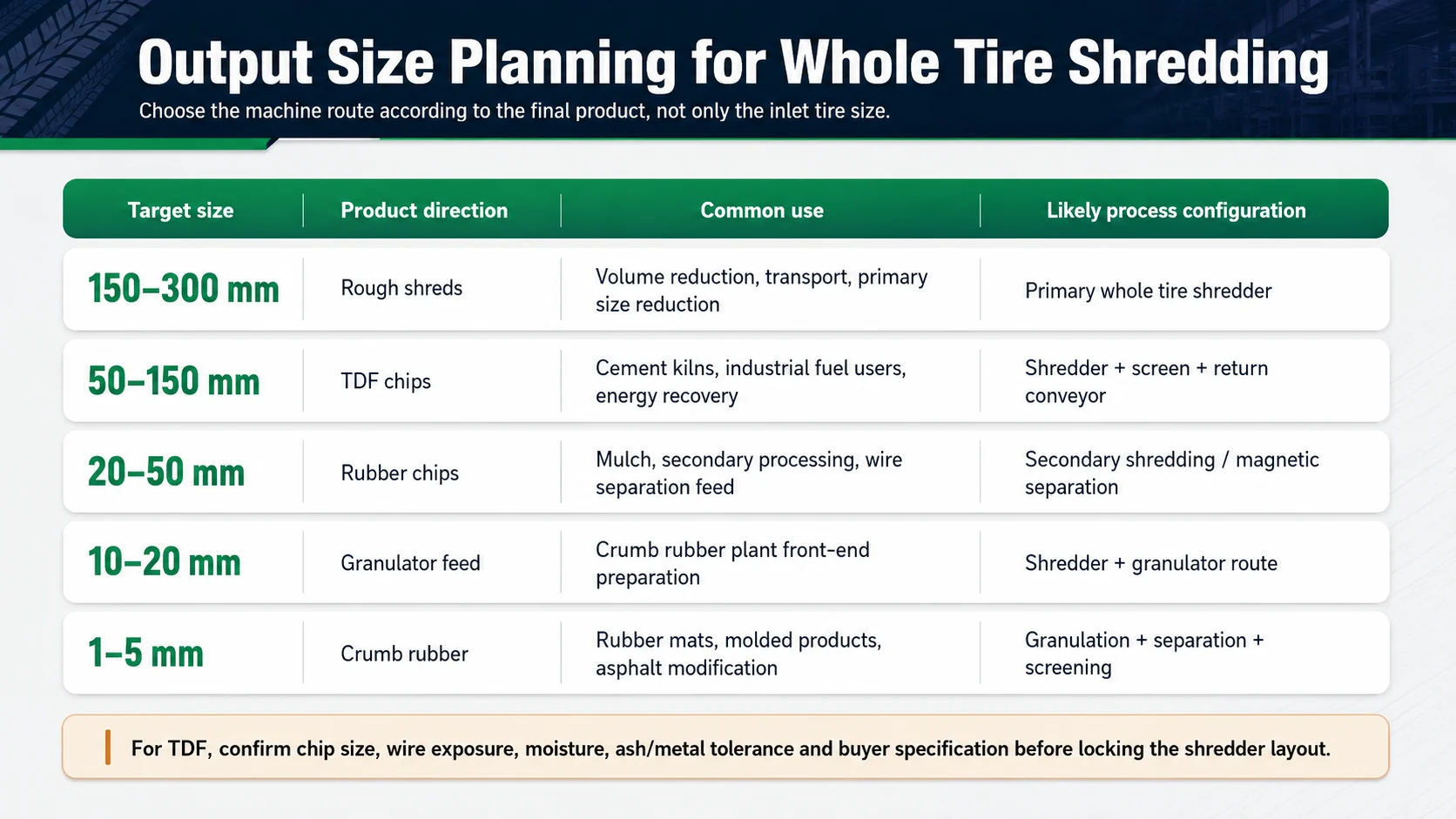
The most common mistake in whole tire shredder selection is asking for capacity before defining output size. A machine producing rough 150–300 mm shreds does not have the same duty as a line producing smaller, more uniform TDF chips. A line feeding crumb rubber equipment has a different requirement again.
ASTM D6700 describes tire-derived fuel as the result of converting whole scrap tires into a chipped form for use as fuel, and frames TDF as an established industrial and utility fuel application. The U.S. EPA also identifies cement kilns, utility boilers and pulp/paper mills as common users of TDF where proper storage, permitting and air-control requirements are met. In other words, chip production is not just a machine output; it is a market specification.
For YUXI’s Tire TDF Plant, the published process route includes bead steel wire removal, whole tire cutting and tire shredding, with a typical TDF chip direction around 50–100 mm or 50–150 mm depending on configuration. This size range is a useful starting point for many fuel projects, but the final specification should always come from the fuel buyer and local compliance requirements.
Target output
Typical use
Line implication
150–300 mm rough shreds
Volume reduction, transport reduction, primary processing
Primary whole tire shredder; screen may be less strict
50–150 mm TDF chips
Cement kilns, industrial boilers, energy recovery
Primary shredder plus screening and return conveyor
20–50 mm rubber chips
Mulch, secondary chips, steel separation feed
Secondary shredding and magnetic separation are often added
Below 20 mm feedstock
Granulator feed for crumb rubber lines
Shredding plus granulation, steel/fiber separation and screening
Output size determines the line design. A TDF project does not need the same downstream system as a crumb rubber or rubber powder plant.
Which line route should you choose?
A whole tire shredder can be the first major machine in several recycling routes. The right route depends on the material market you want to serve.
Route A: whole tire to TDF chips
This route focuses on preparing tire chips for fuel users. It usually needs pre-processing for heavy tires, a primary tire shredder, screening, return conveying and discharge handling. Fuel users may care about chip size, wire exposure, moisture and reliable delivery more than a polished appearance.
Route B: whole tire to wire-free rubber chips
When the target is cleaner rubber chip output, the line needs more attention to steel liberation and magnetic separation. Buyers comparing mulch or rubber chip projects can review YUXI’s Tire Wire Free Mulch Plant to understand how shredding connects with downstream cleaning and sizing.
Route C: whole tire to crumb rubber
For crumb rubber, the primary shredder is only the beginning. The material usually moves through granulation, steel separation, fiber separation and screening before it becomes usable crumb. A buyer planning this route should use the shredder output as feedstock planning, not as the final product. YUXI’s Tire Rubber Crumb Plant is the more relevant reference when the goal is finished crumb rubber rather than fuel chips.
How to select the right whole tire shredder machine
The best shredder quotation starts with a material and output profile. A short inquiry such as “send whole tire shredder price” usually leads to a generic answer. A useful inquiry lets the manufacturer design the chamber, knives, motor, reducer, conveyors, screen and return system around the real job.
1. Define the tire stream
List the types of tires: passenger car tires, truck tires, bus tires, agricultural tires, OTR tires, conveyor belts or mixed rubber scraps. Include the approximate percentage of truck or high-steel tires. A line that processes 90% passenger tires is different from a line that handles a constant stream of truck tires.
2. Confirm the largest tire size
The maximum tire diameter and width affect hopper opening, feeding method and whether pre-cutting is required. Do not design around average tire size if oversized tires appear every day.
3. Decide how bead wire will be handled
Bead wire is one of the toughest parts of a tire. If heavy bead bundles enter the shredder continuously, they can increase torque load and blade wear. For truck and OTR tires, a tire debeader, bead cutting machine or tire cutter may be a practical protection step.
4. Lock the target output size
Target output size determines the screen and return logic. Rough shreds, 50–150 mm TDF chips, 20–50 mm rubber chips and granulator feedstock all need different line settings. The shredder should be selected with the downstream buyer or downstream equipment in mind.
5. Plan capacity by continuous operation
Hourly capacity should be based on real feeding and discharge conditions, not only motor power. Ask how the line behaves when the feed is mixed, wet, high-steel or inconsistent. Also ask what percentage of return material is expected under the target output size.
6. Check maintenance access
Blade inspection, blade replacement, bearing lubrication, reducer maintenance, screen cleaning and conveyor access will all affect the uptime. If the workshop layout does not leave the service space,the machine that looks compact in the catalog may be difficult to maintain.
A practical layout leaves room for feeding, return material, discharge, maintenance access and future downstream equipment.
Buyer checklist before requesting a quotation
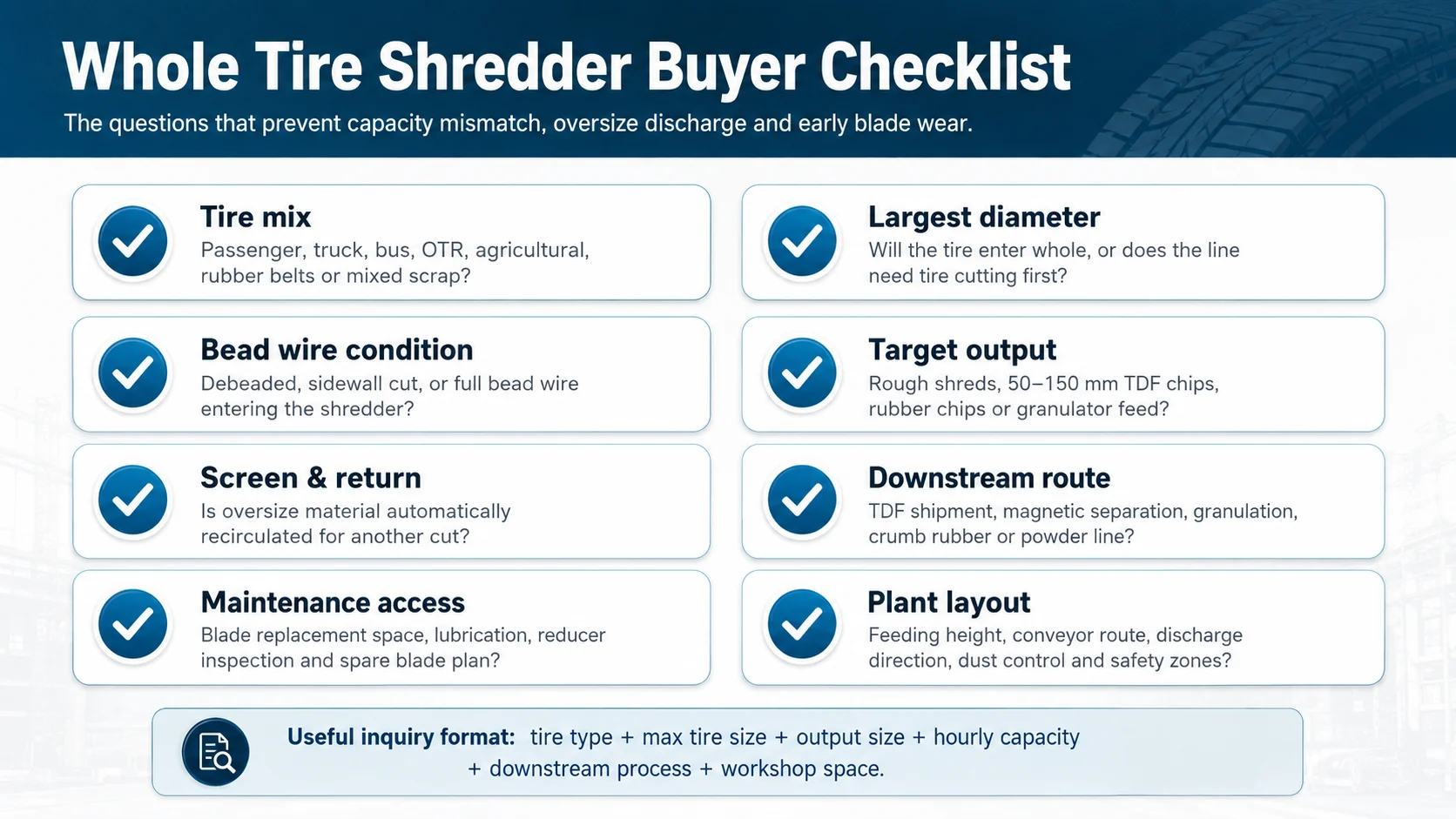
Before requesting a formal configuration,please prepare the following information:
Raw material: passenger tires, truck tires, bus tires, OTR tires or mixed rubber waste.
Maximum tire diameter and width entering the line.
Whether bead wire is removed, cut or left inside the tire.
Required output size range and tolerance for oversize material.
Expected hourly capacity and daily working hours.
Downstream process: fuel sale, magnetic separation, mulch, granulation or powder grinding.
Available workshop space, feeding height, discharge direction and local safety requirements.
This information lets YUXI recommend a machine and line arrangement instead of sending a generic model list. It also helps avoid the two most expensive mistakes: buying a shredder that cannot control output size, or buying a powerful shredder that does not match the downstream process.
The best inquiry package includes tire type, maximum tire size, target output, capacity, downstream process and workshop space.
Operation and maintenance points that affect long-term cost
A whole tire shredder is a wear machine. The purchase price is important, but the long-term cost depends on the blade life, downtime, spare parts and the speed at which the operator removes the anomaly.
Blade system
Ask about blade material, hardness, thickness, replacement method and expected spare blade plan. For tire applications, blade selection should consider steel wire content and output size, not rubber alone.
Reducer and overload protection
Tire feeding is uneven. When a heavy bead section enters the chamber, torque can rise quickly. A suitable reducer, electrical protection and automatic reverse logic help protect the machine from overload events.
Screen cleaning and return control
The screen is not a decorative accessory. It decides which pieces pass and which return. A clogged or poorly matched screen can reduce capacity, increase return load and create uneven discharge.
Safety and layout
Emergency stops, guarded conveyors, safe feeding distance, maintenance platforms and clear discharge zones should be included in the layout discussion. Tire recycling plants handle heavy, elastic and sometimes contaminated material, so line safety should be designed before installation.
Common mistakes when buying a whole tire shredder
Choosing by motor power only
Motor power alone does not tell you chamber size, shaft torque, blade design, screen control or real output consistency.
Ignoring tire type mix
A line designed for passenger tires may struggle if the feed stream quietly shifts toward truck tires or OTR sections.
No oversize return plan
Without a screen-and-return loop, the plant may rely on manual sorting or accept inconsistent output.
Skipping downstream planning
A shredder that is fine for TDF may not provide the right feedstock for wire-free mulch or crumb rubber production.
Whole tire shredder machine FAQ
Can a whole tire shredder process complete tires directly?
Yes, it can be configured for complete tires, especially passenger tires. Truck, bus and OTR tires may require bead wire removal, sidewall cutting or tire cutting before shredding, depending on tire size, steel content and target output.
What output size can a whole tire shredder produce?
Typical project directions include rough shreds, 50–150 mm TDF chips, 20–50 mm rubber chips and smaller feedstock for granulation. The actual size depends on blade layout, screen setting, return material design and downstream process requirements.
Is a whole tire shredder suitable for TDF production?
Yes. For TDF, the shredder should be matched with screening, return conveying and material handling so the chips meet the fuel user’s size and steel exposure requirements. Local permitting and combustion facility requirements must also be confirmed.
Do I need a tire debeader before shredding?
Not always. For passenger tires, direct shredding may be possible. For truck tires, bus tires and large tires with heavy bead wire, debeading or bead cutting can reduce cutting load and improve blade protection.
What affects whole tire shredder machine price?
Main cost factors include chamber size, shaft and blade design, motor and reducer configuration, feeding conveyor, disc screen, return conveyor, automation, spare blades, safety devices and whether the shredder is supplied as a standalone machine or complete line.
What information should I send to get a useful configuration?
Send tire type, maximum tire diameter, bead wire condition, target output size, required capacity, downstream use, workshop space and any buyer specification for TDF, rubber chips or granulator feedstock.
Need a whole tire shredder configuration?
Share your tire type, maximum tire size, target output size, capacity target and downstream process. YUXI can help match the shredder, screen, return conveyor, magnetic separation and downstream equipment for your recycling project.
The article above uses YUXI product-page information for machine configuration, line logic and application direction, and uses the following third-party references for industry context.
U.S. EPA, Frequent Questions on Tire-Derived Fuel — summarizes TDF fuel value, common users such as cement kilns, pulp/paper mills and utility boilers, and the need for proper controls and regulatory compliance.
U.S. EPA, Tire-Derived Fuel overview — discusses responsible use of tires in cement kilns and other industrial facilities with storage, permitting and compliance considerations.
Marie has 8+ years of experience in tire shredding and recycling equipment,with a focus on tire shredders,rubber recycling machines,TDF production,rubber crumb processing,and complete tire recycling systems.