




Quick Answer: Choose a Shredder Around the Process
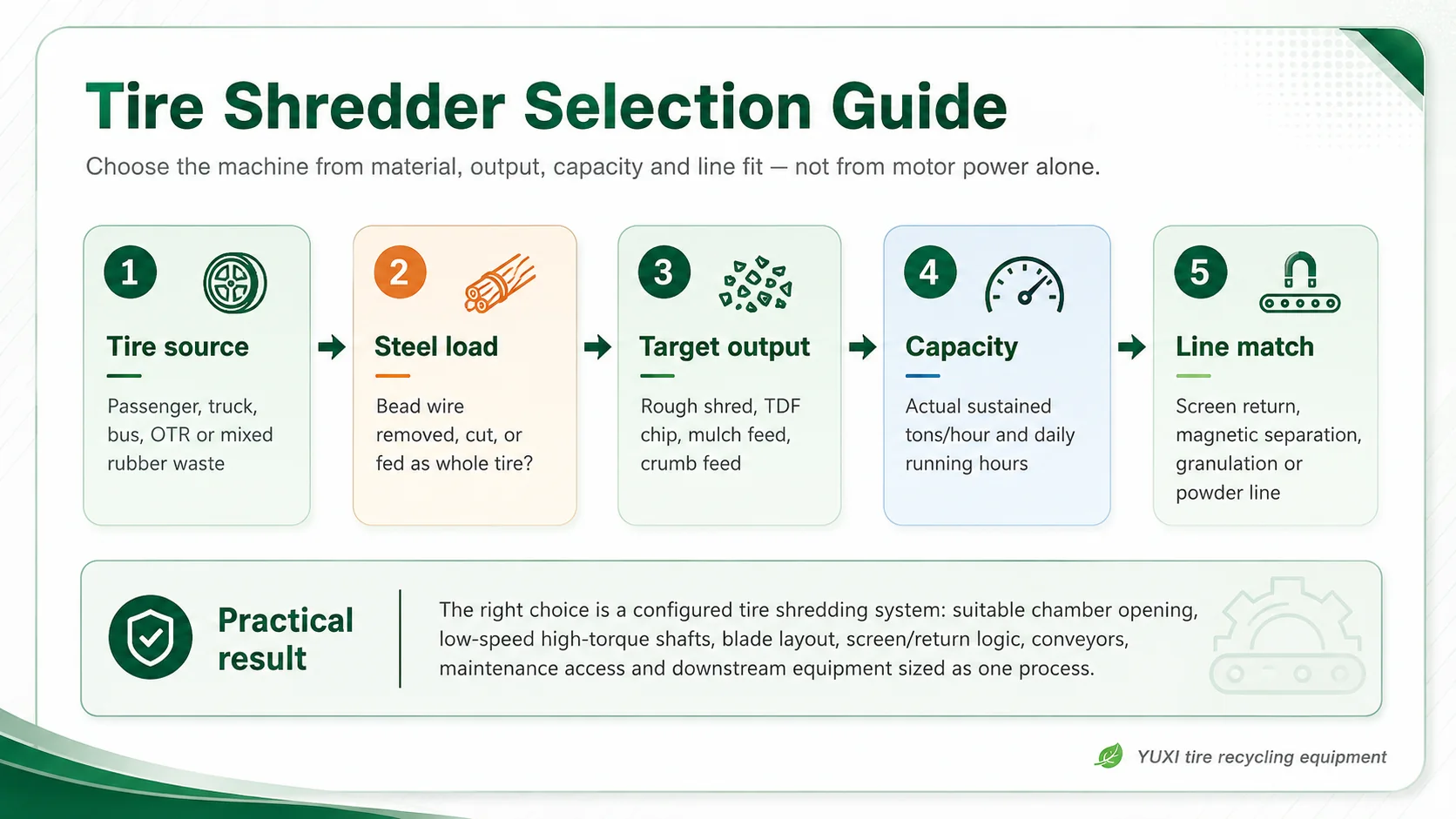
To choose a tire shredder,before comparing the motor power or price, define the tire type, maximum tire diameter, steel wire content, target output size,actual hourly capacity, downstream equipment, safety requirements, and maintenance plan. A collection yard may need rough volume reduction. A TDF project needs controlled chips. A crumb rubber plant needs a shredder output that works with steel separation, granulation, fiber removal and screening. YUXI’s front-end tire recycling equipment page frames the same decision in process terms: tire preparation, cutting, shredding and size reduction are selected according to tire type, steel content, output size and whether the project needs standalone machines or a complete line.1. Start With the Final Product, Not the Motor Power
Many low-quality quotations lead with a model name, motor power and a capacity number. That is not enough. The machine that makes rough tire shreds for storage reduction is not the same system a buyer needs for clean crumb rubber feedstock. The market also explains why the product target matters. USTMA reported in 2024 that 79% of U.S. scrap tires were consumed in the end-use markets, and granding rubber had become the second-largest terminal market, consuming about 28% of scrap tires in 2023. This means that buyers not only need to buy shredders; they are choosing the tire derivatives market they want.| Final product target | What the shredder must support | Typical buyer concern |
|---|---|---|
| Rough tire shreds | Primary size reduction and transport volume reduction | Chamber opening, torque, easy feeding |
| TDF chips | More controlled chip size and oversize return | Fuel user size requirement, steel tolerance |
| Wire-free mulch | Downstream steel liberation and magnetic separation | Cleaner rubber chips and steel recovery |
| Crumb rubber | Stable feed into rasper / granulator and fiber separation | Purity, particle size and continuous operation |
| Rubber powder | Multi-stage size reduction before fine grinding | Granule cleanliness before milling |
2. Confirm Tire Type, Diameter and Steel Wire Load
A tire shredder buying guide should not treat all tires as the same raw material. Passenger tires, truck tires, bus tires and OTR tires behave differently inside the cutting chamber. Truck tires contain heavier rubber sections and stronger bead wire. Large OTR tires may require pre-cutting, bead removal or a special feeding plan before shredding. YUXI’s tire recycling equipment page notes that wire drawing, bead cutting and tire cutting machines are used before heavy shredding when stronger bead sections need to be prepared. This is important because steel bead wire affects blade wear, torque demand, feeding stability and downstream steel recovery.Passenger tires
Often suitable for direct feeding or a simple cutting stage, depending on chamber size and target output.Truck and bus tires
Usually need higher torque, stronger blades and a clear decision on bead wire removal or pre-cutting.OTR and mining tires
Require customized feeding, cutting and material-handling evaluation before any shredder model is confirmed.3. Match Output Size to the Downstream Route
Output size is where many purchasing mistakes begin. A buyer may ask for “small rubber pieces,” but TDF, mulch feed, granulator feed and rubber powder feedstock are different engineering targets. YUXI’s tire shredder page explains that the dual-shaft shredder works with a disc screen return system: qualified pieces pass, while oversized pieces are returned for another pass instead of being manually sorted.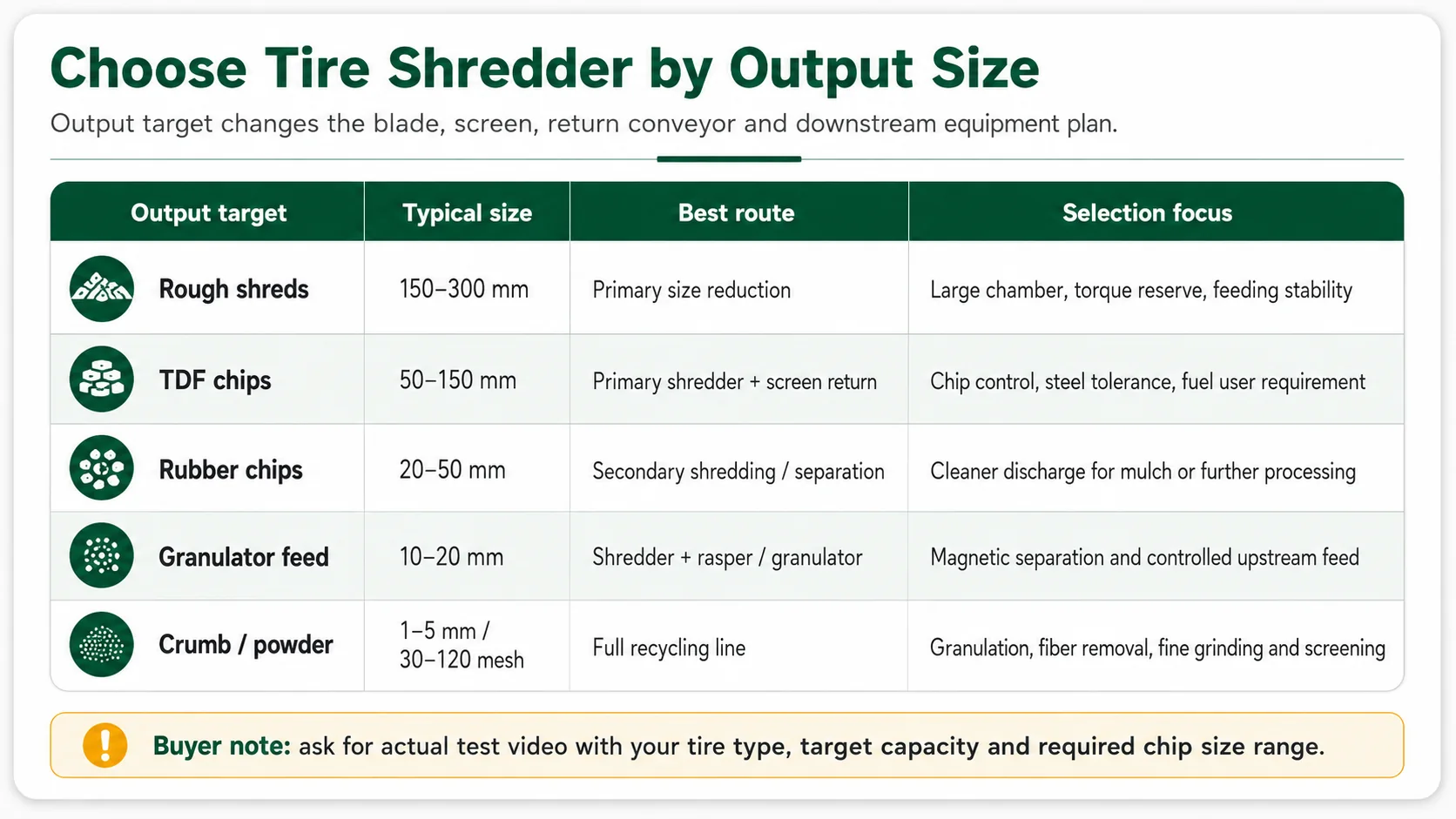
4. Compare Real Capacity, Not Just Nameplate Capacity
Capacity should be stated as a realistic production condition: tire type, tire size range, pre-treatment status, target output size, screen configuration and daily working hours. The shredder may show high capacity when making coarse crumbs,but when buyers require smaller fragments and have more recycling,the running speed of the same mashine may slow down. Supplies are required to separate three numbers:rated motor power,test throughput of specified type and continuous capacity of the whole line. This is especially important for overseas projects where conveyors, return screening, magnetic separation and granulation must be balanced with the shredder.5. Check Whether You Need a Standalone Machine or a Line
A standalone shredder can be the right choice for an existing plant that only needs capacity expansion or replacement equipment. A new project usually needs the shredder to be planned with conveyors, screening, return material handling, magnetic separation, fiber removal, dust-control points and maintenance space. YUXI positions its tire shredder machine as a dual-shaft unit for whole tire pre-shredding, truck tire size reduction, TDF chip preparation and rubber recycling lines. For broader production planning, its complete tire recycling plant page describes configurable lines from primary tire shredding through steel and fiber separation, rubber granulation and fine powder grinding.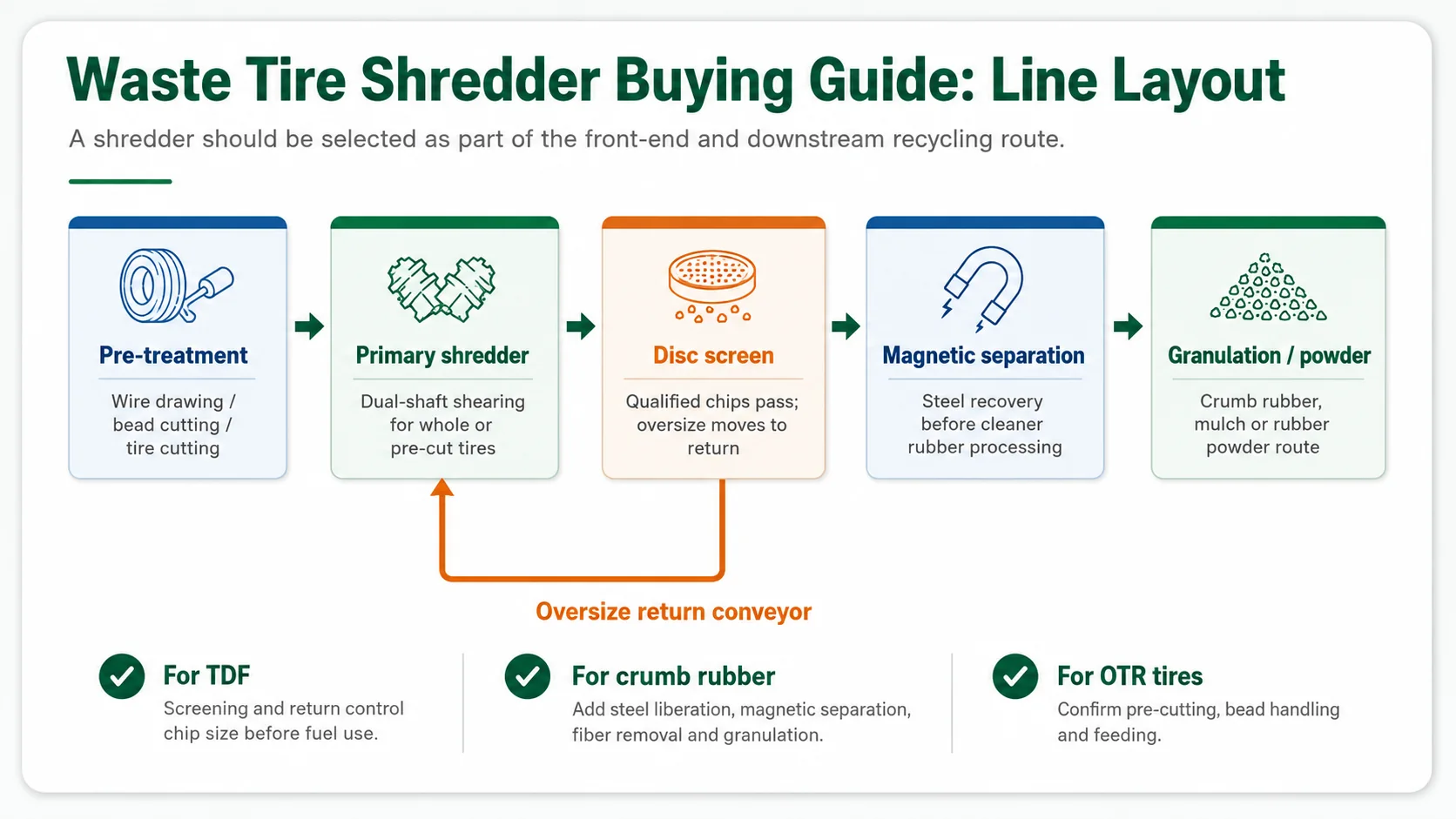
When a simpler TDF line is enough
If the project sells controlled tire chips for fuel users, a Tire TDF Plant route may focus on pre-treatment, primary shredding, screening and chip discharge.When a deeper recycling line is needed
If the target is higher-value rubber granules, the shredder output must fit a Tire Rubber Crumb Plant route with steel separation, fiber separation, granulation and screening. For fine powder, the line adds another grinding and classification stage.6. Do Not Ignore Safety, Access and Maintenance
A tire shredder handles elastic rubber, embedded steel wire, rotating shafts and heavy feed loads. The purchase decision should include guarding, emergency stops, service access, blade replacement method, lubrication points, reducer inspection and lockout procedures. OSHA’s machine protection standards state that one or more protection methods must protect operators and other employees from hazards such as operation points, feeding points and rotating parts. OSHA’s locking/marking guidelines also emphasizes that hazardous energy must be controlled during repair and maintenance so that machines does not accidentally start or release stored energy.- Ask where operators stand during feeding and jam clearing.
- Confirm access platforms, guards, emergency stop locations and electrical cabinet placement.
- Ask how blades are replaced, repaired or rotated.
- Request the spare blade plan, lubrication plan and wear-part list.
- For continuous plants, confirm how cleaning and maintenance are done without unsafe shortcuts.
7. Tire Shredder Buying Checklist for RFQ
Use this checklist before asking for a price. It helps the supplier recommend a real configuration instead of a generic machine list.| Information to provide | Why it matters | Example wording |
|---|---|---|
| Tire type | Determines torque, blade and pre-treatment needs | 70% passenger tires, 30% truck tires |
| Maximum tire diameter | Affects hopper, chamber opening and feeding method | Up to 1200 mm truck tires |
| Steel wire status | Changes wear, torque and downstream separation | Bead wire removed / not removed |
| Target output size | Controls blade, screen and return conveyor design | 50–100 mm TDF chips |
| Capacity target | Prevents under-sizing or over-buying | 2 t/h, 8 hours/day |
| Downstream route | Ensures the shredder discharge matches the next machine | TDF only / crumb rubber / powder line |
| Site conditions | Impacts conveyor direction, layout and power design | Workshop length, width, height, local voltage |
| Compliance and safety | to reduce commissioning risks | security, emergency stop, LOTO practice, dust prevention plan |
8. How to Judge Whether The Supplier Understands Your Project
A professional supplier should ask about your material and output before recommending a model. If a quotation only lists “motor power + price,” it is not a real tire shredder selection guide. Ask for drawings, a process route, videos from comparable tire types, container loading information, spare blade pricing and installation support. YUXI’s equipment page highlights process-based selection, single-machine or line support, output-oriented planning and after-sales considerations. Those points are useful because most tire recycling problems happen at the interfaces: feeding into the shredder, oversized material return, steel separation after shredding and stable feed into the next reduction stage.9. Common Mistakes When Choosing a Tire Shredder
Mistake 1: Buying only according to price
If the blade wears out quickly,oversized materials need to be manually classified,or the discharge cannot be given to the next mashine,then a cheaper machine may become expensive.Mistake 2: Treating truck tires like passenger tires
Truck tires carry stronger wire and heavier sections. Pre-treatment and torque reserve should be confirmed before model selection.Mistake 3: Ignoring output control
Without screening and return logic, the plant may produce too many oversized pieces for TDF users or downstream granulation.Mistake 4: Forgetting maintenance space
A tight layout makes blade replacement, cleaning and reducer inspection harder. Layout drawings should reserve safe service areas.Mistake 5: Not matching the whole line
The shredder must match conveyors, separators, granulators, screens and dust-control points. One undersized machine can limit the entire plant.Mistake 6: Asking for “capacity” without conditions
Always define tire type, feed condition, target chip size and running hours. Capacity without test conditions is easy to misunderstand.10. Decision Matrix: Which Configuration Fits Your Project?
| Project type | Recommended focus | Configuration notes |
|---|---|---|
| Scrap tire collection yard | Rough shredding and volume reduction | Large feed opening, strong frame, simple discharge and easy maintenance |
| TDF chip producer | Controlled chip size and stable output | Dual-shaft shredder with disc screen and return conveyor |
| Truck tire recycler | Steel wire handling and blade protection | Consider wire drawing, bead cutting or tire cutting before shredding |
| Crumb rubber plant | Shredder output matched to granulation | Add rasper / granulator, magnetic separation, fiber removal and screening |
| OTR tire project | Customized pre-processing and feeding | Confirm maximum tire size, section thickness, steel content and lifting method |
| Existing line upgrade | Mechanical interface and output compatibility | Match conveyor height, discharge size, motor control and spare-parts plan |
FAQ: Tire Shredder Selection Guide
How do I choose a tire shredder machine?
Start with tire type, maximum diameter, steel wire content, target output size, capacity, downstream process and site layout. Then compare shredder structure, blades, screen/return system, safety access and supplier support.
What is the best type of shredder for waste tires?
For the whole tires and steel-wire rubber, a low-speed, high-torque double-shaft shredder is usually used because it can grab and cut elastic material instead of relying only on high-speed impact.
Can one tire shredder directly make crumb rubber ?
No. A primary tire shredder prepares rubber chips. Crumb rubber normally requires additional size reduction, steel separation, fiber removal, screening and sometimes fine grinding.
Should bead wire be removed before shredding?
It depends on tire type, shredder design and downstream goals. For truck tires and heavy steel tires, bead wire removal or bead cutting can reduce cutting load, blade wear and downstream separation difficulty.
What output size is common for TDF?
TDF projects commonly use controlled tire chips rather than fine crumb rubber. The exact size should follow the fuel user’s specification and the line’s screen/return configuration.
What should I send to YUXI for a configuration?
Send tire type, maximum diameter, steel wire status, target output size, capacity target, daily operating hours, workshop dimensions, local voltage and final product plan. Photos or videos of the feedstock are also useful.
Need a Tire Shredder Configuration?
Send your material details, target capacity, output requirements, site information and local electrical standard. YUXI can prepare a suitable equipment configuration and quotation.
References and Source Notes
- USTMA, “USTMA Reports Progress in Tire Recycling,” October 24, 2024: end-of-life tire utilization, ground rubber market share and stockpile reduction context.
- U.S. EPA, “Tire-Derived Fuel”: TDF size reduction, de-wiring and beneficial-use guidance.
- FHWA, “Crumb Rubber Modifier”: use of waste tire rubber in engineered asphalt applications.
- OSHA, 29 CFR 1910.212 and Lockout/Tagout standard: machine guarding and hazardous energy control references for maintenance planning.