




Why “How It Works” Matters Before You Ask for Price
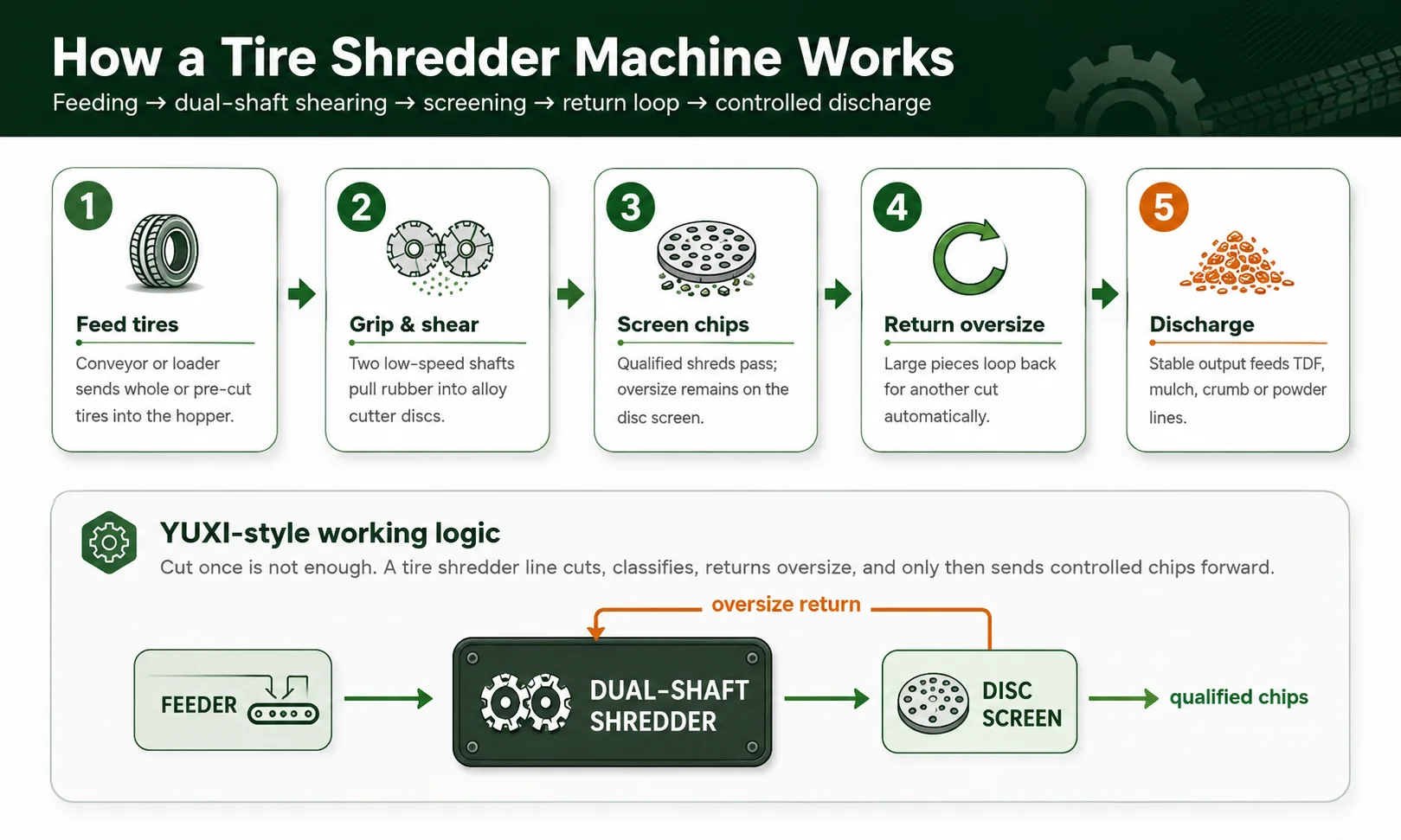
Most buyers ask this question after seeing two very different quotations for what looks like the same machine. One supplier may quote only a basic shredder body. Another may include a feeding conveyor, disc screen, return conveyor, magnetic separator, PLC cabinet, service platform and spare blades. On paper, both are called a tire shredder machine. On the floor, they behave very differently. Scrap tires are difficult because they are elastic, hollow, uneven and reinforced with steel wire and textile cord. When the machine pulls in a passenger tire, the load is not the same as when it pulls in a thick truck tire, an all-steel radial tire or a pre-cut OTR section. That is why YUXI positions its tire shredder machine as a dual-shaft unit for whole tire pre-shredding, truck tire size reduction, TDF chip preparation and front-end rubber recycling line use, with a disc screen return system for oversize material. The practical buyer question is therefore not only, “Can it shred a tire?” A better question is: “Can it keep producing the right chip size for my next machine or customer?” That is where the working principle matters.The Working Principle in Five Stages
1. Feeding: the tire must enter at a controlled rhythm
Scrap tires enter the hopper by conveyor, loader or a planned feeding platform. The goal is not to fill the hopper as quickly as possible. The stable feed rhythm gives the cutters time to bite the tire, reduces bridging and prevents sudden torque peaks. For mixed passenger and truck tires, the feed opening, conveyor angle and hopper volume should be chosen together with the tire size range.2. Gripping: the shafts pull the tire inward
In a dual-shaft tire shredder, two shafts rotate toward each other. The cutter discs act like a series of hooks and shears. Instead of relying on high-speed impact, they grab the tire and pull it into the cutting gap. This is important because tires stretch. High-speed impact crusherS may bounce or heat rubber, while a low-speed high-torque shredderS can more predictably bite and tear the tire structure.3. Shearing: alloy blades cut rubber, wire and cord
The overlapping blades will cut the sidewalls, treads, bead areas and steel-reinforced rubber into smaller pieces when the tire is trapped between the cutter discs.Blade material, thickness, hook profile, shaft strength and reducer torque all affect how well the machine deals with steel cord and thick rubber. In YUXI’s TDF plant information, the tire shredder section is described with double shafts, surface-treated shaft material and high-alloy one-piece blades, because this is the high-load zone of the line.4. Screening: qualified pieces pass, oversize stays out
After the first cut, tire pieces are not perfectly uniform. Some pieces are small enough for the target; others remain long, folded or steel-connected. A screening section separates qualified material from oversized pieces. YUXI’s product page highlights a disc screen return arrangement: qualified material passes forward, while large pieces move toward the return route.5. Return and discharge: the line repeats the cut until the output is usable
The return conveyor sends oversized pieces back into the shredder for a second pass. This simple loop makes a big difference in plant operation. It reduces manual picking, keeps downstream equipment from receiving oversized chunks and helps the output become more predictable for TDF, rasper, granulator or powder-line feeding.What Happened In the Double-Shaft Cutting Chamber?
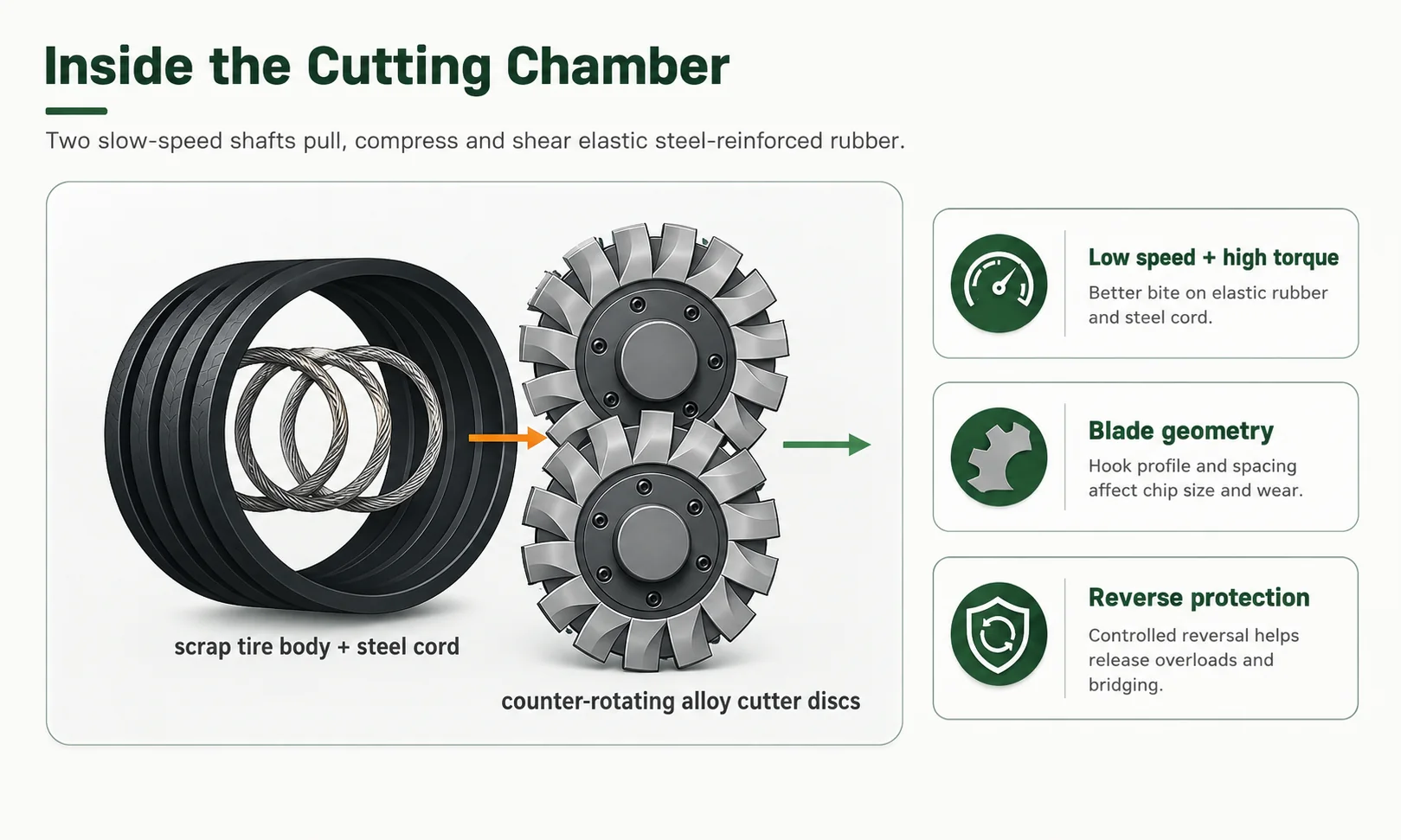
Compression
The tire is squeezed between the shafts and cutter discs. This prevents the hollow tire from simply rolling or bouncing in the hopper.Tearing
As the shafts rotate, the rubber body stretches and tears. The cutter hooks keep dragging the tire into the cutting zone.Shearing
Opposing cutter edges slice across the rubber, textile and exposed wire. This reduces the tire into shreds or chips.Load control
When material is too thick or wrapped, the control system can slow, stop or reverse the shafts depending on the configuration.How Does the Machine Control Output Size?
Many buyers expect output size to come only from blade width. Blade width matters, but it is only one part of the answer. In continuous tire recycling, the final discharge depends on blade design, shaft speed, screen setting, return rate, material type and downstream equipment.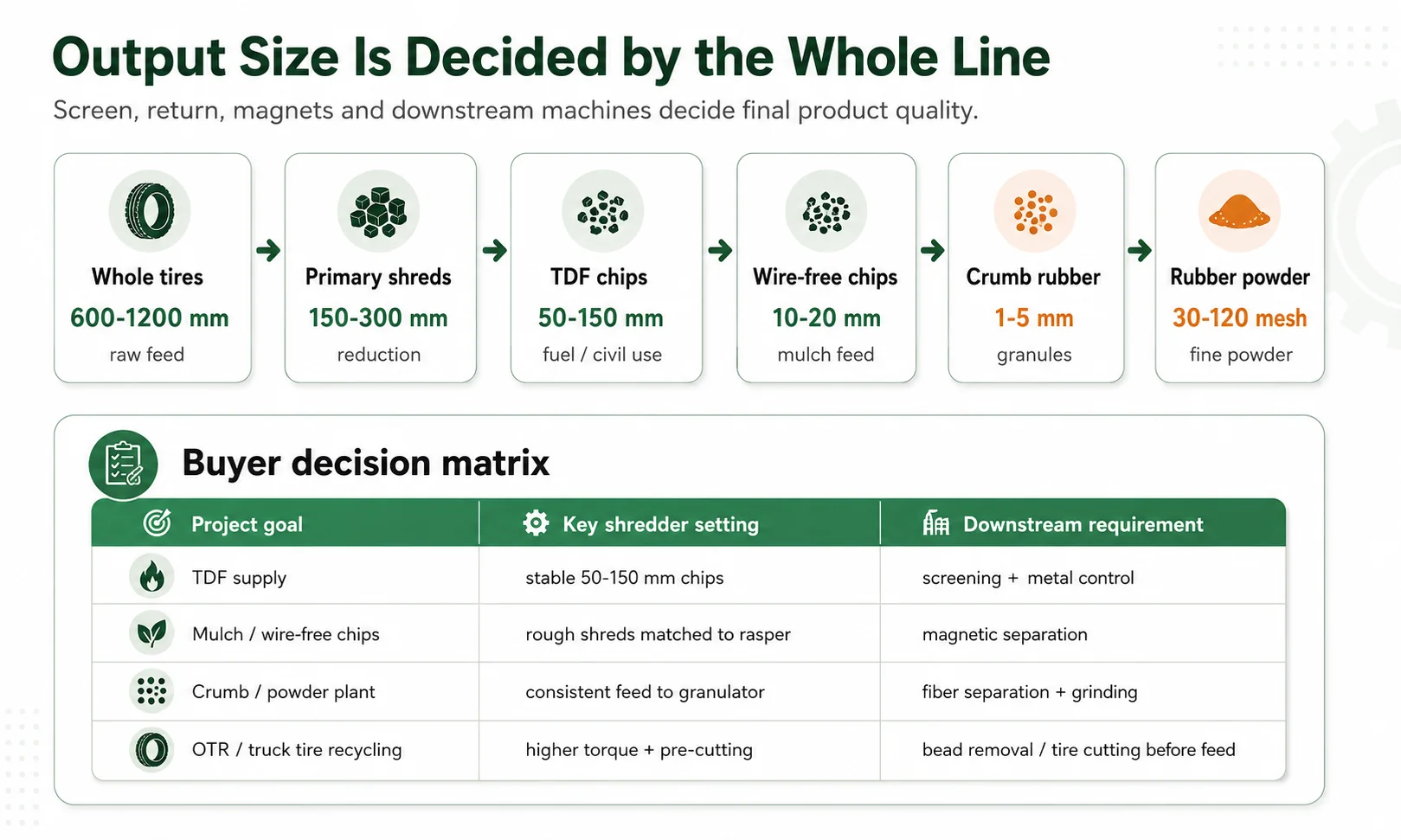
| Target output | Typical role | What the shredder must do | Line implication |
|---|---|---|---|
| 150–300 mm rough shreds | Primary volume reduction | Accept whole or pre-cut tires and reduce bulk | May be enough for transport reduction, but usually not enough for final product sales |
| 50–150 mm TDF chips | Tire-derived fuel preparation | Cut and recirculate until the pieces fit the customer’s size range | Screening and metal control become important |
| 20–50 mm rubber chips | Mulch or secondary processing feed | Feed a rasper or secondary reducer consistently | Magnetic separation is usually needed after liberation of steel |
| 10–20 mm wire-free chips | Rubber mulch and granulator feed | Provide stable upstream material to the rasper | Multi-stage magnetic separation and classification drive product cleanliness |
| 1–5 mm crumb rubber | Sports surfaces, mats, modified asphalt and molded products | The tire shredder is only the first step | Granulation, fiber separation and screening are required |
| 30–120 mesh rubber powder | Fine rubber products and compounding | Prepare the upstream feed, not final powder | Grinding/milling follows granulation and separation |
Does Every Tire Go Directly Into the Shredder?
No. Direct feeding is common for many passenger and truck tire projects, but not always the best choice. Tire size, bead wire content, steel concentration and downstream product requirement decide whether pre-treatment is useful. For wire-heavy tires, removing bead wire before shredding can reduce blade wear and make the next step easier to control. YUXI’s tire wire drawing machine is positioned for pulling bead steel wire from car, bus and truck tires before cutting, shredding, rubber powder production or pyrolysis pretreatment. For oversized truck, agricultural or OTR tires, a tire cutting machine can open the tire into manageable sections before it reaches the shredder. Some plants also use a waste tire bead cutting machine at the front of the line. The reason is simple: the bead ring is one of the hardest sections of a tire. If it enters the shredder in a concentrated form, it can increase drive load, wrapping and abnormal cutter wear.How the Tire Shredder Connects to a Complete Recycling Line
A tire shredder can be sold as a single machine, but most recycling plants need it to work inside a line. The next stage changes the shredder configuration.TDF line: prioritize controlled chip size and fuel-user specifications
In a Tire TDF Plant, the shredder is selected around chip size, screen return and metal tolerance. YUXI’s TDF information describes output around 50–150 mm for rough shreds or rubber chips, and positions the system for car tires, truck tires, OTR tires and mining tires.Wire-free mulch line: prioritize steel liberation and magnetic separation
For rubber mulch, the shredder prepares the first rough feed. The Tire Wire Free Mulch Plant then uses further size reduction and magnetic separation to produce smaller wire-free rubber chips and separated steel. In this type of project, shredder output should be stable enough for the rasper and magnets to work efficiently.Crumb rubber line: the shredder is only the first heavy-duty stage
A Tire Rubber Crumb Plant needs wire-free chips, granulation, magnetic separation, screening and fiber separation. The shredder does not make final crumb rubber by itself. Its job is to reduce whole or cut tires into a size that the rasper and granulator can handle without excessive overload.Rubber powder line: output uniformity affects every stage after it
For a Tire Rubber Powder Plant, the full route can include debeading, cutting, shredding, rasping, granulation, magnetic separation, fiber separation and grinding. If the primary shredder sends inconsistent oversized material forward, the problem repeats through the whole line. Market demand also matters. USTMA’s 2023 End-of-Life Tire report says 79% of U.S. end-of-life tires were reclaimed or recycled in 2023, with TDF at 33% and ground rubber at 28% of ELT use. In Europe, ETRMA reported a 97% treatment rate for end-of-life tyres and 3.9 million tonnes generated in 2024. These markets are large, but each market has a different material specification. That is why the line should be designed from final product backward, not from shredder horsepower alone.Operating Checks: What Keeps a Tire Shredder Stable?
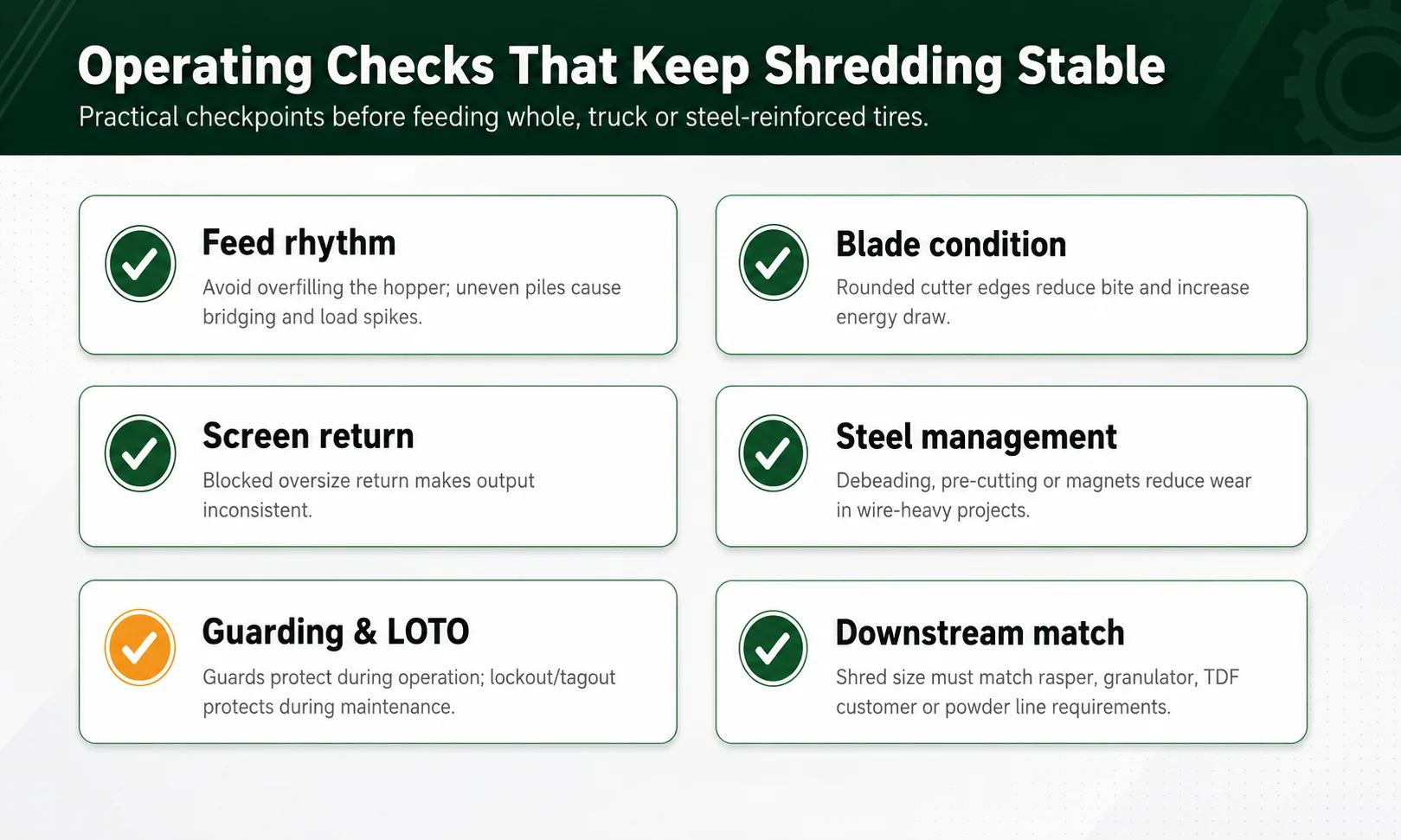
| Symptom | Likely cause | What to check first |
|---|---|---|
| Long strips appear in discharge | Screen opening too large, cutter wear or weak return loop | Disc screen, return conveyor, blade edge condition |
| Frequent shaft reversal | Overfeeding, tire too large, bead wire not removed or insufficient torque margin | Feeding rhythm, raw tire type, pre-treatment plan |
| Downstream granulator overloads | Shredder output is too large or irregular | Target output size, screen setting, secondary shredding requirement |
| Blade wear rises quickly | High steel content, bead ring concentration or abrasive contamination | Debeading, tire inspection, spare blade plan |
| Operator has to manually pick oversize | No return system or return conveyor not matched to screen | Disc screen layout and automatic return route |
How to Choose a Tire Shredder by Working Principle, Not Just Motor Power
Motor power is visible in a quotation, so buyers naturally compare it first. But two machines with similar motor power can perform very differently if the shaft diameter, reducer, blade geometry, hopper design, screen system and return conveyor are different. A better selection process starts with six questions:| Question | Why it changes the machine |
|---|---|
| What tires will you feed? | Passenger, truck, bus, agricultural and OTR tires require different torque and feeding arrangements. |
| What is the maximum tire diameter? | The feed opening and pre-cutting plan depend on the largest tire, not the average tire. |
| Will bead wire be removed? | Bead removal can reduce concentrated steel load and improve downstream separation. |
| What final product do you sell? | TDF, mulch, crumb rubber and powder all require different output control. |
| What hourly capacity is needed? | Capacity must match conveyor, screen, return and downstream machines, not only shredder body. |
| How many hours per day will it run? | Continuous production needs stronger maintenance access, spare blades and service planning. |
FAQ: Tire Shredder Working Principle
How does the tire shredder machine work?
It pulls the tires in two shafts, cuts them with an alloy cutting disc, shields,discharges,and returns the oversized fragments for re-shredding until the output can be used for the next step.
Why is the tire shredder usually a low-speed machine?
Low speed and high torque give the cutter time to grasp the elastic rubber and steel-reinforced tire structure. It also reduces uncontrolled impact compared with high-speed crushing.
Can one tire shredder make crumb rubber directly?
Normally no. A tire shredder makes rough shreds or chips. Crumb rubber requires additional stages such as rasping, magnetic separation, granulation, screening and fiber separation.
What controls tire shredder output size?
Output size is influenced by cutter width, blade geometry, shaft speed, screen opening, return conveyor design and material type. The screen and return loop are especially important for reducing oversize.
Is debeading required before shredding?
It depends on tire type and project goal. Passenger tire items can be benefit from removing beads or pre-cutting to reduce blade wear and improve feeding stability.
What information should I provide before choosing a tire shredder?
Provide tire type, maximum tire diameter, steel wire content, whether bead wire is removed, target output size, hourly capacity, downstream process and available workshop space.
Get a Project Quote
Need a Tire Shredder Layout for Your Output Size? Share your tire type, maximum tire diameter, capacity target and final product. YUXI can help match the shredder, disc screen, return conveyor, magnetic separator and downstream equipment around the real working load. Request Configuration