A 1 TPH, 2 TPH and 3 TPH crumb rubber plant can use the same basic process and still behave very differently as a business. The mistake is treating the number on the quotation as if it were a simple speed setting. It is not. Capacity has to survive the complete route from incoming tire material to a saleable crumb fraction.
YUXI’s tire rubber crumb plant is published as a configurable 0.5–10 t/h solution. The same page also makes an important qualification: final output changes with tire mix and granule size. That qualification matters more than the headline range. A plant producing a broad 1–8 mm stream does not automatically deliver the same accepted tonnage when the buyer switches to a tighter 1–3 mm fraction.
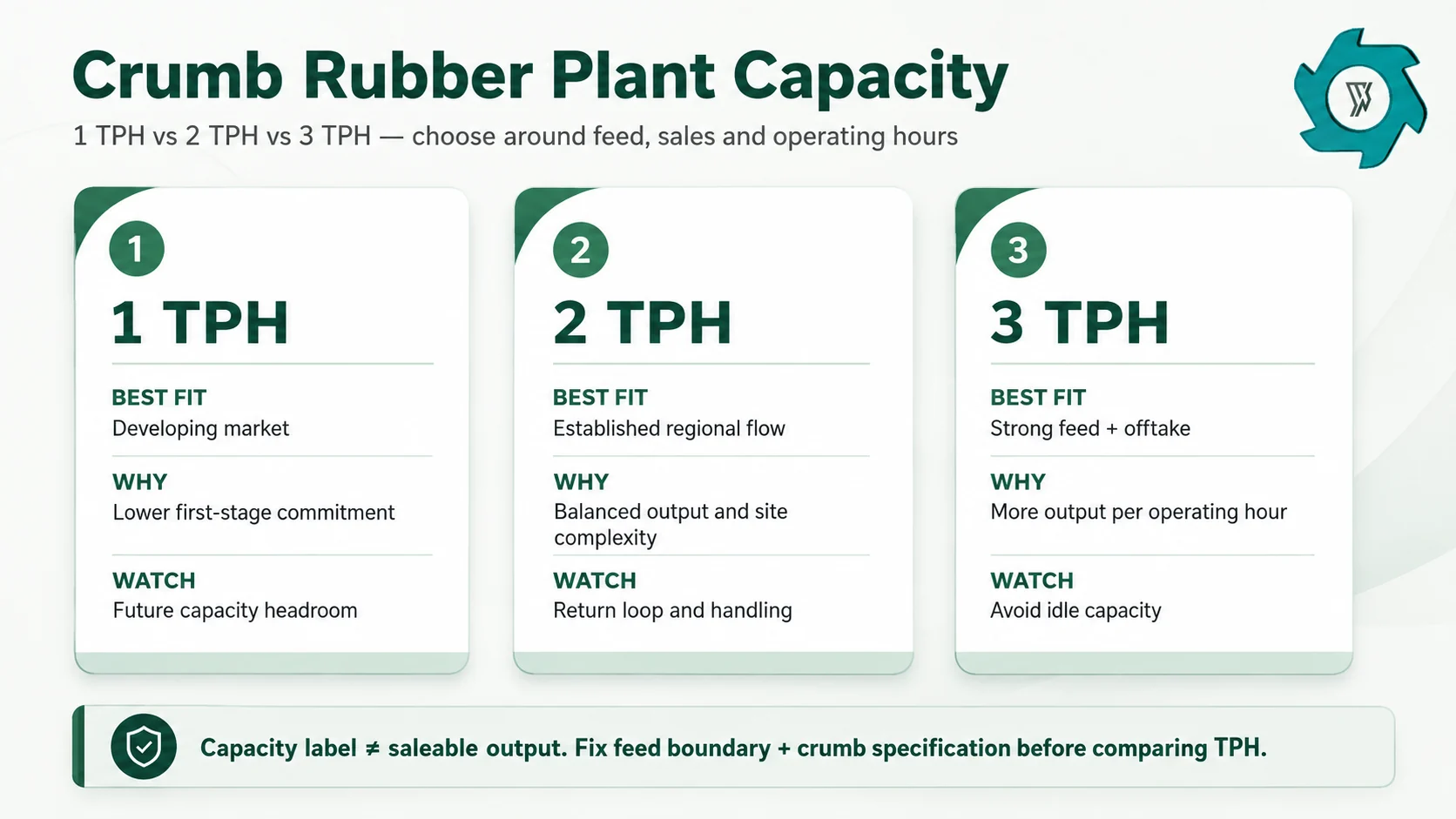
The Practical Difference Between 1, 2 and 3 TPH
For a first comparison, keep the product and feed boundary fixed. Assume all three lines receive the same approved tire mix and are expected to produce the same crumb specification. Only then does “1 vs 2 vs 3 TPH” become useful.
Capacity target
Usually fits best when
Main planning advantage
Main risk if selected too early
1 TPH
Feed supply and crumb sales are developing; one-shift operation is plausible; the project wants a lower first-stage commitment.
Easier to match to a smaller regional tire flow and to learn the real product market before scaling.
A successful sales program can fill the line quickly, leaving little room for maintenance or demand peaks.
2 TPH
There is a steadier tire supply, confirmed product demand and enough utilities/storage for continuous industrial operation.
Provides more output without immediately moving into the handling and site complexity of a larger plant.
Buyers sometimes budget for the core machines but underestimate the larger conveyors, return loop, dust system and finished-product handling.
3 TPH
Feed contracts and offtake can support sustained tonnage; the site can handle higher material movement and maintenance demand.
More production per operating hour, which can reduce the need to chase capacity through longer shifts.
A weak feed pipeline or uncertain crumb market can leave expensive capacity idle. Bottlenecks also become more visible downstream.
Capacity should be chosen around feed security, saleable product demand and operating hours—not around the biggest number a site can physically install.
This is a project-fit comparison, not a claim that every 1 TPH line is small or every 3 TPH line is complex. Supplier architecture varies. ECO Green, for example, publishes a granulator capacity of up to 4 metric TPH for its ECO Granulator, while ELDAN describes a UAE turnkey tire plant with capacity up to 4 tonnes per production hour and the ability to change output size.12 Those public examples are useful because they show that the market already contains several capacity architectures. They are not a reason to compare nameplates without normalizing the test condition.
First Decide What the TPH Number Is Measuring
This is the point that causes the most confusion in quotations. “2 TPH” may describe fresh whole-tire feed, prepared 10–20 mm chip feed into a downstream module, material passing through one granulator, or accepted finished crumb. Those are four different measurements.
A safer capacity definition:
Accepted crumb TPH = mass of finished rubber that passes the agreed size and cleanliness checks ÷ net stable production time.
The YUXI pillar describes an oversize return loop after granulation and grading. This is good process control, but the return stream occupies machine and conveyor capacity. A tighter screen generally sends more material back. Research on waste-tire grinding also shows why the product target matters: finer size reduction requires more grinding work, and published reviews report higher specific energy demand as the target particle size becomes smaller.3
When a 1 TPH Crumb Rubber Plant Makes Sense
A 1 TPH line is easy to dismiss as “small.” That can be a poor conclusion. If a recycler is still building its collection network or qualifying its first crumb buyers, one tonne per hour can be a deliberate way to keep the factory busy without creating a permanent shortage of feedstock.
The commercial question is utilization. A line that is available for one full shift but receives only three hours of feed is not a 1 TPH business in any meaningful annual sense. CM Shredders’ scrap-tire business planning guidance makes a similar operational point: new operators should not assume 100% capacity utilization during the early months of production.4
1 TPH is usually easier to justify when:
the plant is entering a new crumb market and wants real buyer feedback before a larger expansion;
tire supply is regional rather than secured through several large collection contracts;
one shift can meet the initial sales plan without excessive overtime;
the site has limited electrical or material-storage headroom;
management wants to prove size distribution, steel control and fiber removal before committing to more downstream capacity.
There is one catch. Small lines do not remove the need for screening, separation or dust control. A 1 TPH crumb plant still needs to produce the specification. Cutting those stages to make the first project cheaper can leave the business with a lower-priced plant and a product no customer accepts.
Why 2 TPH Is Often the Most Balanced Comparison Point
At 2 TPH, the project normally starts to feel less like a trial line and more like a production system. Feed metering, intermediate storage and product handling deserve more attention because short interruptions now move more tonnes off the daily plan.
This capacity can suit a recycler that has already confirmed a recurring market for crumb but does not yet need a high-volume multi-shift operation. It also gives the project team room to compare two strategies: run a moderate shift schedule with reserve time for maintenance, or extend operating hours when seasonal demand increases.
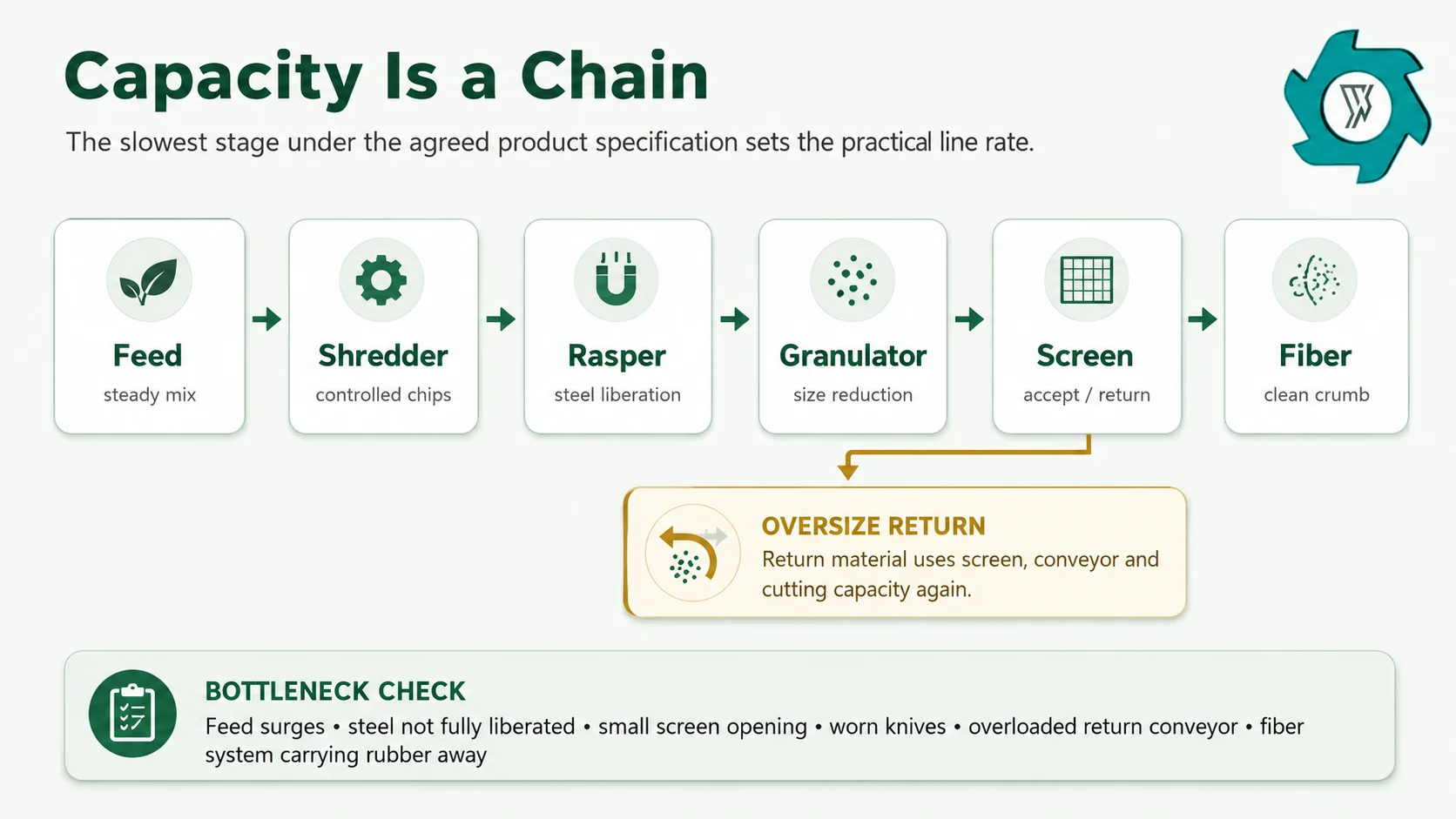
The hidden cost is not necessarily the granulator. It can be the interfaces. An undersized screen may increase recirculation. A small fiber separator may force the upstream feed to slow down. A finished-product conveyor that was acceptable at 1 TPH may create surge problems at 2 TPH. Capacity is a chain.
The line rate is limited by the slowest stage under the agreed feed and crumb specification. Screening and return capacity deserve the same attention as the main cutter.
A 3 TPH Plant Is More Than a Bigger Granulator
Three tonnes per hour can be attractive because it creates more saleable product inside the same operating window. But the project has to move three tonnes of approved feed every hour, remove the steel and textile fractions, circulate oversize material, and clear the finished rubber without starving or flooding another stage.
That changes site planning. Raw-tire receiving, chip buffers, magnets, return conveyors, dust extraction, product bins and forklift movements all see more mass per hour. Maintenance also becomes more consequential: one hour of unscheduled downtime represents more lost output than it does on a 1 TPH line.
For this reason, a 3 TPH purchase should start with feed and sales evidence. USTMA reports that ground-rubber markets consumed about 28% of U.S. end-of-life tires in 2023, so the market is substantial, but national market size is not the same thing as a buyer contract in the plant’s freight radius.5 A local project still needs confirmed specifications, volume and price.
Whole Tires and Prepared Chips Can Both Be Called “2 TPH”
The same capacity number can hide very different equipment scopes. A complete line from whole tires includes front-end preparation, primary shredding, steel liberation and first magnetic recovery before the fine-crumb section. A downstream module can start from controlled wire-free chips and omit much of that front end.
If the project already produces 10–20 mm material, the 10–20 mm rubber mulch size-control guide is the right upstream checkpoint. Chip size, oversize percentage and return load affect how steadily the crumb module can be fed. The industrial rubber mulch process guide explains the earlier shredding, rasping and steel-recovery stages.
Quotation boundary
What 2 TPH should mean
What must be checked
Whole-tire line
Two tonnes per hour of the agreed incoming tire mix, with finished-product output stated separately.
Two tonnes per hour of crumb that passes the written acceptance specification.
Sieve distribution, metal/fiber limits, test duration, sampling method, excluded downtime and side streams.
Where Real Capacity Is Usually Lost
A plant rarely loses all of its output in one dramatic failure. More often, several small restrictions accumulate. The operator slows the shredder because the rasper is full. The rasper slows because wire is not clearing fast enough. The granulator slows because the screen return conveyor is full. Production continues, but the accepted hourly output drifts away from the number used in the business plan.
Feed consistency
A mixed tire stream changes load. Truck tires contain more reinforcement and heavier sections than ordinary passenger tires, while dirty or water-filled tires add handling problems without adding saleable rubber. Capacity tests should use a representative mix rather than the easiest batch available.
Steel liberation before fine cutting
Magnetic separation works best after the steel has actually been exposed. If rubber remains wrapped around wire, the separator can be functioning correctly while the product still carries metal. Pushing more tonnes through the rasper does not solve poor liberation.
Granulator screen and knife condition
Smaller screen openings keep material in the cutting zone longer. Worn or poorly set knives can make that retention worse. A capacity quotation should therefore state the screen and the knife condition used during testing.
External grading and oversize return
This is where broad output claims can become misleading. A granulator may discharge a large mass, but only part of it may fall into the customer’s accepted fraction on the first pass. The return conveyor and granulator must process the rest again.
Fiber separation and product loss
More air is not always better. Excessive aspiration can carry fine rubber into the textile stream, turning saleable product into a loss. Too little air leaves fiber in the crumb. The correct setting is a quality and yield decision, not only a cleanliness setting.
Why 0–5 mm Capacity Is Not the Same as 1–3 mm Capacity
A buyer asking for 0–5 mm gives the plant a relatively broad acceptance window. A buyer asking for a narrow 1–3 mm fraction may reject both oversize and fines. The granulator still does the cutting, but the grading system now decides how much of each pass becomes saleable product.
If the product strategy is not settled, review the existing rubber mulch vs crumb rubber comparison before selecting capacity. Coarse products and fine graded products may share upstream equipment, but they do not create the same bottleneck or operating cost.
Published research on recycled tire grinding consistently treats particle size as a process variable rather than a cosmetic label. A review by Formela and co-authors reports higher specific energy requirements for finer ground tire rubber, including a cited increase when moving from below 5 mm toward below 0.8 mm.3 The exact power draw of a commercial YUXI line must come from the final configuration, but the engineering direction is clear: finer product should not be assumed to preserve the same throughput.
Convert TPH Into a Realistic Annual Production Plan
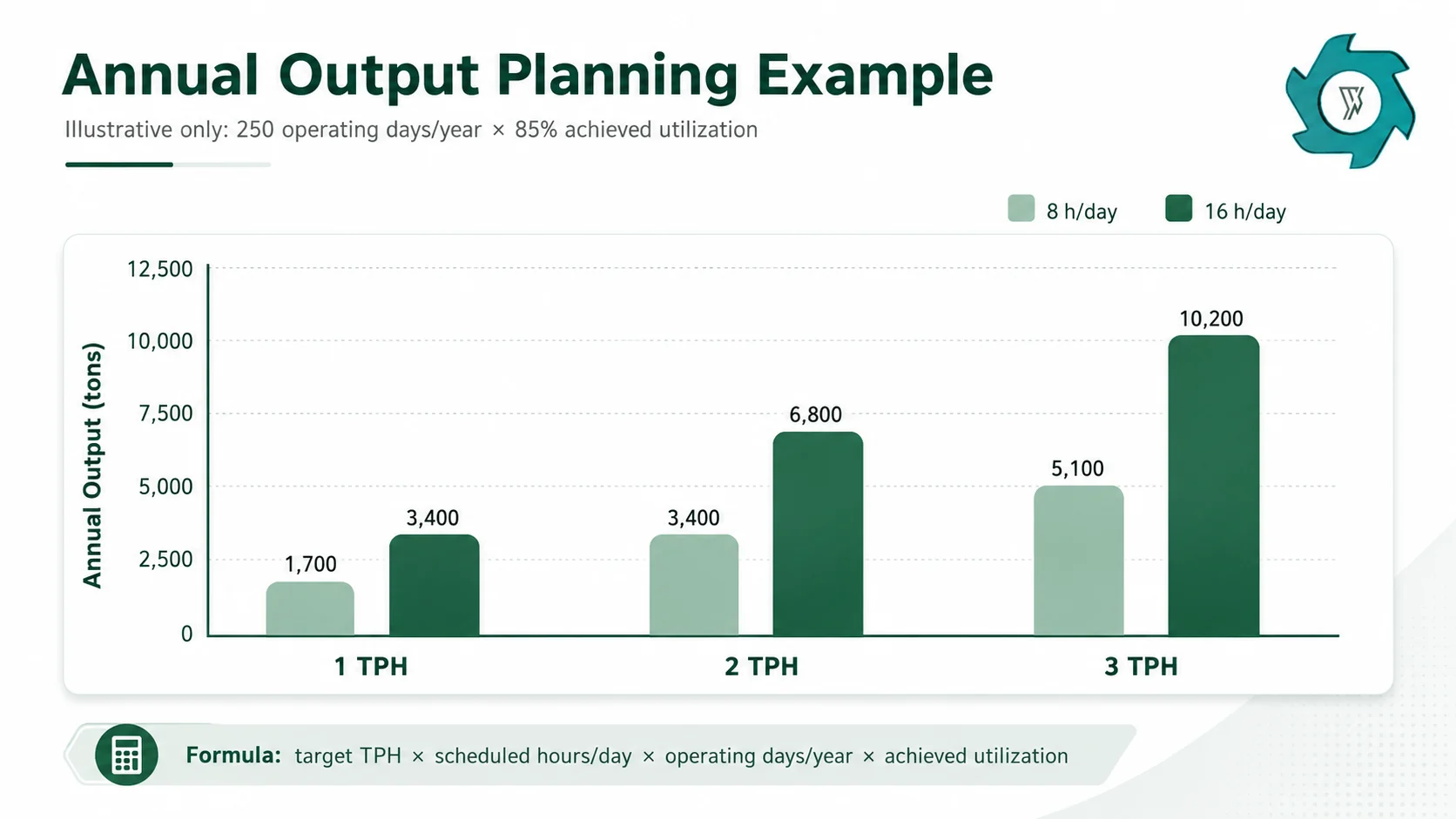
Hourly capacity is only one input. Annual production also depends on shifts, scheduled maintenance, knife changes, cleaning, feed interruptions and product changeovers. A simple planning model is more useful than multiplying TPH by every hour in the year.
It assumes 250 operating days per year and 85% achieved utilization after planned and unplanned losses.
Capacity
8 h/day scenario
16 h/day scenario
What the example shows
1 TPH
1,700 t/year
3,400 t/year
Longer operating time can defer a capacity upgrade if feed, labor and maintenance support the extra shift.
2 TPH
3,400 t/year
6,800 t/year
A mid-scale line can cover a wide annual range depending on shift strategy.
3 TPH
5,100 t/year
10,200 t/year
High hourly output only pays when raw material and product sales can sustain the hours.
Illustrative annual output based on verified accepted-crumb capacity, 250 operating days and 85% achieved utilization. Replace these assumptions with the site’s actual operating data.
Does a 3 TPH Plant Cost Three Times a 1 TPH Plant?
Usually not in a neat straight line. Capacity can require larger machines, wider conveyors, more screening area, stronger dust extraction and more storage. At the same time, some project engineering, controls, panels and site services do not triple simply because throughput triples.
The more important point is that capacity and product grade interact. A 2 TPH line designed for a broad crumb range may be less demanding than another 2 TPH line that must produce several separated fractions with tighter metal and fiber limits. Comparing price per TPH without the product specification can therefore reward the quote with the least scope rather than the best value.
Choose 1, 2 or 3 TPH From Five Numbers
Secured feed tonnes per month. Use contracted or historically reliable supply, not every tire that exists in the region.
Confirmed crumb sales tonnes per month. Separate signed/recurring demand from a general statement that “rubber has many applications.”
Required finished fraction. Write the sieve limits and cleanliness requirements that define saleable output.
Available operating hours. Decide whether the site truly intends one shift, two shifts or a seasonal schedule.
Expansion headroom. Record spare electrical capacity, floor space, dust-system capacity and product storage before calling a future upgrade “easy.”
Lean toward 1 TPH
When feed and sales are still being proven, the site prefers one shift, and the first objective is to establish repeatable product quality.
Lean toward 2 TPH
When there is a stable regional feed base, regular buyers and enough site infrastructure to keep a continuous line supplied and cleared.
Lean toward 3 TPH
When the business already has strong feed/offtake coverage and the project values more output per operating hour enough to support the larger handling system.
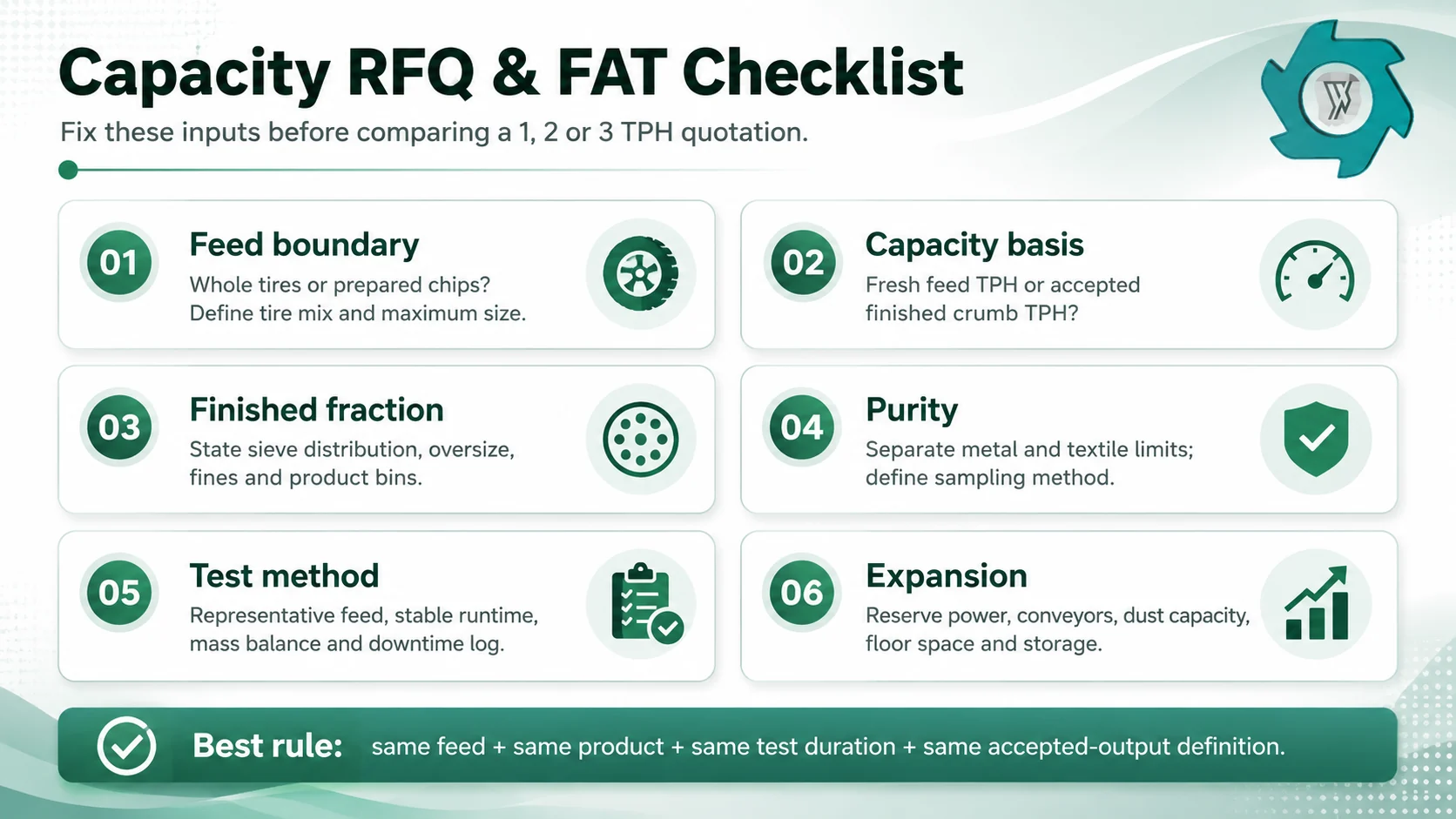
Capacity Should Be Proven With a Written FAT, Not a Short Video
A useful factory acceptance test starts with material everyone has agreed to. The tire mix or prepared-chip sample should be representative of the future plant, not a clean, unusually easy batch. The line should then run long enough to reach a steady state so that return material, screens and separation systems are carrying their normal load.
During the run, weigh the fresh feed and each output stream separately. Keep accepted crumb apart from oversize return. Record recovered steel, textile, contamination and rejected material. At the same time, note motor loads, alarms and any stop that changes net runtime.
FAT item
Why it matters for 1/2/3 TPH comparison
Representative feed definition
Prevents one supplier from testing easy passenger tires while another quote is based on mixed truck/passenger duty.
Exact finished-size specification
Stops broad 0–8 mm discharge from being compared with a narrow saleable fraction.
Net stable test duration
Reduces the influence of a short peak and exposes return-loop accumulation.
Mass balance
Shows where the incoming tonnes went: crumb, steel, fiber, oversize, fines and rejects.
Purity / contamination test
Confirms that higher feed rate did not simply push more wire or textile into the product.
Motor load and downtime log
Shows whether the line sustained the target or repeatedly stopped at one bottleneck.
A comparable RFQ fixes feed, finished fraction and test method before asking suppliers to state capacity.
What to Send YUXI Before Asking for a 1, 2 or 3 TPH Layout
A good RFQ is short but specific. Send the tire categories and maximum dimensions, representative photos, whether the line starts from whole tires or prepared chips, the target crumb fractions, accepted metal and fiber limits, expected operating hours, local voltage/frequency, workshop dimensions and destination country.
Most importantly, state whether “2 TPH” means incoming feed or accepted finished crumb. If the requirement is accepted crumb, include the sieve distribution and sampling method. That one sentence can prevent a large amount of re-quoting later.
Compare 1, 2 and 3 TPH Configurations for Your Feed
Send your tire mix, starting material, target crumb size, required finished output, operating hours and workshop dimensions. YUXI can compare the equipment boundary and layout before you lock the capacity.
Crumb Rubber Plant Capacity FAQ
Is a 2 TPH crumb rubber plant simply twice the size of a 1 TPH plant?
No. The target rate is higher, but the equipment and project scope do not scale in a perfectly linear way. Conveying, screening, dust collection, controls, storage and service access may need larger or additional capacity, while some engineering and control functions remain shared. The comparison only makes sense when feed condition and finished crumb specification are the same.
How many waste tires per hour does a 1 TPH plant process?
Do not convert 1 TPH into a fixed tire count unless the tire mix and average tire mass are known. Passenger, truck and mixed commercial tires have very different weights and reinforcement. For equipment selection, tonnes of representative feed per hour is a safer basis than a universal tires-per-hour number.
Which capacity is best for a new crumb rubber business?
A 1 TPH project can be sensible when feed supply and product sales are still developing. A 2 TPH line is often easier to justify when the recycler has a steadier regional tire supply and confirmed buyers. A 3 TPH project should normally be supported by stronger feed contracts, product offtake, utilities, storage and maintenance planning. These are planning directions, not universal rules.
Why can finished crumb output be lower than the quoted feed capacity?
Some incoming mass leaves as steel and textile, while oversize rubber may circulate through the granulator and screen more than once. Smaller or tighter product grades can increase cutting work and return load. Knife condition, tire mix, moisture, contamination and fiber-separation settings also affect the amount of accepted crumb produced per net operating hour.
Can a 1 TPH plant be expanded to 2 or 3 TPH later?
Sometimes, but only if expansion is considered in the first layout. The workshop should reserve conveyor interfaces, electrical capacity, dust-control capacity, floor space, product storage and control connections. A future upgrade may still require a larger bottleneck machine or a parallel stage, so expansion should be engineered rather than assumed.
What should be included in a capacity guarantee or FAT?
State the starting material, tire mix, target crumb fraction, metal and fiber limits, net test duration and how oversize return is counted. Record fresh feed mass, accepted crumb, recovered steel, separated fiber, rejects, motor loads and downtime. Capacity should be accepted against saleable finished product at the agreed specification, not against a short peak feed rate.
U.S. Tire Manufacturers Association (USTMA). 2023 End-of-Life Tire Management Report and market summary: ground rubber consumed about 28% of U.S. end-of-life tires in 2023.
Marie has 8+ years of experience in tire shredding and recycling equipment,with a focus on tire shredders,rubber recycling machines,TDF production,rubber crumb processing,and complete tire recycling systems.