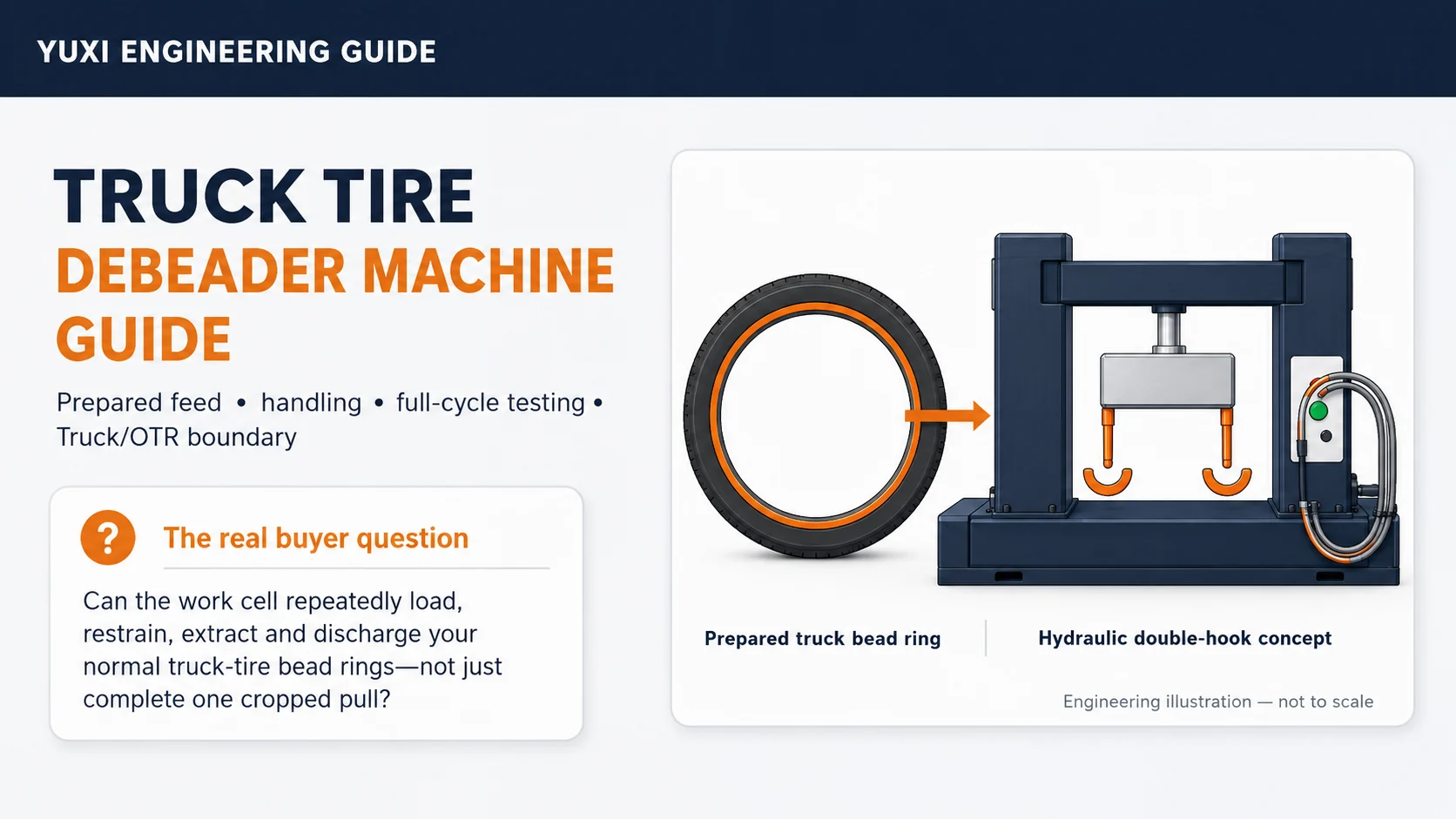
A truck tire is not merely a larger passenger tire. The useful question is whether a defined prepared ring can be loaded, restrained, extracted and discharged repeatedly inside a workable recycling cell.
The application is proved by the complete truck-ring cycle, not by one close-up pulling shot.
Watch a short debeader demonstration which looks almost effortless: a hook enters the bead, the cylinder moves, and a steel bundle appears.According to our experience, this is the most useless part of the judgment in the video.Truck tire projects usually succeed or fail in the work that takes place before and after pulling-how the tire is prepared,how the heavy ring reaches the hook,whether it maintains control,what happens when the wire is released,and whether the next ring can be loaded without clearing the tangled output area.
Quick answer: A truck tire debeader machine should be evaluated against a defined prepared feed, not the label “truck tire.” Record the tire markings, ring dimensions, sidewall-removal state, deformation, operator count, handling aid, complete cycle boundary and downstream destination. Use representative rings in a continuous test. Keep ordinary truck and bus applications separate from OTR or mining tires unless the latter are explicitly engineered and tested.
A buyer may use the same phrase for a regional delivery-truck tire, a heavy highway tire, a bus tire, a wide-base single, a construction-service tire or a large off-road casing. Those categories do not automatically share the same diameter, width, bead package, sidewall stiffness, damage history or handling weight.
The tire sidewall marking is a better starting point than a sales category, but even that is not enough. Worn casings can be flattened, folded, contaminated, cut at different heights or damaged around the bead. The prepared ring may no longer match the original whole-tire geometry.
Project label
Useful clarification
Why it matters to debeading
Commercial truck
Tire markings, radial/bias construction, normal and maximum ring dimensions.
Defines the ordinary production family rather than relying on a broad market name.
Bus or coach
Percentage of the feed mix and whether preparation is identical to truck tires.
A mixed stream can create different handling and engagement times.
Wide-base / super-single
Actual ring width, deformation and access to both bead areas.
A wider or more flexible workpiece may change positioning and restraint.
Construction service
Exact size, bead condition and whether it is an occasional exception or daily feed.
The hardest normal workpiece may not be the largest by diameter.
OTR or mining
Separate tire list, dimensions, weight, preparation and handling study.
Do not extend ordinary truck-tire evidence to a different equipment class.
Practical rule: quote the production mix, not the easiest sample. List the common ring, the largest normal ring and the most difficult normal ring separately.
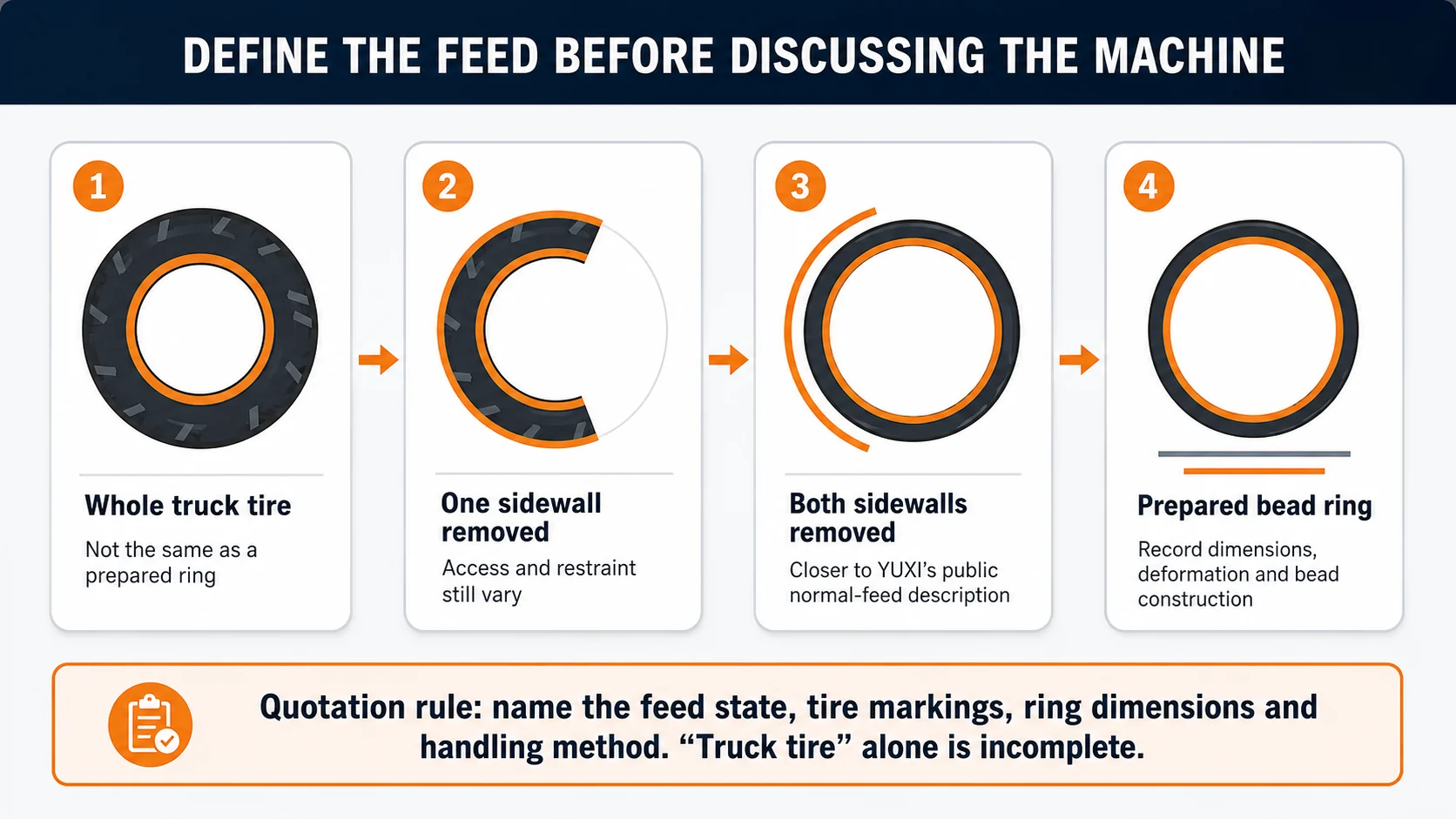
2. Whole Tire, Cut Sidewall or Prepared Bead Ring?
Machine names are inconsistent across the market. A “bead remover” may be a sidewall cutter, a hook-type extractor, a roller separator or a custom OTR system. The incoming material must therefore be stated visually and dimensionally.
YUXI’s public tire wire drawing machine page describes prepared radial tire bead rings, especially rings with both sidewalls removed, as the normal feed condition. It presents passenger-car, bus and truck applications as possible depending on tire size and configuration. That is a much narrower—and more useful—claim than saying every whole truck tire can be loaded directly.
State exactly what arrives at the machine. A whole casing, one-sidewall ring and two-sidewall-removed ring are not interchangeable test inputs.
If the project still needs to create the bead-sidewall section, keep the cutting and extracting functions separate. The Tire Bead Cutter vs Tire Debeader guide explains the output difference. In a real line, one machine may prepare the ring and the next machine may pull the concentrated bead-wire bundle.
Minimum feed-state record
photo of the whole tire before preparation;
photo of the actual ring presented to the hook;
minimum, typical and maximum outside dimensions;
ring width or remaining sidewall width;
whether one or both sidewalls are removed;
radial or other construction when known;
deformation, cuts, embedded debris and storage condition;
how the ring is lifted, turned and placed.
3. Why Truck-Tire Bead Rings Behave Differently
The bead is not loose wire waiting to be picked out. The U.S. Tire Manufacturers Association describes beads as wire bundles that anchor the tire to the wheel, and notes that steel wire is used in tire beads and in plies for truck tires.1 Its manufacturing overview explains that coated steel strands are formed into hoops and embedded in the sidewall structure.2
For the operator, that construction appears as four practical variables:
Ring mass and inertia
A ring that is easy to carry in a sales video may be awkward when wet, deformed or stacked. Loading time and operator exposure increase before the cylinder moves.
Bead access
The hook needs a repeatable approach path. Remaining rubber, an uneven cut or a collapsed ring can turn a nominally suitable tire into a slow setup.
Restraint and deformation
The ring must stay controlled while force travels through the hook, bead bundle, rubber, restraint and frame. A flexible or damaged ring may shift before the wire releases.
Release behavior
The extracted bundle can change shape as it leaves the rubber. The wire and rubber-rich ring need separate, unobstructed discharge areas.
This is why maximum diameter alone is a poor acceptance criterion. Sometimes a slightly smaller but heavily reinforced or badly prepared ring creates the more demanding cycle.
4. Where the YUXI Truck-Tire Configuration Fits
YUXI publicly presents the current machine as a hydraulic double-hook tire debeader using high-strength hooks. The product page describes manual loading with automatic hydraulic pulling and positions the equipment before cutting, shredding, rubber crushing, powder production or some pyrolysis pretreatment routes.
That public information supports a clear application statement: the shown concept is intended to extract concentrated bead wire from prepared tire rings, including truck rings when their size and construction match the quoted configuration. It does not justify publishing a universal truck-tire diameter, pulling force, stroke, motor power, cycle time or capacity. Those fields must be confirmed for the actual project.
What is verified publicly: hydraulic pulling, double-hook positioning, high-strength hook concept, prepared-ring feed, manual loading, automatic hydraulic pull, passenger/bus/truck potential by configuration and front-end line integration. What remains project-specific: exact tire range, hook sequence, cylinder data, usable stroke, capacity, guarding, electrical supply, dimensions and OTR suitability.
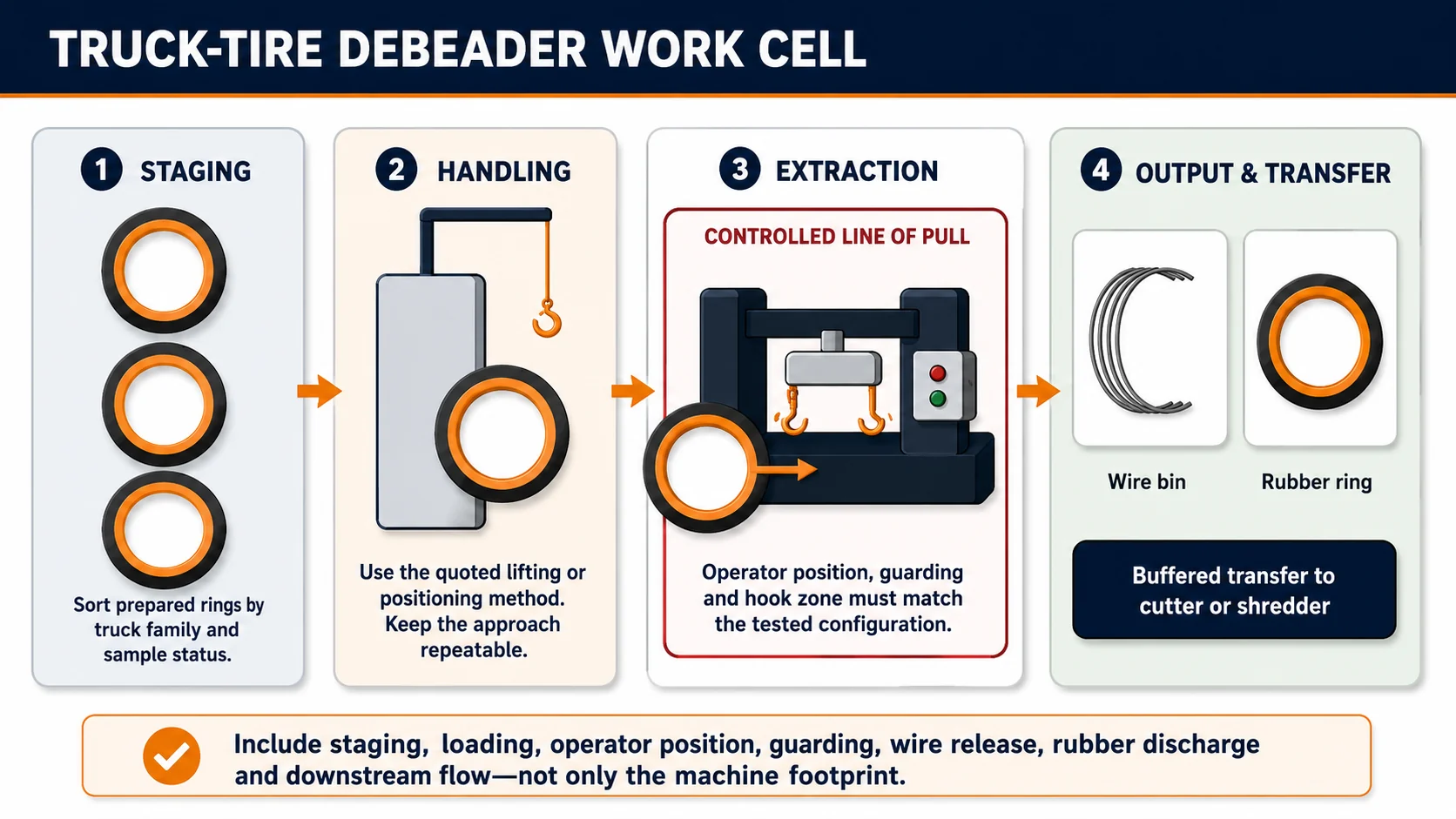
5. Design the Work Cell Around the Heaviest Normal Ring
Manual loading is often interpreted as “no material-handling system required.” That is risky. The machine may not need an automatic infeed conveyor, but the project still needs a controlled way to move the ring from storage to the engagement position and then separate two outputs.
A workable cell includes staging, loading, the line of pull, wire release, rubber discharge and downstream transfer.
In one export project, the machine footprint looked acceptable on the drawing, yet the proposed wire bin sat in the same aisle used to bring in the next ring. The cylinder cycle was not the bottleneck; clearing the output was. This is a common layout error because catalog drawings usually stop at the frame edge.
Layout fields to show on one drawing
incoming ring staging by tire family;
maximum ring envelope during carrying and turning;
loading aid, forklift or trolley route if used;
approved operator position and control location;
line of pull and release exclusion zone;
wire bundle collection and removal path;
rubber-rich ring discharge and buffer;
maintenance access to hooks, hydraulics and guards;
transfer to the next cutter, shredder or storage point;
clear emergency and pedestrian routes.
The broader machine and site comparison belongs in How to Choose a Tire Debeader Machine. Here, the layout question is narrower: can normal truck rings move through the cell without uncontrolled lifting, repeated turning or crossing the wire-release area?
6. Truck-Ring Engagement: Do Not Judge Hook Count Alone
A double-hook arrangement can be useful when both bead areas are accessible in one setup. It may reduce a turn, reload or second positioning step. That benefit is real only when the ring can be restrained and both hooks can engage without long manual correction.
The quotation should state whether the hooks act simultaneously, sequentially or through another control arrangement, and what happens when one side engages before the other. A video should show the full ring, not only the hydraulic cylinder. The detailed configuration comparison remains in Single Hook vs Double Hook Tire Debeader.
Truck-ring observation
What it may reveal
Evidence to request
Hook enters quickly on common rings but not the largest ring
Access path or usable geometry may be more limiting than nominal force.
Close view plus continuous full-cycle video on both samples.
Ring lifts or twists before wire release
Restraint, ring preparation or alignment needs review.
Unedited view showing ring contact points and operator position.
One side completes while the other needs correction
Control sequence or ring variability affects the expected double-hook benefit.
Repeat test across several normal rings, not one successful cycle.
Wire releases into the next loading path
Output handling is the bottleneck and may create exposure or downtime.
Full work-cell view through discharge and reset.
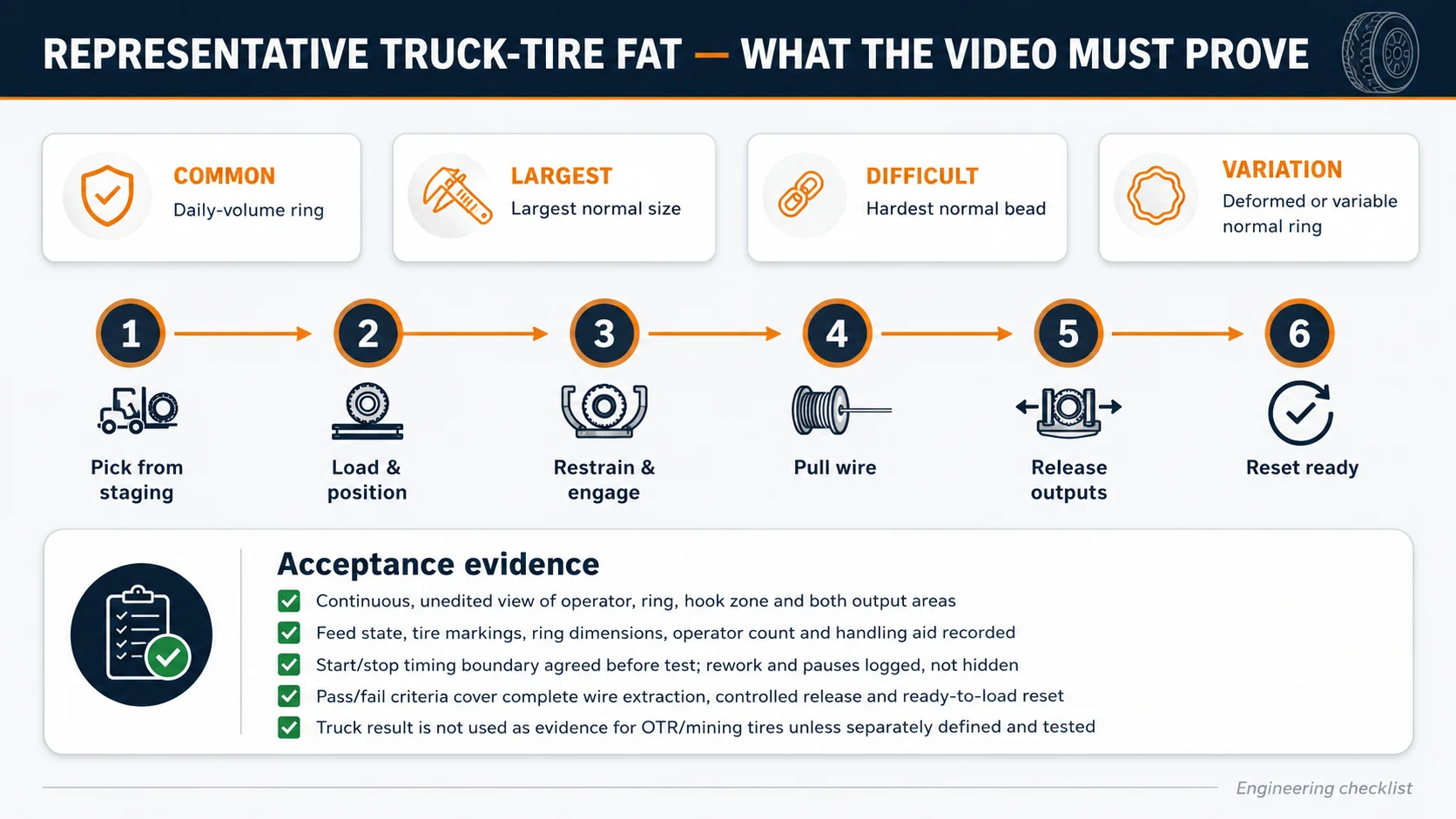
7. Build a Representative Truck-Tire Sample Plan
Sending only the largest tire is better than sending no sample, but it is still incomplete. The largest ring may have clean access and predictable construction, while a common mid-size ring is more deformed or has a less consistent cut. We normally recommend four sample groups:
Common
The ring that represents the largest share of daily production.
Largest normal
The maximum size expected routinely, not a rare future possibility.
Hardest normal
The known difficult bead construction or preparation condition within normal production.
Normal variation
A reasonably deformed or inconsistent ring that the plant cannot economically reject.
Keep prohibited or unsafe items outside the test. Embedded rims, inflated assemblies, unknown pressurized components, large foreign metal or other hazards need a separate receiving and rejection procedure. A factory acceptance test should challenge the recommendation, not introduce uncontrolled material.
Record each sample before testing
tire marking and source category;
whole-tire photo and prepared-ring photo;
outside diameter, inside opening, width and remaining rubber condition;
preparation machine or manual method;
visible deformation and damage;
sample count and reason for inclusion;
operator and handling aid used.
8. Measure the Full Truck-Ring Cycle
A pulling stroke is not production capacity. Start the clock when the operator begins taking an untreated prepared ring from the agreed staging point. Stop when the extracted wire and rubber-rich ring are in their designated output areas and the machine is ready for the next load.
Measured accepted throughput = accepted completed truck rings ÷ total continuous test time
Use accepted completed rings in the numerator. A ring that needs an off-camera second pull, manual cutting or a reset should not be counted as a clean first-pass result. Keep the raw timing for each cycle rather than publishing only the fastest one.
Cycle stage
Start/stop note
Truck-specific delay to record
Pickup and approach
From agreed staging position to machine loading zone.
Two-person lift, trolley movement, ring unfolding or queue interference.
Position and restrain
Until the workpiece is in the approved extraction state.
Turning, centering, collapsed ring, remaining rubber or unstable contact.
Hook engagement
Until the control is ready for the extraction movement.
Repeated approach, one-side correction or manual exposure near the hook zone.
Extraction
Hydraulic movement through completed wire release.
Pause, incomplete release, abnormal ring movement or second pull.
Discharge
Both outputs moved to their intended zones.
Tangled wire, spring-like release, blocked bin or rubber-ring handling.
Reset
Machine and cell ready to accept the next ring.
Hook clearing, housekeeping or operator travel.
For a mixed truck/bus stream, calculate a weighted shift estimate only after each family has its own measured cycle data. Do not apply the fastest truck-ring result across the entire feed.
9. Truck Tire Debeader vs OTR Tire Debeader
“Heavy duty” is not an application boundary. OTR and mining tires may require a different preparation method, lifting system, frame, hook geometry, stroke, pulling arrangement and site layout. The change is not determined by one universal diameter threshold; it is determined by the complete tire and work-cell requirement.
Ordinary truck/bus scope
Define prepared ring dimensions, construction, production mix, handling method and full-cycle evidence. This is the application range discussed in this guide.
OTR/mining scope
Treat as a separate project. Submit exact tires, whole-tire and prepared-feed weights, preparation route, lifting plan, expected output and a dedicated acceptance test.
YUXI’s public page says OTR applications may require customized extraction or cutting according to tire diameter and project conditions. Therefore, an ordinary truck-tire video is not evidence of OTR capability, and a supplier should not use the word “construction tire” to silently extend the contract to giant mining tires.
10. Match the Extracted Ring to the Next Machine
The EPA/USTMA scrap-tire handbook notes that heavy bead wire around the rim may be removed by debeading equipment before processing or by magnets later, and explains that reinforcing wire must be controlled for many ground-rubber applications.3 The important project decision is where concentrated bead wire should leave the process and what steel remains for later liberation.
A hook-type debeader removes the bead bundle. It does not automatically remove steel belts and cords from the remaining tire material. Downstream shredding and magnetic separation still have defined jobs.
Before tire cutting
Confirm that the wire-free or wire-reduced ring can be handled by the cutter and that the front-end cycle does not starve it.
Before primary shredding
Confirm the required input form and buffer. Review the proposed tire shredder machine with the actual prepared output, not an assumed whole tire.
Before granule or powder production
Define residual steel expectations, magnetic stages and the quality specification for the final rubber fraction.
Sometimes the correct choice is not to maximize the debeader’s isolated output. A smaller buffer and balanced line can be more productive than a fast front end that repeatedly blocks the downstream machine or fills the wire area.
11. Control the Point of Operation and Stored Energy
A truck-ring cell combines hydraulic stored energy, a moving hook, a deformable workpiece and a steel bundle that can change shape as it releases. Guarding and safe positioning must be reviewed around the actual work cell, not copied from a smaller sample video.
For U.S. workplaces, OSHA 29 CFR 1910.212 requires guarding against hazards such as the point of operation, ingoing nip points and rotating parts, and requires point-of-operation protection where an employee could be exposed to injury.4 OSHA 29 CFR 1910.147 covers servicing and maintenance where unexpected startup or stored-energy release could cause injury.5 OSHA has also specifically noted that residual hydraulic pressure must be controlled rather than relying on shutdown alone.6
These sources do not replace the supplied manual, local law, machine risk assessment or site energy-control procedure. They do establish a useful purchasing boundary: a stop button is not proof that the hook zone is safe for clearing, adjustment or service.
identify the line of pull and likely wire-release direction;
keep the operator outside the danger zone during the automatic movement;
prevent another person from entering from the output side;
provide controlled collection for spring-like wire bundles;
define safe-state requirements for clearing, inspection and maintenance;
verify emergency stops, guards and control logic in the contracted configuration.
12. Truck-Tire Factory Acceptance Test Checklist
The acceptance test should show representative truck rings and every stage from staging pickup through ready-to-load reset.
FAT field
Minimum definition
Pass evidence
Machine identity
Quoted configuration, hook arrangement, controls and guards.
Nameplate/configuration record and test video of the same machine.
Input identity
Tire marking, prepared state and ring dimensions for every sample group.
Pre-test photos and measurement sheet.
Sample count
Enough consecutive rings to reveal setup variation and output clearing.
Continuous run; no edited compilation of isolated successes.
Operator and handling
Number of people, lifting aid, staging position and output bins.
All people and aids visible throughout the cycle.
Timing boundary
Pickup, load, position, engage, pull, discharge and reset.
Raw cycle log with pauses, rework and rejects retained.
Accepted result
Defined wire extraction, controlled release and no prohibited manual rework.
Each output shown clearly before the next ring starts.
Abnormal events
Ring movement, missed engagement, second pull, fault or stop.
Event log and agreed disposition, not deletion from average.
Safety function
Contracted guards, stops and safe control sequence.
Documented functional checks by authorized personnel.
13. What to Send YUXI Before Requesting a Truck-Tire Quote
A useful inquiry is closer to a material data sheet than a one-line request for “one heavy-duty truck tire debeader.” Send:
Material
tire markings and categories;
minimum, typical and maximum prepared-ring dimensions;
photos before and after sidewall removal;
daily percentage by tire family;
normal deformation and contamination;
largest and hardest normal samples.
Production and site
target accepted rings per hour or shift;
productive minutes per shift;
operator and lifting plan;
downstream cutter, shredder or rubber line;
local voltage and frequency;
available footprint, access doors and aisle drawing;
required guarding, documents, spares and FAT scope.
Commercial cost factors, freight exclusions and quotation normalization belong in the Tire Debeader Machine Price & RFQ Guide. The present page defines the truck-tire evidence that should sit behind that quotation.
Get a Project Quote
Prepare a Truck-Tire Application Review Send representative tire data, prepared-ring photos, target output and your downstream process. YUXI can use that information to confirm the application boundary and propose the project-specific test scope. Contact YUXI with Truck-Tire Data
14. Common Truck-Tire Debeader Purchasing Mistakes
“The catalog says truck tire, so our entire fleet is covered.”
Truck is a category label, not a tire list. Put the approved samples and dimensions in the quotation and acceptance record.
“Maximum diameter proves the hardest tire.”
Preparation quality, bead construction, ring width, deformation and access can matter more than outside diameter alone.
“Hydraulic pressure proves pulling capability.”
Pressure without effective cylinder area, pulling side, stroke, hook geometry, restraint and completed tire evidence is incomplete.
“Two hooks mean twice the output.”
The second hook only creates value when it removes a real handling step. Alignment, sequence, discharge and reset can absorb the expected gain.
“A pulling video is a capacity test.”
A valid test includes pickup, loading, restraint, engagement, extraction, release, separate outputs and ready-to-load reset.
“Truck evidence also proves OTR capability.”
OTR and mining tires require a separately defined application, handling system and test. Do not rely on a generic heavy-duty label.
15. Final Fit Decision
A truck tire debeader is a reasonable fit when:
the plant can produce the agreed prepared bead rings;
the normal truck/bus range is documented;
representative rings complete a controlled full cycle;
handling and wire discharge are designed into the layout;
the front-end output matches the next process;
the quoted scope includes required safety, documents and FAT evidence.
Separate engineering is required when:
only whole truck tires are available and no preparation step is defined;
OTR or mining tires are included;
ring dimensions and tire mix are unknown;
the heaviest ring cannot be handled safely;
the output area crosses an operator or forklift path;
the buyer wants a universal capacity without representative tests.
The strongest buying decision is not “choose a truck model.” It is “approve a machine, feed condition, work cell and test method for this truck-tire stream.” That is the role of this guide inside the YUXI tire wire drawing machine Cluster.
FAQ
Can the YUXI tire debeader process whole truck tires?
YUXI’s public product information describes prepared tire bead rings, especially rings with both sidewalls removed, as the normal feed condition. A whole truck tire should not be assumed acceptable unless the quoted configuration and test explicitly say so.
Is a double-hook tire debeader automatically twice as productive?
No. A second hook can reduce turning or reloading only when both bead areas are accessible and the control sequence, restraint, release and output handling work as intended. Full-cycle testing is required.
Can one truck tire debeader also process OTR and mining tires?
Do not assume it. Truck, construction and OTR tires can differ substantially in dimensions, bead construction, ring weight and handling requirements. OTR capability requires a separately defined scope and representative test.
How should truck tire debeader capacity be measured?
Measure accepted completed rings over a continuous test using a defined full cycle: pickup from staging, loading, positioning, restraint, hook engagement, extraction, output release, unloading and reset. Record rework and pauses.
Does debeading remove all steel from a truck tire?
No. It removes the concentrated bead-wire bundle from the prepared ring. Steel belts or cords may remain in the rubber-rich material and require downstream liberation and magnetic separation.
What truck tire data should be sent to YUXI?
Send tire markings, representative photos and video, minimum and maximum ring dimensions, prepared feed state, tire-mix percentages, expected shift output, operator and handling plan, downstream machines, local power and workshop layout.
Is hydraulic pressure enough to prove truck-tire capability?
No. Pressure is only one input. Cylinder area, pulling direction, stroke, hook geometry, restraint, frame load path and representative tire results all matter.
Where does a truck tire debeader fit in the recycling line?
It is generally a front-end pretreatment step after the required sidewall or bead-ring preparation and before cutting, shredding, rubber granulation, powder production or some pyrolysis pretreatment routes.
References and Source Notes
U.S. Tire Manufacturers Association, “Tires 101,” tire components, bead wire and steel use in truck-tire plies. Source
U.S. Tire Manufacturers Association, “How a Tire Is Made,” coated steel strands formed into bead hoops and embedded in the sidewall. Source
U.S. EPA and USTMA, “Scrap Tires: Handbook on Recycling Applications and Management for the U.S. and Mexico,” bead-wire removal and ground-rubber processing. Source
U.S. OSHA, 29 CFR 1910.212, General Requirements for All Machines. Source
U.S. OSHA, 29 CFR 1910.147, The Control of Hazardous Energy. Source
U.S. OSHA interpretation on residual hydraulic pressure and energy control. Source
Marie has 8+ years of experience in tire shredding and recycling equipment,with a focus on tire shredders,rubber recycling machines,TDF production,rubber crumb processing,and complete tire recycling systems.