




A tire shredder may be rated at 5 t/h, receive fresh tires at 5 t/h, and still produce less than 5 t/h of accepted output. That does not necessarily mean any of the figures is wrong. They may simply refer to different points in the process. The 5 t/h rating could be the machine’s nominal capacity, the feed figure may describe only fresh material entering the line, and the accepted-output figure may count only material that has passed through the screen and return loop and meets the agreed product specification.
For a buyer, the useful capacity number is therefore not the largest number on a quotation. It is the number tied to a defined material, output rule, process boundary and time basis. A tire shredder machine that includes screening and oversize return makes this distinction especially important because the same rubber can pass through the cutting chamber more than once before it becomes accepted output.
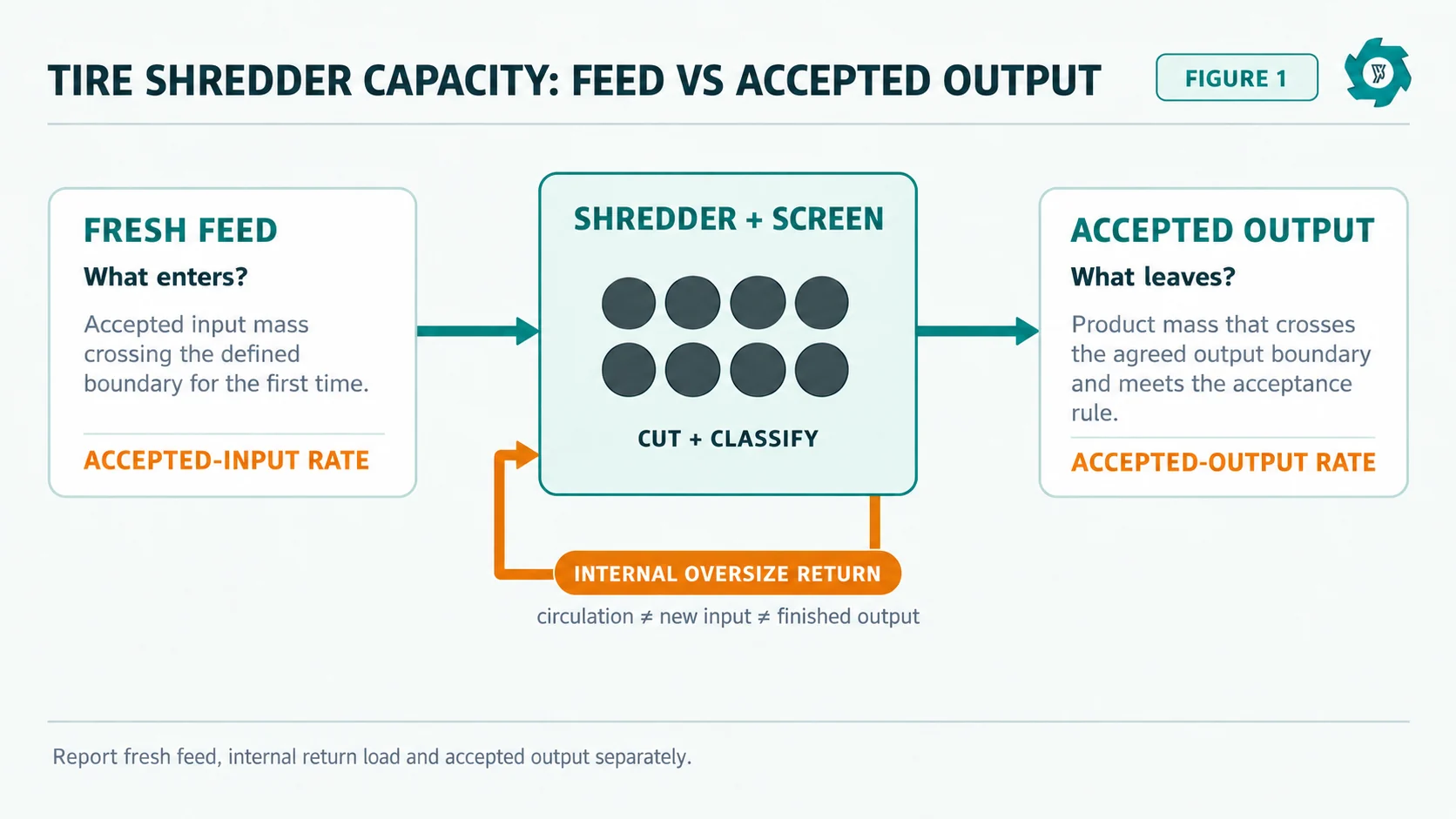
Start with four different quantities, not one word called capacity
In project discussions, “capacity” is often used for several different numbers. Separate them before comparing suppliers or production shifts.
| Quantity | Practical definition | What it tells the buyer | Common mistake |
|---|---|---|---|
| Fresh feed rate | Mass of new tire material entering the defined shredder boundary divided by the agreed time basis. | How quickly the front end is supplying the system. | Adding return-conveyor tonnage to fresh feed. |
| Gross cutting load | The cutting duty created by fresh material plus recirculated oversize passing through the chamber again. | Why the cutters, drive and return loop may be working harder than the fresh-feed number suggests. | Calling repeated internal passes “extra production.” |
| Gross discharge | Material leaving one machine or transfer before the final acceptance rule is applied. | Local conveyor or machine loading. | Assuming everything discharged is saleable or downstream-ready. |
| Accepted output rate | Mass that crosses the agreed output boundary and meets the agreed product rule, divided by the agreed time basis. | What the system actually delivers at the defined quality boundary. | Using a different clock from the feed-rate calculation. |
A useful quotation should state which of these it is reporting. If a supplier writes only “capacity: 5 t/h,” ask where the mass is weighed, whether the number is fresh input or accepted output, what tire mix was used, what output size was required, and whether the rate is based on running time or total elapsed time.
Fresh feed rate measures new material entering the boundary
Fresh feed means material that has not already circulated inside the measured shredder system. If whole tires, pre-cut tire sections or debeaded tires cross the feed scale or another agreed measurement point, that is the fresh input for the test window. Material coming back from an oversize screen is not fresh feed because it has already crossed the input boundary once.
A loader may place 12.5 metric tonnes near the conveyor, while only 12.0 tonnes actually enter the measured system during the test window. Tires rejected before the boundary, tires left on the infeed, and material waiting for the next measured lot should not be silently included in the numerator.
Weighing practice also deserves more attention than it usually gets. NIST Handbook 44 covers technical requirements for weighing and measuring devices and is intended to support accurate, repeatable measurement.[3] A project test does not have to use one particular scale type, but the method should be documented: truck scale, platform scale, belt scale, load cells or weighed containers; resolution; tare method; calibration or verification status; and how material is assigned to the measured window.
Accepted output rate measures what actually crosses the product boundary
Accepted output is different from “what came out of the cutters.” In a screen-return configuration, the cutter discharge contains pieces that may be too large to leave the system. Those pieces go back for another pass. Accepted output is the material that crosses the agreed final boundary after the relevant size or product checks.
For a TDF application, the acceptance rule may include chip size, oversize tolerance, exposed-steel condition or another receiver requirement. ASTM D6700 is a current ASTM guide for the use of scrap tires as tire-derived fuel and emphasizes that fuel specifications and handling requirements have to be evaluated for the intended combustion unit.[2] The plant’s receiving specification still controls the commercial acceptance rule; a generic “TDF” label is not precise enough.
Internal oversize return is circulation, not new production
A return conveyor can carry a large mass during a tight size-control run. That mass is important because it tells the engineer how much recutting duty the system is carrying, but it is not an additional input and it is not additional finished output.
Suppose 12 metric tonnes of fresh tires enter a screen-return system. During the same run, the return conveyor carries 4 metric tonnes of oversize back to the shredder. Adding them and announcing “16 tonnes processed” double-counts material. Some of those 12 tonnes simply crossed the cutting chamber more than once.
The U.S. EPA scrap-tire recycling handbook describes how smaller tire products can require more recycle passes and more cuts, increasing wear and processing duty.[1] That is the reason return load belongs in the operating record. It helps explain why two runs with identical fresh feed can impose different mechanical duty.
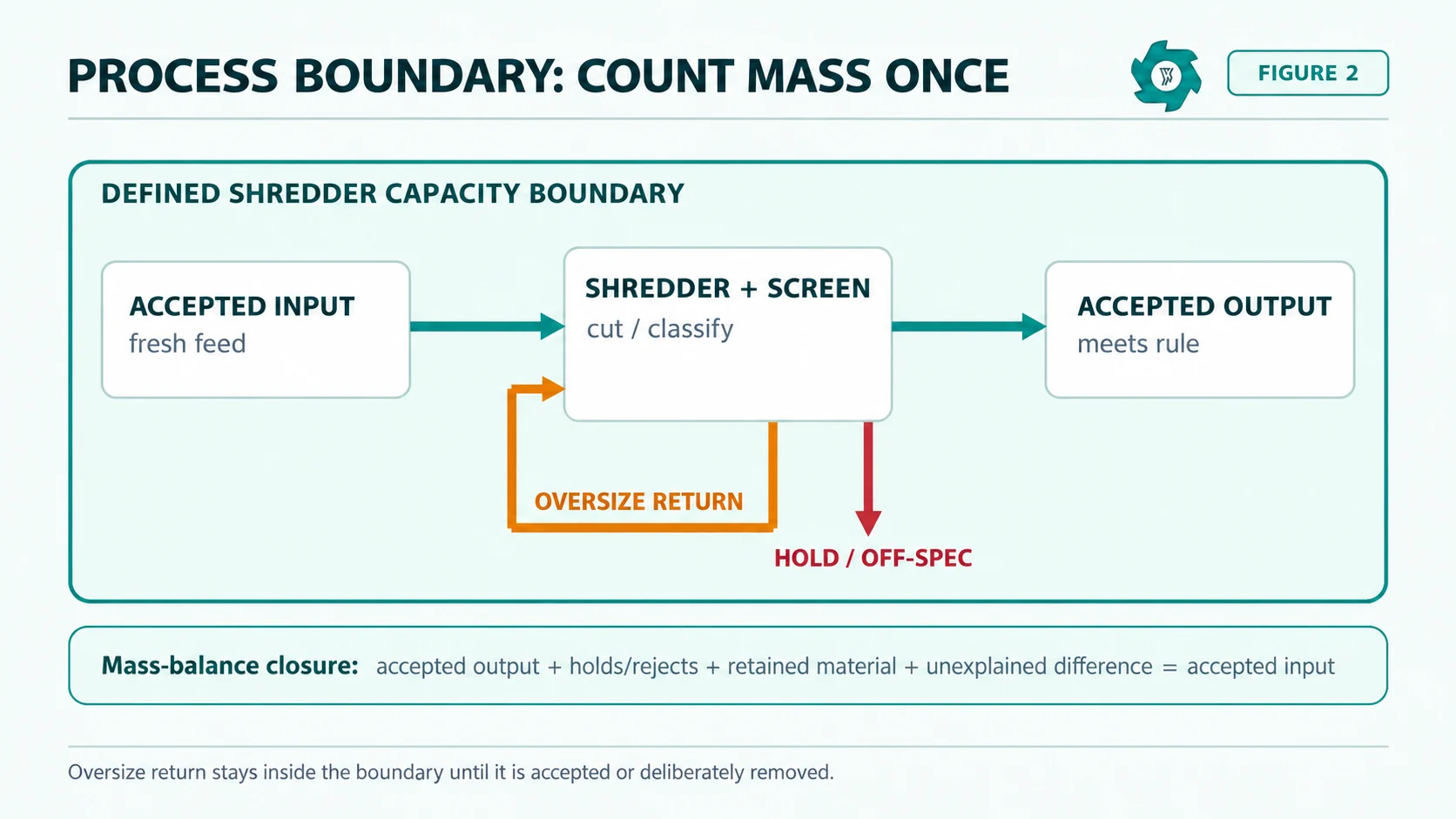
Why feed rate and accepted output separate during real operation
If a shredder is stable, the two rates may be close over a long enough window, but they do not have to match minute by minute. Several ordinary operating conditions can create a gap.
1. The return loop is filling or emptying
At startup, the system may be building an internal inventory of oversize material. Fresh feed can temporarily exceed accepted discharge. Near shutdown, the opposite can happen if feed stops while the system continues clearing material from the screen and return path. This is one reason a short video is a weak capacity test.
2. The product rule is tighter
A smaller screen opening or a stricter oversize limit keeps more material in circulation. YUXI’s TDF plant page illustrates the same engineering relationship: tighter sizing creates more return work than a coarser setting. That does not mean the shredder has “lost” all returned mass. It means the same mass needs more cutting events before release.
3. Material is held, rejected or retained
A test can end with material still in the hopper, cutting chamber, screen, transfer chute or return conveyor. Other material may be deliberately held because it is off-spec or needs investigation. Retained material and product holds are not accepted output. They should remain visible in the mass balance instead of being quietly assigned to the product bin.
4. Stops consume elapsed time
Feed starvation, bridging, overload reversals, manual clearing, downstream holds and maintenance stops can leave the machine capable of cutting but unable to deliver product for part of the scheduled window. Accepted output per running hour and accepted output per elapsed hour answer different questions.
5. The incoming tire mix changes
Passenger, truck and larger tire categories differ in mass, steel content, stiffness and handling behavior. A “tires per hour” number can therefore be misleading. The existing passenger-versus-truck TDF guide goes deeper into that material comparison.
Do not hide the time basis inside the number
| Time basis | What it includes | Best use | Risk if used alone |
|---|---|---|---|
| Elapsed time | The full agreed window from start to finish, including logged stops unless the contract says otherwise. | Shift planning and practical delivered rate. | Can obscure whether low output came from the shredder, feeding or downstream holds. |
| Running time | Time the measured system is in the defined production state, with exclusions recorded by rule. | Machine/process throughput comparison. | Can look generous if exclusions are not controlled. |
| Stable-production time | A defined steady-state portion after startup stabilization. | Comparing technical performance under controlled conditions. | Can overstate what a full shift delivers if startup, clearing and normal stops disappear from the denominator. |
| Scheduled shift time | Planned labor or production window. | Daily/annual production planning. | Not a direct machine capacity unless availability and operating factor are included. |
There is no need to force every commercial calculation onto one clock. It is often better to report two rates: accepted output per running hour and accepted output per elapsed hour. What matters is that both are labeled and supported by the same event log.
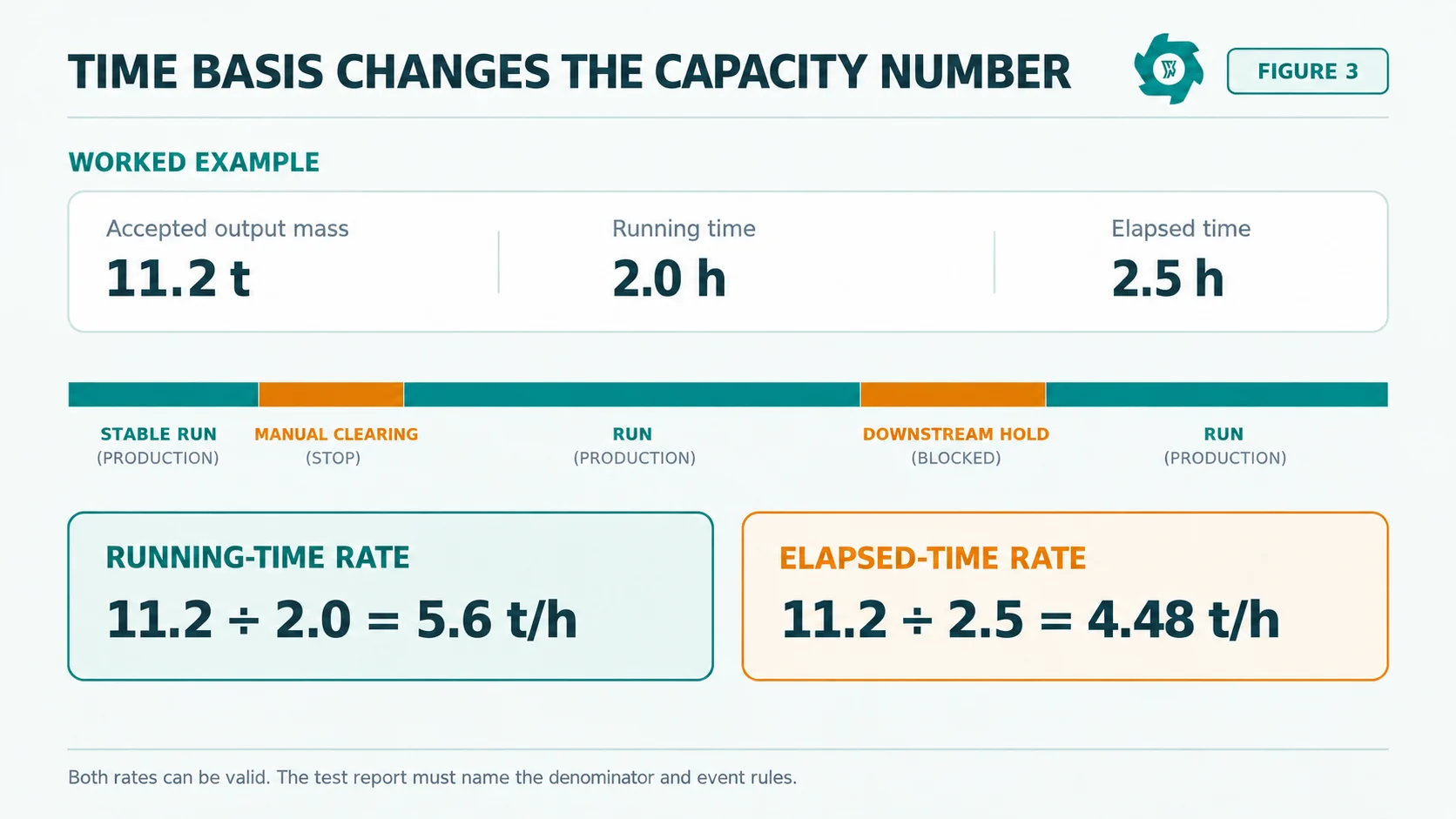
A worked example: one run, three defensible numbers
Assume a measured run has 12.0 metric tonnes of accepted fresh input. The agreed running time is 2.0 hours, while the full elapsed window is 2.5 hours because the event log contains a downstream hold and one clearing stop. The screen-return conveyor records 4.2 tonnes of internal oversize circulation during the run. At closure, 11.2 tonnes have crossed the accepted-output boundary, 0.3 tonnes are held as off-spec, 0.4 tonnes remain as retained material, and the unexplained difference is 0.1 tonne.
The accepted-input rate on running time is 12.0 ÷ 2.0 = 6.0 t/h. The accepted-output rate on the same running-time basis is 11.2 ÷ 2.0 = 5.6 t/h. The accepted-output rate on full elapsed time is 11.2 ÷ 2.5 = 4.48 t/h.
All three numbers describe the same run, but they answer different questions. Six tonnes per hour describes accepted fresh input entering the defined process boundary during running time. 5.6 t/h describes accepted production during running time. 4.48 t/h describes what the measured window actually delivered after the logged interruption time is included. The 4.2 tonnes on the return conveyor is neither extra feed nor extra production. It is evidence of internal cutting duty.
The mass-balance closure is also visible: 11.2 + 0.3 + 0.4 + 0.1 = 12.0 tonnes. Keeping retained material separate from unexplained difference matters because the first can often be physically located and recovered later, while the second is a measurement or accounting gap that deserves investigation.
Accepted-output ratio is useful, but do not oversell it as “efficiency”
For one clearly bounded test window, buyers may calculate:
In the example above, 11.2 ÷ 12.0 × 100 = 93.3%. That percentage can help compare runs when the boundary and product rule are unchanged. It should not automatically be called machine efficiency. Some retained material may become accepted product after the window, and a line with steel separation or multiple product streams needs a wider mass balance than a primary shredder alone.
Likewise, a high accepted-output ratio does not prove that the rate is high. A machine could convert nearly all input into accepted product but do so slowly. Capacity and yield-like ratios should be shown side by side rather than collapsed into one performance claim.
Capacity must be tied to output size and the downstream state
The same shredder can deliver different accepted-output rates at different size settings. A coarse product leaves the system after fewer cutting opportunities. A tighter size window can keep more oversize circulating and increase the number of cuts per metric tonne. The EPA handbook specifically notes the relationship between smaller product size, more recycle passes and greater knife duty.[1]
This is why a capacity promise should never float free from the output condition. Record the screen or sizing configuration, permitted oversize, sample method, and downstream state. If a downstream conveyor, magnet or storage bin limits discharge, the line can show a lower delivered rate even when the shredder itself has unused cutting capacity.
Conversely, removing the screen to demonstrate a larger number does not prove the system can deliver the contracted product. The accepted-output boundary exists to prevent that shortcut.
Separate a shredder rating from a plant production target
Machine sizing and production planning use related but different numbers. A shredder may need enough instantaneous cutting capability to absorb feed surges, while the business plan depends on accepted output over a shift, day and year.
Start with the required accepted production per shift and the actual operating schedule. Convert that target into the accepted-output rate the line must sustain during productive time, then check whether the shredder, screen, return loop and downstream equipment can support that rate under the agreed product condition.
Then apply realistic availability, product-change, cleaning, planned maintenance and site constraints instead of multiplying a catalog peak by every scheduled hour. The TDF operating-cost guide uses accepted output as the economic denominator for the same reason: power, blades and labor are easier to compare when they are tied to product that crossed the defined acceptance boundary.
Do not reverse the logic by choosing an annual tonnage first and then dividing by 8,760 hours. Tire plants do not operate every calendar hour. Start from the real shift pattern, expected productive time and output specification.
What a supplier should state beside every capacity claim
A buyer should be able to read one capacity line and reconstruct the conditions behind it. Ask for the following beside the quoted number:
- fresh feed material: passenger, truck, bus, OTR or defined mixture;
- preparation condition: whole, debeaded, sidewall removed or pre-cut;
- maximum recurring tire dimensions and approximate mass range;
- target product size and permitted oversize;
- screen and oversize-return configuration;
- whether the stated rate is fresh input, gross machine discharge or accepted output;
- the measurement point for input and output mass;
- running-time, elapsed-time and stabilization rules;
- treatment of reversals, stops, operator interventions and manual clearing;
- downstream equipment state during the test;
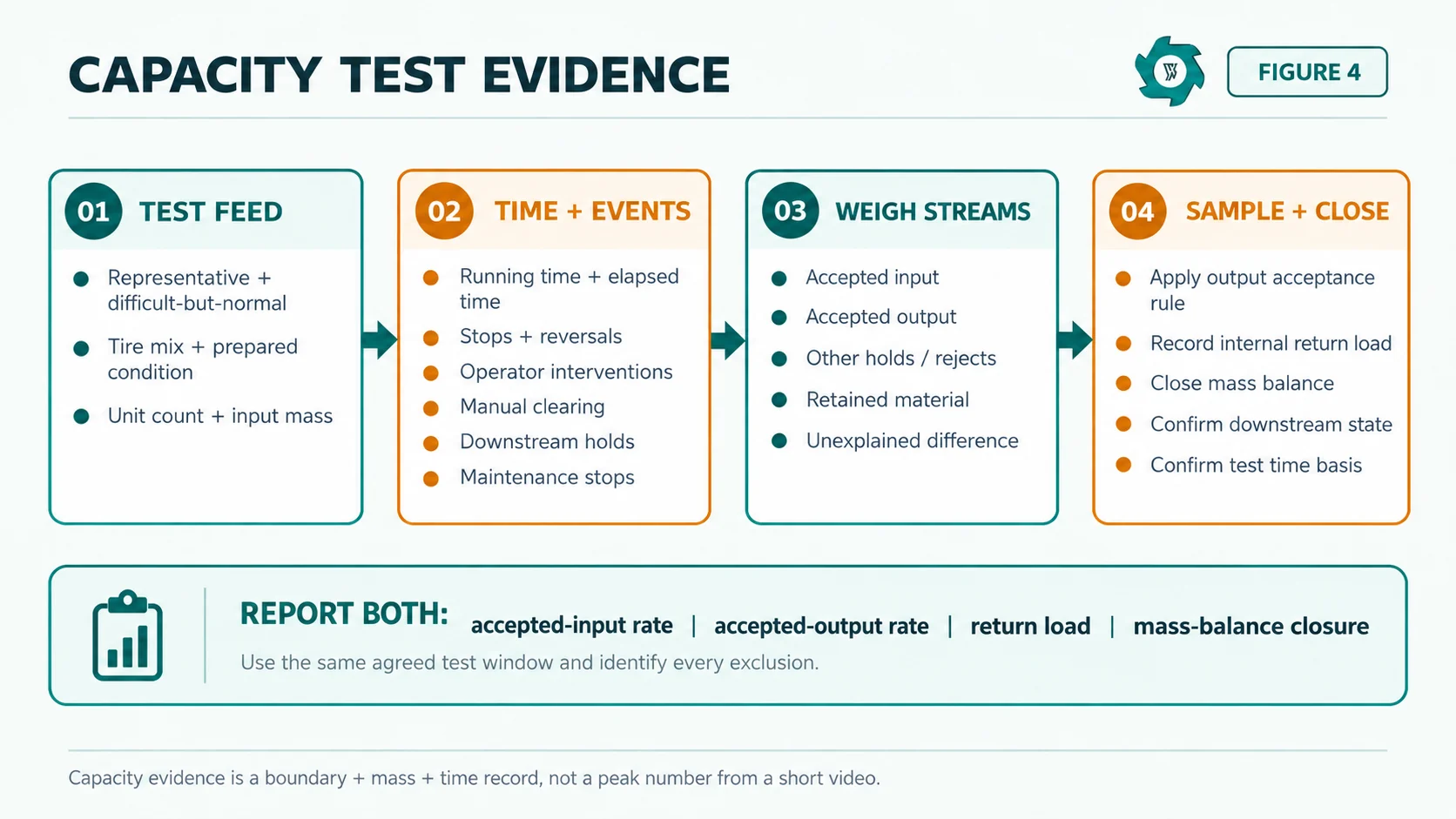
- sample method used to decide whether output is accepted;
- retained material and unexplained difference at closure.
Measure input and output separately; do not back-calculate one from the other
If the purpose of a test is to compare feed rate with accepted output, each side should have its own measurement. Do not weigh only input and assume all input became product. Do not weigh only product and infer how much fresh feed must have entered.
For continuous lines, belt scales can be useful where properly installed and controlled; batch containers or platform scales can be simpler for short tests. NIST Handbook 44 includes separate technical sections for scales, belt-conveyor scale systems and automatic bulk weighing systems.[3] The exact legal-for-trade requirement depends on the jurisdiction and use, but the engineering principle is general: the weighing method, resolution and tare treatment have to be known.
Where scales are not synchronized to the test window, physically identify measured lots. Otherwise product generated before the official start can enter the output total, or material produced during the run can remain in an unweighed bin after the clock stops.
Log events because a rate without causes is difficult to use
If accepted output is below target, the production team needs to know why. The minimum event record should include stops, reversals, operator interventions, manual clearing, downstream holds and maintenance stops. These categories are deliberately descriptive. They do not diagnose the cause by themselves.
For example, frequent reversals can result from difficult feed geometry, tire mix, cutter condition, trapped material or control logic. This article does not assign a diagnosis from the reversal count; the dedicated troubleshooting work should own that analysis.
Any clearing or service work that exposes employees to unexpected energization or stored energy must follow the applicable hazardous-energy-control procedure. OSHA 29 CFR 1910.147 specifically covers servicing and maintenance activities including cleaning and unjamming when unexpected startup or release of stored energy could injure employees.[4]
Use representative and difficult-but-normal test material
A capacity test should not be built entirely from the easiest tires available. At the same time, intentionally abnormal material does not represent normal production. Define a representative mix and include the difficult-but-normal end of that mix.
If the project will regularly receive truck tires, do not prove the rate with passenger tires only. If a certain larger tire occurs every shift, include it or define a separate capacity condition. If OTR tires require upstream sectioning, test the shredder with the prepared condition the production line will actually receive.
Record the mix by mass where practical. Tire count alone can distort comparison because a heavy truck tire and a passenger tire contribute very different mass. USTMA’s end-of-life tire reporting illustrates the importance of treating end markets and material quantities on a mass basis when discussing tire flows at market scale.[5] At plant scale, the same discipline makes capacity records easier to compare.
How to write the capacity line in an RFQ or contract
A good capacity clause names the product and the measurement basis. For example:
Add the event categories, test duration, downstream state and sampling rule. If the purchase depends on a formal factory test, the separate TDF plant FAT guide provides the broader witness-and-closure structure. Keeping the capacity clause focused avoids turning one sentence into an entire test protocol.
Seven red flags when comparing tire shredder capacity quotations
- No output definition. “5 t/h” is given without a screen, size window, permitted oversize or downstream acceptance rule.
- Fresh feed and return load are added together. Internal circulation is counted as extra processed tonnage.
- Tires per hour replaces mass rate. The result changes simply because the test uses lighter tires.
- The denominator is missing. The quote does not say whether t/h means elapsed, running or stable time.
- Only a short peak is shown. A few minutes of aggressive feeding are treated as sustainable production.
- Input is measured but output is assumed. Retained, held or off-spec material disappears from the record.
- The downstream state changes between tests. One supplier runs into an empty receiving system while another is constrained by a screen, conveyor or bin condition.
When these points are corrected, different machine proposals become much easier to compare. The discussion moves away from “whose brochure has the larger number?” and toward “which system produces the required accepted material at the required rate under the same boundary?”
What buyers should ask YUXI before selecting a tire shredder
Prepare a short data package before requesting a configuration: tire categories and percentages, maximum recurring size, whether bead wire is removed, target output size, allowable oversize, required accepted-output rate, intended downstream process, working hours, available power and site layout. Add photos or a short video of the difficult-but-normal tires if the feed is mixed.
For capacity, state both the business target and the test language. “We need 5 metric t/h accepted output at the agreed screen setting over running time, and we also want elapsed-time production reported” is far more actionable than “send a shredder rated for 5 metric t/h.” It gives the equipment supplier a boundary to design around and gives the buyer a number that can later be checked.
The final machine selection still depends on cutting chamber geometry, shaft and cutter configuration, drive torque, feeding method, screen area, return conveyor, controls and downstream interfaces. Capacity reporting does not replace engineering. It makes the engineering claim measurable.
Frequently Asked Questions
What is the difference between tire shredder feed rate and accepted output rate?
Feed rate measures fresh material entering the defined process boundary per unit of time. Accepted output rate measures material that leaves the agreed output boundary and meets the agreed product rule per unit of time. In a screen-return system, the two can differ because material recirculates, remains retained, is held off-spec, or the line experiences logged stops.
Should oversize return conveyor tonnage be added to shredder capacity?
No. Oversize return is internal circulation. It can be measured to understand cutting duty and recirculation load, but adding it to fresh input or accepted output double-counts material that has already crossed the system boundary.
Should tire shredder capacity be based on running time or elapsed time?
Both can be useful if they are clearly labeled. Running-time capacity helps compare the process while it is operating. Elapsed-time capacity shows what the measured window actually delivered after logged interruptions are included. The contract or test plan should define both clocks before the run.
How should accepted output be measured?
Weigh the material that crosses the agreed output boundary and meets the agreed acceptance rule. Define the scale or weighing method, tare treatment, test window, product sampling rule and treatment of material still inside the system when the window closes.
Why can a smaller tire-shredder output size reduce capacity?
A tighter size requirement can keep more oversize material in the return loop, creating additional cutting passes per metric tonne. The practical effect depends on tire construction, cutter condition, screen configuration, feeding stability and downstream state, so the capacity claim should always state the output condition.
What capacity information should be included in an RFQ?
State the tire mix, preparation condition, target size and oversize rule, required accepted-output rate, fresh-input measurement point, accepted-output measurement point, running and elapsed time definitions, screen/return configuration, event categories, downstream state, sampling method, retained material and unexplained-difference treatment.
Need a Capacity Basis You Can Put Into an RFQ?
Send the tire mix, maximum recurring tire size, target output, accepted-output requirement, working schedule and downstream process. YUXI can help define a shredder configuration and a measurable capacity basis for your project.
References
- NIST handbook. Weighing and measuring-device requirements.
- ASTM D6700. TDF specification context.
- EPA handbook. Tire-shredder recycle-pass and knife-duty context.
- OSHA LOTO. Hazardous-energy control during clearing and service.
- USTMA report. End-of-life tire mass-flow context.