


Summary
A recycler can remove textile reinforcement from shredded tires and still collect a fiber fraction with a noticeable amount of rubber. That is not necessarily proof that the separator has failed. Fine rubber pieces can travel with light textile fluff, rubber can remain attached to the cords, and the collected material may not have been cleaned for sale as a separate product. The important question is not simply whether a line has fiber separation. It is what material leaves in the fiber stream, how that stream is sampled, and what its next buyer will use it for.
Three independent studies have examined recovered tire textile containing rubber, but they sampled different materials for different purposes. Their percentages cannot be combined into a standard contamination range. This guide explains what those results actually say, how a buyer can discuss optional cleaning, and what should appear in a testable fiber specification. It does not claim a measured YUXI fiber purity or prescribe a universal limit.
A separated fiber stream is not automatically a finished fiber product
A procurement conversation often starts with a small misunderstanding. A tire recycling line supplier says the machine “removes textile.” The buyer hears “we will receive clean, saleable textile fiber.” Those statements describe different jobs. The first concerns removing a contaminant from the rubber being manufactured. The second concerns the condition of the material that was removed.
Picture two containers beside a line. One holds rubber mulch with a small amount of unwanted fuzz. The other holds dusty textile with black rubber bits caught in it. Better rubber-product quality does not, by itself, prove that the second container meets a customer’s fiber specification. Indeed, moving more material into the fiber container may also carry some saleable rubber along with it. Both streams deserve attention, but they require separate tests and separate denominators.
YUXI’s published Tire Wire Free Mulch Plant page describes primary size reduction, rasping, steel recovery and optional fiber separation when a lower-textile rubber output is needed. That is useful configuration context, not an independently measured purity result for the collected fiber. A plant that intends to sell fiber needs to define this additional product boundary in the quotation rather than assume it comes with the line.
In the literature the collected material may be called waste tire textile fiber (WTTF), recycled tire textile fiber (RTTF), tire textile fluff or recycled tire polymer fiber. The names do not guarantee a fixed grade. A bale described as RTTF might contain short strands, long tangled cords, rubber bonded to fabric, free rubber particles, dust and occasional metal fragments. The mixture depends on the incoming tires and how the material was recovered.
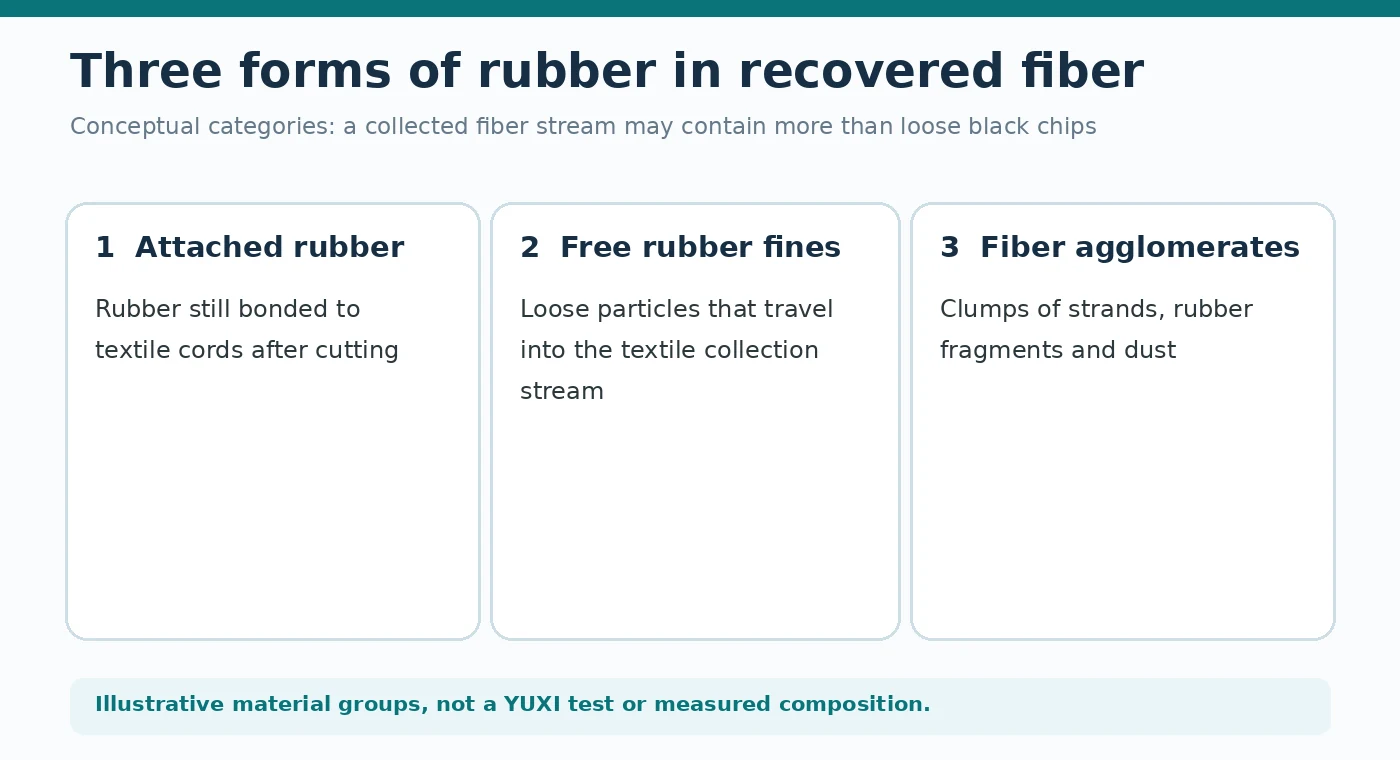
Why does rubber leave with the recovered textile?
A tire is built as a composite, not a stack of convenient, detachable ingredients. Rubber and reinforcing material spend their working life bonded together. Cutting the tire into smaller pieces releases some of those materials, but it does not automatically separate every interface cleanly. The 2022 review Sustainable Reuse of Waste Tire Textile Fibers as Reinforcements describes the variety of recovered-fiber materials and why cleaning matters for their reuse [4].
There are at least three useful ways to describe what a buyer might find in the textile side stream. Attached rubber remains stuck to fibers after cutting or granulation. Loose rubber fines are individual pieces that accompany light fluff into a collection bin. Agglomerates are clumps where textile, rubber particles and dust stay tangled together. A fourth category—small pieces of steel or other foreign material—should be recorded separately rather than quietly counted as rubber.
The distinction matters because these materials may respond differently to handling. A screen can potentially separate some free fragments by size, yet a rubber-coated cord may stay with the fiber. A light-air separation step can change which material is collected, but it cannot make an attached rubber particle disappear. Agglomerates create another difficulty: a handful taken from the top of a fluffy bin may look quite different from material near the bottom.
None of that supplies the correct fan setting, screen opening or cleaner throughput for a particular machine. Those are equipment- and feed-specific questions. For how separation and rubber losses are handled on the rubber product side, see YUXI’s existing article on Steel and Fiber Separation in Rubber Mulch Production. Here we stay with the collected textile fraction and the questions its next user needs answered.
Tire type adds uncertainty. Passenger-car, truck and specialty tires may use different reinforcement constructions. Pretreatment and the point at which material is collected also change what appears in the fiber bin. Two recyclers can both truthfully offer “recovered tire fiber” while supplying materials that behave very differently in a sieve, mixer or forming process. A buyer should ask for an actual sample from the proposed process, not just a brochure photograph.
What does a “rubber contamination percentage” really mean?
One number looks reassuring on a specification sheet: “rubber content: 15%.” Yet the number is incomplete until the supplier describes what was weighed and how the fractions were identified. Is 15% calculated on the wet, as-received material? On an oven-dried sample? On a selected portion of loose fiber after obvious rubber chunks were picked out? Was attached rubber scraped off, screened out, estimated by hand sorting or measured by another method?
The denominator is especially important. Imagine a hypothetical 10 kg received lot sample containing water, loose rubber, rubber-coated fiber and small metal fragments. Reporting free rubber as a share of the received sample will give a different result from reporting all separated rubber on dry material. Neither answer is automatically dishonest; they are simply different measurements. This is a measurement example, not a result from a YUXI trial or an existing standard test procedure.
The research handoff identified three independent experiments. They provide evidence that residual rubber exists in real collected fiber. They do not establish how often a particular percentage occurs in industry.
| Study and material | What the researchers reported | What the number does not establish |
|---|---|---|
| Banaszkiewicz and Badura (2019), fiber from a Polish tire recycler, mainly EU car-tire textile | About 60% of the studied recovered-fiber sample’s mass was rubber fraction, based on the authors’ particle-size analysis [1] | An average for all recyclers, or a cleaning rate for any machine |
| Tariq and colleagues (2026), textile fibers prepared for a concrete experiment | The authors describe about 30% fine rubber particles in their received fiber and approximately 15% after laboratory sieving [2] | A commercially validated reduction rate or a uniform industry measurement basis |
| Ružickij and Grubliauskas (2022), three fiber samples for acoustic testing | Three investigated materials were reported as approximately 10%, 54% and 70% rubber impurity by mass [3] | Three grades from the same commercial line, or universally acceptable quality bands |
The numbers belong to different samples and end uses. The first study used a rubber-textile mixture in a soil-treatment experiment. The second prepared fiber for concrete. The third evaluated sound absorption. They did not run one calibrated comparison of three recycling machines or use a common buyer acceptance protocol.
The 2026 paper is a good example of why close reading matters. Its published text says the fiber’s fine-rubber share went from roughly 30% to 15% after sieving, then describes removal of roughly 10–15% of rubber particles in the same sentence [2]. That wording does not make the mass basis or the relationship between those values fully clear. A careful buyer should treat them as authors’ descriptions of that research sample and not calculate a universal 50% cleaning efficiency from them.
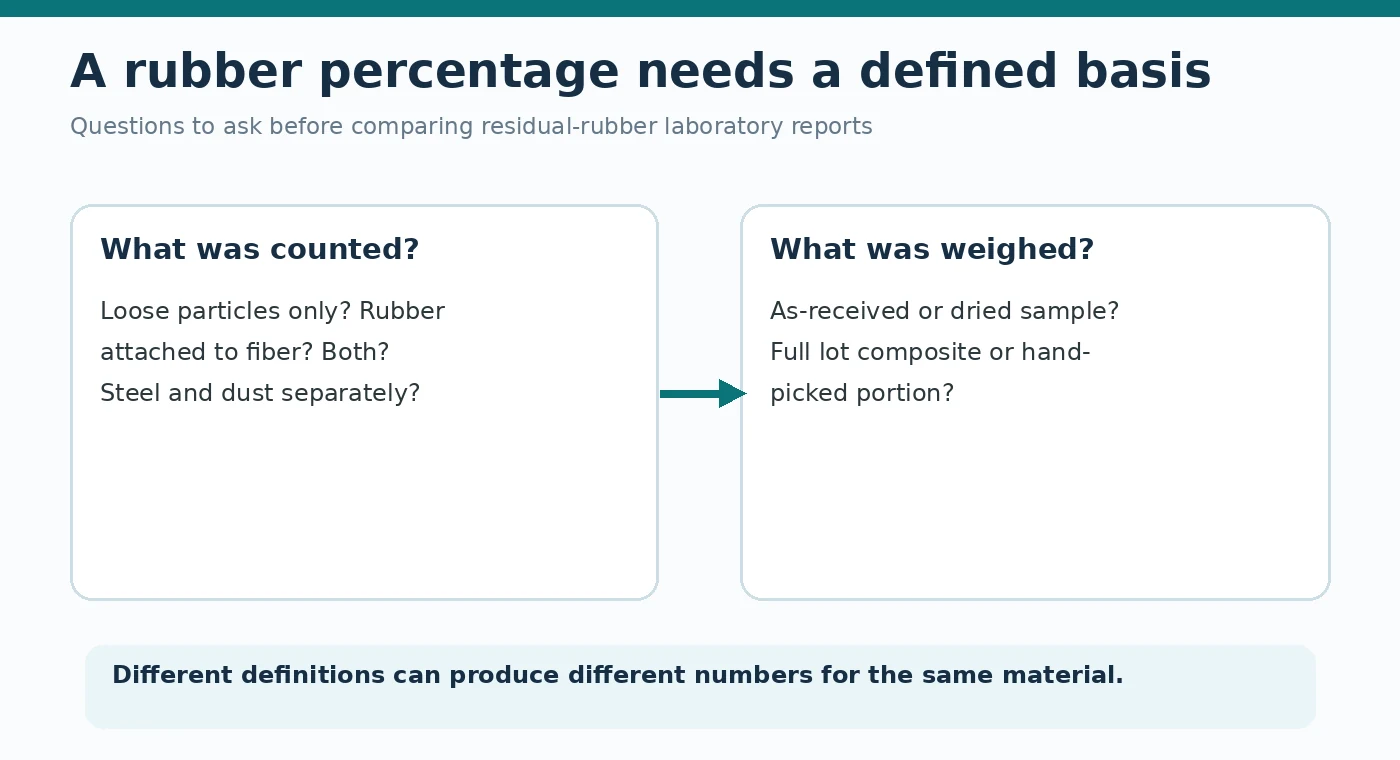
For a purchase specification, the safest starting point is a complete sentence rather than a bare percentage: “Residual rubber will be measured on [defined sample], on a [dry/as-received] mass basis, following [agreed identification and separation procedure], and reported with [agreed uncertainty or repeatability information].” The bracketed parts must be filled in by the parties or their laboratory. They are not a published YUXI test method.
Cleaning the textile fraction: know what the trial actually demonstrates
The point at which a recycler collects textile is not always the point at which a fiber buyer wants to receive it. An additional cleaning pass may be worth evaluating. Whether it is worth buying depends on the new product requirement, how much rubber leaves with the fiber, and what happens to useful fiber during cleaning.
In the 2026 concrete study, Tariq and colleagues used a vibrating table and sieves while preparing recovered tire textile for their laboratory mix. The paper discusses removing larger rubber pieces and fine particles from the sampled fibers [2]. This is direct evidence that the researchers used a physical cleaning step for that material. It is not a performance sheet for a factory-scale textile cleaner. The study does not supply a commercial guarantee for line throughput, a cost per tonne of cleaned fiber or a stable acceptable residue percentage across tire mixes.
The 2022 review describes other researched approaches to separation and cleaning [4]. Such work provides ideas to test, not ready-made settings to copy. A separator and a downstream cleaner may have different duties: the first seeks to keep textile out of the rubber product, while the second seeks to make the collected textile suitable for a particular use. Combining those goals into one promised “separation efficiency” hides both the starting conditions and the costs of additional handling.
A useful trial therefore starts with three physical samples rather than one attractive “after” photograph. Collect a before-cleaning textile sample, an after-cleaning textile sample, and the material removed during cleaning. Record all three masses, including any rejected fiber and rubber particles. If a cleaning change makes the retained textile look better but removes much of the usable fiber, the commercial result may be less attractive than the photograph suggests.
There is also the question of what the unwanted rubber looks like. Loose granules of a defined size may be easier to isolate for a particular test than rubber still bonded to textile cords. A buyer who cares about total rubber content must say whether both are included. Otherwise a supplier may remove visible black chips while leaving the smaller attached fraction uncounted. Conversely, for an application that tolerates some attached rubber, removing every visible speck may add unnecessary work.
Use that distinction in the quotation. Ask the supplier to show the sampling points and stream boundaries, then request any cleaning option as a separately described scope. Avoid asking for a universal setting based on a journal paper. A paper can show that a method was tested; only a representative test on the target feed can show what that method achieves in a proposed commercial arrangement.
The same fiber can face different acceptance questions in different markets
“Clean” is not a useful purchasing target until someone says clean enough for what? Recovered textile might be considered as a reinforcing material, an acoustic component, a research feedstock or a material sent for energy recovery where that route is legally permitted. Those destinations are not interchangeable. Processing a sample for one study does not qualify it for another product.
Research example 1: soil-treatment material. Banaszkiewicz and Badura examined recycled tire polymer fibers with substantial residual rubber in a cement-based experiment concerning volatile organic contaminants in soil [1]. The authors reported roughly 60% rubber fraction in their recovered textile sample and investigated how that mixture affected the treatment process. That number describes the supplied experimental feedstock; it does not show that a buyer should demand 60% rubber or that a recycling plant performed well. Nor does a promising laboratory end use eliminate environmental, material-safety or permitting requirements for real projects.
Research example 2: concrete reinforcement feedstock. Tariq and colleagues prepared recovered tire textile and steel fibers for a 2026 concrete study [2]. Their textile preparation included sieving, and the paper notes that rubber adhering to fiber can influence how that material behaves in a cementitious mix. A concrete researcher asks about fiber geometry, dispersion and how mixed materials affect the test specimens. A fiber broker, by contrast, may first need repeatable lot quality and a stable supply. A plant buyer needs to know whether its selected equipment and feed mix can supply material to the agreed test. Those are three separate questions.
Research example 3: acoustic applications. Ružickij and Grubliauskas tested three textile-fiber materials containing different rubber impurity levels [3]. In their particular impedance-tube tests, the sample with the lowest rubber fraction had stronger sound-absorption performance than the more rubber-rich samples. This is useful evidence that material composition matters to a defined use. It is not a universal acoustic-product certification or proof that the lowest rubber content will always be best under every frequency, density and forming condition.
These examples have one practical point in common: a fiber stream’s suitability is decided by an end-use test against an agreed requirement, not by calling the material recycled textile. An application may be sensitive to rubber fraction, fiber length, clumping, steel inclusions, moisture or several of these at once. The buyer needs to choose what to measure before the plant supplier can define an appropriate scope.
A recycled-fiber sample should not be marketed as fit for structural concrete, an acoustic building product or environmental treatment simply because a journal paper explored that application. Product qualification requires its own design, test and compliance work. For this article, the studies are evidence of different research questions—not certifications for YUXI or for all recovered fiber.
Check both product streams, not just the rubber
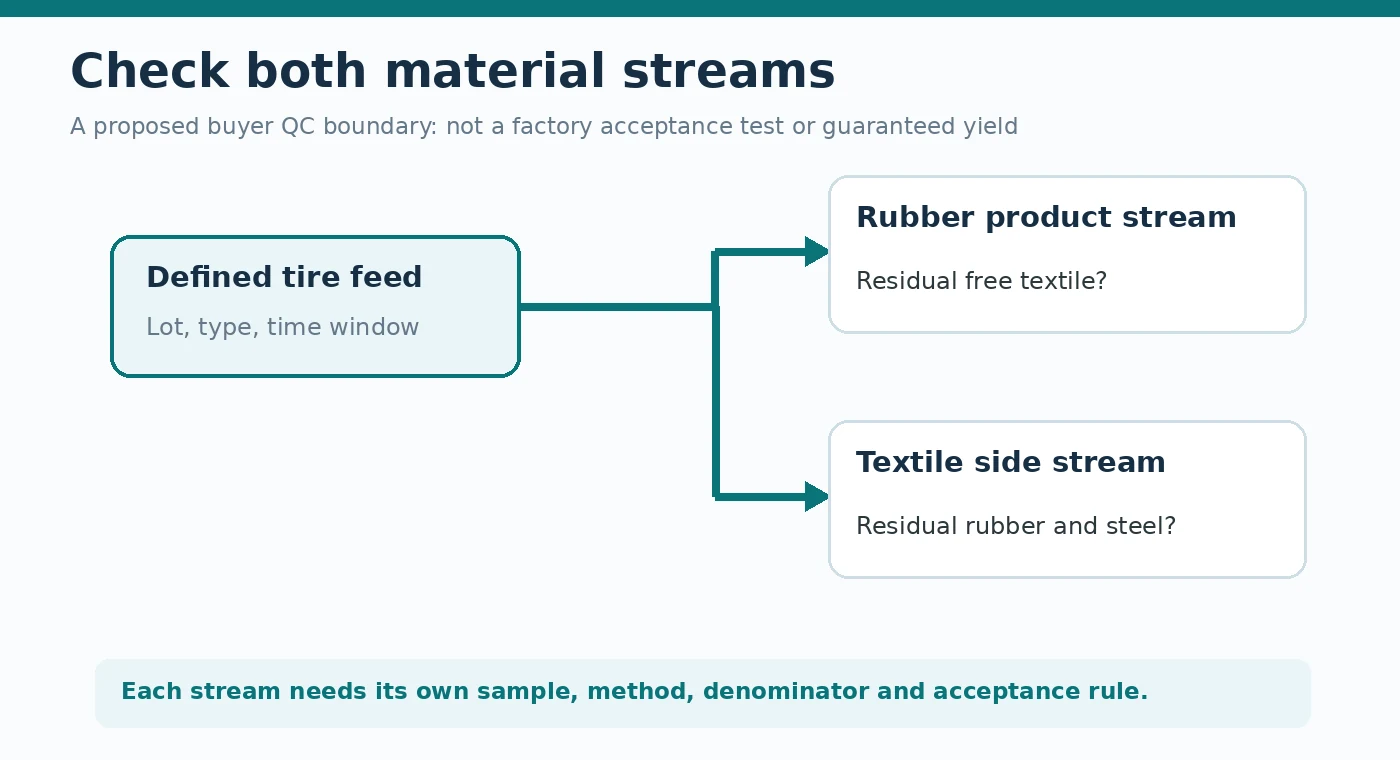
A quality discussion becomes clearer when the two outputs are written on separate lines. For the rubber-product stream, one question is how much free textile remains among the accepted chips or granules. For the recovered textile stream, the question is how much rubber, steel and other material accompany the textile. The test samples, acceptable results and commercial values differ.
YUXI’s published Tire Rubber Crumb Plant describes staged granulation and fiber removal for a finer rubber product route. That is a useful reminder that the product and byproduct streams may need different handling as size reduction continues. The webpage does not provide a validated recovered-fiber grade, so a quotation still needs to specify what happens to that collected fiber if a downstream buyer is involved.
A simple material ledger helps reveal a trade-off that a single purity number can hide. During an agreed trial window, record fresh tire material entering the defined system, accepted rubber product, recovered steel, collected textile, return/oversize, other fines and any unaccounted material. Note whether return material re-enters the system within the same measured period. A recirculation loop should not be added repeatedly to fresh feed and mistaken for new production.
The ledger is a proposed procurement tool, not an ASTM requirement or an existing YUXI factory-acceptance procedure. It can still show whether a promising fiber result was obtained by sending a large amount of useful rubber into the textile reject. It also shows where the test boundary ends. If the fiber is collected after one stage and later processed elsewhere, the parties must decide which stage is responsible for the stated quality.
| Trial record field | Record in the agreed test window | Why the buyer needs it |
|---|---|---|
| Fresh feed | Mass, tire mix, feed preparation, start/end time | Defines the actual input, not cumulative circulation |
| Accepted rubber output | Mass and buyer’s rubber-quality results | Shows the main product result |
| Recovered textile | Collected mass, location, rubber test, other contaminants | Defines the byproduct being discussed |
| Recovered steel and fines | Measured masses or documented estimate basis | Prevents missing streams from disappearing from the balance |
| Oversize / return | Mass or flow estimate, route and timing | Avoids double-counting material processed twice |
| Unresolved difference | Explain weighing uncertainty, retained material and loss | Reveals whether the accounting is good enough to compare runs |
The main lesson is not that every quotation needs a laboratory-scale mass-balance study. It is that the buyer and supplier should agree on which output they are promising. A cleaner rubber product and a cleaner fiber byproduct are related goals, but neither one automatically proves the other.
A practical RFQ and lot-acceptance worksheet for recovered fiber
Consider a fiber buyer offered two loads from different tire recyclers. One supplier lists “less than 15% rubber”; the other writes “high-purity textile fluff.” Neither offer is easy to compare. The first lacks its method and sample basis; the second lacks a measurable result. Before negotiating price, ask both to complete the same worksheet.
The fields below are suggested contract questions, not a universally adopted fiber standard. Where numerical limits are blank, the buyer and seller should agree on them for the intended use and the test laboratory’s capabilities.
| Specification field | What to agree before purchase | Agreed value / method |
|---|---|---|
| Intended use | Research, manufacturing, energy recovery where permitted, or other destination | ______ |
| Lot definition | Shipment, production interval, container or numbered batch | ______ |
| Feed and collection | Tire categories, collection location and relevant cleaning stage | ______ |
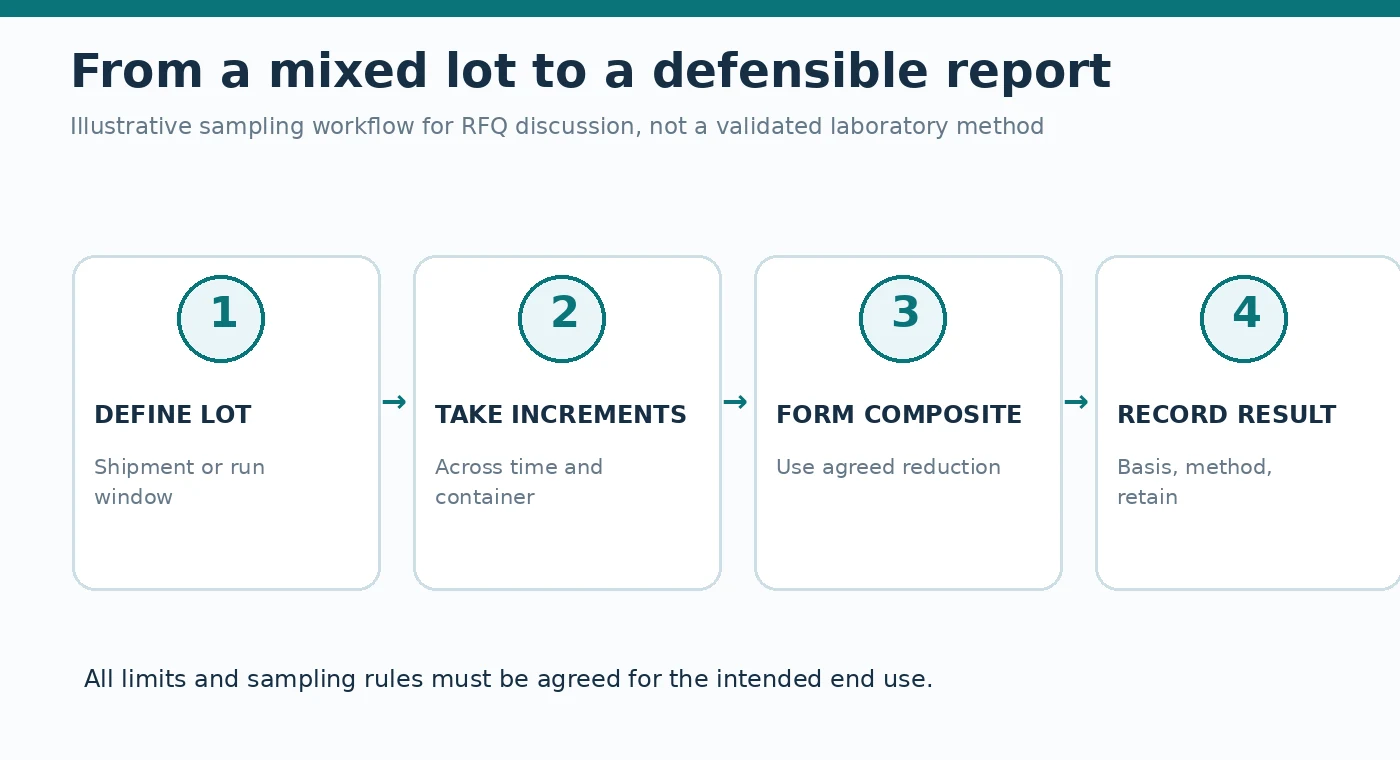
| Sampling plan | Number/location of increments, composite procedure and sealed retain sample | ______ |
| Residual rubber | Count loose fragments, attached rubber or both; method and mass basis | ______ |
| Steel and other debris | Definition, method and acceptance criterion | ______ |
| Textile condition | Fiber length, clumping, visible debris or other application property | ______ |
| Moisture | As-received/dry basis, conditioning and reporting method | ______ |
| Decision rule | Laboratory, repeat tests, uncertainty, fail/accept treatment | ______ |
A useful sampling plan begins with the physical lot. If fiber drops into a large sack over several hours, a handful from the surface may miss denser material that settles below. Agree on how increments will be collected over time and how the final composite will be reduced without selectively dropping rubber-rich clumps. The result should represent the shipment the buyer actually receives, not the cleanest part someone could find.
Specify the material state at testing. Is the sample dried before weighing? Is it conditioned to a stated moisture level? Are long ropes of textile broken apart before sorting? Does the test classify rubber-coated cords as textile, rubber or a mixed fraction? A method description that ignores those choices can make two reasonable laboratory reports appear to disagree.
Ask how the parties will handle a dispute. One sealed retain sample, identified with the same lot code, is often more useful than a promise to “test again later.” Identify the laboratory or a mutually agreed comparison method. Do not quietly change a measurement method after a shipment fails, because the new result may be answering a different question.
The threshold itself belongs to the end use. The studies cited here do not establish a universal limit for residual rubber, moisture or steel in recovered tire textile. If a buyer asks for such a limit, request the downstream manufacturing specification or have an appropriate laboratory help define one. Guessing a number from a paper about concrete or acoustic testing is not sound procurement.
Finally, keep the rubber-product specification separate. The requirements in YUXI’s existing Rubber Powder Quality Specifications article concern the graded rubber being sold, not the rubber fraction carried away with the textile byproduct. A single checklist labeled “plant purity” should not replace both documents.
Five claims that should trigger a follow-up question
“The fiber separator removes all rubber.” Ask whether the claim includes rubber bonded to fibers and whether a test of the collected textile was performed. A clean-looking rubber product is not proof.
“Our residual rubber is 15%.” Ask what sample was used, what counts as rubber and whether the figure is dry or as-received mass. Then ask for the original report, not a rounded sales sentence.
“A published study achieved this cleaning rate.” Check whether the study actually tested a commercial cleaner, a laboratory sieve or a prepared research sample. Do not transfer results between them.
“We can match a competitor’s fiber specification.” Ask whether the same tire types, collection point, method and delivery lot are in view. Even similar equipment names can mask different feed duties. The earlier Primary vs Secondary Tire Shredder discussion is helpful when defining where the upstream size-reduction duty ends, but it does not set fiber quality.
“More cleaning is always better.” Better for which product and at what material loss? A trial should account for both recovered textile quality and useful rubber carried into rejects.
FAQ
Does recovered tire textile fiber always contain rubber?
The independent samples discussed in the cited studies did contain rubber. That does not establish a universal percentage for every recovered-fiber stream or mean that all plants use identical cleaning steps. Ask for a lot-specific sample and an agreed test.
Can I compare two reported rubber percentages directly?
Only after checking that both results use compatible samples, material definitions, moisture bases and separation or analytical methods. Percentages taken from different end-use experiments are not a ranking of recycling lines.
Should a recycling-line buyer request a fiber test even if the main product is rubber crumb or mulch?
If the textile side stream will be sold, reused or contractually controlled, yes: define how it is collected and measured. If it is not a saleable output, the buyer should still understand its disposal or permitted handling route rather than assume it has no cost.
Next step for a project quotation
Send the proposed tire feed, intended rubber product, the planned use for the recovered textile and any existing buyer test requirement. YUXI can discuss a line configuration and where a textile stream may be collected, but the final fiber-quality acceptance rule should be agreed for your actual material and end use. The most useful first result is a clearly specified sample, not an unsupported purity promise.
References
- Banaszkiewicz, K., and Badura, M. (2019). Experimental investigation on the application of recycled tires polymer fibers as a BTEX removal material. SN Applied Sciences. DOI: 10.1007/s42452-019-0570-9. Sample composition: §2.1; study context: abstract and conclusions.
- Tariq, Z., Bahadori-Jahromi, A., and Room, S. (2026). Sustainable Incorporation of Recycled Tire Steel and Textile Fibers as a Hybrid Mix in Concrete. Sustainability, 18(2), 786. DOI: 10.3390/su18020786. Textile sample preparation: published PDF page 8 (article page 7).
- Ružickij, R., and Grubliauskas, R. (2022). Sound Absorption: Dependence of Rubber Particles Impurities in Tyre Textile Fibre. Environmental and Climate Technologies, 26, 331–340. DOI: 10.2478/rtuect-2022-0025. Reported sample fractions and acoustic context: abstract.
- Sustainable Reuse of Waste Tire Textile Fibers (WTTF) as Reinforcements. Polymers (2022). DOI: 10.3390/polym14193933. Review background, not an additional independent experiment.