A buyer may send a photograph of clean-looking black chips and ask a reasonable question: “Is this wire-free?” The picture alone is not enough. No long wire was visible on top, but that did not tell us whether short steel fragments remained inside the sample, whether sharp ends appeared when the chips were flexed, or how much loose textile was mixed through the pile.
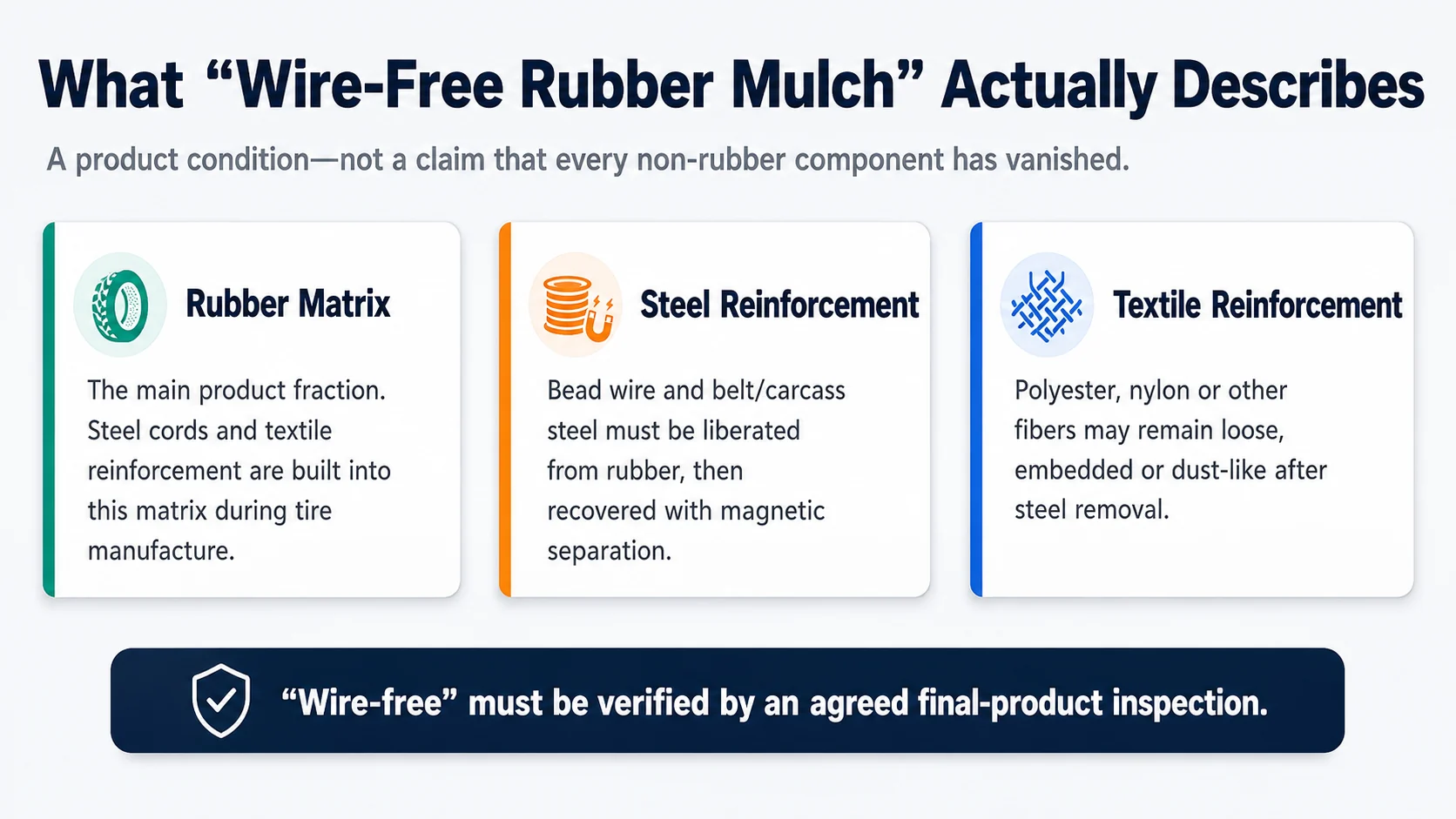
That is the practical problem with the term. Wire-free rubber mulch normally means tire-derived rubber chips that have gone through steel-liberation and magnetic-recovery stages so the delivered product meets an agreed steel condition. It does not automatically mean zero detectable metal, zero textile fiber, playground certification or a single universal purity percentage.
Quick Answer
“Wire-free” is a finished-product acceptance term. It should describe the permitted steel condition in a representative sample—such as no exposed sharp wire under an agreed inspection method, or a stated maximum metal content. The production route normally uses a tire rasper to liberate steel and one or more magnets to recover the released ferrous material.
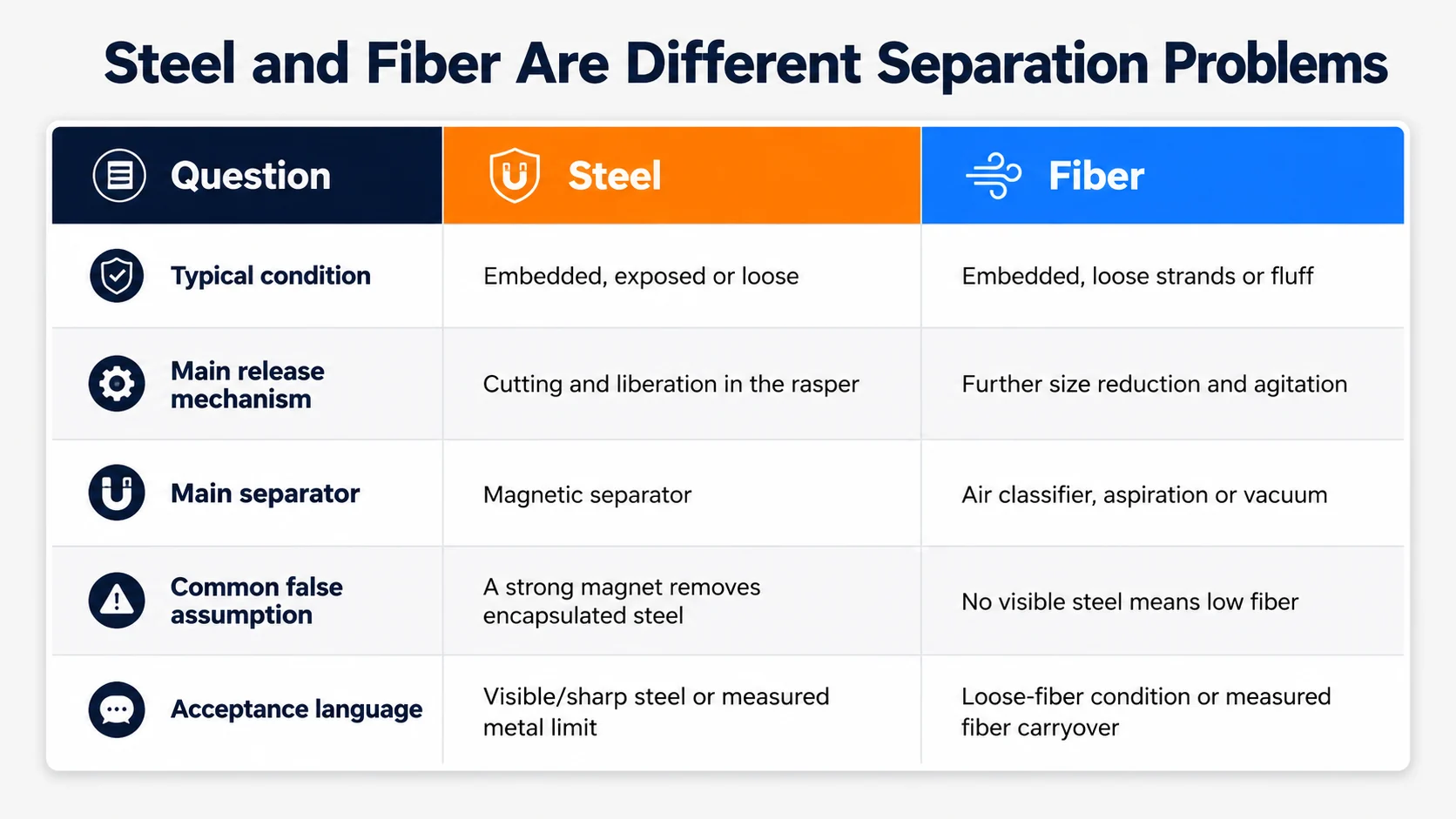
Textile fiber is separate. It is nonmagnetic and may remain embedded in rubber, appear as loose strands or become light fluff after size reduction. A lower-fiber product may need air separation, aspiration, screening and dust collection in addition to magnetic steel recovery.
Start with the Tire: Rubber, Steel and Textile Are Built Together
A tire is not a rubber shell with removable wire lying inside it. Its reinforcement is bonded into the rubber structure. Steel may be concentrated in bead bundles and distributed through belts or carcass cords. Textile reinforcement can include polyester, nylon or other fibers, depending on tire construction.
The EPA’s description of tire-rubber processing makes the separation logic clear: after size reduction, fabric can be removed with air classifiers or vacuums, while steel is removed with magnetic separators.1 These are different material properties and different machines.
A tire-derived mulch stream contains three engineering questions: how rubber is sized, how steel is liberated and recovered, and how textile fiber is controlled.
In practice: when someone says “remove the wire,” we ask which wire condition they mean. A long exposed strand is easy to see. A short sharp fragment may be harder to find. A steel cord still encapsulated in a thick chip may pass under a weak visual check and appear later when the chip wears or breaks.
What Should “Wire-Free Rubber Mulch” Mean?
The useful definition is not “the magnet ran.” It is: the finished mulch meets a written steel acceptance rule when sampled and tested by an agreed method.
That rule can be qualitative, quantitative or both. A landscaping buyer may focus on visible and sharp exposed wire. A product manufacturer may set a mass-based metal limit. A downstream granulation plant may care about the metal burden entering its next machine. None of these can be assumed from the two words wire-free.
Avoid the absolute promise: “100% wire-free” is not a useful engineering statement unless the supplier also states detection limit, sample size, lot size, test equipment and the treatment of embedded versus exposed steel.
Separate Steel Liberation, Magnetic Recovery and Final Quality
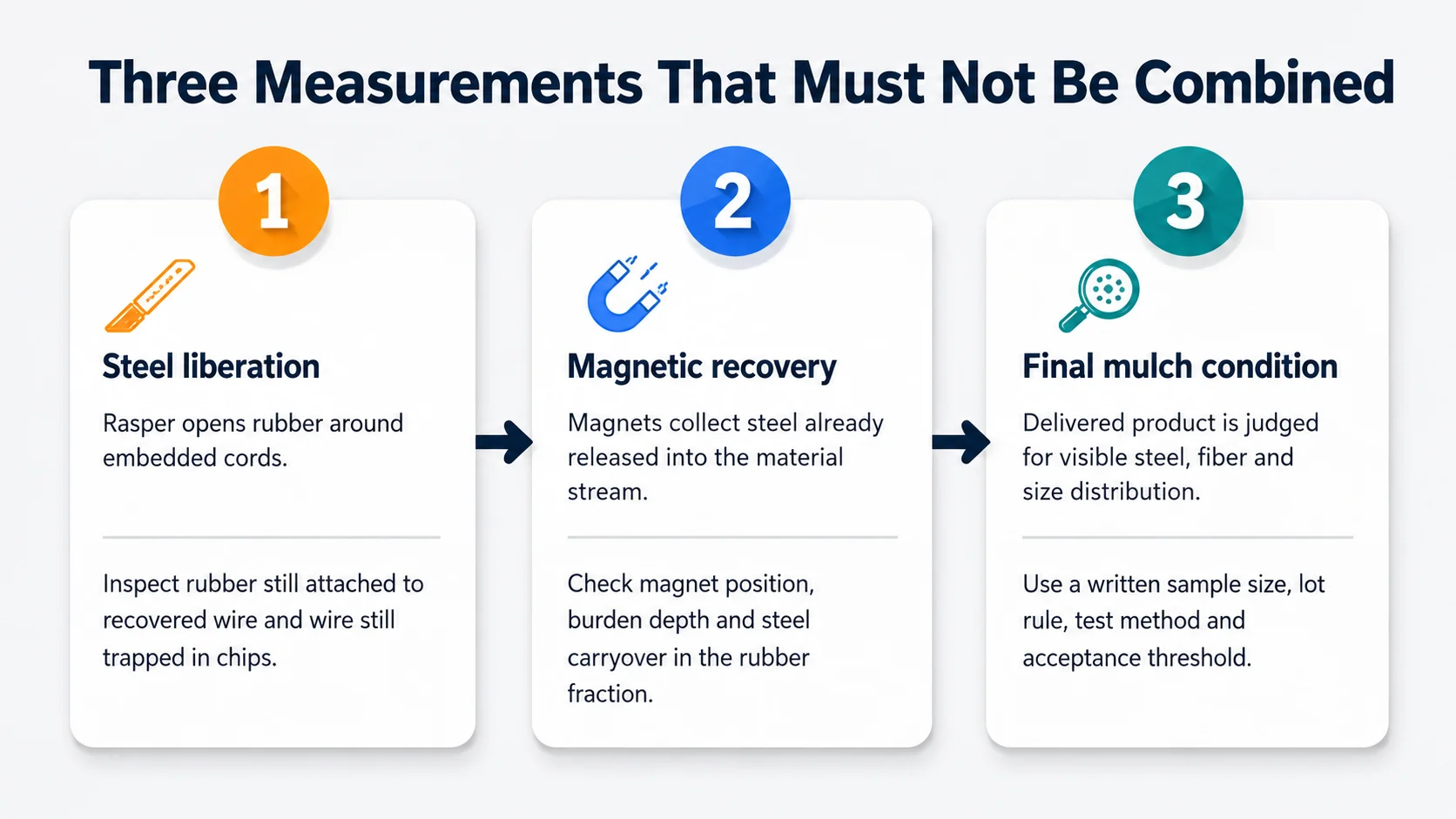
These three measurements describe different boundaries. They should never be added, multiplied or replaced with one undefined “purity” number.
Stage performance is useful for troubleshooting. The customer still buys the final mulch, so product acceptance needs its own test.
1. Steel liberation
Liberation happens during secondary cutting. The rubber around the cords is opened until steel can leave the rubber matrix. A good liberation check looks at both streams: rubber still attached to recovered wire, and wire still embedded in discharged rubber.
2. Magnetic steel recovery
The magnet can only collect ferrous material that is sufficiently exposed and reaches the magnetic field under a manageable material burden. Layer depth, belt speed, magnet position and the shape of released wire all affect recovery.
3. Final mulch quality
This is the delivered product after the configured separation and screening stages. It should be judged for particle-size distribution, visible or sharp metal, any measured metal content, loose textile, foreign contamination and other end-use requirements.
Embedded, Exposed and Loose Steel Are Not the Same Defect
Steel condition
What it looks like
Why it matters
Likely process focus
Embedded steel
Cord remains fully or partly trapped inside a rubber chip.
May not be found by a quick surface inspection; can appear after wear or further cutting.
Rasper feed, knife condition, gap, screen retention and repeat cutting.
Exposed steel
A wire end or strand projects from the rubber surface.
Can be a handling or end-use hazard and is easy to dispute without an inspection rule.
Liberation quality plus final magnetic cleanup.
Loose steel
Detached wire or fragments travel separately in the material.
Should be recoverable magnetically, but may carry over when the burden is deep or the magnet is poorly positioned.
Magnet strength, position, belt speed, burden depth and secondary magnet stage.
Sharp tramp metal
Foreign or tire-derived sharp metal present in the product.
End-use standards may treat sharp tramp metal separately from general metal content.
Feed inspection, separation, product sampling and rejection procedure.
This is why a line test should not rely on one photograph of the magnet discharge. We normally spread a representative product sample on a contrasting surface, turn the pieces, flex suspicious chips and record both the number and condition of findings. Any quantitative method is then applied as a separate check.
Why “Wire-Free” Does Not Mean “Fiber-Free”
Textile reinforcement is nonmagnetic. After the magnet removes liberated steel, the rubber stream can still contain three fiber conditions:
Loose strands: visible cords detach during cutting and travel with the mulch.
Fluff and dust: fine light material accumulates around screens, transfer points and aspiration systems.
Further cutting exposes more fiber, but exposure alone does not remove it. Air velocity, particle shape, moisture, loading rate and separator adjustment determine whether light textile leaves the heavier rubber stream. Surprisingly, an aggressive aspiration setting can also pull away small usable rubber pieces. The aim is not maximum suction; it is a stable separation boundary.
Magnets and air systems solve different problems. A final product specification should therefore contain separate steel and fiber clauses.
For a project that will continue to finer granules, fiber control usually becomes more demanding. The downstream Tire Rubber Crumb Plant uses additional size reduction, screening and separation because finer products expose more reinforcement and require tighter classification.
How a Mulch Line Creates a Wire-Reduced, Lower-Fiber Product
The sequence is staged because no single machine performs all four tasks: size reduction, steel liberation, steel recovery and fiber control. For a configured production route, see YUXI?s Tire Wire Free Mulch Plant.
Primary shredding prepares the feed. Whole tires become rough chips within the accepted rasper envelope.
Rasping performs secondary cutting. Repeated cutting reduces the material toward the mulch range and opens rubber around steel cords.
Magnetic separation recovers liberated steel. A second magnetic pass may be used where the product rule justifies it.
Screening controls size. Oversize returns for another pass; accepted material leaves the circuit.
Air separation controls loose textile. The exact stage depends on the tire mix, product size and buyer’s fiber condition.
Final inspection closes the loop. Findings should feed back to machine settings, wear checks and lot disposition.
A complete whole-tire line and a downstream rasper module can reach the same declared product only when their feed and test boundaries are equivalent. The configuration choice itself is covered in the separate whole-tire line versus rasper module comparison.
How to Read 99%, 97–98% and “99.9% Wire-Free” Claims
Percentages are not automatically wrong. They are incomplete until the denominator and method are known.
Stage percentage
May describe liberated steel or recovered steel under a stated feed and operating condition.
Product percentage
May describe rubber purity, metal content by mass or a supplier-specific wire-free calculation.
Marketing percentage
May be useful only after the supporting test method, sample and detection limit are disclosed.
Ask five questions: What was weighed? What was the sample mass? Was the steel loose, exposed or embedded? How was it detected? Was the result based on incoming feed, recovered steel or accepted finished mulch?
Example: “97–98% steel-wire recovery at the magnetic stage” does not mean “the mulch is 98% rubber.” It describes one stage’s recovery basis. The product can still contain textile, fines, contamination or steel that was never liberated.
How to Write a Useful Wire-Free Mulch Specification
A one-line request—“10–20 mm, wire-free”—leaves too much room for different interpretations. A workable specification should include the following:
Item
What to define
Why it changes the line or test
Feed
Whole tires or chips; passenger/truck mix; maximum chip size; excluded contamination.
Tire construction changes cutting work, steel burden and fiber generation.
Particle size
Target range, allowed oversize, fines limit and measurement method.
Tighter size control increases screening and recirculation.
Visible steel
Whether exposed wire is prohibited; what counts as sharp; inspection surface and lighting.
Creates an objective visual boundary.
Quantitative metal
Maximum metal content, test equipment, sample mass and detection treatment.
May justify additional magnetic cleanup and laboratory checks.
Textile fiber
Acceptable loose strands, fluff, mass fraction or buyer-provided reference sample.
Determines whether aspiration and dust handling are required.
Capacity
Accepted finished mulch per hour, not only incoming feed.
Quality rejects and return load affect saleable output.
Sampling
Lot duration, increment frequency, composite sample, retention sample and retest rule.
Prevents a hand-picked clean sample from representing a full run.
For size distribution, ASTM D5644 provides methods for determining the average particle-size distribution of recycled vulcanizate particulate rubber and can be used as a quality-control reference.2 A mulch contract may use another agreed dimensional method, but it should be written before the factory test.
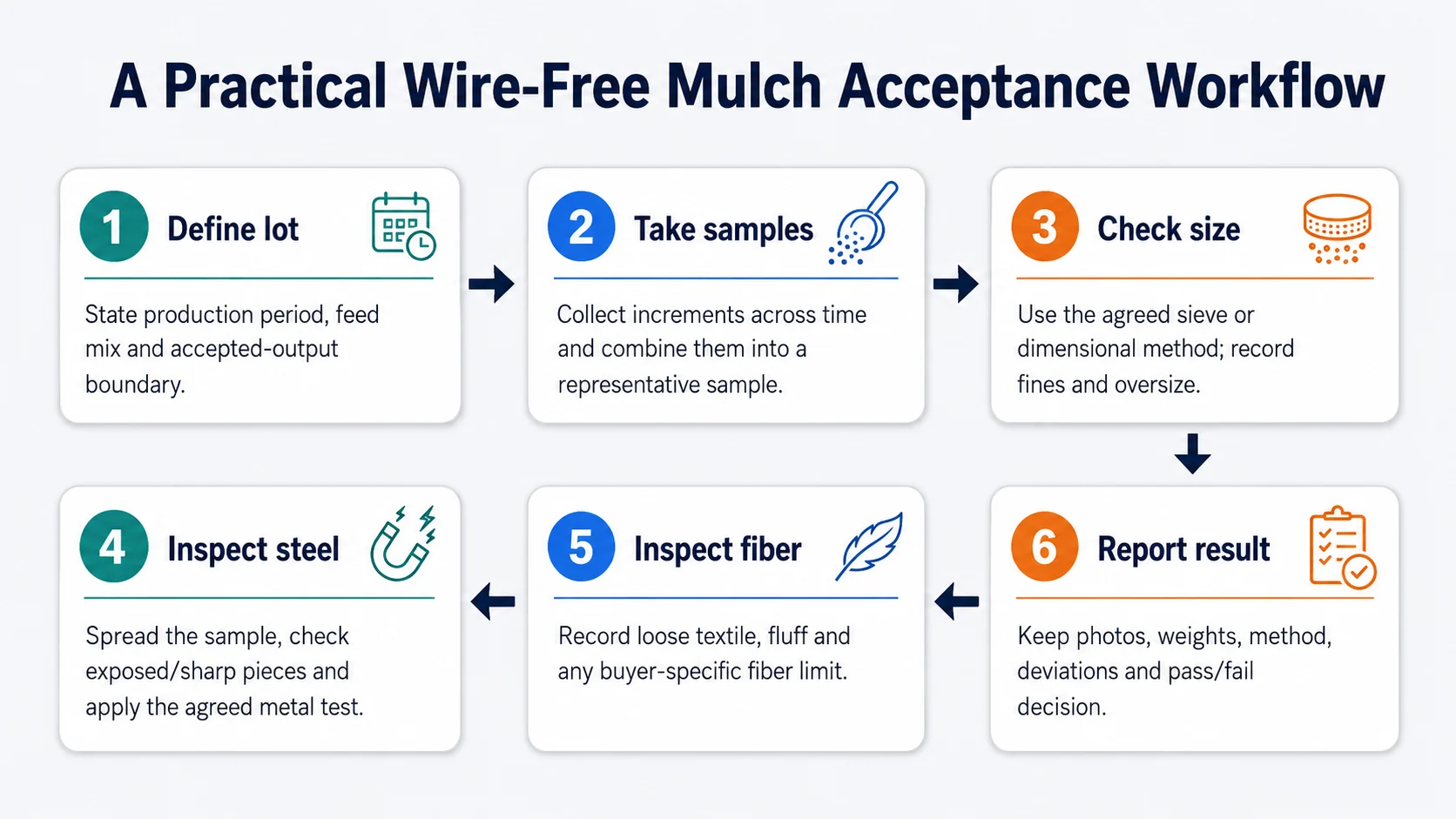
A Practical Acceptance-Test Workflow
Good acceptance testing follows the production lot. It does not begin with a supplier selecting the cleanest handful from the discharge pile.
1. Define the lot and operating condition
Record tire mix, feed preparation, screen, knife condition, magnet arrangement, air-separator setting, net runtime and return load. The line should be stable before acceptance sampling begins.
2. Take increments across time
Collect samples at planned intervals from the accepted-product stream. Combine them into a composite sample large enough for the agreed checks. Keep a sealed retention sample when commercial acceptance depends on the result.
3. Test size before hand sorting
Determine accepted fraction, oversize and fines using the written method. This prevents manual inspection from accidentally removing material that should have been counted in the size result.
4. Inspect and measure steel
Spread the sample, inspect all sides, record exposed and sharp pieces and apply the agreed magnetic or mass-based method. State how embedded steel is handled. Photograph findings beside a scale.
5. Evaluate fiber separately
Record loose strands and fluff using the agreed visual reference or quantitative method. Do not hide fiber results inside a general “purity” figure.
6. Report pass, fail and retest rules
The report should show raw observations, weights, calculations, photos and any deviation from the test plan. A failed lot needs a defined action: reprocess, segregate, downgrade, retest or reject.
Wire-Free Is Not the Same as End-Use Approval
A mulch sample can pass a steel check and still be unsuitable for a particular market. Color, size, chemical testing, impact performance, accessibility, contamination and installation requirements may all sit outside the wire-free definition.
For U.S. playground applications, ASTM F3012 covers performance requirements including particle-size distribution, tramp metal and sharp tramp metal for loose-fill rubber, while installed playground surfacing also has separate impact requirements.3 The CPSC’s 2025 Public Playground Safety Handbook tells purchasers to make sure playground rubber mulch has been tested to ASTM F3012 and ASTM F1292.4
Commercial boundary: equipment suppliers can design and test a processing line against a declared material specification. They should not imply that machine output automatically carries every certification required for landscaping, playground, equestrian or molded-product markets.
Frequently Asked Questions
Does wire-free rubber mulch contain absolutely zero steel?
The term should not be treated as an absolute statement without a test method. A practical specification defines whether exposed or sharp steel is prohibited, whether a measured metal limit applies, how the sample is collected and what happens when a lot fails.
Is wire-free rubber mulch also fiber-free?
No. Steel and textile reinforcement are different fractions. Magnetic separation removes liberated ferrous steel, while loose textile normally requires air separation, aspiration or another fiber-control stage.
What is the difference between steel liberation and steel recovery?
Liberation is the rasper opening rubber around embedded steel. Recovery is the magnetic separator collecting steel that has already been released. A high recovery figure cannot compensate for steel that remains encapsulated in rubber.
Why can fiber remain after the magnet?
Textile is nonmagnetic. It can stay embedded in larger pieces, appear as loose strands or become fluff and dust after size reduction. Its removal depends on particle size, air flow and the configured finishing stage.
How should wire-free mulch be tested?
Define the production lot, collect representative increments over time, combine and weigh the sample, check particle size, inspect for exposed or sharp metal, apply any agreed metal-content method, evaluate loose fiber and record the result with photos and weights.
Does landscaping-grade mulch automatically qualify for playground use?
No. End-use requirements are separate from the word wire-free. In the United States, playground loose-fill rubber should be evaluated against the applicable product and impact standards, including ASTM F3012 and ASTM F1292, as referenced by the CPSC.
What should be included in an RFQ for wire-free rubber mulch equipment?
State the feed route and tire mix, target size distribution, visible-steel rule, any quantitative metal limit, acceptable textile condition, accepted finished capacity, sampling method, test duration and whether the output is sold directly or sent to finer granulation.
Define the Product Before Configuring the Line
Send YUXI your tire mix, feed condition, target mulch range, visible-steel rule, textile-fiber requirement, accepted finished capacity and proposed sampling method. The process scope can then be matched to a testable product rather than a vague purity claim.
Marie has 8+ years of experience in tire shredding and recycling equipment,with a focus on tire shredders,rubber recycling machines,TDF production,rubber crumb processing,and complete tire recycling systems.