




Two rubber mulch quotations can use the same output phrase and still describe different projects. One starts with whole passenger and truck tires. The other starts with chips that have already passed through a primary shredder. The second quotation is naturally smaller, but only because part of the production line sits outside its boundary.
This distinction is easy to miss in a supplier comparison. A buyer sees a rasper, magnets and a screen in both proposals and assumes the front end is optional. In practice, the choice is not “large machine package versus small machine package.” It is a choice about who owns primary size reduction, feed consistency, line balancing and integration risk.
Quick Answer
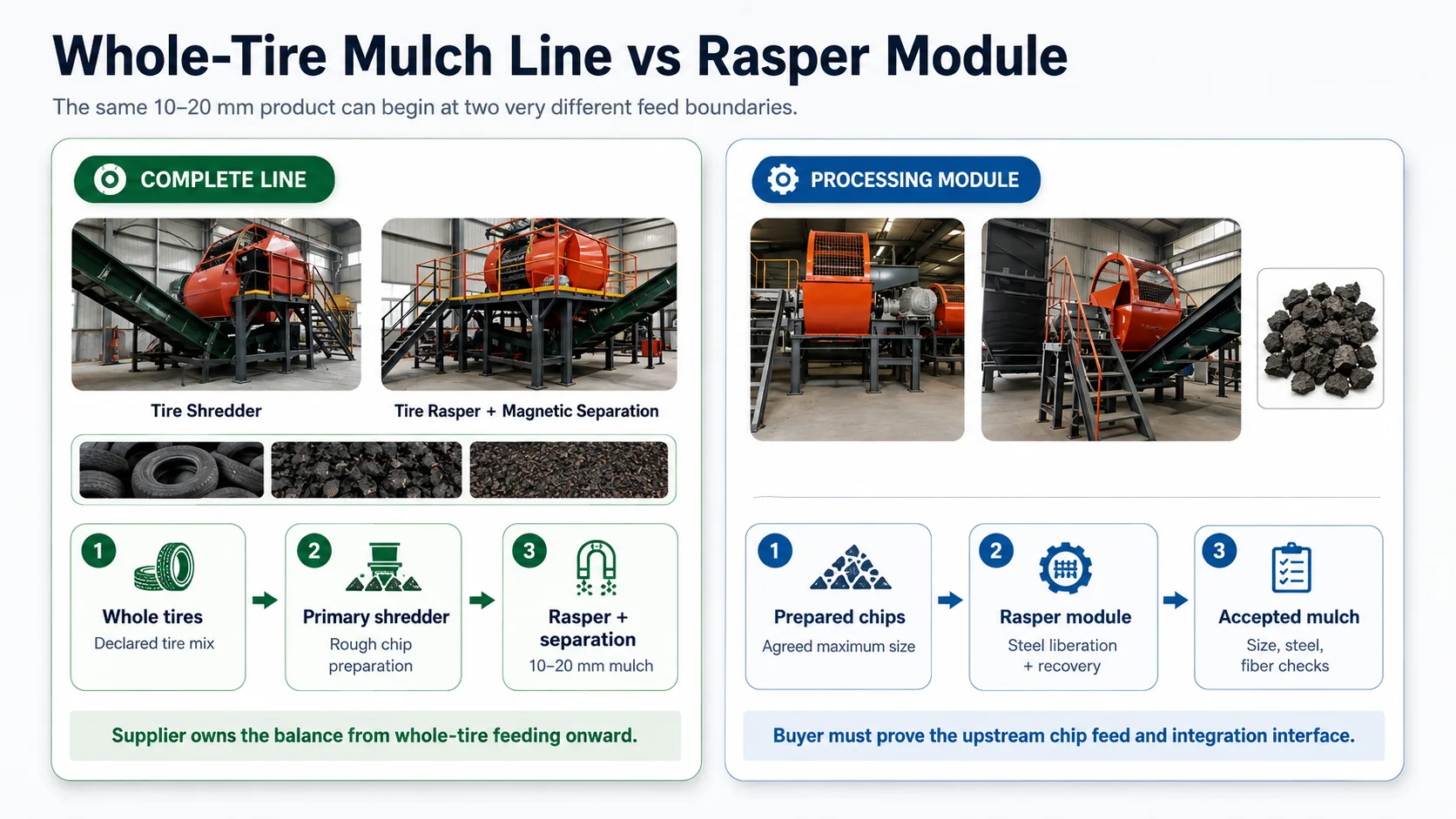
A whole tire rubber mulch production line is the safer fit for a new plant that wants one supplier to accept declared whole tires and deliver an integrated route to approximately 10–20 mm mulch. It normally includes primary shredding, secondary rasping, magnetic steel recovery, screening, oversize return and any fiber-handling stage required by the finished product.
A rasper processing module is the better fit when the site already has a reliable primary shredder and can continuously supply chips within an agreed size and condition. The module may reduce capital scope, floor space and installation work, but it transfers upstream-feed and interface responsibility to the buyer.
On This Page
What Is Included in Each Configuration?
Complete whole-tire rubber mulch production line
The complete whole-tire wire-free mulch plant begins where the recycler receives tires. Its front end has to meter bulky, elastic material into a primary size-reduction stage. The primary tire shredder prepares rough chips that the rasper can process more consistently. The downstream stages then reduce the chips again, release embedded steel, recover that steel and control the finished size.
A typical complete scope contains:
- Whole-tire infeed and primary tire shredding
- Transfer conveyors and surge control between stages
- Tire rasper for secondary cutting and steel liberation
- Magnetic separation for liberated steel
- Screening and automatic oversize return where tighter size control is required
- Optional fiber separation and dust collection connections
- Integrated controls, interlocks, platforms, guards and access provisions
The commercial advantage is not simply that more equipment is included. One party can balance the shredder discharge, conveyor rate, rasper load, magnetic-separation capacity and return loop around the declared tire mix.
Rasper processing module
The module starts later. It receives prepared chips instead of whole tires.
A typical module contains:
- Metered infeed for pre-shredded tire chips
- Rasper for secondary size reduction and steel liberation
- One or more magnetic-separation stages as specified
- Screening and oversize return
- Optional fiber separation and collection
- Local or integrated controls, guarding and maintenance access
What it usually omits is just as important: whole-tire feeding, the primary shredder, some front-end conveyors and the responsibility for producing stable rasper feed. Those items do not disappear. They remain in the existing plant or become the buyer’s integration work.
Whole-Tire Line vs Rasper Module: Side-by-Side Comparison
| Decision factor | Complete whole-tire line | Rasper processing module |
|---|---|---|
| Quoted feed | Declared whole passenger or truck tires, plus any agreed prepared larger tires | Pre-shredded chips within a written size, shape and condition envelope |
| Primary size reduction | Included and balanced with the downstream system | Provided by the buyer’s existing shredder or another upstream supplier |
| Best project type | Greenfield plant, major capacity expansion or site without dependable chip supply | Upgrade where a proven shredder already produces consistent chips |
| Integration responsibility | More concentrated with the complete-line supplier | Shared between module supplier, existing-equipment owner and site integrator |
| Capital scope | Higher because the whole-tire front end is included | Lower only if existing upstream equipment is suitable and available |
| Capacity risk | Incorrect tire-mix assumptions or poor overall line balance | Oversized, irregular or intermittent incoming chips |
| Acceptance test | Can begin with representative whole tires and end with accepted mulch | Must separately prove the incoming chip specification and module output |
| Future changes | Easier to design as one expandable system | Flexible, but interfaces and spare utilities must be planned deliberately |
The Feed Boundary Decides Whether the Module Is Really Smaller
A module quotation is attractive because it removes the most obvious front-end machine. The problem appears when “pre-shredded chips” is treated as a complete specification. It is not.
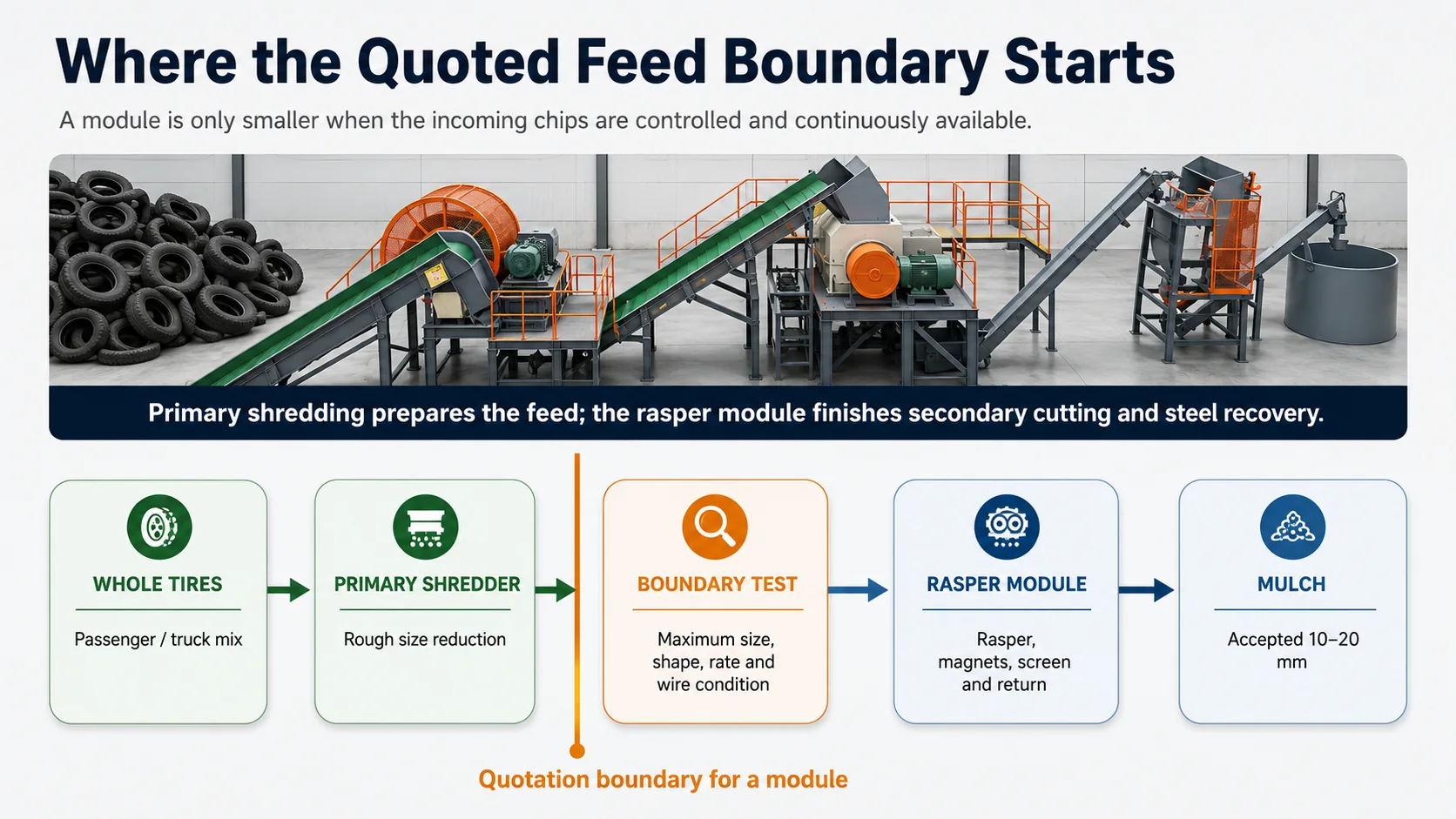
Maximum chip dimensions
One dimension alone can hide long strips. A chip may be narrow enough to pass a ruler check yet still bridge a chute, wrap around a shaft or create an uneven bite in the rasper. State the maximum length, width and thickness, and include a rule for strips, sidewall rings and pieces with long exposed wire.
Chip shape and bulk behavior
Flat tread pieces, curled sidewalls and compact irregular blocks do not flow in the same way. Bulk density and bridging behavior affect conveyor loading, surge capacity and the apparent tons per hour at the rasper inlet. Photographs of the best chips are not enough. Review the least consistent material the upstream system produces.
Tire mix behind the chips
Passenger-tire chips and heavily reinforced truck-tire chips create different cutting loads. The module supplier needs the percentage of each tire category, not only the average chip size. A test based on clean passenger-tire material may not represent a plant that normally handles a high truck-tire share.
Hourly availability and surges
An upstream shredder may have adequate daily tonnage but deliver it in short campaigns. The rasper module then alternates between starvation and overload. A buffer or controlled feed conveyor can solve part of the problem, but it belongs in the engineering scope and floor plan.
Practical proposal check: send a one-hour production record from the existing shredder, a mixed chip sample, images with a scale, the largest recurring pieces and the longest exposed steel observed. That package is more useful than a single “under 100 mm” statement.
Capacity Must Be Compared at the Accepted Mulch Discharge
Accepted mulch capacity = saleable product mass passing the agreed size, steel and fiber checks ÷ measured net production time
For a complete line, suppliers sometimes quote the mass entering the whole-tire shredder. For a module, they may quote the chips entering the rasper. Neither figure automatically equals the accepted 10–20 mm mulch leaving after oversize return, recovered steel, textile removal and rejects.
Why tighter size control changes the result
A screen does not create capacity. It separates acceptable material from oversize. When a tight specification sends more material back to the rasper, the circulating load rises. The machine cuts part of the same mass again, so saleable tons per hour may fall even when the rasper drive is fully loaded.
Why the complete line can be easier to balance
The complete-line supplier can select the primary-shredder discharge, conveyor widths, buffer volume and rasper feed rate as one system. This does not remove the need for a proper test, but it reduces the number of undocumented interfaces.
Why a module can still perform very well
A module is not a compromise when its feed is controlled. In fact, an existing facility may already know its chip distribution, hourly variation and tire mix better than a greenfield project. In that situation, adding a dedicated rasper, magnets and screen-return loop can be the cleanest expansion route.
Do not accept this comparison: “5 t/h complete line” versus “5 t/h rasper.” Ask whether both values mean accepted finished mulch under the same tire mix, screen, oversize tolerance, runtime and product-quality test.
A Module Transfers Integration Work; It Does Not Eliminate It
The mechanical equipment list is only one layer of the upgrade. A module must connect to an existing plant physically, electrically and operationally. The following interfaces should be frozen before fabrication.
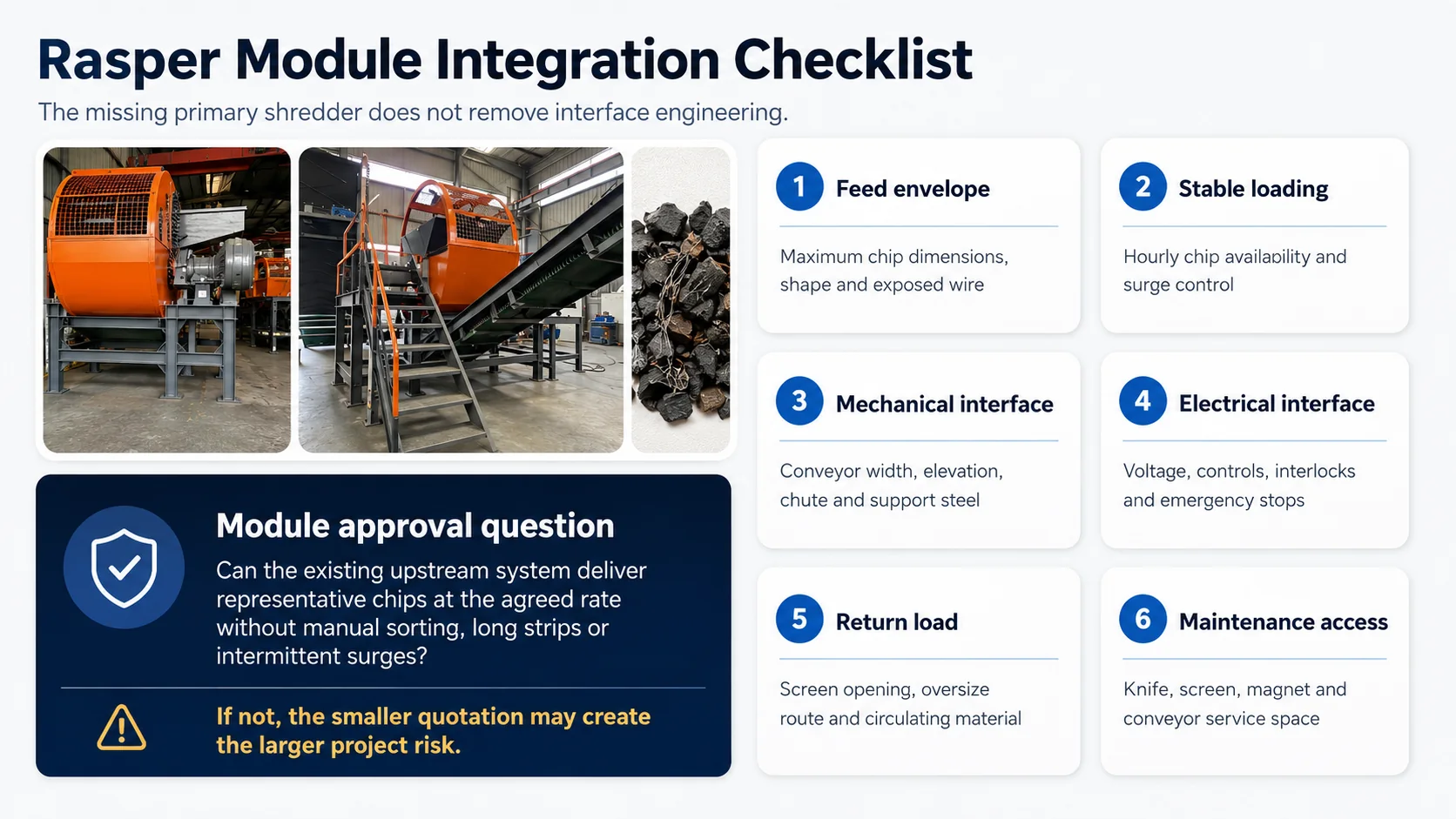
Mechanical interfaces
Confirm conveyor width, discharge elevation, chute angles, support steel, access platforms, foundation loads and space to remove screens or service cutters. A layout that fits during operation can still fail during maintenance.
Electrical and control interfaces
Define voltage and frequency, motor starting method, overload logic, upstream and downstream interlocks, emergency-stop zones, local/manual modes and restart sequence after a trip.
Material-flow interfaces
State how the module reacts to starvation, surges, magnet overload, screen blockage and a full return conveyor. The control philosophy should prevent one problem from becoming a line-wide jam.
Service responsibility
Identify who supplies installation supervision, cable, field sensors, control modifications, commissioning tires, performance testing and operator training.
Safety scope must also be integrated rather than assumed. OSHA’s general machine-guarding rule requires protection from hazards such as ingoing nip points, rotating parts and flying material.4 OSHA’s hazardous-energy guidance also requires control procedures where employees may be exposed during servicing or maintenance.5 Local legal requirements control the final installation, but a quotation should still show guards, access doors, isolation points and maintenance clearances.
Upgrade trap: keeping an old conveyor because it “still runs” may save one purchase item while creating an undersized transfer point, an unguarded nip area or a control gap. Evaluate interfaces by the new duty, not by whether the old component can move.
Both Configurations Need the Same Finished-Product Definition
CalRecycle describes tire-derived material as tires processed to meet market specifications. That market-first principle matters here: the production line should be selected around the product a buyer will accept, not around the broad label “rubber mulch.”2
Particle-size distribution
The YUXI line is organized around approximately 10–20 mm rubber mulch. A purchase specification should add the test sieve or measurement method, sample mass, allowed oversize and treatment of elongated pieces. “Screen opening” and “finished product size” are related but not identical statements.
Steel liberation and magnetic recovery
The rasper cuts rubber away from embedded steel. The magnetic system then collects steel that has been released. These are separate functions. Final mulch quality is a third measurement. Do not convert a stage liberation figure or magnetic-recovery percentage into an unsupported overall purity claim.
Textile condition
After steel recovery, textile cord may remain. Landscaping mulch, horse-arena footing and material intended for later granulation may use different limits. If lower textile content is required, specify the air-separation stage, collection method and finished-product test.
End-use requirements
The U.S. EPA handbook treats scrap-tire processing as mechanical size reduction for recycling, energy recovery or disposal and distinguishes screened shred sizes and finer particulate-rubber products.1 The intended market therefore changes how far the line must process the material.
For playground surfacing, the 2025 U.S. Consumer Product Safety Commission handbook says rubber mulch products designed for playground use should be tested to ASTM F3012 and ASTM F1292; it also warns against relying on untested material.3 A recycling machine supplier can design for size and separation targets, but the product manufacturer or seller still has to verify the end-use standard and local requirements.
Which Configuration Fits Your Project?
Choose the complete whole-tire line when:
- The project is greenfield and has no proven upstream shredder.
- You want one supplier to balance primary shredding, rasping, separation and return flow.
- The incoming tire mix is broad or may include a significant truck-tire share.
- The existing equipment is undersized, poorly documented or difficult to integrate safely.
- The acceptance test should begin with whole tires and end with finished mulch.
Choose the rasper processing module when:
- An existing primary shredder already produces a stable chip feed.
- Chip dimensions, tire mix and hourly availability have been measured.
- The site has suitable conveyors, utilities, controls and maintenance space.
- The main project goal is better steel liberation, magnetic recovery and size control.
- The buyer has an experienced integration team or assigns one supplier clear interface responsibility.
Pause the purchase and test first when:
- The feed is described only as “tire chips” with no dimensional record.
- Long strips, bead rings or heavy exposed wire appear regularly.
- The existing shredder’s output changes sharply with passenger and truck tires.
- The supplier cannot state whether capacity is feed rate or accepted mulch rate.
- No one owns the screen-return, emergency-stop or control-integration design.
Best phased-expansion route: a module can be an excellent first upgrade when the existing shredder is genuinely suitable. Reserve floor space, electrical capacity, conveyor interfaces and controls for later fiber separation or finer granulation instead of relying on an undefined promise that the line is “expandable.”
How to Compare the Two Quotations Fairly
Before comparing totals, normalize the material boundary. The rubber mulch machine price guide explains the broader budget and landed-cost structure. For this configuration decision, place the following items in one comparison sheet.
| Quotation field | Required comparison basis |
|---|---|
| Incoming material | Whole tires or chips; tire categories and percentages; maximum dimensions; contamination and exposed-wire condition |
| Finished product | Target size band, oversize tolerance, visible-steel criterion, textile criterion and sampling method |
| Capacity | Accepted finished mulch t/h, continuous test time, net-runtime definition and return-load treatment |
| Equipment scope | Shredder, rasper, magnets, screen, return conveyor, fiber stage, dust connections, platforms and guards |
| Controls | PLC or local control, interlocks, overload sequence, emergency stops, remote support and field wiring |
| Site interfaces | Foundations, support steel, chutes, cable, transformer, cranes, installation labor and utilities |
| Wear and service | Commissioning spares, first wear set, recommended stock, training, supervision and response scope |
| Acceptance test | Representative feed, sample size, runtime, measurement methods and remedy if performance is missed |
The module quotation should also list the upstream conditions it assumes. That prevents a later dispute where the module supplier attributes poor output to irregular chips while the buyer assumes any shredder discharge should have been acceptable.
Use a Factory Acceptance Test That Follows the Quoted Boundary
A complete line and a module need related but not identical tests. The complete line can be tested from representative whole-tire feeding. The module test begins with an approved chip sample, so that sample becomes part of the contract basis.
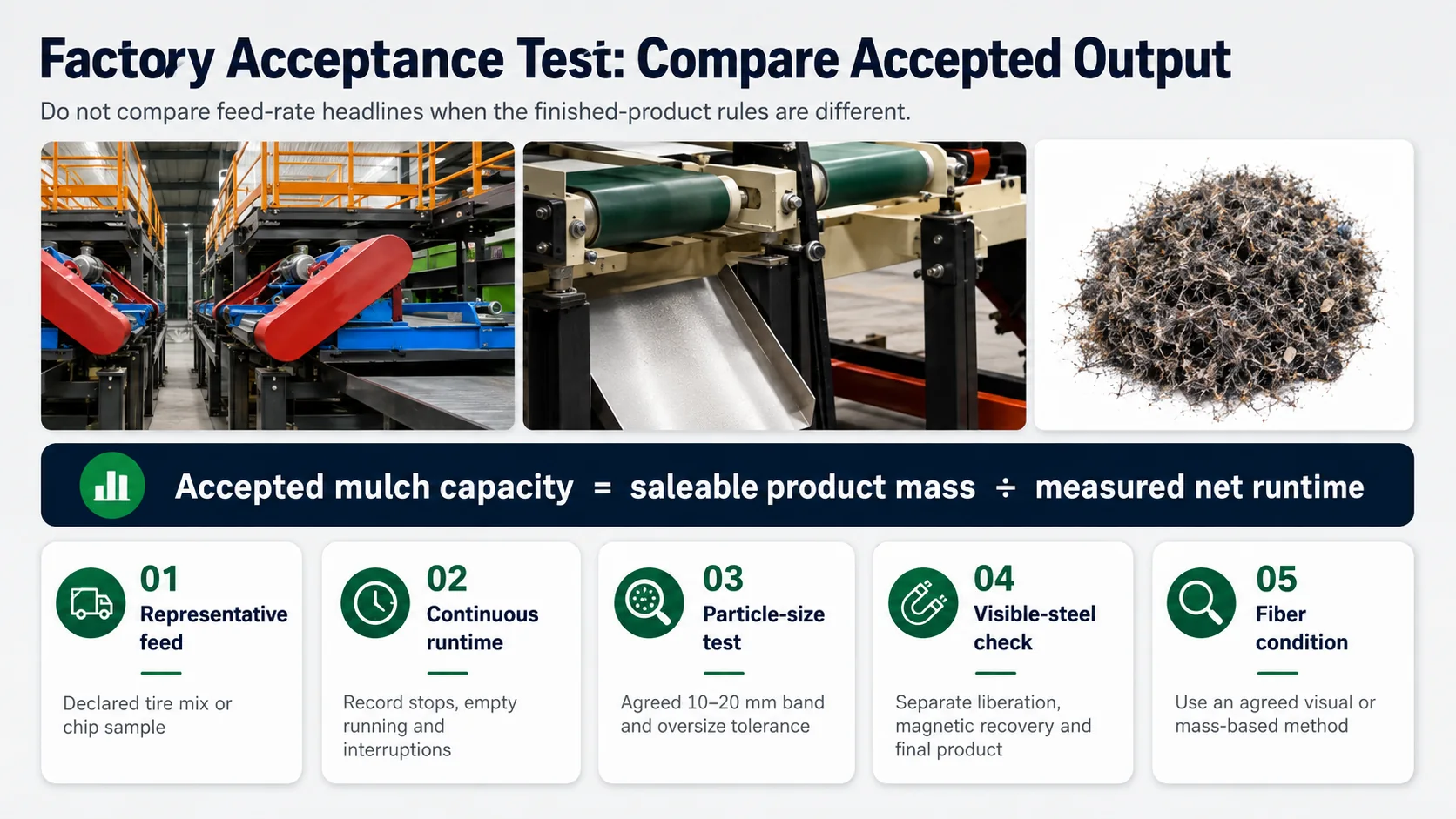
Recommended test sequence
- Approve the feed. Record tire mix for the complete line or chip dimensions and condition for the module.
- Run continuously. State warm-up time, measurement period, empty running, stops and operator interventions.
- Weigh accepted product. Keep oversize return, recovered steel, fiber and rejects outside the saleable-mulch mass.
- Test size distribution. Use the agreed method and sample mass rather than visual judgment alone.
- Inspect steel and fiber. Report final product condition separately from rasper liberation and magnetic recovery.
- Review access and controls. Demonstrate safe shutdown, isolation points, screen access, magnet cleaning and common fault recovery.
We normally recommend attaching photographs of the test feed and retained samples to the report. Material descriptions drift quickly after a project leaves the factory. A visual record makes the acceptance basis easier to understand during commissioning.
FAQ
What is the main difference between a whole-tire mulch line and a rasper module?
A whole-tire line accepts declared whole tires and includes primary shredding before rasping and separation. A rasper module begins with pre-shredded chips, so the buyer or an existing upstream system is responsible for chip size, shape, rate and condition.
Can a rasper processing module accept whole tires?
No. A rasper is a secondary size-reduction and steel-liberation stage. Whole tires require primary shredding or another project-approved preparation route before the material enters the module.
When is a rasper module the better choice?
It is usually the better fit when an existing shredder already produces a stable, documented chip feed and the project mainly needs secondary cutting, magnetic steel recovery, screening and optional fiber handling.
Does a complete line always have higher finished capacity?
Not automatically. Finished capacity depends on the tire mix, target size, screen setting, return load, blade condition and quality acceptance rules. The advantage of a complete line is that one system can be balanced around the declared feed and output.
How should the two quotations be compared?
Compare the same feed boundary, accepted finished mulch capacity, size distribution, visible-steel and fiber condition, screen-return scope, controls, guarding, spares, commissioning and continuous acceptance-test basis.
What should be tested before buying only the module?
Run representative chips through the proposed module or provide samples and detailed records. Confirm maximum dimensions, long strips, exposed wire, bulk density, hourly availability, surge behavior and the accepted 10–20 mm product test.
Sources and Engineering References
- U.S. EPA, Scrap Tires: Handbook on Recycling Applications and Management for the U.S. and Mexico. Scrap-tire processing, screen sizing and particulate-rubber terminology.
- CalRecycle, Waste Tire Market Report 2023. Tire-derived materials are processed to meet market specifications.
- U.S. Consumer Product Safety Commission, Public Playground Safety Handbook, 2025. Testing and end-use guidance for rubber mulch playground surfacing.
- OSHA 29 CFR 1910.212, General Requirements for All Machines. Machine-guarding requirements.
- OSHA, Control of Hazardous Energy (Lockout/Tagout). Hazardous-energy control during servicing and maintenance.
Choose the Correct Mulch Line Boundary
Send your tire mix or representative chip sample, target 10–20 mm product, accepted finished capacity, steel and fiber criteria, existing equipment list, power supply and floor plan. YUXI can compare a complete whole-tire line with a downstream rasper module on the same engineering basis.