In the tire recycling workshop, the shredder is often accused of slow output,heated bearing,wear of the knife or dirty rubber sheets.But sometimes the problem starts earlier:the steel bead has never been processed before the tire reaches the cutting room.
Bead cutting is a front-end decision that affects cutter stress, feeding rhythm and downstream material cleanliness.
Quick answer: why remove tire beads before shredding?
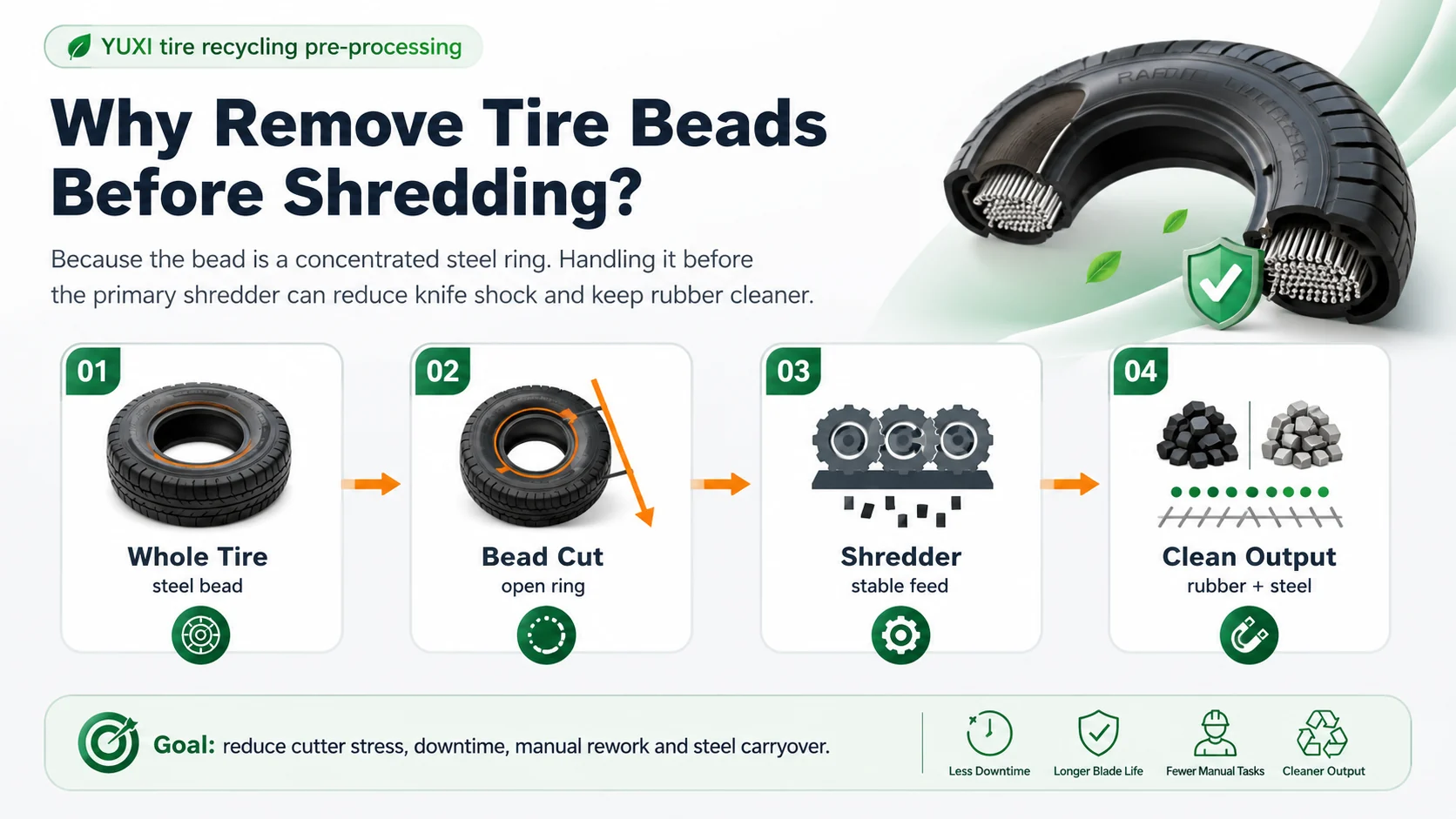
Remove or cut tire beads before shredding because the bead is a concentrated steel-wire ring embedded in a thick, elastic sidewall zone. If that ring enters the primary shredder intact, it can increase impact load on the cutters, accelerate localized blade wear, make feeding less predictable, and send more steel contamination into the downstream rubber stream.
That does not mean every tire line must use the same pre-treatment route. Some projects shred small passenger tires directly. But when the feed includes truck tires, bus tires, all-steel radial tires, mixed stockpiles, thicker sidewalls or stricter rubber cleanliness requirements, bead pre-processing becomes one of the highest-leverage steps before heavy size reduction.
Practical rule: do not ask only “Can the shredder cut it?” Ask “What will this bead wire do to blade life, feeding stability, steel separation, labor and product quality over thousands of tires?”
What is the tire bead, and why is it different from ordinary rubber?
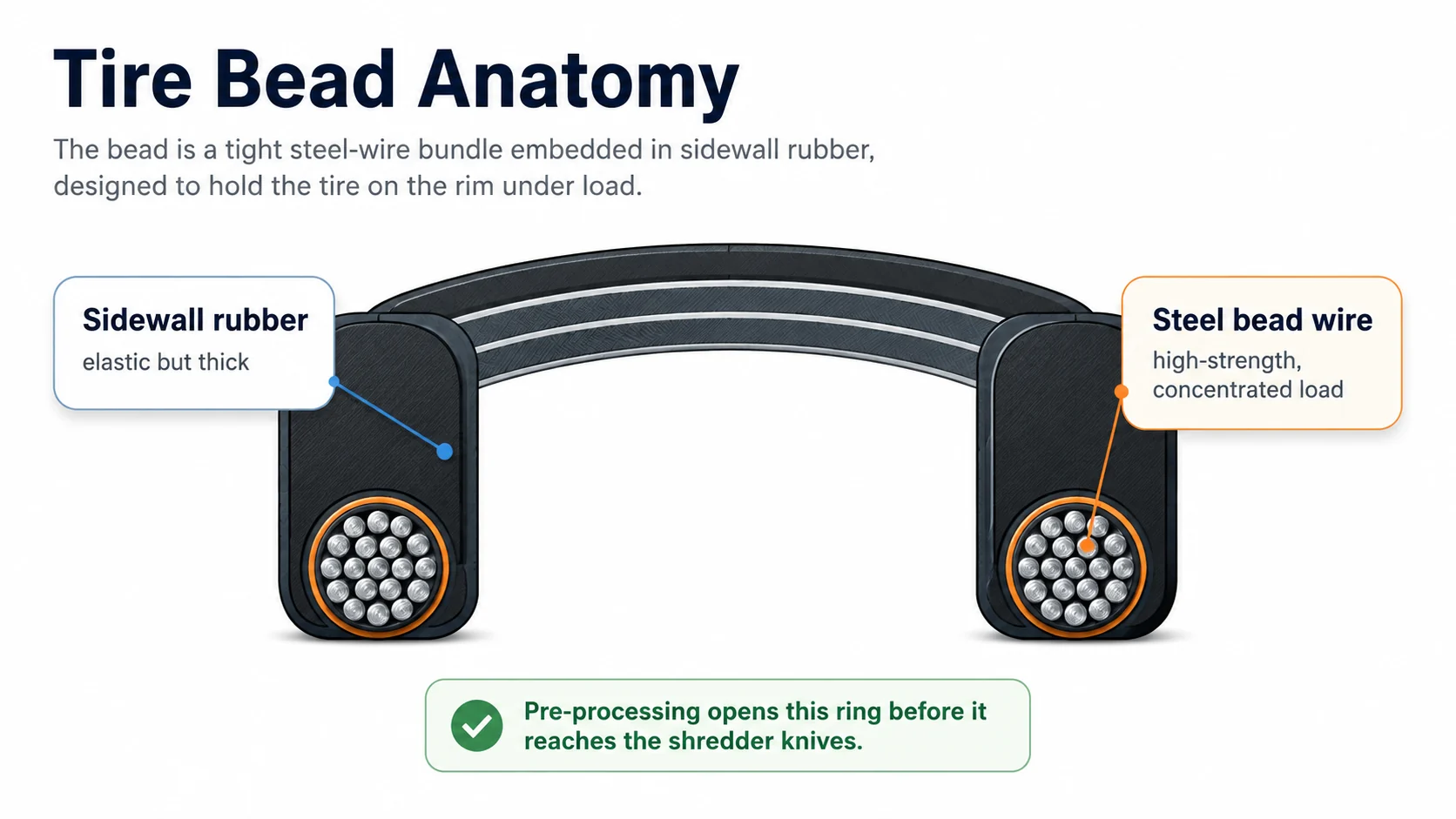
A tire bead is the reinforced inner edge that locks the tire to the wheel rim. Bead-wire manufacturers describe tire bead wire as high-carbon steel designed to anchor the tire securely to the rim and handle different tensile-strength requirements across passenger, truck, bus and OTR tires. Bekaert’s bead-wire information is a useful reference for understanding why this part of the tire is intentionally strong.
In recycling, that strength becomes a processing problem. The study of ultra-heavy mining waste tires in the Scientific Report describes the beads as the key tire components that fix the tires on the rim;it also points out that in the tire recycling plant,separating the beads before cutting and chopping can produce cleaner final products and reduce the wear of mobile shredder parts. Scientific Reports, 2025.
The bead area concentrates steel wire in a tight ring. That concentration is the reason it behaves differently from the tread or ordinary rubber pieces inside a shredder.
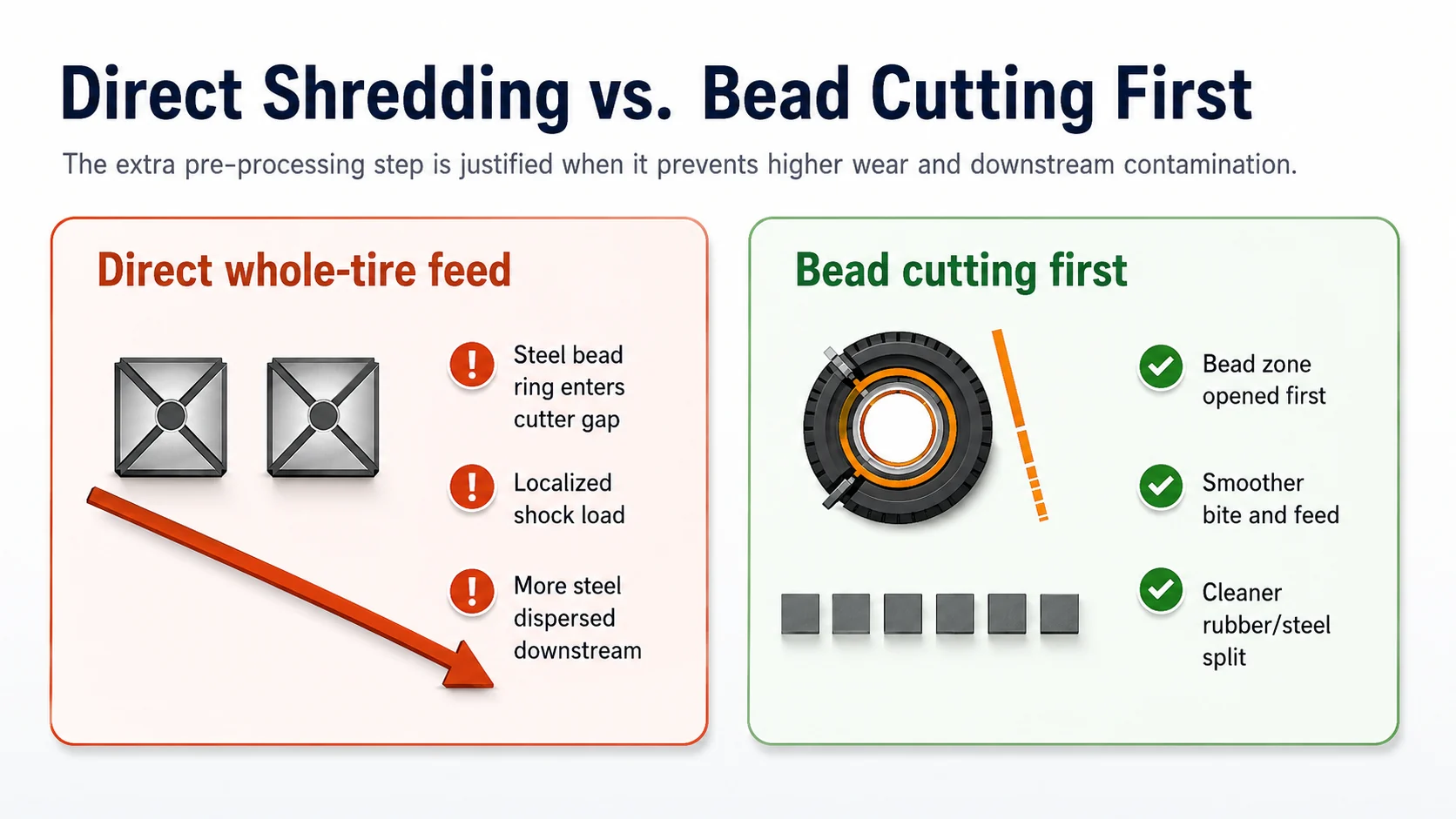
A primary tire shredder is usually built for low-speed, high-torque shearing of rubber, fabric and exposed steel wire. The issue is not that steel is present at all. The issue is concentration. Steel belts distributed through the tire body create one type of load. A bead ring, still locked into a circular bundle, can create a more sudden, localized load when it meets the knife gap.
Six reasons to remove or cut tire beads before shredding
1. Reduce direct impact on shredder knives
Shredder blades fail faster when they repeatedly meet hard, concentrated material instead of a more open rubber structure. The bead ring is one of the most concentrated steel zones in a tire. Pre-cutting or removing it does not eliminate normal wear, but it can reduce the number of severe contact events that shorten blade life or force earlier sharpening and replacement.
2. Make tire feeding more predictable
Whole tires are elastic. They flex, rebound and sometimes rotate at an awkward angle as the shafts pull them into the cutting chamber. When the bead is intact, the tire can resist deformation at exactly the moment the shredder tries to bite. Opening the bead/sidewall section first helps the tire collapse and feed more consistently.
3. Lower the risk of jamming and overload stops
A jam is not only a lost minute. It interrupts the feeding rhythm, increases the exposure of the operator during the cleaning process,and can hide secondary problems such as hot bearings,motor overload or tool damage. Bead pre-processing reduces one common source of sudden resistance, especially in truck and bus tire streams.
4. Improve rubber stream cleanliness
If the final product is crumb rubber, rubber granules, rubber powder or wire-free mulch, steel contamination matters. Removing or isolating the bead section earlier keeps a large steel-rich fraction from being broken into many small pieces that must be captured later by magnets and screening. It is not a substitute for downstream magnetic separation, but it makes the downstream job easier.
5. Recover a more visible steel fraction
The bead section contains steel wire that has value as a recovered metal fraction when handled properly. If the bead is shredded directly into mixed rubber chips, the steel still exists, but it is more dispersed. Pre-processing makes the steel-rich material easier to identify, collect and route to the correct recovery step.
6. Match TDF and material-recycling specifications more easily
For tire-derived fuel, the U.S. EPA notes that scrap tires are often reduced in size for combustion units and may require additional physical processing such as de-wiring. EPA TDF background. For ground rubber or crumb rubber, cleaner feedstock is even more important because buyers are usually more sensitive to residual steel and fiber.
Direct shredding may look simpler at the front end, but bead pre-processing can prevent expensive problems from moving downstream.
Is bead removal always necessary before shredding?
No. A serious answer depends on the tire stream and the business goal. Some primary tire shredders are configured to process whole passenger tires, especially where the output is rough shreds or TDF chips and the downstream system includes magnetic separation. For small, uniform passenger tire streams, direct shredding may be acceptable if the shredder supplier confirms it and the operating cost is understood.
Bead cutting becomes more important when one or more of the following conditions apply:
Truck, bus or all-steel radial tires make up a large share of the feed.
The tire sidewall is thick, stiff or difficult for operators to deform by hand.
The shredder has frequent reverse cycles, overload stops or uneven feeding.
The plant needs cleaner rubber chips, crumb rubber or powder feedstock.
Blade sharpening, replacement or downtime has become a major cost.
The line is planned for export markets or customer contracts with steel-content limits.
Project condition
Direct shredding may be acceptable when…
Bead pre-processing is recommended when…
Passenger tires
Feed is uniform, small and matched to a heavy-duty tire shredder.
Rubber cleanliness or blade-life cost matters more than labor simplicity.
Truck / bus tires
The shredder is specifically configured for this feed and wear cost is budgeted.
Bead bundles cause shock load, feed instability or frequent maintenance.
OTR or very large tires
Rarely direct; usually needs project-specific feeding and cutting design.
Pre-cutting, bead handling and customized handling equipment are usually required.
TDF chips
Wire tolerance is accepted by the buyer and downstream magnets are adequate.
The TDF buyer requires lower wire content or more consistent chip quality.
Crumb rubber / powder
Only if downstream liberation and separation can meet purity requirements.
Cleaner rubber feed, lower steel carryover and lower granulator wear are priorities.
Where the YUXI waste tire bead cutting machine fits
YUXI’s waste tire bead cutting machine is positioned as pre-processing equipment for cutting the bead ring and sidewall section before tire cutting, tire shredding, rubber granule production or pyrolysis pre-treatment. On the product page, YUXI explained that the machine can handle high-strength bead area,so the remaining tires are easier to cut, shred or granule.
Its working principle is very simple: the operator puts the tire on the rotary table, aligns the bead area with the cutting point,clamps/positions the structure to fix the tire, and as the tire rotates,the cutter enters the bead or sidewall area. The result is a separated bead/sidewall section and a tire body that is easier to send to the next machine.
Important boundary: bead cutting is not the same as removing every steel wire from the tire. YUXI notes that the steel wire may remain embedded in the bead rubber and may need a tire wire drawing machine, bead wire separator, shredding, crushing or magnetic separation for further recovery.
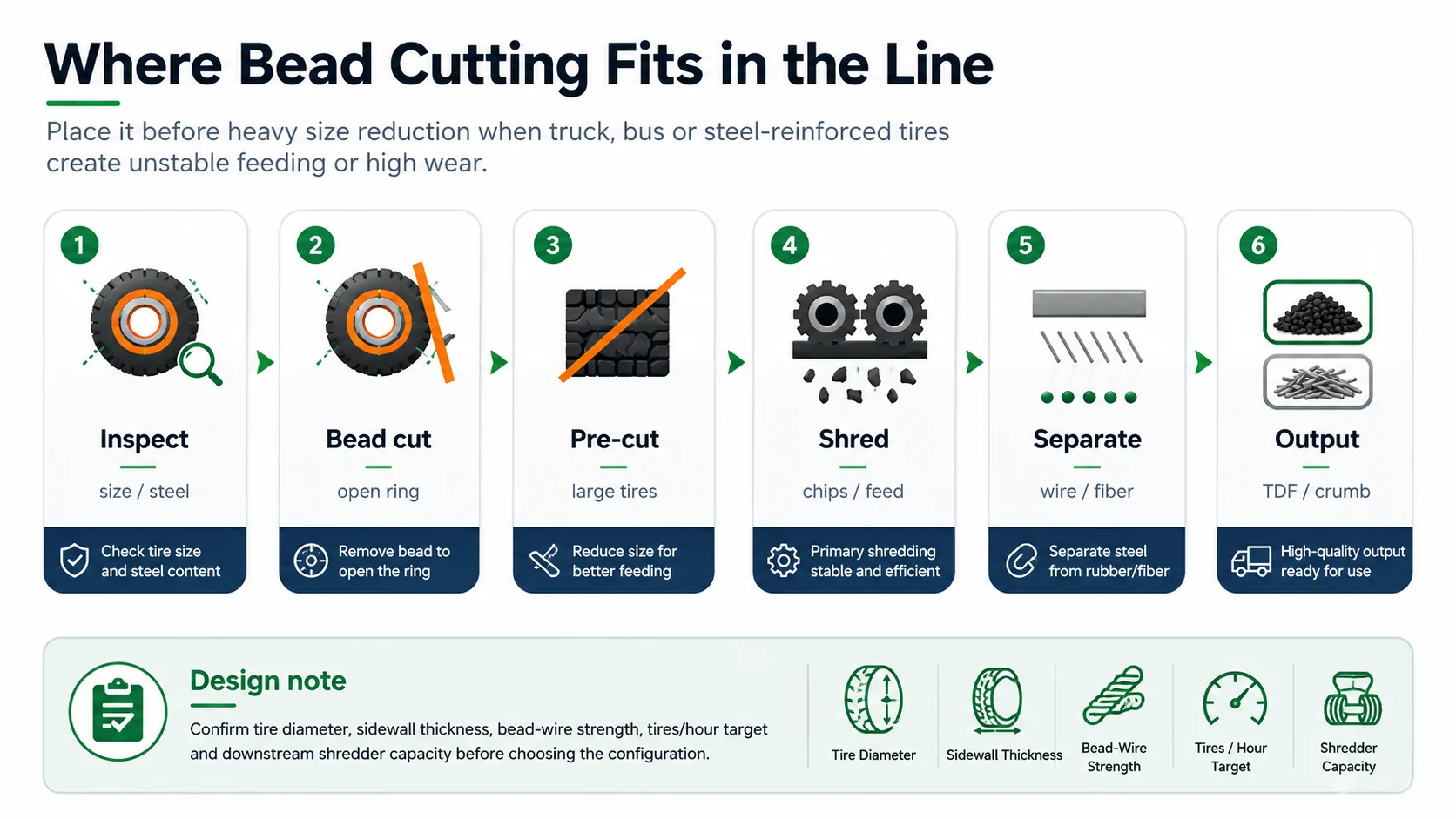
In a typical line, the bead cutter works before the tire shredder machine. For larger or irregular tire streams, it may be paired with a hydraulic tire cutting machine so oversized tires are opened into sections before primary shredding.
A bead cutter should be matched with tire storage, operator position, downstream shredder capacity and the final product route.
Bead cutter, debeader, sidewall cutter: do they mean the same thing?
These terms often overlap in supplier pages, but they do not always describe the same output. The safest way to compare equipment is to ask what leaves the machine after one cycle.
Term
Typical function
What to confirm before buying
Tire bead cutting machine
Cuts around the bead/sidewall section and opens or separates the bead-rich part from the tire body.
Can it process your maximum tire diameter, sidewall thickness and bead strength? Does it cut one side or both sides?
Tire sidewall cutter
Often similar to a bead cutter; may remove the sidewall ring rather than pull out loose wire.
Does the steel bead remain embedded in rubber? What is the next recovery step?
Tire debeader / wire drawing machine
Pulls steel bead wire from the tire or from a prepared bead ring.
What tire sizes are supported? How clean is the wire output? Is pre-cutting needed first?
Tire steel wire separator
May refer to downstream separation of exposed steel from shredded or granulated rubber.
What is the input material: whole tire, bead ring, shredded chips or rubber granules?
For YUXI’s bead cutting page, the verified function is bead ring and sidewall section cutting before downstream processing. If the project goal is clean bead-wire extraction, the configuration should be confirmed with tire photos and the target recovery route rather than assumed from the machine name.
How to decide whether your line needs bead pre-processing
Start with feed reality, not catalog capacity
Capacity figures can be misleading if they ignore the material mix. A line fed by uniform passenger tires behaves differently from a line that receives mixed truck, bus, agricultural and damaged tires. Before choosing a bead cutter, list the tire types and estimate the share of each category. A few heavy tires can create more disruption than a large quantity of light passenger tires.
Check current operating symptoms
If an existing line is already running, bead problems often show up as repeated reverse cycles, visible knife edge damage, material bouncing at the feed opening, operators slowing the feed rate, steel carryover after magnetic separation, or granulator blade wear that is higher than expected.
Connect the decision to the final product
A rough shred line, a TDF line, a rubber crumb plant and a rubber powder plant do not need the same level of steel control. The U.S. EPA’s TDF FAQ describes TDF as a viable alternative fuel used in energy-intensive facilities, but it also shows that the intended market matters. EPA TDF FAQ. Material recycling routes usually require tighter control of residual steel and fiber than rough size-reduction routes.
Include safety in the workflow design
Bead cutting and tire shredding involve rotating parts, cutting points, clamping force and stored energy. OSHA’s machine protection rules require protecting workers from hazards such as operating points, feeding points, rotating parts, flying chips and sparks. OSHA 29 CFR 1910.212. For servicing, jam clearing and maintenance, OSHA’s lockout/tagout standard covers control of hazardous energy and verification before work. OSHA 29 CFR 1910.147.
Publishing note: this article explains process logic. The final plant design should still follow local safety rules, machine guarding requirements, electrical standards and operator training requirements in the destination market.
Required output after bead cutting: one sidewall removed, both sidewalls removed, bead ring separated, or wire pulled out.
Available workshop layout, loading method, conveyor height and operator arrangement.
Voltage/frequency, guarding expectation and maintenance access requirements.
Common buyer mistakes
Buying only by machine name
“Bead cutter,” “sidewall cutter” and “debeader” can mean different outputs. Always ask for photos or videos of the processed tire body and bead section.
Ignoring the downstream bottleneck
A fast bead cutter does not help if the shredder, conveyor, magnetic separator or manual loading station is slower. Match the whole route.
Assuming all steel is removed early
Bead cutting handles the bead area. Steel belts and smaller wire still need later liberation and magnetic separation.
Leaving safety until installation
Plan guarding, emergency stops, lockout access, material handling and operator position before the machine arrives.
Need to decide whether bead cutting belongs in your line?
Prepare tire photos, size range, truck-tire ratio, target output, expected capacity and workshop layout. YUXI can evaluate whether your project should use direct shredding, bead cutting first, tire cutting first, or a combined pre-treatment route.
Because the bead is a concentrated steel-wire ring embedded in thick sidewall rubber. Removing or opening it before primary shredding can reduce cutter stress, make feeding more stable and improve downstream rubber cleanliness.
Is bead removal required for every tire recycling line?
No. Some lines shred small passenger tires directly when the shredder and downstream separation are designed for that feed. Bead cutting becomes more valuable as tire size, bead strength, steel content and rubber purity requirements increase.
Is a tire bead cutter the same as a debeader?
Not always. A bead cutter usually cuts around the bead or sidewall section. A debeader or tire wire drawing machine is designed to pull the bead wire out for steel recovery. Buyers should confirm the actual output of the machine, not only the name.
Does bead cutting remove all steel from the tire?
No. It handles the bead area. Steel belts and smaller wires may still be released later during shredding, granulation and magnetic separation.
What should I send before choosing a bead cutting machine?
Send tire photos, tire diameter and width range, passenger/truck/OTR ratio, expected capacity, downstream process, target output and workshop layout. These details determine the practical configuration.
Marie has 8+ years of experience in tire shredding and recycling equipment,with a focus on tire shredders,rubber recycling machines,TDF production,rubber crumb processing,and complete tire recycling systems.