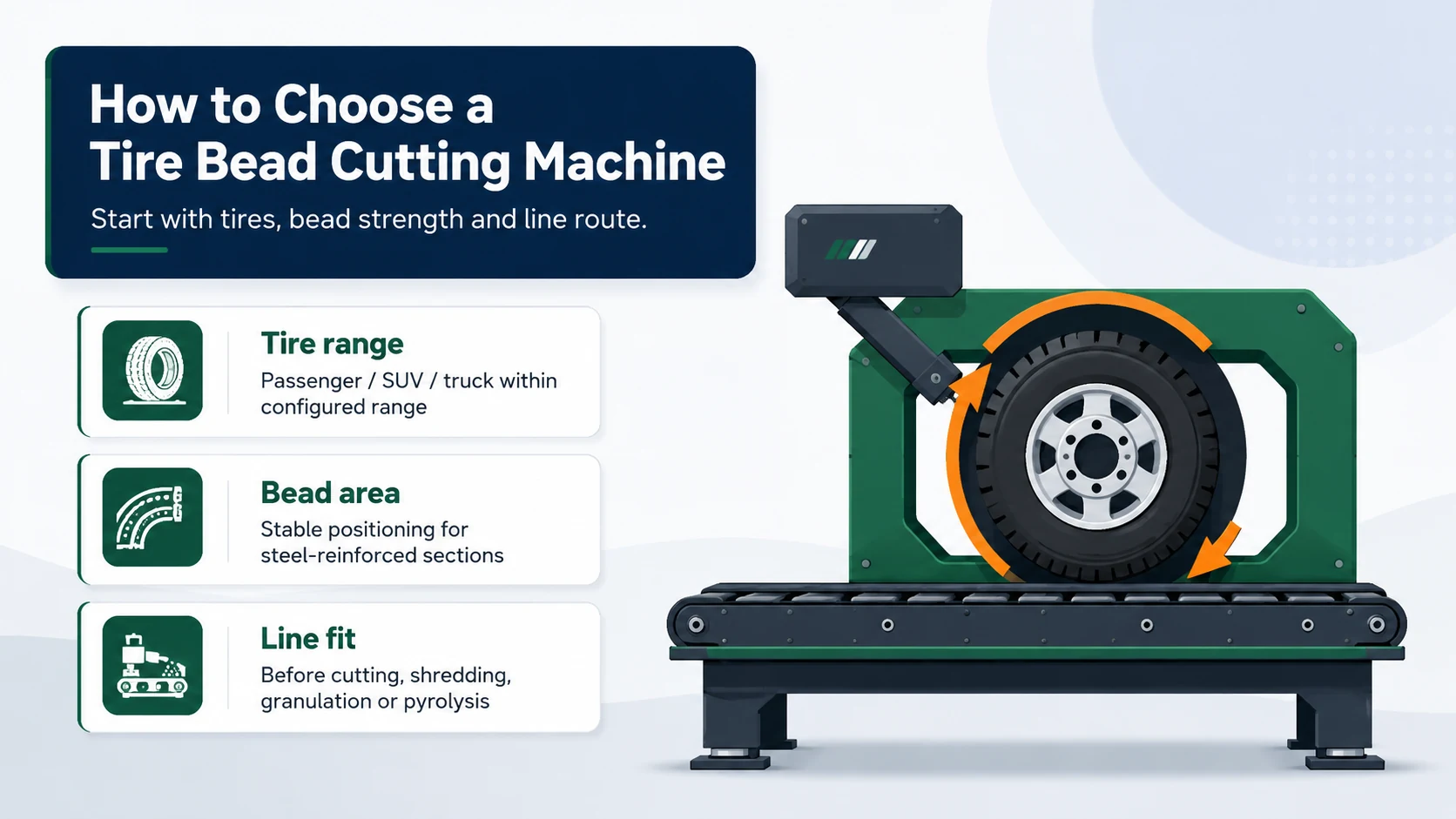
The correct tire bead cutter is not only selected by the motor power.It starts with the tires,steel ball structures,downstream equipment routes and daily operation workflows entering the factory.
A tire bead cutting machine should be selected around tire type, bead strength and line integration.
A buyer usually starts with a simple question: “Which tire bead cutting machine should I buy?” In a real recycling plant, the better question is: “Which tires will arrive, what must be removed before shredding, and how will the front-end machine protect the rest of the line?”
A tire bead cutting machine is a pre-processing machine used to cut through the steel-reinforced bead area and separate the bead ring or bead-sidewall section from the tire body before cutting, shredding, granulation or pyrolysis pre-treatment. On YUXI’s waste tire bead cutting machine page, the machine is described as working on the tire circumference with an alloy cutter while the tire rotates on a worktable. The purpose is to reduce concentrated bead-wire impact on downstream tire cutting and shredding equipment.
Choose a tire bead cutting machine by confirming six things: the incoming tire size range, bead wire strength, required output per hour, downstream equipment route, operator workflow and maintenance access. For common passenger, SUV, light truck, truck and bus tires, a bead cutter can be used as a front-end pre-processing step before a tire cutting machine, tire shredder, rubber granule line or pyrolysis pre-treatment line. For oversized OTR tires or very thick industrial tires, the configuration should be confirmed from tire photos, tire diameter, sidewall thickness and bead structure before quotation.
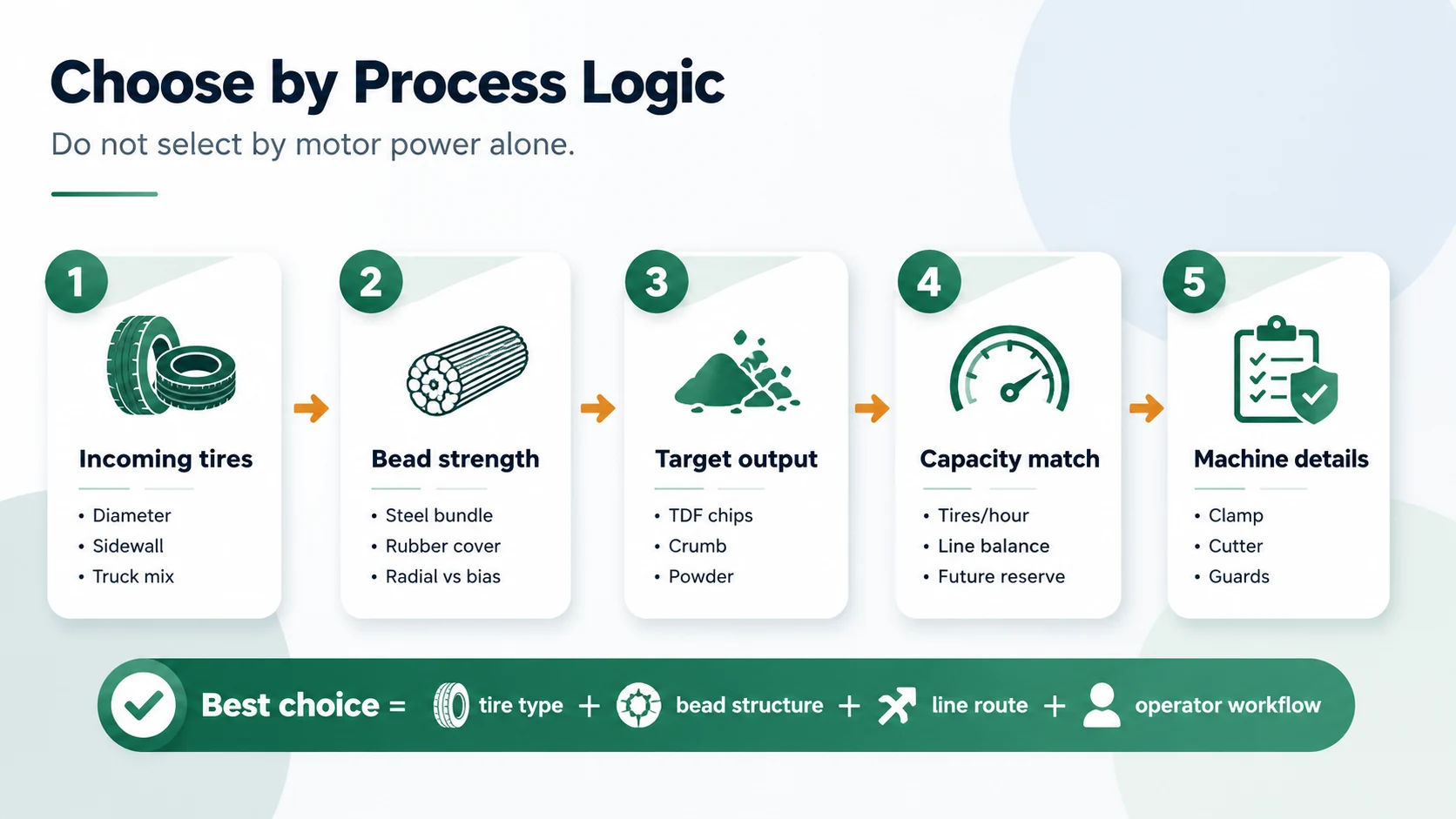
Best buying logic: Do not begin with “how many kilowatts?” Begin with “what tire is being cut, why is the bead section being opened, and what machine receives the tire body next?”
Selection flow: tire size, bead strength, final product, capacity and machine details should be checked together.
What a Tire Bead Cutting Machine Actually Does
A tire bead cutting machine is not the same as a tire changer bead breaker used in a repair shop. It is industrial tire recycling pre-processing equipment. The operator places the scrap tire on the worktable, adjusts the positioning structure, clamps the tire, and allows the cutter to cut near the bead area as the tire rotates. The output is normally a main tire body plus a removed bead ring or bead-sidewall section that still contains steel wire and rubber.
This matters because the bead area is one of the toughest sections of a tire. YUXI’s product information emphasizes that pre-cutting or removing the bead section helps reduce the direct impact from concentrated steel wire rings, makes tire feeding more predictable, and prepares the tire body for further cutting or shredding. If cleaner steel recovery is required, the removed bead section may still need a separate bead wire separator.
The Federal Highway Administration notes that scrap tires can be processed as whole tires, slit tires, shredded/chipped tires, ground rubber or crumb rubber. It also describes slit tires as tires processed by machines that can separate sidewalls from the tread. That makes bead/sidewall cutting a logical early step when the goal is to control tire structure before size reduction.
1. Start with Tire Type, Not Machine Name
Two machines with the same market name may not handle the same tires. A machine that works well for passenger tires may struggle with heavy truck tires if the worktable, clamp, cutter support and drive design are not matched to the bead structure.
Before comparing suppliers, prepare a tire input profile:
Passenger and SUV tires: smaller diameter and lighter bead structures; often suitable for standard pre-processing layouts.
Light truck and common truck tires: stronger bead wire and thicker sidewall sections; require more stable positioning and cutter support.
Bus tires: similar buyer logic to truck tires, but confirm diameter and bead construction.
Small engineering or industrial rubber wheels: possible within the configured range, but the exact bead and sidewall structure should be confirmed.
Oversized OTR tires: do not assume a standard bead cutter is enough. Confirm tire diameter, weight, section thickness and whether a heavy tire cutting machine is needed first.
The reason is simple: steel-belted radial tires are common, and truck tires can contain heavier rubber and reinforcement. FHWA describes a typical scrapped automobile tire as weighing about 9.1 kg while a typical truck tire weighs about 18.2 kg and also contains 60–70% recoverable rubber. That difference affects handling, loading, cutting resistance and plant layout.
2. Match the Bead Cutter with the Downstream Process
A bead cutter should be chosen as part of a process route, not as an isolated machine. YUXI positions the waste tire bead cutting machine before tire cutting machines, tire shredders, rubber granule lines and pyrolysis pre-treatment lines. The value of the bead cutter changes depending on what happens next.
Final product direction
What the bead cutter helps with
Selection note
TDF chips
Reduces bead impact before shredding and supports more stable chip production.
Match bead cutter output with shredder feed demand and target chip size.
Rubber mulch or chips
Removes or opens the most steel-concentrated section before repeated size reduction.
Plan magnetic separation and steel collection after shredding.
Crumb rubber or rubber powder
Helps protect the front end of a longer granulation and grinding line.
Early steel handling can support cleaner downstream separation.
Pyrolysis pre-treatment
Prepares tires for easier loading, cutting or sectioning before feeding.
Confirm whether the pyrolysis system accepts whole tires, sections or smaller pieces.
For a complete equipment plan, YUXI’s tire recycling equipment page groups front-end equipment into wire drawing, bead cutting, tire cutting and shredding. That structure is useful because it forces the buyer to think in process order: first handle the strongest steel sections, then reduce tire size, then shred or granulate.
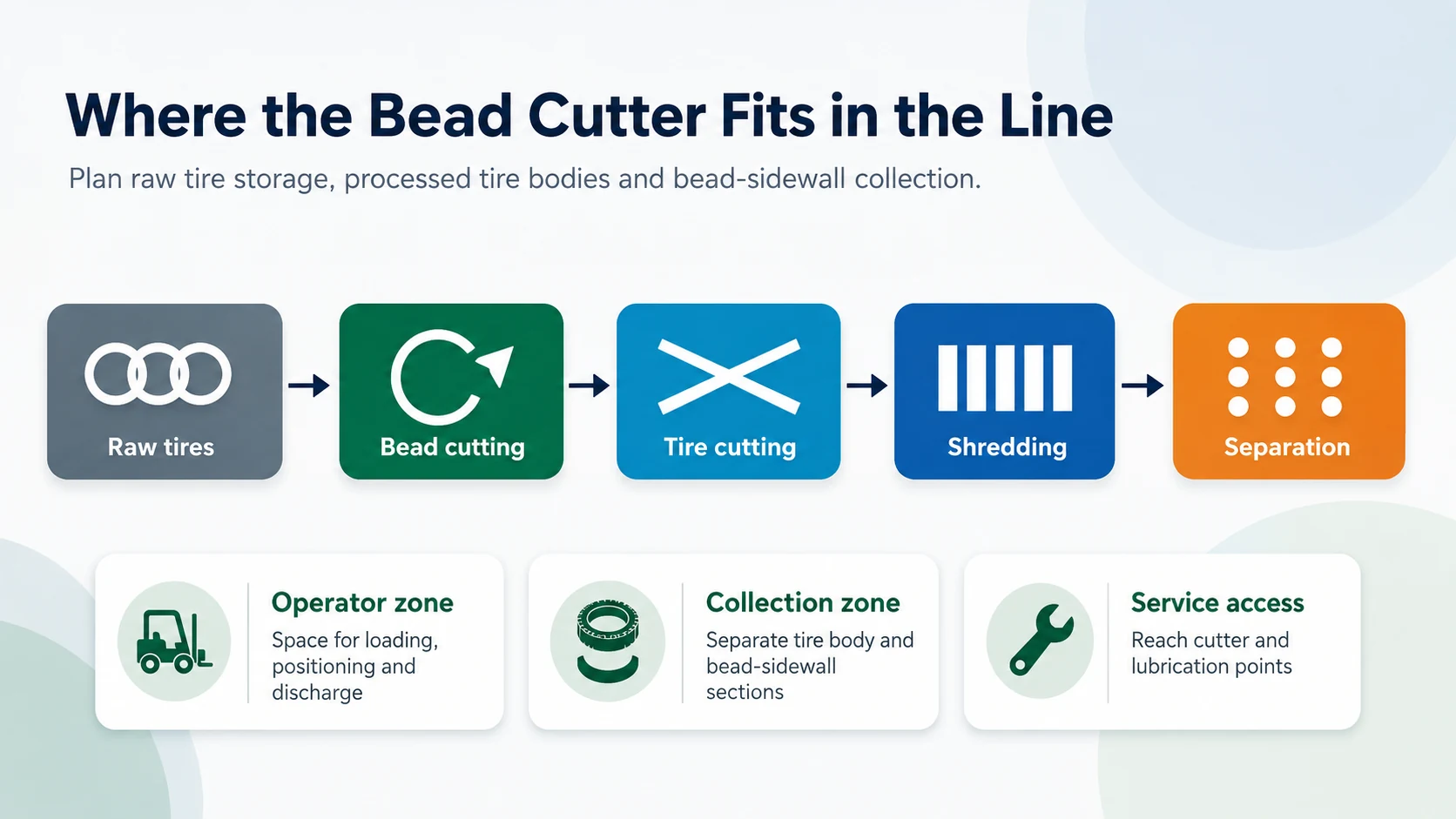
Typical line position: raw tire storage → bead cutting → tire cutting → shredding → granulation or separation.
3. Check Capacity the Right Way
Capacity should not be treated as a catalog number alone. A bead cutter may be evaluated by tires per hour or minutes per tire, but real output depends on loading time, tire weight, clamping adjustment, cutter wear, operator skill and how quickly the processed tire body and bead section are removed.
Use three checks:
Upstream supply: How many tires arrive per shift, and are they sorted by size?
Machine cycle: How long does one tire take from loading to discharge, not just cutting time?
Downstream demand: Can the tire cutter or tire shredder receive the processed tires continuously?
If the bead cutter is too slow, the shredder will wait. If the bead cutter is faster than the line can receive material, the plant needs buffer space. EPA’s tire-derived fuel guidance notes that tires generally need size reduction to fit many combustion units and that additional physical processing such as de-wiring may be required. That is another reason to match front-end processing capacity to the actual end-use specification.
4. Evaluate the Machine Details That Affect Daily Use
Buyers often compare price first, but if it is difficult to operate, maintain or integrate, low-cost machines may become expensive. Focus on these details during supplier evaluation.
Stable tire positioning
The tire should be held firmly while rotating. YUXI’s working principle highlights tire positioning, clamping, circumferential cutting, bead ring separation and material discharge. During video review or factory inspection, watch whether the tire shakes, whether the cutter enters the bead area smoothly and whether repeated manual adjustment is needed.
Alloy cutter and spare cutter plan
A tire bead cutter contacts rubber and steel. Ask what tool material to use, how to replace the tool, what spare parts should be stored, and whether it can enter the replacement area. Do not just ask about the blade life, the answer largely depends on the type of tire,the thickness of the bead wire and maintenance habits.
Guarding and operator safety
Because the machine performs cutting work, guarding should be part of the discussion. OSHA’s general machine guarding rule requires methods of machine guarding to protect operators from hazards such as the point of operation, ingoing nip points, rotating parts, flying chips and sparks. It also states that the point of operation is where work is performed on the material, and that machines exposing employees to injury at the point of operation must be guarded. For buyers, this means guards, emergency stops, safe loading procedures and operator training should be confirmed before purchase.
Voltage, layout and export configuration
YUXI’s specification reference lists customization items such as voltage, motor power, worktable size, guard design and line layout. Export projects should confirm local voltage, available floor space, tire storage area, operator station and whether the machine will feed a standalone shredder or a complete tire recycling plant.
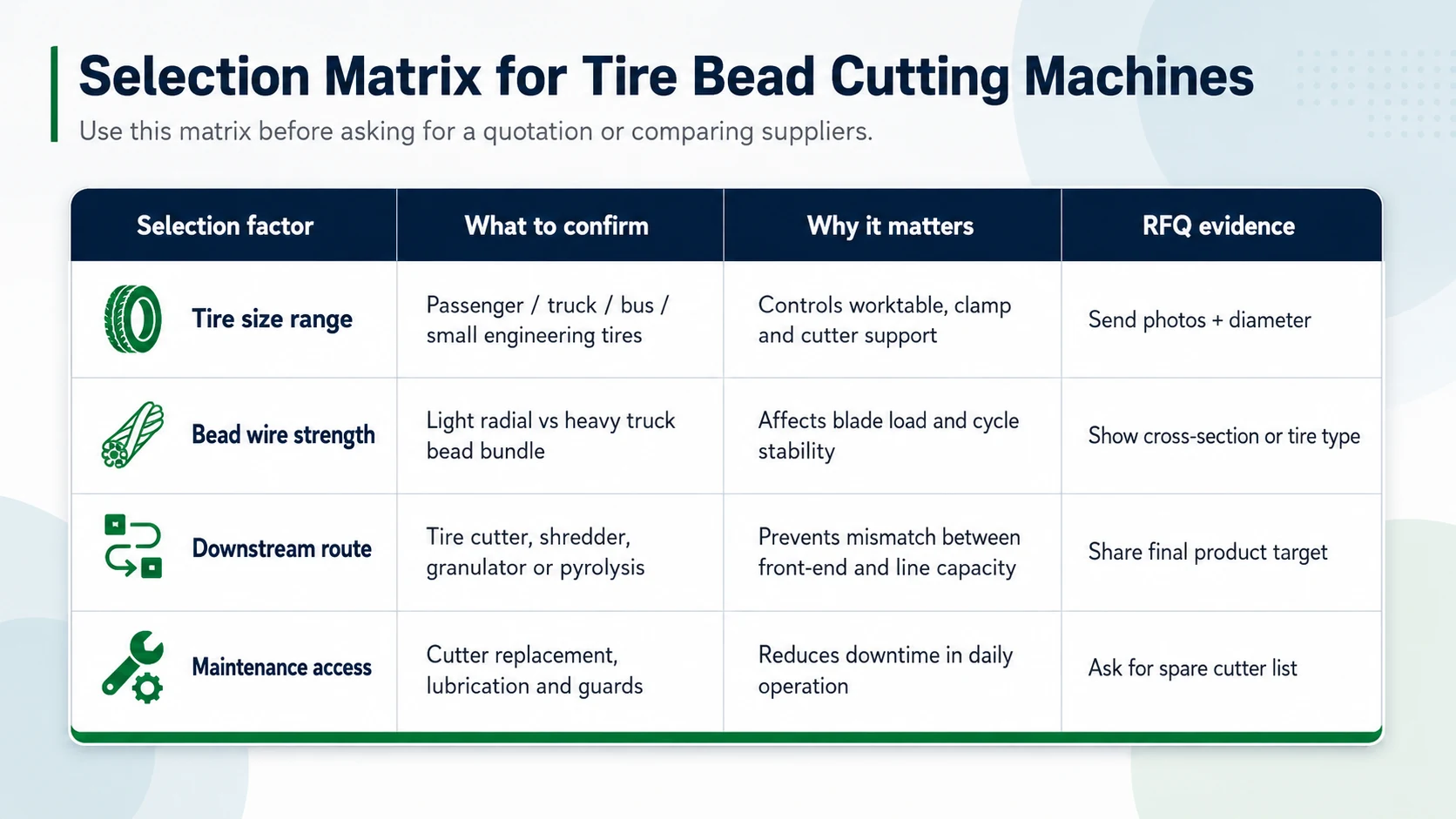
A practical selection matrix for RFQ preparation and supplier comparison.
5. Compare Similar Machines Before Buying
The search results are usually mixed with tire bead cutters,tire sidewall cutters,tire wire removers,tire cutters and bead line separators.The names overlap,so the actual function and output should be compared instead of relying on the title.
Machine name
Main function
Typical output
When to choose
Tire bead cutting machine
Cuts through the sidewall and steel-reinforced bead area around the tire circumference.
Main tire body plus bead-sidewall section containing steel and rubber.
When the line needs front-end bead opening before cutting or shredding.
Tire sidewall cutter
Often refers to the same or similar equipment used to remove sidewall sections.
Tire body plus separated sidewall/bead sections.
When the key need is sidewall separation before further size reduction.
Tire wire drawing machine
Pulls bead steel wire from prepared tire rings with hydraulic force.
Extracted bead wire plus rubber ring material.
When cleaner bead wire recovery or stronger blade protection is required. See YUXI’s tire wire drawing machine.
Tire cutting machine
Cuts whole or large tires into manageable sections.
Large tire sections for easier feeding.
When truck, agricultural or OTR tires are too large or stiff for direct shredding.
Tire shredder
Reduces whole or pre-cut tires into chips for TDF, mulch or further granulation.
Shredded tire chips or rough rubber pieces.
When the tire is ready for primary size reduction. See YUXI’s tire shredder machine.
The safest selection question is not “Is this a bead cutter?” but “What does it separate, what remains inside the removed section, and what machine receives both outputs next?”
6. RFQ Checklist: What to Send the Supplier
A useful quotation needs more than the machine name. Send enough information for the supplier to confirm the correct configuration.
Send this before asking for price:
Tire photos, including sidewall and bead area.
Tire type mix: passenger, SUV, light truck, truck, bus or engineering tires.
Maximum and common tire diameter.
Estimate the tons of tires per hour or per day.
Downstream equipment: tire cuting machine, shredder, granulator, rubber powder line or pyrolysis device.
Final product target: TDF chip, mulch,crushed rubber, rubber powder, steel recycling or pre-pyrolysis feed.
Factory voltage, available floor space and loading method.
Required guarding, operator station preference and maintenance access.
7. Common Mistakes to Avoid
Mistake 1: Buying by price without tire data
A low-cost bead cutter may work for light tires but fail on heavier bead sections. The supplier should know the tire diameter, bead construction and sidewall thickness before final configuration.
Mistake 2: Ignoring downstream capacity
A front-end machine that does not match the downstream tire cutter or shredder can create waiting time, material piles or unstable feeding. Capacity must be checked as a line, not as a single machine.
Mistake 3: Confusing bead cutting with complete steel removal
A tire bead cutting machine cuts and separates the bead-sidewall section from the main tire body. It does not normally strip all rubber from the bead wire. If the project needs cleaner steel bead recovery, plan for additional bead wire separation or wire drawing equipment.
Mistake 4: Forget security and maintenance
The machine handles rotating tires, cutting tools and steel-reinforced rubber. Confirm guarding, emergency stop position, operator distance, cutter replacement method and lubrication points before purchase.
8. Where YUXI Fits
YUXI’s waste tire bead cutting machine is positioned as pre-processing equipment for tire recycling lines. According to the product page, it can process common waste tires such as passenger car tires, SUV tires, light truck tires, common truck tires, bus tires within the configured range and small engineering vehicle tires. It can be placed before a tire cutting machine, tire shredder, rubber crusher, granulator or full waste tire recycling line.
For buyers, the practical advantage is that YUXI does not treat the bead cutter as a standalone catalog item only. The page connects bead cutting with downstream equipment and line layout. That makes it easier to confirm whether your project needs bead cutting alone, bead cutting plus wire separation, a tire cutting machine, or a complete tire recycling equipment route.
Need a Tire Bead Cutter Configuration?
Send YUXI your tire photos, tire diameter range, target capacity, downstream process and factory voltage. A suitable configuration should match your tire type, bead structure, operator workflow and complete recycling line route.
It is used to cut the bead ring and sidewall section of waste tires before tire cutting, shredding, rubber granule production or pyrolysis pre-treatment. The goal is to deal with the steel bead area before it is overloaded in the later machine.
Is the tire bead cutter the same as the tire sidewall cutter?
In many supplier catalogs, the terms overlap. Both usually refer to equipment that cuts around the tire sidewall and bead area. The buyer should confirm whether the machine removers one sidewall, both sidewalls or a bead-sidewall section.
Can a tire bead cutting machine process truck tires?
Yes, if the machine is configured for the tire diameter, sidewall thickness and bead wire strength. Truck tire photos and size range should be sent before quotation.
Does bead cutting remove all steel wire from the tire?
No. It cuts and separates the bead-sidewall section from the tire body. The steel wire normally remains partly covered by rubber in the removed section. For cleaner steel recovery, a tire wire drawing machine or bead wire separator may be needed.
What is the most important factor when choosing?
The most important factor is the fit between incoming tire type and downstream process. Tire diameter, bead strength, output per hour, safety guarding and maintenance access should be checked together.
References and Source Notes
Basic Information Of U.S. EPA, Scrap Tires : Source
Instruction For The Disposal of U.S. EPA, Tire-Derived Fuel and scrap tire : Source
Federal Highway Administration, Description Of Scrap Tires Material : Source
OSHA, 1910.212 General Requirements for All Machines: Source
USTMA, scrape tire management update in 2024: Source
Marie has 8+ years of experience in tire shredding and recycling equipment,with a focus on tire shredders,rubber recycling machines,TDF production,rubber crumb processing,and complete tire recycling systems.