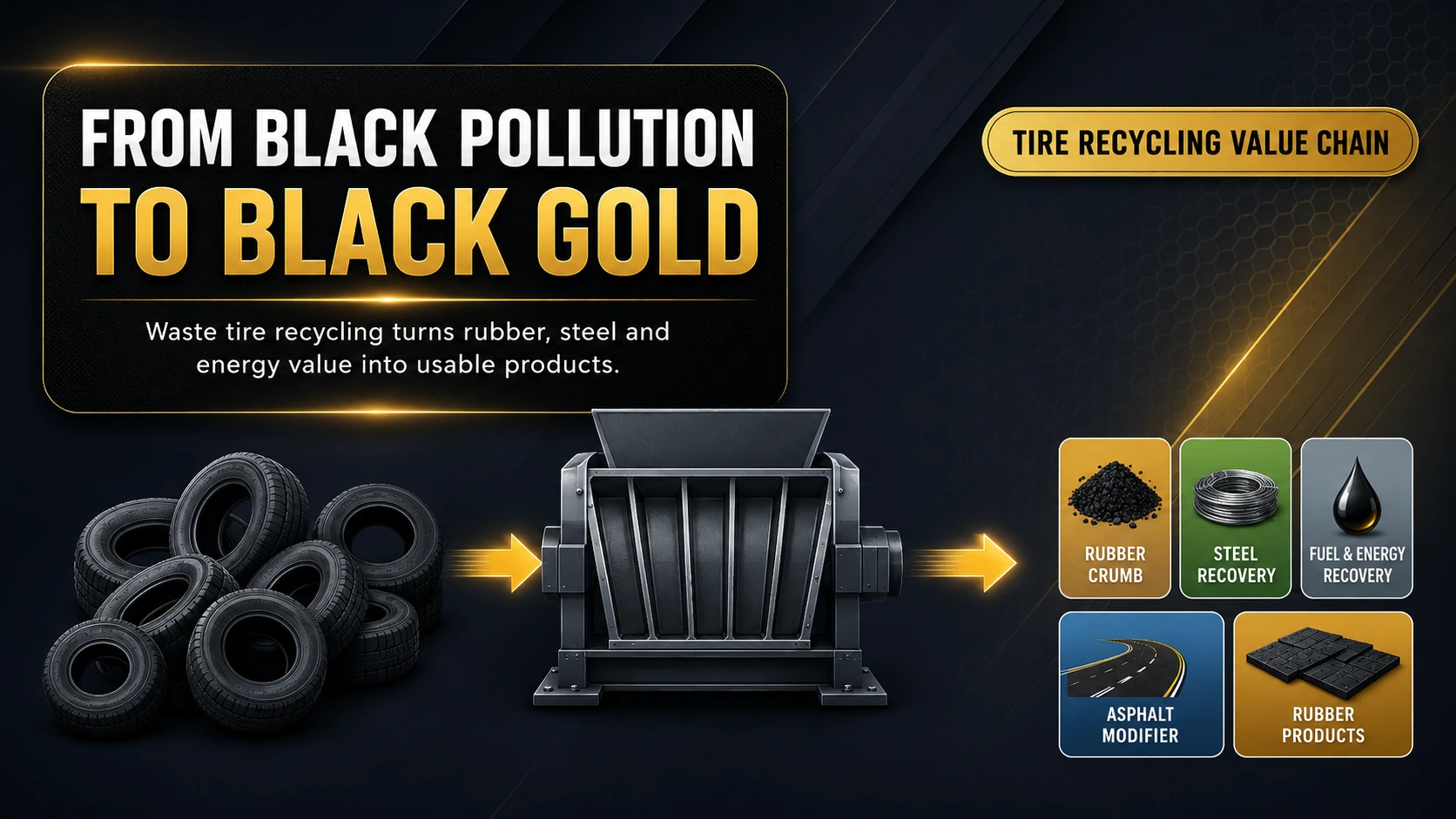
A pile of waste tires does not look like a business opportunity at first. It looks heavy, dirty, difficult to move, and risky to store. For many cities and recyclers, that is why discarded tires have long been described as “black pollution.”
But inside every used tire are materials that still have value: rubber, steel wire, textile fiber, and energy-rich carbon-based material. The difference between pollution and profit is not the tire itself. It is whether the tire is collected, processed, separated, and sold into the right downstream market.
That is the real meaning of turning “black pollution” into “black gold.”
Why Old Waste Tires Become a Pollution Problem
Used tires are difficult to manage because they are large, elastic, slow to degrade and difficult to compress. When they are stored outdoors, they occupy land, trap water, attract pests, and may become a risk of fire. The U.S. EPA pointed out that tire fires can decompose tires into harmful compounds, including gases, heavy metals and oil.
Tire pollution is also more widespread than visible tires. EPA researchers described the impact of tires throughout their life cycle, including production, use, disposal,tire wear particles and chemical mixtures. The agency also pointed out that hundreds of millions of tires are disposed of every year and may be burned into fuel or recycled into products such as asphalt,artificial turf fillers,landscape mulch and doormats.
That’s why modern tire recycling is not just a garbage disposal activity. It is a material recovery process.
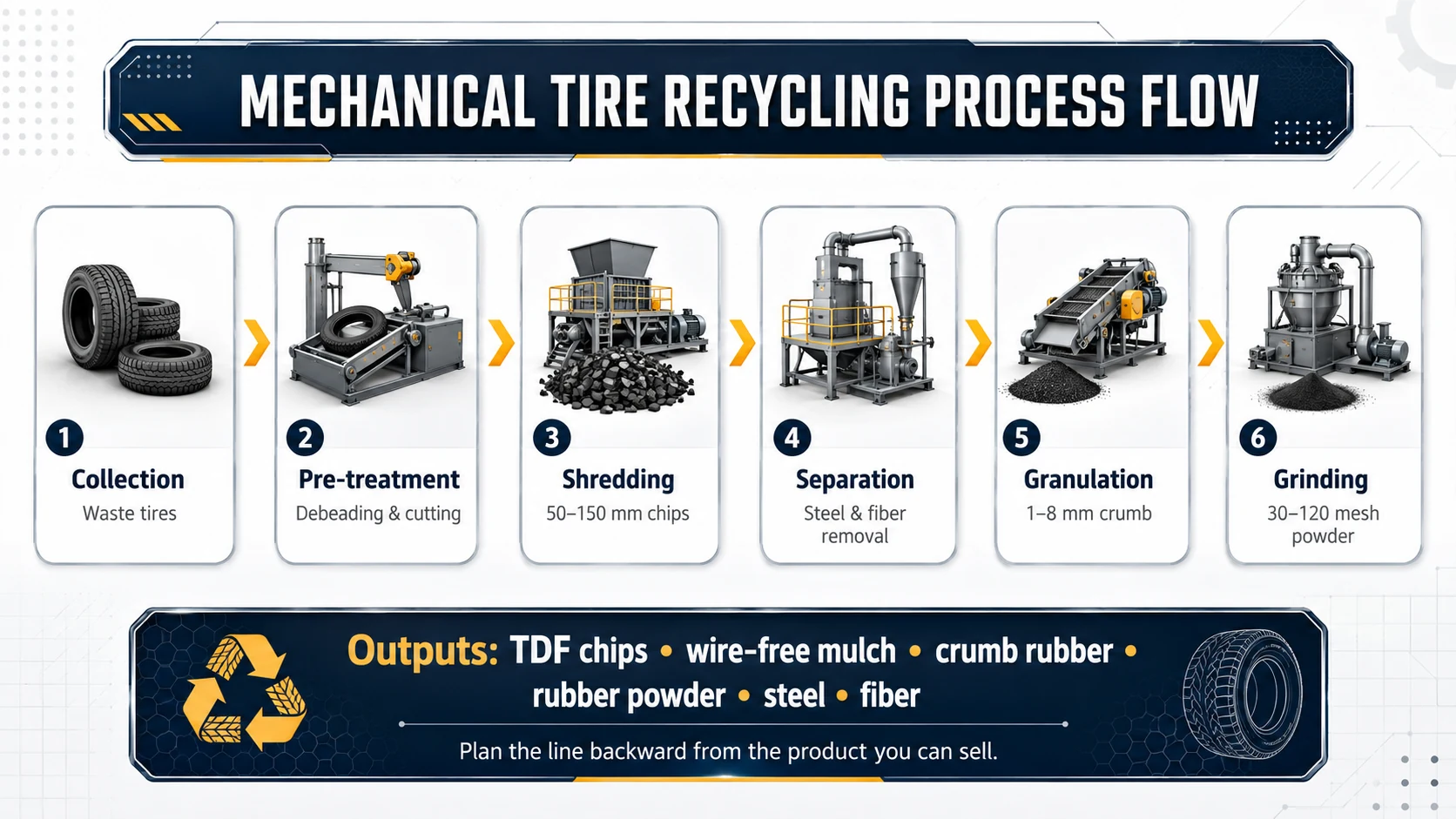
Mechanical tire recycling converts the whole tire into controlled outputs such as TDF chips, mulch, crumb rubber, rubber powder, steel and fiber.
What Makes Used Tires valuable”
A waste tire contains several recoverable fractions:
Rubber can be processed into chips, mulch, crumb rubber or fine rubber powder.
Steel wire, especially bead wire and reinforcing wire, which can be separated and sold to steel recyclers.
Textile fiber, which can be recovered during granulation and used in suitable downstream applications.
Energy value, which can be used in regulated tire-derived fuel applications.
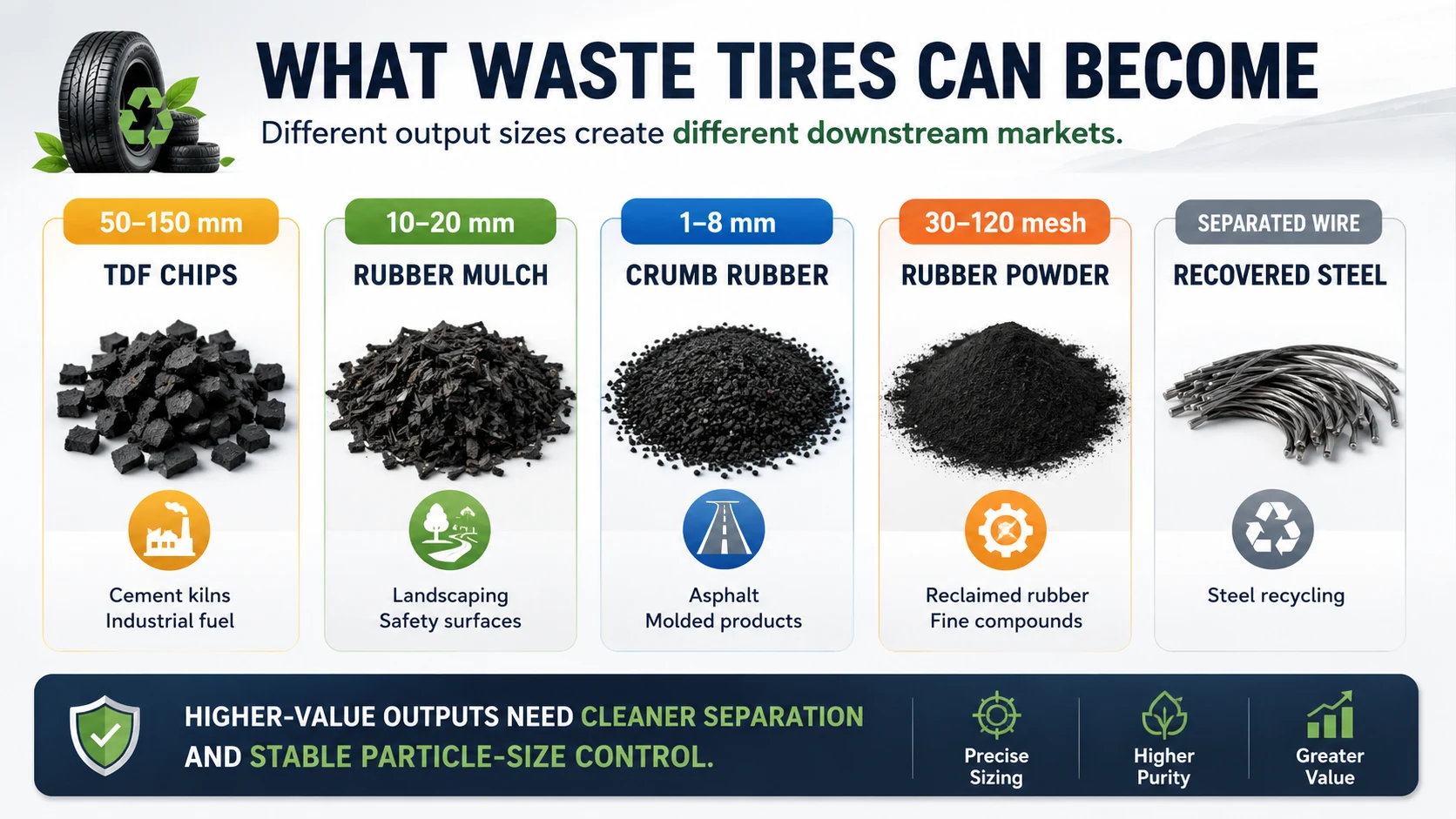
The value of the tire depends on how far the material is processed. Large tire shreds may be suitable for TDF. Cleaner 10–20 mm rubber chips can be used as wire-free mulch or sent to further granulation. Fine crumb rubber and rubber powder require more equipment, but they can enter higher-value markets such as rubberized asphalt, molded products, moving surfaces, mats, mats and recycled rubber production.
Different output sizes create different commercial uses, so the recycling line should be planned from the final product backward.
The main way to turn used tires into reusable products
1. Tire renovation: extend the life of tires before recycling
When the tire shell is still structurally available, refurbishment may be one of the most economical ways to reduce waste. Instead of discarding the whole tire,replace the worn tread and send the tire back for repair.
This route is especially important for truck and bus tires, where the casing has higher value. However, not every tire is suitable for retreading. Damaged casings, mixed waste tires, OTR tires, and heavily worn passenger tires usually need mechanical recycling instead.
2. TDF Chips: A Practical Route for Energy Recovery
Tire-derived fuel, or TDF, uses processed tires as an alternative fuel in cement kilns, pulp and paper mills, industrial boilers, and similar facilities. The EPA describes TDF as a beneficial use rather than recycling, because the tire is used for energy recovery instead of material recovery. It also notes that tires have high heating value and usually need size reduction and, in some cases, de-wiring before use.
For this route, the equipment target is usually simple and practical: reduce whole or pre-cut tires into controlled chips. YUXI’s Tire TDF Plant is designed to process car tires, truck tires, OTR tires, and mining tires into rough shreds or rubber chips, commonly around 50–150 mm, with a process that may include bead wire removal, tire cutting, and shredding.
TDF is often selected when the local market has cement kilns or industrial users that can legally accept processed tire fuel. It is also useful when the project goal is fast volume reduction rather than fine material recovery.
3. Wire-Free Rubber Mulch: A Middle-Stage Product with Flexible Uses
For recyclers who want more value than rough TDF chips, wire-free rubber mulch is a common next step. After primary shredding, the tire material is further processed to liberate steel wire and produce smaller rubber chips.
YUXI’s Tire Wire Free Mulch Plant is designed to produce 10–20 mm wire-free rubber chips through shredding, rasping, and magnetic separation. The plant is a physical processing system operating at normal temperature, and it can recover both rubber chips and steel.
Rubber mulch can be used in landscaping, playground surfaces, safety tiles, sports court surfaces, asphalt supplement applications, or as feedstock for further crumb rubber processing.
4. Crumb Rubber: Higher Purity for Material Recycling
Crumb rubber is one of the most important material-recycling outputs from waste tires. It is usually produced by shredding, rasping, granulating, magnetic separation, fiber separation, screening, and recirculation.
YUXI’s Tire Rubber Crumb Plant processes wire-free tire chips into 1–8 mm rubber granules, with outputs including high-purity rubber granules, steel, and fiber. This type of output has broader market options than rough tire shreds. Crumb rubber can be used in rubber tiles, mats, molded rubber products, rubberized asphalt, construction materials, and other recycled rubber products.
5. Rubber Powder: Fine Material for Higher-Value Applications
Rubber powder is produced by grinding rubber granules into finer mesh sizes. Compared with larger crumb rubber, fine powder can be used in more demanding applications, including rubber products, modified asphalt, sealing materials, shoe soles, mats, shock-absorbing products, recycled rubber boards, and reclaimed rubber production.
YUXI’s Tire Rubber Powder Plant is designed to grind 1–8 mm rubber granules into 30–120 mesh rubber powder. For projects targeting rubber powder, the front-end shredder is only the beginning. The real product quality depends on steel separation, fiber removal, grinding temperature control, screening accuracy, and consistent particle size.
Why Is Rubberized Asphalt Becoming More And More Important
One of the strongest growth fields of recycled tire rubber is rubber modified asphalt. Rubber asphalt is attractive because it links tire recycling with infrastructure. It not only treats waste tires,but also converts ground rubber into a performance materials for roads.
According to the formula and local standards, recycled tire rubber can help improve asphalt elasticity, reduce cracking, and create a more durable road surfaces system. This is important for tire recyclers because asphalt projects can consume a lot of breadcrumb rubber.For road contractors and public infrastructures buyers,it creates a way to use recycled materials in practical,long-life applications.
Europe’s Experience: Collection Is Only the First Step
Europe shows how policy and collection systems can support tire recycling. But collection alone does not create value. After recycling tires,recyclers still need stable equipment,clean separation,reliable output size and downstream buyers.
Practical points: the recycling chain must connect three things: consistent tire supply, suitable processing equipment and real downstream market demand.
Choosing the Right Recycling Route
A waste tire recycling project should not start by asking only, “What machine should I buy”” A better starting point is, “What final product can I sell””
Granulation / fine grinding / screening / dust collection
Reclaimed rubber, rubber compounds, fine recycled products
Recovered steel
Separated wire
Magnetic separation / steel cleaning
Steel recycling
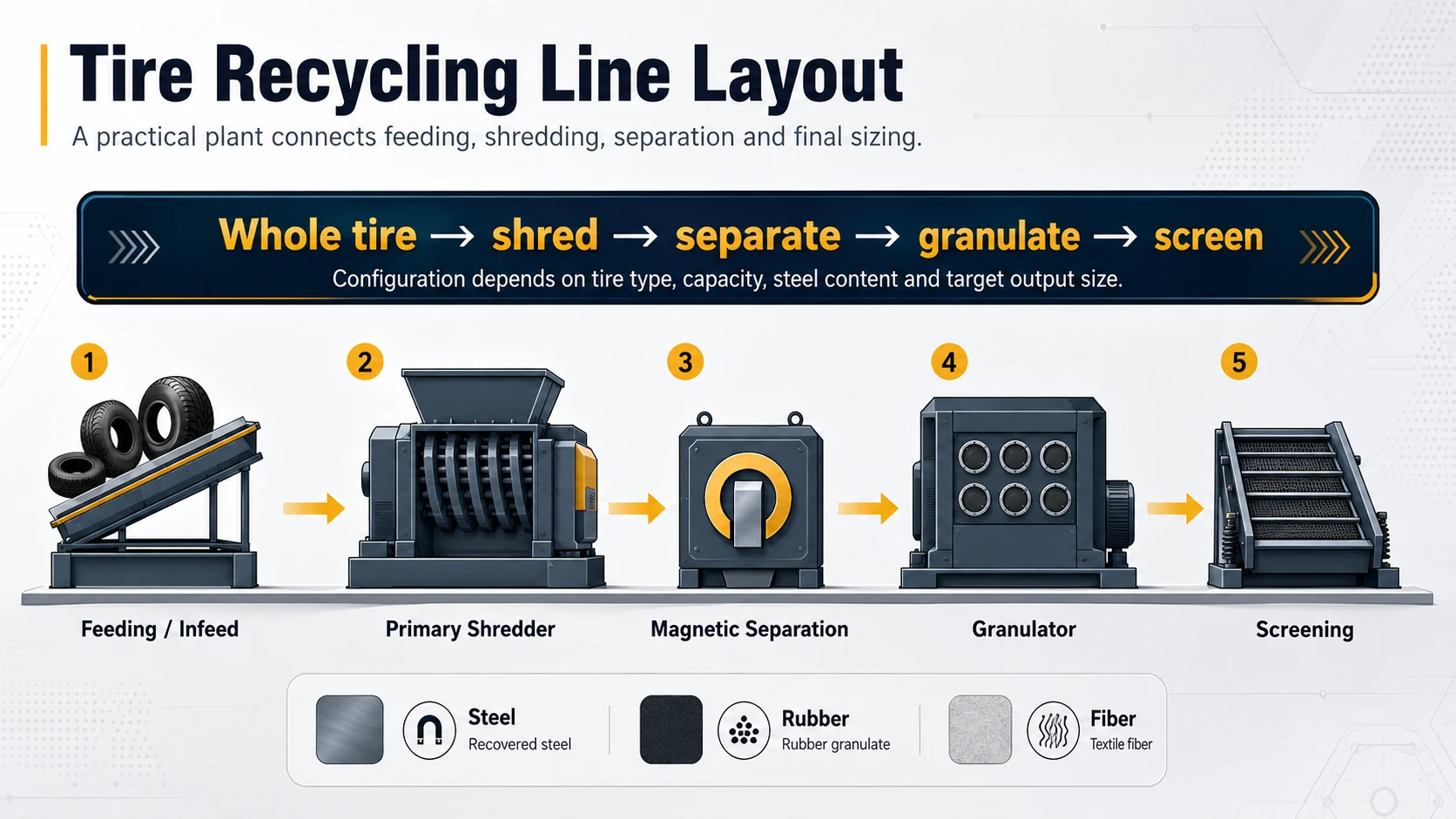
YUXI’s tire recycling equipment range covers front-end preparation, size reduction, steel separation, granulation, powder grinding, and complete tire recycling lines. The correct layout depends on tire type, steel content, output size, and whether the customer needs standalone machines or a complete line.
A complete tire recycling line should connect feeding, size reduction, steel separation, granulation, screening and final product collection.
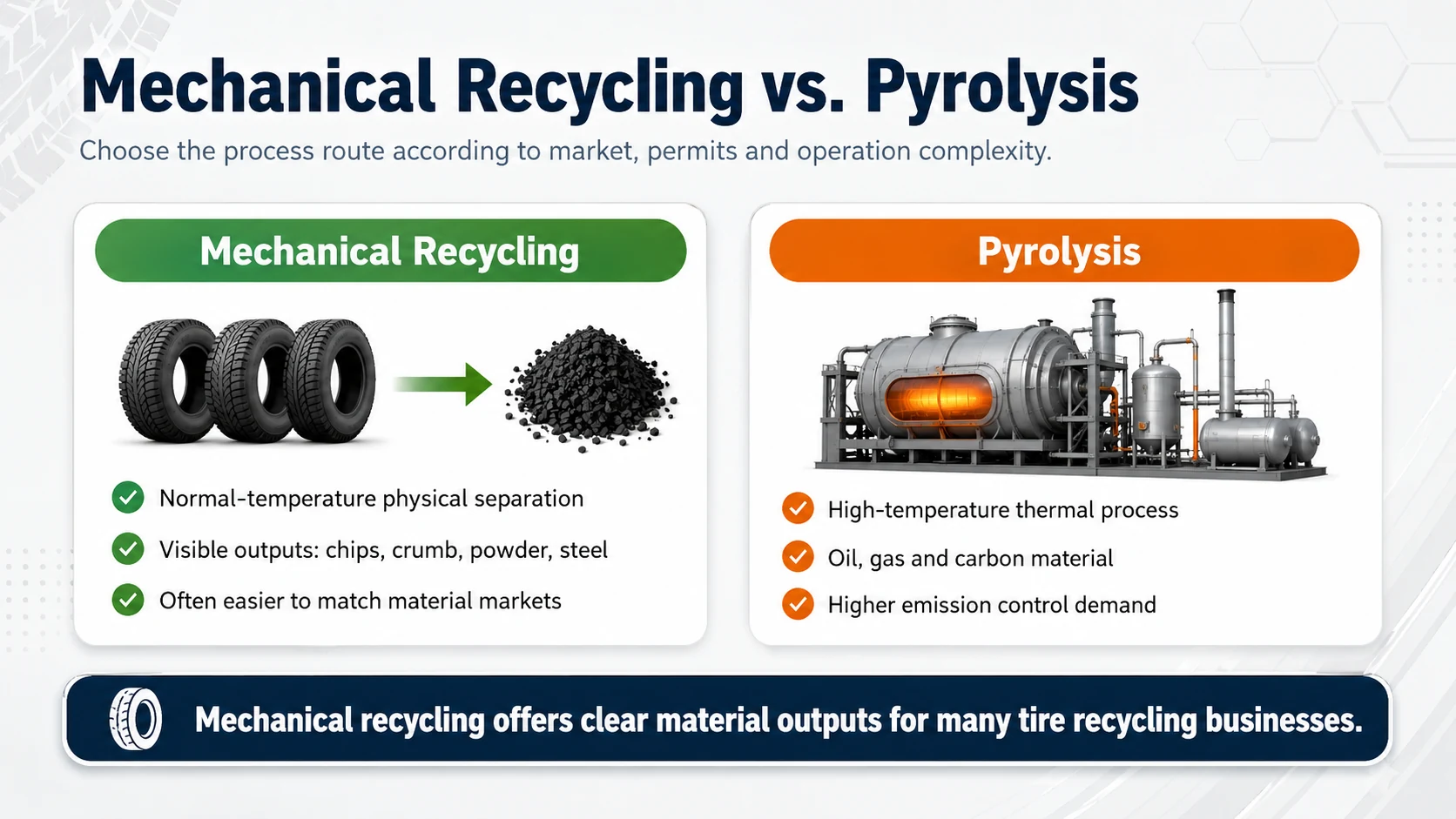
Mechanical Recycling vs. Pyrolysis
Some investors also consider pyrolysis, which converts tires into oil, gas and carbon under high-temperature and hypoxic conditions. Pyrolysis is useful in some markets, but it is more complicated than mechanical recycling.
The EPA pointed out that practical challenges of tire pyrolysis, including complex high-temperature operations, abrasive raw materials, air-emission control needs, product quality/output optimization, regulatory requirements, and the need to stabilize tire supply within an affordable transportation distance.
Mechanical recycling is different. It focuses on physical size reduction and separation at normal temperature. For many operators, this route is easier to understand, easier to permit, and easier to connect with visible product markets such as TDF chips, rubber mulch, crumb rubber, rubber powder, and recovered steel.
Mechanical recycling is usually selected for visible material outputs, while pyrolysis requires more complex thermal processing and control.
From Waste Management to Resource Manufacturing
The future of tire recycling is not just about “getting rid of tires.” It is about manufacturing usable materials from a difficult waste stream.
A poorly managed tire pile is a liability. A properly designed tire recycling line can turn the same material into several saleable outputs. Large chips can go to TDF markets. Wire-free chips can become mulch. Crumb rubber can enter asphalt and molded product markets. Fine rubber powder can support rubber product manufacturing. Steel can return to metal recycling.
This is why waste tire recycling should be planned like a production business, not just a disposal service.
Conclusion: The Tire Is Not the Problem — The Missing Process Is
Waste tires become black pollution when they are dumped, burned without control, or left in stockpiles. They become black gold when the rubber, steel, and fiber are separated into forms that real markets can use.
For recyclers, the key is to match the equipment line with the final product. A TDF plant does not need the same configuration as a crumb rubber line. A rubber powder project needs more separation, grinding, screening, and quality control than a simple shredding operation.
With the right process design, waste tires can move from environmental burden to circular material resource — and from black pollution to black gold.
FAQ
What products can be made from waste tires”
Waste tires can be processed into raw materials for TDF chips, wire-free rubber mulch, crumb rubber, fine rubber powder, recycled steel wire, textile fiber and rubberized asphalt or molded rubber products.
Is tire-derived fuel the same as tire recycling”
Tire-derived fuels are generally considered beneficial energy recovery, while material recycling focuses on recycling rubber, steel and fiber for reuse in products.
How should a tire recycling line be selected”
A tire recycling line should be selected according to the final product market, tire type, steel content, target particle size, capacity, separation requirements, and local permitting conditions.
Get a Project Quote
Need a Tire Recycling Line for Your Target Output” Tell YUXI your tire type, capacity, final product size and local market. The process layout can be matched to TDF, mulch, crumb rubber or rubber powder production.
Marie has 8+ years of experience in tire shredding and recycling equipment,with a focus on tire shredders,rubber recycling machines,TDF production,rubber crumb processing,and complete tire recycling systems.