




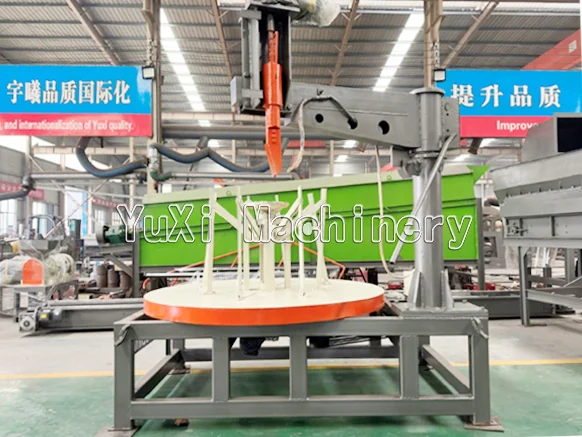
The tire bead cutting machine is a front-end pretreatment unit. It cuts around the rebar bead and side wall area, so the tire body enters the cutting, crushing or granulation, the shock absorption load is smaller, and the feeding is more predictable.
Quick Answer
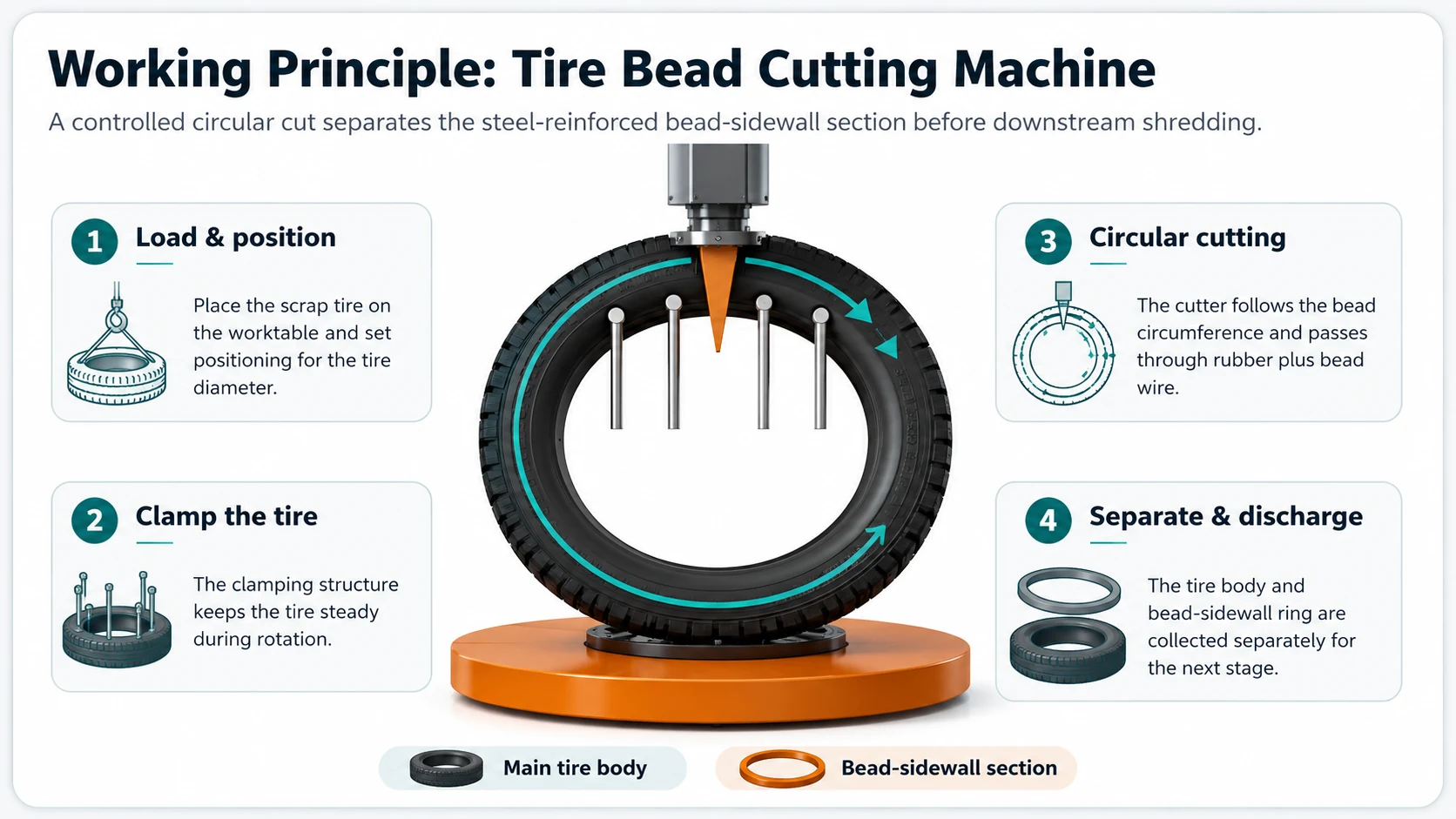
The working principle of the tire bead cutting machine is to put the waste tire on the rotating workbench,fix it with adjustable positioning and clamping structure,and then send the alloy cutter to the side wall near the bead.When the workbench rotates,the cutter cuts the rubber and steel-reinforced bead bundles along the tire circumference,and then separates the bead side wall ring from the main tire body.
In YUXI configuration, the machine is used before tire cutting, tire shredding, rubber granulation or pyrolysis pre-treatment. It is only designed for the bead area: the removed bead part usually still contains rubber around the steel wire, so a separate bead tire separator may be required when cleaner steel is needed.
Why the Tire Bead Area Is Treated First
Waste tires are not uniform rubber rings. A tire contains rubber, textile or fiber reinforcement, steel belts and a dense steel bead bundle around the inner rim area. That bead area helps a tire lock onto the wheel during vehicle use, but in recycling it becomes one of the toughest sections to cut.
The environmental reason for processing scrap tires is also practical. The U.S. EPA describes tire pollution as a life-cycle issue involving production, use, reuse and disposal, and notes that tires disposed at end of life may be burned for fuel or broken down into products such as asphalt, mulch and other recycled materials.1 USTMA’s 2023 end-of-life tire report identifies major reuse and recycling markets such as tire-derived fuel, ground rubber, rubber-modified asphalt and tire-derived aggregate.2
For a recycling plant, however, the question is more immediate: can the line feed, cut and separate tires without constant jamming or excessive blade stress This is where bead cutting becomes useful. By opening or removing the bead-sidewall section before heavy size reduction, operators can send a more manageable tire body into the next machine.
A bead cutter is not installed because every tire must be “perfectly stripped” before shredding. It is installed when the bead ring is creating a bottleneck for feeding stability, cutter life or downstream separation.
Step-by-Step: How a Tire Bead Cutting Machine Works
The YUXI waste tire bead cutting machine is designed to cut through the sidewall and steel-reinforced bead area. The product page explains that as the tire rotates on the worktable, an alloy cutter follows the bead circumference, severs the bead wire bundle and removes the bead ring or bead-sidewall section from the main tire body.
1
Load and position the tire
The operator places the waste tire on the machine worktable. The positioning structure is adjusted according to tire diameter, sidewall thickness and the intended cut path. For mixed streams—passenger, SUV, light truck or truck tires—this adjustment matters because the bead location and stiffness are not identical.
2
Clamp the tire before rotation
The machine fixes the tire with a clamping or positioning structure so that the tire does not move when the workbench rotates. Stable positioning is important, because the knife must stay close to the circumference of the bead, instead of wandering to the tread or cutting too shallowly.
3
Feed the alloy cutter into the bead-sidewall area
A motor-driven cutter enters the sidewall near the bead. The cutting tool must deal with rubber and bead wire contact, so YUXI describes the cutter as an alloy tool selected for repeated waste-tire pre-processing. Actual replacement intervals depend on tire type, steel content, operating hours and maintenance.
4
Rotate the worktable for a circular cut
Instead of forcing a straight blade through the whole tire, the tire rotates. The cutter follows the circumference and gradually severs the sidewall and bead ring. This makes the process more controlled than torch cutting or hand tools when proper guarding and operating procedures are in place.
5
Separate the bead ring or bead-sidewall section
After the circular cut is complete, the machine separates the bead-sidewall ring from the main tire body. The removed section still contains rubber around the bead wire. If the project requires cleaner recovered steel, this section can be sent to dedicated bead-wire separation equipment.
6
Discharge the two material streams
The processed tire body and bead-sidewall section are collected separately. The tire body can move to tire cutting, shredding, granulation or pyrolysis pre-treatment depending on the plant’s final product target.
Machine Anatomy: What Each Part Does
A bead cutting machine looks simple from the outside, but several parts must work together. When evaluating a machine video, watch whether the tire is held steadily, whether the cutter enters smoothly and whether the processed tire can be removed without repeated manual adjustment.
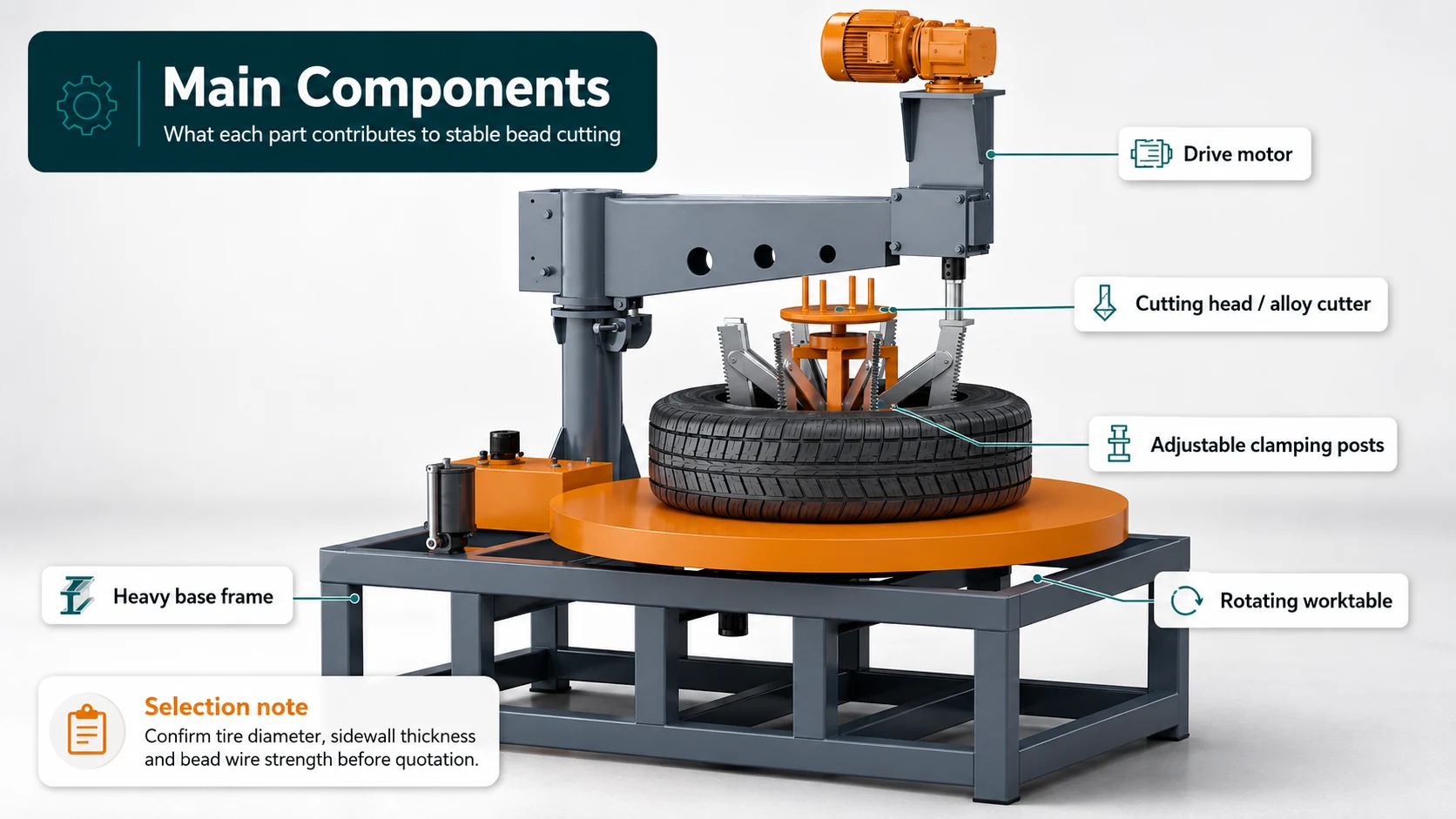
| Component | Function in the cutting cycle | What to check before purchase |
|---|---|---|
| Worktable | Supports and rotates the tire during the circular cut. | Diameter range, table stability, loading height and space for tire handling. |
| Positioning and clamping structure | Keeps the tire centered and steady while the cutter follows the bead area. | Adjustment range for passenger, light truck, truck or mixed tires. |
| Alloy cutter | Contacts sidewall rubber and the steel-reinforced bead bundle. | Blade material, spare cutter availability and maintenance access. |
| Drive and transmission | Controls worktable rotation and cutter movement. | Voltage, frequency, motor power and local electrical compatibility. |
| Frame and guarding | Supports cutting load and reduces exposure to moving parts. | Guard design, emergency stop, safe operator position and maintenance clearance. |
Where It Fits in a Waste Tire Recycling Line
A bead cutter is usually a front-end pre-processing unit, not a standalone “complete recycling line.” YUXI’s recommended route places bead cutting before tire cutting, tire shredding, rubber crushing/granulation and later steel or fiber separation. In small workshops, the machine can work as a standalone pre-processing unit; in full plants, it should be matched with conveyor height, operator position, tire storage and downstream capacity.
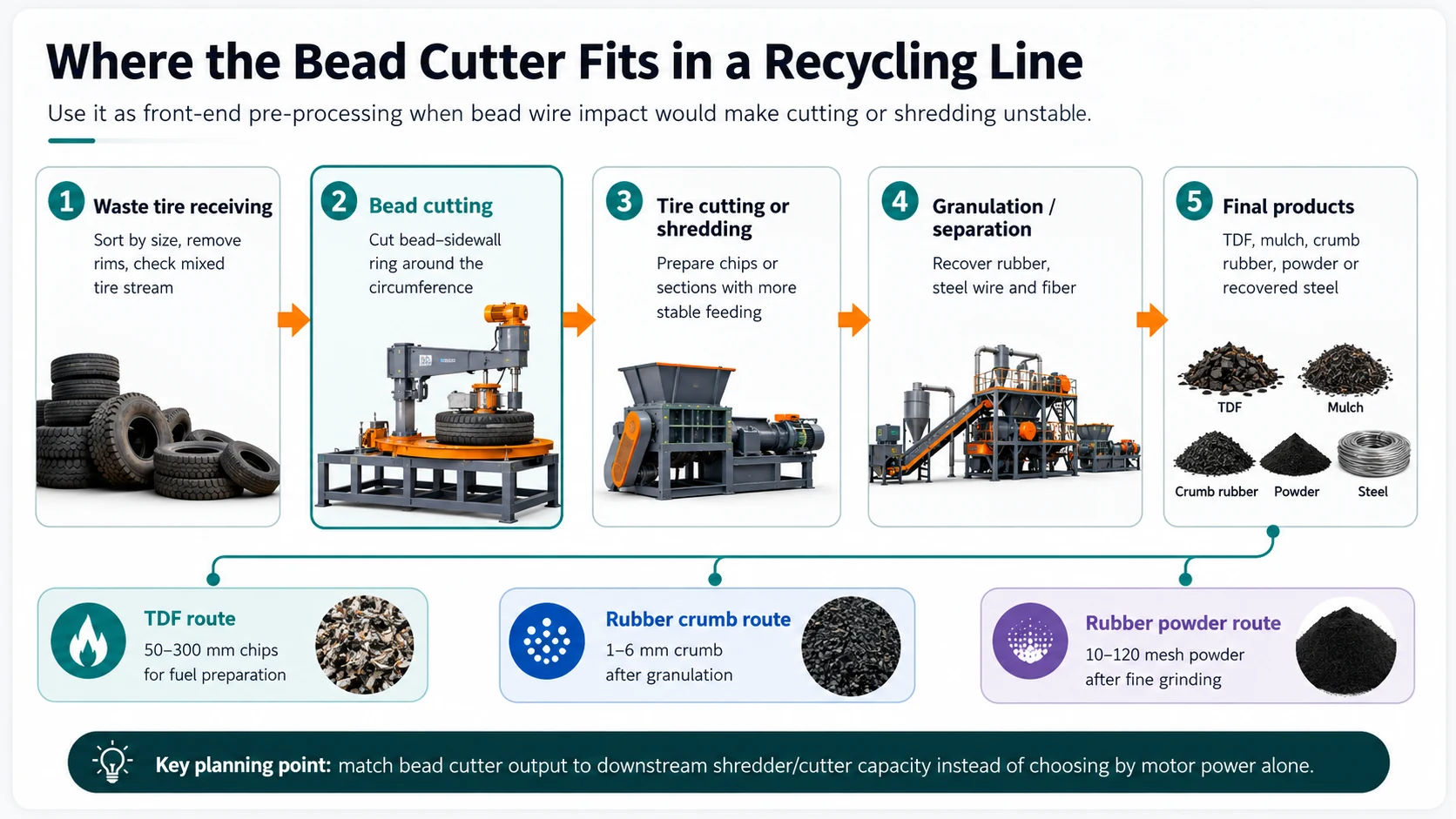
Common process route
RouteWaste tire collection → bead cutting → tire cutting machine → tire shredder machine → rubber crusher or granulator → steel wire and fiber separation.
The exact route changes with the final output. A TDF project may focus on rough chips. A rubber crumb plant needs controlled granulation and separation. A rubber powder plant needs cleaner rubber granules before fine grinding. YUXI’s tire recycling equipment lineup groups these routes by final products such as TDF chips, mulch, crumb rubber and rubber powder.
Pre-processing is especially useful when the line handles truck tires, all-steel tires or mixed streams. In these cases, the bead section can create a high-load event for the downstream cutter or shredder. Removing it first can make feeding more predictable and help reduce concentrated steel-wire impact.
Tire Bead Cutter vs. Sidewall Cutter vs. Debeader vs. Shredder
The naming can be confusing because suppliers use overlapping terms. Instead of comparing names only, compare what material goes in, what mechanical action happens and what material comes out.
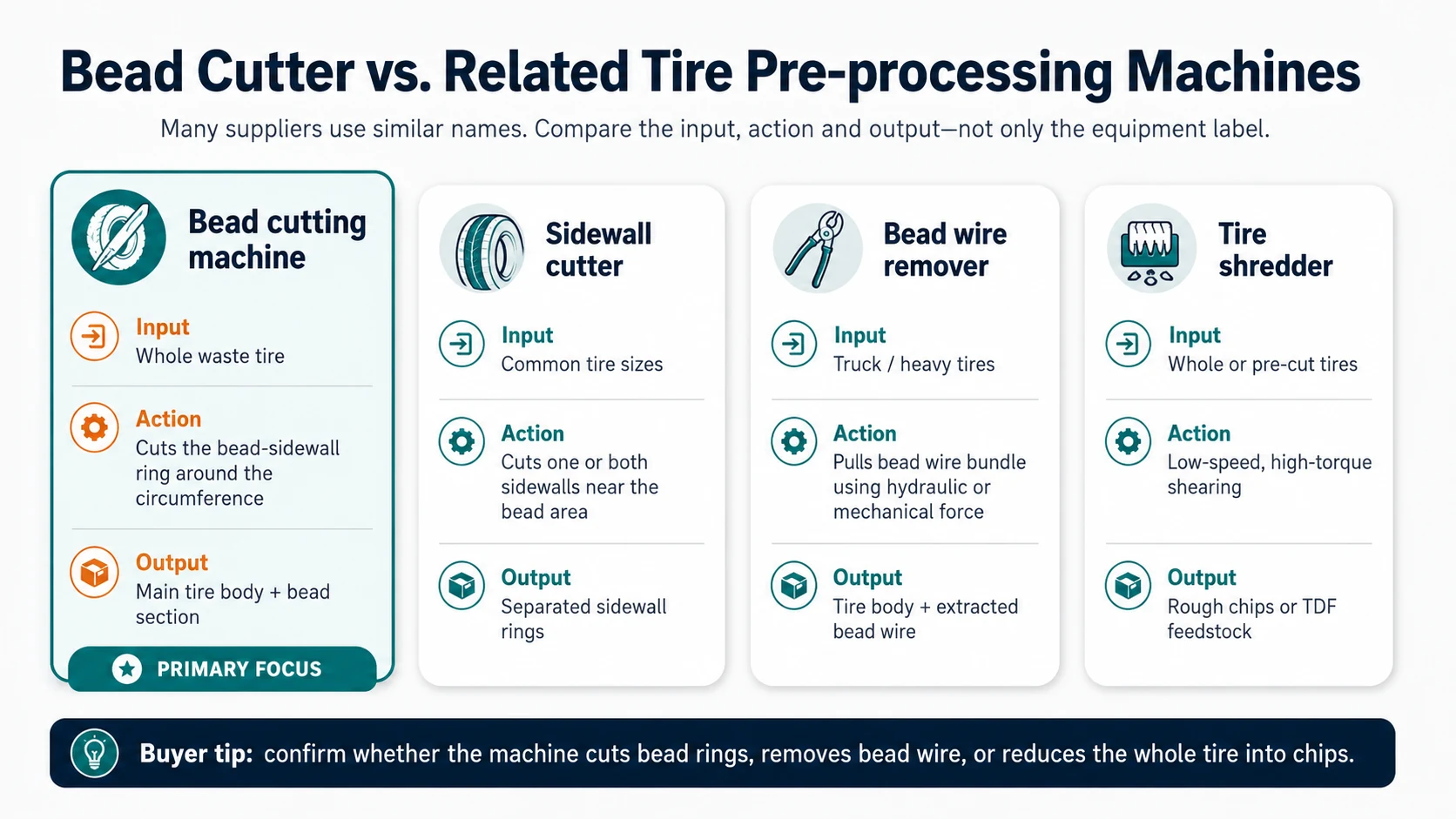
| Machine name | What it usually does | Typical output | Buyer warning |
|---|---|---|---|
| Tire bead cutting machine | Cuts around the sidewall and steel-reinforced bead area. | Main tire body plus a bead-sidewall ring containing steel wire and rubber. | It does not normally strip all rubber from the bead wire. |
| Tire sidewall cutter | Often similar to a bead cutter; removes one or both sidewall rings. | Separated sidewall rings plus tire body. | Confirm whether it cuts one sidewall, both sidewalls or the complete bead section. |
| Tire bead wire remover / debeader | Pulls the bead wire bundle using hydraulic or mechanical force. | Tire body plus extracted bead wire, often with some rubber attached. | Not the same as cutting the bead-sidewall ring. |
| Tire shredder | Uses low-speed, high-torque shafts to reduce tires or tire sections into chips. | Rough shreds, TDF chips or feedstock for granulation. | It is a size-reduction machine, not a bead extraction machine. |
How to Select the Right Tire Bead Cutting Configuration
Do not begin with motor power alone. The right configuration starts with tire type, tire diameter, bead wire strength, labor arrangement and the downstream process. YUXI notes that final parameters should be confirmed according to tire size, bead wire strength, power supply and production layout.
1. Feed tire range
Confirm passenger, SUV, light truck, truck, bus, small engineering or industrial rubber wheels. Oversized OTR tires require special evaluation.
2. Bead wire strength
Truck and all-steel tires put higher stress on the cutter and positioning structure than passenger tires.
3. Target capacity
Capacity should be matched with downstream cutting or shredding so the bead cutter does not become the bottleneck.
4. Operator workflow
Check loading method, one-person operation feasibility, tire weight and discharge convenience.
5. Workshop layout
Leave room for raw tire storage, processed tire body collection and bead-sidewall section collection.
6. Local utilities
Export projects normally need voltage, frequency, guard design and line layout confirmation.
Quotation checklist to send YUXI
- Tire type and photos: passenger, truck, bus, agricultural, OTR or mixed.
- Maximum tire diameter, width and approximate tire weight.
- Expected capacity: hourly tire count, hourly throughput and daily shifts
- Downstream process: cutting, shredding, rubber granules, rubber powder, TDF or pyrolysis pre-treatment.
- Available voltage and frequency.
- Workshop dimensions, loading method and storage space.
- Desired steel recovery quality: simple bead section separation or cleaner wire separation.
Safety and Maintenance Points Buyers Should Not Ignore
A tire bead cutting machine includes rotating parts, a cutter and a heavy workpiece. Machine guarding and operator training must be treated as part of the equipment decision, not an afterthought. OSHA’s general machine guarding standard requires guarding for hazards created by the point of operation, ingoing nip points, rotating parts, flying chips and sparks, and states that point-of-operation guarding must prevent the operator from placing any body part in the danger zone during the operating cycle.3 NIOSH also advises employers to safeguard machine parts, functions or processes that might cause injury and to train workers on machine safety.4
Practical safety checks
- Use proper guarding around the cutter and rotating table.
- Keep hands away from the tire and cutter during rotation.
- Use lockout procedures before clearing jams, changing cutters or doing maintenance.
- Check emergency stop access from the operator station.
- Do not use torch cutting as a casual substitute for controlled mechanical cutting in routine production.
Maintenance checks
Monitor cutter edge condition, clamping stability, bearing lubrication, worktable rotation smoothness and fastener tightness. Keep spare cutters in inventory if the plant runs continuously. The replacement cycle depends on tire type, bead wire thickness and daily operating hours rather than a fixed universal number.
FAQ: Tire Bead Cutting Machine Working Principle
What is a tire bead cutting machine used for
It is used to cut the bead ring and sidewall section of waste tires before tire cutting, shredding, rubber granule production or other pre-treatment steps.
Does it remove all steel from the tire
No. It mainly handles the concentrated bead wire area. Steel belts and other wire reinforcement inside the tread and carcass are normally recovered later through shredding, crushing and magnetic separation.
Can it process truck tires
Yes, if the machine is configured for the truck tire diameter, width and bead wire strength. YUXI recommends sending tire photos and size range before quotation.
Is it required before every tire shredder
Not always. Some whole-tire shredders can process common tires directly. A bead cutter becomes more valuable when the bead section is causing unstable feeding, higher cutter wear or downstream separation issues.
What should I watch in a working video
Check tire positioning, clamping stability, the cutter entry path, worktable rotation, discharge convenience and whether the tire body can be removed without repeated manual corrections.
Need a bead cutting configuration for your tire stream
Send tire photos, tire size range, target capacity, voltage and the next processing step. YUXI can match the bead cutter with tire cutting, shredding, granulation or rubber powder production line requirements. Contact YUXI for a configuration proposal
References and Source Notes
- U.S. EPA, “Where Rubber Meets the Road: EPA Researchers Study the Environmental and Health Impacts of Tires,” 2024. Source
- U.S. Tire Manufacturers Association, “2023 End-of-Life Tire Management Report.” Source
- OSHA, 29 CFR 1910.212, General requirements for all machines. Source
- CDC/NIOSH, Machine Safety in the Workplace, 2024. Source
- U.S. EPA Archive, Basic Information: Scrap Tires. Source