




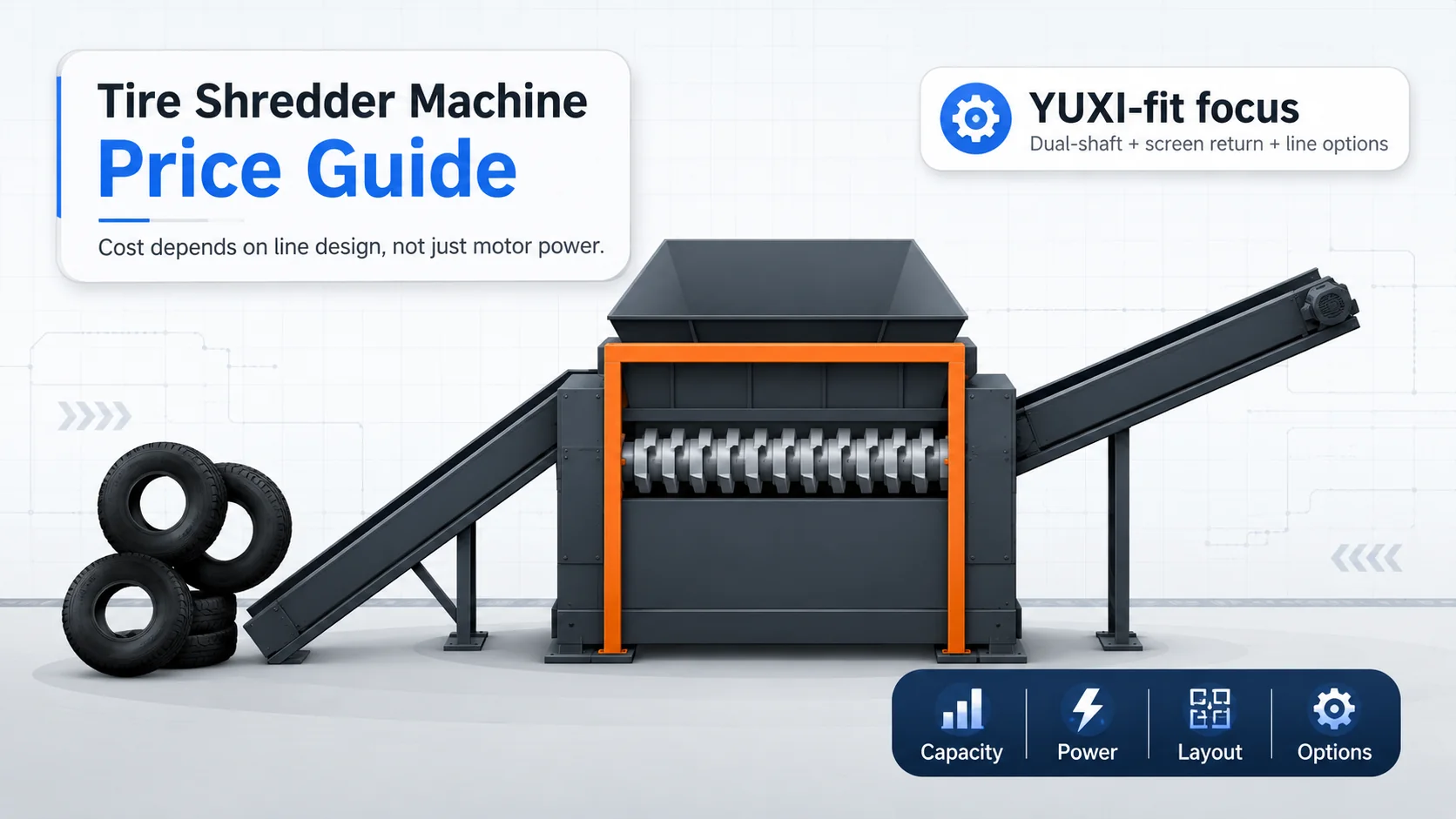
How Much Does a Tire Shredder Machine Cost?
When the buyer asked about the price of the tire shredder,the honest answer was that the body was only a part of the quotation.The price of a small inndependennt shredder for rough volune reduction is noy that of a heavy-duty full-tire shredder with feed conveyor,disc sieve,return conveyor,magnetic separation and spare blade packaging. For early budgeting, public supplier lists and market snapshots usually range from tens of thousands of dolloars for individual tire shredders,and once pre-processing,screens,conveyors,metal proc4essing,control and inst5allation support are included,the complete front-end tire recycling line can move higher.Regard athese scopes as planning references,not YUXI quotations. The better question is not “what is the cheapest shredder?” It is “what configuration can continuously process my tires into the output size my buyer will accept?” That question is where YUXI’s product logic matters. The YUXI tire shredder machine is described around whole tire pre-shredding, truck tire size reduction, TDF chip preparation and rubber recycling lines, with a dual-shaft cutting chamber and a disc screen return system that sends oversized pieces back automatically.
Buyer takeaway:If the cheap machine cannot handle the bead wire,if the output of TDF or granilation is too uneven,or if the blade and reducer are too small for truck tires,it may become expensive. A higher quote can be the safer choice when it includes the correct chamber, torque reserve, screening, return route and maintenance plan.
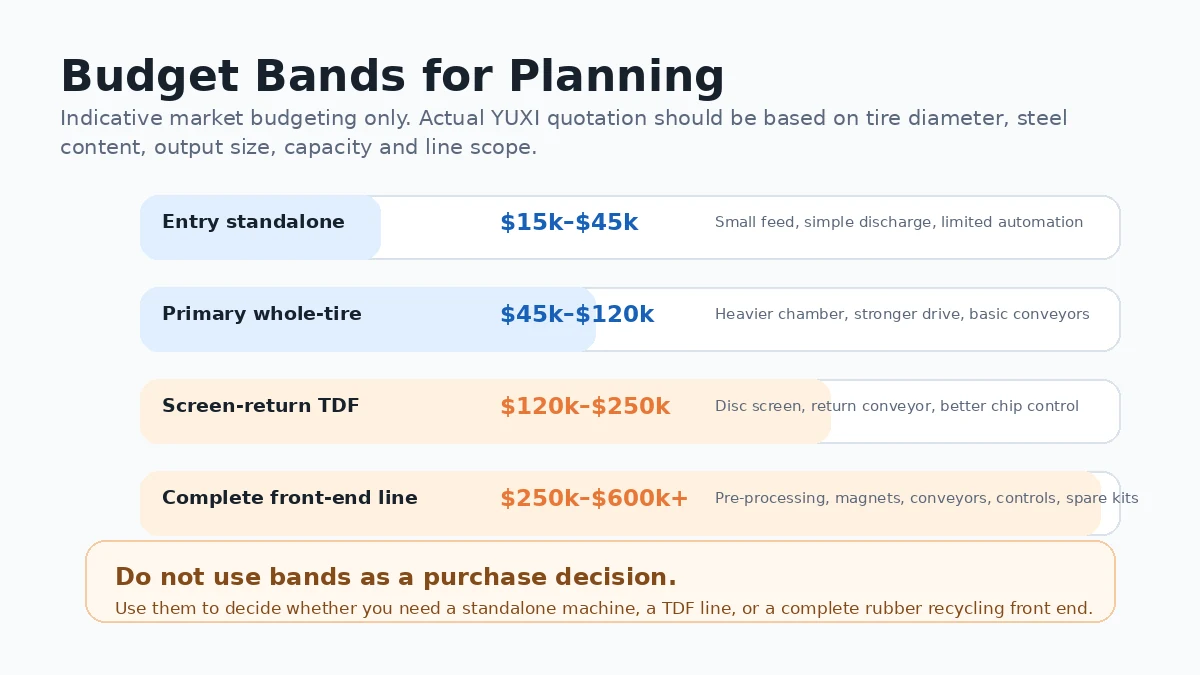
Indicative Tire Shredder Machine Price Bands
The table below is a practical budgeting framework. It combines what buyers commonly see in public market listings with engineering assumptions from real waste tire recycling projects. It should not be read as an official price list because model size, configuration and local delivery scope can change quickly.| Budget Level | Typical Scope | Indicative Planning Range | Best Fit |
|---|---|---|---|
| Entry standalone shredder | Basic cutting chamber, simple feeding and discharge | About US$15,000–45,000 | Low-volume yards, rubber offcuts, rough size reduction |
| Primary whole-tire shredder | Heavier shafts, stronger reducer, larger chamber, basic conveyor | About US$45,000–120,000 | Passenger tires, mixed tires, early TDF preparation |
| Screen-return TDF configuration | Dual-shaft shredder, disc screen, return conveyor and controlled discharge | About US$120,000–250,000 | TDF chips, more stable output size, reduced manual sorting |
| Complete front-end recycling line | Pre-processing, shredder, conveyors, screens, magnetic separation, controls, spare parts and layout support | About US$250,000–600,000+ | New plants, higher capacity, crumb rubber or powder preparation |
What Drives Tire Shredder Machine Price?
Price differences are usually created by engineering decisions, not by supplier markup alone. A tire is elastic, heavy, dirty and reinforced. Passenger tires, truck tires and OTR tires do not behave the same in a cutting chamber. Steel bead wire can punish blades and reducers. Oversized rubber pieces can overload downstream granulators. This is why a serious quotation starts with the raw material and final product.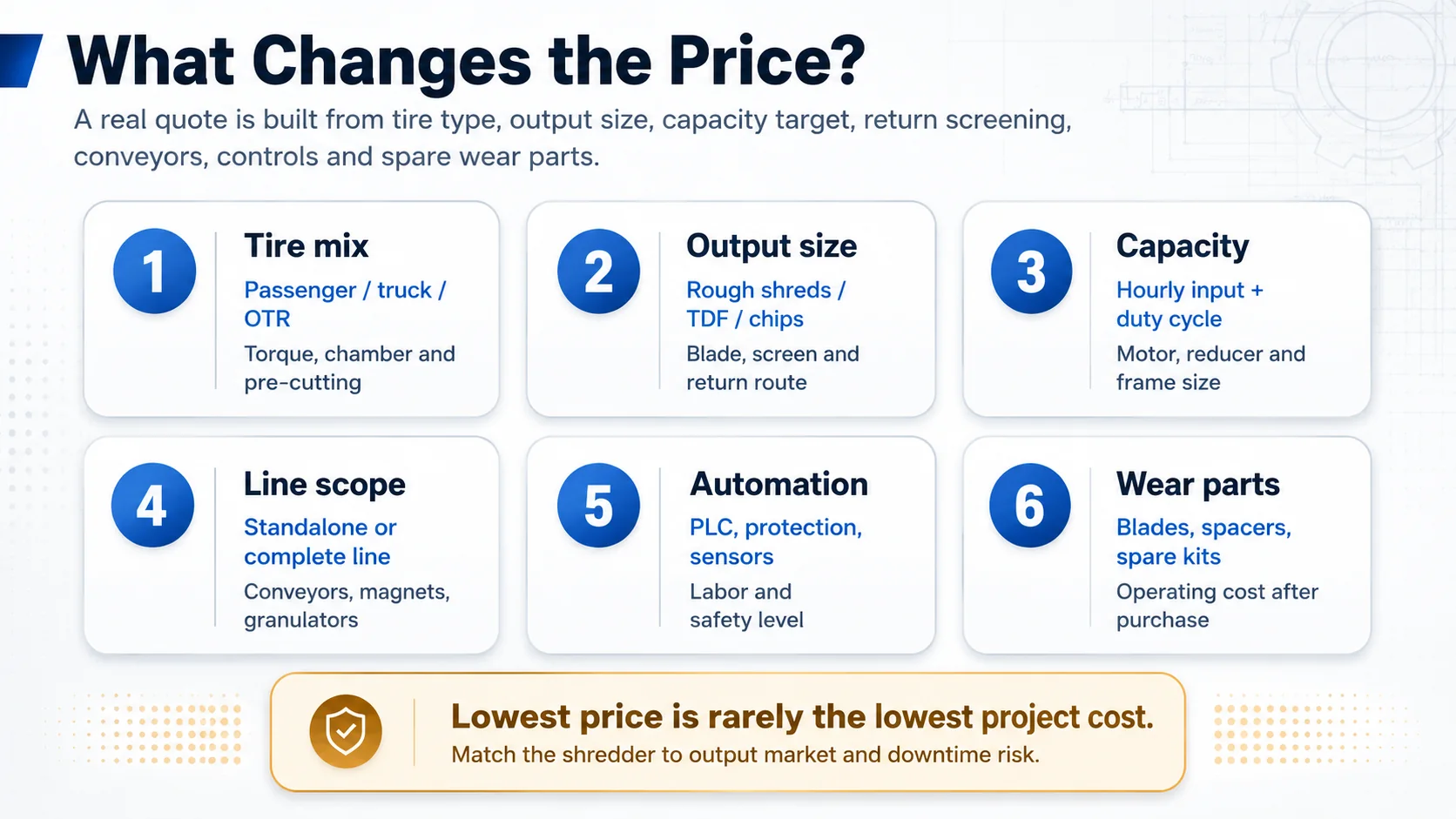
1. Tire Type and Steel Content
Truck and bus tires require more torque because they have thicker rubber and stronger beads,so passenger tires are easier to feed. OTR and mining tires can require pre-cutting or a customized feeding system before shredding. The more steel, thickness and diameter the machine must handle, the more important the shaft design, blade material, reducer selection and frame structure become.2. Output Size and Oversize Control
A rough-shred application can accept a wider size spread. TDF, rubber mulch and downstream granulation usually require tighter control. The U.S. Federal Highway Administration describes tire shreds and chips as products of primary and secondary shredding, with size depending on the shredder model and cutting-edge condition. That engineering reality explains why a screen and return loop can change the price: it adds hardware, but it also helps prevent unqualified oversize from leaving the system.3. Capacity Target and Duty Cycle
The machine that occasionally works in bulk is different from the production line that is expected to run two shifts a day.Higher capacity will affect motor power,reducer torque,shaft diameter,blade thichness,hopper size,conveyor width,electrical control and cooling or lubrication planning.Buyers should state both hourly capacity and daily working hours.4. Feeding, Screening and Return Conveyors
Many low quotes are low because they only include the shredder body. In a real plant, the price may also need feeding conveyor, discharge conveyor, disc screen, return conveyor, magnetic separator, platform, guard, dust-control connection, spare blades and electrical cabinet. A screen-return design costs more at the quotation stage but can reduce manual sorting and improve output consistency.5. Automation and Protection
Controls add cost, but they can protect the investment. Reverse protection, overload logic, emergency stops, motor monitoring, access guarding and interlocked maintenance points are not cosmetic. They help prevent jam damage and reduce operator risk. OSHA’s machine guarding rule requires methods to protect operators from hazards such as points of operation, nip points and rotating parts, which is directly relevant to shredder layouts.6. Spare Parts and Maintenance Access
For steel-wire rubber, blades are a cost center. The quote should clarify blade material, blade quantity, spacer arrangement, replacement procedure, recommended spare kit and access space. A lower machine price without a spare blade plan can lead to longer downtime after the first major wear cycle.How YUXI Product Information Changes the Price Discussion
The YUXI tire recycling category page explains that front-end equipment is selected according to tire type, steel content, required output size and whether the project needs a standalone machine or a complete recycling line. That is a more useful buying logic than comparing model names alone. In the wider YUXI tire recycling equipment system, wire drawing, bead cutting, tire cutting and shredding machines form the front-end equipment group before downstream TDF, mulch, crumb rubber or powder processing. For price evaluation, the important YUXI product points are the dual-shaft shredding structure, low-speed high-torque cutting action, disc screen output control and return conveyor logic. The product page also highlights that a tire shredder can be supplied as a single machine or integrated into a complete waste tire recycling line. Those two options can have very different prices even when the same shredder body is used.Standalone Buyer
Usually asks for a machine replacement, extra front-end capacity or simple volume reduction. Price is driven by chamber size, tire diameter, motor and blade plan.TDF Buyer
Needs chip-size control and stable discharge. Price is affected by disc screen, return conveyor, steel tolerance and fuel-user requirements.Crumb Rubber Buyer
Needs the shredder output to match granulator input. Price is influenced by magnetic separation, secondary size reduction, fiber separation and screening.Standalone Machine vs. Complete Tire Recycling Line
A tire shredder price can look attractive when it is quoted as a single machine. The risk appears later if the buyer still needs conveyors, screens, magnetic separation, platforms, electrical integration and spare parts. That does not mean every buyer needs a complete line. It means the quote should match the project stage.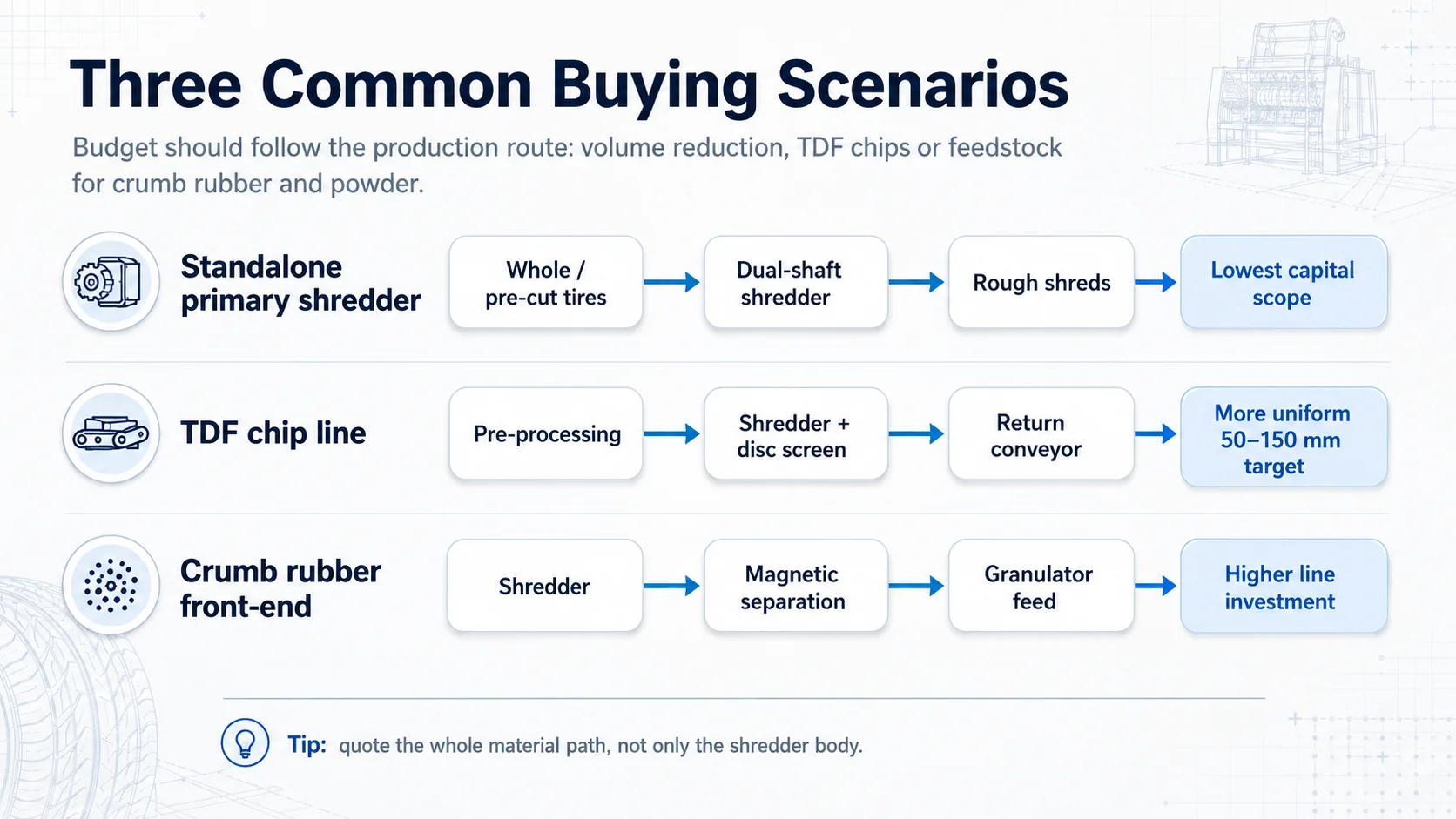
Route A: Volume Reduction
A collection yard may need to cut whole tires into rough shreds for easier handling, storage or transport. In this case, output size tolerance is usually wider. The project can often start with a primary shredder, feeding conveyor and simple discharge arrangement.Route B: TDF Chips
A TDF supplier needs a more controlled material stream. EPA notes that tires are often size-reduced before use as tire-derived fuel, and some applications require additional processing such as de-wiring. For this route, buyers often compare not only the shredder body but also the screen, return conveyor, metal handling and chip-size target. YUXI’s Tire TDF Plant page positions this route around turning whole tires into rough shreds or rubber chips for fuel and further processing.Route C: Wire-Free Mulch or Rubber Chips
When the output needs to be cleaner rubber chips, the line normally adds more separation and screening. A buyer considering landscape mulch or civil engineering chips should budget beyond primary shredding. For that application, the Tire Wire Free Mulch Plant direction is closer to a mid-stream steel-separation project than to a simple shredding yard.Route D: Crumb Rubber and Rubber Powder
Crumb rubber projects usually need several stages after the first shredder: granulation, steel separation, fiber removal, screening and sometimes fine grinding. The Tire Rubber Crumb Plant route is therefore priced differently from a basic shredder project. If the final market requires finer rubber powder, the Tire Rubber Powder Plant route adds grinding and collection stages after size reduction.The Real Cost: Total Cost of Ownership
Purchase price is visible. Operating cost is quieter, but it decides whether the plant is profitable. A tire shredder with a weak drive, poor access or unsuitable output can consume savings through downtime. For a high-steel feedstock, the total cost of ownership should include blades, spacers, reducer service, power consumption, labor, cleaning, jam recovery, screen maintenance, freight, installation, operator training and lost production during shutdown.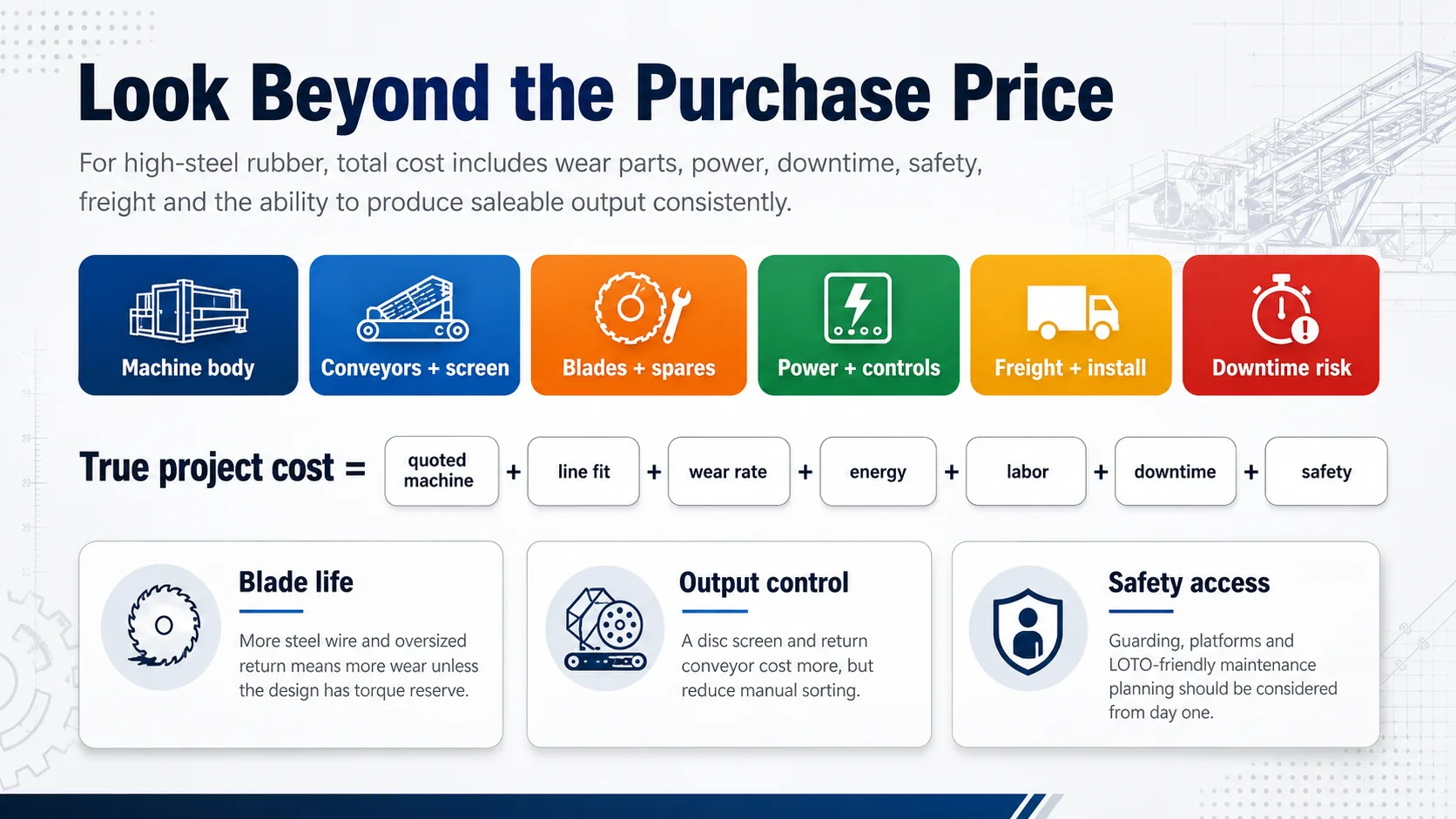
Blade Wear
Blade wear depends on tire mix, wire content, feed contamination, output size and how often oversize material returns to the chamber. Ask whether the quote includes spare blades and how quickly replacement parts can be supplied.Energy and Throughput
A larger motor does not automatically mean lower cost per ton. The machine must pull tires steadily, cut without excessive reversal, and keep downstream equipment fed. A controlled line can produce more saleable tons per shift than a cheaper machine that jams often.Safety and Maintenance Procedures
Industrial shredders require maintenance planning. OSHA’s lockout/tagout standard covers servicing and maintenance where unexpected energization or release of stored energy could injure workers. For buyers, that means safe access, isolation points, guarding and maintenance sequence should be considered before the machine ships, not added after installation.Output Value
End-use markets matter. USTMA’s 2023 end-of-life tire report states that TDF was the largest U.S. end-use market for end-of-life tires at 33%, while ground rubber accounted for 28%; it also notes growth in rubber-modified asphalt. If your local market rewards cleaner chips, wire-free rubber or crumb rubber, a higher front-end investment may support better revenue quality.How to Compare Supplier Quotations
Do not compare tire shredder quotes by the headline price alone. Put each offer into the same scope table. If one quote includes a disc screen and return conveyor while another only includes the shredder body, the lower price may not be lower at all.| Comparison Item | Question to Ask | Why It Matters |
|---|---|---|
| Material assumption | Which tire types and maximum diameters are included? | Truck tires and OTR tires change torque, blade and feeding requirements. |
| Output size | What size range is expected, and is oversize returned automatically? | Output size determines screen, return conveyor and downstream stability. |
| Included equipment | Are feeding, discharge, screen, return conveyor, magnet and control cabinet included? | Machine-only quotes are not equal to line quotes. |
| Wear parts | What spare blades, spacers and service parts are included? | Spare parts affect downtime after installation. |
| Factory testing | Can the supplier provide test photos or video with similar tires? | Rubber load and return behavior are easier to judge from working evidence. |
| Installation support | Are layout drawings, wiring guidance, commissioning and training included? | Bad layout can create feeding bottlenecks and maintenance problems. |
Practical method: Ask every supplier to quote the same tire type, same capacity target, same output size and same line scope. Then compare not only the price, but also the machine weight, reducer brand, blade material, chamber opening, screen design, control logic, spare parts and service response.
RFQ Checklist: What to Send Before Asking About The Price
A clear inquiry can save a few days of round-trit. It also helps prevent under-quoted machines. Before requesting a tire shredder machine price, send the supplier the information below.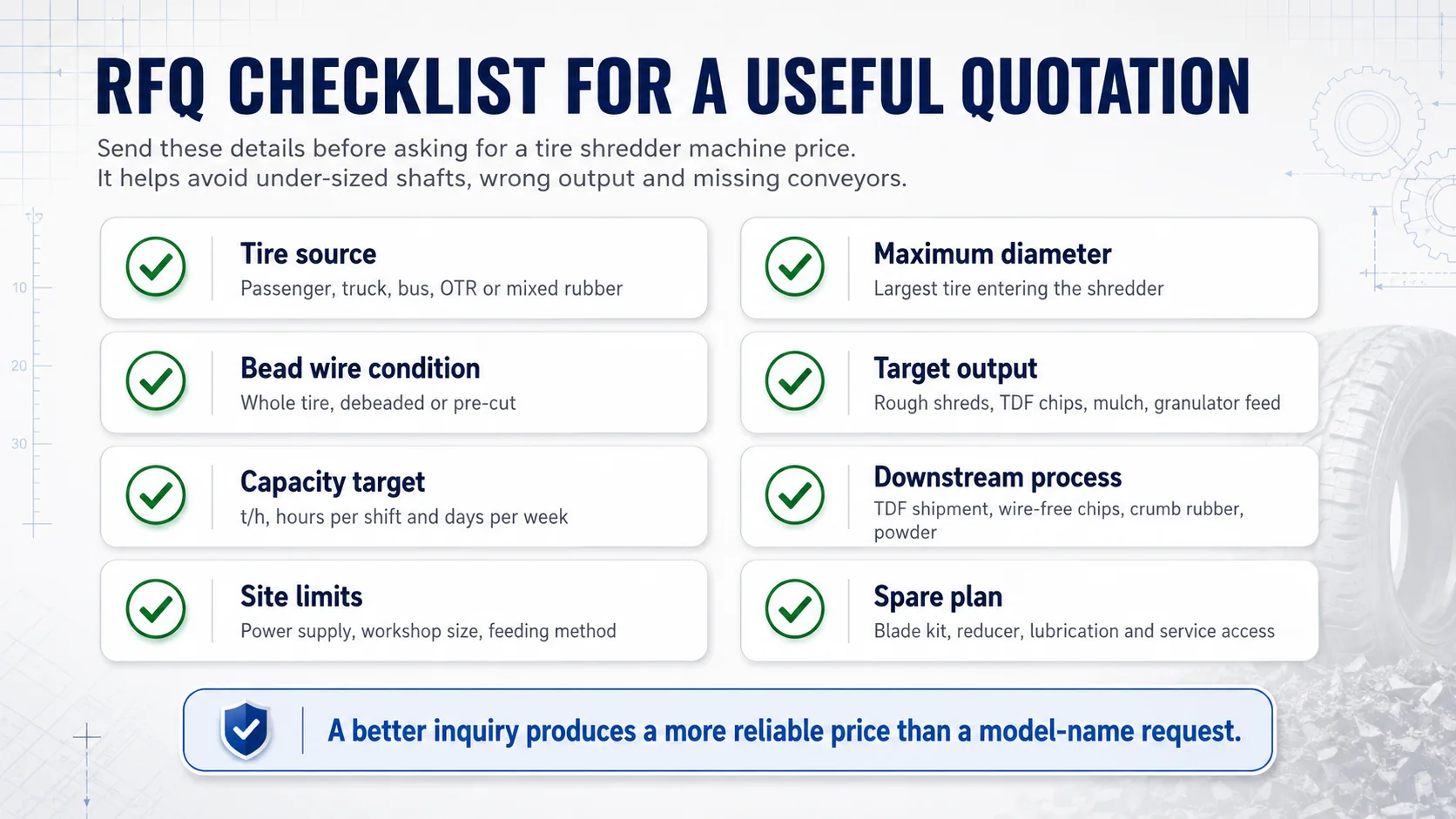
- Tire types: passenger tires, truck tires, bus tires, OTR tires, agricultural tires, rubber belts or mixed rubber waste.
- Maximum tire diameter: largest tire expected in normal operation, not only average tire size.
- Bead wire condition: whole tire, debeaded tire, sidewall cut tire or pre-cut sections.
- Target output: coarse chips, 50–150 mm TDF chips, 20–50 mm rubber chips, granulator feed or smaller debris/powder routes.
- Capacity target: tons per hour,per shift, daily shift and expected operating days per month.
- Downstream process: TDF transportation, magnetic separation, wireless munch, crumb rubber, rubber powder or pyrolysis preparation.
- On-site conditions: available power, workshop height, floor space, feed method forklift or loader channel and dust control expectations.
- Business scope: FOB or CIF terms, spare parts, installation guidance, commissioning support, operator training and document requirements.
Common Price Mistakes Made By Buyers
Mistake 1: Asking for Price Before Defining Output
A shredder for rough volume reduction is not the same as a shredder feeding a crumb rubber plant. Output size decides the screen, return system and downstream equipment. Price without output definition is only a guess.Mistake 2: Comparing Motor Power Only
Motor power does not tell you the geometry of the blade, shaft strength, reducer torque, frame weight, chamber opening or screen-return behavior. A low-speed system of moderate size can be better than a mismatched high-power machine.Mistake 3: Ignoring Tire Bead Wire
Bead wire is one of the toughest sections in a tire. If truck tires are a major part of the feedstock, consider whether wire drawing, bead cutting or pre-cutting should be included before shredding.Mistake 4: Leaving Conveyors Out of the Budget
Conveyors look simple, but feeding rhythm and discharge layout affect the whole plant.After the conveyor angle,transmisssion height or poor installation of the maintenance plan,the aisle may reduce the capacity.Mistake 5: Purchase the lowest quotation without terms of service
For heavy recycling equipment, the minimum prepaid quotation may become expensive if it does not include spare blades,electrical drawings,layout guidance,debugging suggestions or response time for service issues.FAQ: Tire Shredder Machine Price
What is the average tire shredder machine price?
For early planning, individual machines may appear from the low tens of thousands of dollars to a few hundred thousand dollars in public market listings. Complete line pricing can be much higher because it includes conveyors, screens, metal separation, controls, spare parts and installation support. A supplier quotation is still necessary because tire diameter, steel content and output size change the design.Why are tire shredder prices so different?
Prices differ because the quoted scope differs. One offer may include only the shredder body; another may include feeding conveyor, disc screen, return conveyor, magnetic separation, control cabinet and spare blade package. Shaft design, blade material, reducer quality, chamber size and automation also change price.Is a used tire shredder worth buying?
It can be, but only after inspecting blade wear, shaft condition, gearbox history, frame cracks, electrical cabinet, availability of spare parts and whether the output size matches your market. A used machine with no service support can be risky for continuous recycling work.Does a TDF shredder line cost more than a rough shredder?
Usually yes. TDF customers often need controlled chip size and sometimes de-wiring or metal handling. That can require a disc screen, return conveyor, magnetic separation and more complete discharge layout.What output size should I choose before asking for price?
For rough volume reduction, large shreds may be enough. For TDF, many projects target controlled chips such as 50–150 mm. For mulch, crumb rubber or powder, the shredder output must match secondary shredding, granulation and separation requirements. Confirm the buyer’s specification first.Can YUXI quote both a standalone machine and a complete line?
Yes. The practical approach is to share tire type, maximum diameter, output target, capacity and site conditions, then request both a standalone shredder option and a complete line option if you are still comparing project routes.References and Source Notes
External references are included for market context, safety and end-use background. YUXI product information is integrated naturally in the body to keep internal links in context.- USTMA 2023 End-of-Life Tire Report Page — ELT market disposition, TDF, ground rubber and RMA market context.
- U.S. EPA Tire-Derived Fuel page — TDF background, size reduction, de-wiring and responsible use notes.
- FHWA Scrap Tires Material Description — primary/secondary shredding, tire chip/shred descriptions and crumb rubber processing context.
Need a Project-Specific Tire Shredder Quote?
Send your material details, target capacity, output requirements, site information and local electrical standard. YUXI can prepare a suitable equipment configuration and quotation.