




Tire rubber granule recycling turns waste tires into reusable crumb rubber and rubber granules for sports surfaces, modified asphalt, molded rubber products, landscaping mulch and industrial applications. For investors and recycling operators, the important question is not only whether rubber granules can be sold, but how to design a stable production line, control impurities, match particle size to the right market and build a practical profit model.
This guide explains the tire rubber granule recycling process, main equipment, particle size options, cost factors, revenue logic and quotation information needed before building a rubber granule production line.
What Is Tire Rubber Granule Recycling?
Tire rubber granule recycling is the mechanical process of reducing scrap tires into clean rubber particles after steel wire and textile fiber are separated. The final product is usually larger than fine rubber powder and smaller than tire-derived fuel chips. Common output ranges include 1-3 mm, 3-5 mm, 5-10 mm, 10-20 mm and larger rubber chips depending on the downstream application.
Compared with simply shredding tires for fuel, rubber granule recycling focuses more on material recovery. The production line must control particle size, steel content, fiber content, dust, moisture and product consistency. A well-designed line can sell different grades of rubber granules to different markets instead of relying on a single low-value outlet.
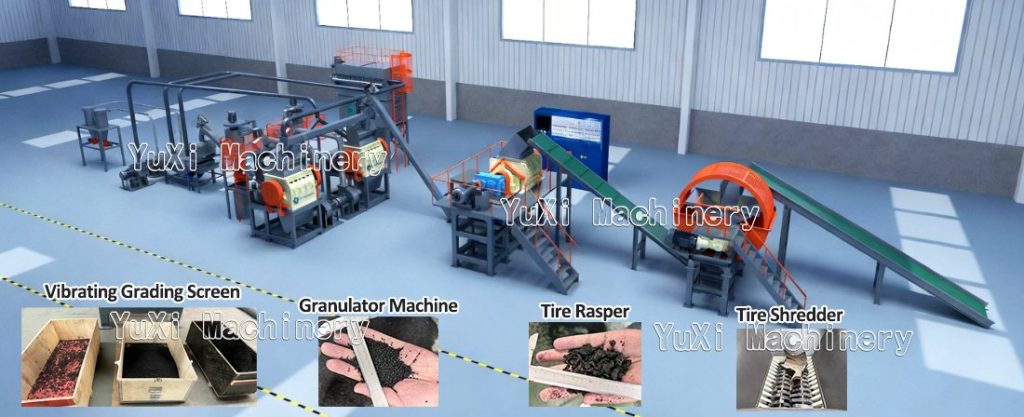
Typical Tire Rubber Granule Production Process
A complete tire rubber granule plant is usually configured according to tire type, capacity, target particle size and purity requirements. A typical process includes the following stages:
- Waste tire feeding and pre-treatment: Whole tires are loaded into the line. Large truck tires or OTR tires may require cutting, bead removal or pre-shredding before continuous processing.
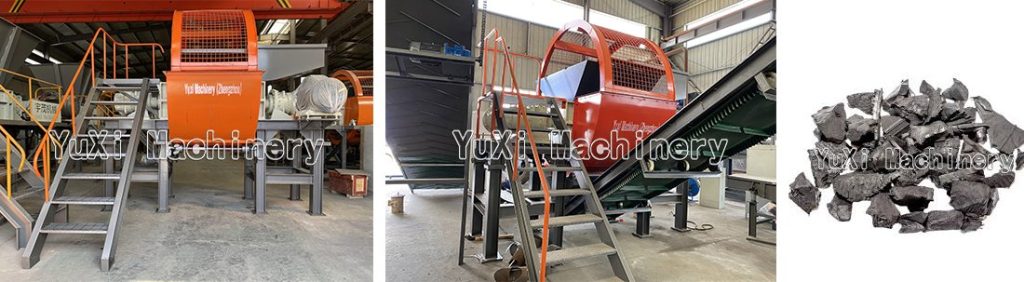
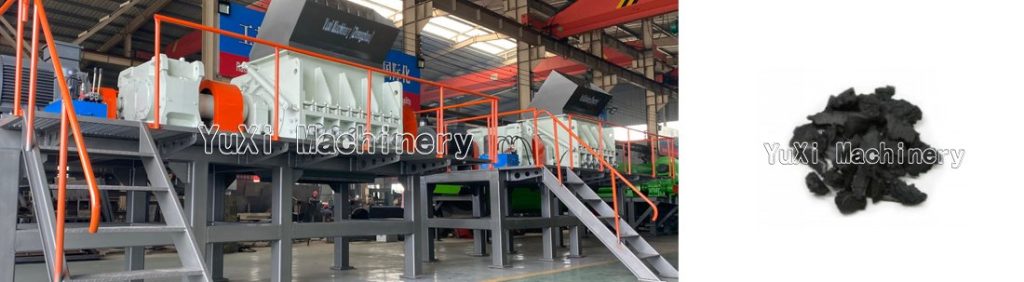
- Primary shredding: A tire shredder machine cuts tires into smaller chips so the material can move through conveyors, screens and downstream separation equipment.
- Steel wire separation: Magnetic separation removes most steel wire after shredding and granulation. The number of magnetic stages depends on purity requirements.
- Secondary granulation: Rubber chips are further reduced by granulators or crushers to the target particle size range.
- Fiber separation: Air separation and screening remove textile fiber and light impurities from rubber granules.
- Screening and grading: Vibrating screens classify rubber granules into different sizes such as 1-3 mm, 3-5 mm, 5-10 mm or 10-20 mm.
- Dust collection and packing: Dust control, storage bins and bagging systems help keep the plant clean and prepare the final product for sale.
If the project target is fine rubber powder, the line may add grinding and milling equipment after the granulation stage. For this route, see the tire rubber powder plant.
Recommended Equipment for a Rubber Granule Recycling Line
The equipment configuration should be selected from the final product backwards. A plant making TDF chips, rubber mulch, crumb rubber or fine powder will use different stages and different screen settings.
| Equipment | Main Function | Selection Notes |
| Tire shredder | Primary size reduction for whole tires or tire sections | Confirm tire diameter, truck tire ratio, steel content and desired chip size. |
| Conveyor system | Transfers material between stages | Layout should match workshop space and maintenance access. |
| Magnetic separator | Removes steel wire from shredded rubber | Multiple magnetic stages may be needed for higher purity. |
| Granulator / crusher | Reduces rubber chips into granules | Choose according to particle size and hourly capacity. |
| Fiber separator | Removes textile fiber and light impurities | Important for sports surfaces and molded rubber products. |
| Vibrating screen | Grades rubber granules by size | Screen mesh should match target products and market demand. |
| Dust collector | Controls dust during crushing, screening and conveying | Necessary for workshop cleanliness and environmental compliance. |
| Packing system | Packs final granules into bags or bulk containers | Choose manual, semi-automatic or automatic packing according to labor cost. |
For a ready-made production route, the tire rubber crumb plant is usually the most relevant equipment page for rubber granule and crumb rubber projects.
Particle Size and Application Matching
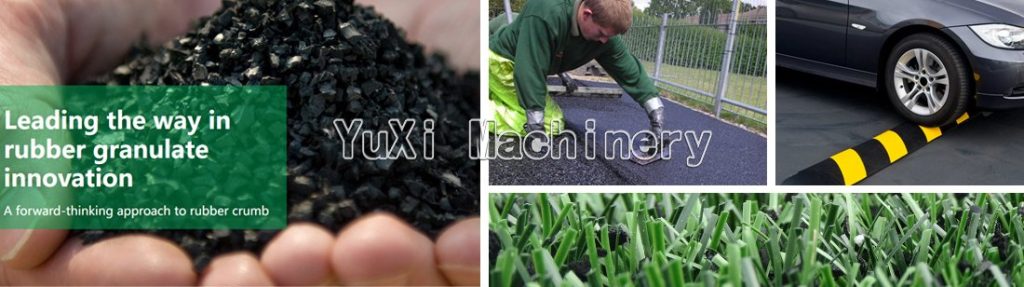
Rubber granule value depends heavily on particle size, purity and buyer requirements. A plant should avoid producing only one size unless there is already a stable buyer. In many projects, screening several product grades gives the operator more sales flexibility.
| Particle Size | Typical Application | Quality Focus |
| 10-50 mm | Rubber chips, mulch, pre-material for further processing | Stable chip size, low oversize, manageable steel content. |
| 5-10 mm | Landscape mulch, drainage layers, rubber products | Clean separation and consistent color or composition. |
| 3-5 mm | Sports surfaces, playground base layers, molded products | Low fiber content and stable grading. |
| 1-3 mm | Artificial turf infill, athletic surfaces, high-value molded products | Higher purity, low dust and tight particle size control. |
| 30-120 mesh | Rubber powder, modified materials, compound applications | Requires additional grinding after granulation. |
What Affects the Cost of a Tire Rubber Granule Plant?
The investment cost of a tire rubber granule recycling plant varies widely. A small line for rough chips and a high-purity crumb rubber line are not the same project. Before asking for a quotation, buyers should define the basic operating target.
- Input tire type: Passenger tires, truck tires, steel radial tires and OTR tires require different feeding and shredding strength.
- Capacity target: A 1 ton/hour line and a 3 ton/hour line use different conveyors, motors, screens, separation systems and workshop layouts.
- Final particle size: Smaller particle sizes require more reduction stages and stronger dust/fiber control.
- Purity requirement: Products for sports fields and molded rubber products often require lower steel, fiber and dust content than rough rubber chips.
- Automation level: Manual packing and semi-automatic systems cost less, while automatic feeding, screening and packing reduce labor.
- Environmental controls: Dust collection, noise control and fire prevention should be designed into the line from the beginning.
- Installation region: Local labor, electric standard, shipping distance and compliance requirements also affect total project cost.
Instead of comparing machine price alone, it is better to compare output stability, maintenance access, blade wear, energy use, impurity control and the ability to sell several product grades.
How Rubber Granule Recycling Creates Profit
Rubber granule recycling profit comes from three areas: waste tire intake, material recovery and value-added product grading. The exact return depends on local tire collection cost, electricity cost, labor cost, product buyers and the reliability of the production line.
A practical profit model usually includes:
- Rubber granule sales: Main revenue source, with price differences by particle size and cleanliness.
- Steel wire recovery: Separated steel wire can be sold as scrap metal if collection and cleaning are properly managed.
- Textile fiber management: Fiber may be reused, sold at low value or handled as waste depending on local markets.
- Product grading: Selling several grades can reduce inventory pressure and match more customers.
- Stable downstream contracts: Sports field contractors, rubber product manufacturers, asphalt suppliers and mulch distributors can all become target buyers.
Be cautious with fixed payback promises. The same machine configuration may perform very differently in two countries because waste tire supply, product price, electricity, labor and environmental requirements are different. A reliable feasibility plan should be calculated with local numbers.
Environmental and Quality Control Points
Rubber granule recycling is a mechanical recycling route, but the plant still needs serious environmental control. Dust, noise, steel wire, fiber and fire risk should be managed during layout design instead of being solved after installation.
- Use dust collection at shredding, granulation, screening and packing points.
- Keep magnetic separation accessible for cleaning and maintenance.
- Design screens so operators can replace mesh safely and quickly.
- Control material storage to reduce fire risk and blocked walkways.
- Use clear product grading standards for each buyer.
- Keep maintenance records for blades, bearings, reducers and motors.
Information Needed for a Rubber Granule Plant Quotation
To recommend a suitable tire rubber granule recycling line, YUXI normally needs practical project information rather than only a target price. This helps avoid undersized equipment, oversized investment or a line that cannot meet the final product requirement.
- Waste tire type: passenger tires, truck tires, OTR tires or mixed tires.
- Maximum tire size and approximate steel content.
- Target capacity: for example 1 ton/hour, 2 tons/hour or 3 tons/hour.
- Final product: rubber chips, rubber granules, crumb rubber or rubber powder.
- Required particle size range and purity target.
- Workshop size, available power and local voltage.
- Preferred automation level and labor plan.
- Destination country and any local environmental requirements.
If you are still comparing production routes, start with the tire rubber crumb plant, tire wire free mulch plant and tire TDF plant pages to compare output targets.
Frequently Asked Questions
What is the difference between tire rubber granules and rubber powder?
Rubber granules are larger particles, often used for sports surfaces, mulch, molded products and modified asphalt. Rubber powder is finer and usually requires additional grinding after granulation.
What particle sizes can a tire rubber granule plant produce?
Common product ranges include 1-3 mm, 3-5 mm, 5-10 mm, 10-20 mm and larger rubber chips. The exact size depends on the shredder, granulator, screen and downstream application.
Can the same line produce several grades?
Yes. With suitable screening and collection design, one line can separate several rubber granule sizes. This helps match different buyers and improves product flexibility.
How much steel wire can be removed?
Steel removal depends on tire type, crushing stage and magnetic separation design. Projects requiring high-purity rubber granules usually need multiple separation and screening stages.
Is water washing required?
Not every project needs washing. It depends on tire cleanliness, target application and buyer requirements. Washing adds water treatment and drying requirements, so it should be evaluated carefully.
What affects rubber granule plant profit most?
The main factors are waste tire supply cost, electricity, labor, output quality, product price, maintenance cost and whether the plant has stable downstream buyers.
Can YUXI provide a complete layout?
Yes. YUXI can help configure shredding, granulation, steel separation, fiber separation, screening, dust collection, conveying and packing according to your capacity and product target.
Conclusion
A profitable tire rubber granule recycling plant is built around three decisions: the waste tires you can collect, the particle sizes your market needs and the equipment configuration required to produce those grades consistently. The best line is not always the largest one. It is the line that matches local tire supply, labor conditions, environmental rules and real downstream buyers.
If you want a practical configuration, send your tire type, target capacity, required particle size and destination country to YUXI. The engineering team can recommend a tire shredder, granulator, separator, screening and packing layout for your project.
Contact YUXI for a tire rubber granule recycling plant quotation.