




Tire rubber powder recycling turns waste tires into fine rubber powder for modified asphalt, molded rubber products, reclaimed rubber, waterproof materials, rubber mats, conveyor belts and other industrial applications. Compared with rough tire shreds or larger rubber granules, rubber powder production requires more precise size reduction, cleaner steel and fiber separation, better dust control and more careful product grading.
This guide explains how a tire rubber powder recycling plant works, what equipment is normally required, how to choose mesh size, what affects investment cost, and what information should be prepared before requesting a quotation from YUXI.
What Is Tire Rubber Powder Recycling?
Tire rubber powder recycling is a mechanical process that reduces scrap tires into fine rubber powder after steel wire, textile fiber and other impurities are removed. The finished material is usually measured by mesh size rather than only millimeters. Common product grades include 30 mesh, 40 mesh, 60 mesh, 80 mesh, 100 mesh and finer powder depending on the grinding system and market requirement.
Rubber powder is not the same as rubber granules. Rubber granules are larger particles used for sports surfaces, playgrounds, mulch and some molded products. Rubber powder is finer and is often used as an additive or raw material in rubber compounds, modified asphalt, reclaimed rubber production and fine rubber products.
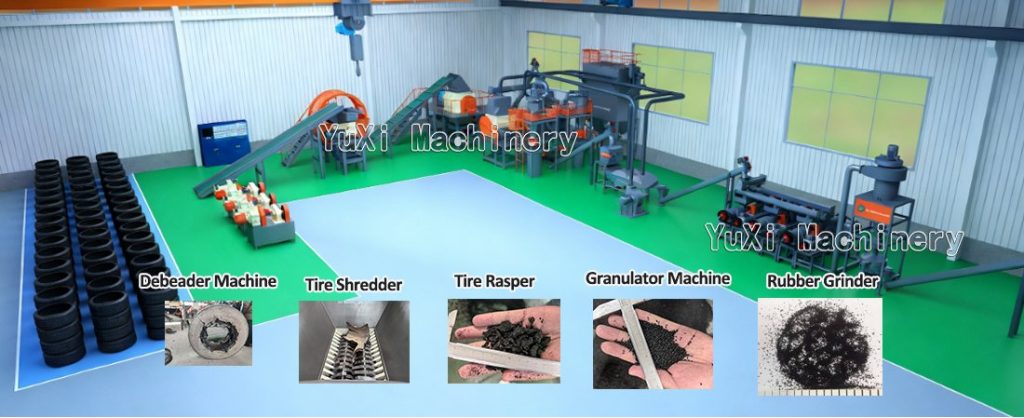
Tire Rubber Powder Production Process
A practical rubber powder line is usually designed from the finished product backwards. The required mesh size determines the number of crushing, granulation, grinding, screening and separation stages.
- Tire pre-treatment: Whole tires are sorted by size. Large truck tires or OTR tires may need cutting, debeading or pre-shredding before continuous feeding.
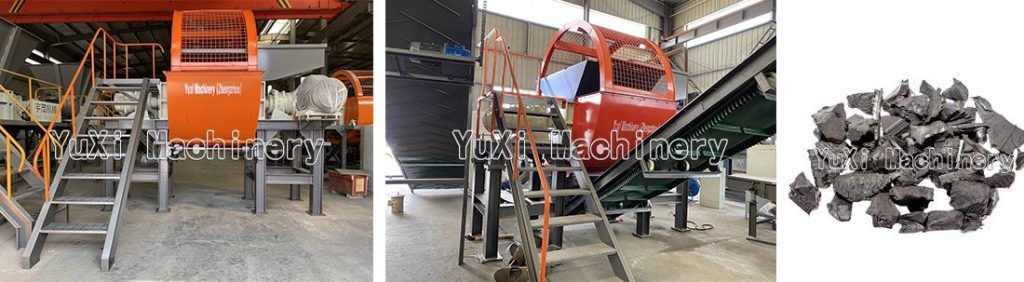
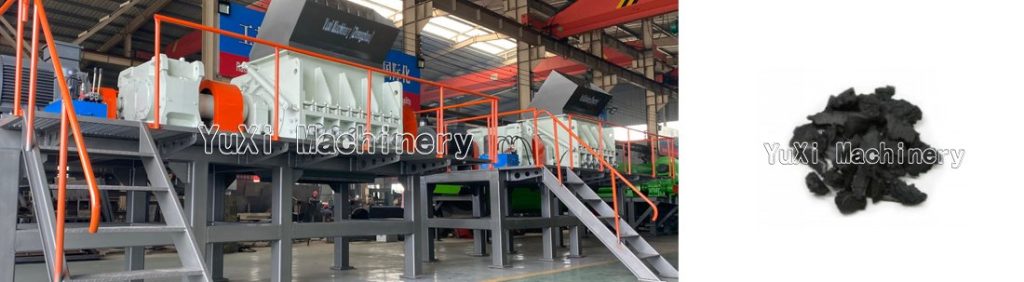
- Primary shredding: A tire shredder machine cuts tires into smaller rubber chips so the material can enter downstream equipment smoothly.
- Steel wire separation: Magnetic separators remove most steel wire after shredding and granulation.
- Rubber granulation: Rubber chips are reduced into smaller granules before fine grinding.
- Fiber separation: Air separation removes textile fiber and light impurities from the rubber material.
- Fine grinding: The rubber granules are ground into the target mesh size. More demanding powder may require multiple grinding passes.
- Screening and grading: Vibrating screens or classifiers separate powder into different mesh grades.
- Dust collection and packing: Dust control, buffer silos and packing systems prepare the final powder for storage and sale.
For projects that only need larger crumb rubber or granules, the tire rubber crumb plant may be enough. For fine powder, the tire rubber powder plant is the more suitable production route.
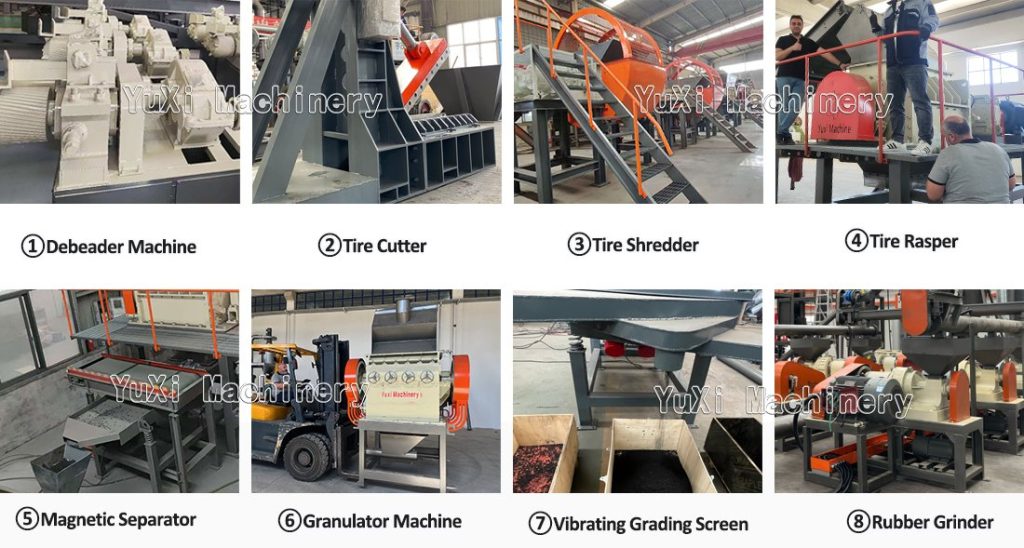
Main Equipment in a Tire Rubber Powder Plant
The equipment list depends on tire type, capacity and final mesh size. A small powder project and a high-capacity automated line may use different layouts, but the core stages are usually similar.
| Equipment | Main Function | Selection Notes |
| Tire cutter or debeader | Pre-treats large or steel-heavy tires | Useful for truck tires, OTR tires and mixed tire streams. |
| Tire shredder | Primary size reduction | Choose by tire diameter, steel content and hourly capacity. |
| Granulator | Reduces chips into granules before grinding | Important for stable fine grinding and lower energy waste. |
| Magnetic separator | Removes steel wire | Multiple stages may be required for cleaner powder. |
| Fiber separator | Removes textile fiber | Critical for powder used in molded products and rubber compounds. |
| Rubber powder grinder | Produces target mesh powder | Configuration depends on 30-80 mesh, 80-120 mesh or finer target. |
| Screening system | Grades powder by mesh size | Helps sell different grades and control returned material. |
| Dust collector | Controls dust during grinding and screening | Necessary for workshop cleanliness, safety and compliance. |
| Packing system | Packs powder into bags or bulk containers | Manual, semi-automatic or automatic options can be selected. |
Mesh Size Guide: 30 Mesh to 200 Mesh
Choosing mesh size is one of the most important decisions in a rubber powder recycling project. Finer powder usually requires more equipment, more energy, stronger dust control and more careful screening. It can also open higher-value applications when the market requires it.
| Mesh Size | Typical Product Direction | Process Notes |
| 30-40 mesh | Rubber mats, molded products, modified asphalt | Lower grinding difficulty and common industrial use. |
| 40-60 mesh | Reclaimed rubber, rubber sheets, waterproof materials | Needs better steel and fiber control. |
| 60-80 mesh | Rubber products, asphalt modification, compounding | Often selected for balanced cost and application range. |
| 80-120 mesh | Higher-grade rubber products and fine compounding | Requires more precise grinding and screening. |
| 120 mesh and above | Special applications where fine particle size is required | Needs careful feasibility calculation before investment. |
Ambient Grinding vs Cryogenic Grinding
Most commercial waste tire powder projects use ambient mechanical grinding because it is more practical for many recycling plants. Cryogenic grinding can produce finer or cleaner powder in some applications, but it also increases system complexity and operating cost.
| Method | Advantages | Considerations |
| Ambient mechanical grinding | Lower equipment complexity, easier maintenance, suitable for many 30-100 mesh applications | Needs good cooling, dust control and repeated screening for stable powder. |
| Cryogenic grinding | Can support finer powder and lower heat influence in selected applications | Higher operating cost and additional liquid nitrogen or cooling system requirements. |
For most buyers, the best first step is to confirm the target market. If local buyers accept 40-80 mesh powder, a practical ambient grinding line may be more economical than chasing very fine powder without confirmed demand.
Applications of Tire Rubber Powder
Rubber powder value depends on particle size, cleanliness, consistency and buyer requirements. A plant should avoid assuming that the finest powder is always the most profitable. The right product grade is the one that matches a stable market.
- Modified asphalt: Rubber powder can improve elasticity and road performance when used in asphalt modification, depending on local standards and mix design.
- Reclaimed rubber: Rubber powder can be used as raw material for reclaimed rubber and rubber compound production.
- Molded rubber products: Rubber mats, tiles, pads, traffic products and other molded items can use suitable grades of recycled powder.
- Waterproof materials: Some waterproof membranes and coatings use rubber powder as a functional filler.
- Industrial rubber products: Conveyor belts, sheets and other products may use rubber powder according to formula requirements.
- Further material modification: Some projects add devulcanization or surface treatment after powder production, but this should be evaluated as a separate process.
What Affects Tire Rubber Powder Plant Cost?
The cost of a rubber powder plant is affected by more than the grinder price. A reliable quotation should consider the complete production route, product mesh size and operating requirements.
- Input tire type: Passenger tires, truck tires and OTR tires need different pre-treatment and shredding strength.
- Capacity target: Higher hourly capacity requires stronger shredding, granulation, screening and conveying systems.
- Final mesh size: Finer powder needs more grinding energy and more precise classification.
- Steel and fiber purity: Cleaner powder requires better separation and screening design.
- Automation level: Automatic feeding, dust collection, packing and control systems reduce labor but increase investment.
- Environmental requirements: Dust collection, noise control and fire prevention should be included in the plant design.
- Local installation conditions: Workshop size, voltage, labor cost, shipping and installation support all affect total project cost.
A low-price line may become expensive if it cannot reach the required mesh size, blocks frequently or produces powder with too much fiber and steel. It is better to compare complete process design and final product quality, not only motor power or machine count.
Quality Control for Rubber Powder Production
Rubber powder buyers usually care about particle size distribution, metal content, fiber content, moisture, dust and batch consistency. These factors should be designed into the line from the beginning.
- Use magnetic separation after shredding and granulation to reduce steel wire residue.
- Use air separation to remove textile fiber before final powder grading.
- Use screening and return loops so oversize particles are processed again.
- Keep the grinding area equipped with dust collection and good airflow control.
- Store different mesh grades separately to avoid product mixing.
- Record blade, screen, bearing and motor maintenance to keep output stable.
How Rubber Powder Recycling Creates Profit
Rubber powder recycling profit depends on local tire collection cost, electricity, labor, product grade, powder buyer demand and equipment uptime. A realistic profit calculation should use local numbers rather than generic payback promises.
The main revenue and value points include:
- Rubber powder sales: Main revenue source, with price differences by mesh size and cleanliness.
- Steel wire recovery: Separated tire steel can be sold as scrap metal when collected properly.
- Product grading: Selling several mesh grades can reduce inventory pressure and match more buyers.
- Stable contracts: Asphalt plants, rubber product factories and reclaimed rubber producers can become target customers.
- Lower disposal pressure: Some regions value waste tire diversion and material recycling, which may support project economics.
Before investing in very fine powder, confirm whether local buyers need that grade and what quality standard they require. Producing 120 mesh powder without stable buyers can increase cost without improving cash flow.
Information Needed for a Quotation
To recommend a practical rubber powder recycling line, YUXI needs project details that affect machine selection and layout.
- Waste tire type: passenger tires, truck tires, OTR tires or mixed tires.
- Maximum tire size and approximate steel content.
- Required capacity, such as 1 ton/hour, 2 tons/hour or 3 tons/hour.
- Target powder mesh size and acceptable particle size range.
- Required steel and fiber purity level.
- Workshop size, power supply and local voltage.
- Preferred automation level and labor arrangement.
- Destination country and any environmental requirements.
If you are comparing routes, review the tire rubber powder plant, tire rubber crumb plant and tire recycling equipment pages before finalizing the process.
Frequently Asked Questions
What mesh size can a tire rubber powder plant produce?
Common rubber powder sizes include 30 mesh, 40 mesh, 60 mesh, 80 mesh, 100 mesh and finer grades. The final mesh size depends on the grinding system, screens, return process and raw tire condition.
What is the difference between crumb rubber and rubber powder?
Crumb rubber is usually larger granules, while rubber powder is finer and measured by mesh size. Rubber powder generally needs additional grinding after shredding, granulation and separation.
Can one line produce several mesh sizes?
Yes. With suitable screening and collection design, a rubber powder line can separate different mesh grades. This helps match several buyer requirements.
Is cryogenic grinding required?
Not always. Many commercial projects use ambient mechanical grinding. Cryogenic grinding may be considered for special fine powder requirements, but it increases operating cost and system complexity.
What affects rubber powder purity?
Purity is affected by steel wire removal, fiber separation, screen accuracy, dust control, raw tire cleanliness and equipment maintenance.
What information is needed before quotation?
Please provide tire type, maximum tire size, required capacity, target mesh size, purity requirement, workshop size, destination country and preferred automation level.
Can YUXI provide a complete rubber powder line layout?
Yes. YUXI can configure shredding, granulation, magnetic separation, fiber separation, fine grinding, screening, dust collection, conveying and packing according to your project target.
Conclusion
A tire rubber powder recycling plant should be designed around real buyer requirements, not only the promise of a finer mesh size. The right line balances tire type, capacity, mesh size, purity, energy use, dust control and final product market. For many projects, stable 40-80 mesh output may be more profitable than chasing ultra-fine powder without confirmed demand.
Send your waste tire type, target capacity, required mesh size and destination country to YUXI. The engineering team can recommend a practical tire rubber powder recycling plant configuration and layout.
Contact YUXI for a tire rubber powder recycling plant quotation.