Both bead cutters and bead removers are suitable for the hardest rebar areas of waste tires,but they work differently. The right choice depends on whether your plant needs to cut the bead-sidewall section, pull the bead wire bundle, or combine both actions before tire cutting and shredding.
Bead cutting and debeading solve related but different front-end tire recycling problems.
A buyer comparing a tire bead cutter with tire debeader is usually not looking for vocabulary. They are trying to avoid buying the wrong front-end machine. One machine cuts around the bead and sidewall area. The other normally pulls the bead wire out of the tire. Both can reduce trouble before shredding, but they create different outputs and fit different process routes.
YUXI’s waste tire bead cutting machine is described as a pre-processing machine that cuts through the steel-reinforced bead area and separates the bead ring or bead-sidewall section from the main tire body before shredding. The product page emphasizes tire positioning, clamping, tire rotation, an alloy cutter and line matching before tire cutting, shredding, rubber granulation or pyrolysis pre-treatment.
That distinction matters because the bead area is not just “rubber.” Scrap tires contain recoverable rubber, steel and textile/fiber reinforcement. FHWA notes that a typical scrapped automobile tire weighs about 9.1 kg, while a typical truck tire weighs about 18.2 kg and contains 60–70% recoverable rubber. In daily plant operation, this difference affects manual handling, cutting resistance, loading equipment and how much stress the bead zone places on the next machine.
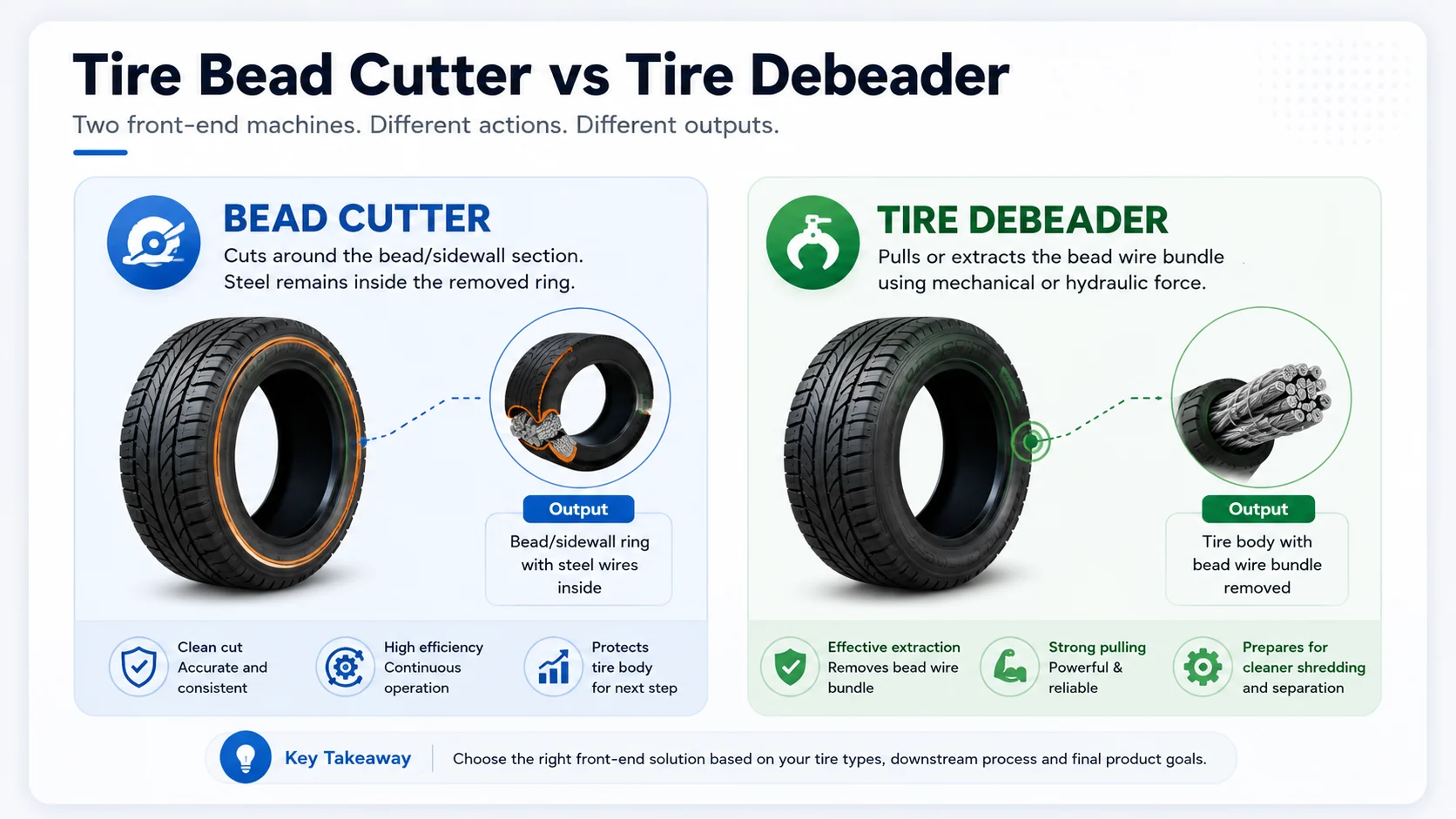
Quick answer: The tire bead cutter cuts off the bead/sidewall ring from the tire body. A tire debeader pulls or extracts the steel bead wire bundle from the tire. Choose a bead cutter when you need controlled circular cutting before a tire cutter or shredder. Choose a debeader when your process needs earlier bead-wire extraction and cleaner front-end steel handling.
The shortest way to explain the tire bead cutter vs tire debeader is: bead cutter cutting; a debeader pulling. The tire bead cutting machine usually cuts along the circular path near the sidewall and the bead area. It separates a bead-sidewall ring from the main tire body, but the removed ring still contains steel wire and rubber together. That is useful when the goal is to make the tire body easier to cut, feed or shred.
A tire debeader, also called a tire bead wire remover in many supplier catalogs, usually uses a hook, puller or hydraulic mechanism to grip the bead area and extract the bead wire bundle from the tire. The output is not just a sidewall ring. It is tire body plus pulled bead wire, often with some rubber still attached depending on tire type and machine design.
Buyer logic: If your next bottleneck is irregular feeding and concentrated bead impact, bead cutting may be enough. If your next bottleneck is steel pollution or heavy bead-wire load before shredding, debeading or drawing may be more valuable.
Tire Bead Cutter and Tire Debeader: Actual Comparison
Comparison Point
Tire Bead Cutter
Tire Debeader
Main action
Cuts around the sidewall and steel-reinforced bead area.
Pulls or extracts the bead wire bundle from the tire.
Typical output
Main tire body plus removed bead-sidewall section containing steel wire and rubber.
Tire body plus extracted bead wire, sometimes with rubber still attached.
Best fit
Before tire cutting, shredding, granulation or pyrolysis pre-treatment when the bead section needs to be opened or removed.
Before cutting or shredding when early bead-wire removal is required to reduce steel load.
Downstream effect
Can make tire feeding more predictable and reduce concentrated bead impact.
Can reduce bead-wire content entering the shredder or cutter, depending on extraction quality.
Steel recovery
Not a complete steel cleaning step; the bead section may need later separation.
Better for front-end bead wire recovery, but the extracted wire may still need cleaning or bundling.
Selection risk
Assuming it removes clean steel wire when it only separates a bead-sidewall ring.
Assuming it replaces all cutting or size-reduction needs; the tire body still needs processing.
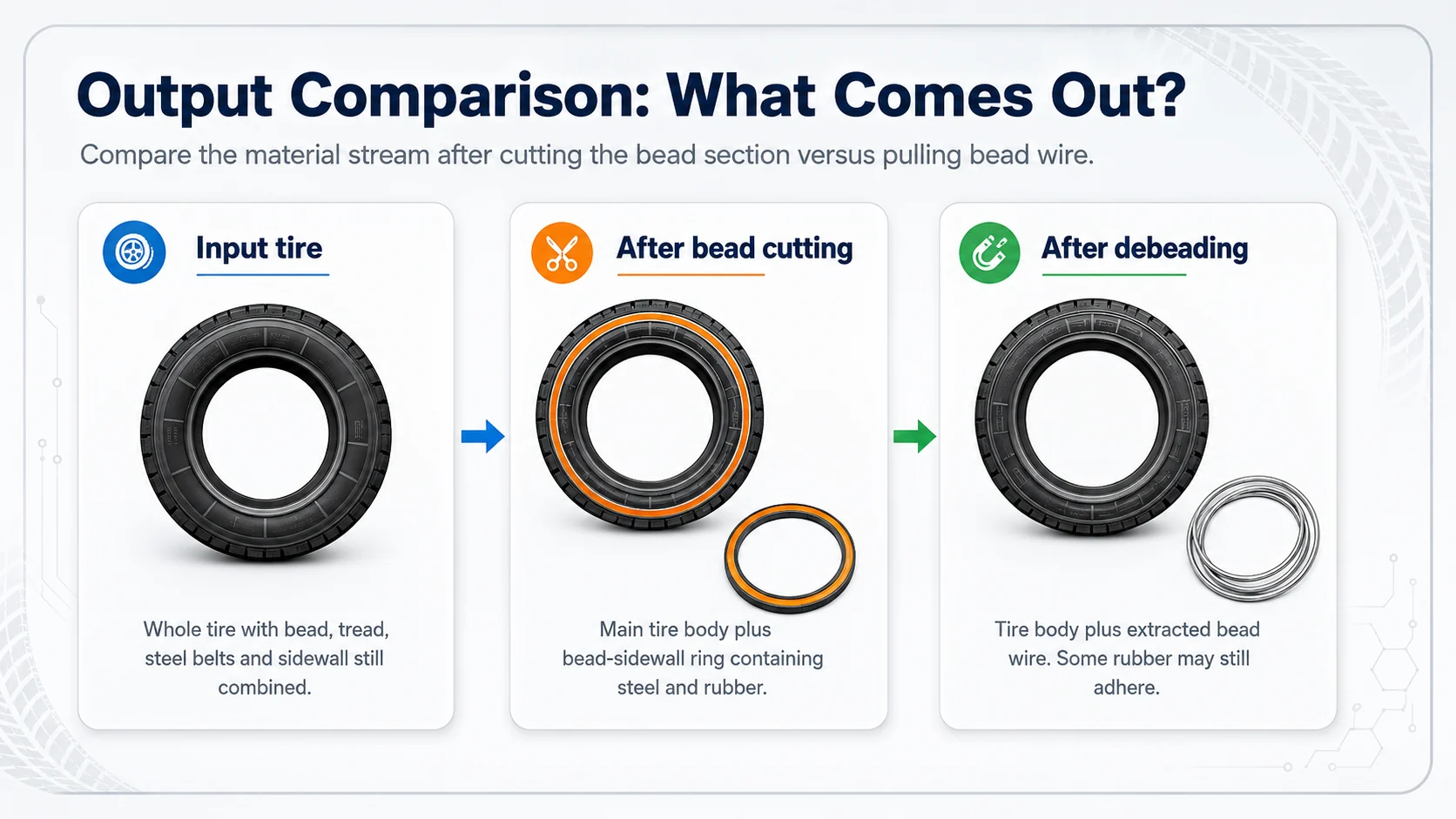
The clearest difference is output: bead-sidewall section versus extracted bead wire.
Why Output Difference Matters
A recycling line is a sequence, not a collection of isolated machines. The output of one front-end machine becomes the input of the next machine. If a bead cutter removes a bead-sidewall ring, the main tire body may feed more smoothly into a tire cutting machine or shredder. But the bead-sidewall ring still has to be handled. It may be stored, sent to a bead wire separator, or processed through another steel recovery route.
If a debeader extracts the bead wire, the operator then has two material streams: tire body and bead wire. That can be helpful for projects focused on reducing steel before size reduction. But it also requires handling the pulled wire safely, managing wire storage and matching the cycle time with the rest of the line.
This is why the phrase “bead removal” should always be clarified. Does the supplier mean removing the bead-sidewall section? Or extracting the bead wire bundle? For a buyer, those are different engineering outcomes.
Where Each Machine Fits in a Tire Recycling Line
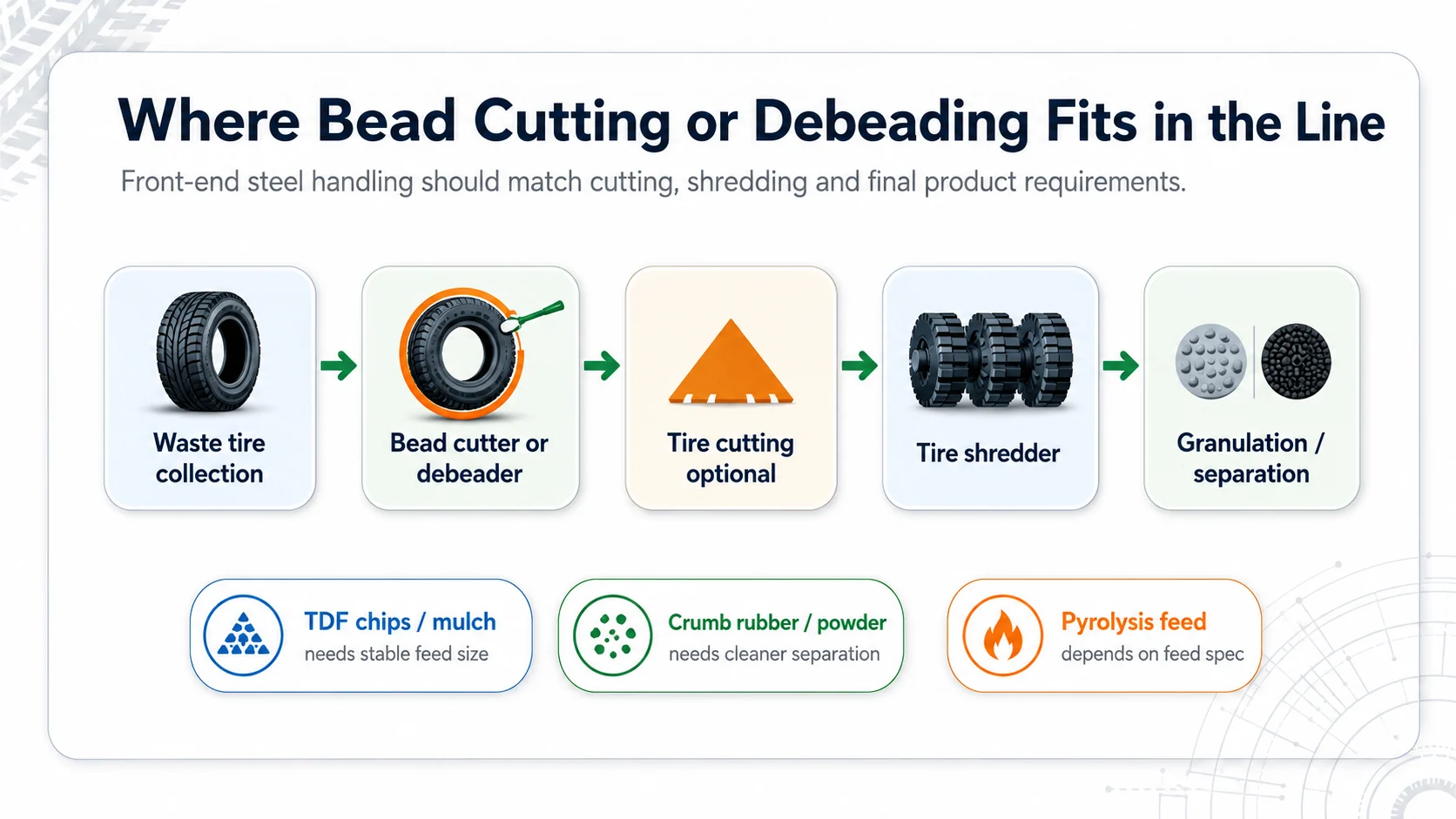
YUXI’s tire recycling equipment structure is process-oriented: tire wire handling, bead cutting, tire cutting and shredding all appear as front-end or size-reduction steps. That is the right way to think about this comparison. A bead cutter or debeader is normally placed before heavy size reduction, not after rubber granules are already produced.
A typical routation may look like this:
For common tire shredding: waste tire collection → bead cutting or debeading when needed → tire shredder → magnetic separation → chips, TDF or further granulation.
For rubber granules or powder: front-end bead/steel handling → cutting or shredding → granulation → repeated magnetic separation → fiber separation → screening.
For large truck or OTR tires: inspection and sorting → debeading or section cutting depending on tire structure → heavy cutting → shredding or pyrolysis preparation.
EPA’s archived scrap tire information notes that scrap tires are managed through routes such as crumb rubber, tire-derived fuel and shredded tire uses. EPA Region 9 also describes end uses including crumb rubber, rubberized asphalt concrete, civil engineering applications and tire-derived fuel. These downstream routes have different feed specifications, which is why the front-end choice should be made from the final output backward.
Bead cutting or debeading should be matched to the line route and final product specification.
How to Choose Between a Bead Cutter and Debeader
1. Start with tire type
Passenger and SUV tires are usually easier to handle than truck, bus and heavy industrial tires. Truck tires contain stronger bead structures and heavier sidewalls. Do not select by machine name only. Ask whether the machine can handle the maximum tire diameter, sidewall thickness, bead wire strength and expected tire mix.
2. Define the real problem
If the plant problem is that tires are hard to feed into a shredder because the bead section is stiff and concentrated, a bead cutter can be a practical solution. If the problem is that too much bead wire enters the cutting chamber and affects steel recovery or cutter load, a debeader or wire drawing route may make more sense.
3. Work backward from the final product
For TDF chips, the immediate priority may be stable shredding and correct chip size. For crumb rubber or rubber powder, steel and fiber removal become more sensitive,because downstream buyers may be concerned about visible wires, dust, fiber pollution and particle consistency. For pyrolysis pre-treatment, the problem is different: what feed size does the reactor or loading system accept?
4. Match cycle time with the whole line
A front-end machine should not become the bottleneck. Ask for realistic cycle time including loading, positioning, cutting or pulling, discharge and operator movement. A catalog video may show only the cutting or pulling moment; production capacity depends on the whole handling cycle.
5. Treat machine guarding as part of the purchase
Both machines involve moving tire bodies, cutting force, pulling force and steel-reinforced rubber. OSHA’s general machine guarding rule requires guarding methods to protect operators from hazards such as the point of operation, rotating parts, ingoing nip points, flying chips and sparks. NIOSH also advises safeguarding any machine part, function or process that might cause injury where possible. For procurement, this means guards, emergency stops, operator position, loading workflow and training should be discussed before signing the order.
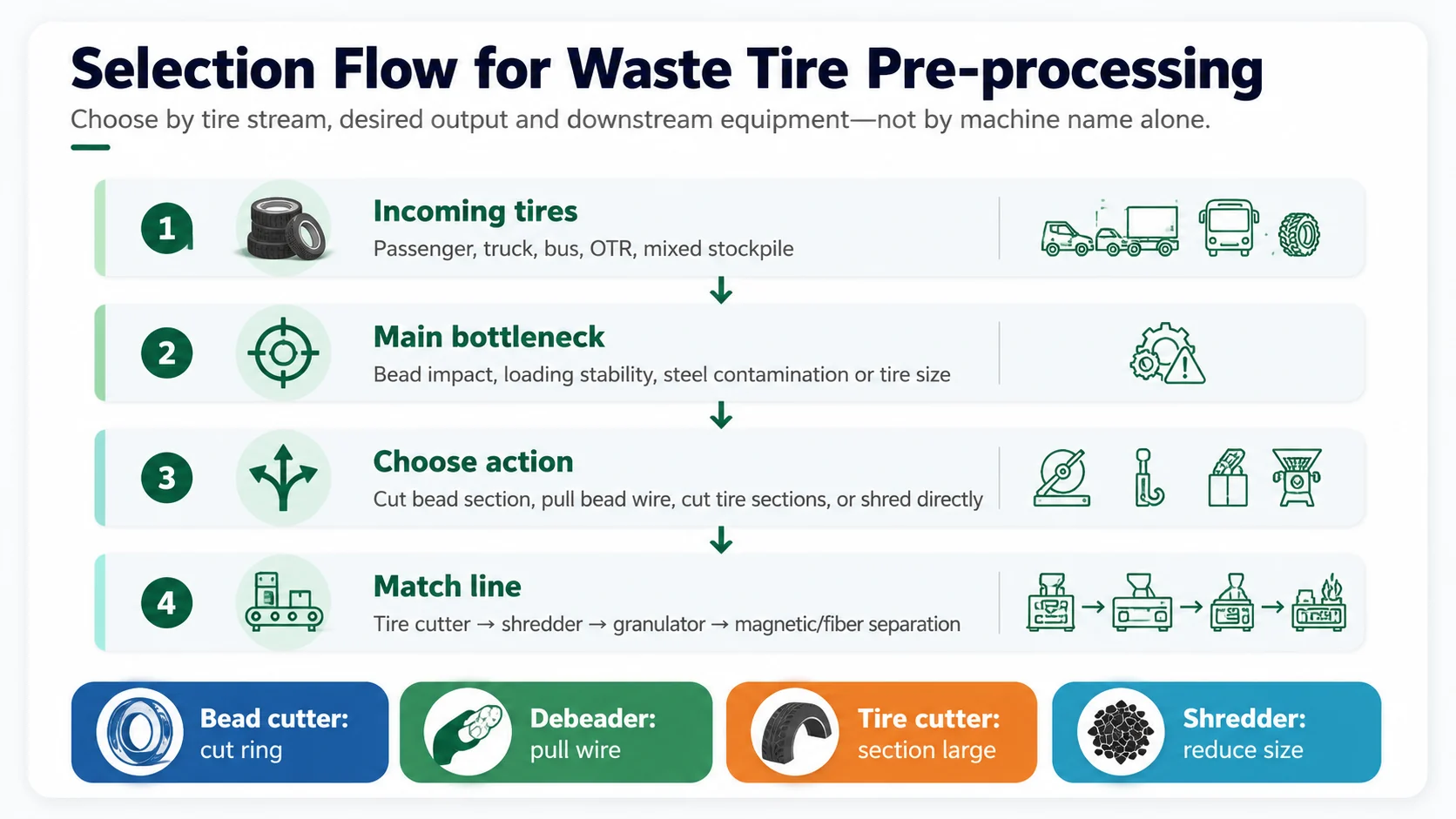
A practical selection flow starts with the tire stream and ends with the downstream process.
Where YUXI’s Bead Cutting Machine Fits
YUXI positions the bead cutting machine as front-end pre-processing equipment. The product page says it can process passenger car tires, SUV tires, light truck tires, common truck tires, bus tires within the configured range, small engineering vehicle tires and industrial rubber wheels with steel bead sections. For oversized OTR tires or thick industrial tires, YUXI recommends the tire size, bead structure and required output capacity before configuration.
The working principle is very simple: the operator puts the tire on the workbench,adjusts the positioning structure,clamps the tire,the tire rotates,and the alloy cutter folllows the bead circumference. The purpose is to cut the steel-reinforced bead area and separate the bead ring or bead side wall part before the tire body moves to downstream equipment such as a tire shredder, granulator or rubber powder line.
YUXI’s page is also careful about configuration rather than fixed universal specs. It asks buyers to confirm tire size, bead wire strength, power supply, production layout, target capacity, maintenance access and downstream equipment. That is the right approach for this comparison because a bead cutter selected for light tires may not be suitable for heavy truck or mixed stockpile processing.
When a Debeader May Be the Better Choice
A tire debeader may be better when your recycling route benefits from pulling bead wire before the tire reaches the cutter or shredder. This is common when the bead wire bundle is causing high steel load, the plant wants earlier bead wire collection, or the downstream product needs cleaner rubber preparation. However, a debeader does not eliminate the need for size reduction. After bead wire extraction, the tire body still needs cutting, shredding, granulation, separation or pyrolysis preparation.
For projects where bead cutting is enough, a debeader may add unnecessary handling. For projects where bead steel must be recovered earlier, a bead cutter alone may leave too much steel in the removed bead-sidewall section. The best answer is often not “which machine is better?” but “which action should happen first for this tire stream?”
Common Buying Mistakes
Mistake 1: Treating all front-end machines as synonyms
A sidewall cutter, bead cutter, wire drawing machine and debeader may appear in the same search results. They should be compared by input material, action and output—not just supplier title.
Mistake 2: Assuming bead cutting means clean steel recovery
Bead cutting separates a bead-sidewall ring. It does not automatically strip clean steel wire from rubber. Plan the next step if recovered steel quality matters.
Mistake 3: Ignoring labor and loading
A machine that cuts quickly can still be slow in practice if tires are heavy, sorting is poor, loading is manual or discharge piles block the operator area.
Mistake 4: Buying before confirming the downstream route
A front-end machine should be matched with the whole tire recycling equipment route. Confirm whether the next step is tire cutting, shredding, rubber granulation, rubber powder production, TDF preparation or pyrolysis feeding.
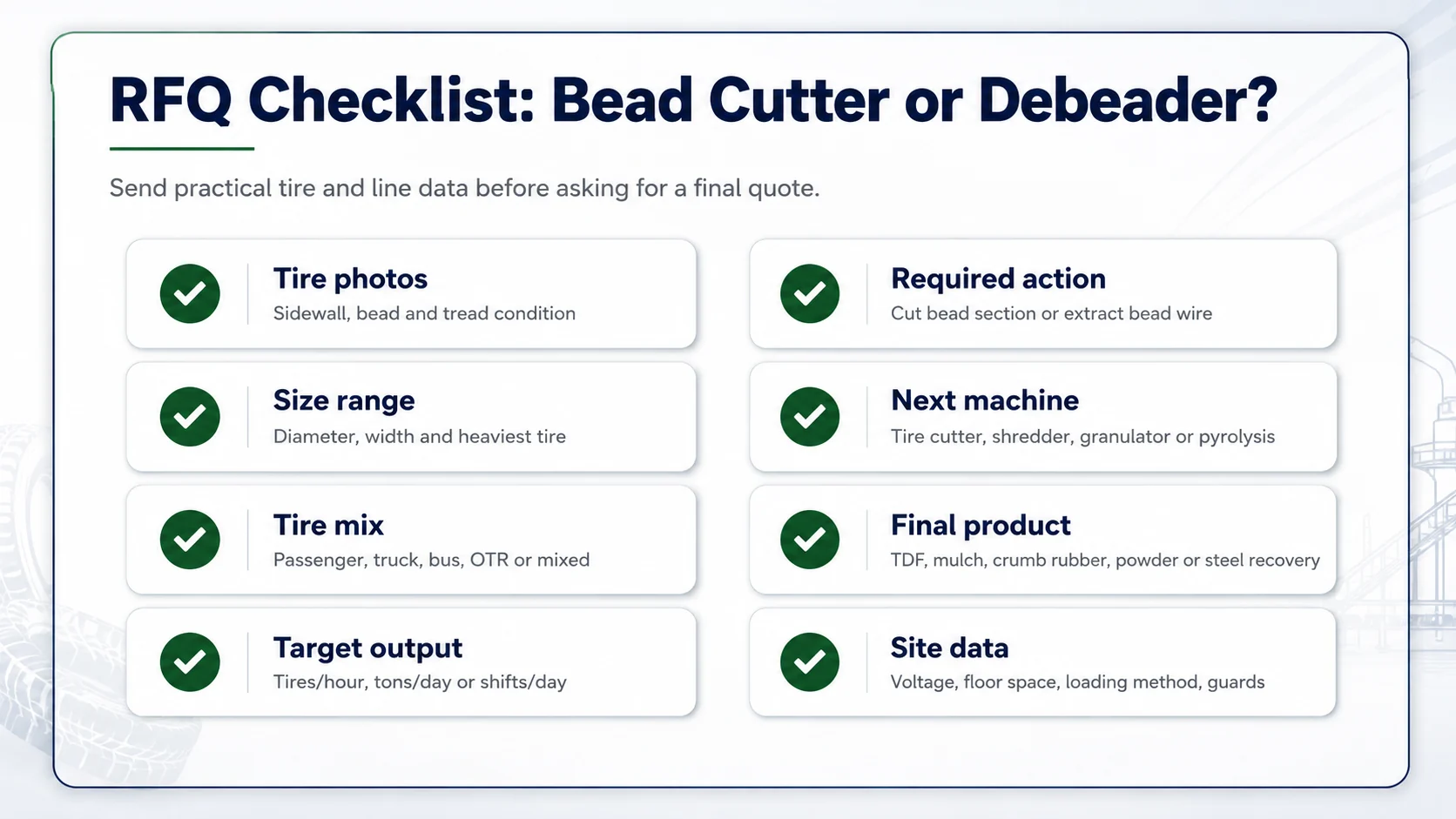
RFQ Checklist: What to Send Before Asking for Price
A useful quotation request should show the supplier what the machine must actually handle. Send more than the words “tire bead cutter” or “tire debeader.”
Send this information:
Display tire photos of the tread,side wall and tread area.
Tire type combination: passenger, SUV, light truck, truck, bus, agricultural, engineering or OTR.
Maximum and common tire diameter, width and approximate tire weight.
Expected throughput in tires per hour, tons per day or shifts per day.
Whether you want to cut the bead-sidewall section or pull/extract bead wire.
Downstream machine: tire cutter, shredder, granulator, rubber powder plant or pyrolysis unit.
Final product target: TDF chip, mulch,crushed rubber, rubber powder, steel recycling or pre-pyrolysis feed.
Voltage, workshop layout, loading method, protection requirements and maintenance channel.
A good RFQ makes the supplier choose by tire data and process route, not by equipment name alone.
Need to choose the right pre-processing route?
Send tire photos, tire size range, target capacity, local voltage and the next processing step. YUXI can help evaluate whether your project needs bead cutting, wire drawing/debeading, tire cutting, shredding or a combined line layout.
Is the tire bead cutter the same as the tire debeader?
Not always. A tire bead cutter cuts around the bead and sidewall area and separates a bead-sidewall ring from the tire body. A tire debeader usually pulls or extracts the bead wire bundle from the tire using hydraulic or mechanical force.
Which machine is better before a tire shredder?
It depends on the tire stream and final product. A bead cutter can reduce concentrated bead-wire impact and improve feeding stability. A debeader is more suitable when the project needs stronger front-end bead-wire removal before cutting or shredding.
Can a bead cutter remove clean steel wire?
Usually no. A bead cutter cuts and separates the bead-sidewall section. The steel wire normally remains partly covered by rubber inside that removed section. Cleaner steel recovery may require bead wire drawing, debeading or a separate bead wire separator.
Do I need both a bead cutter and a debeader?
Some plants may use both, especially when tire streams are mixed or when steel handling is critical. Other plants may only need one front-end machine. The decision should be based on tire type, downstream equipment, final product specification and labor workflow.
What should I check in a working video?
For a bead cutter, check tire positioning, clamping stability, cutter entry path, worktable rotation and discharge. For a debeader, check how the hook grips the bead area, whether wire extraction is stable, how the tire body is released and how the pulled wire is collected.
References and Source Notes
FHWA, Scrap Tires – Material Description: automobile and truck tire weights, recoverable rubber and steel-belted tire context. Source
U.S. EPA File, Basic Information: Waste Tires. Source
U.S. EPA District 9, Waste Tires: crushed rubber, rubber asphalt concrete, civil engineering applications and tire-derived fuel. Source
USTMA, 2023 Scrap Tire Management Report: 79% U.S. ELT reclaimed or recycled in 2023. Source
Tyres Europe / ETRMA, End-of-life tyres in a circular economy: material recovery from ELTs increased from 10% to 60% annually in Europe. Source
OSHA, 29 CFR 1910.212, General requirements for all machines. Source
CDC/NIOSH, Machine Safety in the Workplace. Source
Marie has 8+ years of experience in tire shredding and recycling equipment,with a focus on tire shredders,rubber recycling machines,TDF production,rubber crumb processing,and complete tire recycling systems.