




Quick answer
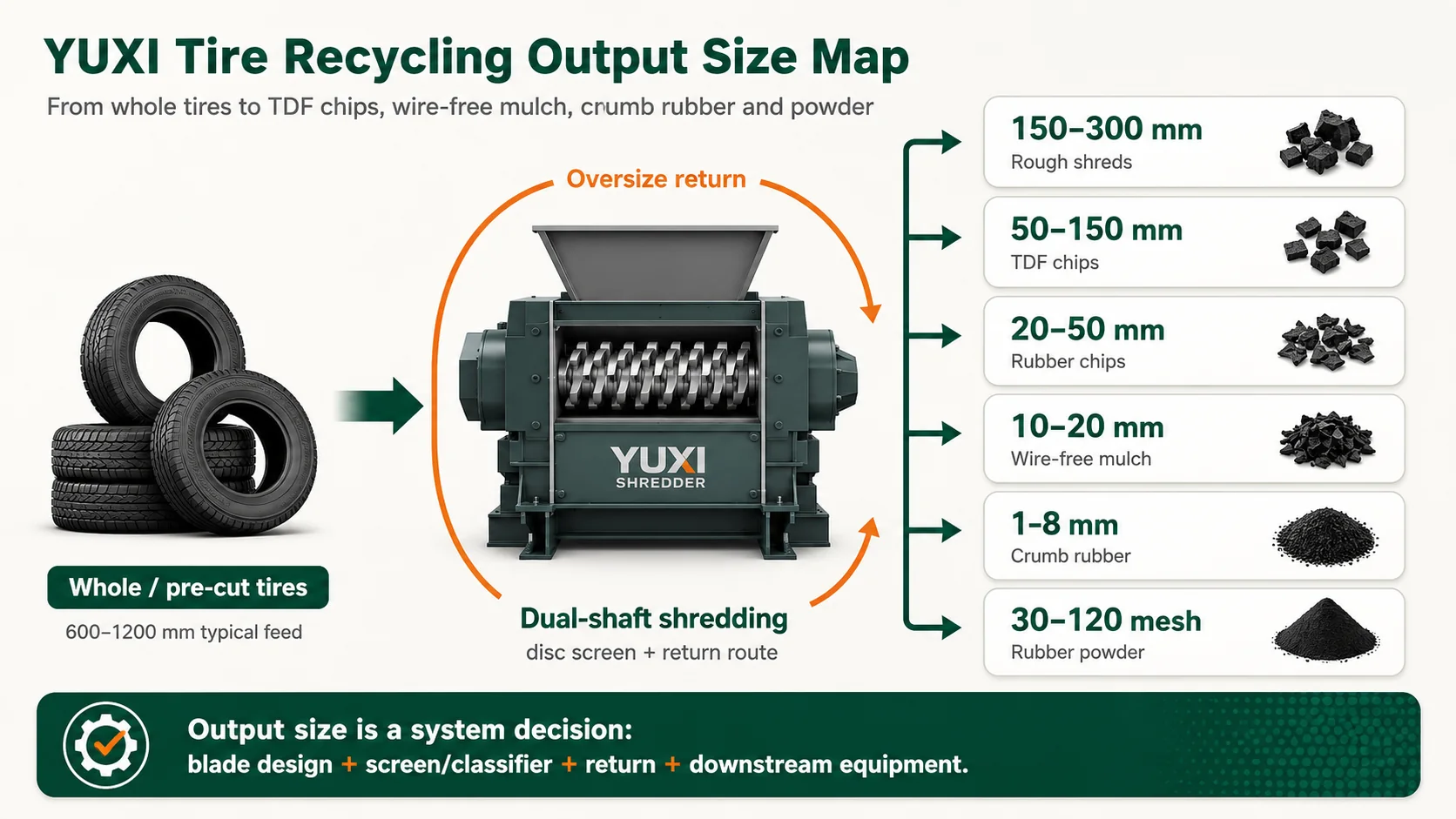
A primary tire shredder commonly produces rough shreds or TDF chips in the 50–300 mm range. Smaller outputs such as 10–20 mm wire-free mulch, 1–8 mm crumb rubber, and 30–120 mesh powder require additional stages: rasper, magnetic separation, granulator, classifier and grinding mill. YUXI’s tire recycling equipment is organized around these product stages, from primary shredding to steel recovery, crumb rubber and powder grinding.What “Tire Shredder Output Size” Actually Means
Output size is not one fixed number printed on a motor plate. It is the size range of discharged tire pieces after cutting, screening and recirculation. In a real waste tire recycling plant, the same shredder body can behave very differently depending on blade width, hook design, screen opening, classifier type, return conveyor layout, feed rate and whether the tire is a passenger tire, truck tire or OTR tire. This is why YUXI positions the tire shredder machine as part of a controlled shredding system rather than just a cutting box. Its dual-shaft cutting chamber pulls elastic rubber and steel-wire tire material into the machine, while the disc screen and return route send oversized pieces back for another pass. That layout is important when the project requires a repeatable chip size instead of mixed, random shreds. Industry use also confirms that tire material is not sold as one generic product. The U.S. EPA describes civil engineering uses for shredded tire material such as lightweight fill, drainage aggregate and landfill applications, while its ground rubber guidance separates coarse and ground rubber markets by particle size. In other words, the value of shredded tire output depends heavily on where the material will go next. EPA civil engineering uses and EPA ground rubber guidance both point to size-specific applications.Tire Shredder Output Size Table
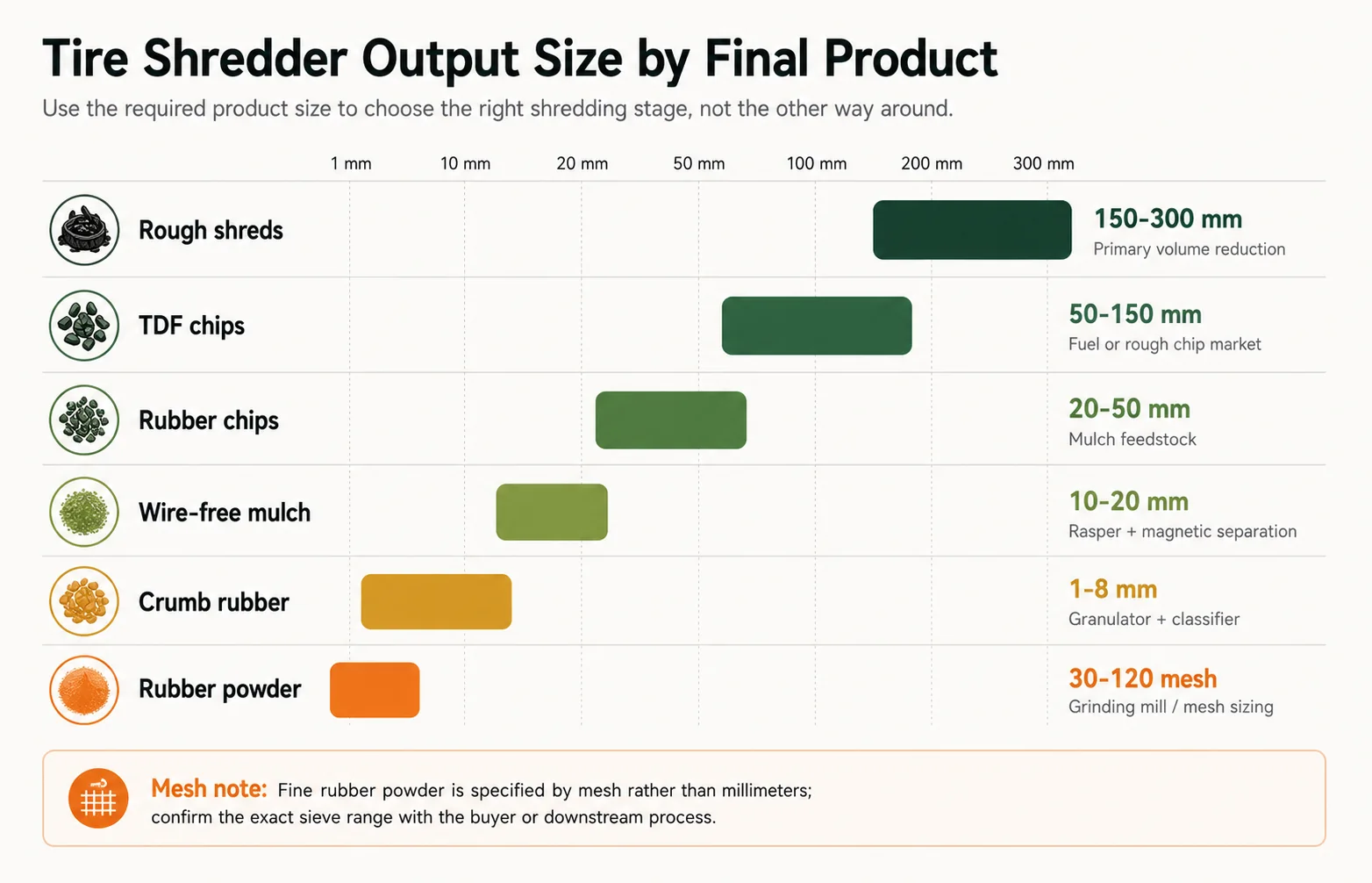
The table below gives practical output ranges for project planning. Actual settings should be confirmed against the tire source, steel content, capacity target and downstream equipment. For TDF, civil engineering aggregate, asphalt or molded rubber products, the buyer’s local specification always takes priority.| Target output size | Typical product | Common application | Recommended equipment stage |
|---|---|---|---|
| 150–300 mm | Rough tire shreds / TDA feed | Volume reduction, transport reduction, civil engineering material where allowed by specification | Primary tire shredder, often with screening if size control is required |
| 50–150 mm | TDF chips / rough rubber chips | Cement kiln fuel, industrial boiler fuel, rough chip sales, further processing | Dual-shaft shredder + disc screen + return conveyor |
| 20–50 mm | Secondary rubber chips | Mulch preparation, pyrolysis feedstock where accepted, granulator feed preparation | Secondary shredding or rasper with magnetic separation |
| 10–20 mm | Wire-free rubber mulch | Landscaping, playground mulch, feedstock for crumb line, saleable steel by-product | Rasper + magnetic separator + screen/classifier |
| 1–8 mm | Crumb rubber / rubber granules | Rubber mats, tiles, sports surfaces, molded rubber products, asphalt modification feedstock | Granulator + vibrating screen + magnetic and fiber separation |
| 30–120 mesh | Fine rubber powder | Modified asphalt, reclaimed rubber, compounds, seals, soles, boards and fillers | Fine grinding mill after clean granule production |
Choose Output Size by Final Application
A good plant design starts from the downstream buyer. Two projects can both say “tire shredder,” but one may need rough TDF chips for fuel and another may need clean 1–3 mm crumb for molded products. Those are not the same line.150–300 mm rough shreds: good for first-stage reduction
Rough shreds are mainly used to reduce bulky tire volume or prepare tires for another stage. For civil engineering markets, tire-derived aggregate specifications may allow large shredded pieces; the USTMA State of Knowledge report describes TDA as scrap tire pieces generally between 3 and 12 inches, or about 76–300 mm, for civil engineering applications. It also notes ASTM D6270 size classes, including Type A and Type B applications. USTMA TDA report For YUXI projects, this range is normally a primary shredding decision. It is useful when the site wants storage reduction, truck loading efficiency, or a first cut before TDF, mulch, crumb or powder production.50–150 mm TDF chips: the common fuel-chip range
TDF buyers usually care about two things: size consistency and metal tolerance. A cement kiln or boiler does not want long rubber strings, oversized chunks, or unpredictable wire exposure. YUXI’s Tire TDF Plant is designed around whole tire shredding into rough TDF chips, with common project ranges around 50–100 mm and flexible 50–150 mm rough chips depending on the buyer specification. This is where a disc screen and return conveyor matter. Material that is too large is not manually sorted on the floor; it is sent back to the shredder, which improves output stability and reduces labor. For a pure TDF project, you should define the accepted oversize percentage, exposed-wire tolerance and whether a magnetic separator is required after shredding.20–50 mm rubber chips: secondary chip or mulch feedstock
Rubber chips in this range are typically a transition product. They are smaller than TDF rough chips but not yet crumb rubber. They may be used as mulch feedstock, pyrolysis feedstock where the process accepts it, or preparation for a granulator. The important point is that 20–50 mm is often not just a “screen change” on the primary shredder; it may require secondary reduction and better steel handling. If the final market requires fewer exposed wires, the line should include steel liberation and magnetic separation. Otherwise the material may be rejected even if the size looks correct.10–20 mm wire-free mulch: cleaner material, more equipment
Wire-free mulch is where size, purity and appearance start to matter together. YUXI’s Tire Wire Free Mulch Plant is positioned as the second step after primary shredding, reducing rough shreds into 10–20 mm rubber chips and using magnetic separation to remove steel. This size can be suitable for landscaping, playground surfaces, sports court layers and feedstock for crumb rubber plants. For buyers selling mulch, the quotation should define not only size, but also steel removal rate, fiber tolerance, color coating requirements if any, and final bagging or bulk-loading method.1–8 mm crumb rubber: the shredder is only the front end
Crumb rubber requires a different way of thinking. The primary tire shredder prepares the material; it does not finish the product. YUXI’s Tire Rubber Crumb Plant uses downstream processing to turn wire-free chips into uniform rubber granules, with steel and textile fiber removal. YUXI’s own process descriptions list stages such as tire shredder output around 50 mm, rasper output around 10–20 mm, and granulator output around 1–6 mm or 1–8 mm depending on configuration. The EPA notes that ground rubber can be used in asphalt applications, and the FHWA describes ground tire rubber technologies for asphalt binders and mixtures, including size references such as 30 mesh and smaller for certain dry process uses and 10 mesh / 2.0 mm distinctions in crumb rubber markets. FHWA recycled tire rubber guidance30–120 mesh rubber powder: a fine-grinding project
Rubber powder is specified by mesh because it is much finer than ordinary tire chips. YUXI’s Tire Rubber Powder Plant is designed to grind clean 1–8 mm rubber granules into fine powder ranges such as 30–120 mesh. This is a later-stage product, usually after steel and fiber are already removed. Fine powder can be used in modified asphalt, reclaimed rubber, rubber products, soles, seals and filler applications. The important engineering detail is temperature control and classification: excessive heat can affect powder quality, while poor screening can create a wide particle distribution that downstream buyers may not accept.How YUXI Controls Tire Shredder Output Size
Output control in tire shredding is not as simple as installing a smaller hole screen. Tire rubber is elastic, steel wire resists cutting, and truck tires behave differently from passenger tires. In a YUXI-style tire recycling line, output control comes from the whole front-end design.Machine factors
- Blade thickness and hook geometry determine the bite, tearing action and approximate chip width.
- Shaft torque and reducer selection affect whether the machine can keep cutting under steel-wire load.
- Disc screen or classifier opening separates qualified chips from oversize material.
- Return conveyor layout controls how oversize pieces re-enter the shredder for another cut.
- PLC and overload logic protect the machine when thick truck or OTR tires increase cutting resistance.
Material factors
- Passenger tires usually process more smoothly and can support higher apparent capacity.
- Truck and bus tires need stronger torque reserve because of thicker rubber and more steel.
- OTR or mining tires may need pre-cutting, bead removal or a customized feeding system.
- Bead wire removal can reduce blade load in some layouts and improve downstream steel separation.
- Mixed feed should be quoted more conservatively than clean, sorted passenger tires.
How Output Size Changes the Line Configuration
A smaller target size usually means a deeper process. This is the point many early buyers miss when they compare only motor power or shredder model names. A line that produces 50–150 mm TDF chips may be very different from a line that produces 1–8 mm crumb rubber at the same hourly input.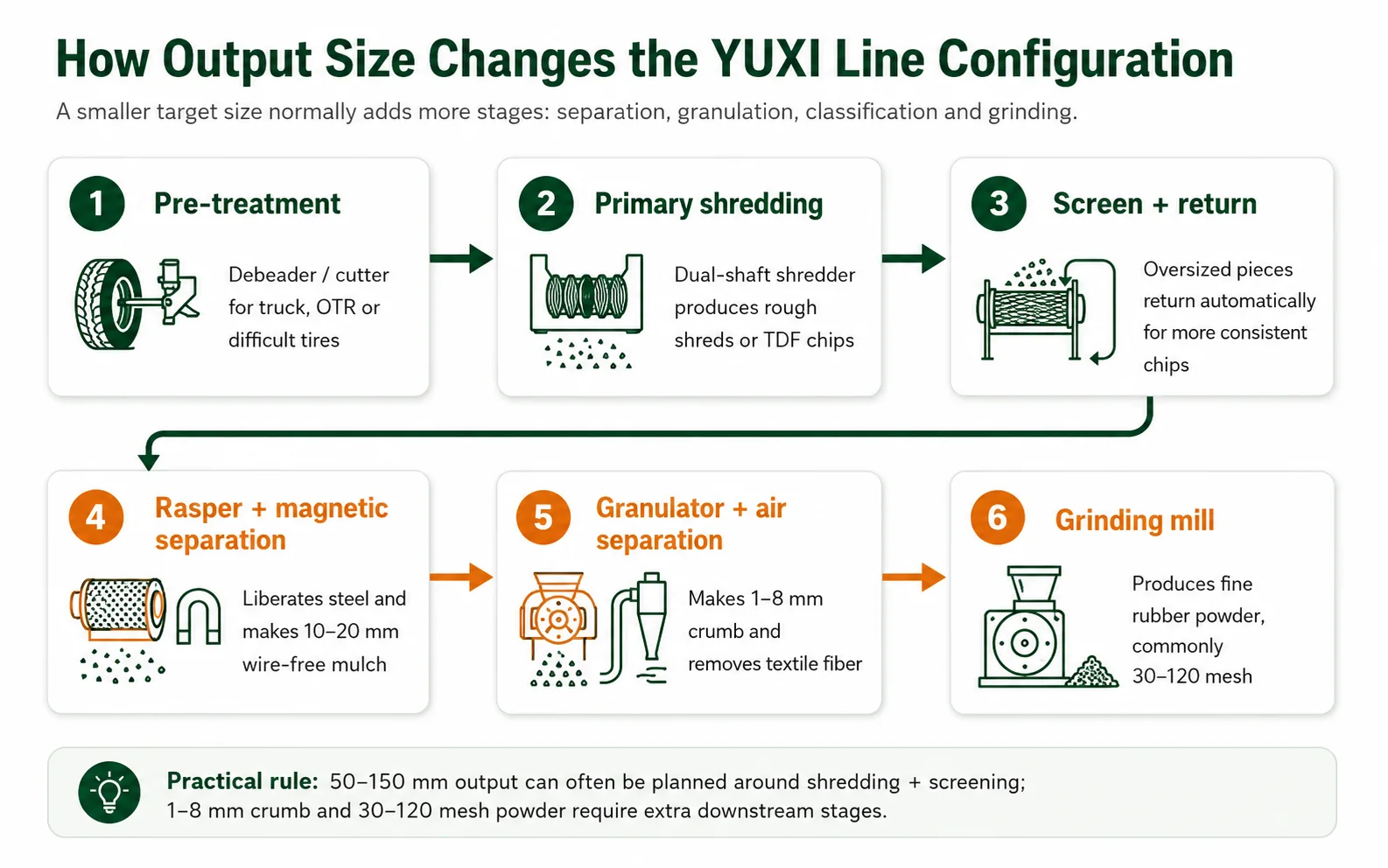
| Project target | Likely line configuration | What to verify before quotation |
|---|---|---|
| Tire collection yard volume reduction | Feeding conveyor + primary shredder + discharge conveyor | Largest tire size, mixed tire ratio, desired transport size and maintenance access |
| TDF chip production | Primary shredder + disc screen + return conveyor + optional magnetic separation | Chip size contract, oversize tolerance, exposed steel requirement, fuel buyer acceptance criteria |
| Wire-free mulch | Primary shredder + rasper + magnetic separator + screen + collection | Steel removal rate, color/appearance requirements, packaging or bulk storage |
| Crumb rubber | Primary shredding + rasper + magnetic separation + granulator + vibrating screen + fiber separator | Target particle range, purity requirement, acceptable fiber, downstream product use |
| Rubber powder | Full crumb line + grinding mill + classifier + cooling and collection | Mesh range, powder temperature, classifier accuracy, dust control and packaging |
Common Mistakes When Specifying Output Size
1. Asking for crumb rubber from a primary shredder
A primary shredder can prepare feedstock, but crumb rubber needs granulation, screening and separation. If a supplier promises final crumb directly from whole tires with one ordinary shredder, ask for a working video, product sample and detailed process flow.2. Ignoring steel and fiber content
Size alone does not make a product saleable. TDF users, mulch buyers and crumb rubber customers may all have different tolerance levels for exposed wire, loose steel and textile fiber.3. Selecting the smallest screen to “improve value”
Smaller output usually lowers capacity and increases wear. A 50 mm target may need more recirculation than a 100 mm target, especially with truck tires.4. Using catalog capacity without feed details
Capacity changes with tire diameter, bead wire, rubber thickness, moisture, contamination and working rhythm. Sorted passenger tires and mixed truck tires should not be quoted as the same feed.Buyer Checklist: Information to Send Before Choosing Size
The fastest way to get a realistic YUXI configuration is to send a short technical brief before asking for a price. Include:- Feed tire type: passenger, truck, bus, agricultural, OTR, mining or mixed tires.
- Maximum tire diameter, width and approximate weight.
- Whether bead wire is removed before shredding.
- Target output size and acceptable oversize percentage.
- Final product: TDF, mulch, crumb rubber, rubber powder, pyrolysis feedstock or civil engineering material.
- Required hourly capacity and working hours per day.
- Steel and fiber purity requirements.
- Available workshop dimensions, feeding method and finished material storage plan.
- Local voltage, frequency and automation requirements.
- Photos or samples of the raw tires and target product if available.
Need a Size-Based Line Configuration?
Send your tire type, target output size, capacity and final product market. YUXI can match the shredder, disc screen, return conveyor, rasper, magnetic separator, granulator or powder mill according to your required product size. Request a tire recycling configuration from YUXI →FAQ: Tire Shredder Output Size
What is the common tire shredder output size?
For primary shredding, common tire shredder output size ranges from about 50–300 mm, depending on the blade layout, screen or classifier, recirculation system and tire type. Finer products such as 1–8 mm crumb rubber or 30–120 mesh powder require downstream granulation and grinding rather than the primary shredder alone.
Can one tire shredder make 1–5 mm crumb rubber directly?
Usually no. A primary dual-shaft tire shredder is designed for high-torque cutting of whole or pre-cut tires, not final crumb rubber. A crumb rubber line normally adds a rasper, magnetic separation, granulator, vibrating screen and fiber separation.
What output size is suitable for TDF?
Many TDF projects work around 50–150 mm tire chips, while some cement or boiler users specify narrower ranges such as 50–100 mm or 50 mm minus. The fuel user’s contract specification should be confirmed before choosing the screen and return system.
Why does smaller output reduce capacity?
Smaller output normally means more cutting passes, more screen control, more recirculated material and higher blade contact time. This increases energy use and wear, so capacity should be evaluated together with output size and tire type.
What should I send to YUXI before asking for a quotation?
Send the tire type, maximum tire diameter, truck tire ratio, whether bead wire is removed, target output size, acceptable steel and fiber content, required hourly capacity, working shifts and final product market. These details allow the shredder, screen, conveyors and downstream stages to be matched correctly.
Source Notes
- U.S. EPA, Scrap Tires: Civil Engineering Applications.
- U.S. EPA, Scrap Tires: Ground Rubber Applications.
- FHWA, Resource Responsible Use of Recycled Tire Rubber in Asphalt Pavements, FHWA-HIF-20-043.
- USTMA, State of the Knowledge Reports on Tire Derived Aggregates.
- EuRIC, Mechanical Tyre Recycling as the best approach for a Circular Economy.
- Tyres Europe, Circularity and End-of-life overview.