




The price changes first with the material boundary: a rasper fed with prepared chips, a complete plant fed with whole tires, or a modular mulch stage designed for later crumb-rubber expansion.
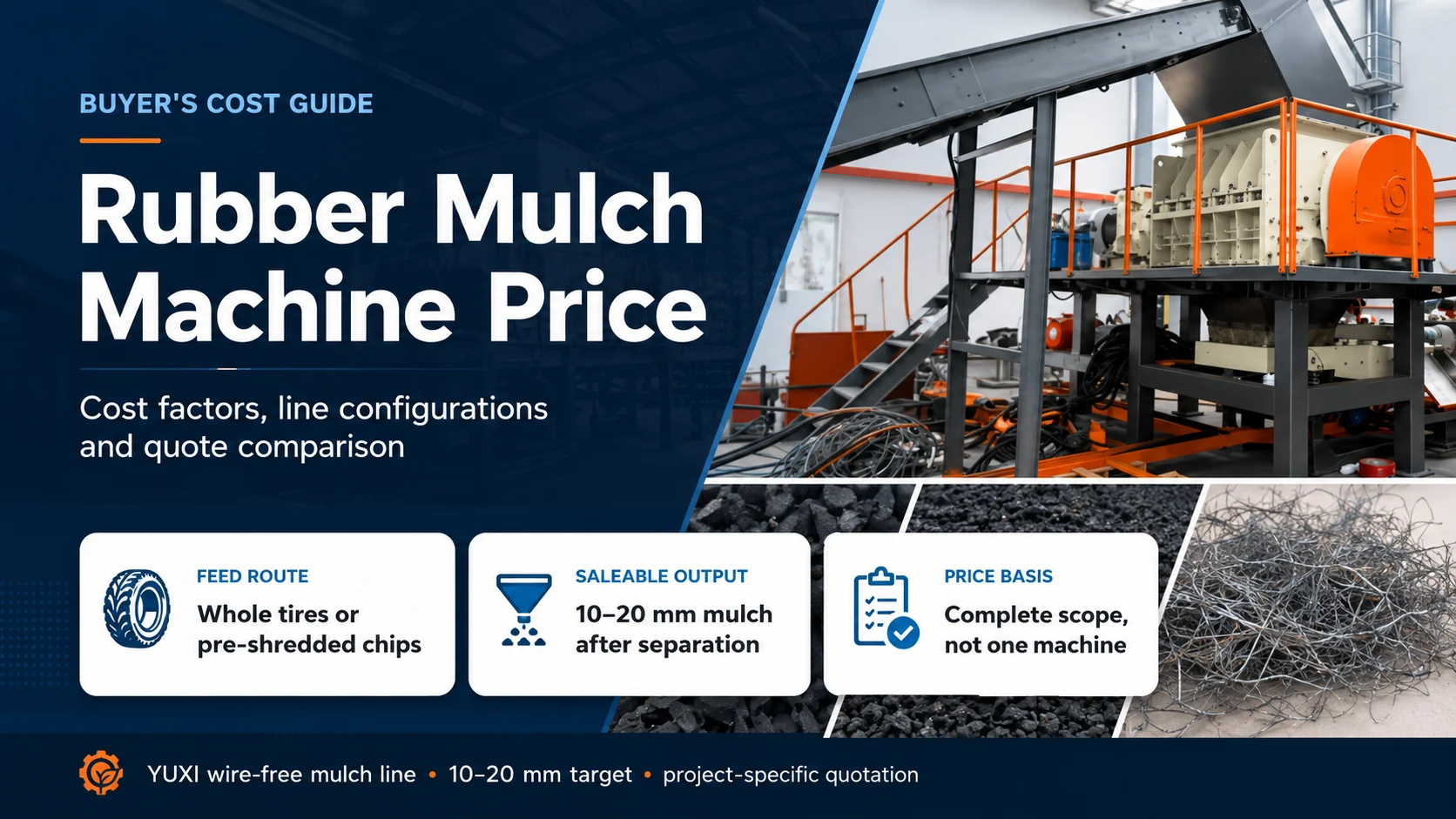
A buyer once sent us two “5 t/h rubber mulch machine” quotations. One contained a rasper and one magnetic separator. The other began with whole tires and included the primary shredder, conveyors, screen return, steel recovery, fiber handling, controls and commissioning. The totals looked impossible to reconcile. In fact, the suppliers were not pricing the same job.
That is the central issue behind rubber mulch machine price. The phrase can mean a single secondary-cutting machine, a downstream module receiving pre-shredded tire chips, or a complete line producing saleable 10–20 mm material from whole passenger and truck tires. A low number has little value until the material entering and leaving the quoted boundary is written down.
Quick Answer
Do not use one universal rubber mulch machine price. First classify the project as a mulch processing module, a complete whole-tire production line, or a mulch stage prepared for future granulation. Then compare price against accepted finished mulch capacity, target size, steel and fiber condition, recirculation, controls, site scope and acceptance testing.
Public listings range from low-cost standalone-machine claims to six-figure complete-system offers, but their labels and inclusions are inconsistent. They are useful evidence that the market mixes unlike scopes, not a dependable YUXI price list.6
We normally separate the quotation into three scopes before discussing money. This simple step removes most misleading comparisons.
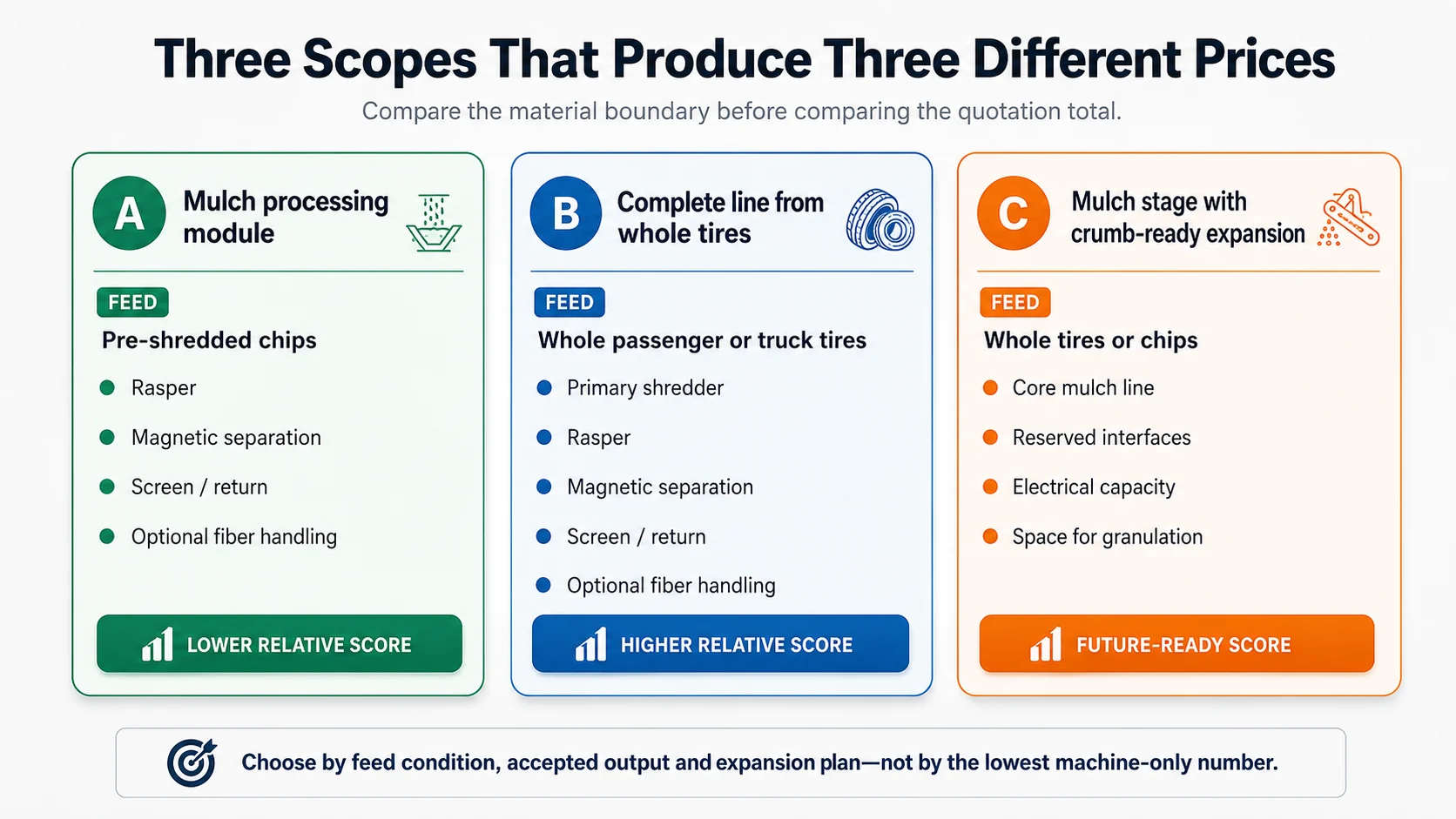
1. Mulch processing module from pre-shredded chips
This is the smallest credible line scope when the customer already owns a primary shredder or has a reliable source of prepared tire chips. The YUXI product logic expects the rasper feed to be below approximately 100 mm. The module can then include the tire rasper, magnetic steel recovery, screen and oversize return, conveyors, and fiber handling where the final specification requires it.
It is usually the lower investment route because the quotation does not need to include whole-tire feeding, the primary tire shredder and part of the front-end structure. However, the apparent saving is real only when the incoming chips are consistent. A module fed with long strips, oversized pieces or irregular truck-tire material may lose capacity, overload the return loop and accelerate cutter wear.
Engineering boundary: “We already have chips” is not enough. Send chip dimensions, shape, tire mix, exposed steel condition, hourly availability and photographs of the least consistent material.
2. Complete rubber mulch production line from whole tires
A complete plant begins with whole tires and therefore includes the primary size-reduction stage. The shredder prepares manageable rough chips; the rasper performs secondary cutting and steel liberation; magnetic separation recovers the released steel; screening controls the mulch range; and fiber separation is selected around the end market.
This is the higher relative equipment scope, but it also gives one supplier responsibility for the line balance. That matters. A rasper can only deliver stable accepted output when the shredder, conveyor width, material layer, magnet loading and return system are matched. Buying the stages independently may reduce the first purchase order while increasing integration work at site.
3. Mulch line with future crumb-rubber expansion
Some investors want to sell 10–20 mm mulch first and add finer processing later. In that case, the initial quotation should reserve conveyor interfaces, electrical capacity, floor space, dust-handling connections and control architecture. The later tire rubber crumb plant processes wire-free chips into finer granules with granulation, additional magnetic separation, grading and fiber separation.
A future-ready line costs more than the bare minimum if it includes stronger interfaces or spare capacity. Still, it can be cheaper than relocating equipment, replacing electrical cabinets and rebuilding conveyors after production has already started. Expansion planning belongs in the original layout, not in a sentence saying “can be upgraded later.”
| Configuration | Quoted feed boundary | Core equipment | Relative investment | Main price risk |
|---|---|---|---|---|
| Mulch module | Pre-shredded chips below the agreed maximum | Rasper, magnets, screen/return, optional fiber stage | Lower | Uncontrolled incoming chip size or condition |
| Complete whole-tire line | Declared passenger/truck tire mix | Primary shredder plus complete mulch module | Higher | Comparing feed t/h with accepted mulch t/h |
| Future crumb-ready line | Whole tires or chips | Core mulch line plus reserved interfaces and utilities | Higher initial scope | Paying for “future ready” without defined interfaces |
What Determines Rubber Mulch Machine Price?
The rasper is central, but its purchase price does not explain the total. Tires contain rubber, steel and textile reinforcement, so the line has to cut, liberate, separate and control multiple material streams rather than simply reduce one homogeneous feed.2
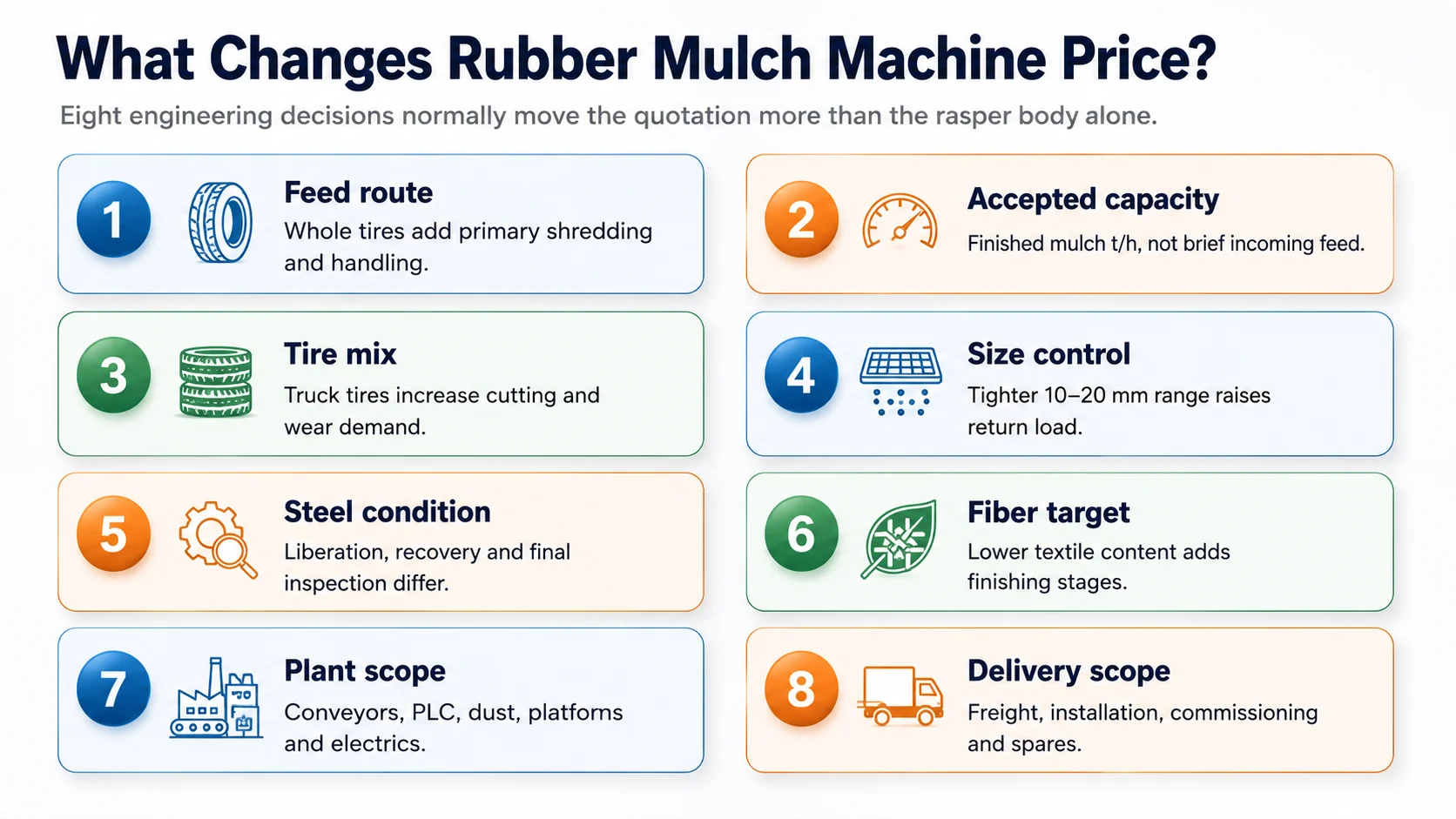
Feed route and front-end responsibility
Whole tires add a primary shredder, feed conveyor, discharge conveyor, platforms, guards and controls. Pre-shredded chips remove those items from the quoted boundary, but they do not remove the need to verify feed consistency. For truck tires, larger dimensions and heavier reinforcement usually increase cutting work and wear demand.
Accepted finished capacity
The YUXI pillar gives a reference line range of 0.5–10 t/h, but that number must be tied to the test basis.1 A supplier may state the mass entering the shredder, the mass entering the rasper or the mass of finished 10–20 mm mulch leaving after return material and rejects. Those are not interchangeable.
For budgeting, use this definition:
Accepted mulch capacity = saleable 10–20 mm product passing the agreed size, visible-steel and textile checks ÷ measured net production time.
A five-ton headline can become a three-ton commercial result when a tight screen keeps a large circulating load in the system. Surprisingly, that does not always mean the line is poorly designed. It may mean the product specification is doing more work.
Tire mix and reinforcement
Passenger tires, truck tires and larger off-road tires do not impose the same load. A quotation based on clean passenger tires can understate the shaft, cutter, reducer and wear demands of a feed containing a large truck-tire percentage. Ask suppliers to show the tire mix behind the capacity claim.
Pre-processing may also change. Large or difficult tires can require cutting, bead treatment or controlled loading before the primary shredder. The guide to cutting tires before shredding explains why the next machine’s accepted feed should decide that step rather than a universal rule.
Target mulch size and oversize tolerance
The YUXI line is organized around a typical 10–20 mm mulch direction. A smaller or tighter range normally means more secondary cutting and more oversize return. Screen area, opening geometry, return-conveyor capacity and rasper condition all affect the result.
This is why two suppliers can use the same words—“10–20 mm”—while pricing different systems. One may allow a broad oversize percentage. Another may include closed-loop screening designed to keep nearly all off-size material in circulation. The correct number is the one your buyer accepts, measured by a written sampling method.
Steel liberation, magnetic recovery and final mulch condition
These three terms must remain separate. The YUXI page describes a stage reference of 99% steel liberation at the rasper and 97–98% steel-wire recovery at magnetic separation. It specifically warns that these values should not be combined into a final rubber-purity claim.1
That distinction changes price. Better liberation can require appropriate cutter condition and feed control. Better magnetic recovery can require adequate magnet width, position, material-layer depth and sometimes more than one separation pass. Final product inspection then checks what is actually present in the mulch.
For playground surfacing, the U.S. Consumer Product Safety Commission advises that recycled tire rubber mulch should be inspected before installation to ensure metal has been removed.4 It also cautions that material marketed for landscaping may not automatically be appropriate for playground use.5 A machine quotation should therefore follow the product specification of the intended market; it should not promise that every black rubber chip has the same end-use approval.
Textile-fiber target
After magnetic separation, textile cord may remain with the rubber. A landscaping buyer, horse-arena operator and crumb-rubber processor may set different limits. When lower fiber content is required, the quotation can add air separation, collection equipment, dust-control connections and additional conveying.
“Fiber separator included” is still incomplete. Ask which stream enters it, the expected loading, how separated fiber is collected, whether the quoted capacity includes that stage and how final textile content is inspected.
Screening and recirculation complexity
A screen-return loop adds equipment and power, but it also controls the product. Its cost includes the screen, support structure, return conveyor, chute design, level control, guards and the extra load carried by the rasper. The important figure is the expected return ratio under representative feed, not the existence of a screen in a layout drawing.
Automation, electrical standard and plant layout
A simple local-control package and an integrated PLC line are different purchases. Price can move with motor starters, variable-frequency drives, overload logic, interlocks, remote diagnostics, cable scope, enclosure rating, local voltage and frequency, safety circuits, platforms and maintenance access.
On export projects, layout details frequently arrive too late. A narrow building may require extra conveyor elevation. A low roof may change the separator position. Limited crane access may alter installation sequencing. These are not decorative CAD decisions; they can change steelwork, cable length and commissioning time.
Wear parts, testing and service scope
A machine-only quotation can exclude spare cutters, screens, bearings, magnetic-belt parts, installation supervision and operator training. Another quotation may include them. We recommend separating the base equipment, commissioning spares, first-year wear forecast and optional service so buyers can see the difference rather than hiding everything in one total.
The Purchase Order Is Not the Landed Project Cost
The equipment total is only one part of the budget. A realistic project estimate should identify every cost required to reach stable production.
1. Equipment supplyMachines, conveyors, screens, magnets, controls, platforms and guards.
2. Export and logisticsPacking, inland transport, ocean freight, insurance, customs and local delivery.
3. Site preparationFoundations, structural supports, drainage, fire protection, lighting and access.
4. UtilitiesElectrical distribution, cables, compressed air where required and dust extraction.
5. Installation and commissioningMechanical assembly, electrical connection, alignment, trial runs and training.
6. Start-up inventoryCutters, screens, lubricants, bearings, belts and critical electrical spares.
A cheap quotation may simply move work from the supplier’s scope to the buyer’s site. That can be a rational strategy when the buyer has experienced engineers and fabrication capability. It is risky when the site team assumes every chute, cable and platform is included.
Ask for an inclusion-and-exclusion schedule
The most useful commercial attachment is often not another brochure. It is a table stating who supplies foundations, embedded plates, steel structures, interconnecting chutes, field cable, control cable, transformer, dust ducting, crane, tools, accommodation, translators, permits and test tires.
We have seen projects delayed because the equipment was technically complete but the local electrical distribution was not. That is not a machine failure. It is a scope failure, and it should be found before the deposit.
Estimate Operating Cost per Accepted Ton
Capital price gets attention because it is visible. Long-term cost is less obvious and can matter more. Rubber mulch lines consume energy, cutters, screens, conveyor components and labor. They also produce recovered steel that may create a by-product credit, depending on local quality and market conditions.
Operating cost per accepted ton = (energy + labor + wear + maintenance + handling + disposal − by-product credits) ÷ accepted mulch tons.
Energy should follow the production boundary
Do not divide the installed motor total by headline capacity. Measure real kWh during a representative run and divide by accepted output. A line with recirculation may have a higher installed load but a lower rejection rate. Another line may draw less power and produce more off-size material. The finished product decides the economics.
Wear cost follows tire mix and contamination
Foreign steel, rims, stones and unstable oversized feed can shorten cutter and screen life. Ask for wear-part material, replacement method, expected service range under the declared feed, sharpening policy and lead time. A precise universal blade-life guarantee is usually less credible than a transparent inspection and replacement plan.
Labor depends on handling and cleaning, not only automation
A PLC does not load tires, remove contamination, manage product storage or clean textile dust by itself. Include operators at receiving, feeding, line supervision, product handling, maintenance and quality inspection. Also include the time needed to clear wraps, change screens and inspect magnets.
Recovered steel is not automatically clean revenue
Recovered tire wire may contain rubber and fiber. Its sale value depends on local buyer requirements, contamination and handling. The credit should be based on an actual off-take discussion, not a perfect theoretical separation balance.
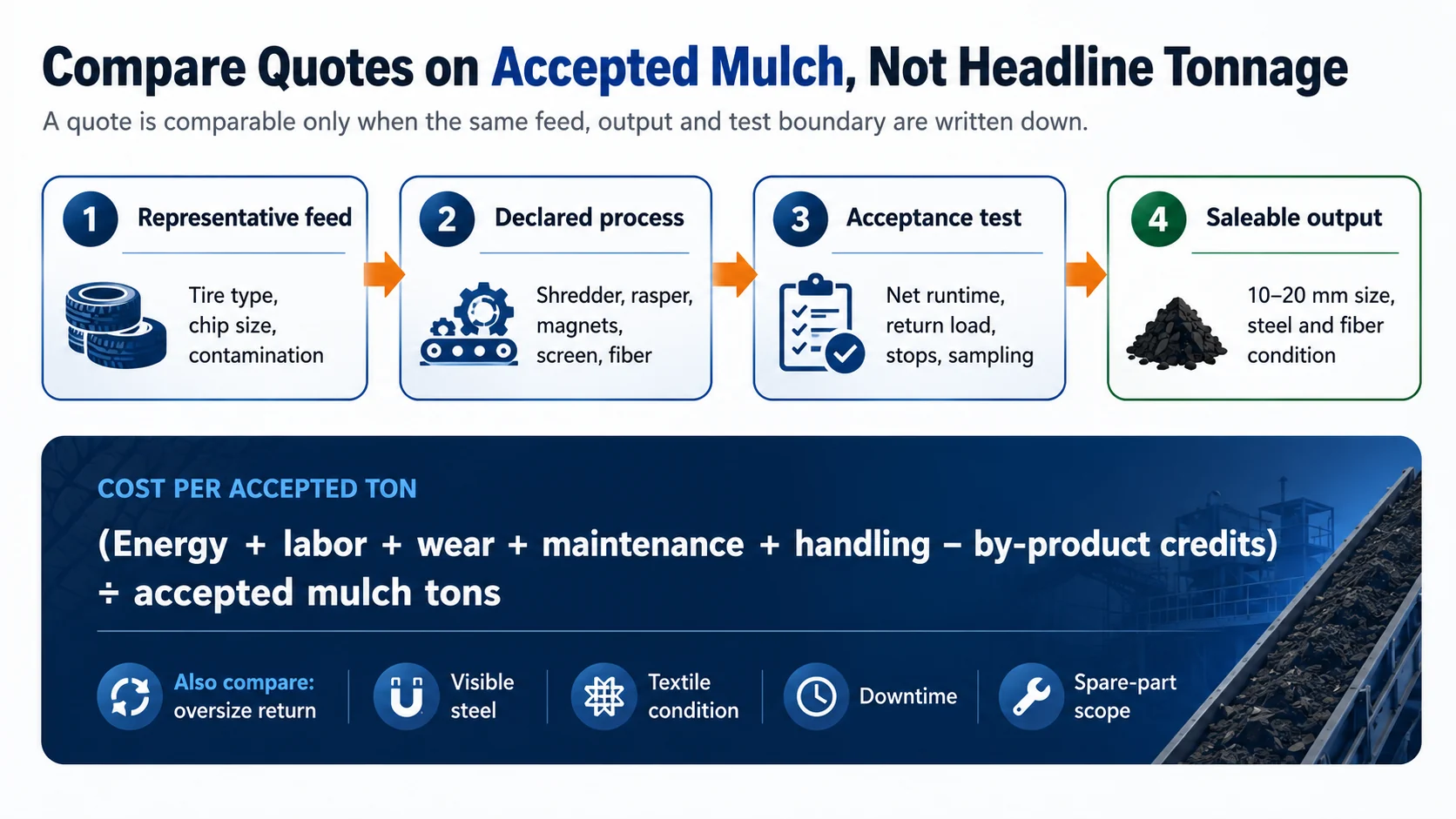
How to Compare Two Rubber Mulch Machine Quotations
Put the offers into one normalization sheet. Blank cells are useful; they show where a supplier has not defined the basis.
| Comparison item | What must be written | Why it changes price |
|---|---|---|
| Feed boundary | Whole tires, prepared sections or chips; maximum size; passenger/truck percentages | Determines front-end machines, torque and wear |
| Output definition | 10–20 mm range, oversize tolerance, visible-steel rule and textile condition | Determines rasping, magnets, screening and fiber handling |
| Capacity basis | Accepted finished t/h, net runtime and representative feed | Prevents feed-rate and product-rate confusion |
| Return load | Screen opening and measured recirculation under test | Affects rasper duty, energy and net output |
| Machine scope | Every conveyor, chute, magnet, platform, guard and control cabinet | Exposes machine-only offers |
| Electrical scope | Voltage, frequency, VFDs, cables, field devices and safety interlocks | Can create major local integration cost |
| Installation scope | Foundation data, supervision days, tools, crane and training | Separates supply price from start-up cost |
| Spare and wear package | Quantities, materials, unit prices and lead times | Shows first-year cash requirement |
| Acceptance test | Test duration, feed lot, sampling, weighing and pass/fail criteria | Turns claims into comparable evidence |
Do not compare motor power as a shortcut
A higher motor rating does not prove better product quality or lower cost per ton. The cutter geometry, shaft design, feed control, screen return and material balance work together. Motor power is one line in the specification, not the purchasing conclusion.
Do not accept “wire free” without a product check
A magnet recovery percentage can describe one machine stage while the finished mulch still contains unacceptable pieces. The reverse can also occur: a conservative supplier may avoid a dramatic purity percentage but demonstrate a better final product under a clear test.
Do not let future expansion remain undefined
For a crumb-ready project, state the future product size, expected capacity, planned equipment position, reserved electrical load and transfer height. Otherwise “expandable” may mean only that another plant can be built beside it.
Which Configuration Is Usually the Better Buy?
Choose the downstream module when…
You already produce stable chips below the agreed maximum, know their tire mix and can guarantee feed volume. Confirm that the existing shredder output will not create excessive rasper return.
Choose the complete line when…
You need one coordinated route from whole tires to saleable mulch, or your existing front end cannot provide stable feed. This normally simplifies responsibility for line balance and commissioning.
Choose future-ready interfaces when…
The mulch market is the first commercial step, but finer granules are part of a documented expansion plan. Reserve space and utilities based on actual future equipment, not a vague possibility.
The cheapest configuration is the one that meets the current product requirement without creating avoidable rework—and preserves only the future options that have a credible business case. More equipment is not automatically better. Less equipment is not automatically cheaper.
Rubber Mulch Machine RFQ Checklist
A useful quotation can be prepared much faster when the inquiry contains the engineering inputs below.
- Feed route: whole tires, prepared sections or pre-shredded chips.
- Tire mix: passenger, light-truck, truck, bus, agricultural or OTR percentages.
- Maximum feed: tire dimensions or chip length, width, thickness and shape.
- Contamination policy: rims, dirt, stones, free steel, water and other excluded material.
- Finished size: target 10–20 mm range and allowed oversize.
- Steel condition: visible-steel limit, sampling method and intended end-use.
- Fiber condition: acceptable textile content and whether air separation is required.
- Accepted capacity: finished product t/h, shifts per day and annual operating days.
- Product route: direct mulch sale or later crumb-rubber processing.
- Utilities: voltage, frequency, available transformer capacity and dust-control plan.
- Site: floor plan, clear height, access doors, foundation limits and storage arrangement.
- Commercial boundary: freight destination, installation support, training and spare package.
- Test basis: representative feed quantity, runtime, sampling, weighing and acceptance criteria.
Best first message: “We feed 70% passenger and 30% truck tires, need accepted 10–20 mm mulch at 2 t/h, allow no visible exposed wire in the agreed sample, require lower textile content for our buyer, operate two shifts, and may add a 1–6 mm granulation stage later.” That is far more useful than “Send 2 t/h rubber mulch machine price.”
Frequently Asked Questions
How much does a rubber mulch machine cost?
There is no reliable universal price because the term may describe a standalone rasper, a downstream mulch module or a complete whole-tire line. A useful quotation must define feed route, accepted output, capacity basis, steel and fiber condition, screening, controls, delivery scope and test method.
Is a tire shredder enough to make finished rubber mulch?
Usually no. A primary tire shredder prepares rough chips. Finished 10–20 mm wire-free mulch normally requires secondary rasping, magnetic steel recovery and, depending on the product specification, screening, oversize return and fiber separation.
Is a mulch module cheaper than a complete line?
A module beginning with pre-shredded chips normally has a lower equipment scope because it omits the primary shredder and part of the front-end handling. The comparison is valid only when incoming chip size and condition are guaranteed.
What does wire-free rubber mulch mean?
It means embedded steel is liberated during rasping and recovered magnetically. Buyers should still define the final inspection method for visible steel, textile fiber and particle-size distribution.
Why can two 5 t/h quotations have different prices?
One may quote incoming feed while another quotes accepted finished mulch. Tire mix, recirculation, steel and fiber limits, runtime, conveyors, controls and installation scope can also differ.
What information should be sent for an accurate quotation?
Send the feed route, tire mix, maximum dimensions, target mulch range, oversize tolerance, steel and fiber requirements, accepted finished capacity, shifts, utilities, layout, loading method, delivery destination and expansion plan.
Sources and Engineering References
- YUXI Tire Wire Free Mulch Plant. Product scope, 10–20 mm output direction, 0.5–10 t/h reference range, configuration routes, stage terms and quotation inputs.
- U.S. EPA, Methodology Document for Selected Municipal Solid Waste Products. Tire material components include rubber, steel and textiles.
- U.S. EPA, Scrap Tires: Handbook on Recycling Applications and Management. Terminology and processing references for granulated tire rubber.
- U.S. Consumer Product Safety Commission, Public Playground Safety Handbook. Recycled tire rubber mulch inspection guidance.
- U.S. CPSC, Tire Crumb Rubber Questions and Answers. End-use caution for landscaping mulch versus playground surfacing.
- Public rubber mulch machine marketplace listings. Used only to illustrate inconsistent market scopes and broad listing spreads; not a YUXI quotation or universal price range.
Build a Comparable Rubber Mulch Line Quotation
Send your tire or chip feed, target 10–20 mm product, accepted finished capacity, steel and fiber condition, power supply, layout and expansion plan. YUXI can separate the essential machines from optional finishing and future-ready interfaces.