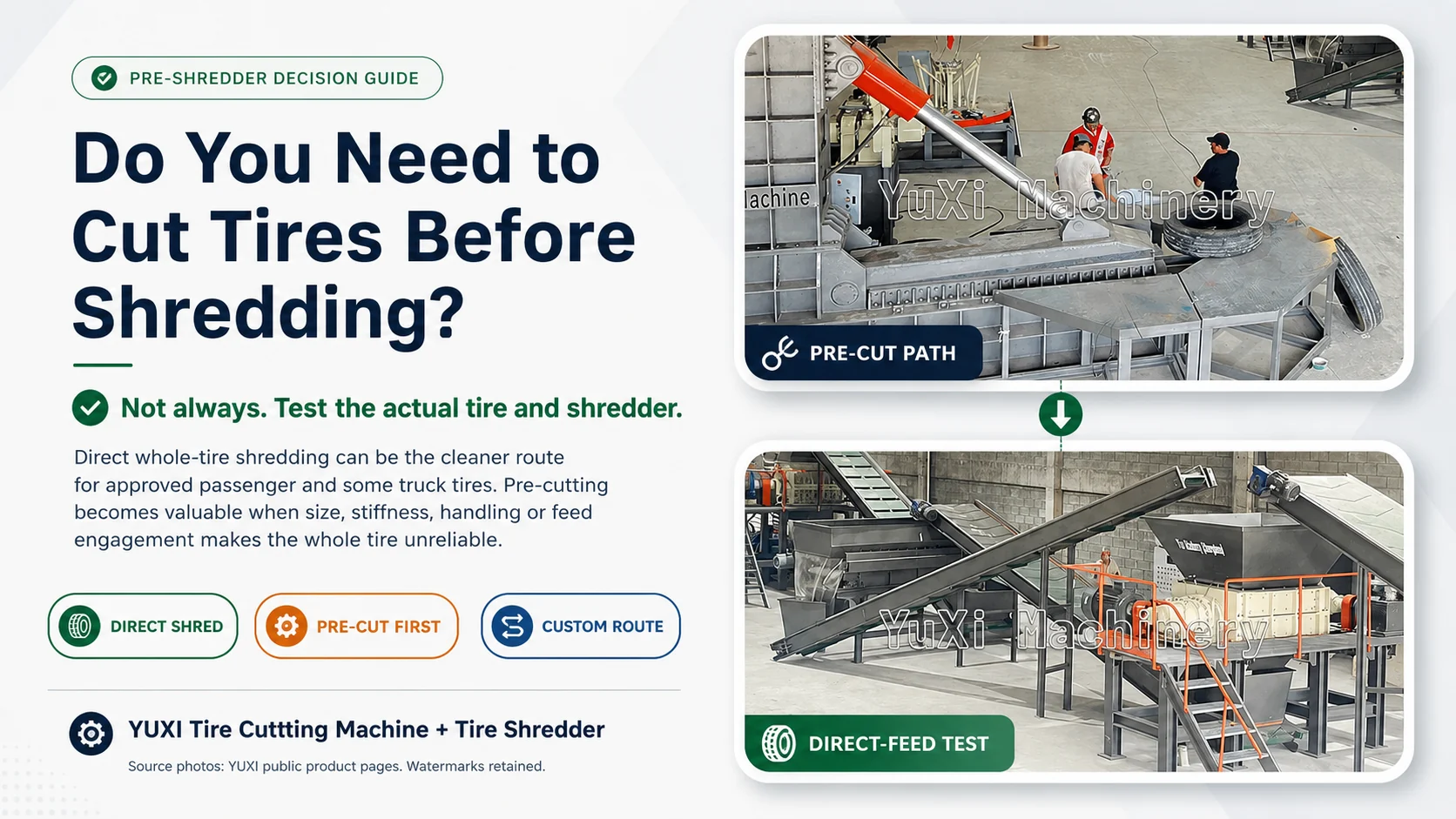
Sometimes yes. Sometimes adding a cutter only creates another work cell. The correct answer comes from testing whether the largest approved tire can fit, engage, move through and leave the shredder as accepted material.
Pre-cutting is a feed-conditioning decision, not a compulsory step in every tire recycling line.
A tire can fit through the top of a hopper and still be a poor shredder feed. It may land flat, rotate above the shafts, rebound after the first bite or require an operator to reposition it repeatedly. The opposite is also true: a buyer can install a cutter for every tire even though the selected shredder would have accepted most of the stream directly.
Quick Answer
No, you do not always need to cut tires before shredding. Whole passenger tires—and some truck tires—can go directly into a shredder when the complete feed arrangement has been designed and tested for them. Pre-cutting becomes technically justified when tires are too large, wide, stiff, heavy or irregular for stable whole-tire loading and shaft engagement. It is particularly relevant for agricultural, OTR and mining tires, mixed stockpiles with a difficult oversize fraction, and lines where the shredder requires a defined section envelope.
YUXI positions its tire cutting machine for truck, all-steel radial, agricultural and OTR tire pre-processing when direct feed is difficult. The public product page also makes the limitation clear: final configuration depends on tire dimensions, weight, steel content, handling and the next process.
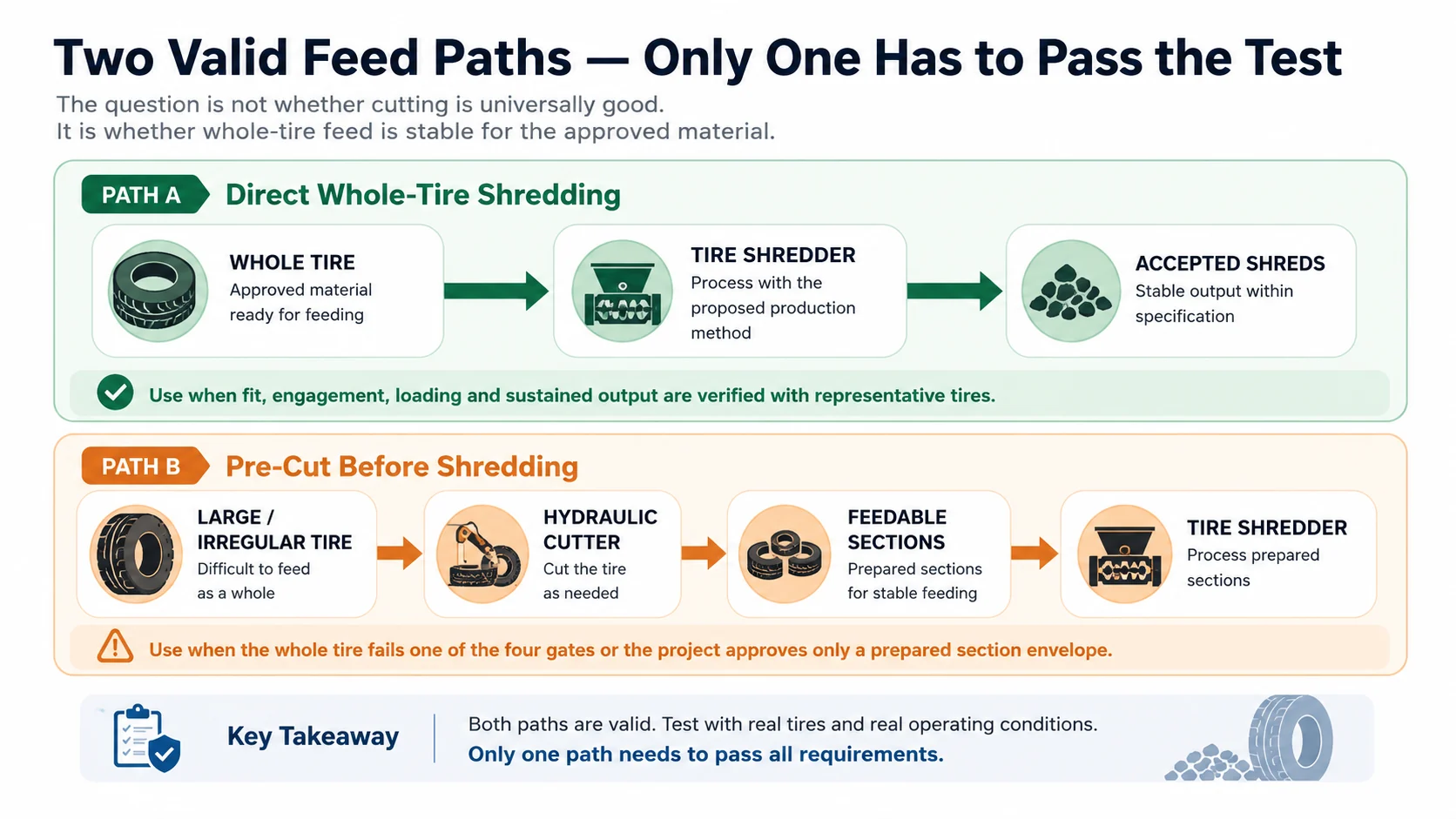
Both routes can be correct. The approved route is the simplest one that repeatedly passes the feed and output test.
“Passenger, Truck or OTR?” Is Only the Starting Point
Tire family matters, but it does not describe the full feed condition. Two tires with a similar outside diameter can behave differently because width, mass, bead construction, steel reinforcement, sidewall stiffness, deformation and surface contamination change how they are lifted and how the shafts first engage them.
USTMA’s tire-construction overview explains that a tire is an integrated structure of inner liner, body plies, belts, sidewalls, tread and steel-wire bead hoops.2 In practical shredder feeding, that reinforced closed-ring construction can behave differently from loose rubber scrap.The first shredder bite has to collapse and restrain a spring-like structure while cutting rubber and reinforcement.
The shredder configuration matters just as much. YUXI describes its tire shredder machine as a low-speed, high-torque dual-shaft system with screening and automatic return for oversized material. Its page states that passenger and truck tires can be configured for processing, while large OTR tires may require pre-cutting, bead treatment or a customized feeding system.
Engineering judgment: do not classify a route as “whole-tire capable” from chamber width alone. The useful boundary includes the hopper, loading tool, tire orientation, initial shaft engagement, allowable reversals, screen return and accepted discharge.
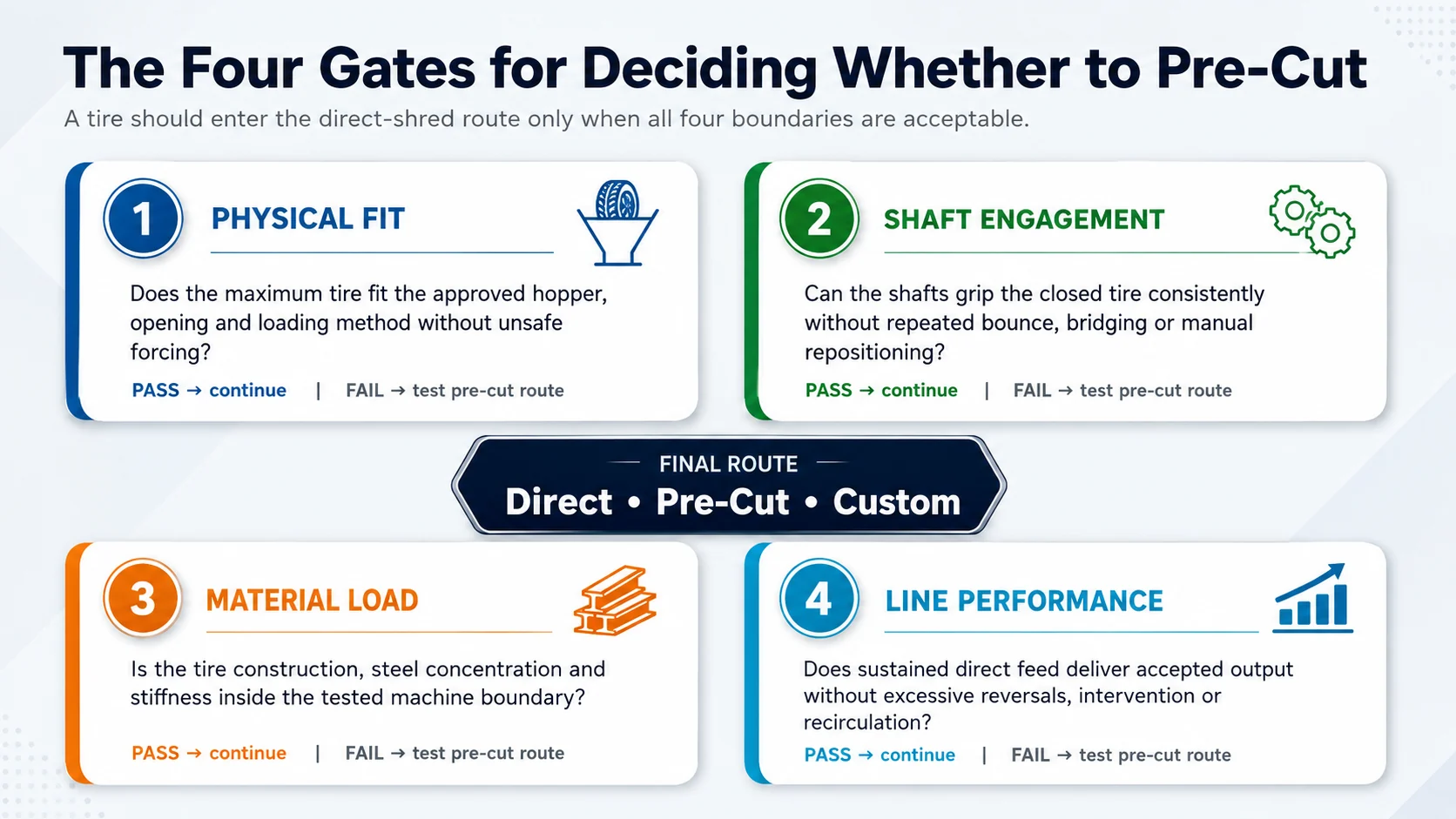
The Four Gates a Whole Tire Must Pass
We have found that the decision becomes much clearer when it is split into four gates. A tire belongs in the direct-shred route only when all four are acceptable under representative production conditions.
Failure at one gate does not automatically prove a cutter is the only solution; it proves that the proposed direct-feed route needs redesign or a pre-treatment test.
Gate 1: Physical fit
Start with the maximum approved tire, not the average tire. Confirm its outer diameter, section width, approximate weight and condition. Then compare those values with the complete loading path: yard handling, conveyor or loader approach, hopper opening, internal restrictions and the space needed for safe presentation.
A tire that technically enters the hopper may still be difficult to control. Wide agricultural tires can sit across an opening. Deformed casings may not roll or lift predictably. Very heavy OTR sections may need a tire handler, loader or crane even after cutting. Fit is therefore both a geometry question and a material-handling question.
Gate 2: Shaft engagement
A closed tire has no convenient free edge. The shafts must pull the ring down, deform it and start a stable cut. Some whole-tire shredders are designed around that task. Others work much better after a sectioning cut exposes edges and removes the closed-ring geometry.
Watch the first ten seconds of each feed, not just the final discharge. Does the tire rotate above the shafts? Does it bridge against the hopper wall? Does the control system reverse repeatedly? Does an operator use a tool or loader to push it into a different angle? Those observations are often more revealing than the headline motor rating.
Gate 3: Material load
The shredder must be approved for the tire’s real reinforcement, not only “rubber.” Truck and OTR tires can contain heavier steel and stronger structural zones than passenger tires. The bead area is especially concentrated. USTMA describes bead hoops as bronze-coated steel strands embedded in the sidewall, while belts and plies provide additional structural strength.2
Gate 4: Sustained line performance
One successful bite is not a production result. The line must repeatedly produce the accepted discharge while the screen, return conveyor and downstream process remain balanced.
Record normal feed intervals, reversals, bridging, manual intervention, unplanned stops, return-material behavior and the amount of accepted output. A direct route that needs constant correction may be technically possible but operationally poor. Equally, a pre-cut route can be poor when the cutter becomes the slowest stage or creates a queue of heavy sections.
A common mistake: testing the shredder with pre-cut samples while calling the result “whole-tire capacity.” The test material must match the quoted production feed state.
Practical Decision Table by Tire Stream
Tire stream
Starting assumption
What can change the answer
Best proof
Passenger car tires
Direct whole-tire shredding is often the simpler route when the shredder is designed for it.
Run-flat construction, unusual contamination, mixed oversize tires, weak loading control or a tighter downstream output requirement.
Continuous test with the actual passenger-tire mix and the proposed conveyor or loader.
Light truck and mixed commercial tires
Do not assume. Test the largest and strongest approved tire.
Separate results for normal tires and the difficult fraction rather than one blended capacity claim.
All-steel radial truck or bus tires
Direct feed may work with a suitably configured heavy-duty shredder; pre-treatment becomes more defensible as engagement and steel load become difficult.
Maximum casing size, construction, loading orientation, reversals and intervention frequency.
Full route test that shows loading, first bite, accepted discharge and return behavior.
Agricultural and machinery tires
Pre-cutting is commonly worth testing because width, sidewall form and irregular geometry can make direct presentation awkward.
Actual tire family, whether the ring collapses, loader access and the shredder’s approved opening.
Side-by-side direct-feed and section-feed trials with the same representative tire.
OTR and mining tires
A customized pre-treatment route is usually the responsible starting point rather than assuming whole-tire feed.
Diameter, width, weight, bead and belt construction, lifting method and whether one cutter can cover the approved range.
Documented cut plan followed by a shredder test using the actual resulting sections.
Deformed, burned or heavily contaminated tires
Classify separately from normal tires.
Embedded metal, soil, rocks, water, unstable shape and damage that changes handling.
Inspection and explicit supplier approval before any production trial.
This is guidance, not a universal machine limit. The correct row can change with the quoted shredder, the handling cell and the final product. EPA’s scrap-tire pages also show why there is no single processing route: end uses include tire-derived fuel, civil engineering applications, ground rubber and whole or cut products.1 For TDF specifically, EPA notes that tires may be used whole or shredded depending on the combustion device.3
When Direct Whole-Tire Shredding Is the Cleaner Route
Skipping the cutter has real advantages when the direct route already works. It removes one machine, one guarded work cell, one transfer point and one maintenance package. It can also reduce individual handling of heavy tire sections.
Direct shredding is credible when:
the maximum approved tire fits the entire loading path;
the handling method presents tires consistently without personnel entering a danger zone;
the shafts engage the closed tire without repeated bridging, bounce or correction;
the tire construction and steel condition are inside the supplier’s tested boundary;
the line sustains accepted output, not merely peak shaft activity;
the result is compatible with screening, recirculation and downstream separation.
Passenger-tire projects are the obvious example, but the principle is not limited to small tires. Some truck-tire lines can also run direct. The important phrase is “some truck-tire lines,” because the tire, shredder and loading arrangement have to be considered together.
When Pre-Cutting Earns Its Place
Pre-cutting is useful when it changes a failed or unstable feed condition into a repeatable one. The cutter reduces the handling envelope, opens the ring and creates free edges that the shredder can grip. For very large tires, it may also be the only practical way to move material between process stages.
Strong reasons to test pre-cutting
The tire exceeds the approved opening; it bridges or rotates above the shafts; the loader cannot present it safely; the largest tire dominates stoppages; or the supplier requires a maximum section envelope.
Weak reasons to add a cutter
“Every recycling line has one,” “smaller is always better,” or “the cutter has a large hydraulic cylinder.” None of these statements proves a balanced process.
In practice, a mixed stockpile may need two routes. Common passenger tires can feed directly, while the oversize truck, agricultural or OTR fraction moves through a cutter. That can be more sensible than forcing every tire through the slowest front-end step.
Do Not Specify “Four Pieces” Without an Interface Limit
Quartering a tire sounds like a specification. It is not. Four pieces from a truck tire and four pieces from a mining tire can have completely different length, width, curvature, weight and exposed-wire condition.
The shredder sees a three-dimensional object, not a piece count. A useful pre-cut specification normally states the maximum section length, width and height; approximate maximum weight; whether the ring must be fully opened; permitted attached wire; loading orientation; and the handling method used to reach the hopper.
Example acceptance wording: “The approved tire shall be converted into fully separated sections that fit the stated shredder loading path and can be presented by the proposed handling method without manual entry into the feed zone. Maximum section dimensions and attached-wire condition shall match the agreed test photographs.”
Once the route decision has been made, the separate waste tire cutting machine selection guide covers cutter capability, handling, blade support, utilities and factory acceptance evidence in more detail.
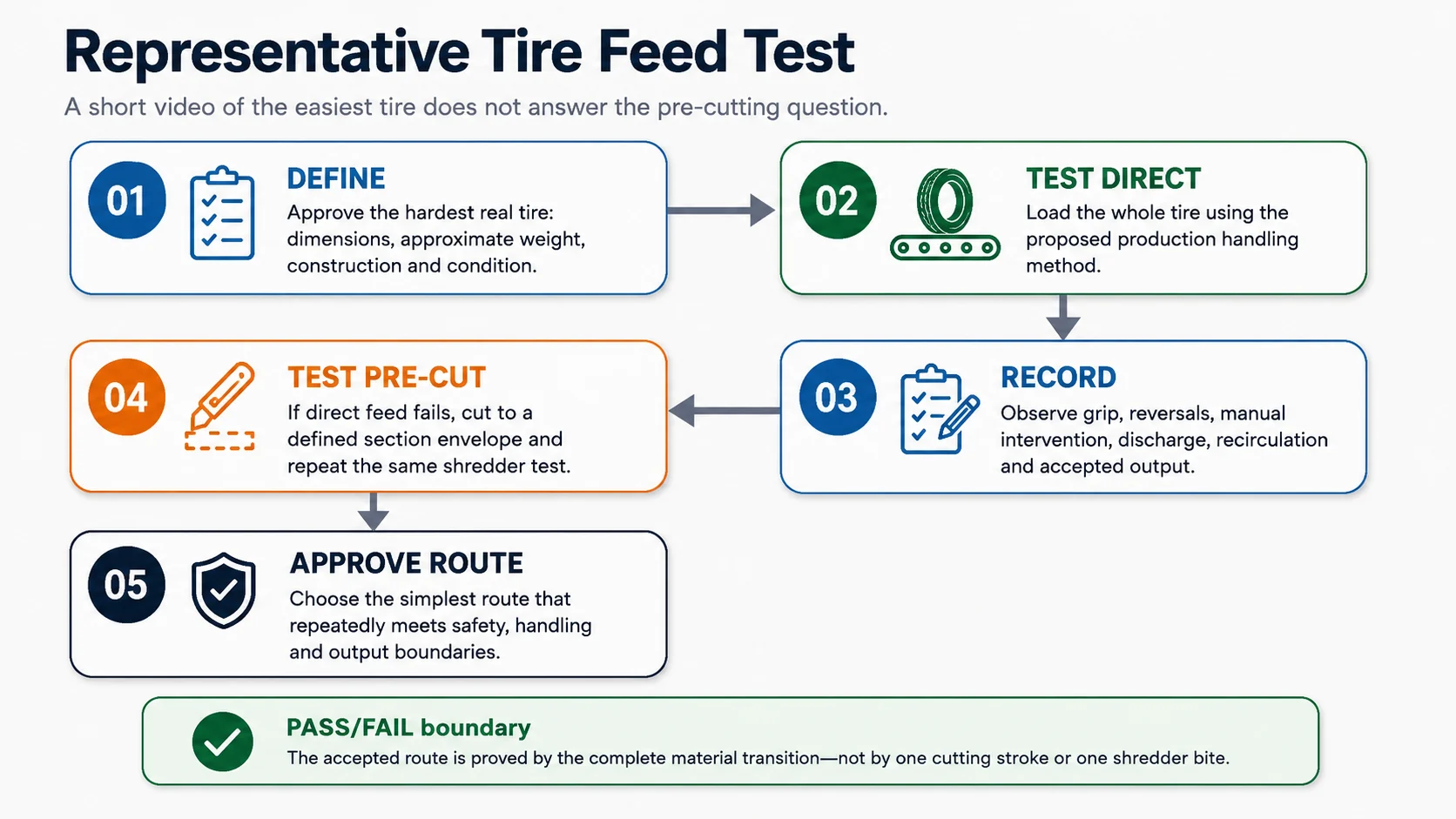
How to Prove Whether Pre-Cutting Is Necessary
A representative material test is the strongest answer. The test should compare complete routes, not isolated machine actions.
Keep the tire, handling method, shredder configuration and accepted-output definition consistent when comparing routes.
Define the approval set. Record the largest, widest, heaviest and strongest tires that the project genuinely plans to process. Include representative normal tires too.
Write the direct-feed boundary. State the proposed loader or conveyor, hopper configuration, operator count, accepted interventions and the output measurement point.
Run the direct route. Show the complete cycle from pickup or conveyor loading through initial engagement, shredding, screening, return and accepted discharge.
Record failures honestly. Count bridging, reversals, loader pushes, manual repositioning, stops, incomplete engagement and material that cannot enter the route.
Run the pre-cut route when needed. Use the same tire family, cut it to a defined section envelope and feed those actual sections into the quoted shredder.
Compare line output, not visual speed. Include cutter loading, positioning, cutting, section discharge and transfer time. Then compare accepted material at the same downstream point.
Approve the simplest stable route. Direct shredding wins when it meets the boundary. Pre-cutting wins when its extra stage removes a larger bottleneck or makes difficult tires processable.
One common commissioning failure is a clean cutter demonstration and a clean shredder demonstration performed with different material. The cut sections shown in the first video never enter the machine shown in the second. The interface remains unproved.
The Hidden Cost Exists on Both Sides
A cutter is not free merely because it improves feed geometry. It adds capital cost, floor space, hydraulic maintenance, blade wear, loading and repositioning labor, section handling and another energy-isolation point.
Direct whole-tire feed is not free either. If the tire repeatedly bridges, rebounds or needs loader correction, the plant pays through unstable output, operator attention, reversals, delay and potentially more severe contact with concentrated tire structures.
Choose the route with the lower total cost of accepted output—not the route with fewer machines or the faster-looking single action.
Surprisingly, the best answer may be selective pre-cutting. If five percent of the incoming tires cause most of the feed disruption, routing only that fraction through the cutter can protect line simplicity without building the whole plant around the hardest tire.
How YUXI Equipment Fits the Decision
YUXI’s public tire-cutter information places hydraulic cutting before shredding, granulation, TDF preparation or selected pyrolysis pre-treatment when large tires are difficult to feed directly. The listed applications include all-steel radial truck tires, agricultural tires and OTR or mining tires. The page describes hydraulic loading and clamping logic, alloy cutting components, factory test availability and layout support with handling tools, conveyors and a shredder.
YUXI’s tire-shredder page takes the other side of the interface. It describes whole-tire pre-shredding with counter-rotating shafts, a disc screen and automatic return of oversized material. Passenger and truck tires can be configured for processing; OTR tires may need pre-cutting, bead removal or a customized feed system. Together, those pages support a conditional answer rather than a universal one.
Send the Real Tire, Not Just a Capacity Number
For a useful route evaluation, send YUXI representative tire photos and markings, maximum diameter and width, approximate weight, tire-mix percentages, the required final material, target accepted output, loading method and workshop layout. When a shredder already exists, include the hopper drawing, opening, shaft arrangement and current feed problem.
Safety Boundary: Cutting and Shredding Create Different Hazards
A tire cutter creates a hydraulic point-of-operation and heavy-material handling hazard. A shredder creates hopper access, ingoing nip, rotating shaft, conveyor and recirculation hazards. When both machines are used, the transfer between them must not create an uncontrolled lifting or access problem.
The Final Decision Rule
Do not cut tires before shredding merely because cutting sounds protective. Do not skip cutting merely because the tire fits through the hopper.
Approve direct whole-tire shredding only when the hardest real tire passes physical fit, stable engagement, material-load and sustained-performance gates. Approve pre-cutting when a defined section solves a failed gate and the complete cutter-to-shredder route remains balanced. Use a custom or split route when the tire stream is too diverse for one answer.
That is the practical conclusion: pre-cutting is neither mandatory nor decorative. It is justified when it converts an unqualified tire into a qualified shredder feed.
FAQ
Do all tires need to be cut before shredding?
No. Passenger tires and some truck tires can be shredded whole when the quoted shredder, hopper and handling method have been tested for that exact tire range. Pre-cutting becomes more relevant as tires become larger, wider, stiffer, heavier or harder to present consistently.
Can a tire shredder process whole truck tires?
It may, but the answer is configuration-specific. Confirm the maximum approved tire dimensions and construction, loading method, shaft engagement, steel condition and sustained accepted output with representative truck tires.
Do OTR tires need pre-cutting before shredding?
Large OTR and mining tires often require pre-cutting, bead treatment or a customized feeding route. The final route depends on diameter, width, weight, construction and the approved feed envelope of the shredder.
Does cutting tires before shredding always increase capacity?
No. A cutter adds its own loading, positioning, discharge, labor and transfer time. It improves the line only when it removes a larger direct-feed bottleneck or makes the shredder’s accepted output more stable.
How small should tires be cut before shredding?
There is no universal section size. Define the maximum length, width, height, weight, ring opening and attached-wire condition that the quoted shredder and handling system can accept.
Is pre-cutting the same as removing the tire bead?
No. Whole-tire sectioning changes the tire’s geometry. Bead cutting or debeading treats the concentrated bead area. A project may use one, both or neither step depending on the tire and downstream process.
What should I send YUXI for a route evaluation?
Send representative photos and markings, maximum diameter and width, approximate weight, tire mix percentages, downstream product, required capacity, proposed loading method, workshop layout and any existing shredder opening or feed limits.
References and Source Notes
U.S. EPA — Markets and Uses for Scrap Tires. Used to establish that scrap-tire end uses include different material states and therefore do not share one universal pre-processing route.
Marie has 8+ years of experience in tire shredding and recycling equipment,with a focus on tire shredders,rubber recycling machines,TDF production,rubber crumb processing,and complete tire recycling systems.