




Contents
Quick Answer
Tire Debeader Machine Price Snapshot
| Public listing type | Observed price | What the listing appears to cover | Why it is not directly comparable |
|---|---|---|---|
| U.S. passenger/light-truck sidewall bead-wire remover | US$6,599 listed | A named BWR5-1 unit intended to extract steel bead wire from passenger and light-truck sidewalls. | This is not the same feed, scale or duty as every hydraulic truck-tire or prepared-ring debeader. |
| Hydraulic waste-tire wire drawing marketplace listings | About US$5,500–25,500 | Mixed supplier offers under similar product names. | Model identity, tire range, included equipment, output basis and delivery scope vary. |
| Heavy or OTR marketplace listings | About US$27,500–48,000 | Longer or heavier machines marketed for OTR wire pulling. | OTR tire dimensions, cutting preparation and material handling can change the machine category completely. |
| Dedicated supplier advertised starting price | From US$18,000 | A supplier statement for its tire debeader range. | A starting price does not define configuration, shipping, site work or the tire used for the claim. |
Why Online Tire Debeader Prices Are So Far Apart
- What exact material is loaded: whole tire, cut sidewall, prepared bead ring or an OTR section?
- Which tire families and maximum dimensions were approved?
- What mechanical method separates the wire?
- What is included in one complete operating cycle?
- What equipment, safety devices, documentation and commercial services are included?
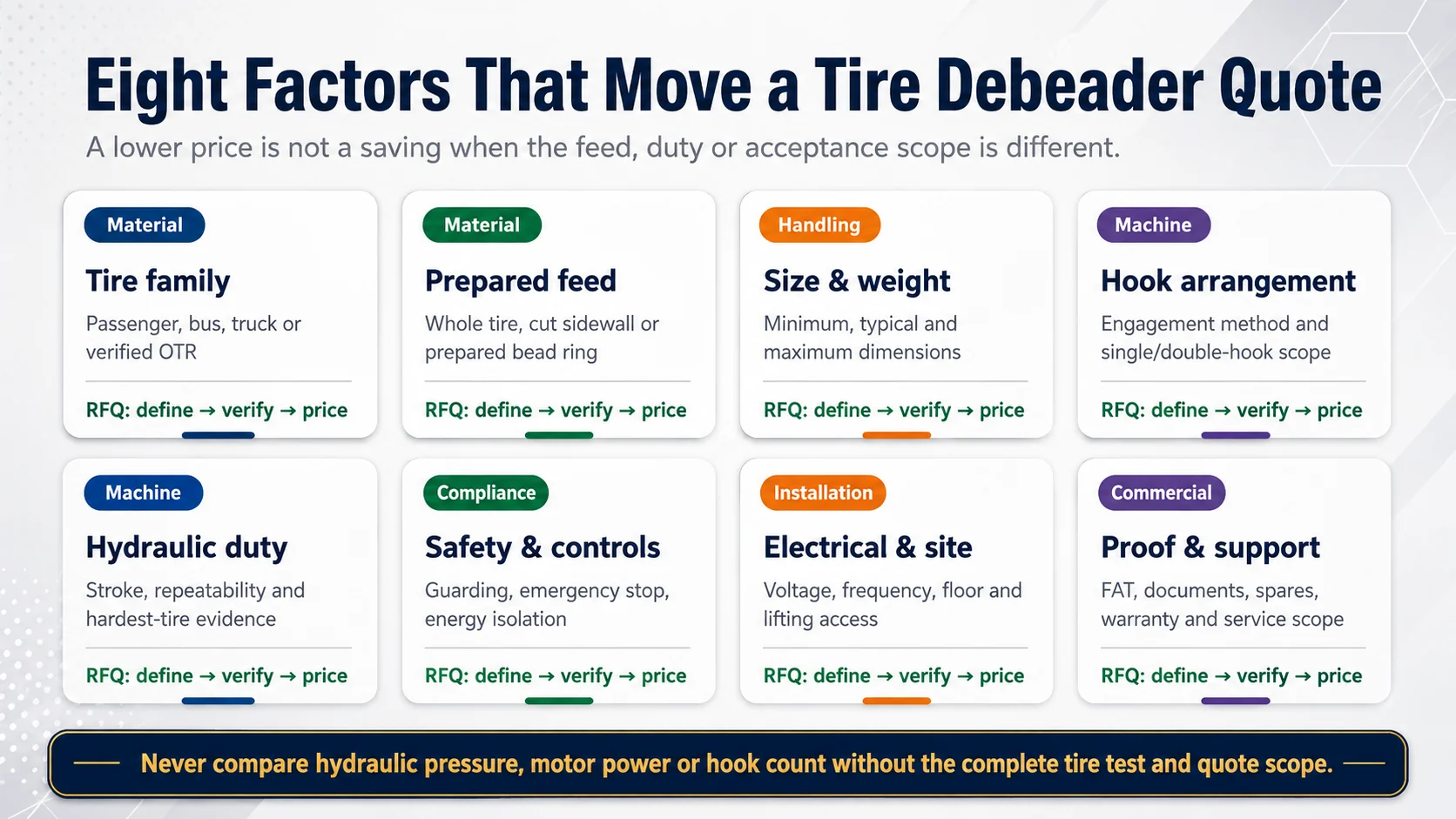
Eight Factors That Change Tire Debeader Machine Price
1. Tire family and bead construction
2. The prepared feed condition
3. Minimum, typical and maximum size
4. Hook arrangement and working parts
5. Hydraulic system and duty
6. Frame, guarding and controls
7. Electrical supply and workshop integration
8. Validation, documentation and support
What Specifically Changes a YUXI Tire Debeader Quotation?
| Buyer information | Why YUXI needs it | What should appear in the response |
|---|---|---|
| Representative tire photos and video | Confirms tire family, damage, sidewall preparation and handling reality. | Approved feed condition and any required upstream preparation. |
| Minimum, typical and maximum dimensions | Determines fit, hook approach, stroke, frame envelope and handling. | Applicable range for the quoted configuration. |
| Tire mix and bead difficulty | A mixed passenger/truck stream has different duty from continuous truck rings. | Test sample plan and any configuration boundary. |
| Completed rings per hour or shift | Allows the supplier to consider the full cycle rather than only pulling time. | Capacity basis, operator assumption and exclusions. |
| Downstream process | Defines the required rubber output condition and line balance. | Connection to cutting, shredding, crushing, powder or pyrolysis preparation. |
| Voltage, site and destination | Changes electrical components, packing, freight and installation planning. | Electrical configuration, delivery term and installation boundary. |
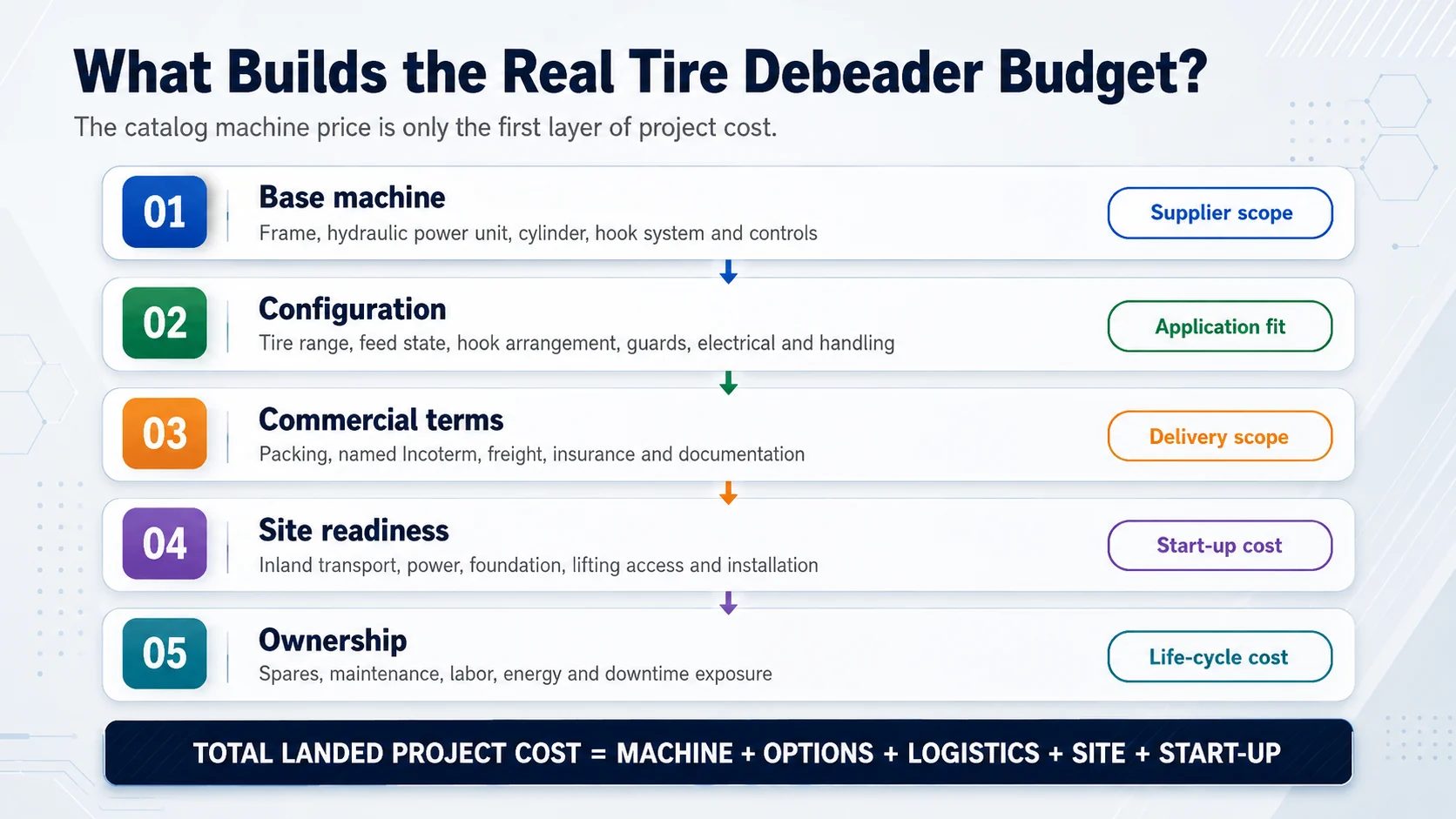
Calculate the Total Landed Project Cost
| Budget line | Questions to ask | Typical risk when omitted |
|---|---|---|
| Machine and included accessories | Are hooks, guards, hydraulic oil, tools, cables, anchor hardware and control panel included? | The “same model” arrives with a smaller usable scope. |
| Export packing | Is seaworthy packing included? Are loose components identified? | Unexpected packing charges or transport damage. |
| Freight and insurance | Which port or address? What shipment dimensions and weight are used? | A provisional freight figure changes after packing. |
| Tariffs, taxes and customs | Which HS classification is proposed? Who confirms local rates? | Budget excludes local import charges. |
| Unloading and inland transport | What lifting capacity and truck access are required? | The buyer cannot unload or move the machine safely. |
| Site work | Foundation, anchors, electrical cable, breaker, oil, lighting and guarding interfaces? | Machine is delivered but cannot be commissioned. |
| Installation and training | Remote or on-site? Travel, visa, lodging and local labor included? | Support assumptions differ after payment. |
| Start-up spares | Which hooks, seals, filters, hoses and sensors are recommended? | Minor damage creates a long production delay. |
How to Compare Three Supplier Quotations Fairly
| Comparison row | Supplier A | Supplier B | Supplier C |
|---|---|---|---|
| Exact feed state approved | Prepared ring defined | “Waste tire” only | Sidewall only |
| Largest representative tire tested | Included | Video of another tire | Optional |
| Hook and restraint scope | Detailed | Unclear | Single hook |
| Guards and emergency controls | Included | Not stated | Optional |
| Electrical supply | Buyer voltage confirmed | Standard factory voltage | Transformer extra |
| Export packing | Included | Extra | Included |
| Delivery basis | FOB named port | EXW | CIF named port |
| Start-up spares | Listed | Not included | Price pending |
Price Is Not the Same as Cost of Ownership
Tire Debeader Machine RFQ Guide
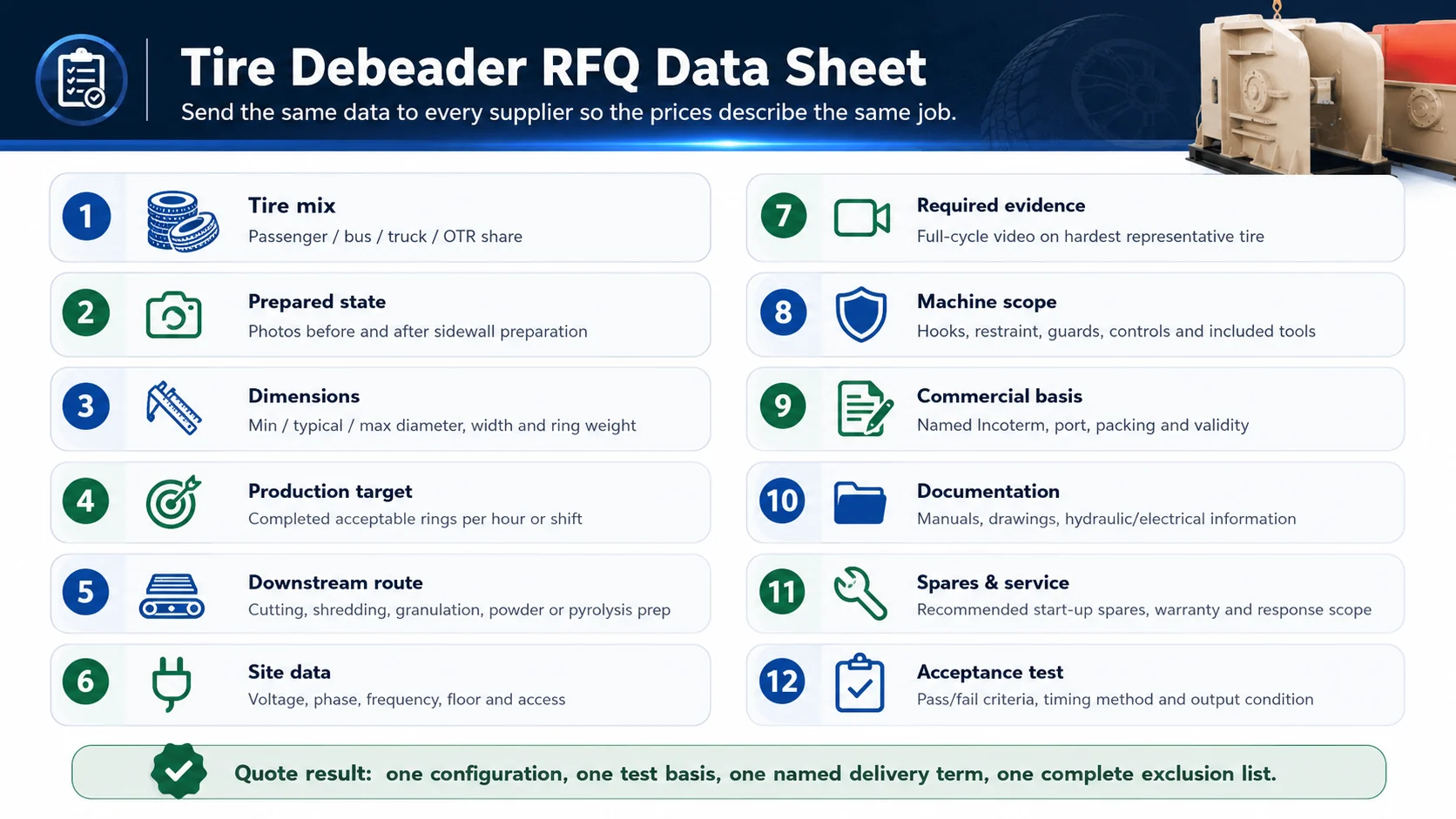
Material and production data
- Tire categories and estimated percentage of each category
- Photos of typical, smallest, largest and most difficult tires
- Incoming state and prepared bead-ring state
- Minimum, typical and maximum outside diameter and width
- Approximate prepared-ring weight
- Known unusual bead construction, damage or contamination
- Required completed acceptable rings per hour or per shift
- Number of operators and available lifting or handling equipment
Process and site data
- Upstream cutting or sidewall-removal equipment
- Downstream tire cutter, shredder, crusher, granulator, powder or pyrolysis-preparation process
- Required output condition for steel and rubber
- Local voltage, phase and frequency
- Workshop floor, doorway, loading access and lifting capacity
- Destination country, named port or full delivery location
- Preferred language for manuals and training
Supplier response requested
- Quoted configuration and approved feed boundary
- Machine dimensions, weight and utility requirements
- Hook, restraint, hydraulic, control and guarding scope
- Complete inclusion, exclusion and optional-equipment list
- Representative-tire FAT proposal and pass/fail criteria
- Production lead time and quotation validity
- Named Incoterm and packing/freight basis
- Warranty, documentation, recommended spares and support process
Define the Acceptance Test Before the Purchase Order
| FAT field | Recommended definition |
|---|---|
| Test material | Named tire samples supplied or approved by the buyer, including the largest and most difficult normal ring. |
| Feed condition | Exactly the prepared state expected in production. |
| Quantity | Enough consecutive cycles to reveal loading, engagement, release and reset—not one successful demonstration. |
| Timing | Start at ring pickup or loading; stop after steel and rubber are cleared and the machine is ready for the next ring. |
| Successful output | Define acceptable wire extraction and the permitted rubber attachment. |
| Failures | Record re-engagement, incomplete pull, unsafe movement, leakage, control fault and abnormal stop. |
| Operator and handling | State number of people, lifting aid and any pre-positioning work. |
| Evidence package | Full-frame video, close hook view, both outputs, control sequence and recorded test sheet. |
Price Red Flags to Resolve Before Paying a Deposit
Technical red flags
- “Suitable for all tires” without dimensions or feed state
- Capacity based only on cylinder pulling time
- Pressure or motor power used as the only proof
- Truck and OTR tires treated as the same class
- No full-cycle video of the requested tire
- Guards, restraint and wire-release method not shown
Commercial red flags
- Price has no model or configuration revision
- Incoterm has no named port or place
- Packing, freight or local charges are “to be confirmed” after order
- No inclusion and exclusion schedule
- Warranty begins before shipment or has no scope
- Spare parts and documents are not listed
Prepare a Quote That Can Be Compared
Frequently Asked Questions
How much does a tire debeader machine cost?
Public listings observed in July 2026 range from compact passenger or light-truck bead-wire equipment around the mid-thousands of U.S. dollars to heavy hydraulic and OTR machines in the tens of thousands. These are not normalized quotations. YUXI does not publish one fixed price because tire size, feed preparation, hook and hydraulic configuration, safety scope, electrical supply, testing and delivery terms change the quotation.
Why do tire debeader prices vary so widely online?
Many listings use the same product name for different machines: sidewall bead-wire removers, hydraulic hook-type debeaders, roller separators, truck-tire machines and customized OTR systems. Price also changes with included guards, controls, packing, freight, spares, documentation and support.
What information does YUXI need before quoting?
Send representative tire photos and video, tire family and mix, prepared feed condition, minimum and maximum dimensions, approximate ring weight, target completed rings per hour or shift, downstream equipment, local voltage and destination port or delivery location.
Should I compare EXW, FOB or CIF prices?
Compare every supplier on the same named Incoterm and destination. Incoterms allocate responsibilities for shipment, insurance, documentation and customs activities. A low EXW price is not directly comparable with a CIF quote that includes ocean freight and insurance.
Does a double-hook tire debeader always cost more and produce twice as much?
A double-hook configuration may add structure, hook hardware and hydraulic or control requirements, but it does not automatically double sustainable output. Loading, engagement, release, ring handling and the downstream process still determine completed rings per hour.
What should be included in a tire debeader acceptance test?
Define the exact tire samples, prepared feed state, number of test rings, timing start and stop points, successful wire-removal condition, allowed re-engagement attempts, operator and handling method, safety controls, output collection and how failed cycles are recorded.
What costs are commonly excluded from the machine price?
Common exclusions can include export packing, inland transport, ocean freight, insurance, duties, taxes, customs fees, unloading, foundation, electrical work, lifting equipment, installation, travel, accommodation, training, spare parts and local compliance work. The quotation should state each inclusion and exclusion.
References and Source Notes
- U.S. Occupational Safety and Health Administration, 29 CFR 1910.212, general machine guarding requirements. Source.
- U.S. International Trade Administration, “Determine Total Export Price,” landed-cost components. Source.
- U.S. International Trade Administration, “Know Your Incoterms.” Source.
- U.S. Occupational Safety and Health Administration, 29 CFR 1910.147, control of hazardous energy. Source.
- OSHA standard interpretation on lockout/tagout of hydraulic systems and stored pressure. Source.