A useful selection process begins with the tire and the production line—not with a catalog model, a motor rating or the lowest quotation.
A buyer’s guide to matching prepared tire rings, hook and hydraulic configuration, labor and downstream equipment.
Two machines can look almost identical in a short sales video and still behave very differently on the buyer’s tire mix. The difference often appears after delivery: the largest truck ring is awkward to load, the hook misses a heavily embedded bead, the operator spends more time clearing wire than pulling it, or the debeader finishes material faster than the downstream cutter can accept it.
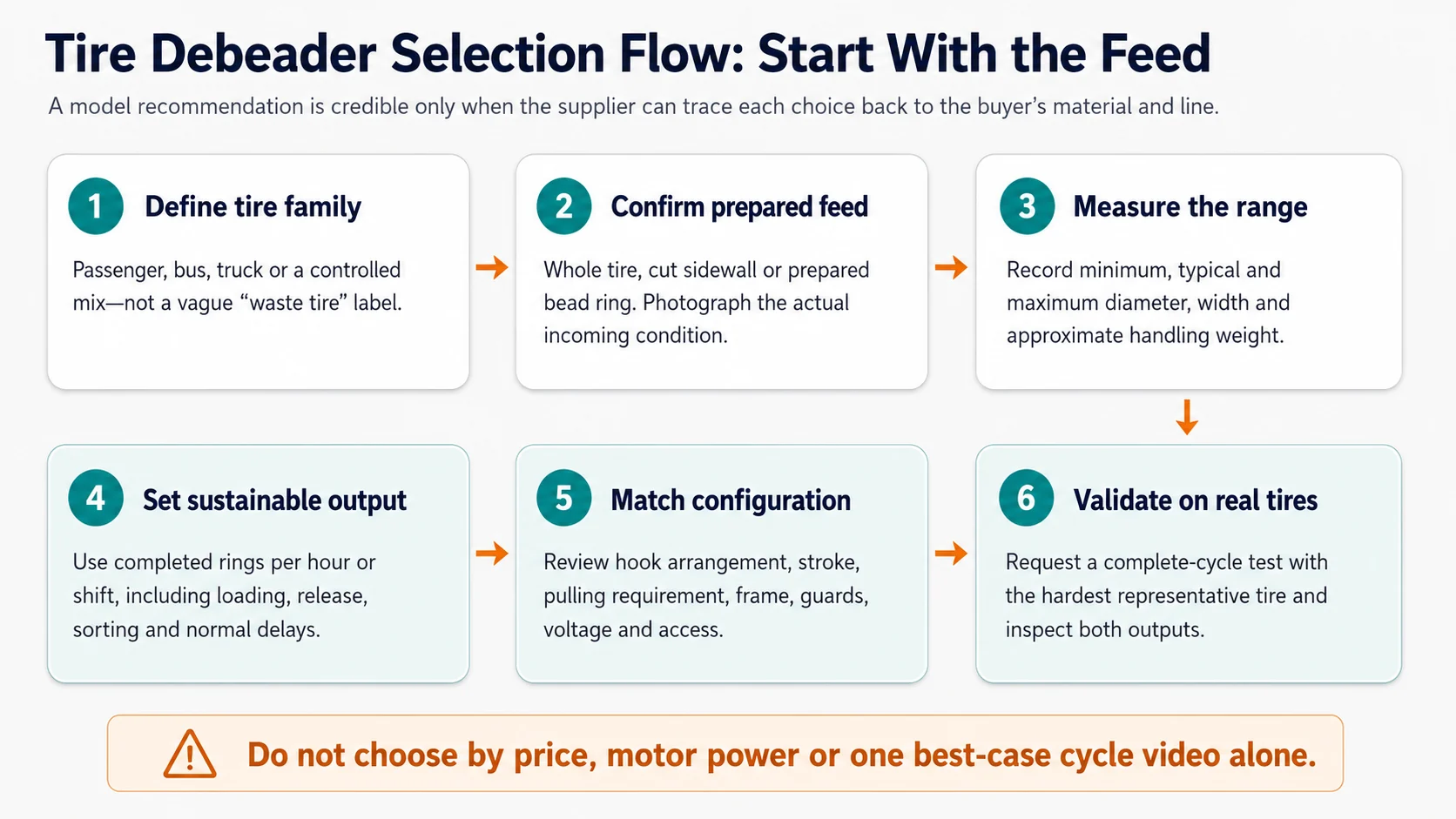
Choose a tire debeader by working backward from six facts: the tire family, prepared feed condition, maximum dimensions and weight, sustainable shift output, available operators, and the equipment that receives the rubber after wire removal. Use those facts to evaluate hook arrangement, hydraulic pulling system, stroke, workpiece restraint, frame rigidity, safety controls, electrical supply and service access. Finalize the purchase only after a complete-cycle test on the largest and most difficult representative tire.
A price comparison made before those six facts are known is not a machine comparison. It is a comparison of incomplete quotations.
The Selection Rule: Material → Process → Machine
Tire and feed facts → production requirement → machine configuration → representative-tire validation
A debeader is a force-and-handling machine. It must grip a concentrated high-tensile bead bundle, restrain a flexible rubber ring, complete the pull, release the output and return to a safe loading condition. Every selection item should improve one of those tasks.
The best configuration is traceable: each design choice should answer a specific material, output, labor or site requirement.
1. Define the Actual Feed Before Discussing Models
“Waste tires” is not an adequate feed description. A supplier needs to know what physically arrives at the machine. Is it a whole tire, a tire with one sidewall removed, a ring with both sidewalls removed, or a semi-finished bead section from another cutting process?
YUXI describes its hydraulic tire debeader as a machine for prepared radial tire bead rings, especially rings with both sidewalls removed. It lists passenger-car, bus, truck and some construction-vehicle tire material as possible applications depending on size and configuration. That wording should be treated as a selection boundary, not as permission to load every whole tire into one standard machine.
Buyer action: photograph the incoming tire before and after the current preparation step. Include a ruler or dimension reference. A ten-second feed video often reveals more about lifting, flexibility and sidewall condition than a spreadsheet entry marked “truck tire.”
Feed preparation changes hook access, positioning time and the amount of loose rubber entering the work area. It can also determine whether the workpiece stays stable during the pull. Before ordering, ask YUXI to confirm the exact acceptable feed state in writing and show the same state in the working test.
2. Describe the Tire Range, Not Only the Largest Diameter
Outside diameter matters, but it is only the first dimension. Record minimum, typical and maximum diameter, maximum width, approximate ring weight and the percentage of each tire family in the expected feed. A plant processing mostly passenger tires with occasional truck rings has a different handling problem from a plant that receives truck tires all day.
Tire construction also matters. USTMA notes that steel wire is used in tire belts and beads, and in the plies of truck tires. It describes bead wire as the structure that anchors the tire to the wheel. USTMA’s manufacturing explanation further describes bronze-coated steel strands formed into two hoops and embedded into the sidewall to form the bead.12
Those differences explain why a machine that pulls a light passenger bead reliably may need a different hook, restraint, stroke or handling arrangement for heavy commercial-tire rings. For a more detailed application boundary, use the planned Truck Tire Debeader Machine Guide rather than treating “truck capable” as a yes-or-no catalog label.
Keep OTR separate. A standard truck tire and a mining or giant OTR tire are not interchangeable material classes. Do not approve an OTR claim without a verified model, maximum dimensions, real working evidence and a handling layout for that tire.
3. Set Capacity From the Full Cycle
Buyers often compare one visible number: seconds per pull. That number excludes much of the work. A commercial capacity target should count completed acceptable rings, with wire and rubber moved to their intended discharge points.
Include in cycle time
Picking and loading the prepared ring
Positioning and restraint
Hook approach and engagement
Hydraulic pulling and return
Wire release and collection
Rubber-ring removal and reset
Include in shift output
Normal tire-family changes
Routine inspection and cleaning
Expected re-engagement attempts
Operator walking and handling
Planned breaks and changeover
Downstream waiting or blockage
State the production requirement as completed prepared rings per hour or per shift, then show the tire mix behind the number. “Forty rings per hour” means little unless the supplier knows whether those rings are light passenger material, heavy truck material or a changing mix.
Leave room for normal variability, but do not add arbitrary safety factors without evidence. The right margin comes from a representative test, a realistic productive-time assumption and a line balance with the downstream machine.
4. Decide Whether Single Hook or Double Hook Solves the Real Bottleneck
Hook count is often treated as a ranking: double is assumed to be better than single. In practice, the useful question is whether the arrangement removes repositioning, improves engagement or allows both bead areas to be handled in one controlled setup.
YUXI publicly presents a double-hook configuration and describes manual loading with automatic hydraulic pulling. A double-hook layout may reduce handling between pulls, but it does not automatically double sustainable output. Loading a heavy ring, aligning both bead areas, releasing two wire bundles and clearing the work zone may take longer than the cylinder stroke.
Ask four questions:
Do the two hooks act simultaneously or sequentially?
Can both bead bundles be removed without rotating or reloading the ring?
What happens when only one hook engages correctly?
How are the extracted wire bundles released and moved away from the loading zone?
The dedicated Single Hook vs Double Hook Tire Debeader comparison should be used for a deeper decision matrix. At the buying stage, do not select hook count until the full-cycle test shows what it changes for the actual tire mix.
5. Evaluate the Complete Pulling System—not One Pressure Number
The hydraulic system provides the linear movement of the hook by extracting the stroke.Parker Hannifin described the hydraulic cylinder as a device that converts fluid pressure and flow into force and linear motion,and pointed out that the cylinder specifications balance factors such as capacity,stroke length,speed,installation style,hole diameter,rod size,seal and operatingg conditions.3
For a tire debeader, the buyer should evaluate the cylinder, hook, workpiece restraint and frame as one load path:
Item
Why it matters
Evidence to request
Hook geometry and material
The hook must enter the prepared bead region, capture the bundle and resist wear or bending.
Close working video, hook material statement, replacement procedure and spare-hook availability.
Cylinder and stroke
Stroke must suit the machine geometry and extraction path; cylinder sizing affects available force and movement.
Verified technical data, stroke sequence and full extraction on the largest representative ring.
Hydraulic power unit
Pump, valves, reservoir, filtration and oil condition affect repeatability and serviceability.
Hydraulic diagram or component list, filter access, oil specification and service documentation.
Ring restraint
Available pulling force is wasted if the flexible ring slips, twists or follows the hook.
Video showing the full workpiece during the stroke and the approved positioning method.
Frame and alignment
The structure reacts the pulling load and keeps cylinder, hook and workpiece geometry aligned.
Machine movement during the hardest test, anchoring guidance and installation envelope.
Do not choose by hydraulic pressure alone. Pressure without cylinder area, stroke, hook engagement, losses, frame condition and tire evidence does not predict successful extraction. Nor should a buyer plan to increase pressure to compensate for poor feed preparation or failed engagement.
The future Tire Wire Drawing Machine Specifications page should explain verified YUXI parameters individually. Until a current datasheet is supplied, keep power, pressure, pulling force, dimensions, weight and capacity as project-confirmation fields rather than published assumptions.
6. Confirm Electrical Supply, Workshop Access and Handling
A mechanically suitable machine can still be a poor project fit if the electrical supply, floor access or material movement was not discussed before shipment. Send voltage, phase and frequency exactly as available at the installation site. Ask which control components, motor configuration and protective devices are included for that supply.
The layout should show more than the machine footprint. It should include:
Safe loading approach for the heaviest prepared ring
Operator position and view of the workpiece
Guard and control-panel access
Separate discharge areas for spring-like wire and rubber rings
Space for hydraulic and hook maintenance
Forklift, pallet truck or lifting-aid routes if used
Clear transfer to the next machine without cross-traffic
Manual loading does not mean the project has no material-handling requirement. Tire rings become more difficult to control as diameter, width and weight increase. Ask how many operators are assumed in the quoted capacity and what lifting or positioning aids were used during testing.
7. Match the Debeader to the Next Process
A debeader is normally a front-end pretreatment machine. YUXI places it before tire cutting, tire shredding, rubber crushing and rubber powder production. The selection goal is not simply to create a pile of extracted wire; it is to supply the next process with material in the required condition and at a manageable rate.
The EPA/USTMA scrap-tire handbook states that heavy bead wire around the rim may be removed by debeading equipment before tires are processed or by magnets after processing. In its ground-rubber discussion, the handbook emphasizes the need to remove reinforcing wire for products where residual wire can create injury risk.4
That distinction affects selection:
Before a cutter or primary shredder
Focus on stable prepared-ring supply, reduced concentrated bead load, compatible transfer and enough buffer that one machine does not repeatedly stop the other.
Before granule or powder production
Define the expected residual steel condition and the role of downstream magnetic separation. Debeading removes the bead bundle; it does not remove every steel belt or cord from the remaining tire material.
When comparing quotations, ask the supplier to show the complete proposed sequence and state which machine performs sidewall preparation, bead extraction, cutting, shredding and final steel separation.
8. Review Safety as a Selection Feature, Not an Optional Accessory
The working zone combines a moving hook, hydraulic stored energy, a flexible heavy ring and high-tensile wire that may spring or change shape as it releases. The buyer should identify the line of pull, point of operation, loading zone and output-removal zone before accepting the machine layout.
For U.S. workplaces, OSHA 29 CFR 1910.212 requires guarding methods to protect operators and other employees from point-of-operation and moving-part hazards, and states that point-of-operation guarding should prevent body parts from entering the danger zone during the operating cycle.5 OSHA 29 CFR 1910.147 addresses shutdown, isolation, control of stored energy and verification before servicing or maintenance.6
Ask the supplier to identify:
Normal operating position and control method
Fixed, movable or interlocked guarding supplied
Emergency-stop locations and restart behavior
How the tire is loaded and removed without entering the danger zone
How wire is released and collected
Electrical and hydraulic isolation points
Machine-specific procedures for clearing, inspection and hook replacement
A safety feature shown only in a quotation should also appear in the final working video, manual and delivered machine configuration.
9. Require Evidence From the Hardest Representative Tire
A supplier test is most useful when it is designed to challenge the recommendation, not to create the shortest promotional clip. Send the supplier the largest and most difficult normal tire, plus at least one common tire from the daily mix.
Identify each test tire
Record tire category, dimensions, approximate weight and exact feed preparation. Avoid anonymous tires selected only by the supplier.
Film the full work zone
The video should show loading, restraint, hook engagement, the complete pull, frame movement, release, both outputs and reset.
Time the complete cycle
Start when the operator handles the incoming ring and stop when the work zone is ready for the next ring. Repeat enough cycles to reveal variability.
Inspect the outputs
Check whether the bead bundle is removed as intended, how much rubber remains on the wire and what steel remains in the rubber-rich ring.
Confirm the quoted configuration
Match the test machine’s hook arrangement, controls, guarding, motor, hydraulic components and accessories to the formal quotation.
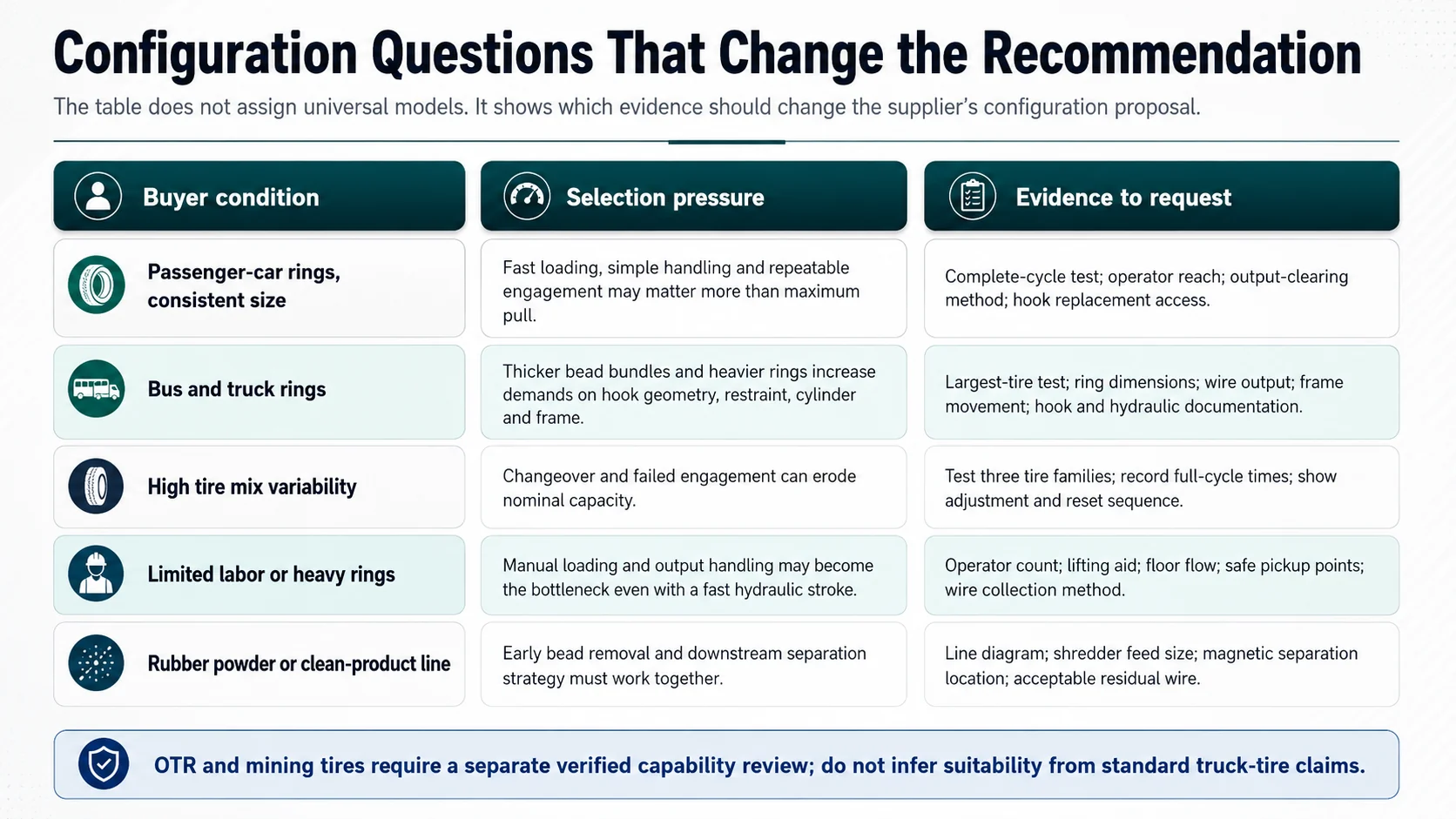
Fast repeatable loading, simple hook engagement, low handling burden and accessible service points.
Test the typical and maximum passenger ring; compare full-cycle labor rather than maximum hydraulic force.
Truck-heavy feed
Largest-ring access, hook strength, restraint, cylinder and frame response, output handling and upstream preparation.
Require the largest normal truck tire test and document whether both sidewalls must be removed.
Mixed passenger and truck operation
Changeover, adjustment, failed engagement, operator handling and weighted shift output.
Test at least three representative tire families and calculate output from the expected mix.
Complete rubber-powder line
Line balance, residual steel strategy, buffer space, magnetic separation and clean material transfer.
Approve a complete process flow and clarify which steel is removed at each stage.
High labor cost or limited operators
Loading aids, two-side handling sequence, wire release, control position and maintenance access.
Compare operator minutes per completed ring, not machine stroke time alone.
11. Common Tire Debeader Buying Mistakes
Choosing from price first
A lower quote may exclude the configuration, guarding, voltage, spare parts or handling arrangement needed for the actual tire.
Sending one tire diameter
A maximum diameter does not describe width, weight, bead construction, feed preparation or the percentage of heavy tires.
Comparing motor power only
Motor rating does not show cylinder sizing, hook geometry, restraint, frame alignment, hydraulic losses or full-cycle performance.
Assuming double hook doubles output
Loading, engagement, release and sorting may remain the bottleneck. Verify the complete sequence.
Accepting a cropped working video
A close-up of the hook can hide ring movement, operator intervention, output handling and reset time.
Ignoring downstream balance
An oversized debeader can create unsafe piles and idle time if cutting or shredding cannot accept the prepared material.
Confusing truck and OTR capability
A standard truck claim is not evidence for mining or giant tires. Treat OTR as a separate engineered project.
Leaving maintenance until after purchase
Hook replacement, filter access, hose routing, seals, manuals and local spare-parts supply affect long-term availability.
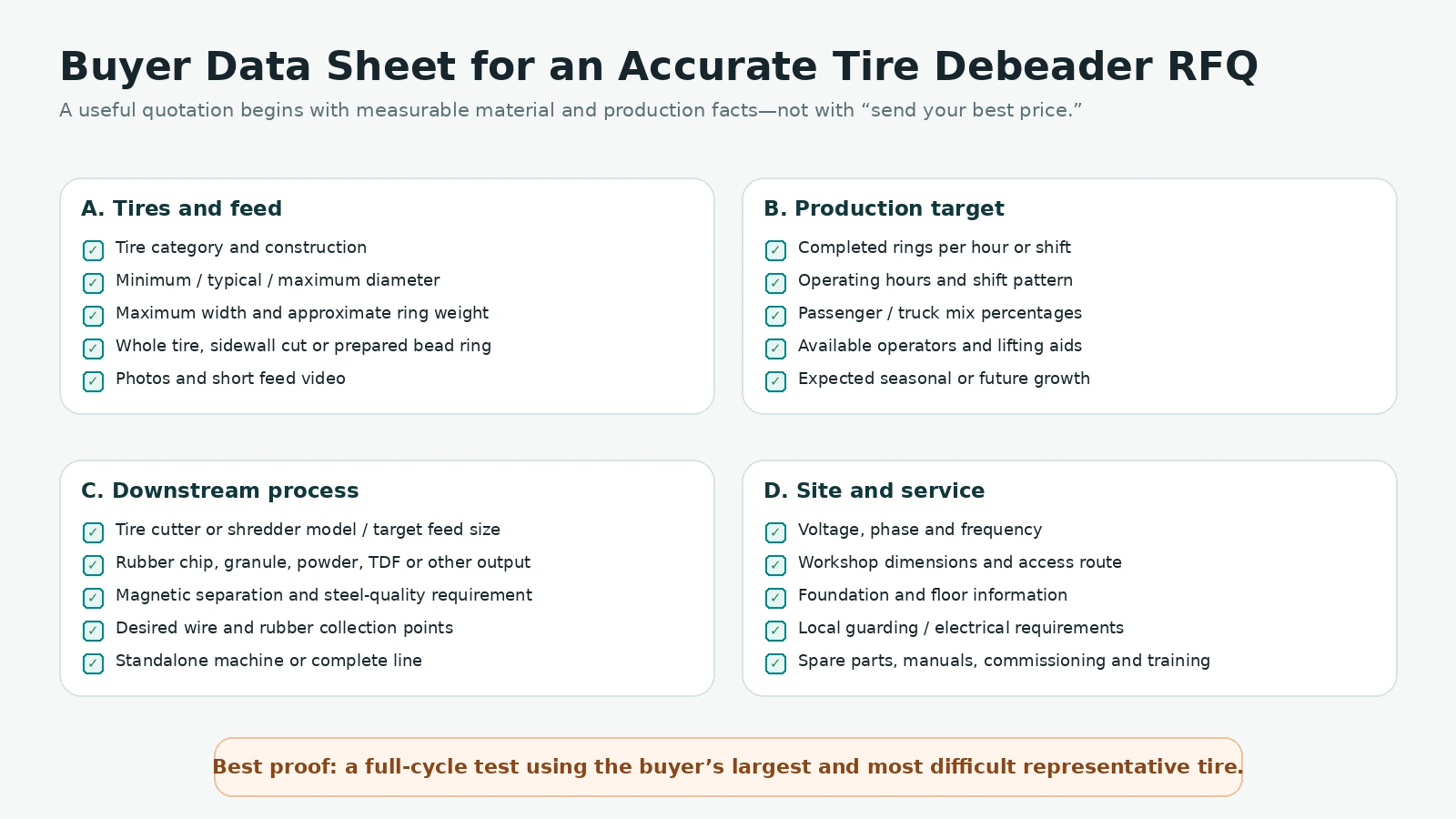
12. Information to Send With the RFQ
Complete material and site information allows YUXI to recommend a configuration rather than quote a generic machine.
RFQ field
Information to provide
Tire type
Passenger, bus, truck or controlled mix; identify radial and unusual tire categories.
Dimensions
Minimum, typical and maximum diameter; maximum width; approximate prepared-ring weight.
Feed condition
Whole tire, one sidewall removed, both sidewalls removed or prepared bead ring, supported by photos and video.
Production target
Completed rings per hour or shift, shift duration and expected tire-mix percentages.
Labor and handling
Available operators, lifting aids, preferred loading height and wire/rubber collection method.
Downstream process
Tire cutter, shredder, granulator, powder line or other system, including target feed size and output.
Utilities
Voltage, phase, frequency and relevant local electrical requirements.
Workshop
Available area, access-door dimensions, floor or foundation information and transfer route.
Service scope
Required spare parts, manuals, drawings, commissioning, training and remote support.
Ask for a Configuration, Not a Generic Price
Send YUXI tire photos, maximum diameter, prepared feed condition, completed rings per hour or shift, downstream equipment, local voltage and workshop dimensions. Request a complete-cycle test using the hardest representative tire before final approval.
What information is most important when choosing a tire debeader?
Start with tire category, actual prepared feed condition, minimum and maximum dimensions, target completed rings per hour or shift, operator availability, downstream equipment and local electrical supply. A machine recommendation made without these facts is provisional.
Should I choose a single-hook or double-hook tire debeader?
Neither arrangement is universally better. The decision depends on whether both bead areas can be handled in one setup, how much repositioning is required, tire variability, ring weight, labor and full-cycle output. Ask for a complete-cycle demonstration using representative tires.
Can one standard tire debeader process car, truck and OTR tires?
Do not assume so. Passenger, bus and truck tire rings differ in dimensions, bead construction and handling load. OTR and mining tires should be treated as a separate verified capability requiring model-specific evidence.
How should I compare tire debeader capacity?
Compare sustainable completed rings per hour or shift, not only hydraulic pulling time. Include loading, positioning, engagement, extraction, wire release, rubber handling, reset, normal inspection and material changes.
Is higher hydraulic pressure always better?
No. Useful extraction depends on the complete system: cylinder size and stroke, hook geometry, ring restraint, frame alignment, valves, flow, pressure limits and the actual tire. A higher number does not correct poor engagement or an unsuitable feed condition.
What should a supplier show before I order?
Request a full-cycle test with the largest and most difficult representative tire, close views of hook engagement, both separated outputs, cycle timing, machine movement, safety controls, technical documentation, spare-parts information and a layout showing loading and discharge access.
What YUXI information must still be confirmed for a quotation?
YUXI states that exact model, motor power and capacity depend on tire diameter, bead structure and project layout. The buyer should submit tire photos, dimensions, feed preparation, output target, downstream process, site voltage and workshop information.
References and Source Notes
U.S. Tire Manufacturers Association, “Tires 101,” steel in tire belts, beads and truck-tire plies. Source
U.S. Tire Manufacturers Association, “How a Tire Is Made,” steel strands formed into two bead hoops. Source
Parker Hannifin, Hydraulic Cylinder Specification resources, cylinder function and interacting specification factors. Source
EPA/USTMA, “Scrap Tires: Handbook on Recycling Applications and Management for the U.S. and Mexico,” bead-wire removal and ground-rubber processing. Source
U.S. OSHA, 29 CFR 1910.212, General Requirements for All Machines. Source
U.S. OSHA, 29 CFR 1910.147, Control of Hazardous Energy. Source
Marie has 8+ years of experience in tire shredding and recycling equipment,with a focus on tire shredders,rubber recycling machines,TDF production,rubber crumb processing,and complete tire recycling systems.