A second hook is valuable only when it removes a real handling or engagement bottleneck. This guide compares the complete cycle, labor, tire range, maintenance and line fit—not a cropped pulling stroke.
A supplier can make almost any tire debeader look fast by filming only the moment when the hook moves. The operator’s harder work happens before and after that moment: lifting a flexible ring, locating the bead, recovering from a missed engagement, releasing spring-like wire, turning the material and clearing the work zone.
That is why the useful comparison is not “one hook versus two hooks.” It is one complete accepted tire ring versus another complete accepted tire ring. The correct configuration is the one that handles the buyer’s prepared feed with fewer non-productive actions, stable engagement and a cycle that matches the next machine.
Choose a single-hook tire debeader when one-side-at-a-time processing is acceptable, the project is intermittent or modest in volume, tire handling is manageable, or the application needs one specially reinforced pulling point. Choose a double-hook tire debeader when both bead areas can be accessed in one setup and the second hook demonstrably reduces turning, reloading or operator movement on representative tires.
Do not assume a double-hook machine will deliver twice the sustainable output. Confirm whether the hooks pull simultaneously or sequentially, how the ring is restrained, what happens when one side fails to engage, and how two extracted wire bundles are released. Time the cycle from incoming-ring handling until the work zone is ready for the next ring.
1. What “Single Hook” and “Double Hook” Actually Mean
A hook-type tire debeader uses hydraulic movement to engage and extract the concentrated steel bundle near the tire bead. The bead is not a loose wire placed inside a rubber ring. The U.S. Tire Manufacturers Association describes the manufacturing step as steel strands being formed into two hoops and embedded into the tire structure to create the beads.1 That embedded construction is why feed preparation, hook access and restraint matter.
Single hook normally describes a machine with one active pulling hook. In the common market configuration, one bead area is processed per engagement, so removing both sides may require the ring to be turned, rolled, reoriented or reloaded. However, “single” does not automatically mean light duty. Some oversized or OTR applications use one much larger reinforced hook because the engineering priority is force, access and frame strength rather than two-side speed.
Double hook describes a machine with two pulling points arranged to access both bead areas in one setup. Some designs pull both sides together; others use a controlled sequence. The name alone does not tell the buyer which sequence is supplied, whether both hooks share one control action, or how the machine responds if only one hook engages correctly. The final quotation and full working test must settle the actual hook sequence for the supplied machine.
Do not confuse a tire debeader with a complete steel-removal system. A hook-type machine targets the bead bundle. Steel belts and other reinforcement can remain in the rubber-rich tire body and require shredding, liberation and magnetic separation later in the process.
2. How the Complete Working Cycles Differ
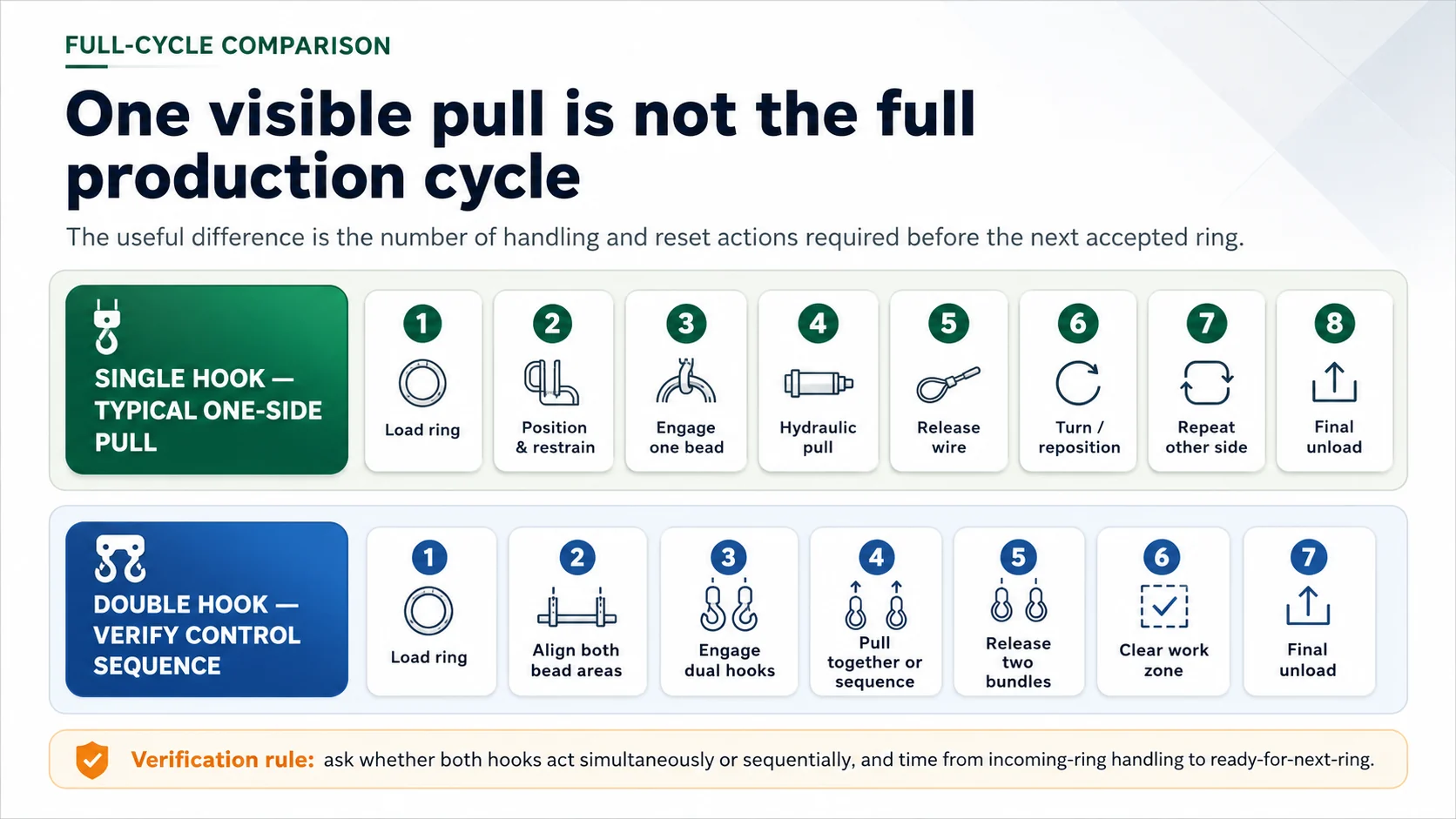
The visible extraction stroke is only one component of the cycle. For a fair comparison, start the timer when the operator begins handling an incoming prepared ring and stop it when both outputs have been cleared and the machine is ready to accept the next ring.
A useful cycle comparison includes positioning, hook engagement, wire release and reset—not only hydraulic pulling time.
Typical single-hook cycle
The operator loads and restrains the prepared ring, aligns one bead area with the hook, completes the pull, releases the wire bundle and clears that side. When the project requires both bead bundles to be removed, the ring is repositioned and the engagement-pull-release sequence is repeated. The second-side action may be simple for light, consistent rings and much more demanding for heavy truck material.
Typical double-hook cycle
The operator loads one ring and aligns both bead areas with the two pulling points. The hooks then act together or in a supplier-defined sequence. After extraction, two wire bundles must be released and placed away from the loading path before the rubber-rich ring is removed. The second hook can eliminate an intermediate turn, but it can also require more careful initial alignment and output clearing.
The cycle difference that matters
A double-hook machine creates value when the time and effort removed from repositioning exceed any extra time required to align two hooks and handle two outputs. That balance changes with ring diameter, weight, bead exposure, operator skill, lifting aids and material-flow direction. It cannot be proved by counting hooks in a product photo.
3. Single Hook vs Double Hook: Side-by-Side Comparison
Decision factor
Single-hook tire debeader
Double-hook tire debeader
What the buyer should verify
Active pulling points
One hook and one bead-area engagement at a time.
Two hooks arranged for access to both bead areas.
Actual hook movement, control sequence and quoted configuration.
Ring repositioning
May require turning or reloading for the second side.
Can reduce or remove the intermediate turn when both sides are accessible.
Full-cycle video on the same prepared feed.
Initial alignment
One engagement point may be easier to locate on variable rings.
Both bead areas must align with the supplied geometry and restraint.
Success on distorted, heavy or unevenly prepared rings.
Operator handling
More manual movement when two sides are required.
Potentially less turning, walking and rehandling.
Operator-minutes per completed accepted ring.
Output clearing
One wire bundle is released per pull.
Two bundles may enter the work zone in one cycle or sequence.
Safe discharge direction and collection method.
Throughput
Can suit intermittent or lower-volume work when handling is not restrictive.
Can improve sustainable output when repositioning is a real bottleneck.
Repeated complete cycles, not a single best pull.
Mechanical scope
May have fewer pulling components, depending on the design.
Has two hook engagement points and related alignment or service items.
Component list, access, spares and maintenance procedure.
Heavy special tires
One reinforced hook can be appropriate for a dedicated heavy-duty design.
Two standard hooks are not evidence of OTR suitability.
Model-specific dimensions, force path, handling plan and test tire.
Purchase decision
Do not select only because the machine appears simpler or cheaper.
Do not select only because two hooks appear faster.
Total quoted scope and measured operating result.
4. Loading, Repositioning and Operator Labor
Hook count affects labor mainly through the number of times a ring must be touched. For passenger-car bead rings, the turning step may be manageable. For bus and truck material, a seemingly small additional action can involve lifting, rolling, regripping and controlling a ring that does not behave like a rigid metal part.
A good labor comparison records the number of operators, their walking path, the lifting or positioning aids used, and every manual intervention. It should also note whether the operator must reach near the line of pull or extracted wire. OSHA’s general machine-guarding rule requires methods that protect employees from point-of-operation and moving-part hazards, while the lockout/tagout standard addresses unexpected start-up and stored-energy release during servicing and maintenance.45
Labor question for single hook
Can the second-side turn be completed at the required pace without excessive lifting, unstable rolling, cross-traffic or fatigue? If the ring is already prepared and light, the answer may be yes.
Labor question for double hook
Does one setup genuinely remove the turn, and can the operator align both bead areas and clear two wire bundles from the approved position? If not, the second hook may move the bottleneck rather than remove it.
Do not compare labor from supplier videos unless the same tasks are visible. A close-up can hide a second worker, pre-positioned tires, off-camera wire clearing or a pause between cycles. Ask for a continuous shot that includes the incoming stack, machine, operator area and both discharge points.
5. Pulling Speed vs Full-Cycle Capacity
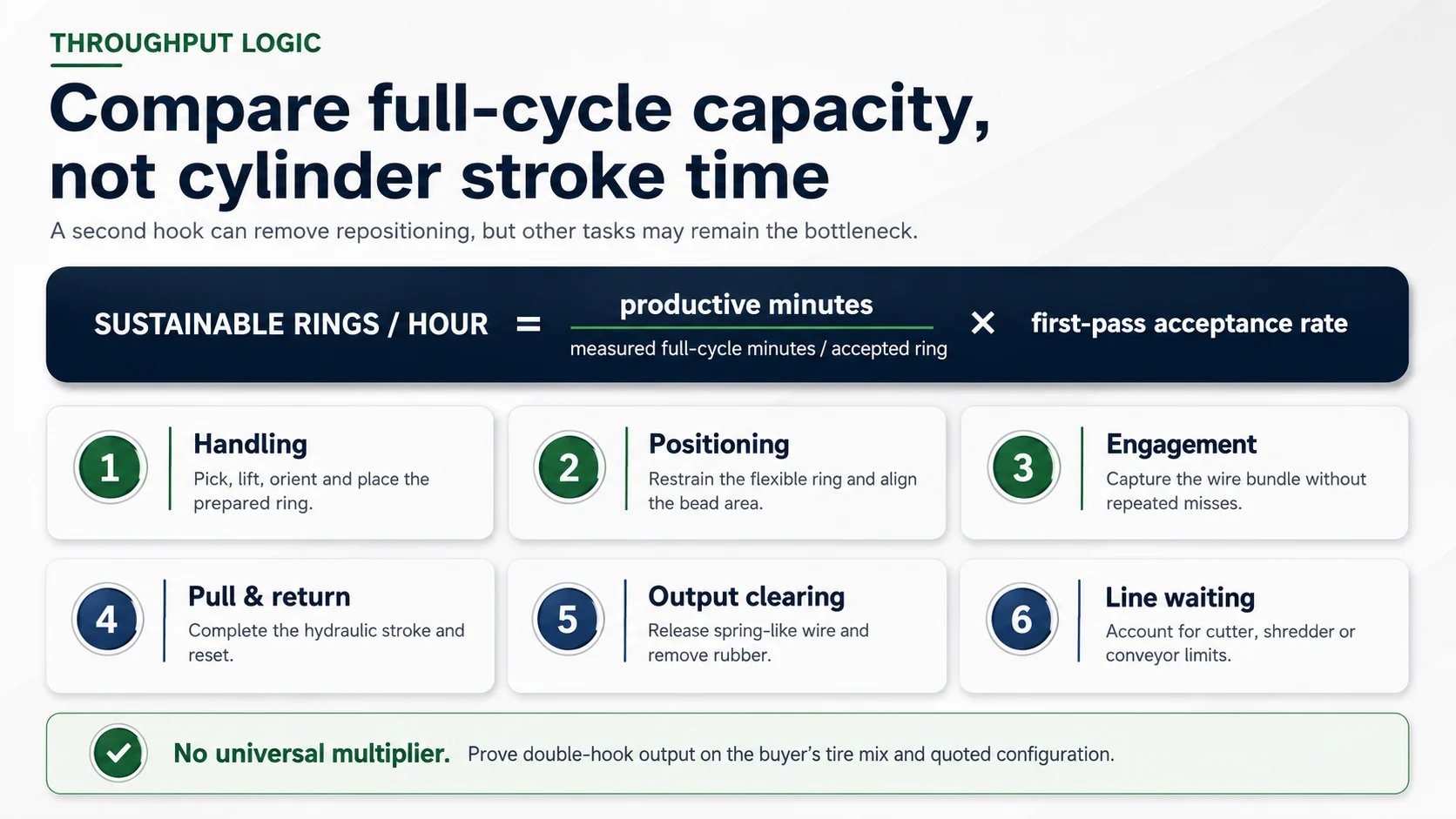
Capacity should be expressed as completed acceptable rings per hour or shift. “Pulls per minute” is not enough because one ring can require multiple pulls, a re-engagement attempt or a second-side action. Nor does the shortest observed cycle describe sustainable output across a normal tire mix.
Sustainable output depends on productive time, measured complete-cycle time and first-pass acceptance—not hook count alone.
Practical calculation: sustainable rings per hour = productive minutes per hour ÷ measured full-cycle minutes per accepted ring × first-pass acceptance rate. For a mixed stream, calculate a weighted cycle from the expected percentage of each tire family.
The first-pass acceptance term matters. A fast pull followed by frequent missed engagement, partial extraction or manual correction can produce a worse shift result than a slightly slower but repeatable cycle. Record unsuccessful attempts and output condition instead of deleting them from the test.
Line balance also matters. A faster debeader is not useful when the tire cutter, shredder or material-handling route repeatedly stops it. The best configuration can be the one that produces a stable, manageable buffer rather than the largest isolated machine number.
6. Tire Type and Bead Structure Change the Decision
A hook comparison is meaningful only after the feed has been defined. The YUXI tire wire drawing machine page describes prepared radial tire bead rings, especially rings with both sidewalls removed, and lists passenger-car, bus and truck material as possible applications depending on size and configuration. It does not state that every whole tire or every oversized tire can enter one standard machine.
Passenger-car tire rings
These rings can be smaller and easier to handle, so a single-hook second-side operation may not dominate the cycle. The important questions are fast repeatable positioning, hook access and whether the upstream cutting method produces a consistent bead opening.
Bus and truck tire rings
Larger rings increase handling effort and may contain stronger bead structures. Here, avoiding an intermediate turn can be valuable, but dual engagement and restraint become more demanding. Test the largest normal truck ring, not only a convenient sample selected by the supplier.
Mixed tire streams
A machine that performs well on one category may lose time during size changes or on distorted rings. Build a weighted test set that reflects the expected percentage of passenger, bus and truck material. Measure each category separately before combining the results.
OTR and mining tires
Keep OTR as a separate engineered class. One reinforced hook may be the correct architecture for an oversized, extremely heavy bead, while a standard double-hook machine may be unsuitable. Require model-specific maximum dimensions, workpiece handling, hook design, frame and hydraulic evidence. Never use the passenger/truck hook comparison as proof of mining-tire capability.
7. Hook Engagement, Hydraulic Pulling and Structural Load
The hook is only one link in the load path. Hydraulic movement acts through the cylinder and hook into the bead bundle; the tire restraint and frame react that load. A machine with two hooks introduces two engagement locations and potentially two load paths that must remain aligned with the flexible workpiece.
For a single-hook machine, the buyer should examine how the ring is supported while the pull occurs and whether the one hook enters the bead consistently. For a double-hook machine, the buyer should examine whether both hooks share load as intended, whether the ring twists when one side engages first, and how the control system handles unequal engagement.
System item
Single-hook focus
Double-hook focus
Evidence to request
Hook geometry
Access, capture and release on one bead area.
Matched access and release at two bead areas.
Close video, material statement and spare-hook information.
Workpiece restraint
Prevent the ring following or rotating with one pull.
Hold alignment while two pulling points act.
Full-frame video of the hardest representative ring.
Hydraulic sequence
Approach, extraction, return and release.
Simultaneous or sequential action and response to uneven engagement.
Control description and uninterrupted cycle footage.
Frame response
Reaction to a concentrated pulling load.
Reaction to dual or changing load distribution.
Machine movement, anchoring and installation guidance.
Output release
One bundle after each pull.
Two bundles without entangling the next loading action.
Approved collection layout and operator position.
Do not ask only for hydraulic pressure or motor power. Without cylinder area, stroke, hook geometry, losses, restraint, frame condition and actual tire evidence, one number cannot predict extraction success. Exact YUXI model, power and capacity should remain quotation-confirmation fields until a current project-specific datasheet is supplied.
8. Maintenance and Wear Points
A single-hook layout may have fewer engagement components, but that does not automatically make its lifetime cost lower. One hook can accumulate more cycles when each ring needs two side operations. A double-hook layout has more hook contact points and may require closer attention to matched alignment, pins, bushings, cylinders, hoses, seals and release mechanisms.
The useful maintenance comparison is based on component cycles, access and replacement work. Ask how many pulls each hook performs per completed ring, how the hooks are inspected, whether wear parts can be changed without disturbing alignment, and which components are included in the recommended spare package.
Inspect
Hook tip and body, attachment points, visible deformation, restraint surfaces, hose condition, leakage and unusual movement.
Record
Tire family, pulls per ring, failed engagement, cycle count, extraction quality and the side or hook where variation begins.
Isolate before service
Follow the machine manual and site energy-control procedure before clearing, adjustment, hook replacement or work near stored hydraulic energy.
Maintenance intervals, oil specifications, fastener torques and pressure settings must come from the delivered manual and approved project data. They should not be copied from another supplier’s model or inferred from a public photograph.
9. Floor Space and Tire-Recycling Line Integration
The floor-plan difference is larger than the machine footprint. A single-hook cell may need a turning or staging area beside the machine. A double-hook cell may need a wider alignment path and two safe wire-discharge zones. Both require clear access to controls, guards, the hydraulic unit and maintenance points.
YUXI positions the debeading step before tire cutting, shredding, rubber crushing, rubber-powder production or pyrolysis preparation. The next machine determines what “complete” debeading means for the project. EPA material-market information notes that some scrap-tire products are made after removal of the steel bead, while mechanical recycling more broadly recovers rubber, steel and textiles as material streams.67
When the prepared rubber ring will enter a tire cutting machine, check the transfer height, buffer and ring shape. When it will enter a tire shredder, confirm that the remaining tire body fits the feed opening and that the shredder’s rate can absorb the debeader output. The hook decision should support this flow rather than create a pile between machines.
10. When a Single-Hook Tire Debeader Makes Sense
A single-hook configuration can be a reasonable choice under the following project conditions:
Production is intermittent, seasonal or modest enough that the second-side turn is not the limiting task.
Prepared rings are relatively light and consistent, and the operator can reposition them using an approved handling method.
The process intentionally removes only one bead area at that stage.
Space or material flow favors a simple one-side station and the turning zone has been safely planned.
The project requires one specially reinforced pulling hook for a verified heavy-duty or OTR application.
The buyer values simpler access but has confirmed full-cycle labor and spare-parts scope rather than assuming lower total cost.
Single hook is not the “entry-level” answer in every case. A purpose-built heavy single-hook machine can be more specialized and more demanding than a standard double-hook unit. Compare architecture within the correct tire class.
11. When a Double-Hook Tire Debeader Makes Sense
A double-hook configuration is easier to justify when:
Both bead areas are exposed and repeatably accessible in one prepared-ring setup.
Turning or reloading heavy rings is a measured labor, fatigue or safety bottleneck.
The line needs more completed rings per shift and representative tests show that dual engagement improves the full cycle.
The tire mix is controlled enough that both hooks can align without frequent manual correction.
The output layout can safely release and collect two wire bundles without blocking the next load.
The cutter or shredder has enough capacity to accept the resulting material flow.
The value is not “two hooks.” It is the removed operation between the first and second bead areas. When that removed operation is small, inconsistent or replaced by a longer dual-alignment step, the business case becomes weaker.
12. Where the YUXI Double-Hook Tire Debeader Fits
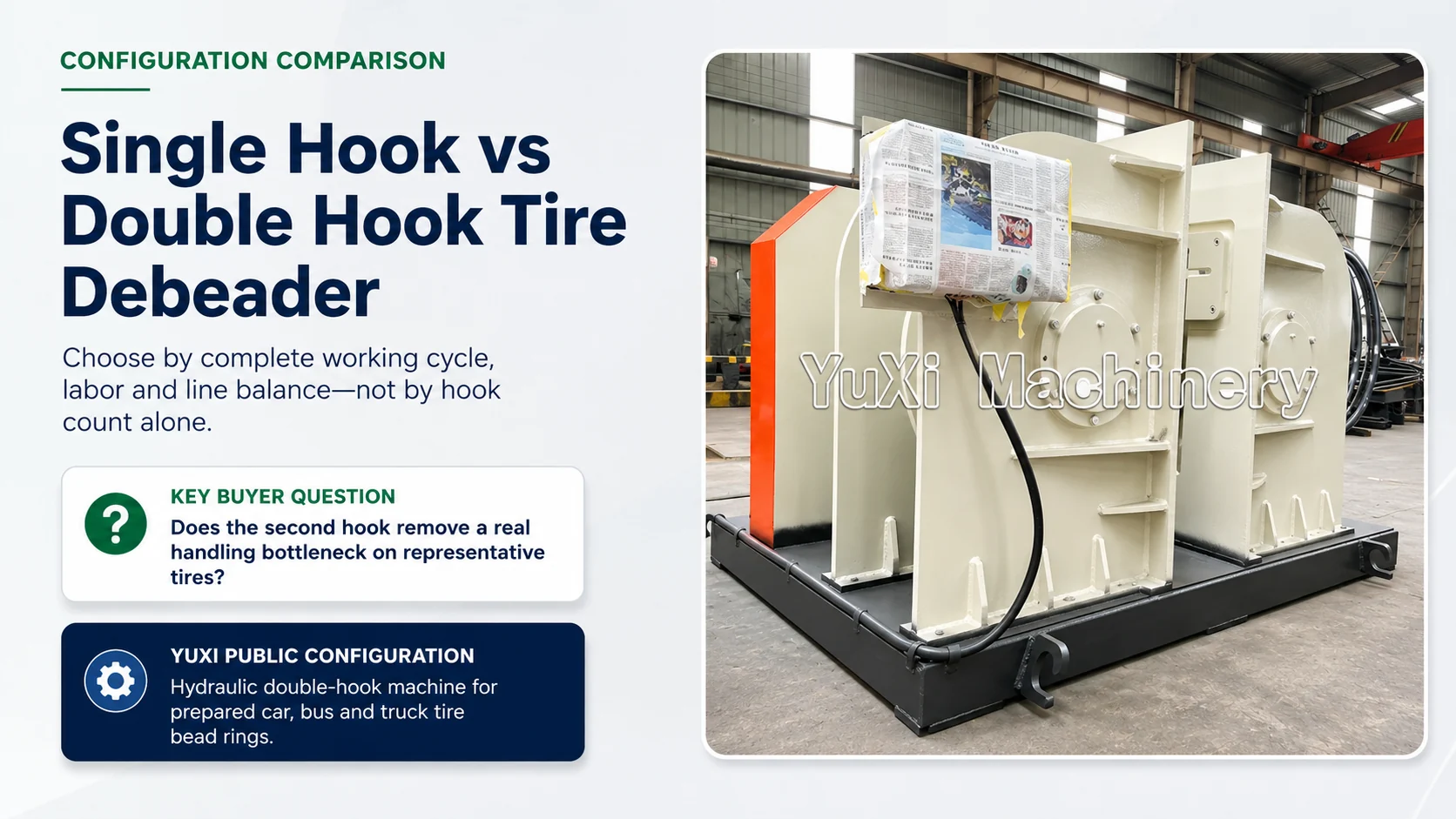
YUXI publicly presents its current tire wire drawing machine as a hydraulic double-hook tire debeader. The product page states that it uses a hydraulic pulling system and high-strength hooks for prepared bead rings from waste passenger-car, bus and truck tires, depending on tire size and configuration. It also describes manual loading with automatic hydraulic pulling.
That public information supports a clear article position: YUXI’s shown configuration is intended for projects where dual-hook extraction can prepare cleaner tire material before cutting, shredding, rubber-powder production or pyrolysis pretreatment. It does not support publishing a universal capacity, motor power, pulling force, tire range or claim that both hooks always act simultaneously.
Project confirmation fields: exact prepared feed, minimum and maximum ring dimensions, tire-mix percentages, hook sequence, pulling stroke, hydraulic configuration, motor and electrical supply, completed rings per hour or shift, guarding, loading method and downstream layout.
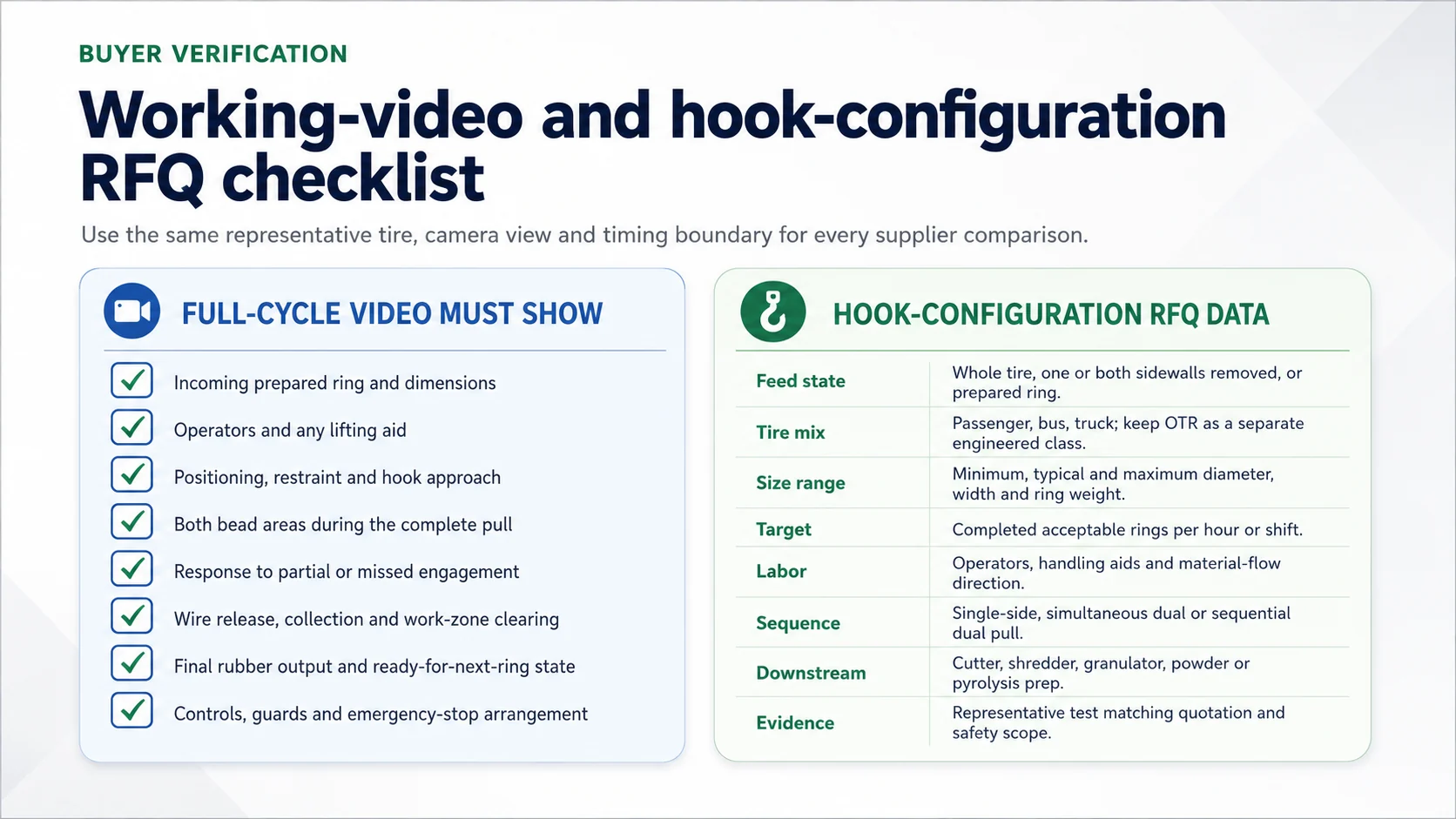
The test should challenge the recommendation, not create the shortest sales clip. Send the supplier the largest difficult normal ring and at least one common ring from the daily mix. Define the feed preparation and timing boundary before the test starts.
Use one evidence standard for single-hook and double-hook quotations so hidden handling work does not distort the comparison.
Show the complete incoming prepared ring, with its tire category and dimensions recorded.
Keep the operator, workpiece, hook zone and wire-discharge area in the frame.
Show loading, restraint, hook engagement, extraction, release, unloading and reset without editing.
For double hook, show whether the hooks act together or sequentially.
Show what happens when only one hook engages or one bead is more difficult.
Record the number of operators and every handling aid used.
Time at least several consecutive cycles and include failed engagement or correction.
Inspect the extracted bead bundles and remaining rubber ring after the test.
Match the test machine’s controls, guards, hooks and accessories to the formal quotation.
14. RFQ Data Needed for the Hook Configuration
This is a focused configuration RFQ, not a substitute for the full project inquiry. It should give YUXI enough information to decide whether the second hook solves a real production problem.
RFQ field
Information to provide
Why it changes the hook decision
Prepared feed
Whole tire, one sidewall removed, both sidewalls removed or separate bead ring; include photos and video.
Determines hook access, ring stability and whether two bead areas can be reached in one setup.
Tire categories
Passenger, bus, truck and any unusual construction; keep OTR separate.
Changes bead strength, dimensions, weight, handling and suitable architecture.
Size distribution
Minimum, typical and maximum diameter and width; approximate prepared-ring weight.
Shows whether the same alignment and loading method work across the range.
Tire-mix percentages
Expected share of each category in a normal shift.
Allows weighted cycle testing instead of selecting from one best tire.
Production target
Completed acceptable rings per hour or shift and productive minutes.
Reveals whether repositioning is actually the bottleneck.
Labor and handling
Available operators, lifting aids, preferred loading height and material-flow direction.
Quantifies the practical value of avoiding a second-side turn.
Required hook sequence
Ask YUXI to state single-side, simultaneous dual or sequential dual action.
Prevents a configuration name from replacing a technical description.
Downstream machine
Cutter, shredder, granulator, powder line or pyrolysis preparation.
Sets the required ring condition, buffer and maximum useful debeader rate.
Safety and service scope
Guarding, controls, isolation points, manuals, spares and hook-replacement access.
Changes delivered scope and long-term operability.
Request a Complete-Cycle Configuration Test
Send YUXI the prepared-feed video, tire range, tire-mix percentages, target completed rings per shift, operator plan and downstream process. Ask the engineering team to confirm the hook sequence and test the hardest representative ring in one uninterrupted cycle.
The second hook may remove a turning step, but it does not remove loading, initial alignment, hydraulic return, wire release or unloading. Measure the complete cycle.
Comparing supplier capacity tables as if the feed were identical
Public listings can refer to whole tires, prepared sidewalls, bead rings, passenger tires, truck tires or OTR material under the same “debeader” name. Treat unnormalized numbers as market examples, not engineering proof.
Ignoring failed engagement
A dual-hook cycle can look efficient when both sides engage. The test must also reveal how the machine and operator recover when one side does not capture the bundle correctly.
Selecting single hook only for lower purchase price
A simpler configuration may still carry higher labor or handling cost when every ring needs a second setup. Compare delivered scope and operator-minutes.
Selecting double hook without planning wire discharge
Two extracted bundles can obstruct the loading zone or create extra manual clearing. The layout must show where both outputs go.
Using truck-tire evidence to claim OTR capability
Oversized mining and earthmover tires require separate model-specific proof. Hook count is not a substitute for dimensions, force path, frame, handling and test evidence.
Frequently Asked Questions
Is a double-hook tire debeader always twice as fast as a single-hook machine?
No. A double-hook arrangement may remove a second positioning step, but full-cycle output also depends on loading, alignment, successful hook engagement, hydraulic stroke, wire release, unloading, operator movement and downstream waiting. Compare timed complete cycles on representative tires.
What is the main advantage of a single-hook tire debeader?
A single-hook layout can be mechanically simpler and may suit intermittent production, controlled one-side processing or special heavy-duty applications where one reinforced hook is more appropriate than two standard hooks. The quoted design and tire test matter more than hook count alone.
What is the main advantage of a double-hook tire debeader?
A properly matched double-hook configuration can reduce tire turning or reloading when both bead areas are accessible in one setup. This may lower operator handling and improve full-cycle consistency, but the control sequence and output handling must be verified.
Can one double-hook machine process passenger, bus and truck tire rings?
YUXI publicly lists prepared passenger-car, bus and truck tire bead rings as possible applications depending on tire size and machine configuration. Buyers should still submit the full tire range and require a test on the largest and most difficult normal ring.
Does a tire debeader remove all steel from a tire?
No. A hook-type tire debeader removes the concentrated bead-wire bundle. Steel belts and other reinforcement can remain in the rubber-rich tire body and require downstream shredding, liberation and magnetic separation.
What should I send YUXI before choosing the hook configuration?
Send photos and video of the prepared feed, minimum and maximum dimensions, tire-mix percentages, expected completed rings per hour or shift, operator and handling plan, downstream equipment, site power and a request for a complete-cycle test using representative tires.
References and Source Notes
U.S. Tire Manufacturers Association, “How a Tire Is Made,” steel strands formed into tire bead hoops. Source
U.S. OSHA, 29 CFR 1910.212, General Requirements for All Machines. Source
U.S. OSHA, 29 CFR 1910.147, Control of Hazardous Energy. Source
U.S. EPA archived Scrap Tire Markets and Uses page, including rubber-product routes after steel-bead removal. Source
European Recycling Industries’ Confederation, Mechanical Tyre Recycling fact sheet, describing rubber, steel and textile recovery. Source
Marie has 8+ years of experience in tire shredding and recycling equipment,with a focus on tire shredders,rubber recycling machines,TDF production,rubber crumb processing,and complete tire recycling systems.