




For whole waste tires, a dual-shaft shredder is usually the simpler primary size-reduction architecture: two low-speed, high-torque shafts grip irregular tires and make coarse cuts. A four-shaft shredder adds cutting interactions and commonly uses a sizing screen to keep material in the chamber until it is small enough to pass. That does not make four shafts automatically better. If the project needs robust whole-tire intake and a separate screen-return loop can control oversize, a dual-shaft system can be the more direct process. If the project needs repeated cutting and tighter discharge control inside one shredder stage, a four-shaft configuration may fit better. Compare accepted output, tire mix, screen rule, reversals, maintenance access and downstream requirements under the same test conditions.
When buyers compare tire shredders, shaft count is often the first difference they notice. It is not the specification that should decide the purchase. Start with the job: reliable whole-tire intake, a defined feed for the next machine, or repeated cutting to an accepted size.
Waste tires are awkward feed. The casing flexes, the tread is thick, steel belts resist the cut, and the bead area can produce a short, severe load peak. A machine that looks comfortable on passenger tires may behave very differently when several truck tires arrive together. Cutter engagement, chamber geometry and oversize handling usually tell more about real production than shaft count.
This guide compares dual-shaft and four-shaft shredders specifically for waste tires. It does not repeat the broader question of whether a tire should be pre-cut before shredding, and it does not repeat the detailed screen-and-recirculation discussion from the dedicated size-control guide. The purpose here is narrower: decide which architecture better matches the feed tire, accepted product and downstream stage.
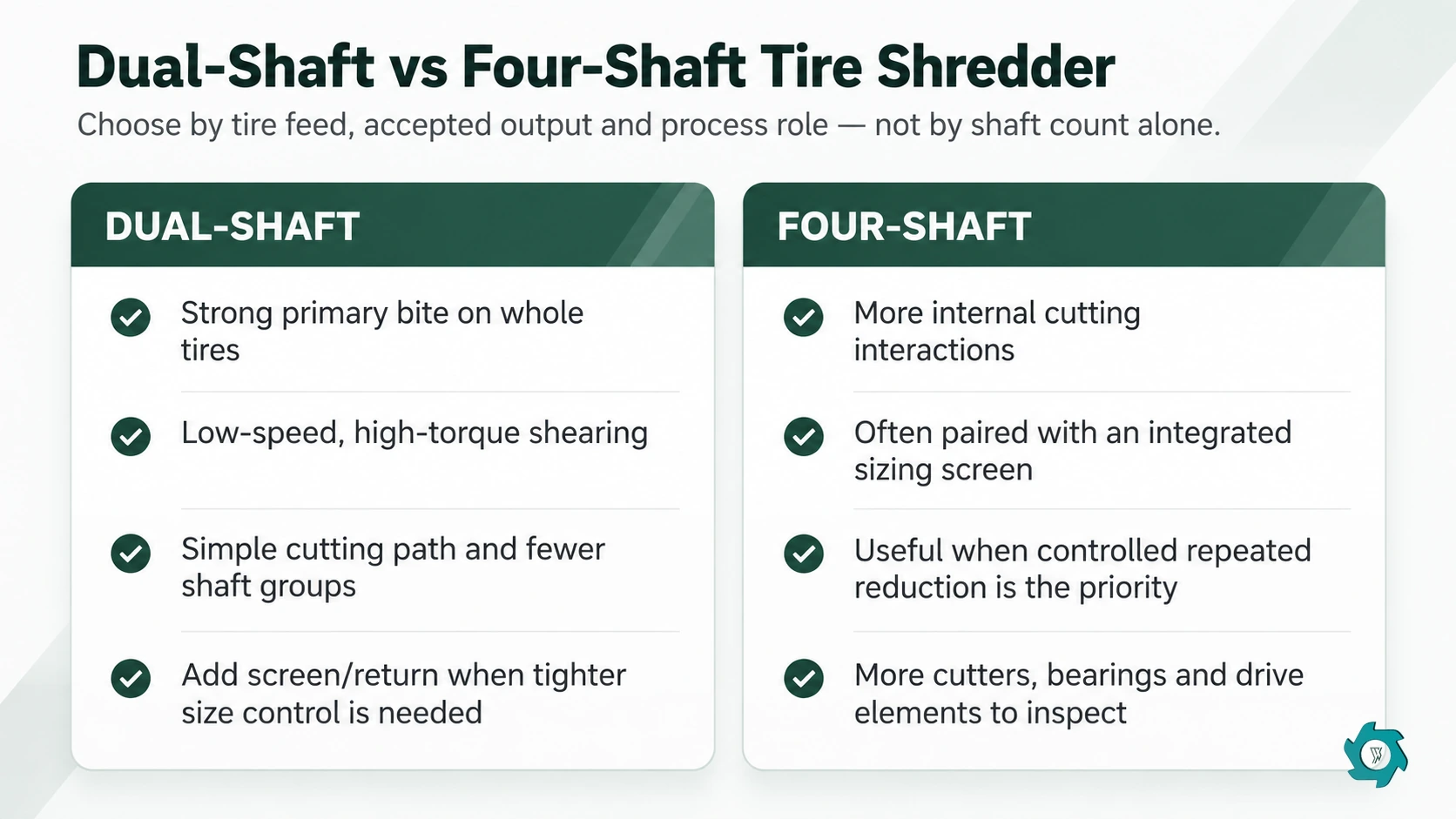
Quick Comparison: Dual-Shaft vs Four-Shaft for Waste Tires
| Decision point | Dual-shaft tire shredder | Four-shaft tire shredder |
|---|---|---|
| Typical process role | Primary whole-tire or prepared-tire size reduction. | Controlled repeated reduction where an internal screen is part of the sizing strategy. |
| Material movement | Two counter-rotating cutter shafts grip, pull and shear. | Four cutter shafts create more cutting and recirculating interactions before discharge. |
| Output control | Coarse output can be acceptable directly; tighter control is often achieved with an external screen and return conveyor. | Frequently uses an integrated screen so oversize remains in the cutting zone until it can pass. |
| Whole-tire intake | Well suited when chamber, cutter hooks and torque are designed for the largest tire in the feed. | Possible, but feed opening and internal geometry still have to match the whole tire. Four shafts do not compensate for an undersized chamber. |
| Complexity | Fewer shaft groups and generally a simpler cutting chamber. | More cutters, bearings, seals and internal service points. |
| Best comparison KPI | Accepted tons per hour at the same tire mix and accepted-size rule, plus kWh/t, reversal frequency, oversize ratio and maintenance observations. | |
Start With the Required Product
Define the discharge first. A collection yard may be satisfied with rough shreds for transport. A TDF buyer may have a chip-size window from the fuel user. A crumb line needs pieces that enter the next steel-liberation or granulation stage without bridging. These are different duties.
Those jobs place different value on the same machine features. For rough primary reduction, strong intake, torque reserve and tolerance for irregular whole tires can matter more than a narrow particle-size distribution. For a controlled product, the line must prevent oversize pieces from escaping, which makes the sizing and recirculation strategy more important.
The YUXI tire shredder machine uses a dual-shaft cutting chamber with a disc-screen return system. This is an important example because it shows why “dual shaft means uncontrolled output” is too simple. A dual-shaft cutting chamber can be combined with external classification and automatic oversize return, so cutting architecture and size-control architecture should be evaluated separately.
Four-shaft suppliers commonly use a screen below or around the cutting zone so pieces that cannot pass remain inside for additional cutting. UNTHA describes its RS150 four-shaft shredder for tires and other difficult materials with fraction size based on the screen, while other four-shaft designs similarly describe screen-controlled discharge.[1]
How a Dual-Shaft Shredder Behaves on Tires
A dual-shaft shredder uses two counter-rotating shafts carrying intermeshing cutter discs. Hook geometry catches the tire, draws it between the shafts and creates shear at the cutter edges. Low rotational speed and high available torque are useful because tire cutting is not a clean, constant load. The load rises sharply when thick tread, belt packages or folded bead areas enter the nip.
The main engineering advantage is a direct material path. There are fewer cutter shafts between the hopper and discharge, which keeps the primary task direct: catch the tire, create enough cutting force, clear the chamber after a difficult bite and move the reduced material to the next control stage.
This simplicity is valuable only if the cutters can reliably engage the feed. A large tire rotating on top of the cutter stack instead of being pulled in will destroy practical throughput even if the motor nameplate looks impressive. Chamber width, shaft center distance, hook profile, blade thickness, hopper geometry and feed control all affect first-bite behavior.
For mixed passenger and truck tires, operators should watch how the machine behaves when a stiff tire arrives immediately after several easy passenger tires. A good primary shredder should not depend on an operator repeatedly pushing material into the cutters. Automatic reverse can clear a temporary overload, but frequent reverse cycles are a production symptom, not free capacity.
Where Four Shafts Change the Process
A four-shaft shredder adds two more cutter shafts, creating more opportunities to pull, reorient and recut material inside the chamber. Many designs combine the four-shaft arrangement with a screen. Material smaller than the opening can leave; larger pieces continue circulating until additional cuts make them pass. UNTHA lists perforated-screen sizing on its four-shaft RS tire-shredding range.[2]
The useful difference is the extra opportunity to turn and recut a piece before it leaves. That matters when long strips or folded sections are unacceptable. With a suitable screen, those pieces remain in circulation instead of letting the first successful cut define the final product.
There is a trade-off. Additional cutter shafts increase cutter rows, bearing positions, sealing points and service locations. The maintenance question becomes more important: how long does inspection take, which cutter rows can be accessed without dismantling unrelated components, and how is wrapped wire removed from difficult locations?
A four-shaft machine can therefore be attractive when tighter repeated reduction is valuable, but it should not be purchased because “four is more than two.” A badly matched four-shaft chamber can still suffer poor feeding, excessive recutting, heat, wear or low net output.
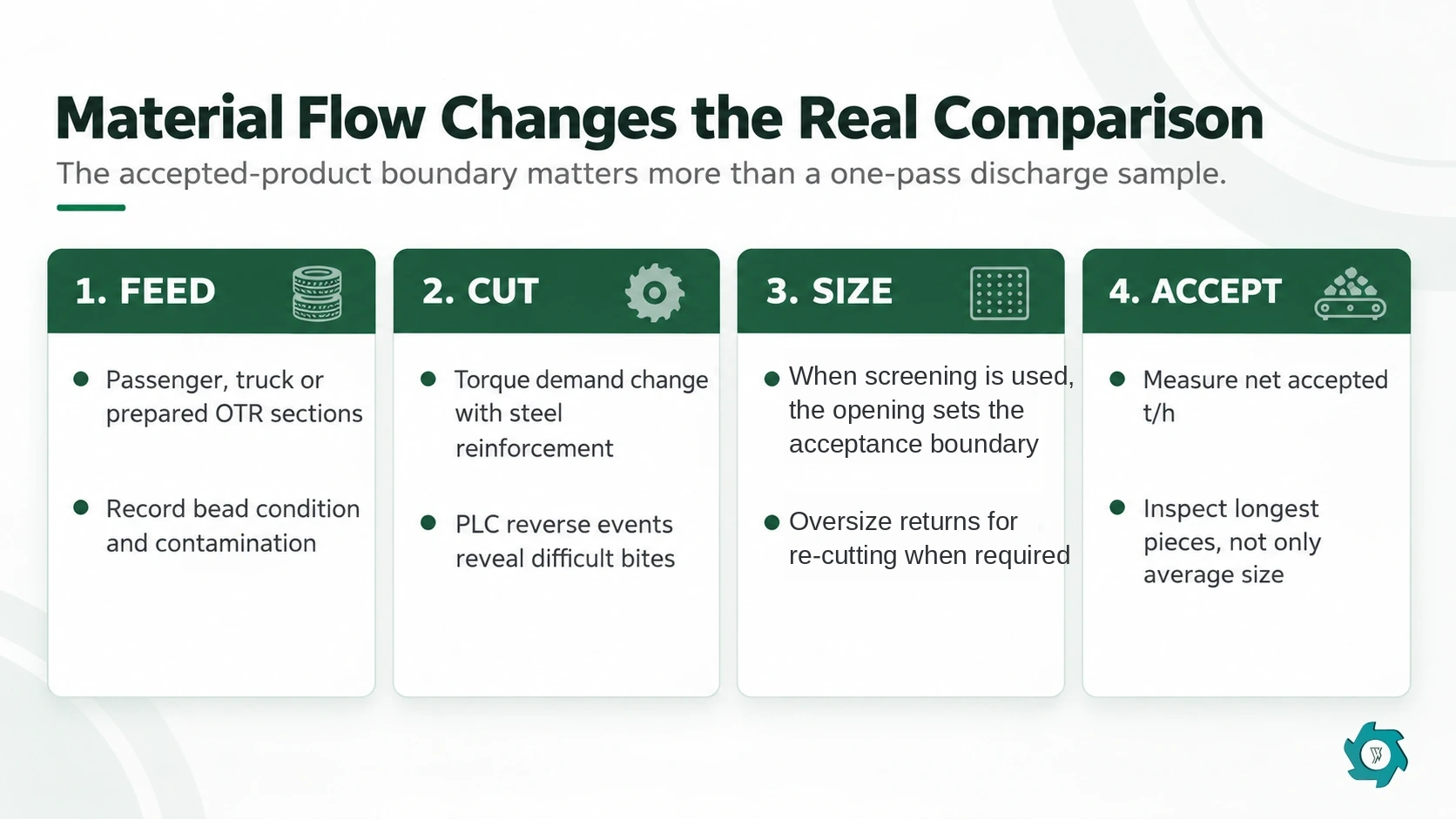
Compare Accepted Product, Not One-Pass Discharge
A pile of smaller chips is not enough to prove a better shredder. If one machine discharged after one pass and the other kept oversize behind a screen for several cuts, the two piles came from different process boundaries.
If the dual-shaft system is intended to discharge onto a disc screen and send oversize back, the accepted product should be sampled after that classification loop. The oversize is work in process, not final output. Conversely, if a four-shaft machine uses an internal screen, its gross cutting-chamber throughput should not be compared with another line’s net accepted discharge.
Use net accepted throughput:
Define the discharge rule before the test. For example, the rule may be “passes the agreed screen opening,” or it may include a maximum longest dimension and a limit on oversize count. Avoid vague phrases such as “about 50 mm” when flexible tire strips can pass a nominal opening in one orientation but remain much longer in another.
The separate screen and recirculation guide explains this sizing loop in detail. In this comparison, the important point is that the sizing method must be included in the machine architecture you are evaluating.
Torque and Reverse Cycles Tell More Than Motor kW
Installed motor power alone cannot tell a buyer whether two or four shafts will process a specific tire mix better. Tire shredders operate through changing load states: empty rotation, normal cutting, difficult steel-reinforced bites, overload response, reverse and restart. Reducer ratio, shaft speed, cutter diameter and control limits convert motor output into usable cutting behavior.
A dual-shaft primary shredder often emphasizes strong low-speed bite and torque. A four-shaft machine distributes cutting across more rotating elements, but its useful performance still depends on how those shafts are driven and controlled. A quotation that lists only total kW hides the important details.
During a test, note shaft speed, reducer arrangement and overload setting, then watch the HMI with representative tires. A few reversals around a heavy bead are normal protection behavior. Reversing every few seconds on ordinary feed means capacity is being lost even though the motors are running.
For energy, compare measured electrical energy with accepted output from the same test window. The dedicated tire shredder power consumption guide explains why installed kW and kWh per accepted ton are different. Do not assume that four shafts always use more energy or that two shafts always use less; the answer depends on recutting, feed utilization, accepted size and drive efficiency.
Truck Tires and Steel Reinforcement Raise the Load
Waste tires contain reinforcement that makes them fundamentally different from clean plastic or wood. Steel belts can expose sharp wire after cutting, and bead bundles create local high-resistance sections. Truck tires normally present a heavier cutting duty than passenger tires. OTR tires can exceed the practical intake envelope of a standard whole-tire shredder and may require pre-cutting or bead treatment.
For this reason, a supplier should know whether the test tires have their bead wire removed, whether the plant will process radial truck tires, and what share of the daily feed is the heaviest tire class. A test made only with easy passenger tires is weak evidence for a plant dominated by truck casings.
When the largest tires are beyond the shredder’s intake geometry, pretreatment is a process decision rather than a shaft-count decision. The pre-cutting guide covers when whole tires can go directly to shredding and when large or difficult tires should be reduced first.
Two Ways to Control Oversize
The most useful way to compare these systems is often not “two shafts versus four shafts,” but “external classification loop versus internal repeated cutting.”
Dual-shaft with external screen and return
The shredder performs the heavy primary cut. Discharge moves to a screen. Qualified material leaves the stage, while oversize travels back on a return conveyor. This separates the main functions physically. Operators can inspect the screen loading and return stream, and the line designer can change conveyor or classification arrangements without redesigning the cutting chamber.
Four-shaft with integrated screen
Material remains in the chamber until it can pass the selected screen. This can create a compact repeated-reduction stage and gives direct control over discharge. The screen, however, also becomes part of the load. A smaller opening can increase residence time and recutting, which may reduce net capacity and increase heat or wear.
Maintenance Access Can Change the Economics
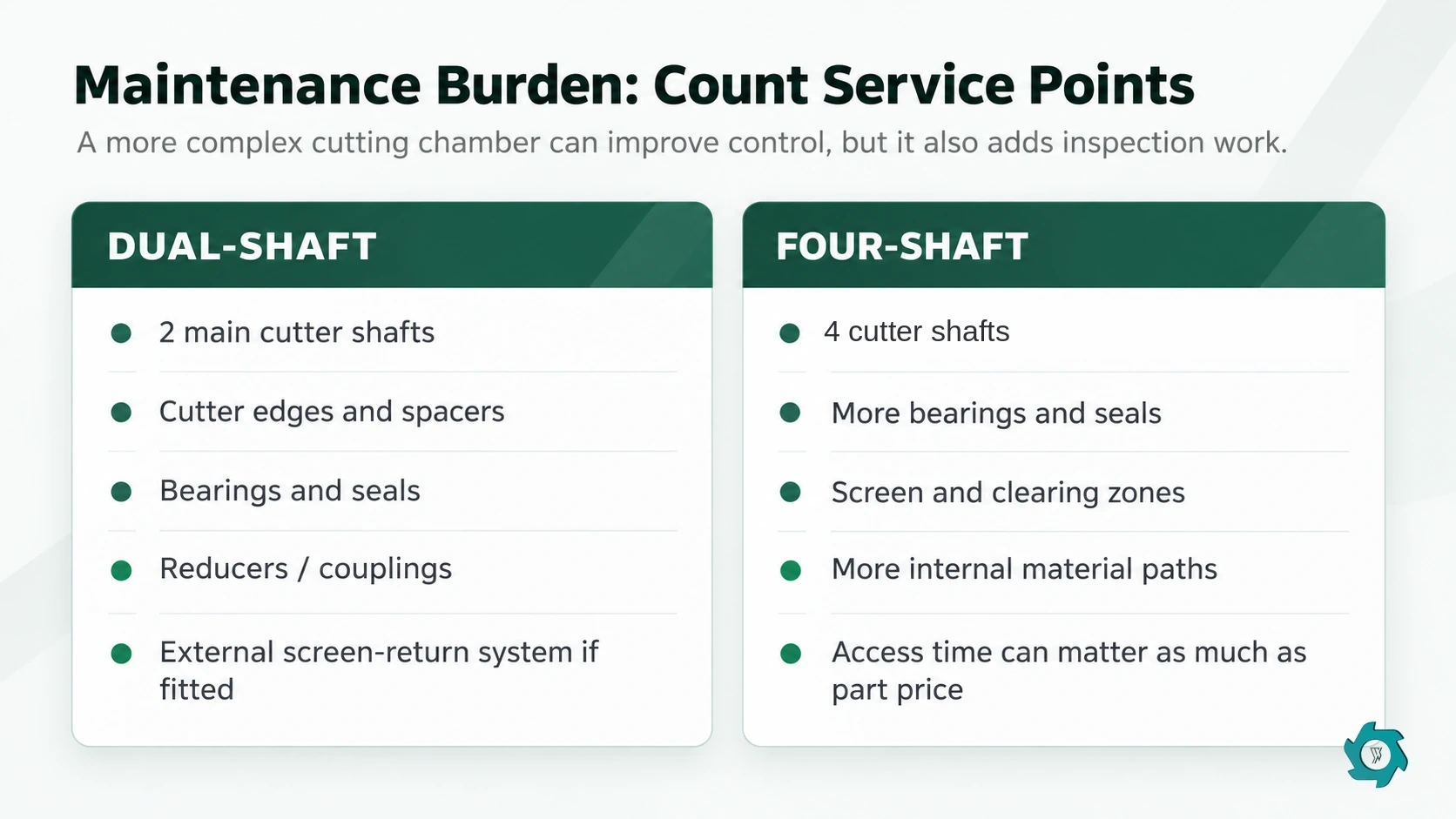
Maintenance cost should be evaluated as labor time plus parts plus lost production, not simply the purchase price of one blade. A dual-shaft chamber has two main cutter shafts. A four-shaft chamber has more cutter rows and associated support points. The exact number of bearings and drives varies by design, but the service burden should be mapped before purchase.
Ask the supplier to demonstrate cutter inspection, blade replacement, spacer access, bearing access, screen removal and wire cleaning. Time the procedure if maintenance availability is critical. A machine with excellent cutting performance can still be a poor fit if a routine wear job requires a long shutdown and the plant has no redundant shredder.
Also inspect how the chamber protects bearings and seals from rubber dust, wire fragments and contamination. Tire feed can carry stones, mud and embedded debris. Automatic overload protection helps, but it does not replace upstream inspection and prohibited-material control.
Capacity Should Mean Downstream-Ready Output
Capacity needs a measurement boundary. A loader may feed 8 t/h for part of a test while the screen releases only 6 t/h of accepted chips and the rest stays in circulation. Put the measurement point in the quotation and acceptance protocol.
Gross chamber throughput is not the same as saleable or downstream-ready output. Record accepted t/h together with the oversize return ratio or another indicator of recutting. A high return fraction may be intentional, but it consumes cutting time and energy and therefore belongs in the capacity discussion.
For TDF, Work Backward From the Off-Taker Specification
TDF projects are specification-driven. The receiving cement plant or other off-taker may set limits for chip dimensions, exposed steel, contamination and moisture. The shredder should be selected around that acceptance requirement rather than around a generic “TDF machine” label.
A dual-shaft shredder with screen-return can be effective when whole-tire intake and robust primary cutting are priorities and the external loop can enforce the accepted chip size. The YUXI TDF plant route combines tire preparation, shredding and output control according to the target fuel chip.
A four-shaft system may be considered when the project wants more repeated reduction inside the shredder and the selected screen can produce the required accepted fraction at the required net rate. In either case, the buyer should test the actual tire mix and the actual acceptance rule.
For Mulch, Crumb and Powder, Protect the Next Machine
For smaller rubber products, the tire shredder is only the front end. It should prepare stable feed for steel separation, rasping, granulation and grinding. Trying to make a primary shredder do the work of every downstream machine can reduce efficiency and accelerate wear.
If the next machine accepts coarse tire chips, a strong dual-shaft primary stage can be enough. If the downstream equipment needs a tighter feed envelope, the line can use screening, a secondary shredder, rasper or granulator rather than forcing an extremely small screen into the primary shredder.
Process staging matters here. A four-shaft machine can provide controlled reduction, but it does not eliminate the need for steel liberation, fiber separation or fine grinding when the final target is crumb rubber or powder.
OTR Tires Are Mainly a Feed-Geometry Problem
Large off-the-road tires are a special case. Their diameter, section width, mass and reinforcement can exceed the safe and efficient feed envelope of standard tire shredders. A four-shaft label does not solve that geometric problem.
For OTR projects, confirm maximum tire diameter and width, maximum single-tire mass, bead construction, loader method and whether the tire will be cut into sections first. The correct process may use a hydraulic cutter before the shredder. The tire cutting machine page shows the separate role of cutting large tires into manageable sections before further reduction.
Watch the PLC During a Real Tire Test
Both architectures need overload protection. In a typical low-speed shredder, the controller watches motor current, torque estimate or another load signal. When the threshold is exceeded, the shafts can stop, reverse briefly and attempt the cut again. If the overload repeats, the machine should stop for inspection instead of endlessly cycling.
During acceptance testing, count reverse events over a stable production window. Record what caused them. One reverse after an unusually stiff bead section is different from continuous reversing with ordinary feed. Frequent reversals reduce accepted throughput and can indicate poor cutter engagement, too aggressive a feed rate, an unsuitable screen condition or a mismatch between the machine and tire class.
Do not compare PLC programs by the number of menu options. Compare whether the logic protects the drive, clears realistic jams and returns to production without unsafe manual intervention.
Blade Thickness Alone Does Not Set Chip Size
Buyers often expect blade thickness to equal finished particle size. That is not a safe assumption for elastic tire material. Cutter thickness, hook count, hook depth, spacer arrangement, shaft speed, screen opening and recirculation all interact. Long flexible strips can also orient themselves differently during discharge.
Thicker cutters can offer more section strength and create a coarser cutting pattern, while thinner cutters create more cutting edges across a given chamber width. But thinner is not automatically finer and better: steel-rich tire duty can place high stress on cutter tips and edges.
Ask for the actual cutter drawing or at least blade diameter, thickness, hook geometry, material and heat-treatment specification for the quoted model. Then connect those values to test results with the same tire type.
A Factory Test Should Expose the Weak Point
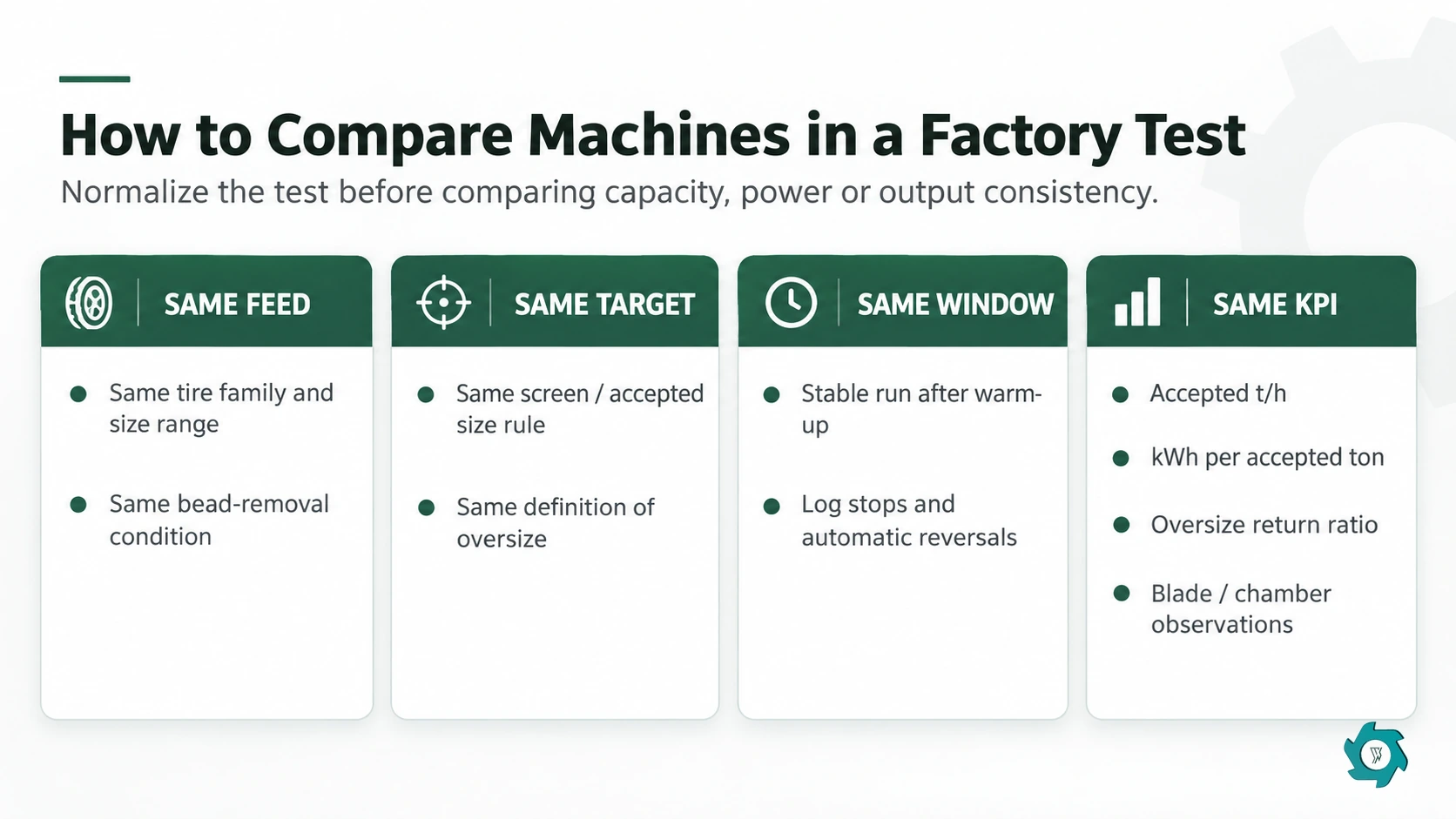
For a factory test, use a batch that resembles the difficult part of the real feed, not only clean passenger tires. If truck tires will be 30% of production, include them. Record bead condition, weigh the material, and agree where accepted output will be collected before the machine starts.
Run long enough to move beyond the first easy batch and reach a stable cycle. Record feed gaps, automatic reversals, manual interventions, screen loading, oversize return and stops. If power is part of the buying decision, meter the same electrical boundary for both systems.
Finally, inspect the accepted output. Do not select only attractive pieces for photos. Take samples at several times, identify the longest or most problematic pieces and record the fraction that does not meet the agreed rule.
Selection Matrix for Common Tire Projects
| Project condition | What to prioritize | Architecture to investigate first |
|---|---|---|
| Whole passenger/truck tires; coarse primary reduction | Intake, torque, simple maintenance, stable primary t/h | Dual-shaft |
| Whole tires; controlled TDF chip with room for conveyors | Primary bite plus screen-return performance | Dual-shaft + external classification loop |
| Prepared feed; repeated cutting and compact screen-controlled stage | Screen residence time, accepted t/h, maintenance access | Four-shaft |
| Very large OTR tires | Feed geometry and pretreatment before shaft count | Pre-cutting + correctly sized shredder |
| Crumb/powder line | Stable feed to downstream steel liberation and granulation | Choose the primary stage that best feeds the complete line; do not force final grinding into it |
| Dirty mixed feed with uncertain foreign objects | Protection logic, inspection, prohibited-material control | Compare actual machine protection and serviceability, not shaft count alone |
Information Worth Sending With the RFQ
A supplier cannot make a defensible two-shaft versus four-shaft recommendation from “I need a tire shredder” alone. A useful RFQ should state the tire families, largest diameter and width, truck-tire percentage, bead-removal condition, contamination, target accepted size, required net capacity, operating hours, local voltage/frequency and downstream process.
Also state the business purpose. If the output will be sold as TDF, provide the off-taker specification. If it feeds a rasper or granulator, provide that machine’s maximum feed size. If the objective is only transport-volume reduction, say so. A machine that is excellent for one of these jobs can be unnecessarily complex for another.
Selection Mistakes to Avoid
Assuming four shafts always mean higher capacity
More cutting interactions can improve reduction control, but a tighter screen can increase residence time. Capacity must be measured at the accepted product boundary.
Assuming dual shaft means uncontrolled size
A dual-shaft machine can work with a screen and automatic return loop. Evaluate the complete stage, not the cutter chamber in isolation.
Comparing motor kW instead of production
Installed power is an electrical design value. It does not replace accepted t/h, kWh/t or reversal data.
Ignoring the heaviest tire in the mix
The largest truck or OTR tire can determine chamber opening, pretreatment and loader arrangement even if most daily feed is smaller.
Buying for the smallest possible output
Primary shredding should prepare the next process efficiently. Fine rubber production normally requires staged steel separation, granulation and grinding.
What to Check Before Choosing
Before choosing, put four numbers beside each proposal: accepted t/h, oversize or recirculation rate, measured kWh per accepted ton, and time needed for the main cutter or screen service job.
For whole-tire intake and coarse primary reduction, a dual-shaft configuration is commonly investigated first, provided chamber geometry, cutter engagement and test results support the duty. A four-shaft configuration deserves closer attention when repeated internal cutting and screen-controlled discharge are central to the stage.
A short production test with the real tire mix will settle more questions than another page of catalog data. Use the same feed, accepted-size rule and measurement window, then inspect the output and the machine rather than relying on the HMI capacity number alone.
FAQ
Is a four-shaft tire shredder always better than a dual-shaft shredder?
No. A four-shaft design can provide more internal repeated cutting and screen-controlled sizing, but a dual-shaft system can be a better primary shredder for whole tires and can use external screening and recirculation when controlled output is needed.
Which shredder is better for whole truck tires?
Start with chamber opening, cutter engagement, torque reserve and the actual truck-tire construction. A heavy-duty dual-shaft primary shredder is commonly suited to whole-tire intake, but the quoted model must be tested with representative truck tires.
Can a dual-shaft tire shredder make controlled TDF chips?
Yes, when the cutting stage is combined with appropriate screening and oversize return. The accepted TDF specification, not the number of shafts alone, should determine the configuration.
Does a four-shaft shredder use more electricity?
Not necessarily. Energy per accepted ton depends on drive efficiency, tire mix, screen size, residence time, recutting and net output. Measure kWh and accepted tonnage over the same stable test window.
Which design is easier to maintain?
A dual-shaft chamber generally has fewer cutter shafts and associated service points. Actual maintenance time depends on bearing layout, cutter mounting, access, screen design and how quickly wire can be cleared. Ask for a maintenance demonstration.
Should OTR tires go directly into a four-shaft shredder?
Not based on shaft count alone. Large OTR tires may require bead treatment or hydraulic pre-cutting so the sections fit the shredder safely and can be gripped efficiently.
Compare the Process Before You Compare the Machine
Send YUXI your tire types, largest tire size, target accepted output, required capacity and downstream use. The configuration can then be matched around the cutting stage, screening route and maintenance requirements.
Request a Tire Shredding ConfigurationReferences
- UNTHA, RS150 — four-shaft shredder for tires and difficult applications; screen-based fraction sizing.
- UNTHA, Tire Shredding — tire application page listing RS four-shaft shredders with perforated-screen sizing.