A crumb rubber recycling business should not begin with the question, “Which machine can process the most tires?” The more useful first question is, “Who will buy the finished rubber, at what specification, and how often?” Equipment only becomes an investment after those answers are reasonably clear.
Start With the Market, Not With the Machine
A new recycler can find dozens of videos showing tires becoming black granules. The commercial gap is everything after the conveyor: particle-size distribution, steel and textile limits, moisture, packaging, documentation, order size and payment terms. A buyer who rejects the product turns nominal plant output into inventory, not revenue.
EPA describes tire crumb as scrap-tire rubber reduced to selected sizes, with steel and fabric removed and oversize material returned through screening.1 That manufacturing description is useful for business planning because it makes one point clear: “crumb rubber” is not a single commodity grade. Your market survey should therefore collect specifications, not only names of applications.
Asphalt and paving
Ask the asphalt producer, binder supplier or road authority which process it uses and what sieve distribution, moisture and contamination limits apply. FHWA documents both wet- and dry-process uses of scrap-tire rubber in asphalt, but the actual purchase specification remains project- or agency-specific.2
Molded and resilient products
Flooring, mats, tiles and molded components may accept selected fractions, but the processor can care about bulk density, fines, textile carryover and consistency from batch to batch as much as the nominal top size.
Sports and impact surfaces
This market deserves extra qualification. Material acceptance and public policy can vary by system and jurisdiction, so do not build a business case around generic “sports infill” demand without written buyer and regulatory confirmation.
A complete line only creates value when its finished output matches a confirmed market specification.
If you are still deciding whether the local market wants a coarse product or a finer granule, compare the commercial boundary in the existing rubber mulch vs crumb rubber guide.
Secure Tire Feedstock Before You Size Annual Revenue
A recycler can have a strong product market and still run an underfed plant. Tire supply is not simply “how many scrap tires exist in the region.” The business needs tires that can legally reach the site, at a known handling cost, in a mix that the equipment is designed to process.
Build the feedstock study around routes and counterparties. Tire shops, fleets, retreaders, municipal programs, waste contractors and transfer stations can all behave differently. Some markets support intake or tipping revenue; elsewhere the recycler pays for collection or competes aggressively for material. Treat intake fees as a local contract variable, not a guaranteed feature of the business model.
Feedstock variable
Why it changes the business case
What to verify
Tire mix
Passenger, truck and other tires contain different rubber, steel and textile proportions and can create different wear and output behavior.
Monthly tonnage by tire category, maximum size, off-spec share and contamination.
Collection radius
Bulky whole tires are expensive to move. A wider radius can improve supply while quietly increasing logistics cost.
A verbal promise is difficult to finance and impossible to schedule around.
Minimum/maximum monthly volume, price or fee basis, contamination rule and termination terms.
Storage limit
Large tire inventories can trigger fire, zoning or waste-facility requirements and tie up working capital.
Permitted onsite quantity, pile configuration, access lanes, fire plan and seasonal buffer.
Seasonality
Tire replacement cycles, weather and municipal programs can create uneven intake.
Monthly history rather than one annual total.
For a whole-tire project, the front end must prepare bulky and steel-rich material before fine granulation. The industrial sequence is easier to understand by reviewing how waste tires are reduced to controlled wire-free material. That upstream work is not optional simply because the final business target is crumb.
Feed preparation determines how hard the fine-granulation stage has to work and how much steel reaches it.
Choose the Revenue Model Before the Equipment Depth
The safest business plan does not assume that one revenue stream will carry the entire plant. Depending on local contracts, a crumb operation may earn from finished rubber, recovered steel and lawful intake or service fees. Textile fiber may have a disposal cost, a low-value outlet or a permitted recovery route; it should not be counted as revenue until a real customer and legal use are confirmed.
There is also a strategic choice between selling raw recycled materials and entering downstream manufacturing. Producing rubber tiles, mats or molded products can create more value per ton, but this is a different business: additional presses or mixers, molds, adhesives, product testing, sales channels and inventory. For a first plant, clean graded crumb is often easier to model because the production boundary is clearer. That does not make it automatically more profitable.
Define One Saleable Product Grade for Phase One
New projects often ask for the ability to make 0–1 mm, 1–3 mm, 3–5 mm and several mesh products from day one. Technically, multiple fractions can be useful. Commercially, every extra grade adds screens, bins, recirculation patterns, bagging requirements and inventory. The first phase is usually easier to commission when one or two products dominate the plan.
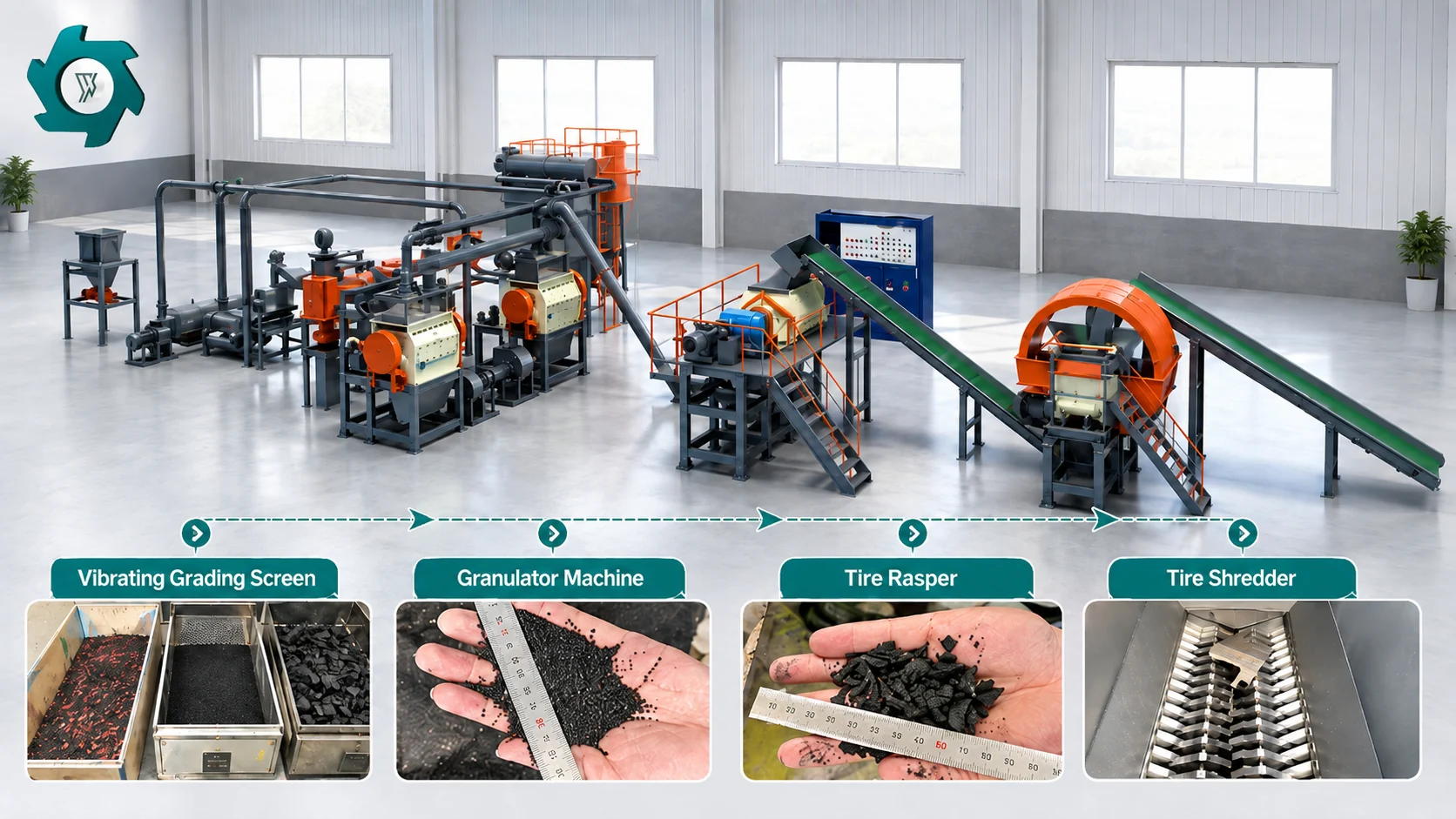
The YUXI Tire Rubber Crumb Plant is organized around whole-tire or prepared-chip configurations, staged magnetic recovery, granulation, screening, fiber separation and a primary 0–5 mm finished-product direction. The same page also warns that a narrower or finer grade can reduce accepted finished throughput because more material remains in the cutting and return loop. That distinction should appear in the financial model: feed tons per hour and saleable crumb tons per hour are not automatically the same.
Write a commercial specification before the RFQ. At minimum, define the sieve or size distribution, maximum metal, maximum textile, moisture where relevant, visible contamination, packaging, sample size and test procedure. If the buyer uses its own lab method, obtain it before factory acceptance testing.
ROI should be calculated from accepted saleable product, not gross material passing through the line.
What Equipment Does a Crumb Rubber Business Actually Need?
The answer depends on the starting material. A plant receiving whole tires needs a much deeper line than a processor buying clean wire-free chips. Quotations that use the same phrase—“crumb rubber plant”—can therefore differ by several machines before capacity or automation is even discussed.
Process stage
Whole-tire startup
Prepared-chip expansion
Commercial purpose
Tire preparation
As required by tire type and selected front end
Usually outside scope
Remove or reduce difficult bead sections and prepare oversize tires where required.
Primary shredder
Normally required
Usually outside scope
Create a controlled rough chip for the secondary stage.
Rasper / secondary cutter
Normally required
Can be outside scope if feed already meets the written handoff condition
Reduce rough chips and liberate embedded steel.
Magnetic separation
Required in stages
Still commonly required
Recover liberated steel before and after finer cutting.
Granulator
Required for crumb
Core new machine
Reduce prepared rubber into smaller granules.
Grading + return
Required for controlled product
Required
Separate accepted product and return oversize without double-counting capacity.
Fiber separation
Required when textile cleanliness matters
Required for many finished crumb specifications
Remove loosened textile while limiting rubber loss.
Dust collection / housekeeping
Project-specific engineered system
Project-specific engineered system
Control airborne and deposited dust at cutting, transfer and separation points.
Conveying / storage / bagging
Required
Required
Keep material flow stable and separate saleable fractions and by-products.
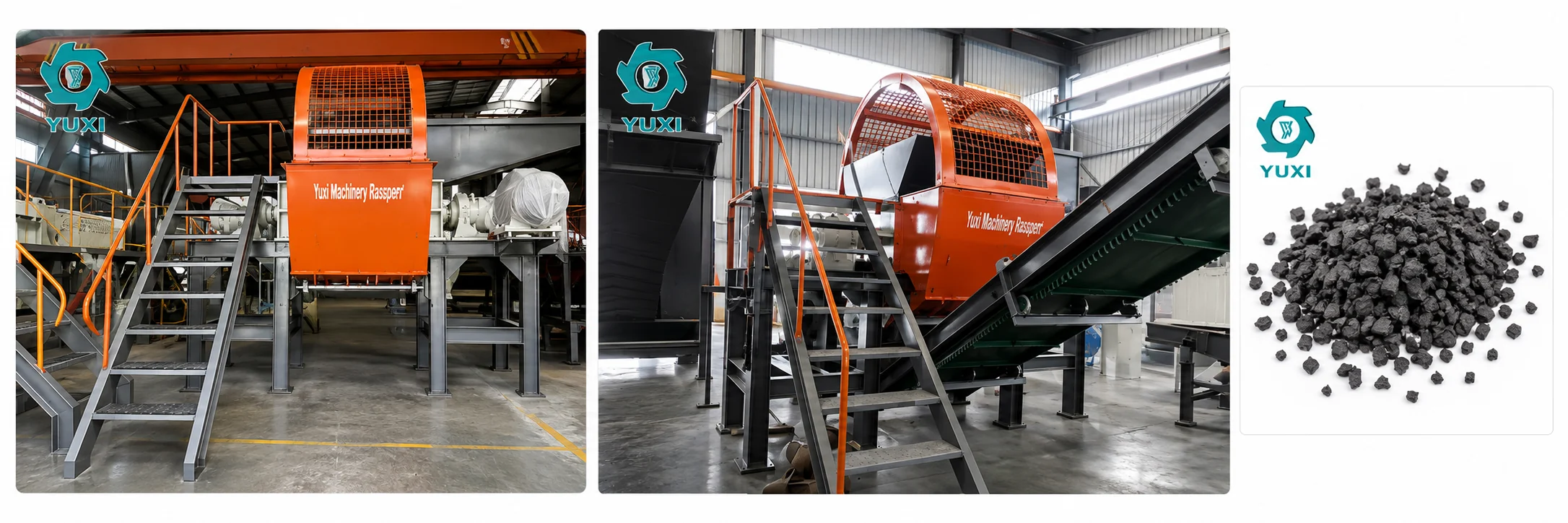
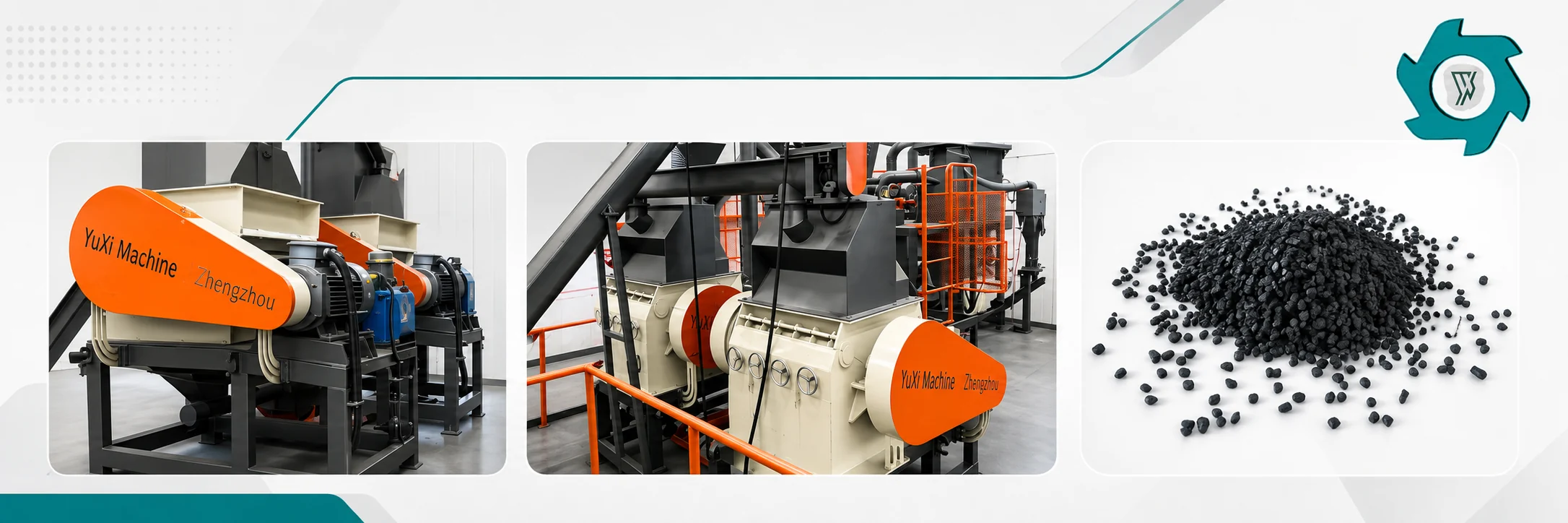
The handoff between the rasper and fine granulator is especially important. A granulator should not be expected to compensate for rough, steel-rich feed. The existing tire rasper vs rubber granulator comparison explains why those machines solve different problems and why their capacities should be tested as part of one line rather than compared as brochure numbers.
Whole-tire projects include more front-end work than a granulation module starting from prepared wire-free chips.
Size Capacity From Annual Sales Backward
A 5 t/h plant is not automatically a better business than a 1 t/h plant. If the local market only absorbs 1,500 tons of your approved grade per year, the larger line may spend most of its life idle while depreciation, insurance, rent and finance costs continue.
Start from expected annual sales and work backward. Divide confirmed annual demand by realistic operating days, shifts and utilization. Then correct for yield into the accepted crumb fraction. The useful capacity number is the tonnage that passes the agreed product test at steady operation.
Utilization should include cleaning, knife service, screen changes, minor stoppages, feed interruptions and product changeovers. A new plant normally should not build its debt-service model on perfect uptime. Run a conservative base case and a downside case before sizing the line.
Build the Startup Budget in Layers
Search results for tire recycling equipment often mix a single shredder price, a granulation module and a turnkey whole-tire line. That makes a single “crumb rubber plant cost” number unreliable. The business model needs at least four layers: core process equipment, installed project cost, startup inventory and working capital.
Core machinery
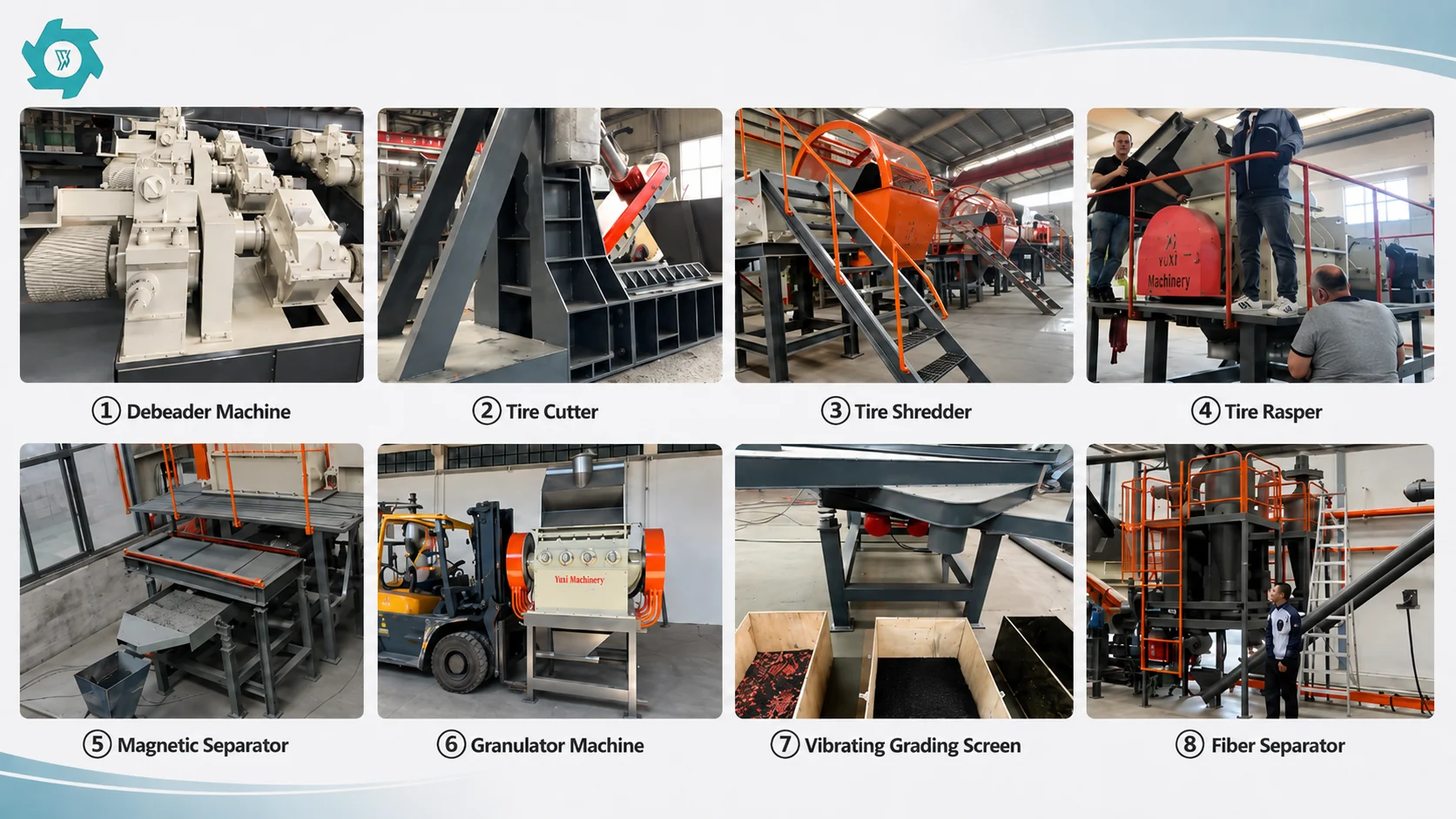
Shredding, rasping, magnets, granulator, screens, fiber separation, conveyors, controls and any required tire preparation.
Installed project scope
Freight, unloading, foundations, electrical distribution, transformer work, dust extraction, guarding, fire measures, installation, commissioning and training.
Mobile and support equipment
Loader or forklift, bins, scales, bagging equipment, maintenance tools, laboratory sieves and initial spare knives/screens.
Working capital
Payroll, electricity deposits, collection logistics, packaging, inventory, customer credit terms, insurance and cash reserve during ramp-up.
Keep tax, import duty, land and financing costs in separate rows because they are location- and deal-specific. It also helps to separate “must be installed before first production” from “can be added after sales are proven.” A phased budget often gives a more realistic investment decision than forcing every future product option into the first purchase.
Model ROI From Contribution per Accepted Ton
ROI becomes much clearer when the spreadsheet follows one accepted ton of crumb through the business. Begin with revenue attributable to that ton. Subtract the variable costs required to collect, process, package and deliver it. The remainder is contribution margin. That contribution must then cover fixed operating costs, debt service and the original investment.
Contribution per accepted ton = crumb sales + allocated steel revenue + lawful intake/service revenue − collection − electricity − wear parts − labor directly tied to throughput − packaging − disposal − outbound freight
Annual operating cash contribution = contribution per accepted ton × accepted tons sold − annual fixed operating costs
Simple payback is only a screening tool. The financing model should also include taxation, debt schedules, depreciation, capital maintenance, working-capital fluctuations and customer payment timing. If the project relies on grants or incentives, model the economics both with and without those incentives.
A worked example—using assumptions, not market claims
Assume a project has a total invested cash requirement of $900,000 including installation and startup working capital. The operator expects to sell 2,400 accepted tons per year. After all variable costs and allocated by-product revenue, the contribution is assumed to be $170 per accepted ton. Annual fixed operating costs are assumed at $210,000.
Item
Illustrative assumption
Calculation
Accepted tons sold
2,400 t/year
Input assumption
Contribution per accepted ton
$170/t
Input assumption
Gross annual contribution
$408,000
2,400 × $170
Fixed operating costs
$210,000/year
Input assumption
Operating cash contribution before finance/tax
$198,000/year
$408,000 − $210,000
Simple payback
About 4.5 years
$900,000 ÷ $198,000
If accepted sales fall 25%, or if contribution drops because electricity, blades or freight rise, payback can lengthen quickly. That downside test is more useful than copying an advertised “12-month ROI” from a different country, plant size and product mix.
Run at least four sensitivity cases
Volume case: accepted tons sold at 60%, 75% and 90% of the commercial plan.
Price case: finished-product price down 10–20% while intake terms remain unchanged.
Cost case: electricity, knives/screens and collection cost above budget.
Cash case: customers pay 30–60 days slower than expected and feedstock must still be collected continuously.
A Practical Order for Launching the Business
The order matters because each stage removes a different commercial risk. Buying machinery before these questions are settled simply converts uncertainty into sunk cost.
Interview real buyers.
Map tire supply.
Select the first saleable grade.
Choose the process boundary.
Request normalized quotations.
Build the installed budget.
Model downside economics.
Clear permits and site design.
Run a factory acceptance test.
Ramp production by customer approval.
For businesses planning a 10–20 mm intermediate product before finer granulation, the 10–20 mm rubber mulch size-control guide is useful for understanding how screen return, feed condition and oversize affect the handoff into the crumb stage.
Common Startup Mistakes That Distort ROI
Using feed capacity as sales capacity
A line may accept several tons per hour while a smaller amount passes the finished sieve and contamination limits. Financial models should use accepted product.
Counting every by-product as revenue
Steel often has a market, but textile and fines may not. Use a verified local outlet and net delivered value, not a theoretical commodity price.
Ignoring knife and screen economics
Fine cutting is a wear process. Knife rotation, sharpening, replacement, screen wear and unplanned damage belong in variable cost per ton.
Buying for a future market before proving the first one
Extra grinding, classification and bagging equipment can sit idle for years. Reserve expansion space, but make phase-one capital earn its way into phase two.
Underestimating collection logistics
Whole tires occupy volume and routes are rarely perfect. Model truck utilization and handling labor with real pickup data.
Using one optimistic payback number
A serious investment memo shows base, downside and stress cases. If the project only works at maximum uptime and the highest selling price, the risk is already visible.
Information to Prepare Before Requesting a Plant Quote
Tire types and approximate percentages.
Maximum tire diameter, width and weight.
Starting material: whole tire, shred or wire-free chip.
Photos and representative feed samples.
Target crumb fraction and sieve distribution.
Metal, textile, moisture and fines limits.
Target accepted finished tons per hour.
Annual sales plan and intended operating schedule.
Local voltage, frequency and transformer capacity.
Workshop dimensions and clear height.
Dust-collection and fire-protection design boundary.
Packaging and finished-product storage method.
Steel and fiber handling method.
Destination, freight term and installation scope.
Required spare knives, screens and maintenance tools.
Factory acceptance test sampling procedure.
Future expansion to finer powder or extra grades.
FAQ
Is a crumb rubber recycling business profitable?
It can be. We have seen projects with a good local tire supply and steady crumb buyers perform very differently from plants that depend on occasional orders. The important numbers are what you pay to collect the tires, how much finished rubber you can actually sell, and what it costs to keep the line running. Steel recovery can add some value as well. Before using any payback figure, work out the margin on each ton of finished crumb and then compare it with your yearly fixed costs.
How much does it cost to start a crumb rubber recycling business?
There is no single startup price that fits every project. A line that receives whole tires needs more front-end equipment than one that starts with prepared rubber chips. The machine quotation is only part of the budget, too. Freight, electrical work, foundations, dust control, installation, spare parts, loaders, packaging and the cash needed during the first months of operation can all change the final number. This is why two “crumb rubber plant” quotations can look very different even when the stated capacity is similar.
What equipment is needed to make crumb rubber from waste tires?
If you start with whole tires, the process normally includes primary shredding, further size reduction to release the steel, magnetic separation, granulation, screening and fiber removal. Oversize rubber is usually sent back for another pass instead of being treated as finished product. A business buying clean, wire-free chips can start farther downstream and may not need the complete tire-processing front end.
What size crumb rubber should a new business produce?
That decision should come from the customer, not from the machine brochure. One buyer may want a relatively coarse fraction, while another may care much more about fines, steel content or fiber contamination. We normally recommend confirming at least one realistic product specification before choosing the screen setup. It is much easier to add another grade later than to build several grades from day one and discover that none of them has a regular buyer.
Do I need permits to recycle waste tires?
In many locations, yes. The exact requirement depends on where the plant is built and how tires are transported and stored there. Zoning, fire access, dust control, waste handling and the amount of tire inventory on site may all be reviewed separately. One common mistake is to finish the equipment layout first and only then ask about local rules. It is better to check the site requirements early, because they can affect both the building and the process layout.
How should ROI be calculated for a crumb rubber plant?
Start with the rubber you expect to sell, not the maximum feed rate printed on the equipment list. Add any realistic income from recovered steel or lawful tire intake fees, then deduct collection, power, labor, wear parts, packaging, disposal and delivery costs. After that, allow for the fixed expenses of running the facility. We also suggest testing a slower-sales case. If the project only looks attractive when the plant is nearly full every day and crumb sells at the best expected price, the ROI estimate is probably too optimistic.
Build the Plant Around Your Buyers, Feedstock and Accepted Output
Send your tire mix, starting material, target crumb specification, finished capacity, local power, workshop dimensions and destination. YUXI can compare a complete whole-tire line with a downstream granulation module and define the equipment boundary for your business plan.
Marie has 8+ years of experience in tire shredding and recycling equipment,with a focus on tire shredders,rubber recycling machines,TDF production,rubber crumb processing,and complete tire recycling systems.