




A practical route from incoming waste tires to controlled 10–20 mm rubber mulch, with the handoff conditions, separation stages and acceptance checks that determine whether the finished material is actually usable.
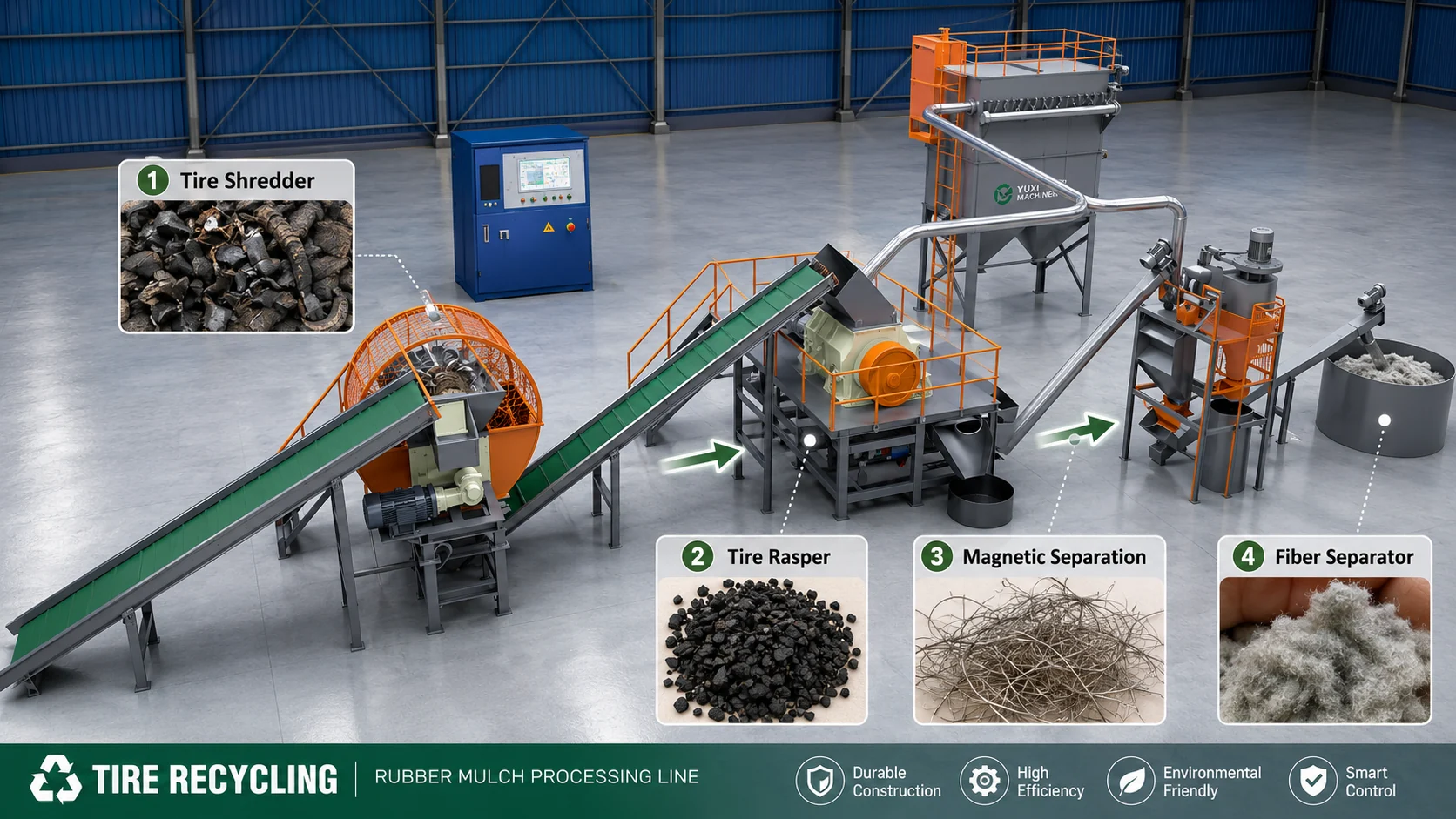
A pile of waste tires and a sample bag of clean-looking mulch can make the process appear simple. Put the tires into a shredder, remove the wire and collect the rubber. In practice, most production problems hide between those verbs.
The primary shredder may produce chips that bridge at the rasper. The rasper may reduce size but leave steel locked inside thick pieces. The magnet may work correctly while loose wire remains entangled under a deep, uneven burden. A screen may make an attractive product sample while a large return loop quietly consumes much of the line’s available capacity.
Quick Answer
Industrial rubber mulch is made by preparing waste tires, reducing them to controlled chips, using a tire rasper to cut the chips and liberate embedded steel, recovering the released steel magnetically, screening the rubber into the required size range and controlling loose textile fiber and fines.
For YUXI’s Tire Wire Free Mulch Plant, the normal product direction is 10–20 mm rubber mulch, with a reference complete-line range of 0.5–10 t/h. Those values are a solution range, not a promise for every tire mix. Final equipment and accepted output must be confirmed from representative feed, product limits and a written test method.
On This Page
- Define the mulch before the machines
- Whole-tire and chip-feed routes
- Step 1: receive and prepare tires
- Step 2: primary shredding
- Step 3: tire rasping
- Step 4: magnetic steel recovery
- Step 5: screening and return
- Step 6: fiber and fines control
- Step 7: verify and handle output
- Machine handoff table
- Capacity and bottlenecks
- Rubber mulch quality checks
- Common process problems
- Layout, utilities and safety
- Factory acceptance test
- RFQ information
- FAQ
Start with the Finished Rubber Mulch Specification
“Rubber mulch” is not a complete product definition. It may describe landscaping chips, playground surfacing feed, equestrian material, drainage media or an intermediate product that will be processed again. Different destinations can use different particle-size bands, color requirements, visible-metal limits, fiber limits, packaging and regulatory documentation.
Before selecting a shredder or rasper, write an output sheet that covers at least five items:
- Particle-size range: target band, measurement method, maximum piece, permitted oversize and permitted fines.
- Steel condition: whether exposed wire is prohibited, how visible steel is inspected and whether a quantitative metal limit is required.
- Textile condition: acceptable loose fiber, embedded fiber and dust-like fluff.
- Feed exclusions: rims, stones, soil, water, oil, foreign metal, burned tires and other contamination.
- Delivery condition: loose bulk, bagged product, moisture expectation, color or coating status and lot-identification method.
In practice: the phrase “wire-free” often causes more confusion than the screen size. One buyer means no long exposed wire by visual inspection. Another requires a documented metal-content limit. Those are not the same acceptance test, and the line proposal should not treat them as interchangeable.
The U.S. Environmental Protection Agency describes scrap-tire size reduction as a sequence in which screens classify material and return oversize, magnets remove wire and other metal, and air systems can remove fabric. That is a useful process model, although EPA’s crumb-rubber discussion should not be converted into a universal quality guarantee for every 10–20 mm mulch product.1
Choose the Correct Feed Route
A rubber mulch project can start from whole tires or from pre-shredded tire chips. The two routes can produce a similar final product, but they do not require the same machinery, floor space or acceptance boundary.
Route A: whole tires
The line includes receiving, tire handling and primary size reduction before the rasper. This route gives the plant more control over the full process but adds a large-duty first reduction stage, more conveying and a wider range of feed behavior.
Route B: pre-shredded chips
The project begins at a defined chip condition, commonly below an agreed maximum such as about 100 mm for the YUXI module concept. The buyer must verify size, thickness, exposed steel, contamination and consistency rather than accepting “tire chips” as a sufficient description.
The chip-feed route is not automatically simpler. It transfers part of the process risk to the incoming-material contract. If chips arrive with long steel loops, dense sidewall sections, oversized pieces or inconsistent thickness, the rasper may spend capacity correcting upstream work that the quotation assumed was already complete.
Step 1: Receive, Inspect and Prepare the Waste Tires
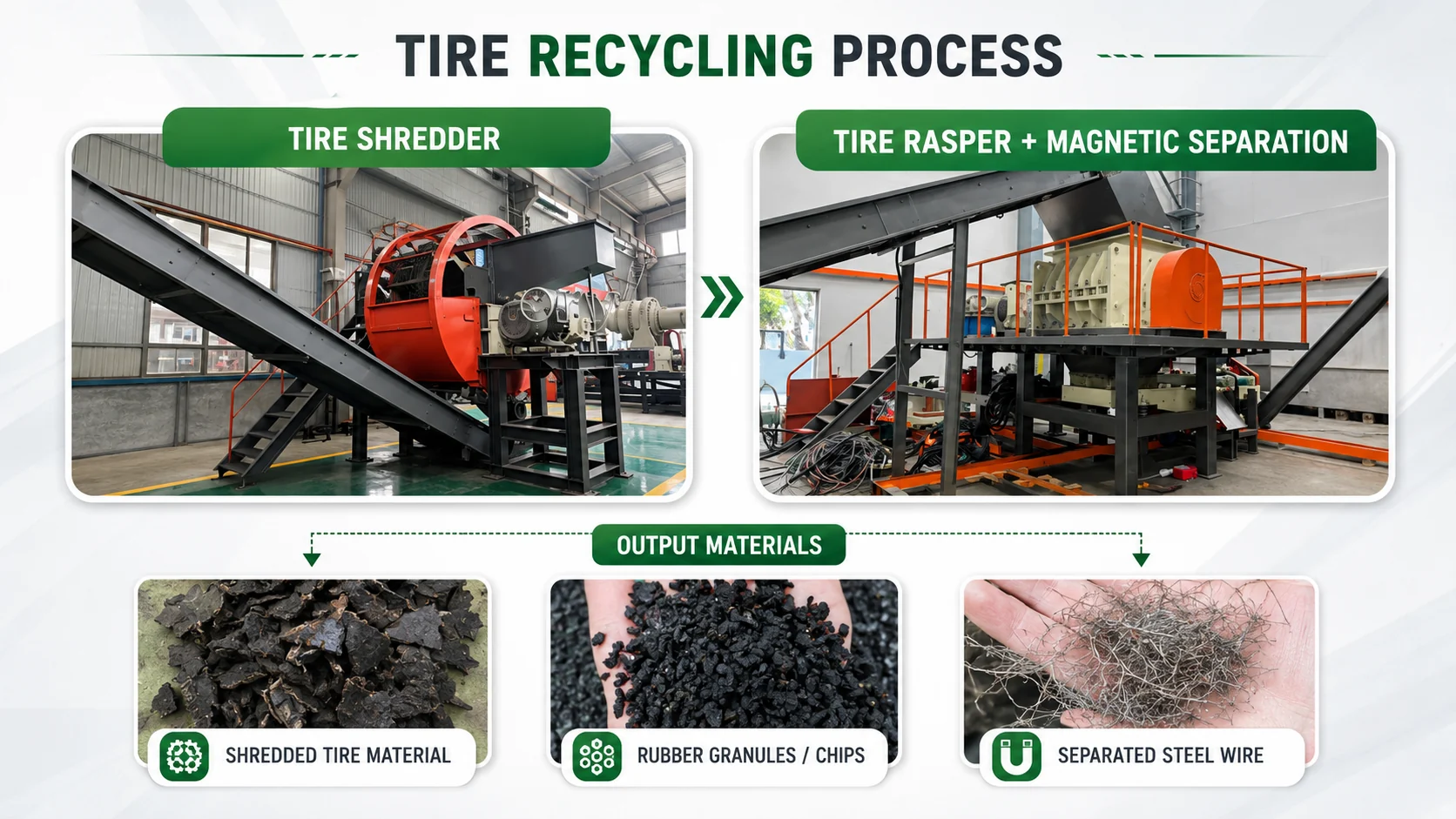
The production line begins before the first motor starts. Incoming tires should be grouped by the characteristics that change handling and cutting: passenger, truck, agricultural or OTR class; outside diameter and width; mass; bead and belt reinforcement; deformation; rims or other attachments; and contamination.
Sorting does not mean every tire needs a separate bin. It means the plant knows which tires are inside the approved feed range and which require another route. A mixed lot can be processed, but capacity and wear should then be evaluated against the actual mix rather than the easiest tire shown in a demonstration.
Preprocessing may include more than one decision
Passenger and compatible truck tires may feed a configured primary tire shredder directly. Large agricultural, OTR or mining tires can require bead treatment, sectioning or a customized handling system. The objective is not to add equipment for its own sake. The objective is to deliver a shape and mass that the next machine can capture repeatedly without unsafe manual forcing.
Reject or isolate unknown hazards. Mounted tires, pressurized tires, tires containing liquid, embedded objects, excessive soil or rock, hot or burned material and unidentified industrial contamination need a defined receiving procedure. The production target never overrides safe isolation and local requirements.
Step 2: Reduce Whole Tires to Controlled Primary Chips
A primary shredder changes a closed, spring-like tire ring into rough chips. That geometry change is the first major production task. Tires are composite structures made from bonded rubber, body plies, belts and steel-reinforced bead areas, so the machine is cutting reinforcement as well as rubber.2
YUXI’s tire shredder machine uses a low-speed, high-torque dual-shaft approach with screening and return of oversize material in configured systems. For mulch production, the primary stage should not be judged only by the mass entering the hopper. Its output must fit the rasper’s maximum piece size, thickness and presentation needs.
What the primary stage must control
- Maximum chip dimensions and the measurement rule
- Frequency of long strips, folded pieces and bead-rich sections
- Exposed wire length and entanglement risk
- Oversize return rate and screen loading
- Stable discharge to the next conveyor rather than intermittent surges
Surprisingly, a smaller nominal screen is not always the fastest route to accepted mulch. Tighter primary screening can increase return load before the rasper, while a looser screen can overload the secondary stage. The correct setting balances the complete line, not one machine’s instantaneous output.
Step 3: Use the Tire Rasper for Secondary Cutting and Steel Liberation
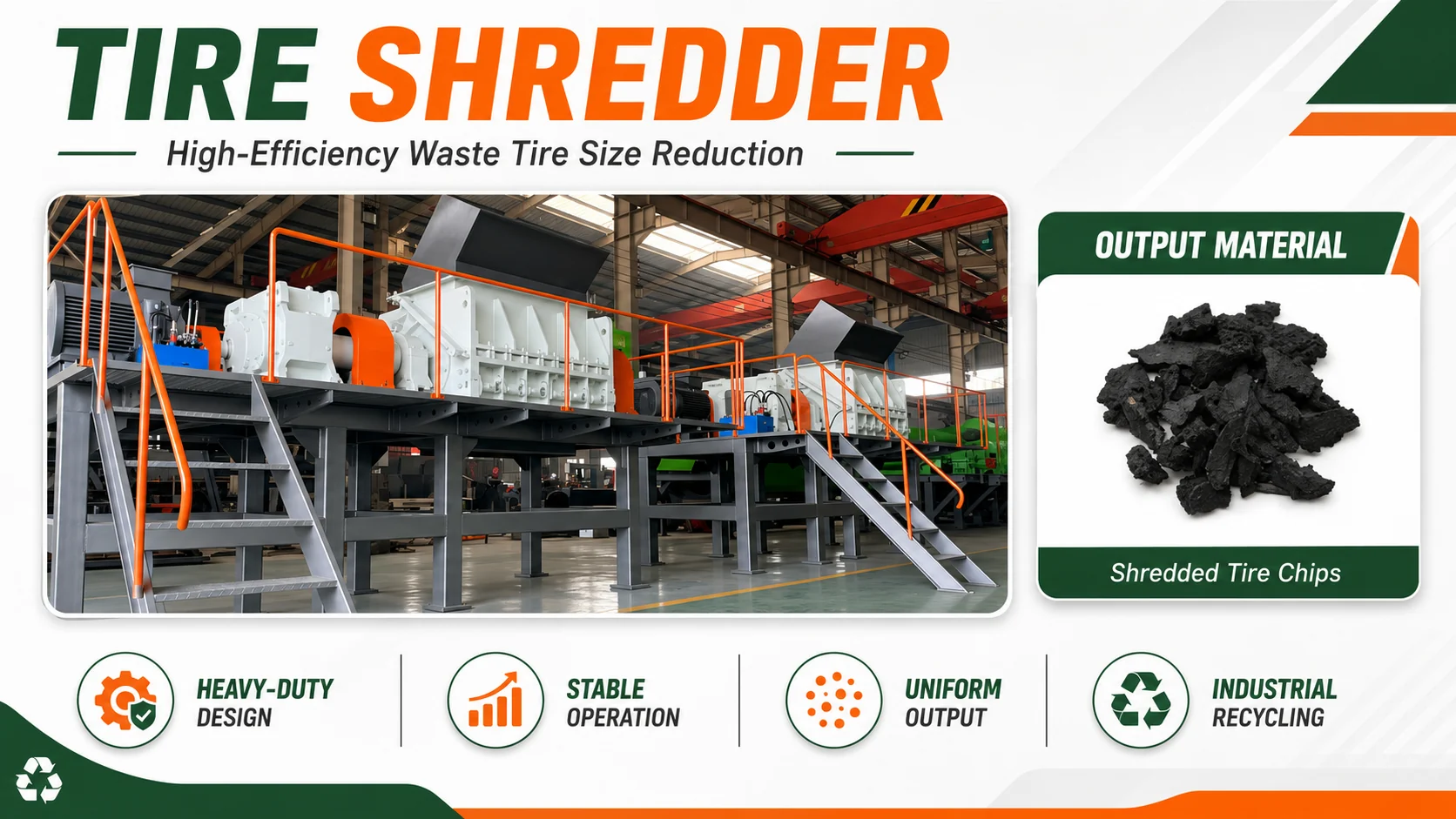
The tire rasper receives controlled primary chips and cuts them repeatedly against rotor and stationary knives. A screen retains oversize pieces until they are small enough to discharge. During this work, rubber is opened around belts and cords, and much of the steel becomes physically separated from the rubber.
This is the critical distinction: the rasper liberates steel; it does not complete the magnetic recovery by itself. The discharged stream can contain rubber chips, loose wire and textile fiber. The next separation stages must handle that mixture at the burden depth and feed rate used during production.
Four variables change rasper performance
Feed geometry
Thick, folded or bead-rich pieces behave differently from flat tread chips. Maximum dimension alone does not describe the cutting duty.
Cutter condition
Rounded, damaged or incorrectly set cutters can increase heat, fines, motor load and incomplete liberation even when the screen remains unchanged.
Screen and return load
The screen controls discharge opportunities. A tighter target can increase recirculation, dwell time and wear.
Feed rate
Overfeeding can create an unstable chamber load and a deep downstream burden that reduces separation quality.
Step 4: Recover the Liberated Steel Magnetically
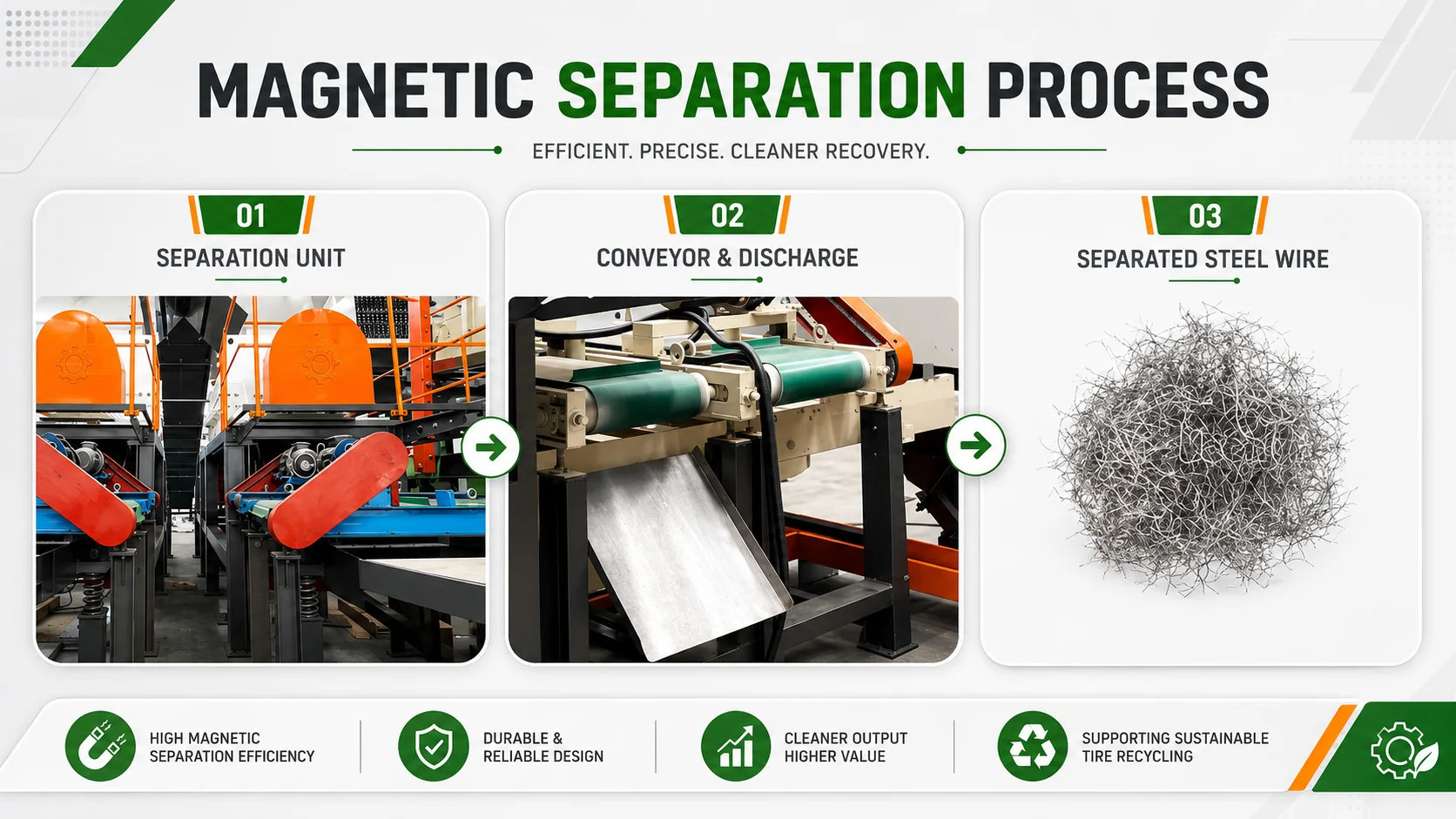
After the rasper, a magnetic separator attracts ferrous wire that has been physically released. Its performance depends on more than magnetic strength. Material presentation matters: burden depth, conveyor speed, wire shape, entanglement, particle size and the distance between material and magnetic field all change the result.
A magnet cannot remove wire that is still sealed inside a rubber piece. It may also struggle when long wire binds multiple chips together or when a deep layer hides steel beneath rubber. This is why a low steel count in the finished product should be traced back through liberation, feed distribution and magnetic recovery rather than assigned to one machine.
Separate the metrics. Record at least three different results: steel liberated by size reduction, steel recovered into the magnetic side stream and residual steel in the accepted rubber product. Combining them into one undefined “purity” figure makes troubleshooting almost impossible.
Step 5: Screen the Rubber and Return Oversize
The sizing screen divides the stream according to a physical aperture and the way irregular chips present themselves to it. A nominal opening does not mean every accepted piece has one exact dimension. Long, thin or flexible pieces can orient differently from thick blocks.
The accepted fraction moves toward final cleaning or storage. Oversize returns to the rasper or another approved size-reduction stage. This return loop stabilizes the finished size distribution, but it also consumes conveyor, rasper and screen capacity.
Accepted finished throughput = gross process feed − oversize return − rejects − recovered steel − removed fiber/fines
That equation is simple, yet supplier comparisons often ignore it. A line rated by gross rasper feed can look stronger than a line rated by accepted 10–20 mm product. Ask where the tons-per-hour measurement is taken, over what duration and with which side streams included.
Screening checks that belong in commissioning
- Accepted size distribution using the agreed sampling and measurement method
- Oversize percentage and return-loop mass
- Fines generation and destination
- Screen loading, blinding and material spread
- Changes in return load as cutters wear or the tire mix changes
Step 6: Control Textile Fiber, Dust and Loose Fines
Tire construction includes textile reinforcement as well as steel. Size reduction exposes and loosens part of that fiber. Depending on the tire mix and product requirement, the line may use aspiration, air classification or another configured fiber-control stage after screening or between size fractions.
Air separation is sensitive to particle size, shape, moisture and feed consistency. Light rubber flakes can follow the fiber stream, while dense fiber knots can remain with the rubber. The goal is therefore not simply “more air.” It is a stable separation window with measured rubber loss and an agreed fiber limit.
Dust control also belongs in the process design. Rubber dust and fine textile can accumulate around transfer points, screens and air systems. OSHA identifies rubber-product manufacturing and recycling among industries where combustible-dust hazards may require evaluation.3 The final design should follow the supplied equipment instructions and the plant’s local fire, electrical, ventilation, housekeeping and hazardous-dust requirements.
Step 7: Verify, Store and Prepare the Finished Product
Finished mulch should be sampled before it is accepted as saleable output. A single clean handful taken after a magnet is not a production test. Samples should represent normal running conditions, including the agreed tire mix and a stable return loop.
The basic product may be sold as black rubber mulch or transferred to a separate downstream coloring and coating operation. Coloring equipment, pigments, binders, curing and product-specific environmental requirements are a separate process scope unless they are explicitly included in the quotation. The mulch line should not imply that size reduction alone creates a finished colored landscaping product.
Storage and packaging also affect quality. Keep finished material separated from incoming tires, recovered steel, fiber and fines. Prevent recontamination from loader buckets, floors and open transfer points. Where moisture or lot traceability matters, define covered storage, bagging and batch identification.
Machine Handoff Conditions
| Stage | Input that must be defined | Output the next stage needs | Evidence to record |
|---|---|---|---|
| Receiving / preprocessing | Tire class, dimensions, rims, contamination and handling condition | Approved whole tires or controlled sections | Feed dossier, photos, reject rules and tire-mix record |
| Primary shredder | Approved whole tires or sections | Chips within the rasper’s accepted geometry | Size distribution, exposed wire, oversize return and sustained discharge |
| Tire rasper | Controlled chips at a stable feed rate | Mulch-size rubber with steel sufficiently liberated for recovery | Motor load trend, screen setting, return load and liberation samples |
| Magnetic separator | Evenly presented rubber, steel and textile mixture | Recovered ferrous stream plus rubber with reduced residual steel | Steel-stream mass, rubber carryover and residual-steel samples |
| Screen / return | Stable rasper discharge | Accepted size fraction and controlled oversize return | Accepted output, oversize, fines and screen condition |
| Fiber control | Suitable size fraction and consistent moisture | Rubber meeting the agreed loose-fiber condition | Fiber-stream mass, rubber loss and finished-product inspection |
| Storage / packaging | Accepted rubber mulch | Traceable, uncontaminated delivery lot | Lot number, weight, sample record and packaging condition |
Calculate Capacity at the Finished-Product Boundary
YUXI presents a reference range of 0.5–10 t/h for configured wire-free mulch lines. A project within that range still needs a defined capacity basis. The same equipment can produce different accepted tons per hour as tire mix, feed size, screen target, return load, cutter condition and product limits change.
A reliable capacity statement includes:
- The tire categories and their percentage of the test mix
- Whether capacity starts at whole tires or pre-shredded chips
- The maximum and typical feed dimensions
- The finished size range and oversize/fines rule
- The visible-steel and fiber acceptance method
- Gross runtime, net productive time and allowed interruptions
- Mass of accepted product, return material and all side streams
The slowest stable stage controls the line
A primary shredder may have spare torque while the screen is full. The rasper may cut quickly while the magnet receives an uneven burden. The air separator may clean well only below the feed rate used in the supplier’s capacity claim. Line balancing means finding the rate at which every stage can operate continuously and still produce the accepted product.
One export-project lesson: short demonstrations tend to understate recirculation. The first material through the line is counted as output before the return loop is fully loaded. A longer test reaches a steady state and shows the real relationship between fresh feed, oversize return and accepted mulch.
How to Check Rubber Mulch Quality
Quality control should convert descriptive words into repeatable checks. “Clean,” “uniform” and “wire-free” are useful goals, but they are not enough for a purchase contract.
| Quality item | Useful test question | Common mistake |
|---|---|---|
| Particle size | Which sieve or manual measurement method defines accepted, oversize and fines? | Using only the screen-opening label as the finished-product specification |
| Visible steel | How large a sample is inspected, and what exposed-wire condition causes rejection? | Checking one hand sample immediately after the magnet |
| Total residual metal | Is a quantitative limit required, and which validated method will be used? | Assuming visual inspection and laboratory metal content are equivalent |
| Textile fiber | Is the limit based on loose visible fiber, mass fraction or another agreed method? | Calling embedded fiber and loose fluff the same defect |
| Fines | What lower size is considered fines, and where will that stream go? | Ignoring fines because they are not oversize |
| Contamination | Which foreign materials are prohibited at receiving and in the finished lot? | Expecting downstream separators to correct every incoming contaminant |
| Consistency | How many samples and lots must pass during the acceptance run? | Approving the line from one visually attractive sample |
Common Production Problems and What They Usually Mean
Long wire in finished mulch
Check whether the wire was liberated, whether long loops are bypassing or entangling at the magnet, whether material is too deep on the conveyor and whether bead-rich feed has increased.
Too much oversize return
Review feed thickness, cutter condition, screen blinding, feed rate and whether the specified size band is realistic for the selected machine duty.
Capacity falls during the shift
Look for a growing return loop, hot or worn cutters, blocked transfers, fiber accumulation, inconsistent feeding and housekeeping stops rather than blaming motor power first.
Excess fines
Investigate repeated recirculation, cutter condition, unnecessary dwell time and whether the product target is forcing the material through too many cutting events.
Rubber lost with steel
Inspect wire-rubber entanglement, burden depth, magnetic discharge and the shape of liberated steel. Better liberation can improve recovery while reducing rubber carryover.
Rubber lost with fiber
Adjust the air-separation window only after stabilizing size, moisture and feed distribution. A stronger airflow can remove more fiber and more saleable rubber at the same time.
Plant Layout, Utilities and Safety Boundaries
A rubber mulch line needs more than the machine footprints shown on a quotation drawing. Allow space for tire storage, reject isolation, infeed handling, safe access, oversize return, recovered steel, fiber and fines, finished-product storage, maintenance removal paths and fire-safe housekeeping.
Layout questions worth resolving early
- Can the heaviest approved tire or chip container reach the infeed without crossing finished-product traffic?
- Can long wire be removed from chutes and magnetic discharge points under a documented isolation procedure?
- Is there access to withdraw screens, cutters, bearings or conveyors without dismantling unrelated equipment?
- Are transfer points enclosed or extracted where dust and fiber are generated?
- Can steel, fiber, fines, rejects and accepted mulch be weighed separately?
- Are electrical supply, controls, compressed air and dust-management provisions matched to the final configuration?
Machine guarding, emergency stops and lockout/tagout procedures must cover the complete integrated line, including conveyors and return loops. OSHA’s control-of-hazardous-energy guidance explains why stored and unexpected energy must be isolated during servicing rather than relying on a stopped control circuit.4 Local regulations and the supplied manuals control the final implementation.
Factory Acceptance Test for a Rubber Mulch Line
A useful FAT tests the promised process, not a staged machine moment. Agree on the feed, duration, sampling, allowed interventions and output calculations before the test begins.
- Freeze the feed basis. Record tire categories, dimensions, preparation state, contamination and mix percentages.
- Confirm the output contract. State size, oversize, fines, visible steel, fiber and delivery condition.
- Define the measurement boundary. Decide whether the test begins with whole tires or chips and where accepted output is weighed.
- Run to steady state. Allow the screen and return loop to reach normal loading before the accepted-capacity period.
- Record every stream. Weigh accepted mulch, oversize return, steel, fiber, fines and rejects.
- Log interruptions. Separate planned checks, feed shortages, jams, cleaning, adjustment and equipment stops.
- Sample throughout the run. Use several timed samples rather than one final bag.
- Inspect after the run. Review cutters, screen, conveyors, magnetic discharge and fiber-control areas for abnormal wear or accumulation.
Acceptance principle: approve the sustained production of accepted mulch, not peak feed rate. The line should be able to repeat the result with the agreed tire mix and operating method.
Information to Send for a Rubber Mulch Line Proposal
A supplier can configure a more defensible process when the RFQ describes the material and product rather than asking only for “a 3 t/h rubber mulch machine.”
- Whole tires or pre-shredded chips, with representative photos and video
- Tire categories, percentage mix, maximum diameter, width and approximate mass
- Whether rims, bead wire or other preprocessing have already been removed
- Chip dimensions, thickness, exposed-wire condition and contamination if buying a module
- Target rubber mulch size and the proposed measurement method
- Visible-steel, total-metal, textile-fiber and fines requirements
- Required accepted finished tons per hour or tons per shift
- Planned operating hours, labor, loading equipment and storage method
- Workshop dimensions, access, voltage, frequency and local environmental constraints
- Destinations for recovered steel, fiber, fines, rejects and finished mulch
- FAT duration, sampling plan and documentation expected
For commercial scope, compare the standalone and complete-line boundaries in the rubber mulch machine price guide before normalizing quotations.
Configure the Process Around Your Tires and Product
Send the tire mix, starting feed condition, required mulch specification, accepted output target and workshop information. YUXI can review the full route and identify which stages must be included in the quotation and FAT.
Frequently Asked Questions
Can whole tires go directly into a tire rasper?
Normally no. A rasper is a secondary machine. Whole tires first need a primary shredder or an approved preprocessing route that produces chips within the rasper’s accepted feed envelope.
What size is rubber mulch made from waste tires?
YUXI’s wire-free mulch solution is organized around a typical 10–20 mm product direction. The purchase specification should still define the measurement method, maximum piece, undersize, oversize and return-load rules.
Does a tire rasper remove all steel by itself?
The rasper cuts rubber and liberates embedded steel. A downstream magnetic separator recovers the released ferrous wire. Liberation and magnetic recovery are separate performance checks.
Why is screening required after the rasper?
A screen separates accepted material from oversize pieces. Oversize is returned for another controlled pass, which stabilizes product size but also creates recirculation that must be included in capacity calculations.
How is textile fiber removed from rubber mulch?
Air separation, aspiration or another configured fiber-control stage can remove loose textile after size reduction. The required stage depends on the product specification and the amount of fiber exposed by the tire mix.
What should a rubber mulch acceptance test measure?
Measure accepted finished product over a representative run. Record tire mix, feed preparation, screen setting, net runtime, return load, size distribution, visible steel, textile carryover, fines, rejects and all recovered side streams.
Can the same plant make fine rubber crumb?
A mulch line can provide prepared wire-reduced feed for further processing, but fine crumb normally requires additional granulation, screening and fiber-control stages. The mulch plant and a fine crumb plant should not be treated as the same equipment scope.
References
- U.S. EPA — Tire Crumb Questions and Answers. Used for the general size-reduction, screening, magnetic and fabric-separation process model.
- U.S. Tire Manufacturers Association — How a Tire Is Made. Used for tire construction and reinforcement context.
- OSHA — Combustible Dust National Emphasis Program. Used for the need to assess rubber/fiber dust hazards.
- OSHA — Control of Hazardous Energy. Used for servicing and isolation boundaries.