




When buyers ask how a tire shredder makes a certain chip size, the common answer is “choose the right screen.” That answer is incomplete. A screen is only a classifier. It does not make an oversized strip smaller. Size becomes controlled only when the screen is connected to a return route that sends retained material back to the cutting chamber and when the shredder has enough torque, cutter condition and available duty to process both fresh tires and returned pieces.
This distinction matters in real projects. A shredder may appear to process a high gross mass while the return conveyor is carrying the same material through the system again. The plant can also show a visually busy discharge while the accepted product rate falls. For that reason, this guide focuses on the engineering of the tire shredder machine screen-and-recirculation loop: what controls the finished boundary, how screen opening changes return load, how to diagnose unstable sizing, and what to record during commissioning.
1. The Screen Does Not “Create” the Final Size
A twin-shaft tire shredder produces a distribution of pieces rather than identical cubes. Tire rubber is elastic, steel cords resist a clean fracture, and a piece can leave the cutters as a block, strip, folded section or irregular shape. Blade width and cutter geometry influence the first-pass result, but they cannot by themselves guarantee that every discharged piece is below a contractual dimension.
The screen creates a pass/fail boundary. Material that can pass the selected opening is allowed to move forward. Material retained by the screen remains unfinished. In a recirculation system, that retained fraction is conveyed back to the shredder for another cutting opportunity. The U.S. EPA describes this same basic principle in scrap-tire processing: screens classify material and return oversize pieces to the reduction process. EPA’s scrap-tire handbook also notes that disc screens and other classification devices are used to separate defined tire-chip sizes, with larger pieces returned for further size reduction.[1]
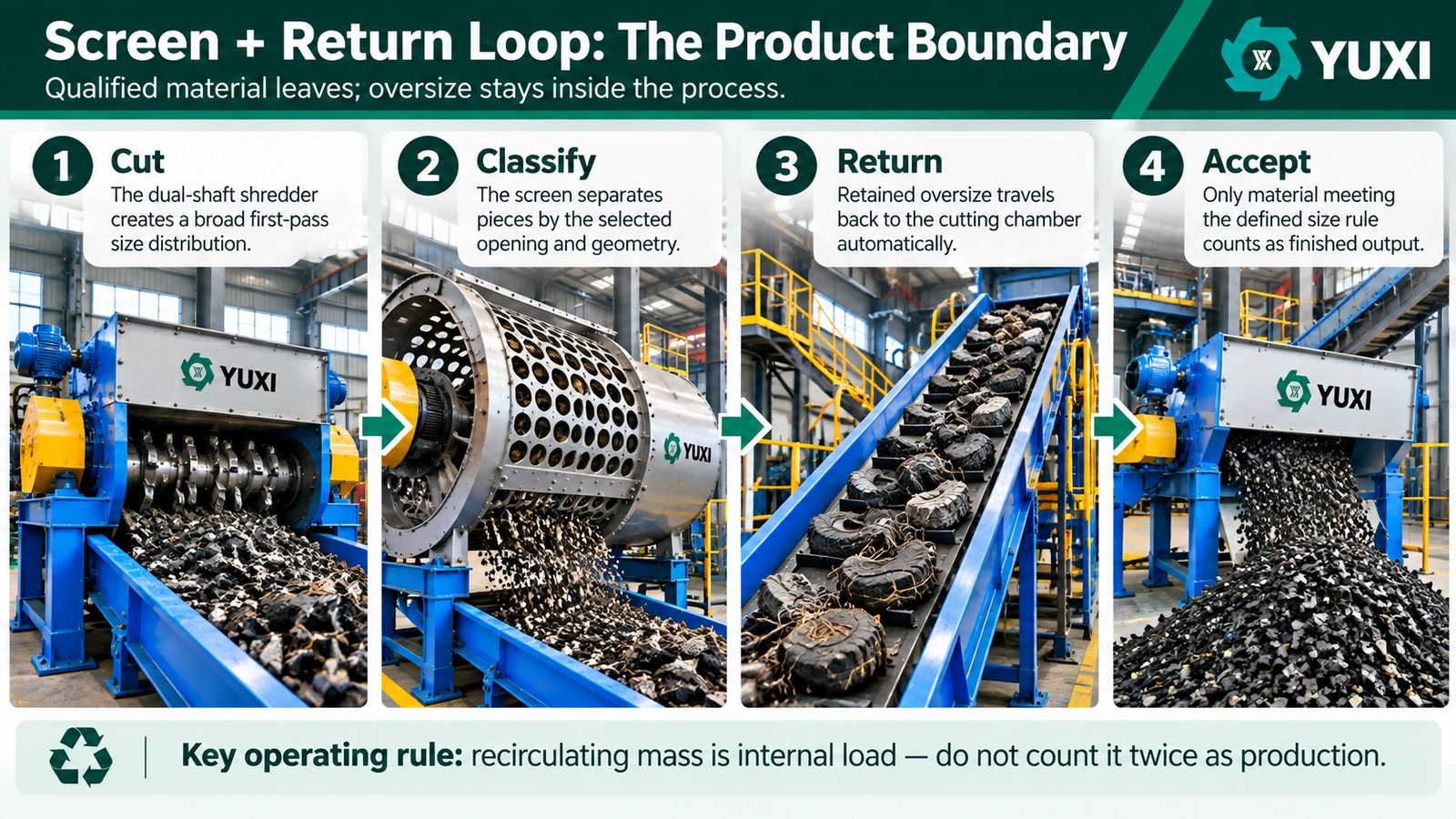
This is why “shredder output” needs a definition. Material falling from the cutter chamber is cutter discharge. Material crossing the product screen is accepted output. They are not the same stream. For equipment selection and performance tests, accepted output is normally the more useful number because it represents product that can actually move to the next process or customer.
2. Four Variables Control the Size-Reduction Loop
Blade geometry and cutting condition
Blade thickness, hook profile, overlap, shaft speed and the gap between cutting elements influence how a tire is gripped and sheared. However, a nominal blade dimension should not be treated as a guaranteed chip dimension. As cutting edges wear, rubber can stretch farther before separation. Long strips and partially torn sections may become more common. Those shapes can increase the retained fraction even though the screen itself has not changed.
For maintenance planning, record blade condition when sampling output. If oversize rises gradually over weeks while the tire mix and screen remain unchanged, cutter wear is a more plausible first check than immediately replacing the screen. Inspect edge rounding, damaged hooks, abnormal clearance and steel wrapping around the shafts. A screen change can hide a cutting problem temporarily while increasing recirculation and energy use.
Screen opening and screen geometry
The opening is the physical classification threshold, but the relationship between opening size and actual chip dimensions is not one-to-one. Irregular tire pieces can orient themselves differently as they move. A long narrow strip may pass an opening in one orientation while a shorter bulky piece may be retained. Disc spacing, shaft arrangement, agitation, bed depth and feed presentation all affect classification behavior.
Therefore, a statement such as “100 mm screen equals 100 mm chips” is too absolute for contract language. A better specification defines the accepted product, sampling method and oversize tolerance. For TDF, ASTM D6700 treats fuel size, handling and feeding requirements as project-specific considerations that should be evaluated for the intended combustion unit rather than assumed from a generic TDF label.[2]
Return conveyor capacity
The return conveyor is not a minor accessory. It must carry the retained fraction without becoming the bottleneck. If the screen rejects 30% of gross flow during one operating condition, the return route must move that material reliably while fresh tires continue entering the shredder. A narrow belt, steep transfer, poor chute angle or low belt speed can create a pile-up that looks like a shredder problem.
Return conveyors also need protection from stringy rubber and exposed wire. Transfer points should avoid sharp ledges where steel cords can catch. Inspection access should allow operators to clear wrapped material without climbing into unsafe positions. The conveyor drive should be selected for the expected recirculation duty, not only the average fresh-feed rate.
Fresh-feed rate
A recirculation loop has finite cutting capacity. Fresh tires compete with returned oversize for cutter time. If an operator keeps increasing fresh feed while the return load is already high, the cutting chamber can become continuously full. Motor current rises, reversals increase, and the screen may receive an uneven surge instead of a stable material bed.
Good control logic treats return load as part of the shredder’s workload. A high-level signal, motor-current threshold, belt-load signal or other plant-specific indicator can slow or pause fresh feed. The purpose is not to chase maximum instantaneous tonnes. It is to keep the system inside a stable operating envelope where accepted product leaves continuously.
3. Why Smaller Output Usually Means More Recirculation
Imagine one tonne of tires entering a line. With a coarse screen, a large share of first-pass pieces may qualify. With a tighter screen, more pieces are retained and must be cut again. Some returned pieces may still fail after the second pass and circulate a third time. The original tonne has not become two or three tonnes of production; it has accumulated more internal handling and cutting work.
This simple ratio is useful when a belt scale is available. If direct weighing is not practical, a consistent proxy can still help: return-conveyor motor load, belt loading from calibrated observation, or timed collection during a controlled test. The goal is to trend the loop, not invent false precision.
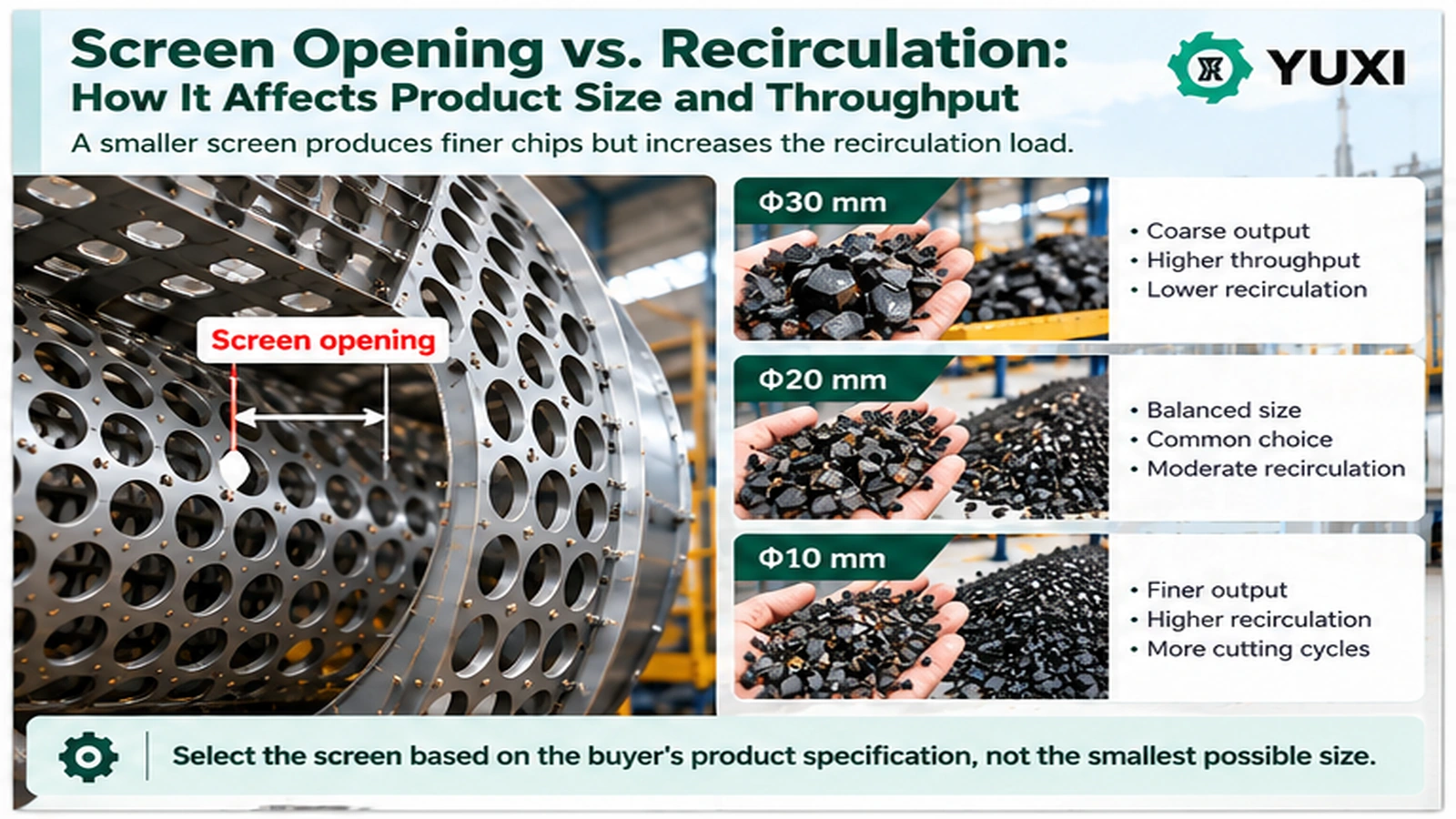
The important production metric is accepted tonnes per hour. This avoids the double-counting problem discussed in the site’s separate guide on feed rate vs accepted output. That article focuses on capacity accounting; this article uses the same process boundary only to explain why the screen-and-return loop changes sizing behavior.
The trade-off also explains why a smaller screen can increase specific energy consumption. Returned pieces receive more cuts and more conveyor travel before becoming product. The detailed energy accounting belongs in the separate kWh per ton guide; for size-control decisions, the practical point is simply that a tighter product boundary consumes more of the machine’s available duty.
4. Screen Selection Should Start With the Receiver Specification
Do not select the smallest screen that physically fits the machine. Start with what the downstream process will accept. A cement kiln, a secondary shredder, a wire-separation stage and a granulator do not need the same feed. Oversizing the size-reduction duty wastes capacity and wear without adding value.
| Question | Why it matters | What to define before quotation |
|---|---|---|
| What is the end use? | Different receivers tolerate different size distributions and exposed steel. | TDF, rough shred, secondary-shred feed, or downstream granulation feed. |
| How is size judged? | “About 80 mm” is not a test method. | Screen pass, maximum dimension, sieve method, or buyer-specific inspection. |
| What oversize is allowed? | Zero visible oversize may require excessive recirculation. | Maximum oversize percentage and sampling basis. |
| What tire mix enters? | Truck tires and passenger tires can cut differently. | Mass share, diameter range, bead condition and contamination. |
| What accepted capacity is required? | Gross cutter flow can overstate saleable output. | Accepted t/h at the agreed product specification. |
For a TDF project, the Tire TDF Plant page describes a standard 50–80 mm target and an adjustable 50–150 mm range for its stated configuration. Those numbers should not be copied automatically into every project. The fuel receiver’s written requirements remain the controlling design input. ASTM D6700 notes that TDF is processed to fit the combustion and handling requirements of the intended unit.[2]
5. Disc Screen, Trommel or Other Classifier?
Classifier choice depends on chip size, flow behavior, plant layout and downstream objective. EPA’s scrap-tire handbook identifies trommels for larger shreds and disc or tapered-slot screens for smaller tire chips, while vibrating screens are used for finer ground-rubber classification.[3] For a primary tire shredder, a disc-screen return arrangement can be attractive because it continuously separates larger pieces and routes them back without requiring operators to manually pick oversize.
But classifier type alone does not guarantee a narrow product distribution. A disc screen can still be overloaded. A deep bed of material can shield smaller pieces from openings. Long wire can catch at transfer points. Wet dirt can accumulate. A trommel can also classify poorly if its loading, aperture and residence time do not match the material. The system should be evaluated as a flow path rather than as an isolated screen specification.
6. What Happens When the Return Ratio Gets Too High?
High return is not automatically a fault. It may be the expected cost of making a tighter product. It becomes a problem when the internal loop consumes so much capacity that the line cannot maintain stable accepted output or when mechanical duty rises beyond the intended operating envelope.
Common symptoms include a continuously full return belt, frequent shredder reversals, elevated motor current, irregular fresh feeding, piles at transfer points, excessive fines, hotter bearings or reducers, and a falling accepted-output rate. Operators sometimes respond by feeding harder because finished tonnes are low. That can make the loop less stable.
A better response is to determine why material is being retained. Is the screen target tighter than necessary? Did the truck-tire percentage increase? Are cutting edges worn? Is a screen section damaged or blocked? Are long strips orienting poorly? Is the return conveyor too small? Is the fresh-feed conveyor delivering batches instead of a steady rate? Each cause requires a different correction.
7. Troubleshooting Oversize Without Guessing
Problem: oversize increases but screen opening is unchanged
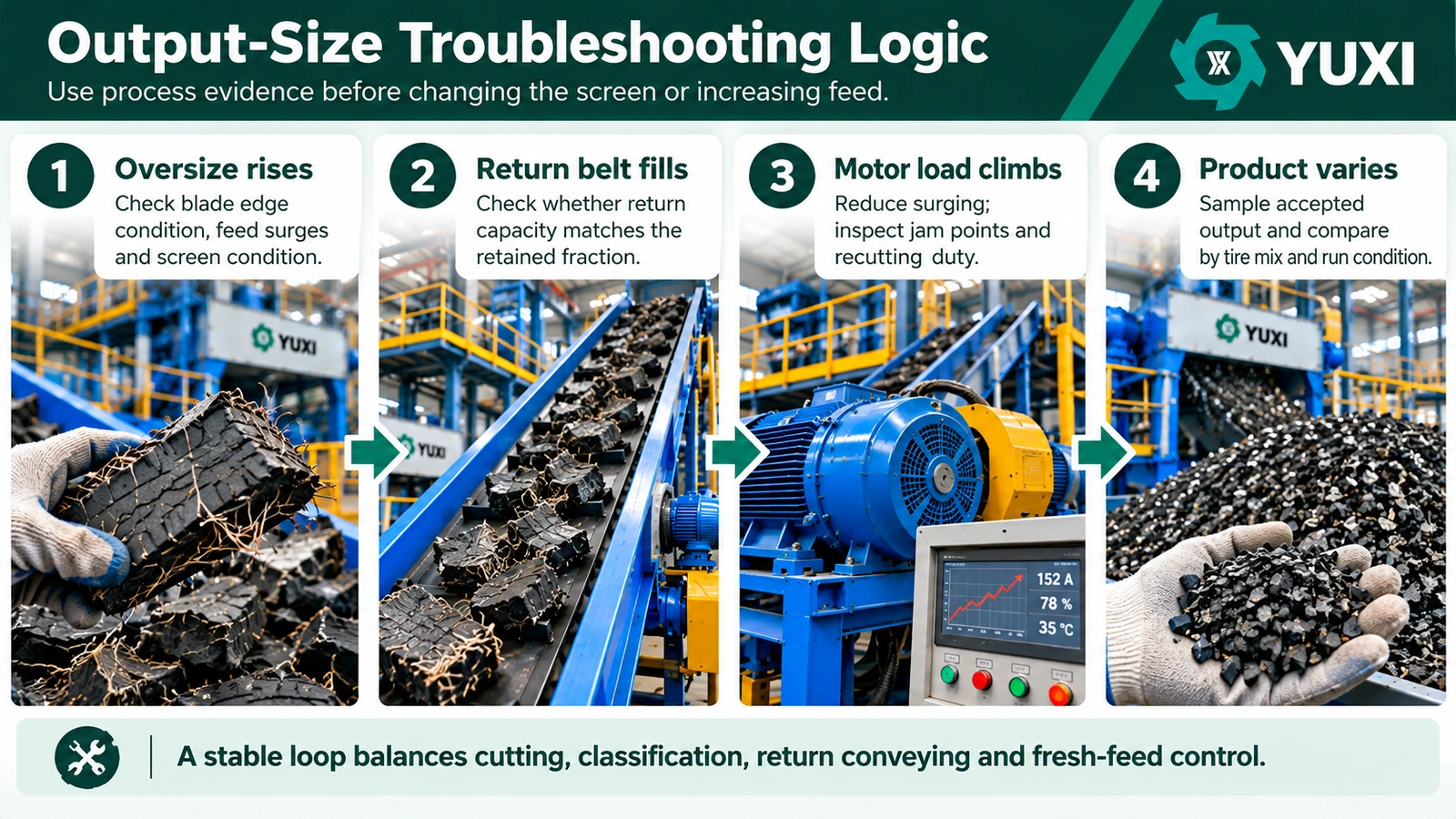
Inspect the cutters first. Compare current oversize shapes with samples from a known-good run. Long torn strips can indicate that rubber is stretching rather than being cleanly sheared. Check blade edges, overlap, shaft clearance and steel wrapping. Also verify whether the incoming tire mix changed. A higher share of truck tires can increase cutting resistance and steel load.
Problem: product size is acceptable but accepted t/h falls
Measure or estimate return load. If recirculation has increased, determine whether the screen is partially blocked or whether cutter condition has deteriorated. If return load is stable, look for unrelated restrictions such as fresh-feed starvation, conveyor slipping or downstream accumulation. Do not blame the screen solely because it is visible.
Problem: return conveyor repeatedly plugs
Observe the exact transfer point. A blockage at a chute lip is a transfer-design issue; a belt uniformly overloaded along its length is a capacity issue. Long steel strands may require changes upstream or better handling around the return path. Do not solve a mechanical catch point simply by increasing belt speed, because higher speed can worsen bouncing and spillage.
Problem: too many fines
Fines can rise when material receives unnecessary repeat passes or when the line is trying to make a much smaller product than the next stage requires. Confirm the downstream specification. If the process only needs a coarse TDF chip or secondary-shred feed, excessive recutting consumes wear life. Also inspect whether worn or damaged components are rubbing rather than shearing.
Problem: frequent PLC reverse cycles
Automatic reversal protects the shredder when load rises or a hard piece jams. Occasional reversals are normal in difficult feed, but a rising frequency is an operating signal. Record reversals per hour together with tire mix, fresh feed, return load and motor current. If reversals increase only when the return loop is heavy, fresh-feed control may need adjustment. If they increase at low return load, inspect the cutting chamber for foreign metal, wrapped wire or mechanical clearance issues.
8. A Practical Commissioning Test
A commissioning test should prove that the complete loop can make the agreed product continuously. A short video of a few tires entering the shredder is useful evidence of operation, but it does not establish sustained capacity or size compliance.
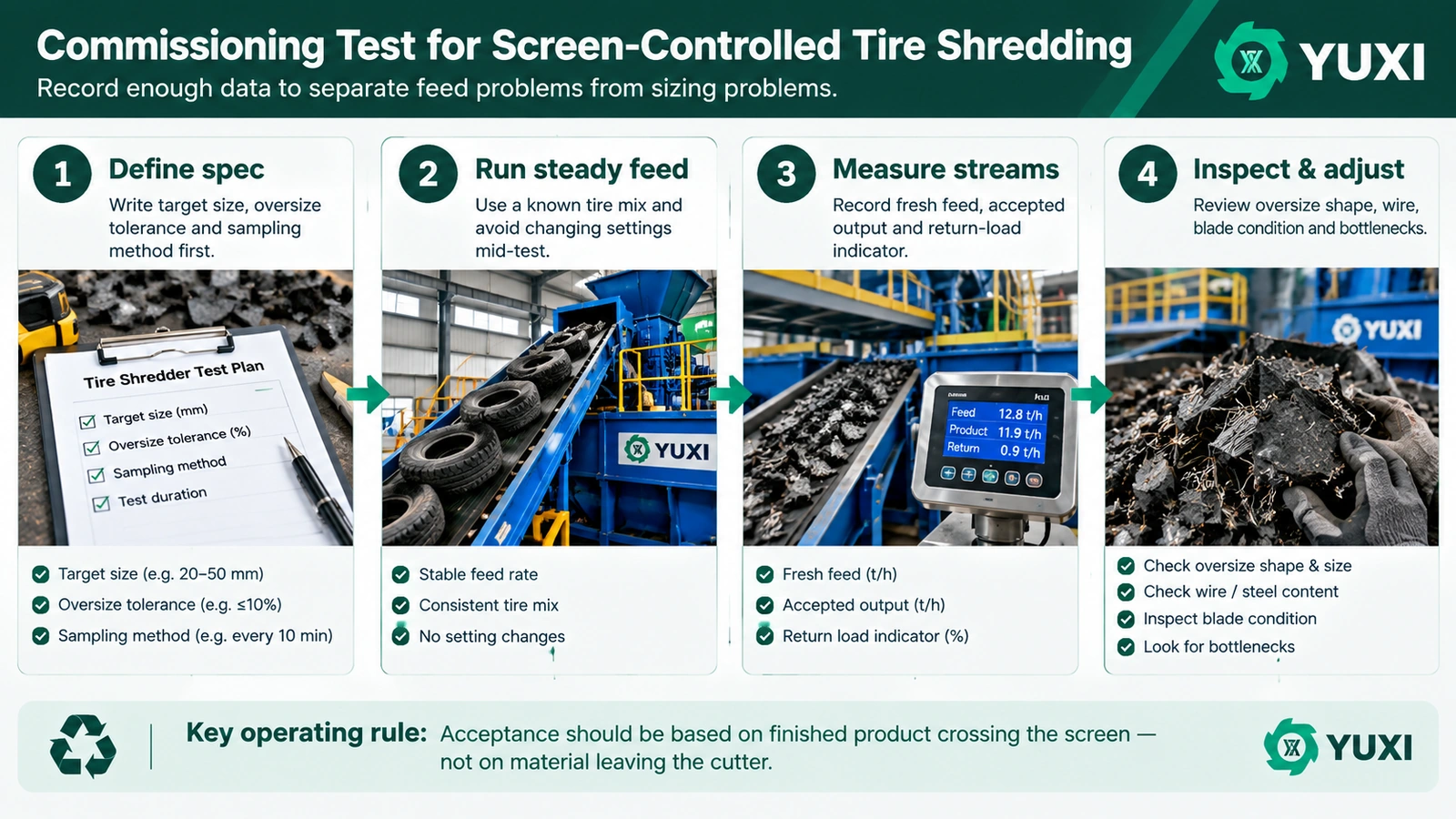
- Write the acceptance rule. Define target chip size, allowed oversize, exposed-wire requirement if relevant, and the method used to judge a sample.
- Record the feed. Note passenger/truck/other tire shares, approximate tire size range, bead-removal status, moisture or heavy dirt, and any known foreign material.
- Stabilize the line. Bring conveyors, shredder and return system to normal operation before starting the timed test. Avoid changing screen settings during the measured period.
- Measure fresh input once. Do not add returned oversize to fresh feed. Returned material is internal circulation.
- Measure accepted product. Weigh the material that actually crosses the product boundary during the timed run.
- Track return duty. Use a belt scale if available, or a consistent return-load indicator. Record motor current and reverse events at the same time.
- Take representative samples. Sample across the run, not only from the best-looking pile at the end.
- Inspect after the run. Check screen condition, transfer points, cutter chamber, wire accumulation and abnormal heating before changing settings.
A useful acceptance sheet reports accepted t/h together with the product specification. “5 t/h shredder capacity” is ambiguous if the line can only make 3.5 t/h of compliant product at the requested screen. Likewise, a high gross circulation number is not evidence of higher production.
9. How Tire Type Changes Screen-Return Behavior
Passenger and truck tires should not be assumed to produce the same return ratio. Truck tires generally contain heavier reinforcement and thicker sections. They can create tougher pieces and higher cutting resistance. Mixed-feed plants should record the tire mix during performance tests because a change in feed composition can look like a screen problem.
Large OTR tires may require pre-cutting or other front-end preparation before they enter a conventional shredding loop. Trying to compensate for an oversized feed item with a tighter screen does not solve the intake problem. The cutting chamber, hopper and feed method must first accept the raw tire safely and consistently.
Bead condition matters too. Removing heavy bead wire before shredding can reduce the most concentrated steel load, but radial steel remains in the tire carcass. The correct preparation depends on the final product and equipment route. For projects that require upstream size reduction before whole-tire shredding, review the separate tire cutting machine configuration rather than forcing unsuitable tires into the shredder.
10. Do Not Use the Primary Shredder as a Fine Granulator
For crumb rubber, EPA notes that reduced tire material is classified by screens and oversize is returned to the reduction process; magnets and air separation are then used to remove steel and fabric.[1] Classification therefore remains important through multiple stages, but a primary shredder screen should not be expected to replace fine granulation or mesh classification.
If the final target is 1–5 mm crumb or rubber powder, do not ask the primary tire shredder to make that finished size. Its job is to prepare a controlled feed for subsequent liberation, granulation, steel separation, fiber separation and fine grinding. Over-reducing material in the wrong machine stage can increase wear and lower line efficiency.
11. Design Details to Confirm Before Buying
Ask for the screen opening or available screen options, but also ask how the screen is accessed, how retained material reaches the return conveyor, and what happens when the return route is full. Confirm whether the control system can pause fresh feed based on shredder load. Ask how operators safely inspect the screen and remove wrapped wire.
For the shredder itself, confirm shaft and blade arrangement, reducer torque philosophy, overload and reverse logic, lubrication points, bearing access, blade replacement method and recommended spare parts. For the return system, confirm belt width, lift height, transfer chute arrangement, motor sizing and guarding. A line with a strong shredder but an undersized return conveyor cannot maintain controlled output.
Also reserve physical maintenance space. Screens need cleaning and inspection. Conveyor head and tail pulleys need access. Blades eventually require service. A layout that places the return conveyor tightly against a wall may save floor area on a drawing but increase downtime later.
12. Operating Data Worth Keeping
A simple shift log can reveal more than a one-time catalog test. Record fresh-feed mass, accepted mass, operating hours, screen configuration, tire mix, return-load indicator, average or peak motor current, reverse count, blade hours and major stops. Add notes for unusual contamination, rain-soaked tires or a change in operator feeding method.
With those records, the plant can distinguish three different causes of low output: not enough fresh feed, excessive internal recirculation, or downstream stoppage. It can also compare a new blade set with a worn set at the same product target. This makes maintenance decisions evidence-based rather than dependent on visual impressions.
| Metric | Use | Warning pattern |
|---|---|---|
| Accepted t/h | Measures saleable or downstream-ready production. | Falls while fresh feed remains similar. |
| Return-load indicator | Shows recutting duty. | Rises without a deliberate tighter product target. |
| Motor current | Shows cutting load trend. | Rises with more reversals or lower accepted output. |
| Reverse events/hour | Tracks overload/jam frequency. | Gradual increase at the same tire mix. |
| Blade hours | Connects wear to performance. | Oversize or return load increases late in the service interval. |
13. Common Selection Mistakes
Choosing by screen opening alone. Two systems with the same nominal opening can behave differently because of cutter condition, screen geometry, loading and return design.
Demanding the smallest possible chip. Smaller is not automatically better. It can consume capacity and wear while adding no value to the receiver.
Counting return material as production. Returned oversize has already been counted as fresh input. Adding it again inflates the apparent throughput.
Ignoring the return conveyor. A correctly sized shredder can still be limited by a narrow belt, poor transfer or steel snagging.
Testing with an easy tire mix. A passenger-tire demonstration does not prove the same accepted capacity on a truck-heavy feed. Commissioning material should represent the intended project.
Using a short visual test as acceptance. Product samples, accepted mass and timed operating data are stronger evidence than a few minutes of visually attractive discharge.
14. What Makes a Good Screen-Return Configuration?
A good configuration is not the one with the most recirculation. It is the one that produces the required size at a stable accepted rate with manageable wear and power demand. The screen should reject genuinely non-compliant material, the return route should move that material without plugging, and fresh feeding should respond to the combined cutting load.
The best operating point often sits between two extremes. A very coarse screen may release too much oversize. A very tight screen may meet the product rule but sacrifice unnecessary capacity. Commissioning should find the setting that reliably satisfies the receiver while keeping return duty within a stable range.
That is also the reason equipment quotations should state the target product and feed conditions next to capacity. A buyer comparing two tire shredders should ask: “At what tire mix, screen configuration and accepted chip specification was this capacity measured?” That question is more useful than comparing motor kilowatts alone.
Tire Shredder Screen & Recirculation FAQ
Does blade thickness determine the final tire chip size?
No. Blade geometry influences the first-pass cut, but finished size is controlled by the complete cutting, screening and return loop. Irregular tire pieces can leave the cutters in different shapes, so the screen defines which material is accepted and which material returns for another pass.
Will a smaller screen always produce better output?
It can reduce oversize, but “better” depends on the receiver specification. A screen tighter than necessary can increase recirculation, wear, energy per accepted tonne and the risk of lower finished throughput.
Should returned oversize be included in shredder capacity?
Not as new production. Return material is internal circulation. For performance reporting, count fresh feed once and measure accepted product after the screen. Return load can be recorded separately as an operating indicator.
Why does oversize increase as blades wear?
Rounded or damaged cutting edges can allow rubber to stretch or tear into longer pieces before separation. More of those pieces may be retained by the screen, increasing return duty even though the screen opening has not changed.
What should be checked if the return conveyor keeps overloading?
Check whether the retained fraction has increased, then inspect belt width and speed, transfer chutes, wire snag points, screen blockage and fresh-feed surges. Determine whether the problem is excess return generation or insufficient conveying capacity before changing settings.
How should output size be verified during commissioning?
Define the acceptance method before the test, run a representative tire mix at steady conditions, measure accepted product after screening, record return duty and take representative samples across the run. Do not rely only on the nominal screen opening.
References
- U.S. EPA, Tire Crumb Q&A — screening, oversize return and downstream separation.
- ASTM International, ASTM D6700 — TDF specification and handling considerations.
- U.S. EPA, Scrap Tire Handbook — tire-shred classification equipment and return processing.
Need a Tire Shredder Sized for a Specific Output?
Send your tire type, maximum tire diameter, target accepted chip size, required tonnes per hour and downstream use. YUXI can match the shredder, screen opening, return conveyor and control logic around the product you actually need.