




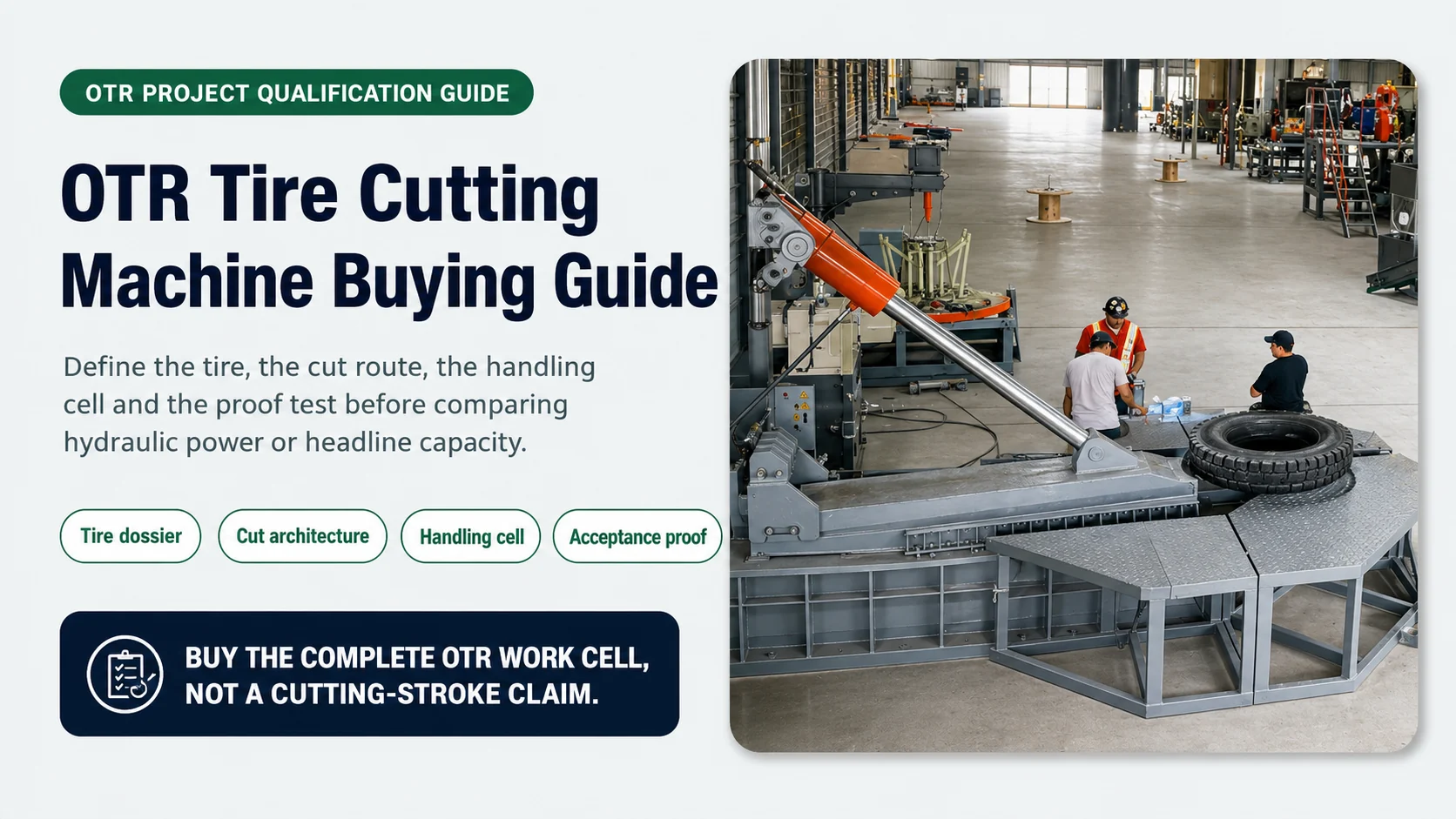
Quick Answer
Contents
- OTR is not one tire size
- Build the tire dossier
- Choose the processing route
- Match the machine architecture
- Design the handling cell
- Review clamp, cutter and wear support
- Measure OTR capacity correctly
- Specify safety and isolation
- Write the factory acceptance test
- Compare complete commercial scope
- Where YUXI fits
- Project scenarios
- OTR RFQ checklist
- Common buying mistakes
- FAQ
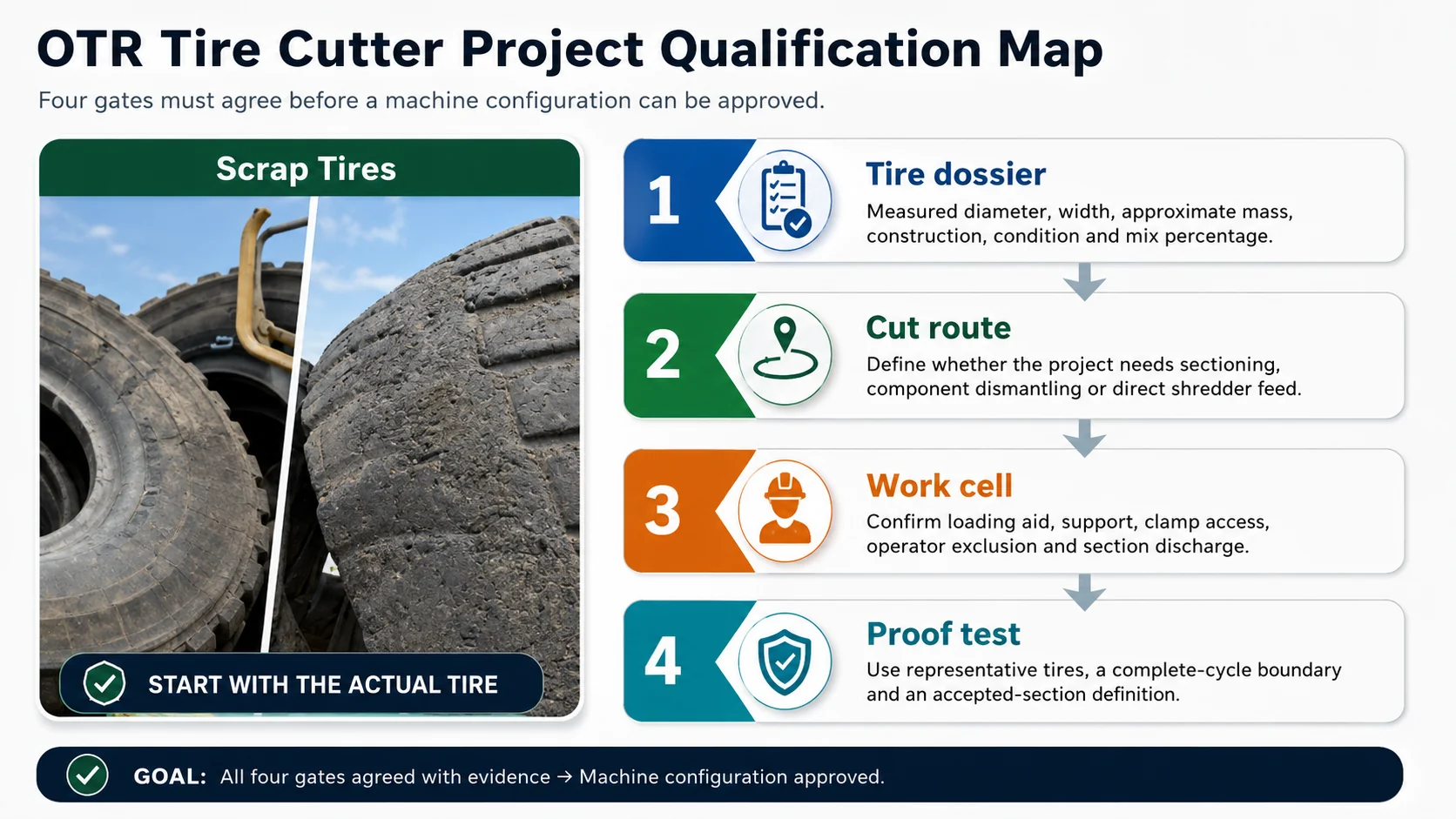
OTR Is an Application Family, Not One Tire Size
1. Build an OTR Tire Dossier Before Requesting a Model
| Dossier field | What to record | Why it changes the project |
|---|---|---|
| Tire identity | Size code, manufacturer and equipment application where known. | Helps match technical data and distinguish normal production tires from unusual stock. |
| Measured geometry | Maximum and typical outside diameter, overall width and visible deformation. | Sets the support area, machine opening, cutter travel and transport envelope. |
| Approximate mass | Scale record, supplier shipping data or a defensible estimate for each tire family. | Determines forklift, loader or crane selection, floor loading and repositioning method. |
| Construction | Radial or bias where known, steel condition, bead condition and major repairs. | Changes cutting resistance, tool load and the condition of exposed reinforcement. |
| End-of-life condition | Intact, worn smooth, split, deformed, fire-damaged, water-filled, muddy or partially dismantled. | A damaged tire may not support, clamp or rotate like a clean catalog sample. |
| Preparation state | Rim removed, bead treated, sidewall removed, or whole tire as received. | Defines the actual feed object and prevents a demonstration on easier pre-treated material. |
| Production mix | Percentage by tire family and the expected maximum tires per shift or month. | A small fraction of extreme tires can dominate handling time, downtime and cutter wear. |
2. Choose the Processing Route Before the Cutting Machine
Geometry reduction
Shredder feed preparation
Component dismantling
3. Match the Tire Dossier to the Machine Architecture
| Architecture area | OTR-specific review | Evidence to request |
|---|---|---|
| Support platform | Must support the widest and most deformed approved tire before and after opening. | Loaded-tire photos, platform dimensions and general arrangement drawing. |
| Clamp and restraint | Must control rolling, lifting, twisting and spring-like movement without requiring hands in the danger zone. | Video of the actual tire clamped through the complete cut plan. |
| Cutter opening and travel | Must reach the planned cut positions on the approved geometry, not only fit the outside diameter. | Cut-path drawing and measured finished sections. |
| Frame and guides | Must maintain alignment while resistance changes through rubber, belts, plies and bead-rich zones. | Configuration drawing, inspection points and test observation. |
| Hydraulic power unit | Must deliver the required movement under the stated duty and ambient conditions. | Documented electrical supply, cooling arrangement, reservoir access and settings. |
| Handling interfaces | Must accept the planned loader, crane, forklift, manipulator or conveyor approach. | Plan and elevation drawings with approach and service clearances. |
4. Buy the Handling Cell, Not Only the Cutter Frame
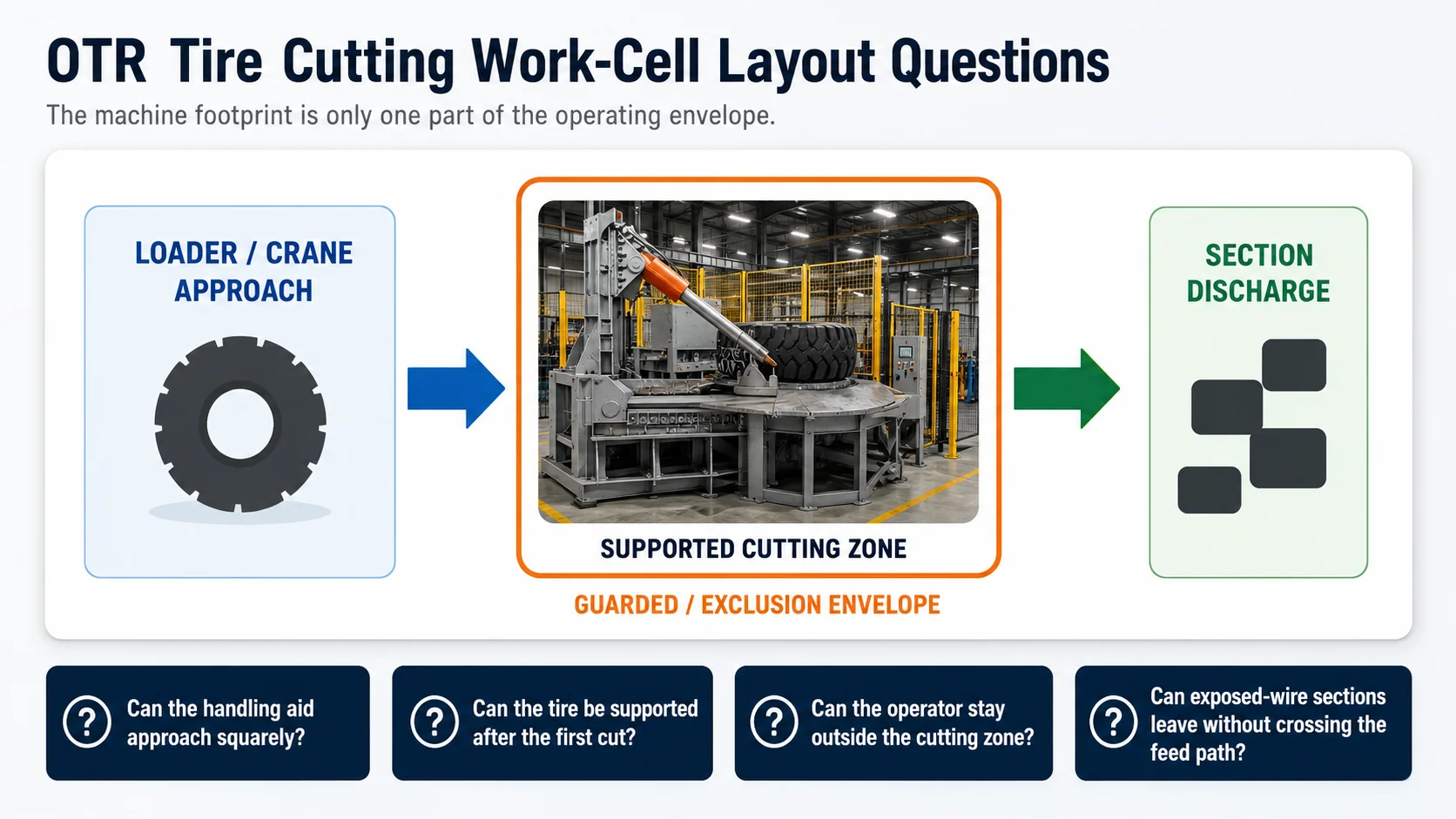
Loading and approach
After the first cut
Discharge and housekeeping
5. Review the Clamp, Cutter and Wear-Support Package
- Cutter material and geometry: identify the supplied cutter specification, cutting-edge geometry and approved tire families.
- Access: confirm how the cutter is inspected, removed, handled and installed without unsafe suspended work or body entry into an unsupported mechanism.
- Sharpening or replacement rule: request a documented decision boundary based on condition and cutting performance.
- Spare plan: list the recommended initial spare cutter, seals, hoses, filters and critical sensors or control components.
- Lead time: record whether parts are standard, drawing-controlled or custom to the machine configuration.
- Post-service setup: confirm alignment checks, fastening requirements and the test required before returning to production.
| Cycle element | Record | Common hidden delay |
|---|---|---|
| Pickup and approach | Time from agreed staging point to supported cutting position. | Loader travel, rigging, tire cleaning or poor approach alignment. |
| Position and restrain | Time until the approved safe operating state is reached. | Repeated centering, clamp correction or unstable contact. |
| All required cuts | Every advance, retract and approved repositioning step. | Off-camera second stroke, incomplete separation or manual correction. |
| Section removal | Time until all accepted sections reach the stated discharge zone. | Snagged wire, overloaded bin or crossing material routes. |
| Reset | Time until the cell can accept the next tire. | Housekeeping, tool clearing, guard reset or operator travel. |
7. Specify Normal-Operation Safety and Maintenance Isolation
Normal operation
- guarding or safeguarding around the cutting and clamp zones;
- control location with visibility of the work cell;
- defined reset behavior after a stop or guard opening;
- emergency-stop and communication arrangements;
- operator exclusion from the loader, cutting and discharge paths.
Service and maintenance
- identified electrical, hydraulic and mechanical energy sources;
- energy-isolating devices suitable for the site procedure;
- method to relieve or restrain stored hydraulic and gravitational energy;
- blocking or support for raised moving parts;
- documented cutter-change and jam-clearing procedures.
8. Write an OTR-Specific Factory Acceptance Test
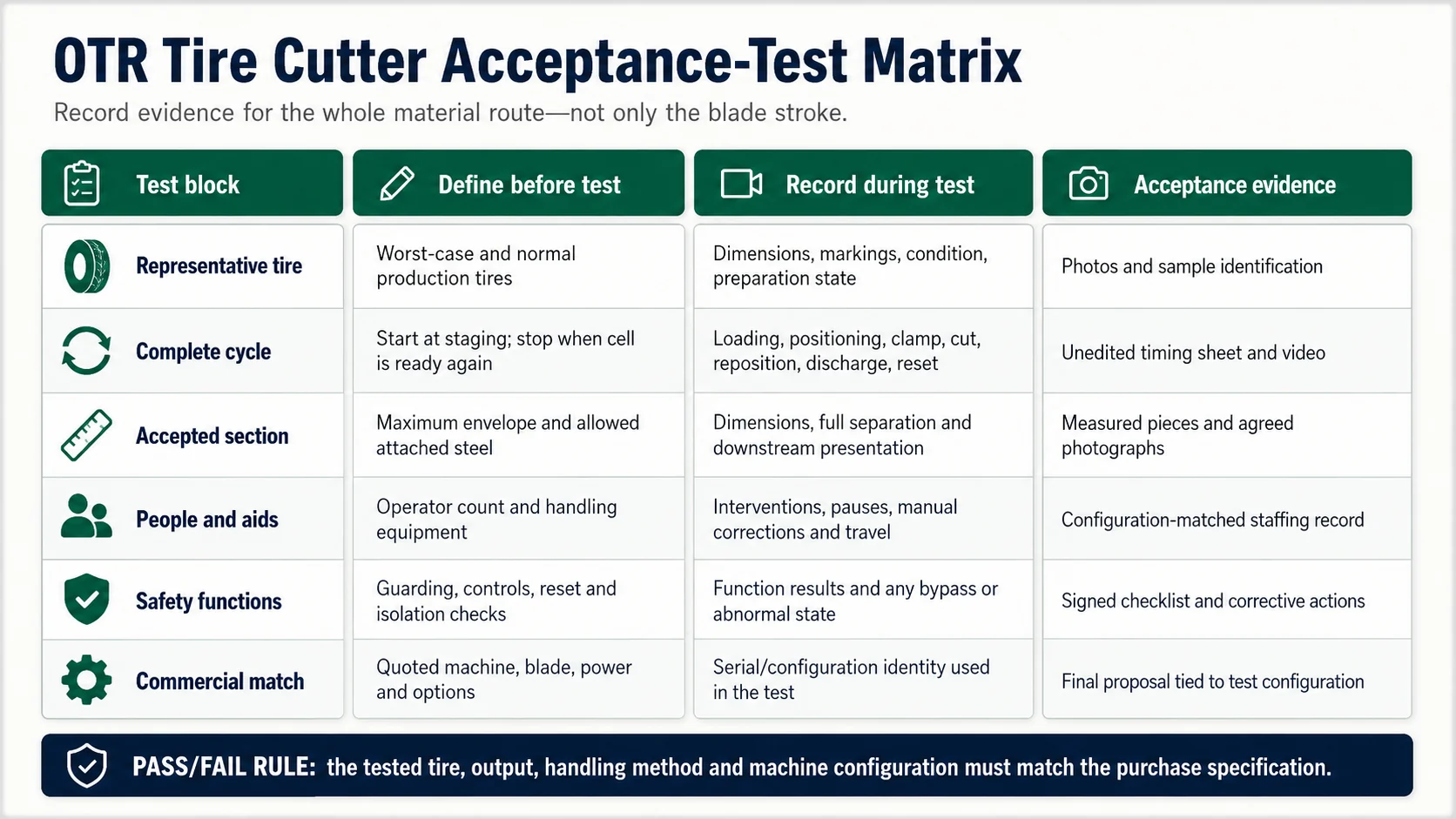
Minimum test definition
- identified worst-case and normal production tires;
- documented preparation state, including rim and bead condition;
- agreed cut plan and accepted-section envelope;
- defined staging, cycle start, cycle stop and permitted interruptions;
- stated operator count and handling equipment;
- confirmation of normal safeguards and selected safety-function checks;
- unedited complete-cycle video, timing sheet and measured output photographs;
- machine configuration and options tied to the final proposal.
9. Compare the Complete Commercial Scope
| Scope block | Confirm in writing | Why it matters |
|---|---|---|
| Machine and options | Approved tire range, cutter, clamp, controls, guards, power unit and handling interfaces. | Prevents a successful test option from disappearing from the final supply. |
| Documents | General arrangement, foundation data, electrical and hydraulic documents, manuals and parts list. | Controls installation readiness and future maintenance. |
| Freight and delivery | Packing split, dimensions, mass, Incoterm, insurance and unloading responsibility. | Large structures may create significant logistics and assembly work. |
| Site works | Foundation, anchoring, power cable, hydraulic oil, lifting equipment and guarding interfaces. | These costs may sit outside the equipment price. |
| Commissioning | Remote or on-site support, duration, travel responsibility, language and training scope. | A custom OTR cell often needs configuration-matched startup support. |
| Acceptance and warranty | FAT/SAT criteria, exclusions, warranty start, response method and parts responsibility. | A general warranty cannot replace a measurable application acceptance rule. |
10. Where the YUXI Tire Cutting Machine Fits
11. Three OTR Project Scenarios
| Project | Likely cutter role | Procurement focus | Do not assume |
|---|---|---|---|
| Recycler with mixed truck, agricultural and occasional OTR tires | Create a separate oversize route while ordinary tires bypass the cutter where approved. | Changeover, staging, handling aids and separate capacity data by tire family. | That every tire should pass through the slowest front-end step. |
| Mine or quarry processing a known fleet tire | Dedicated sectioning cell designed around a narrow but demanding tire dossier. | Exact tire sample, loader/crane integration, cut plan, remote-site parts and acceptance evidence. | That a catalog maximum diameter proves the real fleet tire. |
| Pyrolysis or transport project accepting large sections | Reduce volume and create pieces compatible with the loading door, basket, container or handling limit. | Section mass, stacking behavior, exposed wire and loading cycle. | That four equal-looking pieces automatically satisfy the downstream interface. |
12. OTR Tire Cutter RFQ Checklist
Information to send
- tire photographs, markings and equipment application;
- minimum, typical and maximum outside diameter and width;
- approximate mass for each main tire family;
- radial/bias and reinforcement information where known;
- end-of-life condition, contamination and damage;
- rim, bead and sidewall preparation state;
- estimated tire mix and operating schedule;
- required cut result and downstream machine or loading opening;
- planned loader, crane, forklift or manipulator;
- available floor area, clear height, access doors and material routes;
- local voltage, phase and frequency;
- destination, installation support and document language.
Information to request
- written approved tire range and explicit exclusions;
- general arrangement with operation, handling and service clearances;
- support, clamp and cut-path explanation for the submitted tire;
- cutter specification, inspection method and spare-parts proposal;
- electrical, hydraulic, cooling and ambient-condition requirements;
- guarding, control and energy-isolation concept;
- complete-cycle FAT proposal and evidence package;
- packing, shipment split, site assembly and commissioning responsibilities;
- warranty terms tied to the approved material and operating conditions.
Common OTR Tire Cutter Buying Mistakes
Using only the tire size code
Approving “up to” language without the tested tire
Comparing hydraulic numbers before the cut route
Timing one stroke
Leaving the loader and crane outside the machine review
Buying a demonstration configuration and receiving a reduced scope
FAQ
What does OTR mean in OTR tire cutting machine?
In this context, OTR means off-the-road: tires used on mining, quarry, earthmoving, construction and other heavy equipment. It does not mean over-the-road trucking.
Can one standard tire cutter process every OTR tire?
No. OTR is a broad application family, not one fixed size. Final configuration depends on actual diameter, width, approximate mass, construction, condition, cut route, handling method and downstream interface.
Should I compare OTR tire cutters by hydraulic force?
Hydraulic force is only one design input. Buyers should also confirm the support table, clamp geometry, cutter path and travel, frame stiffness, blade specification, handling cell and representative full-cycle evidence.
Do OTR tires always need cutting before shredding?
Not always, but large or irregular OTR tires commonly require pre-cutting, dismantling or a customized feed route. The decision should be tested against the approved shredder opening, loading method and shaft engagement.
How should OTR tire cutter capacity be measured?
Measure accepted completed tires or accepted sections over a defined continuous test that includes loading, positioning, clamping, every required cut, repositioning, discharge and reset.
What should I send YUXI for an OTR tire cutter quotation?
Send tire photographs and markings, maximum and typical dimensions, approximate mass, tire mix, preparation state, desired cut result, downstream equipment, handling method, target operating schedule, power supply and workshop layout.
References and Source Notes
- Michelin, Earthmover Technical Data. Used to support the point that earthmover/OTR tires are documented through extensive size and shipping-weight tables rather than one universal OTR dimension. Source.
- U.S. Tire Manufacturers Association, “Tires 101” and “How a Tire Is Made.” Used for tire steel-belt, bead-wire and truck-ply construction context. Source.
- NIOSH/CDC, Ergonomic Guidelines for Manual Material Handling and Revised NIOSH Lifting Equation resources. Used for task-specific handling factors and the preference for engineering interventions. Source.
- U.S. Occupational Safety and Health Administration, 29 CFR 1910.212, General Requirements for All Machines. Used for point-of-operation guarding context; local legal review remains required. Source.
- U.S. Occupational Safety and Health Administration, Control of Hazardous Energy (Lockout/Tagout) overview and 29 CFR 1910.147. Used for electrical, mechanical and hydraulic energy-control context. Source.
- U.S. EPA and SEMARNAT, Scrap Tires: Handbook on Recycling Applications and Management for the U.S. and Mexico. Background source for scrap-tire processing terminology and route-dependent recycling applications. Source.