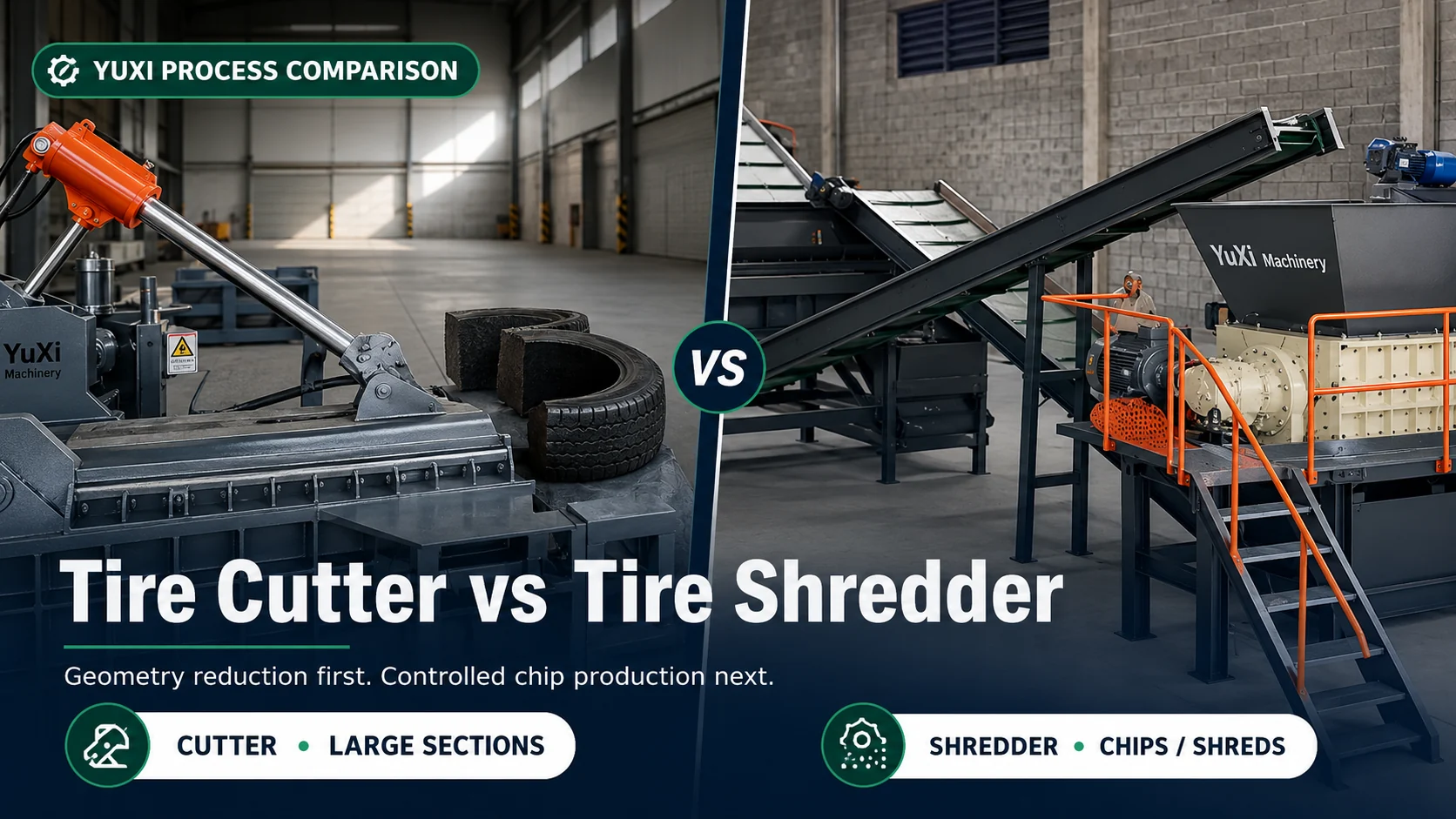
Both tire cutting machines and tire shredders use cutting force,but they solve different plant problems.A part that turns oversized tires into manageable parts.Another turns the tire or part into rough shreds or controlled chips
The machines are often discussed as alternatives. In many heavy-tire projects, they are consecutive process stages.
Two quotations can describe the same pile of waste tires and still recommend very different equipment. One supplier suggests a hydraulic tire cutter. Another sends a dual-shaft shredder layout. The buyer may assume the machines compete for the same job because both visibly cut rubber. That is the wrong comparison.
The useful question is not which machine cuts harder. It is what material must enter the stage, what must leave it, and whether the next machine can accept that result. Once those boundaries are defined, the difference becomes straightforward.
Quick Answer
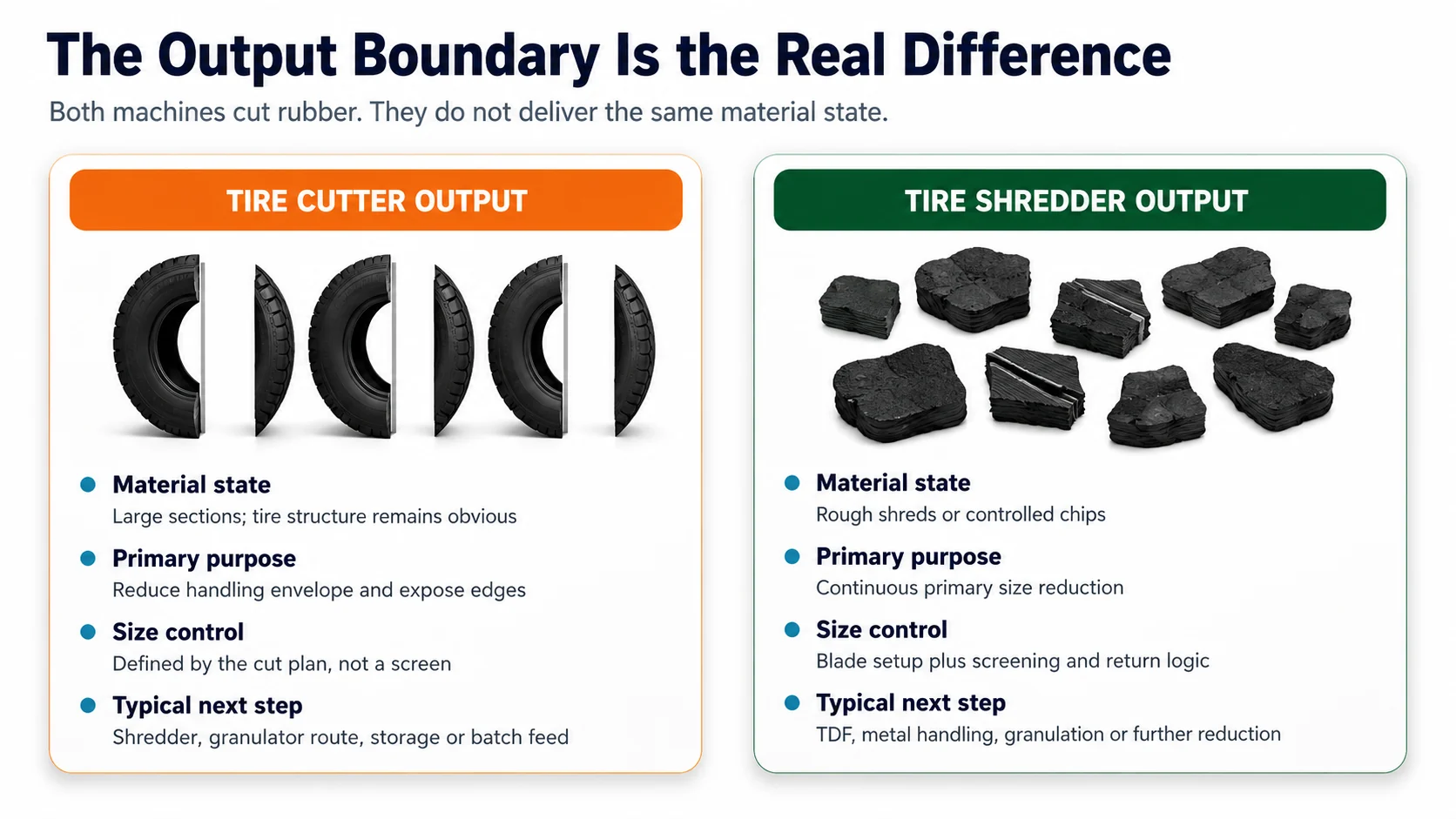
A tire cutter makes a small number of deliberate cuts and leaves large tire sections. A tire shredder continuously pulls in whole tires or prepared sections and produces rough shreds or controlled chips. Choose a cutter when the first problem is tire size, weight, stiffness or feed geometry. Choose a shredder when the required result is size-reduced material for TDF, separation, granulation or another downstream process. Large OTR, agricultural and some truck-tire projects may need both.
The Practical Difference: Geometry Reduction vs Material Reduction
A hydraulic tire cutter is mainly a geometry-control machine. It takes a tire that is difficult to lift, position or feed and converts it into sections with a smaller handling envelope. The tire structure is opened, but it remains recognizable. Steel cord, bead regions, tread and sidewall are still combined in large pieces.
A tire shredder is a continuous material-reduction machine. Counter-rotating shafts grip the tire or prepared section, shear it repeatedly and discharge rough shreds or chips. When screening and a return conveyor are part of the configuration, oversized pieces are recirculated until they meet the accepted range.
In practice, the distinction is visible at the discharge point. A cutter operator can count the sections. A shredder operator is managing a material stream.
A useful wording rule
Call it a cutter when the output specification is a section envelope or cut plan. Call it a shredder when the output specification is a chip or shred range, often supported by screening and recirculation.
Tire Cutter vs Tire Shredder Comparison Table
Comparison point
Tire cutter
Tire shredder
Buyer implication
Primary job
Change tire geometry and reduce the handling envelope.
Reduce tires or sections into a continuous stream of shreds or chips.
State the required discharge material, not only the machine name.
Typical line position
Front-end preparation before shredding, selected batch feeding, storage or transport.
Primary size reduction before screening, metal handling, granulation or other downstream stages.
The cutter may precede the shredder; it does not automatically replace it.
Typical input
Whole truck, all-steel radial, agricultural, machinery or OTR tires that are difficult to feed directly.
Whole approved tires, truck tires, mixed tires or pre-cut sections, depending on the tested configuration.
Use the largest and hardest approved tire as the acceptance reference.
Cutting pattern
Discrete hydraulic shear strokes with repositioning between cuts.
Repeated low-speed, high-torque shearing between rotating shafts.
Stroke time and shredding throughput are not comparable capacity metrics.
Output
Large, irregular or defined tire sections.
Rough shreds, TDF chips or rubber-chip feedstock.
A cutter cannot produce screened chips by itself.
Size control
Cut plan, operator positioning and required maximum section envelope.
Blade arrangement, chamber design, screen and return system where supplied.
Ask how oversize is handled at each stage.
Material handling
Heavy individual objects; lifting, rotation and discharge dominate the work cell.
Continuous or batch-fed material stream; conveyors and hopper presentation dominate.
Layout should be reviewed as a complete cell or line.
Capacity expression
Accepted tires or sections per complete cycle or shift.
Mass throughput at a defined feed and accepted discharge condition.
Do not compare “tires per hour” with “tons per hour” without a common test boundary.
Common reason to add it
The tire cannot enter or engage the next machine safely and consistently.
The project needs controlled size reduction for a market or downstream process.
Each machine should solve a measured constraint.
Why the Output Boundary Matters More Than the Blade
Buyers often focus on the visible cutting action because it is easy to compare in a short video. The blade descends, or the shafts rotate, and the tire breaks. However, the commercial value of the stage appears after the cut.
Large sections may be exactly what a project needs. A batch-loading opening may accept quartered tires. A storage or transport plan may only need the ring opened. A giant OTR casing may need sectioning before any other practical movement is possible. In these cases, asking the cutter to make chips would add machinery that the next process does not require.
That is not always true. TDF users, magnetic separation systems, granulators and rubber-powder lines normally need a more controlled material stream. The U.S. EPA notes that many combustion units require tires to be reduced in size and may also require de-wiring. Its 2020 scrap-tire fact sheet further explains that simple shredding or quartering alone may not constitute sufficient processing for specific fuel-status purposes; sorting and wire removal may also be relevant to the end user’s needs.12
This is why “it cuts the tire” is an incomplete machine comparison. The accepted output defines the process.
Large sections preserve much of the tire structure; shredder output behaves as a bulk material stream for the next stage.
When a Tire Cutter Alone May Be Enough
A cutter-only route is defensible when the accepted end point is a large section and no downstream stage requires chips. The most common logic is simple: the project has a handling or loading problem, not a chip-production requirement.
Possible cutter-only endpoints
Selected pyrolysis batch feeding, easier storage, reduced transport envelope, manual sorting of opened tire sections, or delivery to another facility that performs shredding.
What must be verified
Maximum section dimensions and weight, exposed wire condition, loading opening, lifting method, stacking behavior and whether the receiving process truly accepts irregular sections.
One export project can fail this check even when the cutter performs perfectly. The tire is divided into four pieces, but one curved tread section still bridges across the receiving hopper. The corrective action is not automatically a larger cutter. It may be a different cut plan, an additional cut, a changed hopper opening or a shredder stage.
The YUXI tire cutting machine is positioned for this type of heavy-tire preprocessing. Its public page emphasizes truck, agricultural and OTR applications, hydraulic clamping and cutting, and project-specific confirmation around tire dimensions, weight, steel content and downstream use.
When a Tire Shredder Alone May Be Enough
A direct-shred route can be the cleaner layout when the incoming tires are already within the tested feed and handling limits. Passenger tires are the obvious example, but some truck-tire projects can also feed directly when the shredder, hopper, loading method and shaft engagement have been demonstrated with representative material.
Skipping the cutter removes one machine, one transfer point and one work cell. It can also reduce manual repositioning. However, that saving is real only when direct feed remains stable across the actual tire mix—not just during a short demonstration with a light, regular casing.
Direct shredding is more credible when:
The maximum tire fits the opening; the handling tool can present it consistently; the shafts engage without repeated bridging or bounce; the approved steel condition is within the shredder design; and the accepted output is produced without abnormal recirculation or intervention.
YUXI describes its tire shredder machine as a twin-shaft system for whole-tire pre-shredding, truck-tire size reduction, TDF preparation and rubber recycling lines. The disc-screen return layout is important here because it separates feed acceptance from output acceptance: a tire may enter successfully, yet still require recirculation before the material reaches the target range.
When the Recycling Line Needs Both Machines
The combined route is used when two constraints exist at the same time. First, the incoming tire is not a stable shredder feed. Second, the project still requires chips or rough shreds rather than large sections.
Large OTR tires make the logic easy to see. Their diameter, width, mass and steel-reinforced structure can make direct presentation impractical. Cutting opens the ring and creates smaller units that can be lifted and oriented. Shredding then performs the repetitive material reduction that the cutter was never intended to provide.
Mixed yards can need the same arrangement even when giant tires are a small percentage of volume. Surprisingly, the rarest tire can control the layout. A direct-feed shredder may handle 90 percent of the stream, while the remaining agricultural or OTR casings require a separate cutter route. The line does not necessarily need every tire to pass through the cutter; it needs a defined routing rule.
This parallel-routing approach is less visually simple than one straight flowchart, but it often fits real collection streams better.
Three Practical Project Scenarios
Scenario 1: Passenger tires for TDF chips
The tires fit the shredder opening, the loading system presents them consistently and the target is a controlled chip stream. A cutter adds handling without solving a measured constraint. The stronger starting point is a shredder-based line with the required screening and metal-handling plan.
Scenario 2: Mixed truck, agricultural and OTR tires for further recycling
Most truck tires may be direct-feed candidates, but the agricultural and OTR fraction is too wide, heavy or irregular. The plant uses a routing decision at receiving. Standard tires go to the shredder. Oversized tires are sectioned first, then rejoin the shredder feed. In our experience, this is where a layout drawing and material-handling simulation become more useful than a generic “whole tire” claim.
Scenario 3: Large tires for a batch process that accepts sections
The receiving process does not require TDF chips or granulator feed. It only requires the tire to fit a door, basket or loading envelope. A cutter may be sufficient. The acceptance test should measure the resulting section envelope and complete handling cycle—not imply that the output is shredded material.
What Goes Wrong When the Wrong Machine Is Used
Expecting a cutter to make final chips
The operator adds more cuts, handling time rises and section size remains irregular. There is no continuous gripping, screening or return loop to create a bulk chip specification.
Forcing oversized tires into a shredder
Feeding becomes inconsistent. Tires can bridge, bounce or enter at an unfavorable angle. The handling tool and hopper may become the bottleneck before shaft torque is even relevant.
Adding both without a routing rule
Every tire is cut even though many could feed directly. Floor space, labor and transfer time increase without a corresponding process benefit.
Comparing capacities as if they were identical
A cutter claim may count completed tires; a shredder claim may measure mass flow. Different tire mixes, cycle boundaries and recirculation make the headline numbers non-comparable.
The existing Tire Shredder vs Tire Crusher guide addresses a different mistake: confusing primary whole-tire shredding with downstream secondary crushing or granulation. Here, the error happens one stage earlier—confusing feed preparation with primary shredding.
The Handling and Safety Problems Are Different
A cutter cell is dominated by individual heavy objects and a hydraulic point of operation. The operator or handling device must load, restrain, reposition and remove sections without entering the cutting path or being exposed to unstable material. OSHA’s hydraulic-press guidance highlights point-of-operation hazards, heavy or slippery material handling, guarding, control placement and emergency-stop access.3
A shredder line has a different hazard pattern: an infeed hopper, rotating shafts, nip points, power transmission, conveyors and potentially a recirculation loop. The general machine-guarding requirement in 29 CFR 1910.212 calls for protection from points of operation, ingoing nip points, rotating parts and similar hazards.4
Safety boundary
This comparison is not an operating or safeguarding procedure. Final equipment selection and installation require the supplier’s machine-specific manual, applicable local law, site risk assessment, energy-isolation procedures, competent installation and authorized training.
From a layout perspective, the practical difference is that the cutter needs a controlled heavy-material work cell, while the shredder needs a guarded material-flow system. When both are used, the transfer between them must not create a new lifting, rolling or conveyor-access hazard.
How to Test a Cutter–Shredder Proposal
A comparison article should not repeat a full machine-purchasing checklist. Still, one test principle belongs here: verify the material transition between stages.
Select the largest and most difficult tire that the project genuinely intends to approve.
Record its dimensions, approximate weight, construction and condition.
When cutting is proposed, measure the completed sections and show how they are lifted, rotated and discharged.
Feed those actual sections—not a different prepared sample—into the quoted shredder configuration.
Record stable engagement, operator intervention, recirculation, accepted discharge and the final destination of the material.
Repeat the route with a representative normal-production tire, because the worst-case tire alone does not establish sustainable throughput.
A successful cutter video and a successful shredder video from separate days do not prove that the two machines form a balanced line. The interface is where many practical problems appear: section dimensions, conveyor width, loading orientation, buffer space and mismatched cycle rates.
How YUXI Equipment Fits the Comparison
YUXI’s public product information places the hydraulic cutter before shredding, granulation preparation, TDF preparation or selected pyrolysis feeding when large tires are difficult to handle directly. It places the dual-shaft shredder at the primary size-reduction stage, with a disc screen and return conveyor available to control oversize material.
That separation is useful because it avoids a universal flowchart. Small passenger-tire streams may go directly to the shredder. Heavy truck, agricultural and OTR streams may need pre-cutting. A project targeting TDF chips or rubber feedstock still needs shredding after cutting, while a section-only batch route may stop earlier.
For TDF projects, the YUXI Tire TDF Plant should be discussed around the fuel user’s accepted chip size, steel tolerance and processing requirements—not around whether a catalog calls the first machine a cutter or shredder.
YUXI configuration boundary
The public pages do not justify one universal model, tire-size limit or capacity claim for every project. Final configuration should be based on tire type and dimensions, steel condition, desired output, loading method, line layout and representative test evidence.
Final Decision Path
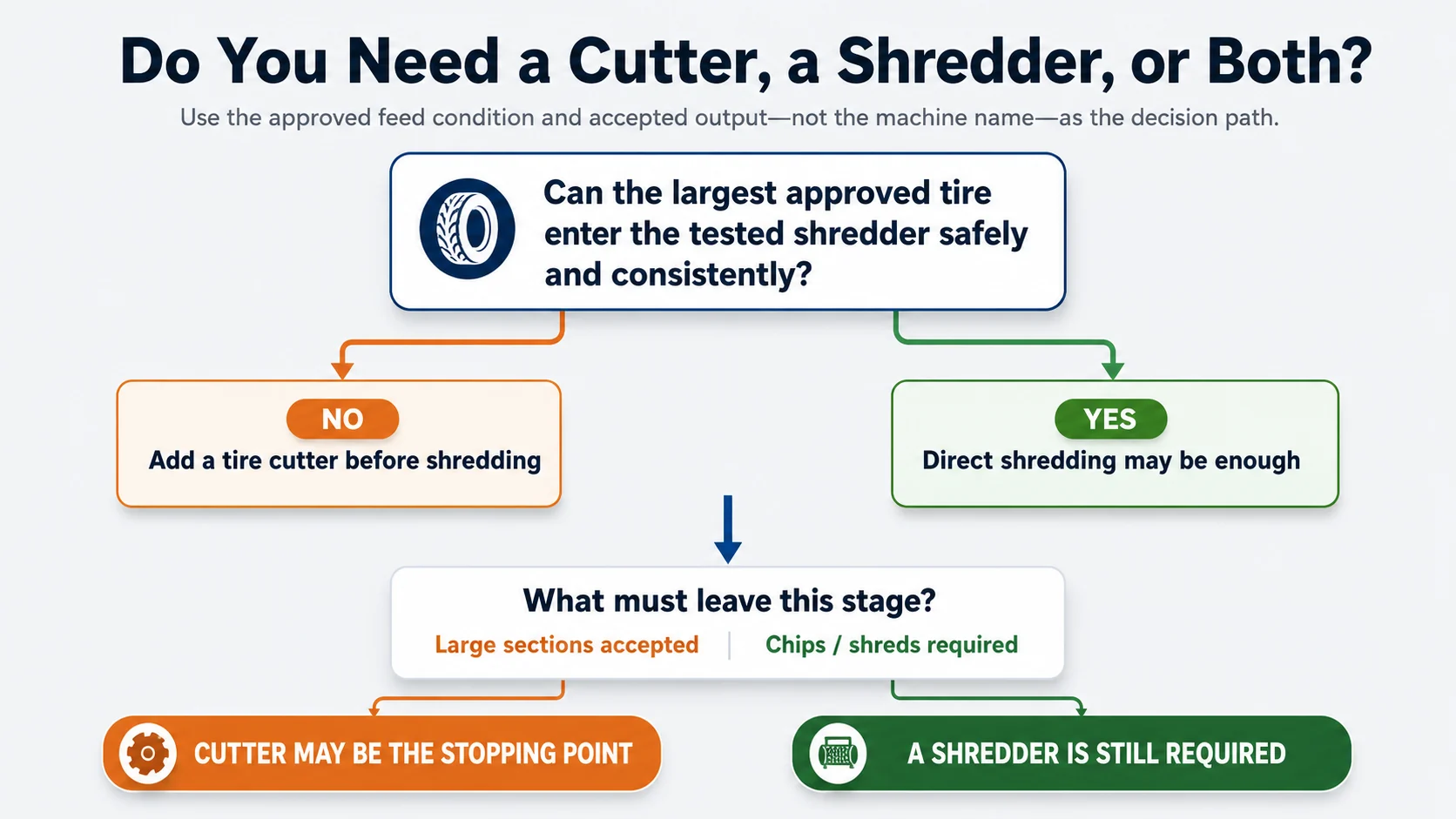
Start with feed acceptance, then define the output required from the stage.
The shortest defensible decision is:
Use a tire cutter when the incoming tire is too large, heavy, stiff or irregular for the next approved handling or feeding step, and large sections solve that constraint.
Use a tire shredder when whole approved tires or prepared sections must become rough shreds or controlled chips.
Use both when oversized tires first need sectioning and the process still requires shredded material.
Use neither automatically. Every machine should solve a defined input, output or handling boundary.
A buyer should therefore send two statements with an RFQ: “This is the hardest tire the line must accept,” and “This is the material the next stage must receive.” Those two statements usually decide the cutter-versus-shredder question more reliably than a catalog comparison.
Confirm the Correct Front-End Route
Send YUXI representative tire photos, maximum dimensions and weight, tire mix, steel condition, required output, downstream process, loading method, capacity target and workshop layout. Ask whether the project should use direct shredding, pre-cutting only or a cutter–shredder route.
Frequently Asked Questions
Is a tire cutter the same as a tire shredder?
No. A tire cutter makes a limited number of large sectioning cuts to change the tire’s geometry and handling envelope. A tire shredder continuously shears whole tires or prepared sections into rough shreds or controlled chips for downstream processing.
Can a tire cutter replace a tire shredder?
Only when large cut sections are the accepted end point for storage, transport, selected batch feeding or another process. It cannot replace a shredder when the project requires TDF chips, screened rubber pieces or feed for granulation.
Do I always need a tire cutter before a tire shredder?
No. A shredder designed and tested for the project’s passenger or truck tires may accept them directly. A cutter becomes relevant when the largest tires are too large, stiff, heavy or irregular for safe and stable direct feeding.
When should a project use both machines?
Use both when oversized truck, agricultural or OTR tires must first be converted into feedable sections and the final route still requires rough shreds, TDF chips or smaller material for separation and granulation.
Which machine should be tested first?
Test the complete material route. Demonstrate the hardest approved tire through cutting when required, then feed the resulting section into the quoted shredder and verify accepted discharge, recirculation, handling and operating conditions.
What information should I send YUXI?
Send representative tire photos, maximum dimensions and weight, tire family and steel condition, desired output, downstream use, capacity target, loading method, power supply and workshop layout. State whether large sections are acceptable or chips are required.
References and Source Notes
U.S. Environmental Protection Agency, Tire-Derived Fuel. Size reduction, whole-tire use and de-wiring depend on the combustion unit.
Marie has 8+ years of experience in tire shredding and recycling equipment,with a focus on tire shredders,rubber recycling machines,TDF production,rubber crumb processing,and complete tire recycling systems.