A supplier’s fastest cutting video is not a production capacity test. This guide shows how to calculate tires per hour, mixed-tire output and sustainable shift capacity without inventing a universal YUXI number.
Capacity should cover the complete tire cycle, not only the moment when the cutter contacts the bead area.
“How many tires can it process per hour?” sounds like a simple purchasing question. For a tire bead cutter, the answer changes with tire diameter, bead wire strength, required cut, worktable adjustment, loading method, operator rhythm and the next machine in the recycling line.
YUXI’s waste tire bead cutting machine product information therefore does not present one universal capacity number. It states that typical output is commonly evaluated in tires per hour or minutes per tire and should be matched with downstream tire shredder capacity. Final parameters are confirmed around tire size, bead wire strength, power supply and production layout.
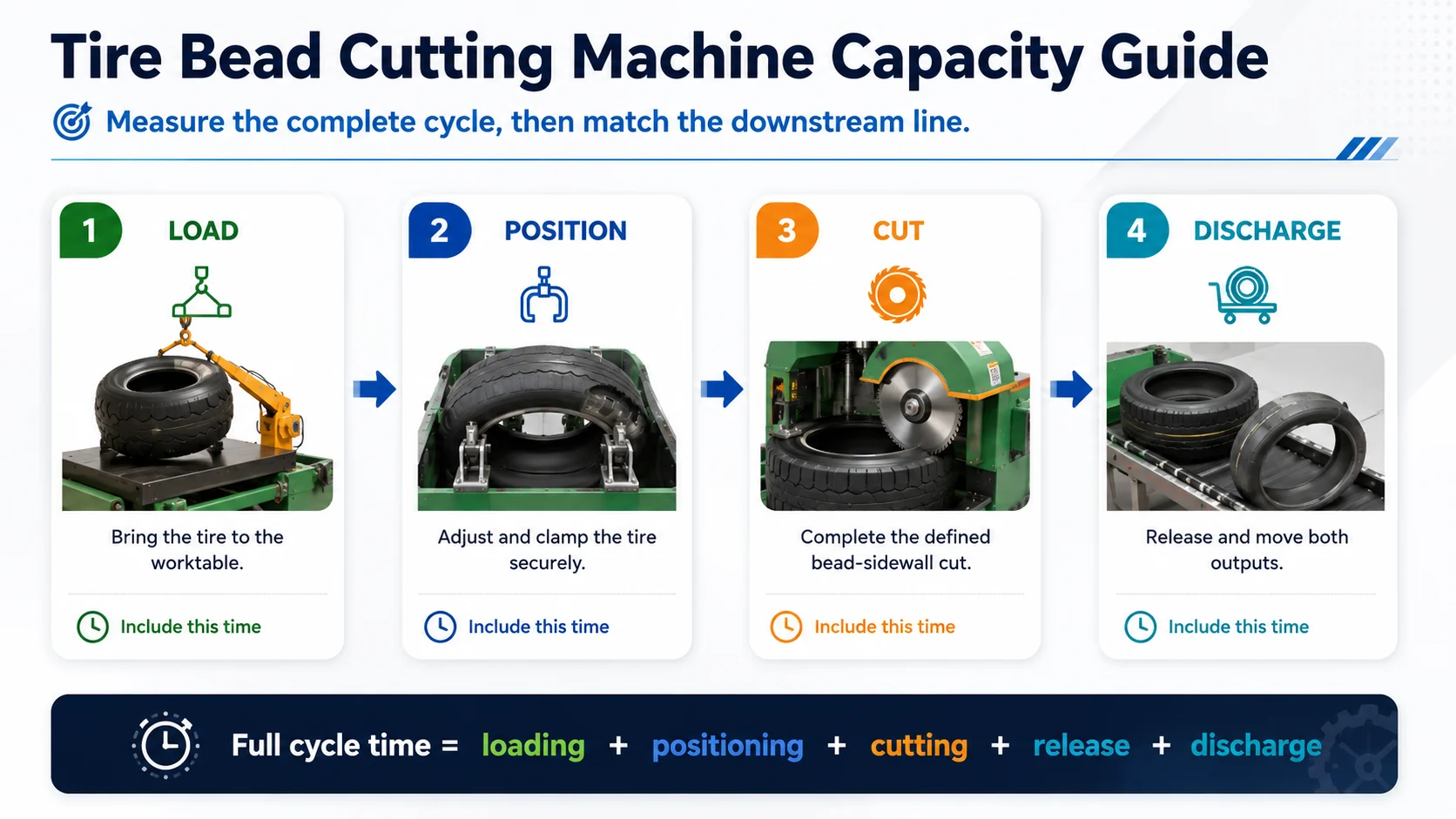
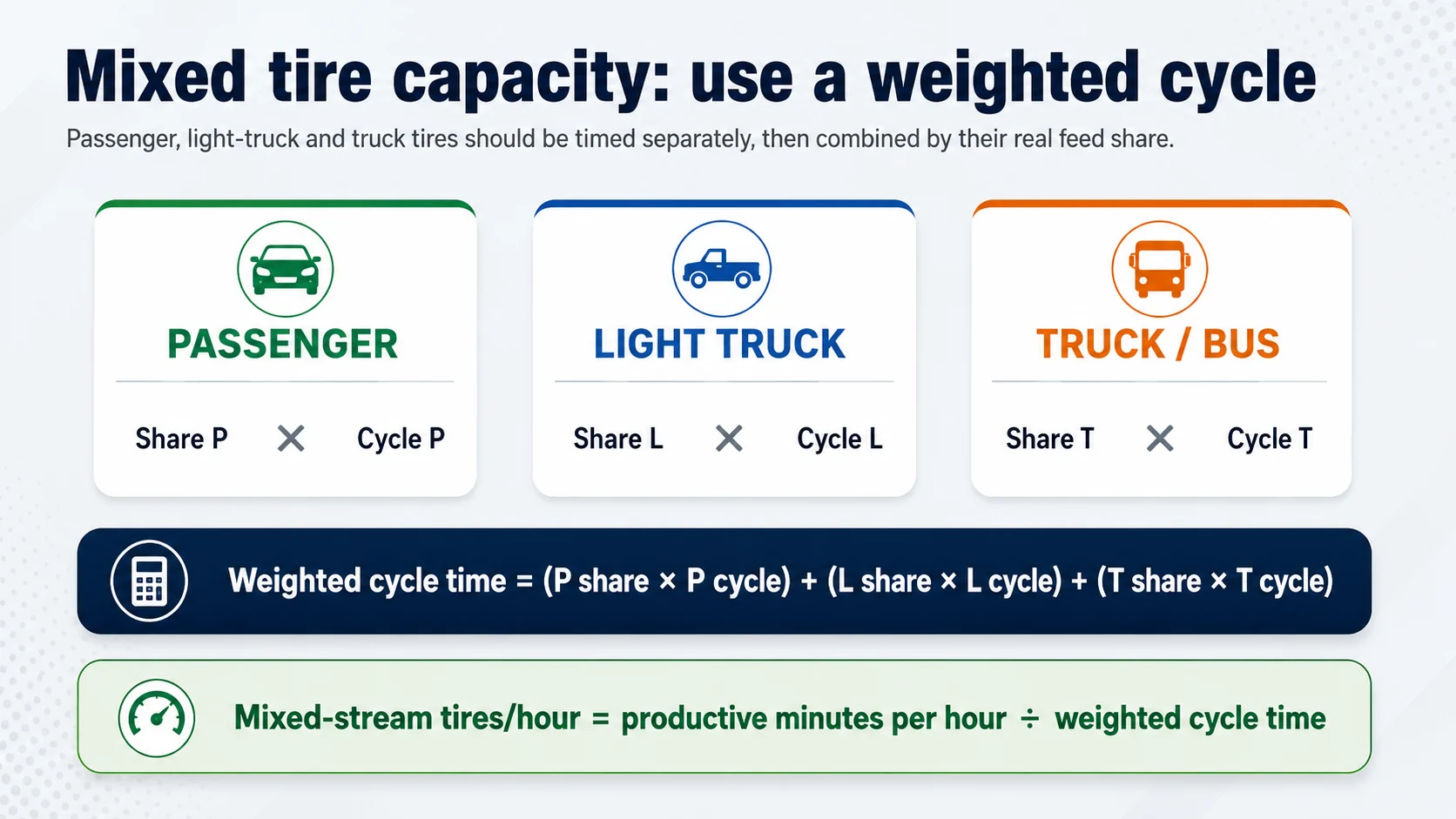
Calculate capacity from full cycle time, not cutting time. Start timing when the operator begins handling an unprocessed tire. Stop when the main tire body and removed bead-sidewall section are discharged to their correct collection points. Test passenger, light-truck and truck tires separately, then weight the results by the actual feed mix.
Theoretical tires per hour = 60 ÷ full cycle minutes per tire
Sustainable shift output = productive shift minutes ÷ weighted full cycle minutes per tire
“Productive shift minutes” should be measured or planned after subtracting breaks, inspection, cutter checks, tire-size changeovers, cleaning, planned maintenance and waiting caused by material handling or the downstream process. Do not insert a generic utilization percentage unless the buyer has a documented reason for it.
Search results show why buyers need this framework. Published supplier claims range from tens of tires per hour to much higher peak figures, but they often describe different machines, tire sizes, cuts, loading methods and test conditions. Those numbers are useful for understanding search intent, not for creating an unverified YUXI specification.
1. Separate four different capacity numbers
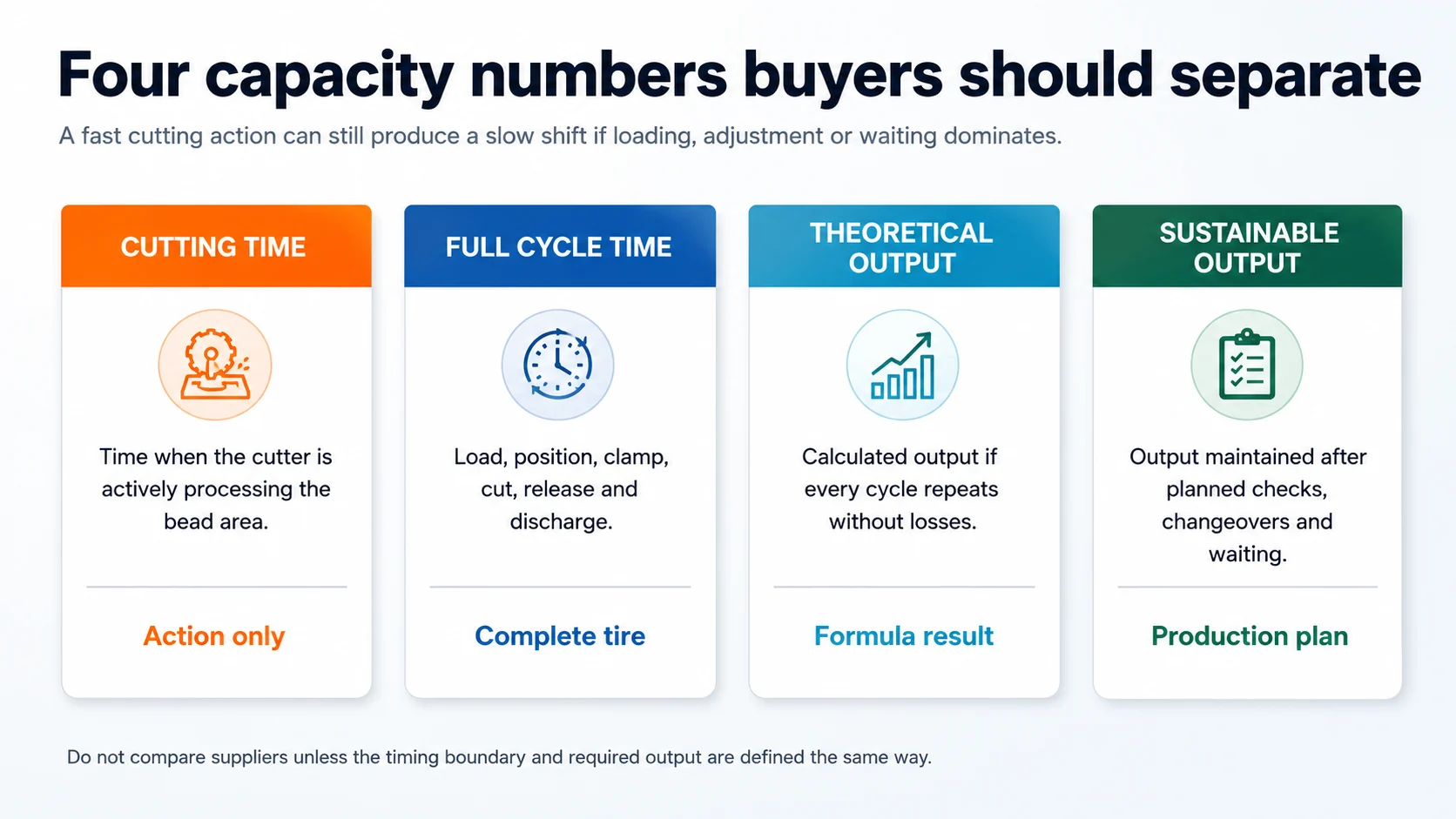
Cutting time, full cycle time, theoretical output and sustainable output answer different questions.
Capacity term
What it includes
What it excludes or can hide
Best use
Cutting time
Time when the cutter actively travels through the sidewall and bead area.
Loading, positioning, clamping, release, discharge and rework.
Comparing the cutting action under controlled conditions.
Full cycle time
The complete sequence from an unprocessed tire to separated outputs in the correct collection areas.
Long-term breaks, maintenance and upstream/downstream waiting.
Calculating theoretical tires per hour.
Theoretical output
Sixty minutes divided by full cycle minutes per tire.
Shift losses and changing tire mix unless specifically modeled.
Initial equipment comparison.
Sustainable output
Measured or planned productive minutes divided by weighted cycle time.
Unexpected failures outside the defined operating plan.
Staffing, buffer design and production commitments.
The YUXI product page describes a semi-automatic process: the operator loads and positions the tire, fixes the structure and tires during the rotation process,the alloy cutter follows the circumference of the ball bead,and the processed tire body and the side wall part of the ball bead are discharged respectively.Each stage will affect the achievable output.
2. Define full cycle time before doing any calculation
Use one timing rule for every supplier, operator and tire type. Without a shared start and stop point, a “two-minute cycle” could mean a two-minute cutting action, a two-minute single-side cut or a two-minute complete tire process.
Recommended timing boundary
Start: the operator begins moving or lifting the next unprocessed tire toward the worktable.
Stop: the main tire body and removed bead-sidewall section are placed in their defined discharge or collection positions, and the workstation is ready for the next tire.
Full cycle components
Move the tire from the input buffer to the worktable.
Adjust the positioning structure for the current tire diameter.
Clamp and stabilize the tire.
Start and complete the required cutting action.
Turn or reposition the tire if a second side is required.
Release the clamping mechanism.
Move the tire body and bead-sidewall output to separate collection areas.
Remove fragments or reset the station when necessary.
For heavy tires, handling can dominate the cycle even when cutting is fast. NIOSH’s Revised Lifting Equation considers object weight, hand location, travel distance, asymmetry, lifting frequency, duration and grip quality when assessing manual lifting tasks.2 The equation is not a tire-cutter capacity standard, but it reinforces the need to include handling method and repetition in production planning.
3. Calculate theoretical tires per hour
Theoretical tires/hour = 60 ÷ average full cycle minutes/tire
Use the average only after checking the distribution. A few easy passenger tires can hide repeated delays on thicker truck tires. Record median time, average time and the slowest representative cycles. Remove a data point only when the reason is documented, such as an unrelated facility interruption.
Capacity worksheet
Measured item
Buyer input
Notes
Number of representative tires tested
_____ tires
Use enough tires to include normal variation, not one demonstration tire.
Total elapsed full-cycle minutes
_____ minutes
Include all defined cycle steps.
Average full cycle time
Total minutes ÷ tires = _____ min/tire
Calculate separately by tire class.
Theoretical hourly output
60 ÷ average cycle = _____ tires/hour
Not yet a shift commitment.
Do not convert tires per hour directly into tons per hour without measured tire weights. Passenger, light-truck, truck and bus tires can differ substantially in weight. A tons-per-hour figure based on an assumed “average tire” can distort both labor and downstream line sizing.
4. Estimate sustainable shift output
A shift contains time that is not available for repetitive cutting. Sustainable output should therefore use productive minutes rather than the scheduled shift length.
Keep every deduction visible. If the plant assumes 420 productive minutes in an eight-hour shift, document why 60 minutes are unavailable. The reason may be breaks, worktable adjustment, cutter inspection, tire sorting or waiting for a forklift. Transparent deductions are more useful than a generic “85% efficiency” assumption.
Breaks
Scheduled non-production time.
Changeover
Adjustment between tire size groups.
Checks
Cutter, clamp and guard inspection.
Waiting
Material handling or downstream delays.
5. Calculate capacity for a mixed tire stream
Passenger and truck tires should not share one cycle-time assumption. YUXI notes that passenger and truck tires can require different clamping and cutter settings, while thicker bead sections require stronger cutter support and stable positioning.
Measure each tire category separately, then weight its cycle time by the real feed share.
Mixed-stream output = productive minutes ÷ weighted cycle time
The category shares must total 100%. Use the expected production mix, not the easiest test batch. If truck tires arrive in occasional large batches, calculate a mixed-shift case and a truck-heavy case. The truck-heavy case helps reveal whether loading or cutter adjustment becomes the limiting operation.
Mixed-stream worksheet
Tire category
Expected share
Measured full cycle
Weighted contribution
Passenger / SUV
_____ %
_____ min/tire
Share × cycle = _____
Light truck
_____ %
_____ min/tire
Share × cycle = _____
Common truck / bus within configured range
_____ %
_____ min/tire
Share × cycle = _____
Total
100%
—
Weighted cycle = _____ min/tire
6. Define what counts as one completed tire
Capacity is meaningless unless the required output is defined. Tire bead cutter and tire sidewall cutter are overlapping market terms, but suppliers may describe different cutting results.
Output definition
Capacity implication
Buyer verification
One sidewall or one bead-sidewall section
May require one cutting pass and no tire turning.
Confirm whether the remaining side stays on the tire body.
Both sidewalls
May require a second pass, tire turning or a different machine arrangement.
Include both sides in the timing boundary.
Complete bead ring section
Cut position and output handling may differ from a simple sidewall removal.
Approve a sample output photograph.
Clean steel bead wire
A bead cutter alone normally does not remove all surrounding rubber.
Evaluate a debeader or bead-wire separator as another stage.
For a clearer distinction between cutting and pulling bead wire, use Tire Bead Cutter vs Tire Debeader. If the project requires heavy tire sectioning rather than bead-area cutting, review the tire cutting machine route.
7. Find the real capacity bottleneck
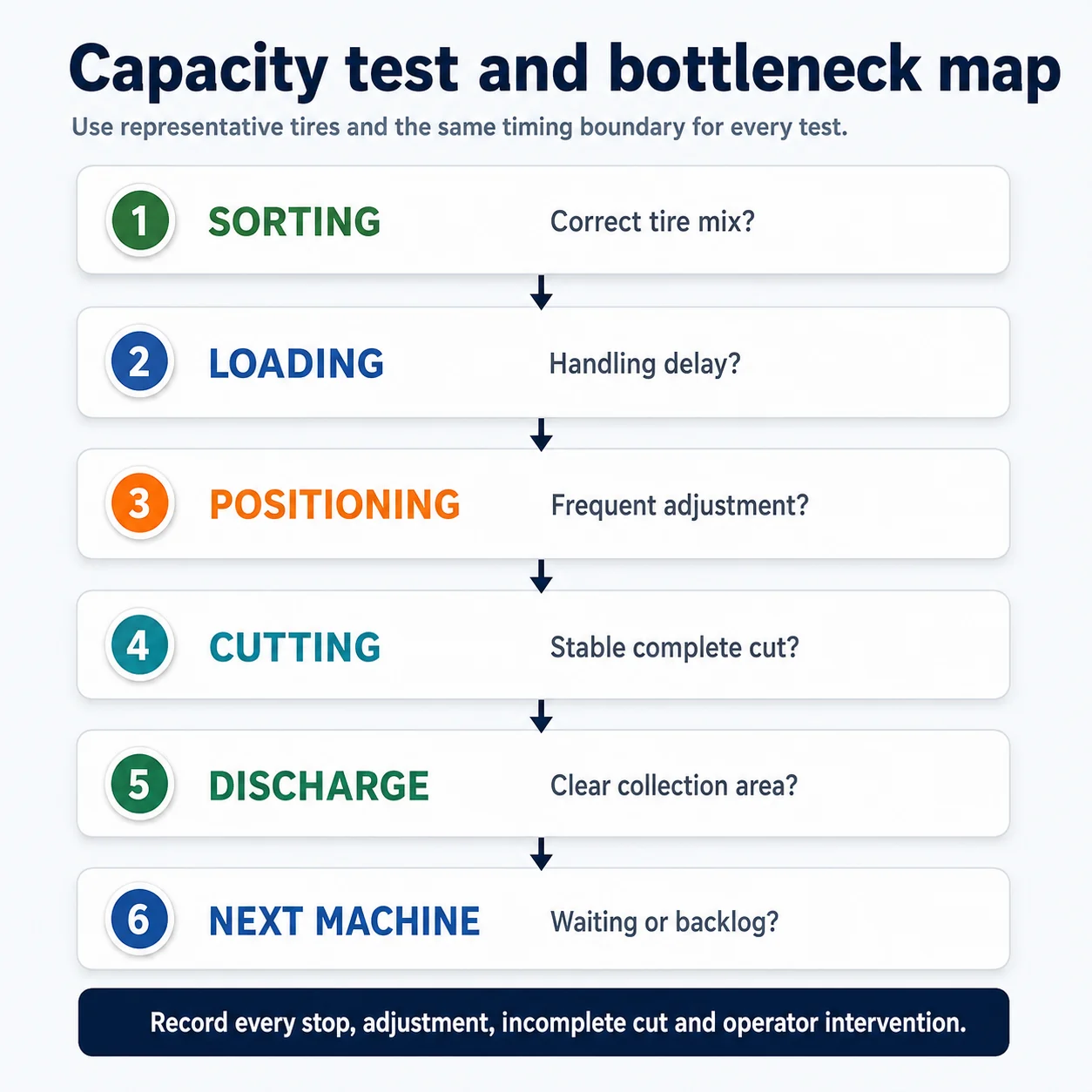
Improving cutter speed does not improve plant output when another step controls the cycle. Observe each stage and record every stop, adjustment and incomplete cut.
Capacity losses can occur before the cutting action, during discharge or at the next machine.
Possible bottleneck
Typical sign
What to test
Tire sorting
Operator repeatedly searches for a suitable tire or rejects oversized tires.
Pre-sort tires by size and construction before timing.
Loading
The cutter waits while heavy tires are moved manually or by forklift.
Compare floor-level, rack, roller and assisted-loading layouts.
Positioning and clamping
Frequent adjustment or tire movement during cutting.
Time changeover by tire category and inspect worktable stability.
Cutter condition
Longer cycles, incomplete cuts or repeated passes.
Document cutter condition at the start and end of the test.
Discharge
Processed tire bodies or bead sections accumulate near the station.
Define collection bins and removal frequency.
Downstream machine
The bead cutter stops because the next machine or buffer is full.
Test the connected line, not only the standalone machine.
8. Match bead cutter capacity with the downstream line
YUXI positions the bead cutter before tire cutting, shredding, granulation or pyrolysis pre-treatment. Its capacity should therefore be selected from the full process route.
When the next stage is a tire shredder machine, compare accepted prepared tires per hour—not only the shredder’s tons-per-hour rating. If the shredder accepts whole and prepared tires at different rates, use the actual planned feed condition. Also account for screen return, feed interruptions and the number of operators serving both machines.
Undersized bead cutter
The downstream machine waits for prepared tires, reducing utilization of a more expensive size-reduction stage.
Oversized bead cutter
Prepared tire bodies accumulate, consuming floor space and possibly creating unnecessary handling.
Use a buffer when normal cycle variation would otherwise stop either machine, but do not treat unlimited floor stock as a capacity solution. The buffer size should be based on observed arrival and consumption patterns, handling method and safe storage layout.
9. Factory acceptance test and site acceptance test
Capacity should be written into the test method, not left as a verbal “about” figure. A factory acceptance test (FAT) can verify the machine with agreed representative tires before shipment. A site acceptance test (SAT) confirms the result after installation with the buyer’s power supply, operators, handling method and layout.
Capacity test checklist
Test tire list: tire class, size, outside diameter, width, condition and bead structure.
Tire mix: passenger, SUV, light truck, truck and bus proportions.
Required output: one side, both sides or a defined bead-sidewall section.
Test quantity: enough consecutive tires to expose normal variation and adjustment time.
Timing start: clearly defined loading point.
Timing stop: outputs discharged and station ready for the next tire.
Loading method: manual, forklift, roller or other assisted handling.
Operator rule: identify who operates the machine and whether assistance is allowed.
Acceptable cut: define completeness, location and permitted remaining material.
Stops: record tool checks, adjustments, incomplete cuts and material-handling delays.
Cutter condition: new, used, sharpened or replaced during testing.
Guarding: conduct testing with the agreed safety arrangement in place.
OSHA’s general machine-guarding rule requires guarding methods to protect operators from point-of-operation, rotating-part and flying-material hazards and states that the point of operation must be guarded where exposure could cause injury.3 Capacity testing should not bypass guards or procedures to create an unrealistic peak figure.
Peak output is not acceptance output. A valid test should achieve the agreed cut using the agreed tire mix, operator arrangement, guards and handling process. A speed obtained only by skipping safe steps or leaving materials piled beside the machine should not be treated as sustainable capacity.
10. What to send YUXI for a capacity recommendation
The fastest way to obtain a meaningful capacity estimate is to send production data rather than only requesting “a high-capacity bead cutter.”
Photos of the common tires and the largest tire.
Outside diameter, width and tire class for each major group.
Send representative tire photos, size distribution, required cut, shift target, loading method and downstream equipment. YUXI can review the complete process instead of quoting an unsupported universal tires-per-hour number.
How is tire bead cutting machine capacity measured?
Capacity is commonly evaluated as tires per hour, minutes per tire or tires per shift. A reliable figure should use the full cycle from tire loading through positioning, cutting, release and discharge.
Why is cutting time different from full cycle time?
Cutting time covers only the active cutting action. Full cycle time also includes loading, positioning, clamping, release, discharge and any required tire turning or second-side operation.
Can passenger and truck tires use the same capacity figure?
No. They should be timed separately because tire size, weight, sidewall structure, bead wire strength, worktable adjustment and handling can change the full cycle.
How do I calculate capacity for a mixed tire stream?
Multiply each tire category’s share by its measured cycle time, add the results to obtain weighted cycle time, then divide productive minutes by that weighted cycle time.
What information should be included in a capacity acceptance test?
Define tire types and sizes, the required cut, number of test tires, timing start and stop points, operator and loading method, acceptable cut quality, allowed stops and how incomplete cuts are recorded.
Marie has 8+ years of experience in tire shredding and recycling equipment,with a focus on tire shredders,rubber recycling machines,TDF production,rubber crumb processing,and complete tire recycling systems.