A practical specification guide for buyers who need a tire bead cutter quotation but do not want to compare machines based only on motor power.
A useful specification sheet connects tire data, cutter design, capacity and the downstream recycling route.
When a buyer asks for “tire bead cutting machine specifications,” the supplier often receives a short message: tire cutter price? motor power? capacity? That is not enough. A bead cutter works on one of the toughest parts of a scrap tire—the steel-reinforced bead area—so the right specification depends on the tires entering the workshop and on the machine that receives the tire body next.
YUXI describes its waste tire bead cutting machine as a pre-processing machine that cuts through the sidewall and bead area before shredding, helping reduce concentrated bead-wire impact on downstream cutting equipment. That wording is important: this is not a universal catalog item with one fixed answer for every tire stream. The final configuration should be confirmed around tire size, bead wire strength, power supply and production layout.
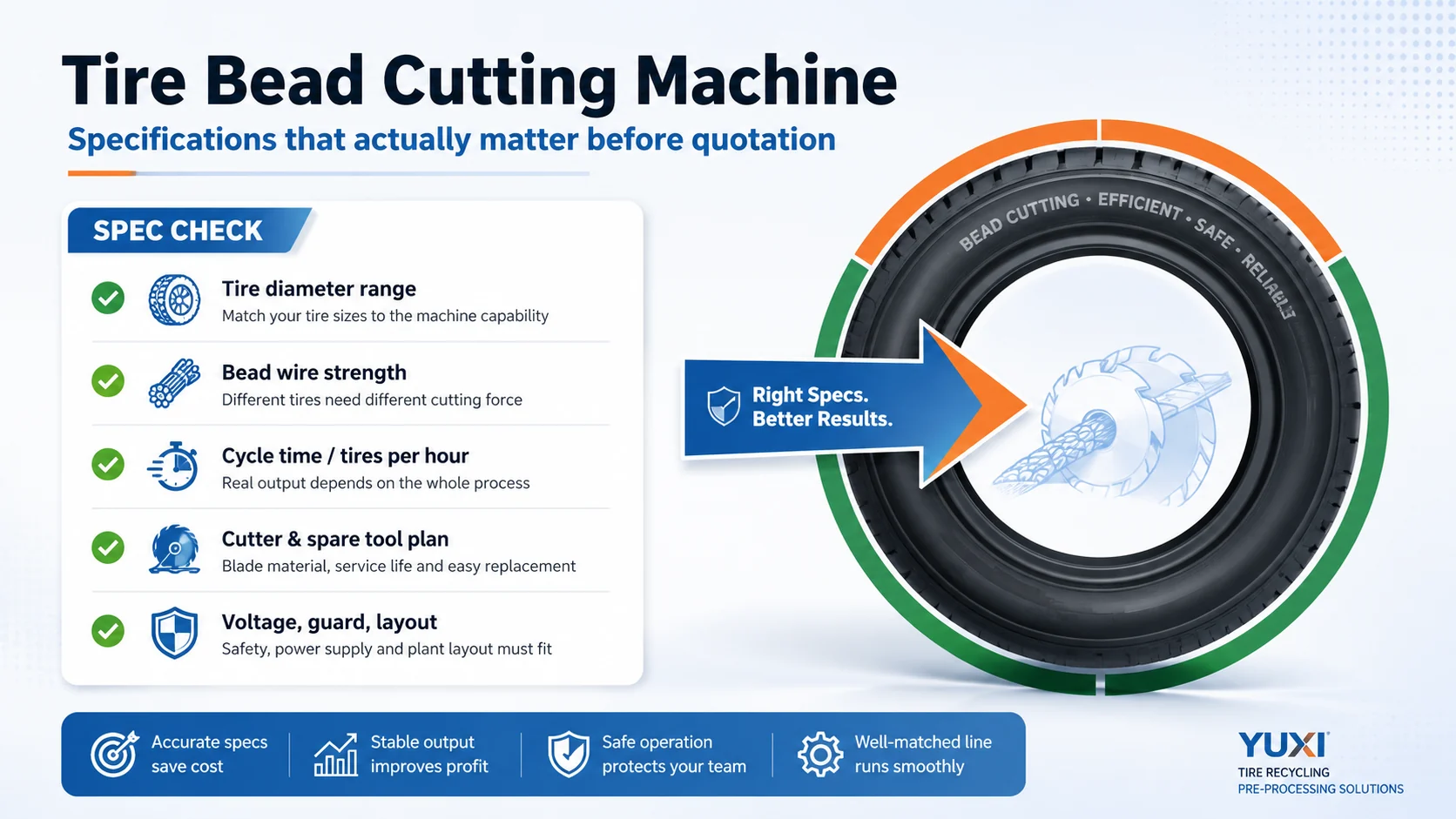
The most useful tire bead cutting machine specifications are not only motor power and price. Before quotation, confirm the incoming tire diameter range, tire type, bead wire strength, sidewall thickness, cutting output, tires per hour, cutter material, clamping method, guard design, local voltage and the downstream machine that will receive the processed tire body.
For common passenger, SUV, light truck, truck and bus tires within the configured range, a bead cutter can be used before tire cutting, tire shredding, rubber granulation or pyrolysis pre-treatment. For oversized OTR tires or very thick industrial tires, the specification should be reviewed from tire photos and tire dimensions before any final machine selection.
Why bead cutter specifications are not universal
A tire bead cutting machine cuts around a tire circumference near the bead area. In operation, the tire is positioned on the worktable, held by the clamping structure, rotated, and cut with an alloy cutter. The output is normally a main tire body plus a bead-sidewall section that still contains steel wire and rubber.
That job looks simple in a catalog photo, but the load changes quickly in real recycling plants. A light passenger tire does not behave like a truck tire. A sorted stream does not behave like a mixed collection-yard stream. A standalone cutter in a small workshop does not need the same layout as a bead cutter feeding a continuous tire shredder machine.
The Federal Highway Administration devides waste tires into all-rubber,slits,crushed rubber and describes slit tires as tires processed by cutting machines,which can separate the side walls from the tread. That supports the same practical point: sidewall or bead-area cutting is a structural preparation step, not just a machine-name comparison.
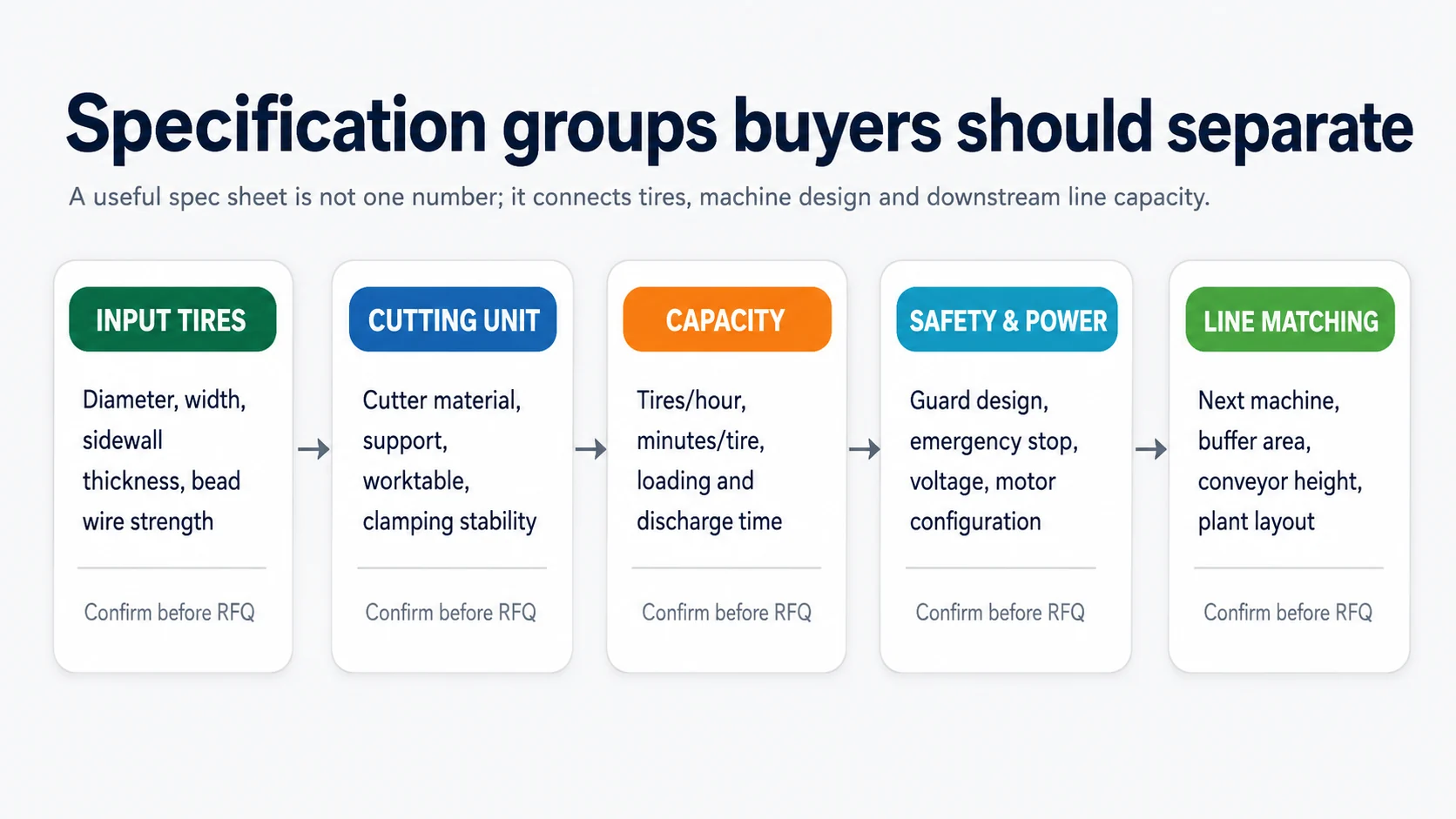
Separate the specification into tire input, cutting unit, capacity, safety/power and line-matching details.
Main tire bead cutting machine specification checklist
Use the table below as a buyer-side specification checklist. It deliberately avoids invented fixed numbers. For YUXI projects, the final model and configuration should be confirmed with tire photos, tire dimensions, plant layout and downstream process requirements.
Specification item
What to confirm
Why it matters
Buyer note
Tire type
Passenger, SUV, light truck, truck, bus, small engineering tire or mixed stream.
Different tire types have different bead structures, sidewall thickness and handling weight.
Send tire photos instead of only naming the tire category.
Tire diameter range
Common diameter and maximum diameter to be processed.
Determines worktable size, positioning range and loading method.
Do not select only by the average tire size.
Tire width and sidewall thickness
Typical tire width, section height and sidewall stiffness.
Affects cutter entry, clamping stability and operator handling.
Useful for truck and bus tire projects.
Bead wire strength
Light bead, common truck bead or heavy steel-reinforced bead section.
The bead bundle is the hardest concentrated steel area in the tire.
Heavy bead sections may require stronger cutter support and more careful spare-tool planning.
Cutting output
One sidewall, both sidewalls, bead ring or bead-sidewall section.
Suppliers may use “bead cutter” and “sidewall cutter” differently.
Confirm the expected output with a video or sample photo.
Cutter material and spare parts
Alloy cutter specification, replacement access and spare cutter plan.
Rubber-plus-steel contact creates wear; blade life depends on tire type and operating hours.
Ask for recommended spare parts for continuous production.
Worktable and clamping
Positioning adjustment, tire holding method and rotation stability.
Unstable tires cause poor cutting quality and operator rework.
Watch how the tire moves during cutting, not only the finished result.
Capacity expression
Tires per hour, minutes per tire, or shift output.
Real output includes loading, positioning, cutting and discharge time.
Match it with the downstream shredder or tire cutter.
Power supply
Voltage, frequency and electrical standard for the buyer’s country.
Export machines often need power customization.
Confirm local voltage before final quotation.
Guard design and controls
Machine guard, emergency stop, operator position and maintenance access.
Cutting and rotation create point-of-operation risks.
Confirm local safety expectations and operator workflow.
Line layout
Raw tire storage, loading direction, bead section collection and next machine position.
Bad layout can slow the line even when the cutter itself is strong.
Share a workshop sketch if available.
Downstream process
Tire cutting, shredding, rubber granule line, powder line or pyrolysis pre-treatment.
The bead cutter should be specified around the full process route.
Output must fit the next machine, not just the first machine.
1. Tire input specifications
Start with the tire stream. A specification sheet that begins with motor power but ignores tire diameter and bead structure is already incomplete. The machine has to hold the tire, rotate it, cut into the bead area and release the processed parts in a repeatable way.
Confirm the tire size range
List the common tire sizes and the largest tire expected in regular operation. If the plant receives mixed waste tires, sort the typical stream into passenger/SUV, light truck, truck/bus and special tires before requesting the machine configuration.
Confirm bead and sidewall condition
The bead section can be light or very steel-heavy. Sidewall thickness and tire age can also change how easily the cutter enters the material. Photos of the tire sidewall and bead area help the supplier judge the real cutting load.
For oversized OTR tires or very thick industrial tires, do not assume that a standard bead cutter is the right first machine. Depending on the diameter, weight and downstream goal, a heavy tire cutting machine may be needed to section the tire before or after bead-area preparation.
2. Machine and cutting specifications
The cutting unit is where many quotations become hard to compare. One supplier may emphasize motor power. Another may emphasize cutter hardness. A third may show a fast video but omit loading time. A practical specification separates the cutter, worktable, clamping, rotation and discharge design.
Cutter and support
Ask what type of cutter is recommended for rubber and steel bead contact. Also ask how the cutter is supported, how it is replaced and what spare tools should be stocked. The right answer depends on tire type, bead wire strength and daily operating hours.
Worktable and positioning
The worktable must match the tire size range. The clamping structure should stably fix the tire during rotation.In the video review,observe whether the tire is shaking,whether the cutter is stable along the bead path,and whether the operator must repeatedly correct the tire.
Output definition
Before comparing specifications, define exactly what the machine should separate. In some markets, “tire bead cutter,” “tire sidewall cutter” and “bead ring cutter” are used loosely. The key question is: does the machine remove a sidewall, both sidewalls, bead rings or bead-sidewall parts that still contain rubber-covered lines?
Important: The tire bead cutting machine usually cuts and separates the side wall of the bead from the tire body. It does not automatically strip all surrounding rubber from the steel bead wire. If the project needs cleaner steel bead recovery, plan additional separation equipment or review the route with the supplier.
3. Capacity specifications: tires per hour is not enough
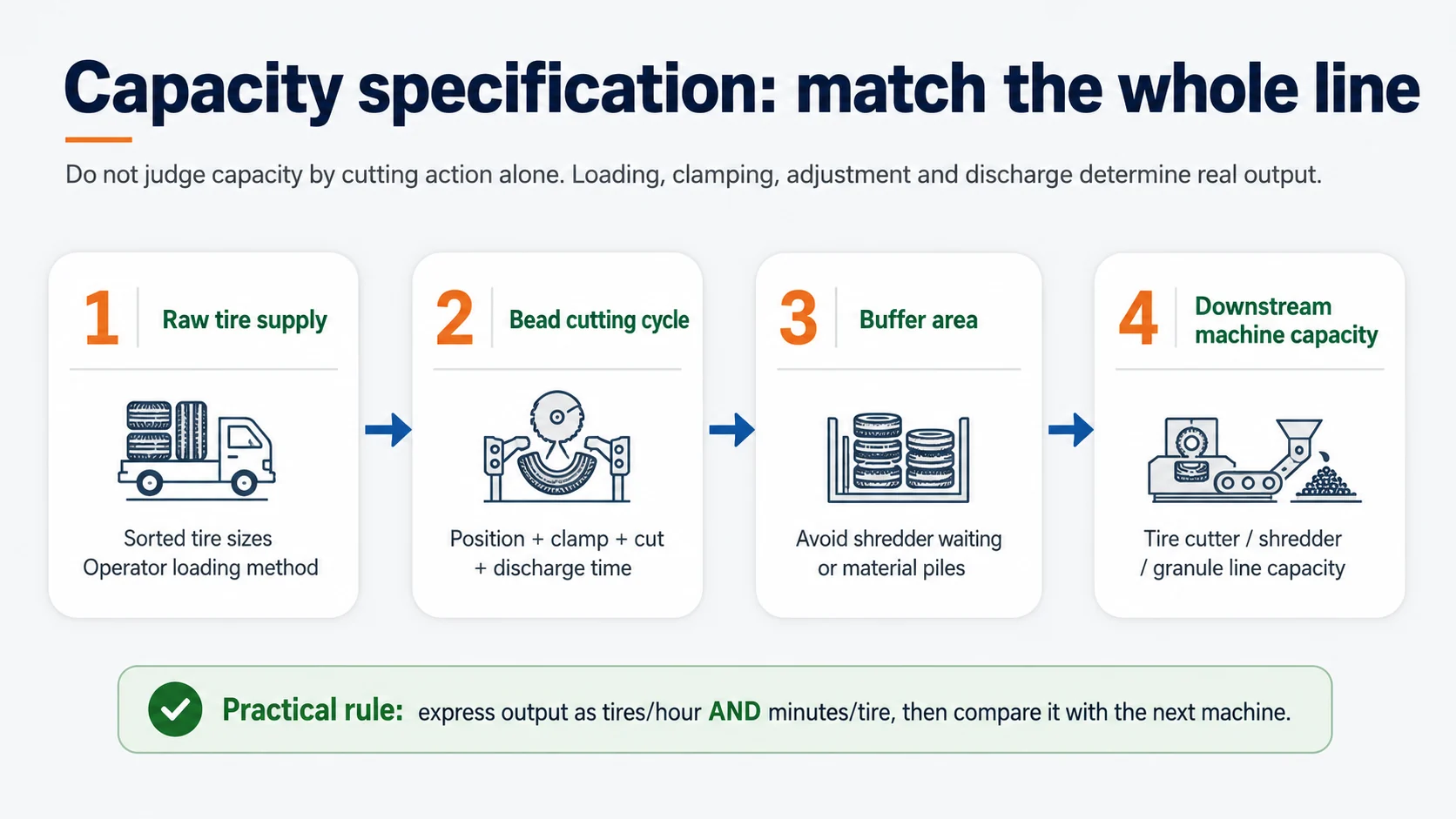
Capacity should be expressed in a way that operators can use. “Tires per hour” is helpful, but it can hide the difference between cutting time and full-cycle time. For real plant planning, ask for minutes per tire from loading to discharge, then compare that number with the tire supply and the next machine’s feed demand.
Capacity must include loading, clamping, cutting and discharge—not only the cutting moment.
The EPA notes that tire-derived fuel and other markets often require processed tire forms, and crumb-rubber production uses screens, magnets and air separation later in the process. In other words, the bead cutter is only one front-end stage. Its specification should support the full route, whether the buyer targets TDF chips, rubber mulch, crumb rubber, rubber powder or pyrolysis feed.
A practical capacity check
Question
What the answer tells you
How many tires arrive per shift?
Whether the bead cutter is a bottleneck or has enough reserve capacity.
Are tires sorted before cutting?
Whether operators lose time adjusting the worktable for mixed sizes.
How is the tire loaded?
Manual loading, forklift loading and conveyor-assisted loading create different cycle times.
What receives the processed tire body?
The bead cutter output should match the capacity and input needs of the next machine.
4. Safety, power and layout specifications
Because the machine rotates tires and cuts steel-reinforced rubber, safety and layout belong inside the specification—not after purchase. OSHA’s general machine-guarding rule requires machines that expose employees to point-of-operation hazards to be guarded, and also refers to hazards such as rotating parts and flying material. Local requirements differ by country, but the buyer should still ask about guards, emergency stops, operator position and safe maintenance access.
Power
Confirm voltage, frequency and site electrical standard. Export projects should not leave this until the shipping stage.
Guarding
Ask how the cutting point is guarded and where the operator stands during loading, cutting and unloading.
Layout
Plan raw tire storage, processed tire body collection, bead-section collection, maintenance space and the next-machine direction.
This is also where a buyer should connect the bead cutter with the broader tire recycling machine route. A standalone bead cutter may be enough for a small pre-processing workshop. A new recycling plant usually needs the bead cutter, cutter/shredder, separation stages, conveyors and storage areas planned together.
5. RFQ template: information to send before final specifications
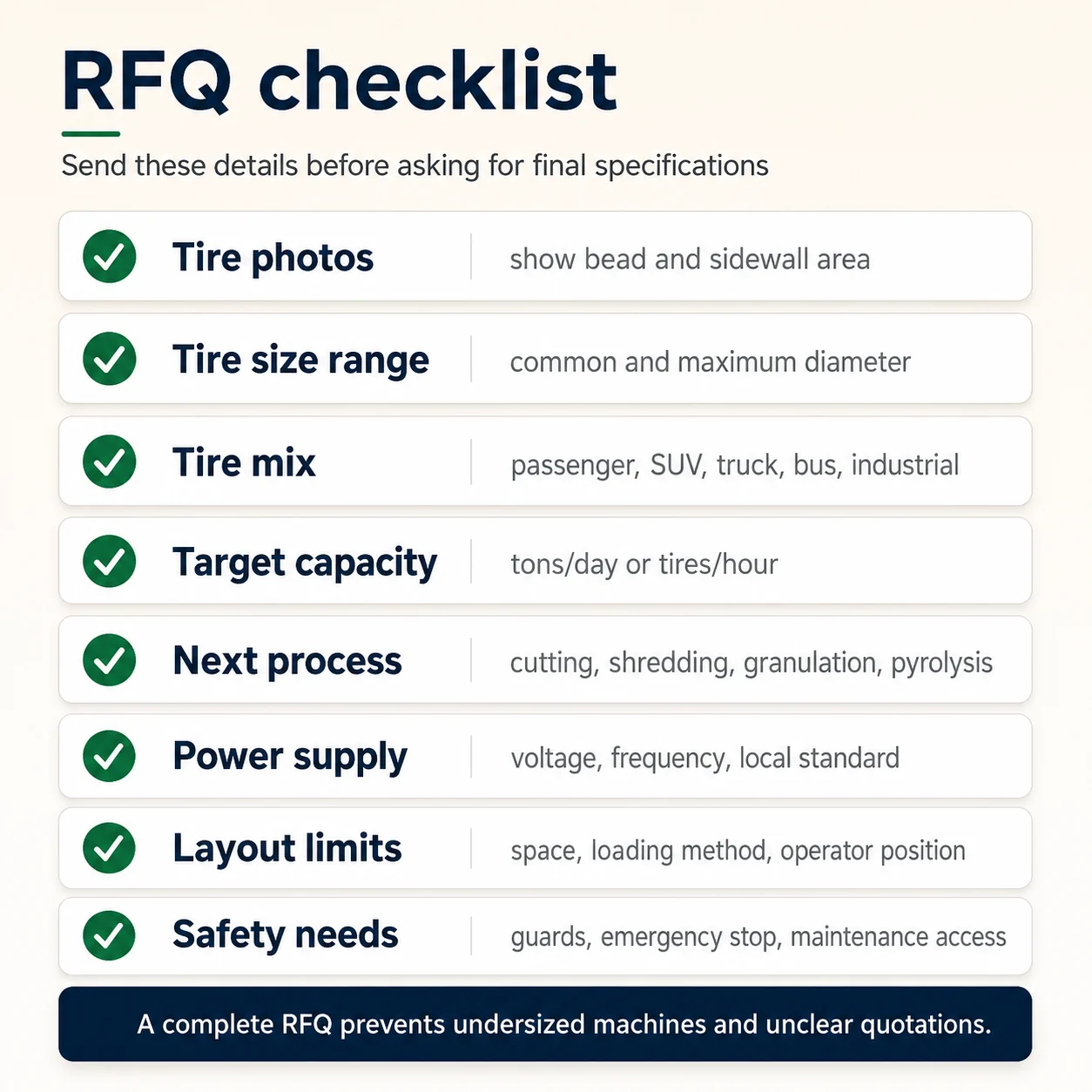
A clear RFQ helps avoid undersized machines, vague quotations and later layout changes. Copy the checklist below and send it with tire photos.
Good specifications start with real tire data and the downstream process target.
RFQ template
Raw material: passenger tires / SUV tires / light truck tires / truck tires / bus tires / mixed tires.
Maximum tire diameter and common tire size range.
Photos of the tire sidewall and bead area.
Expected output: tires per hour, tons per day or shift output.
Local power supply: voltage, frequency and electrical standard.
Workshop layout: available space, loading method and collection method for bead-sidewall sections.
Safety expectations: guard preference, emergency stop position and maintenance access.
6. How specifications affect the quotation
This article is not a price guide, but specifications and price are connected. A machine configured for light passenger tires will not have the same cost structure as one prepared for heavier truck tires, thicker bead sections, special voltage, additional guarding or line integration. If the buying team needs a cost-focused page, use the Tire Bead Cutting Machine Price Guide after the technical requirements are clear.
A useful supplier discussion should therefore move in this order: tire data first, process route second, machine specification third, quotation fourth. Starting with price alone usually creates a quotation that looks simple but is hard to compare.
7. Where YUXI fits
YUXI positions the tire bead cutter as front-end pre-processing equipment for waste tire recycling lines. According to the product information, the machine can be configured for common waste tires such as passenger car tires, SUV tires, light truck tires, common truck tires, bus tires within the configured range, small engineering vehicle tires and industrial rubber wheels with steel bead sections.
The practical advantage is line thinking. YUXI does not present the bead cutter as a machine isolated from the rest of the plant. It can be considered before tire cutting, tire shredding, rubber granulation, rubber powder production or pyrolysis pre-treatment. For buyers still deciding which front-end route fits the tire stream, the How to Choose a Tire Bead Cutting Machine guide can be used alongside this specifications checklist.
Need a tire bead cutter specification?
Send tire photos, maximum tire diameter, tire mix, target output, downstream process, voltage and available layout. YUXI can recommend a practical bead cutting configuration instead of a generic machine name.
What specifications matter most for a tire bead cutting machine?
The most important specifications are tire diameter range, tire type, bead wire strength, sidewall thickness, cut type, capacity, cutter material, clamping stability, safety guarding, power supply and downstream line matching.
Should I compare tire bead cutters only by motor power?
No. Motor power is only one part of the configuration. The machine must also match tire size, bead structure, worktable support, cutter design, operator workflow, guard design and the capacity of the next machine.
Does a tire bead cutting machine remove all steel wire from a tire?
No. It cuts the bead or sidewall area and separates a bead-sidewall section from the tire body. Steel wire may remain inside the removed rubber section, so cleaner steel recovery may require additional separation equipment.
What information should be sent to YUXI before asking for final specifications?
Send tire photos, tire size range, tire type mix, target capacity, downstream process, local voltage, workshop layout and preferred loading method. These details help confirm the correct machine configuration.
Can the same bead cutter specification handle passenger and truck tires?
Sometimes, but it should not be assumed. Truck tires normally have stronger bead sections and may require more stable positioning, stronger cutter support and different handling workflow. Confirm the tire mix before quotation.
Marie has 8+ years of experience in tire shredding and recycling equipment,with a focus on tire shredders,rubber recycling machines,TDF production,rubber crumb processing,and complete tire recycling systems.