For most buyers, the real question is not “How long is the machine?” It is whether the site can receive tires, run the line safely, store rubber products, move trucks and still leave room for maintenance.
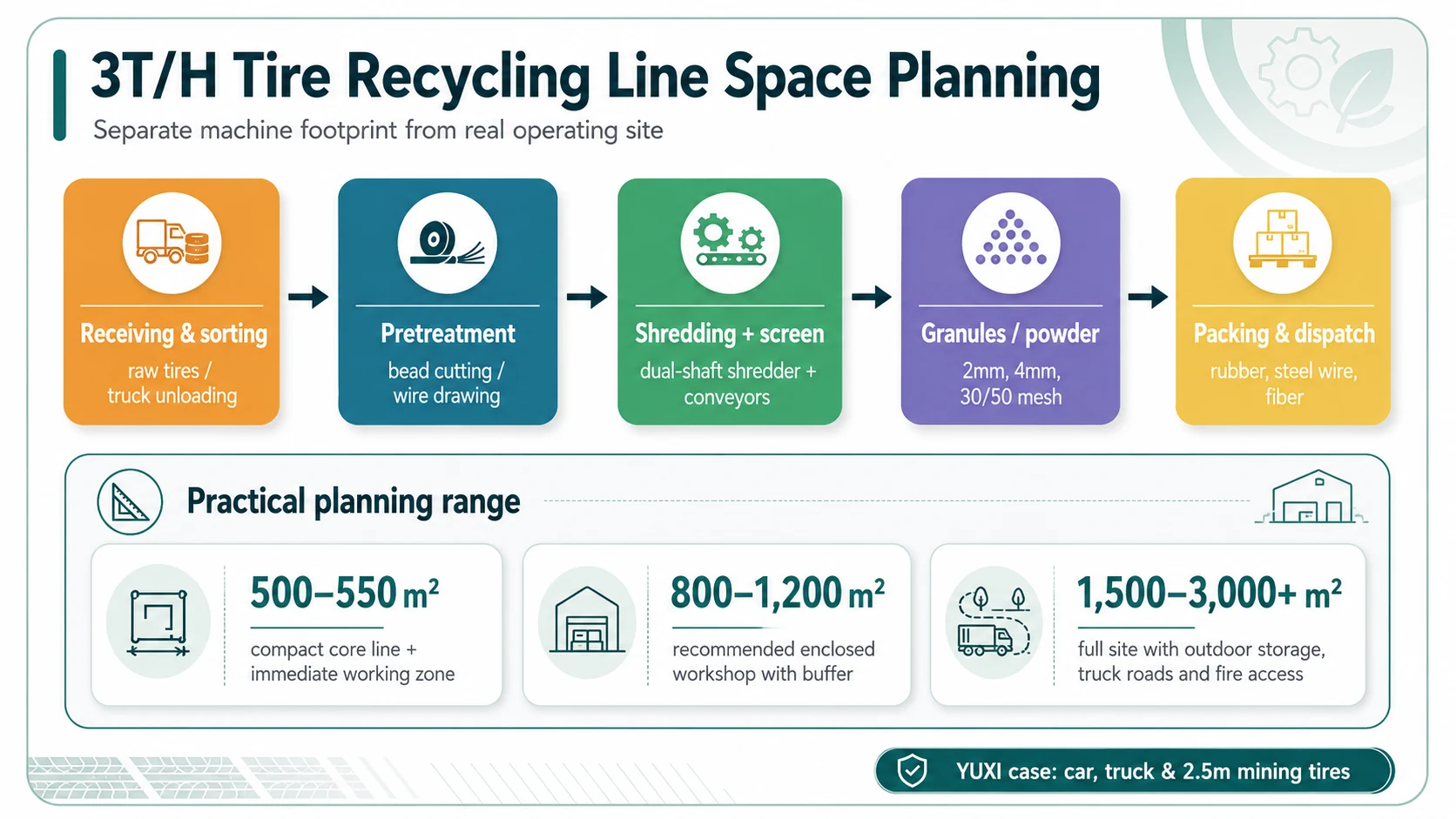
Figure 1. A 3T/H tire recycling project should be planned as a production system, not just a row of machines.
The practical answer: plan three numbers, not one
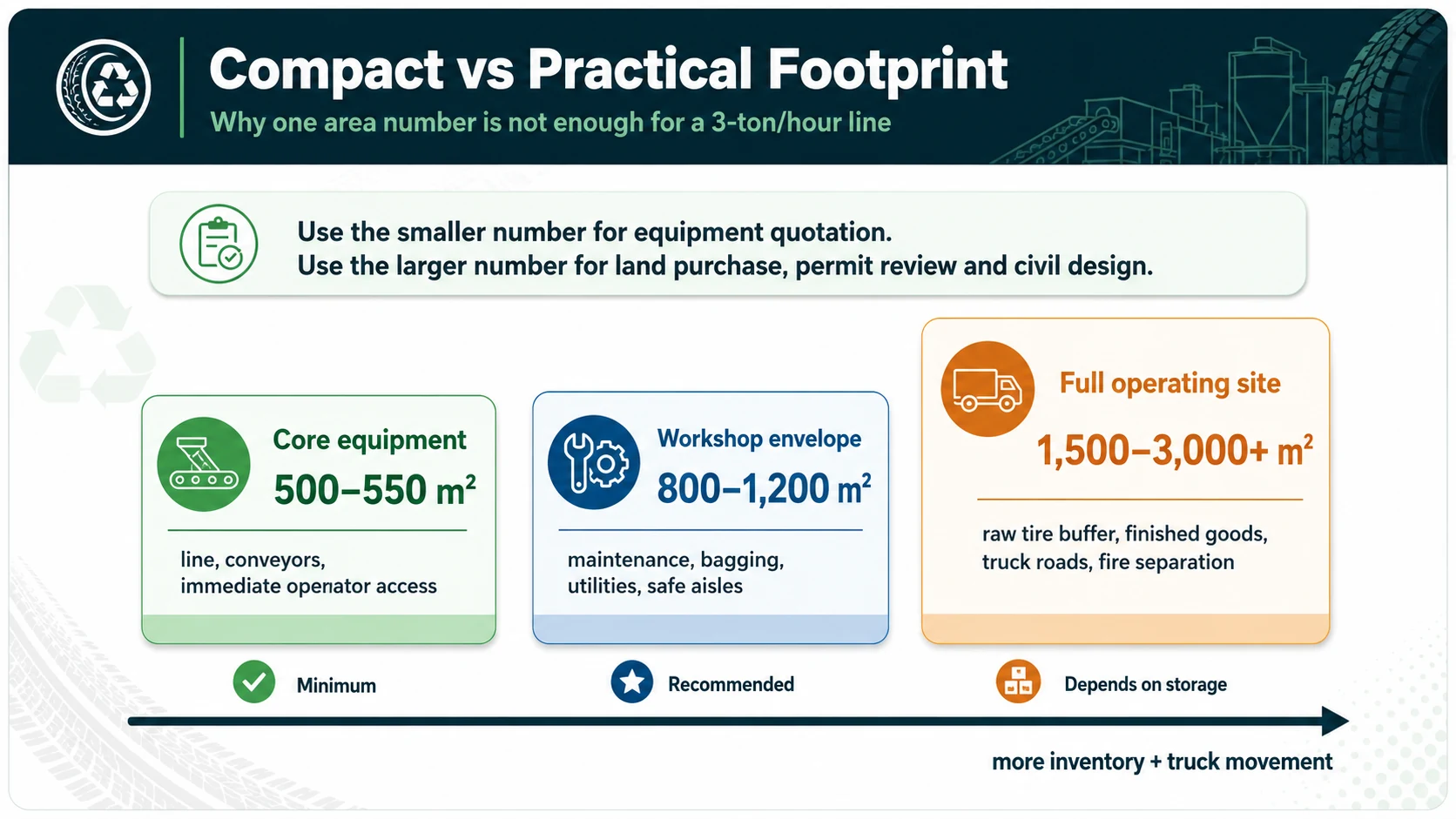
A compact 3-ton-per-hour tire recycling line may fit into about 500–550 m² when only the core process and immediate working area are counted. For a smoother commercial plant, a more practical workshop is usually 800–1,200 m². When raw tire storage, truck roads, fire separation, finished goods, offices and utilities are included, the total site can easily reach 1,500–3,000+ m².
500–550 m²core line / compact production zone
800–1,200 m²recommended enclosed workshop
1,500–3,000+ m²full site with storage and traffic
These are planning ranges, not a civil-engineering drawing. The final layout depends on tire size mix, daily operating hours, local storage rules, building shape, conveyor routing, fire-code requirements and the finished product target.
Many tire recycling investors ask for a single area number because they are comparing land, building rent and equipment quotations at the same time. That is understandable, but it can also create mistakes. A 3T/H line is not a small workshop grinder. It receives bulky whole tires, handles steel wire, moves material through several size-reduction stages and may produce rubber granules, rubber powder, steel wire and fiber by-products.
The YUXI 3T/H project page describes processing car tires, truck tires and 2.5-meter mining truck tires, the finished product includes 2mm and 4mm rubber, plus 30 grains and 50 grains of rubber powder. These product targets require more than just a tire shredder: the layout must also consider pretreatment, conveying, screening, steel separation, fiber treatment, grinding/classification, packing and storage. Please refer to the YUXI 3T/H tire recycling line case to understand the background of the project.
What the YUXI 3T/H case tells us about space
The YUXI case is useful because it is not written around only passenger tires. The material mix includes passenger tires, truck tires and large mining tires. That matters because large tires change the feeding method, raw-material buffer, roof height, forklift turning area and pretreatment arrangement.
YUXI 3T/H project point
Why it changes layout planning
Space implication
Car tires, truck tires and 2.5m mining tires
Mixed tire diameter and steel content require receiving/sorting before feeding.
Separate raw tire zones and wider handling aisles are safer than one mixed pile.
2mm, 4mm, 30-mesh and 50-mesh outputs
Granules and powder need screening, grinding/classification and product collection.
The downstream area is larger than a simple TDF chip line.
Applications include floor tiles, shoe soles and asphalt improvement
Different buyers require consistent particle size and cleaner material.
Leave space for bagging, sampling, finished goods and quality checks.
Project support from vacant land to operation
The plant is planned as a project, not as one standalone machine.
Layout, civil base, power room, storage and logistics should be confirmed early.
YUXI’s main site also positions its waste tyre recycling equipment as a set of configurable lines: TDF chips around 50–100mm, wire-free chips around 20mm, rubber crumb around 1–8mm and rubber powder around 30–120 mesh. That product ladder explains why a buyer should clarify the target product before fixing the workshop size. A line designed for rubber powder needs more downstream space than a line designed only for rough TDF shreds.
Figure 2. The smaller number is useful for equipment discussions; the larger number is needed for land and permit planning.
Why 500–550 m² can be true—and still not enough
A compact 500–550 m² area can be realistic when the discussion is limited to the production line itself: feed side, main machines, conveyors, immediate working passage and a small buffer. This kind of number is helpful during early quotation because it tells the buyer whether the main line can physically fit into an existing building.
However, a plant owner does not operate only the footprint under the machine frame. Operators need aisles. Forklifts need turning radius. Maintenance teams need access to blades, reducers, screens, magnetic separators and dust collection points. Trucks need a receiving route that does not cross the packing area. OSHA’s material-handling rule requires sufficient safe clearances where mechanical handling equipment is used, and aisles and passageways must remain clear and marked. That is the reason a practical workshop is often larger than the machine footprint.
For budgeting, treat 500–550 m² as the compact equipment zone. Treat 800–1,200 m² as the better workshop target for a 3T/H commercial line.
Recommended area split by functional zone
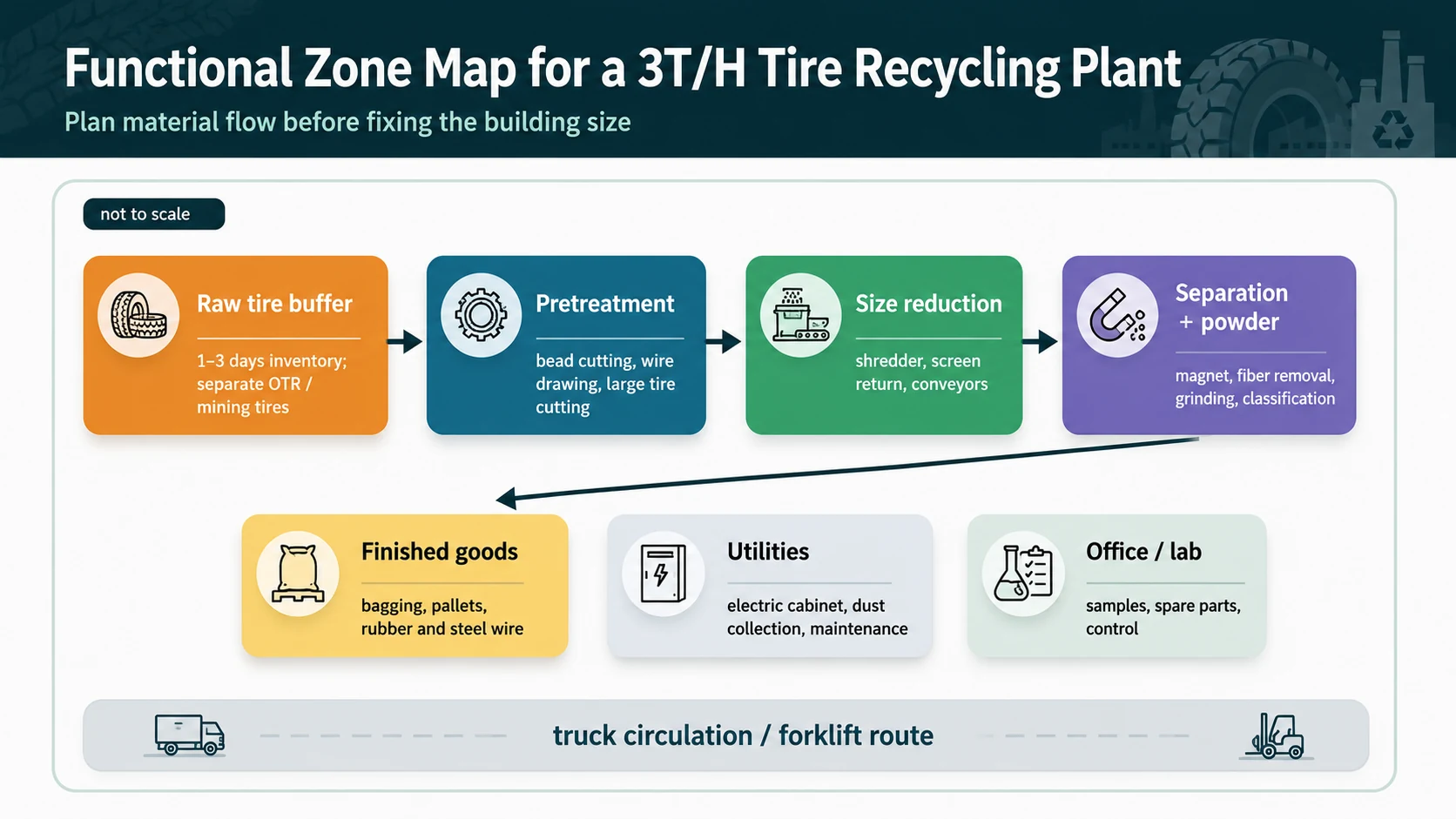
The easiest way to plan the site is to divide the plant into zones. Do not start with the shredder centerline. Start with truck receiving, material flow and where each product leaves the line.
Zone
Typical role
Practical space note
Raw tire receiving and sorting
Unload, inspect and separate passenger, truck and OTR/mining tires.
Can be inside or outside; large tires need extra turning and lifting space.
Pretreatment
Bead cutting, wire drawing or large tire cutting before shredding.
Place near raw tire storage, not at the far end of the plant.
Primary shredding and return screening
Reduce whole or pre-cut tires into controlled chips.
Leave maintenance clearance around the main shredder, screen and return conveyor.
Secondary size reduction and separation
Granulation, magnetic separation, fiber removal and classification.
Dust collection and steel-wire discharge need planned side space.
Rubber powder grinding
Produce 30–50 mesh or finer powder when required.
Requires stable feeding, classifier space, collection bins and electrical capacity.
Finished goods and by-products
Bag rubber granules/powder, store steel wire and handle fiber.
Do not let finished product pallets block forklift or maintenance routes.
Utilities and maintenance
Electric cabinet, dust collector, compressor, spare blades and tools.
Often forgotten in early drawings, but critical for uptime.
In YUXI’s equipment family, a tire shredder machine can use a dual-shaft cutting chamber with a disc-screen return system, so oversized rubber pieces can return automatically instead of being manually sorted. That improves product stability, but it also means the return conveyor and screen are part of the footprint, not optional empty space.
Figure 3. The practical layout reserves space for receiving, preprocessing, production, storage, utility and truck movement.
Three layout patterns that work for a 3T/H line
1. Straight-through layout
Raw tires enter from one end, finished products leave from the other. This is easy to understand and works well when the building is long and narrow. The disadvantage is that the line can become too long if every conveyor is placed in a straight row.
2. U-shaped layout
Receiving and dispatch can stay near the same yard entrance while the production flow turns inside the workshop. This saves truck movement and can be efficient for rectangular buildings. The U-shape needs careful separation between dirty raw tires and packed rubber powder.
3. L-shaped or split workshop layout
This is common when the site already has an existing building. Pretreatment and primary shredding can be placed in one slot, while granulation, powder grinding and packing can be placed in another slot. The risk is conveyor complexity, so a layout drawing should confirm transfer points before ordering equipment.
Raw tire storage: the part that often doubles the land requirement
If your operation runs 3 tons per hour in an 8-hour shift, the production line may consume about 24 tons of tires per day. If it runs for nearly 20 hours a day, the daily demand can be close to 60 tons. That is why raw tire storage policy matters as much as machine footprint. A plant with one day of tire inventory needs a very different site from a plant that wants three to seven days of inventory.
The U.S. EPA notes that scrap tire stockpiles can create fire, smoke, oil and vector-control risks when poorly managed. USTMA’s 2023 report also shows why proper recovery markets matter: end-of-life tires enter markets such as ground rubber, tire-derived fuel, tire-derived aggregate and industrial products. In other words, storage is not just a warehouse topic; it is an environmental and operational-control topic.
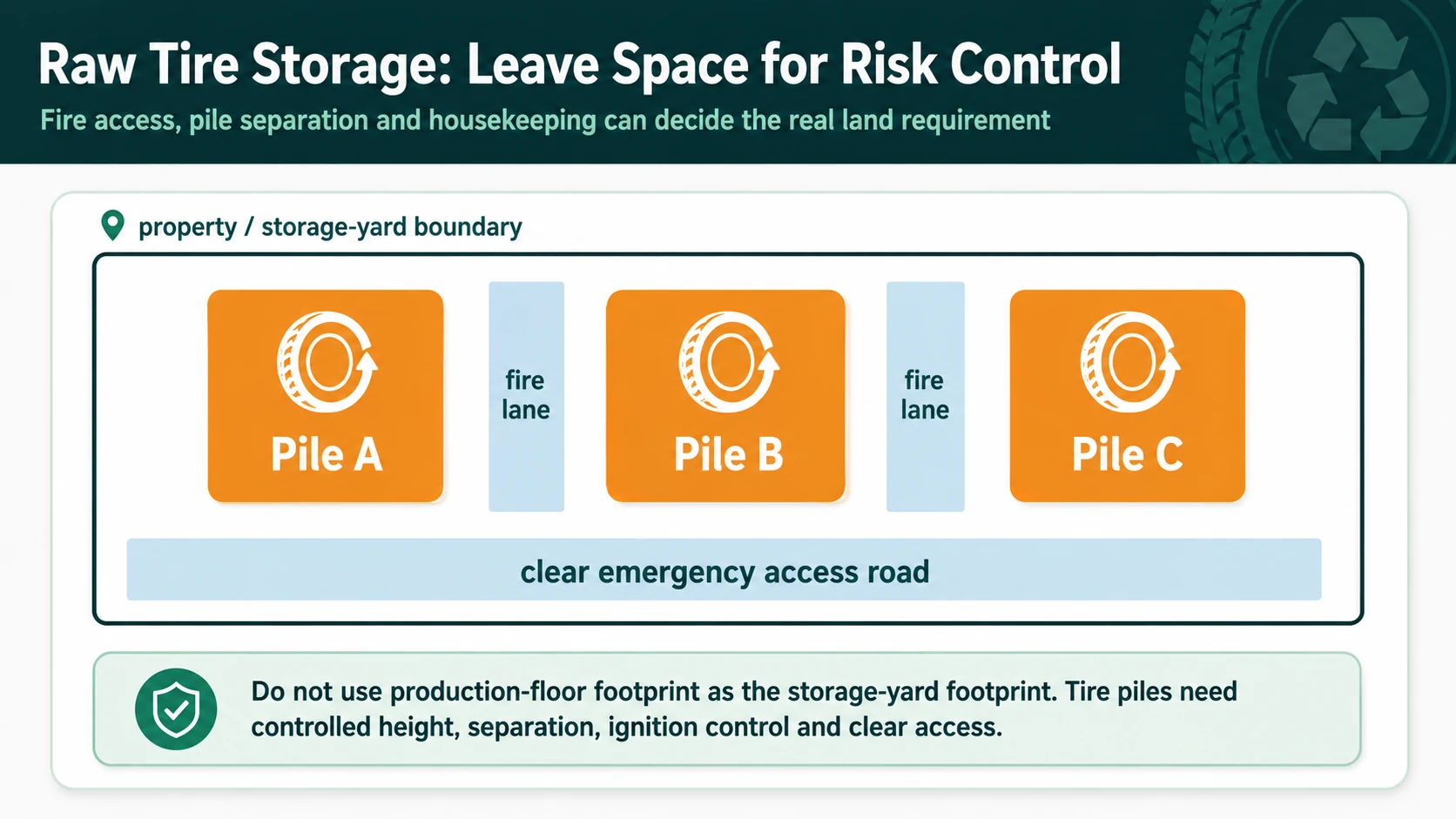
Figure 4. Outdoor tire storage can require more land than the production line itself once fire access and pile separation are included.
Local rules vary, so the final yard layout must be checked with local fire and environmental authorities. Some jurisdictions require tire-pile size limits, pile separation, clear fire apparatus roads, vegetation control and ignition-source control. For example, South San Francisco fire-prevention guidance requires approved pile sizes, maintained separation distances, clear fire lanes, vegetation control and control of open flames/smoking/hot work. Texas scrap tire storage rules, as published by the Legal Information Institute, specify pile height/area limits and fire-lane/separation requirements for registered storage sites. These rules are not universal, but they show why “just pile the tires outside” is not a layout plan.
Floor, roof height and civil design notes
For a 3T/H line, floor design should be discussed before the machines arrive. The main shredder, conveyors, granulators, grinders, steel separation equipment and collection systems create static load, vibration and maintenance demands. For large mining tires, raw-material storage may also need higher clear height and heavier handling equipment. The existing YUXI space article notes that a compact 3T/H project may require hardened concrete and a high raw-material warehouse area for mining tires; your local civil engineer should verify slab thickness, reinforcement, foundation points and drainage according to the actual machine list.
Minimum workshop height
For normal truck and passenger tire lines, many workshops can work with moderate clear height, but OTR/mining tires change the requirement. If tire diameter can reach 2.5m, reserve enough door height, handling clearance and safe lifting space. A raw tire storage bay of about 6m clear height is a useful planning reference for large-tire projects, but exact height should be confirmed by handling method and local code.
Maintenance clearances
Do not place a shredder tightly against a wall. Blade inspection, reducer access, bearing work, conveyor belt cleaning and screen maintenance all need working clearance. If the plant uses bead pretreatment, leave safe operator space around the tire wire drawing machine and the waste tire bead cutting machine. If large tires must be opened before feeding, a tire cutting machine should be placed where operators can move heavy sections directly toward the shredder feed side.
Common layout mistakes to avoid
Counting only machine length. Conveyors, return screens, discharge bins, dust collection and maintenance paths are part of the plant.
Using one mixed raw tire pile. Passenger tires, truck tires and mining tires should be separated for feeding stability and safer handling.
Forgetting finished product storage. Rubber powder and granules need dry packing and pallet space; steel wire and fiber need separate handling.
Blocking emergency access with inventory. Outdoor tire storage should be designed around local fire-code and environmental requirements.
Choosing a building before choosing the product target. A TDF chip line, crumb rubber line and rubber powder line do not require the same downstream footprint.
Figure 5. The best equipment layout starts with tire mix, output target, operating hours and local storage requirements.
What to send YUXI before asking for a layout drawing
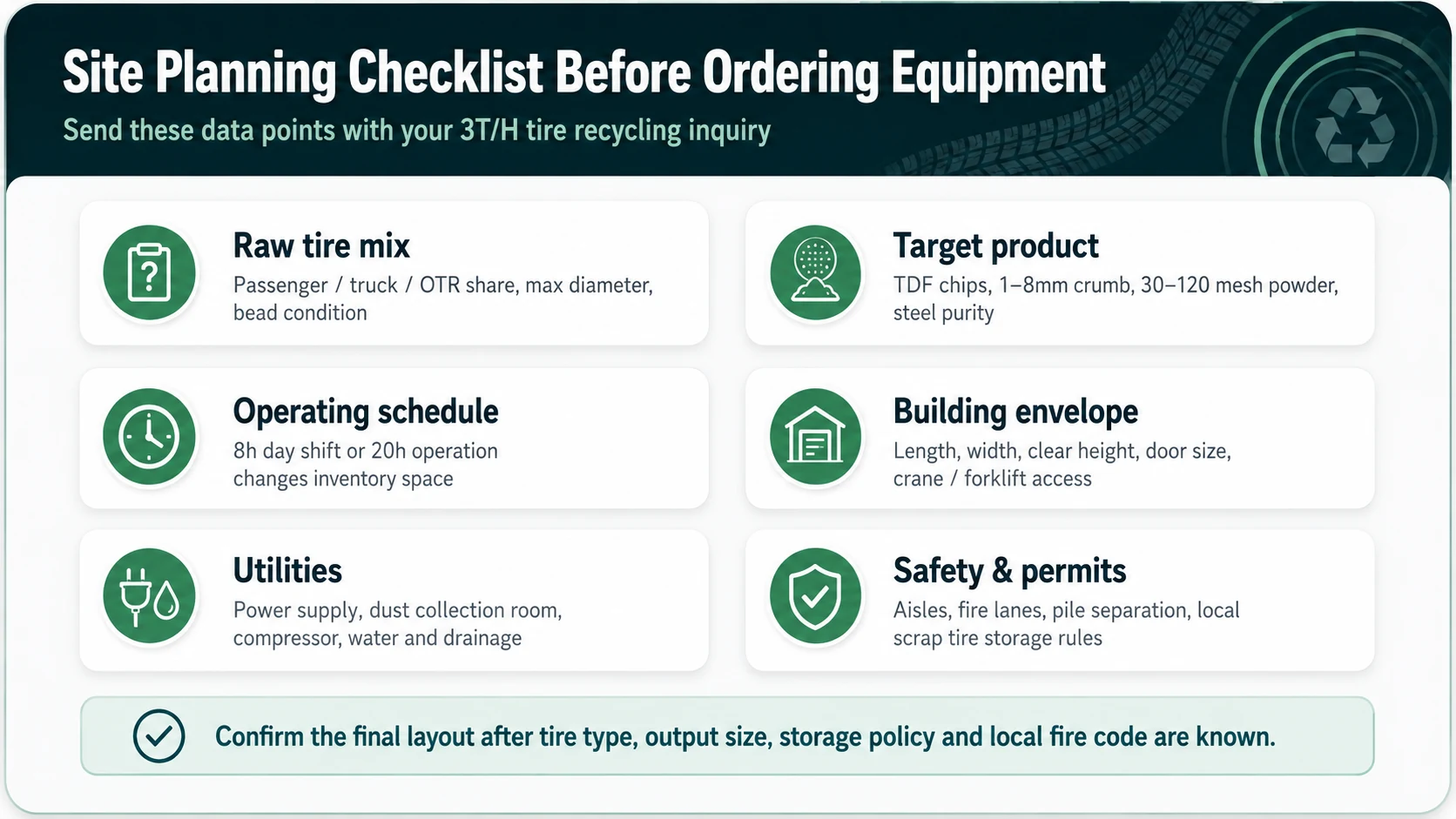
A good layout starts with the right input data. Before asking for a final drawing, prepare the following information:
Available land size and existing building dimensions: length, width, clear height, door size and column spacing.
Raw material mix: passenger tire percentage, truck tire percentage, maximum OTR/mining tire diameter and whether bead wire will be removed.
Target finished products: TDF chips, wire-free chips, 1–8mm crumb rubber, 30–120 mesh powder, steel wire and fiber handling.
Operating schedule: one shift, two shifts or near-continuous running.
Inventory policy: how many days of raw tires and finished products will be stored on site.
Local requirements: fire lanes, pile size, stormwater control, dust collection, noise limit and utility connection.
YUXI’s homepage describes a broader waste tyre recycling plant portfolio covering shredding, TDF, wire-free mulch, crumb rubber and rubber powder lines. Use that product direction to decide whether your 3T/H project is a simple size-reduction site or a deeper rubber-powder production plant.
FAQ
Can a 3T/H tire recycling line fit in 500 m²2
It may fit if the number refers to the compact production zone and the layout is carefully planned. But a fully operational factory usually needs additional areas to store original tires, finished products, truck movements, fire passages, utilities and maintenance.
For a 3-ton-per-hour rubber powder line, what workshop scale is recommended2
For commercial operation, 800–1,200 m² is a more practical planning range than the area of the core machine. The rubber powder line needs more downstream space for grinding, classification, dust collection and product packing.
How much outdoor space is needed for raw tire storage2
It depends on operating hours and inventory policy. A line running 3 tons per hour for one shift may consume about 24 tons per day, while near-continuous operation can require much more raw tire supply. Outdoor storage must also meet local pile, fire lane and access requirements.
Does a 3T/H line require pretreatment equipment2
For mixed passenger and truck tires, pretreatment may include bead cutting or wire drawing to reduce steel-wire impact. For OTR or mining tires, cutting or special handling may be required before shredding.
What is the most common layout error2
The most common mistake is to only count the floor area and ignore the conveyor, forklift aisle, maintenance channel, raw tire inventory and finished-product storage.
Source notes
U.S. Tire Manufacturers Association, 2023 End-of-Life Tire Management Report page: ELTs enter markets including ground rubber, tire-derived fuel, tire-derived aggregate and other products. Source
U.S. EPA Scrap Tires Basic Information: scrap tire markets and stockpile risks. Source
OSHA 29 CFR 1910.176: safe clearances, clear aisles and secure storage principles for material handling. Source
City of South San Francisco Fire Prevention: storage of scrap tires and tire byproducts, including pile separation, fire lanes, vegetation control and ignition-source control. Source
Texas Administrative Code §328.61 as published by LII: example scrap tire storage pile and fire-lane requirements. Source
Marie has 8+ years of experience in tire shredding and recycling equipment,with a focus on tire shredders,rubber recycling machines,TDF production,rubber crumb processing,and complete tire recycling systems.