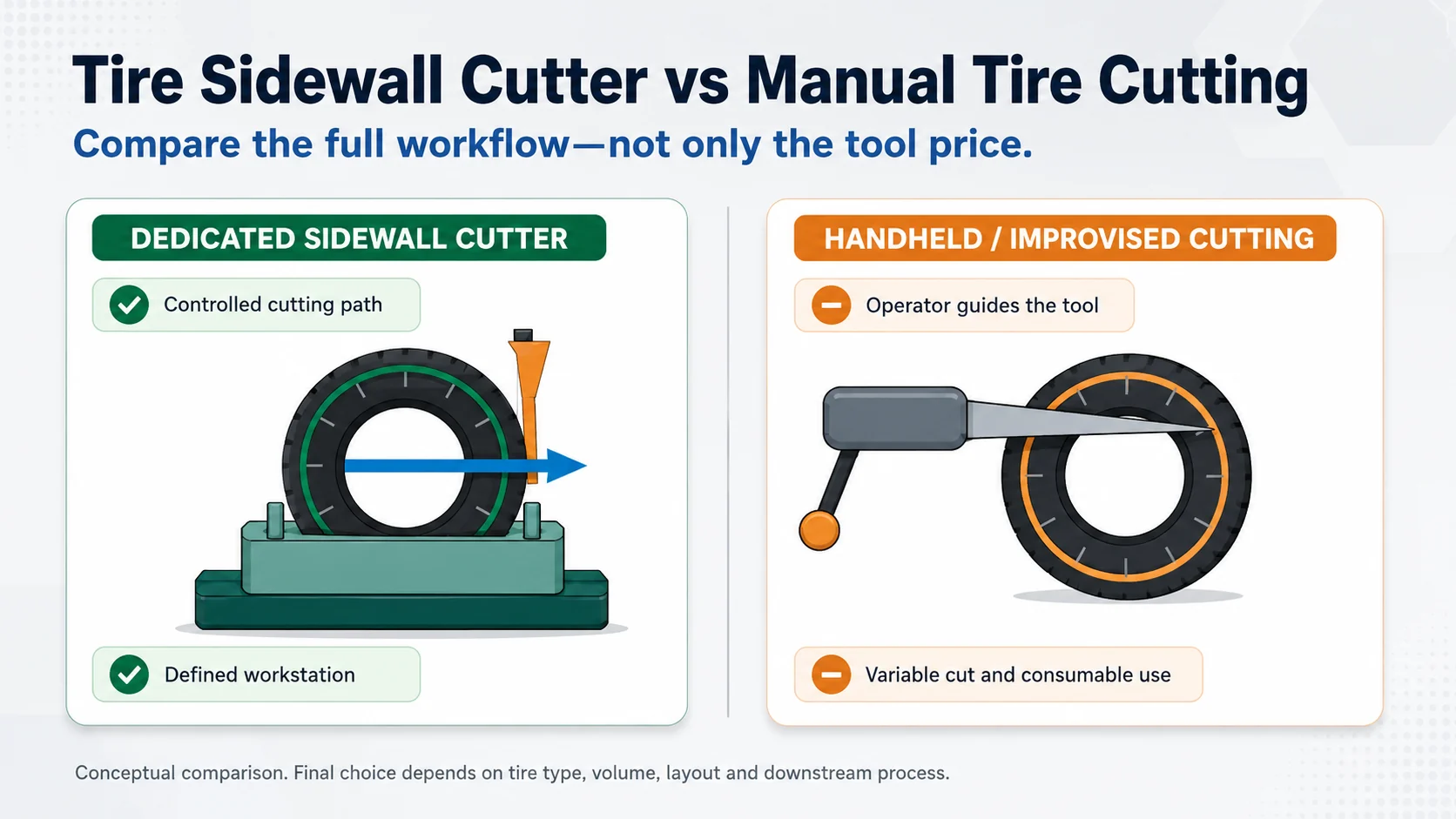
Manual cutting wins on initial tool cost. A dedicated sidewall cutter can win when labor, consumables, repeatability and downstream workflow are counted over the full operating year.
Compare the whole workflow: tire handling, cutting, consumables, supervision, discharge and downstream feeding.
A small recycler can remove tire sidewalls with handheld tools and spend very little on equipment. That does not automatically make manual tire cutting the cheaper production method. Once the same task is repeated across a shift, the real comparison includes operator minutes, tire handling, consumable blades, cut consistency, interruptions and what happens when the processed tire reaches the next machine.
This guide uses “manual tire cutting” to mean cutting tires with handheld knives, saws, grinders or other non-dedicated tools. It does not mean the normal operator loading and control work required by a semi-automatic sidewall cutter. YUXI’s waste tire bead cutting machine is a dedicated pre-processing unit: the tire is positioned and clamped on a worktable, rotates through a controlled path, and an alloy cutter separates the bead or bead-sidewall section from the main tire body.
The broader market justifies taking the decision seriously. The U.S. Tire Manufacturers Association reports that approximately 79% of U.S. end-of-life tires went to recycling and reclaiming markets in 2023.1 At plant level, however, the important question is not the national rate. It is whether the chosen front-end method can prepare the local tire stream without becoming a labor or material-flow bottleneck.
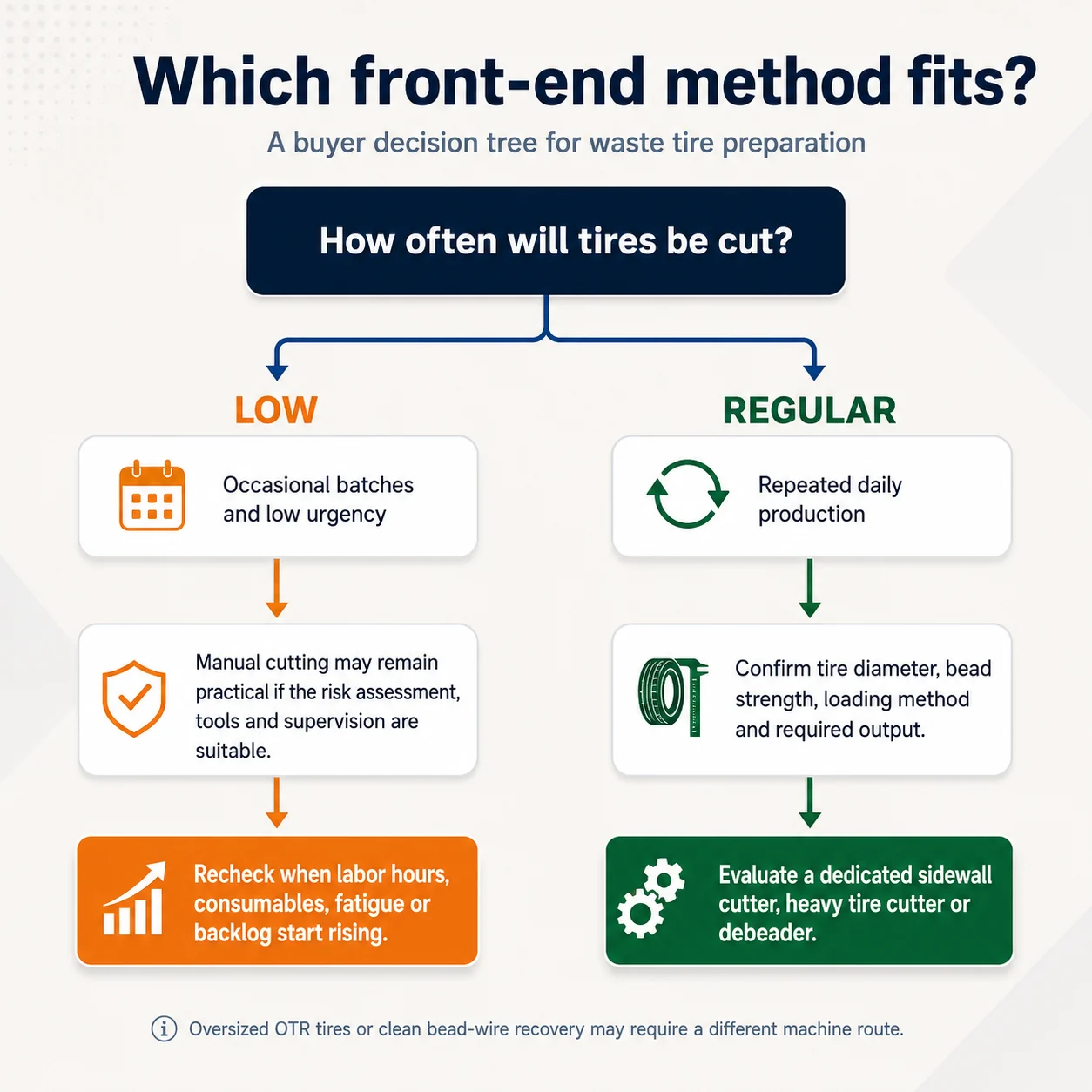
Manual tire cutting can remain practical for occasional batches, low daily volume and non-urgent work. A dedicated tire sidewall cutter becomes more defensible when the plant cuts tires repeatedly, needs predictable shift output, is consuming many handheld blades or discs, has more than one operator producing inconsistent cuts, or must feed a tire cutter, shredder or granulation line at a steady rate.
What counts as manual tire cutting?
Manual cutting is a method, not a single tool. It may involve a knife for light rubber, a reciprocating saw for reinforced sidewall material, a grinder or another improvised cutting setup. In each case, the worker controls the tool path and holds or stabilizes the tire while the cut is made.
A semi-automatic sidewall cutter is different even though an operator still handles the tire. The machine provides a defined worktable, positioning method, clamping structure and cutting path. YUXI’s product information describes an adjustable worktable and clamping process followed by circumferential cutting near the bead. For a step-by-step description, see How Does a Tire Bead Cutting Machine Work?
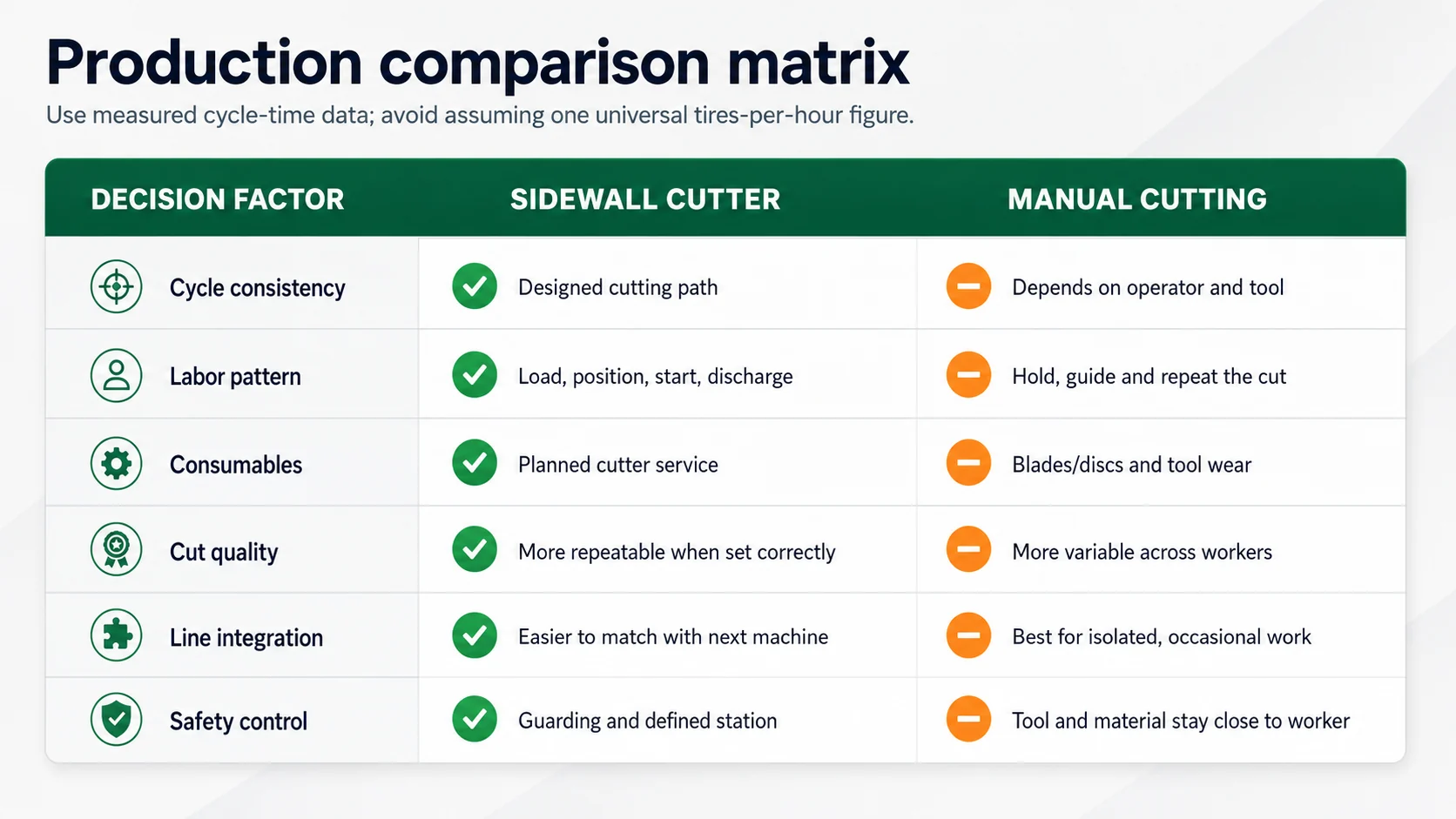
Tire sidewall cutter vs manual tire cutting
Decision factor
Dedicated tire sidewall cutter
Manual tire cutting
Buyer check
Initial investment
Higher because the buyer purchases a dedicated machine, electrical configuration and possibly handling or guarding options.
Lower when suitable handheld tools already exist.
Do not stop at purchase price; calculate annual labor and consumables.
Cycle consistency
More repeatable when tire size, clamping and cutter setting are correct.
Depends heavily on operator technique, fatigue and tool condition.
Time at least 20–30 representative tires from the actual stream.
Labor pattern
Operator loads, positions, starts the cycle and discharges materials.
Operator holds or guides the tool through most of the cut.
Record active cutting time and handling time separately.
Consumables
Planned cutter inspection, sharpening or replacement based on tire type and operating hours.
Handheld blades, discs or tools may be replaced more frequently and less predictably.
Use purchasing records instead of supplier assumptions.
Cut consistency
More suitable for repeated bead-area cuts and standardized output.
Cut position and completeness can vary between workers.
Check whether variation affects the next machine.
Handling
The tire still needs loading and unloading; heavy tires may require assisted handling.
The worker usually handles and stabilizes the tire throughout the operation.
Include lifting, rolling, turning and stacking in the work study.
Safety controls
Can provide a defined operating station, guard arrangement and emergency stop when correctly designed and installed.
The cutting tool and tire are normally close to the worker’s hands and body.
Complete a site-specific risk assessment for either method.
Downstream line fit
Easier to size around a tire cutter, shredder or recycling line.
Better suited to isolated or occasional preparation where backlog is acceptable.
Compare front-end output with the next machine’s real feed demand.
Best-fit scenario
Repeated daily work, rising labor cost, mixed operators, capacity targets and line integration.
Small batches, irregular demand, low urgency and no stable production schedule.
Review the decision whenever volume or tire mix changes.
The dedicated machine creates a defined cutting station; manual cutting remains more dependent on the worker, tool and tire position.
1. Speed and throughput: measure the complete cycle
The fastest visible cut is not necessarily the fastest process. For both methods, the complete cycle includes finding the next tire, moving it into position, adjusting or stabilizing it, completing the cut, separating the sidewall or bead section, moving the output and preparing for the next tire.
Manual demonstrations often show a skilled worker cutting one prepared passenger tire. Production includes worn tools, mixed tire sizes, repeated repositioning, cleanup and interruptions. Machine demonstrations can also be misleading when they show cutting time but exclude loading and discharge. Use the same start and finish points for both methods.
Cycle-time study: Start timing when the operator touches the unprocessed tire. Stop when the main tire body and removed section are placed in their correct collection areas. Record tire type, diameter, tool condition, operator and any rework. Use the median and a conservative high-time case—not only the fastest result.
Capacity must also match the rest of the plant. If manual cutting supplies tires faster than a small downstream machine can consume them, a sidewall cutter may not improve total output. If a shredder regularly waits for prepared tires, front-end cutting has become a bottleneck. This is why the Tire Bead Cutting Machine Specifications guide recommends comparing minutes per tire with the next machine’s feed requirement.
2. Labor and ergonomics: count handling as well as cutting
Manual cutting does not only use the worker’s hands. Tires must be rolled, lifted, tilted, held, turned and stacked. Try to change with tire weight,working height,floor condition,storage layout,and whether the tire must move repeatedly.
NIOSH explains that manual material handling can lead to work-related musculoskeletal diseases,and suggests redesigning tasks to reduce physical needs,stretching out,bending and unnecessary weight lieving.3 The guidance does not prove that every manual tire cutting task is unsafe,but it supports the inclusion of tire handling and repeated postures in the selection study.
Manual method labor
Measure active cutting, tire stabilization, tool changes, repositioning, collecting cut sections and cleaning the work area. Also note whether output drops later in the shift.
Machine-assisted labor
Measure loading, worktable adjustment, clamping, cycle start, release and discharge. A machine may shorten cutting work while leaving heavy handling unchanged.
For truck or bus tires, the handling plan may be more important than the cutter alone. A sidewall cutter that accepts the tire size can still underperform if one operator cannot move tires to and from the worktable efficiently. Consider tire racks, rolling height, lift assistance and separation bins during layout planning.
3. Safety: a dedicated machine is not automatically safe
A dedicated workstation can make the cutting action more controlled, but it still contains a cutting point, rotating tire, clamping movement and stored electrical, mechanical, hydraulic or pneumatic energy depending on the configuration.
OSHA’s general machine-guarding rule requires one or more guarding methods to protect workers from hazards created by the point of operation, ingoing nip points, rotating parts and flying material. It also states that the point of operation must be guarded when operation exposes an employee to injury.4 For servicing and maintenance, OSHA’s hazardous-energy rule addresses unexpected energization, startup and release of stored energy.5
These are U.S. general-industry references, not a universal certification statement for a specific machine. Buyers must confirm applicable local regulations, risk assessment, guard design, emergency stops, operating procedures and maintenance isolation at the installation site.
Do not market either method as “completely safe.” Manual cutting can expose the worker directly to a handheld cutting tool and unstable material. A machine can introduce powered movement and stored energy. The correct comparison is which system allows hazards to be identified and controlled more effectively in the buyer’s actual workflow.
4. Cut quality and downstream process
For an isolated volume-reduction task, a rough manual cut may be acceptable. In a production line, output variation matters. An incomplete sidewall cut can require rework. An oversized remaining bead section may be harder to feed. Different cut positions can create inconsistent tire sections and irregular stacking.
YUXI positions the sidewall/bead cutter before tire cutting, shredding, rubber granulation or pyrolysis pre-treatment. The machine separates a main tire body and a bead-sidewall section that normally still contains rubber around the steel wire. It does not remove every steel component from the tire.
When the next stage is a tire shredder machine, repeatable preparation can make feeding easier to plan. When the feed consists of oversized OTR or very thick industrial tires, a heavy tire cutting machine may be more appropriate than a standard sidewall cutter.
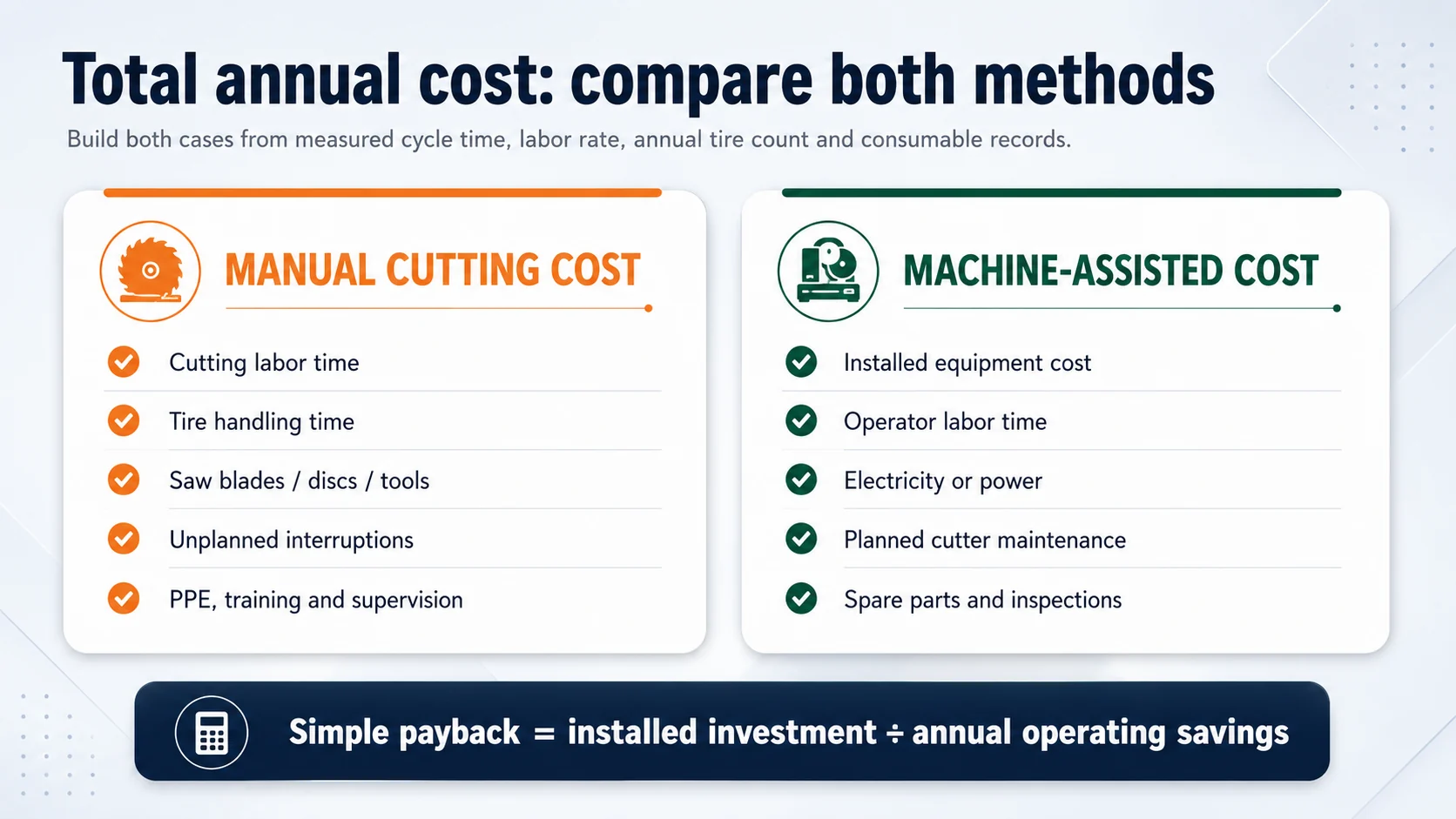
5. Total cost and simple payback
Manual cutting almost always has the lower initial equipment cost. The annual decision changes when the buyer calculates paid labor, consumables and interruptions. The purpose of a payback model is not to prove that the machine must win; it is to make both methods comparable using the same tire volume and work schedule.
Use site data for labor, cycle time and consumables. Do not substitute a supplier’s fastest demonstration cycle.
Simple payback period = total installed investment ÷ annual operating savings
This simple formula excludes financing, tax, depreciation, insurance, production growth and the time value of money. Use it as a first screen, not a guaranteed return.
If the annual saving is small or negative, manual cutting may remain economically reasonable. If the result is highly sensitive to one assumption—such as unrealistically fast machine loading—repeat the analysis with conservative, base and high-volume cases. For equipment quotation variables, use the Tire Bead Cutting Machine Price Guide.
When manual tire cutting can still make sense
Manual cutting is not automatically an outdated choice. It can remain practical when all of the following are broadly true:
The workshop processes small or irregular batches rather than continuous daily production.
Waiting for manual preparation does not idle a more expensive downstream machine.
The tire type is manageable with the selected tool and workholding method.
The business has documented procedures, suitable PPE, supervision and a site-specific risk assessment.
Consumable use and tool changes remain low enough to monitor easily.
The output does not need a highly repeatable sidewall or bead cut.
The buyer is still testing a market and does not yet have stable tire supply.
Even in this scenario, track cycle time and consumables. A method that was reasonable at 10 occasional tires may not remain reasonable after the collection contract changes or a second shift is added.
When a tire sidewall cutter is easier to justify
The investment case becomes stronger when several of these conditions appear together:
Sidewall or bead-area cutting is repeated every production day.
Manual preparation limits the utilization of the downstream tire cutter or shredder.
More than one worker produces noticeably different cut positions or completion rates.
Handheld blade, disc or tool consumption is becoming a significant recurring cost.
The tire stream includes truck or bus tires within the cutter’s configured range.
The plant needs separated tire bodies and bead-sidewall sections collected consistently.
The buyer needs a defined workstation that can be incorporated into layout, guarding and operating procedures.
High volume does not automatically mean “buy a sidewall cutter.” Tire size and required output may point to a heavy cutter or debeader instead.
Sidewall cutter, tire cutter or debeader?
Some buying mistakes occur because the correct answer is not one of the two options in the title. A sidewall cutter is designed around the bead-sidewall area. A heavy tire cutter sections large or thick tires. A debeader pulls the bead wire bundle rather than simply cutting off the surrounding ring.
Required result
Likely equipment direction
Important limitation
Remove or open the sidewall/bead section before shredding
Tire sidewall cutter / bead cutting machine
Removed steel wire may still be covered with rubber.
Turn large truck, agricultural or OTR tires into manageable sections
Heavy tire cutting machine
Final design depends on tire diameter, width, weight and steel content.
Pull concentrated bead wire from the tire
Tire debeader / wire drawing machine
Output and remaining rubber depend on tire preparation and machine route.
Reduce whole or prepared tires into chips
Tire shredder
Preprocessing need depends on tire type, bead condition and target product.
YUXI’s public product information positions the waste tire bead cutting machine as semi-automatic pre-processing equipment for passenger, SUV, light truck, common truck and bus tires within the configured range. The final configuration should be confirmed from tire diameter, sidewall thickness, bead wire strength, target output, local power supply and production layout.
This means YUXI should not quote the machine from the phrase “manual cutting is too slow” alone. A useful inquiry needs enough information to determine whether the buyer actually needs a sidewall cutter, a stronger tire cutter, a debeader or a different front-end route.
Send these items for engineering review:
Photos of the common tire types and the largest tire.
Tire diameter, width and passenger/truck/OTR mix.
Current manual minutes per tire and workers assigned to the task.
Daily or shift tire volume and expected growth.
Required output: one sidewall, both sidewalls, bead-sidewall ring, clean bead wire or tire sections.
Downstream equipment and required feed rhythm.
Local voltage, available floor space and tire handling method.
Guarding, emergency-stop and maintenance-access expectations.
Replace assumptions with a real cutting study
Send YUXI representative tire photos, current manual cycle data, annual tire volume and the next process. The correct recommendation may be a sidewall cutter—or a different preprocessing route.
Is a tire sidewall cutter always better than manual tire cutting?
No. Manual cutting may remain reasonable for occasional, low-volume work when the tire type, tools, supervision and risk controls are suitable. A dedicated cutter becomes more attractive when cutting is repeated daily, labor time and consumables rise, or the next machine needs more consistent feed.
Does a tire sidewall cutter eliminate all manual labor?
No. Operators still need to load, position and discharge tires unless the project includes additional handling equipment. The machine changes the cutting task from guiding a handheld tool to operating a defined workstation.
Can a tire sidewall cutter process truck tires?
It can when configured for the tire diameter, sidewall thickness and bead wire strength. Tire photos and maximum dimensions should be reviewed before quotation. Oversized OTR tires may require a heavy tire cutting route instead.
Is a sidewall cutter the same as a tire debeader?
Not always. A sidewall cutter normally cuts around the bead and separates a bead-sidewall section. A debeader pulls the bead wire bundle from the tire. Cleaner bead-wire recovery may require a debeader or a later bead-wire separator.
How should I calculate whether the machine is worth buying?
Measure manual minutes per tire, machine-assisted minutes per tire, annual tire volume, loaded labor rate, consumable cost, maintenance and installed equipment cost. Annual operating savings can then be divided into installed investment for a simple payback estimate.
Marie has 8+ years of experience in tire shredding and recycling equipment,with a focus on tire shredders,rubber recycling machines,TDF production,rubber crumb processing,and complete tire recycling systems.