




Contents
- Quick answer
- The blade is a cutting system
- Why blade life is not fixed
- Main wear factors
- Wear and damage states
- Signs that need inspection
- Blade issue or machine issue?
- Inspection checklist
- When to replace the blade
- Can it be sharpened?
- Safe blade replacement
- Blade condition and capacity
- Spare cutter planning
- Maintenance log template
- Ordering a YUXI replacement
- FAQ
Quick answer
1. The blade is part of a cutting system
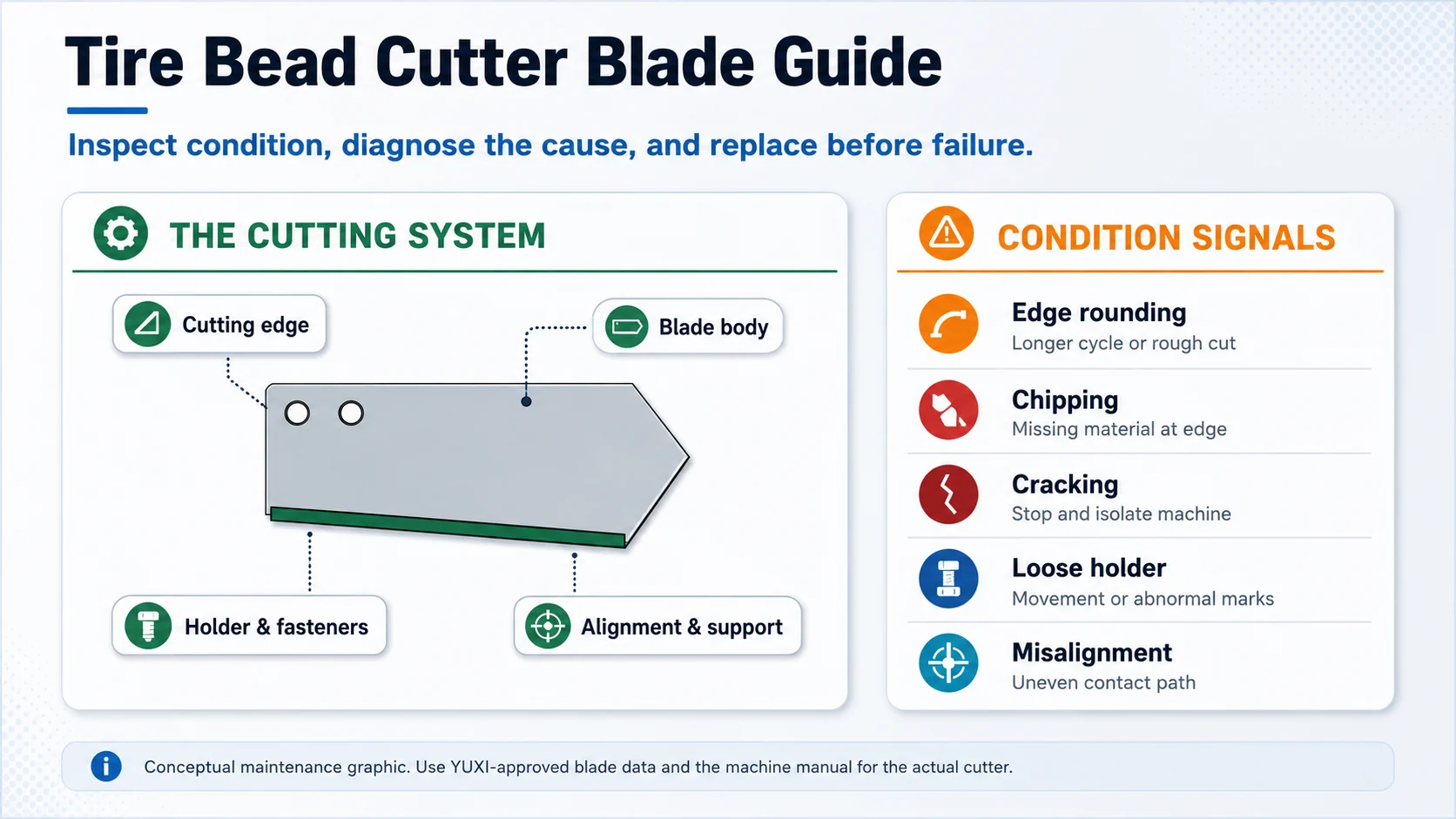
Cutting edge
Blade body
Blade holder
Fasteners
Alignment
Tire clamping
2. Why tire bead cutter blade life is not one fixed number
| Variable | Why it changes wear | What to record |
|---|---|---|
| Tire category | Passenger, light-truck, truck and bus tires can have different sidewall and bead structures. | Daily percentage by tire class. |
| Bead wire strength | Heavier or thicker bead bundles can increase cutting load and edge impact. | Representative tire photos and recurring heavy tire types. |
| Required output | One-side, both-side and complete bead-ring cuts create different total contact per tire. | Approved output definition. |
| Positioning and clamping | Movement or incorrect contact can concentrate load on a small part of the edge. | Adjustment or movement events. |
| Operating hours | Wear accumulates with actual cutting work, not calendar time alone. | Runtime, shifts and tires processed. |
| Inspection and maintenance | Loose fasteners, contamination or delayed replacement can turn normal wear into damage. | Inspection date and action. |
3. Main factors that accelerate blade wear
Tire mix changes
Repeated incomplete cuts
Loose or unstable support
Incorrect cleaning or grinding
Uncontrolled tire movement
4. Normal wear, dulling, chipping and cracking
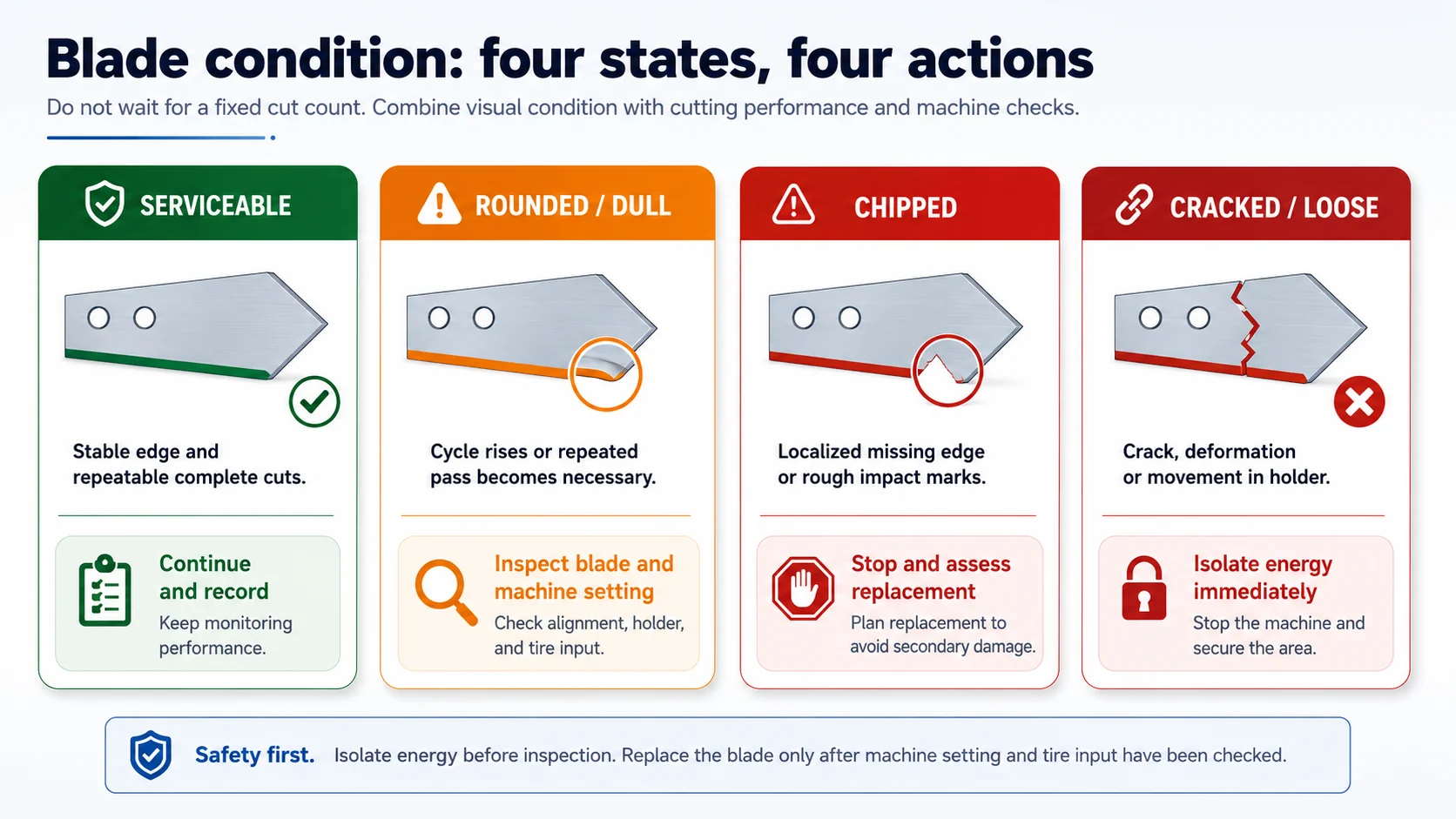
| Condition | Typical observation | Recommended response |
|---|---|---|
| Serviceable | Stable edge profile, complete cut and no abnormal movement or contact marks. | Continue operation and update the inspection record. |
| Rounded or dull | Edge looks less defined; cycle time rises or the machine begins requiring another pass. | Stop for inspection of the blade and the complete cutting setup. |
| Chipped | A localized piece is missing from the edge, sometimes with a rough impact mark. | Do not continue normal production until the cause and replacement need are assessed. |
| Cracked, deformed or loose | Visible crack, blade-body deformation, movement in the holder or damaged mounting area. | Stop, isolate hazardous energy and obtain authorized technical review. |
5. Cutting symptoms that should trigger inspection
- Full cycle time rises without a documented change in tire type or output.
- The cutter needs a second pass on tires previously completed in one cycle.
- The cut surface becomes irregular, torn or inconsistent around the circumference.
- The tire moves or vibrates abnormally during cutting.
- New impact marks appear on the blade body, holder or nearby structure.
- Fasteners appear loose or the cutter no longer sits in its approved position.
- Noise, vibration or motor load changes noticeably.
- Chips, cracks or deformation are visible.
6. Blade issue or machine-setting issue?
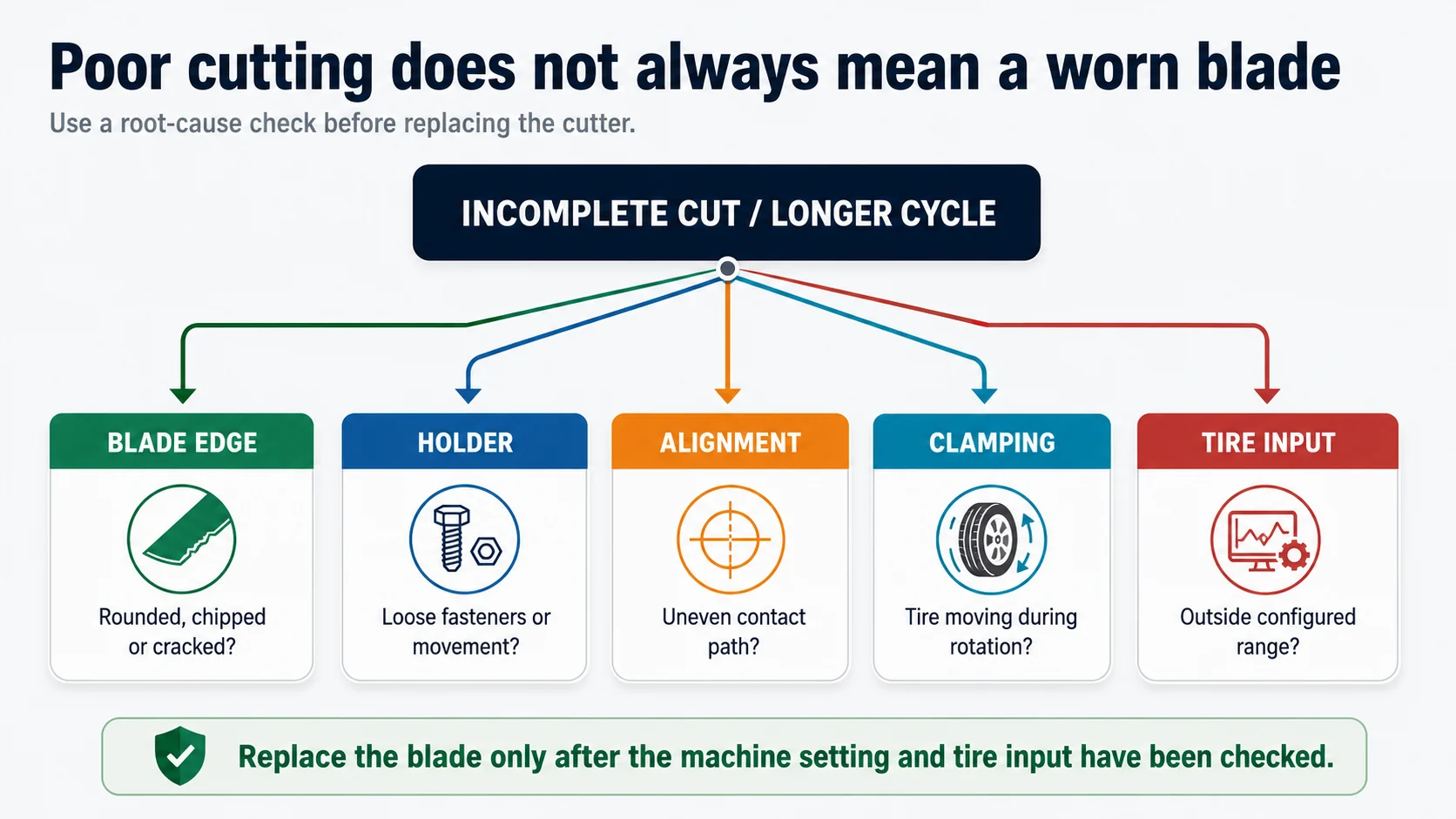
| Observed problem | Possible blade-related cause | Other causes to check |
|---|---|---|
| Longer cycle | Rounded or damaged edge. | Different tire mix, insufficient clamping, incorrect positioning or drive-system issue. |
| Incomplete bead cut | Localized edge damage or excessive dulling. | Wrong cutting path, tire outside configured range or movement during rotation. |
| Damage repeatedly occurs in one edge area | Weak or previously damaged local section. | Concentrated load caused by holder support or alignment. |
| New blade cuts poorly immediately | Incorrect or incompatible replacement cutter. | Mounting error, contamination, wrong orientation, setting or tire input. |
| Blade body shows movement marks | Mounting surface or cutter body damage. | Loose fasteners, holder damage or improper installation. |
7. Daily and periodic blade inspection checklist
Before the shift
- Follow the site’s approved safe-inspection procedure.
- Check that the cutter is correctly seated and not visibly loose.
- Look for cracks, major chips, deformation and unusual contact marks.
- Confirm guards and protective devices are installed.
- Check the holder and accessible fasteners according to the manual.
- Confirm the scheduled tire group is within the approved range.
During production
- Record incomplete cuts and repeated passes.
- Watch for tire movement or a changed contact path.
- Track cycle-time change by tire group.
- Stop when abnormal noise, vibration, movement or visible damage appears.
At the planned inspection interval
- Isolate hazardous energy using the authorized site procedure.
- Clean only by the approved method.
- Inspect the complete edge and blade body under suitable lighting.
- Inspect the holder, mounting surfaces and fasteners.
- Compare current condition with the prior record or approved reference photo.
- Document continued service, supplier review, sharpening approval or replacement.
8. When should the cutter be replaced?
Plan replacement
Stop immediately
9. Can a tire bead cutter blade be sharpened?
10. Safe blade replacement and hazardous-energy control
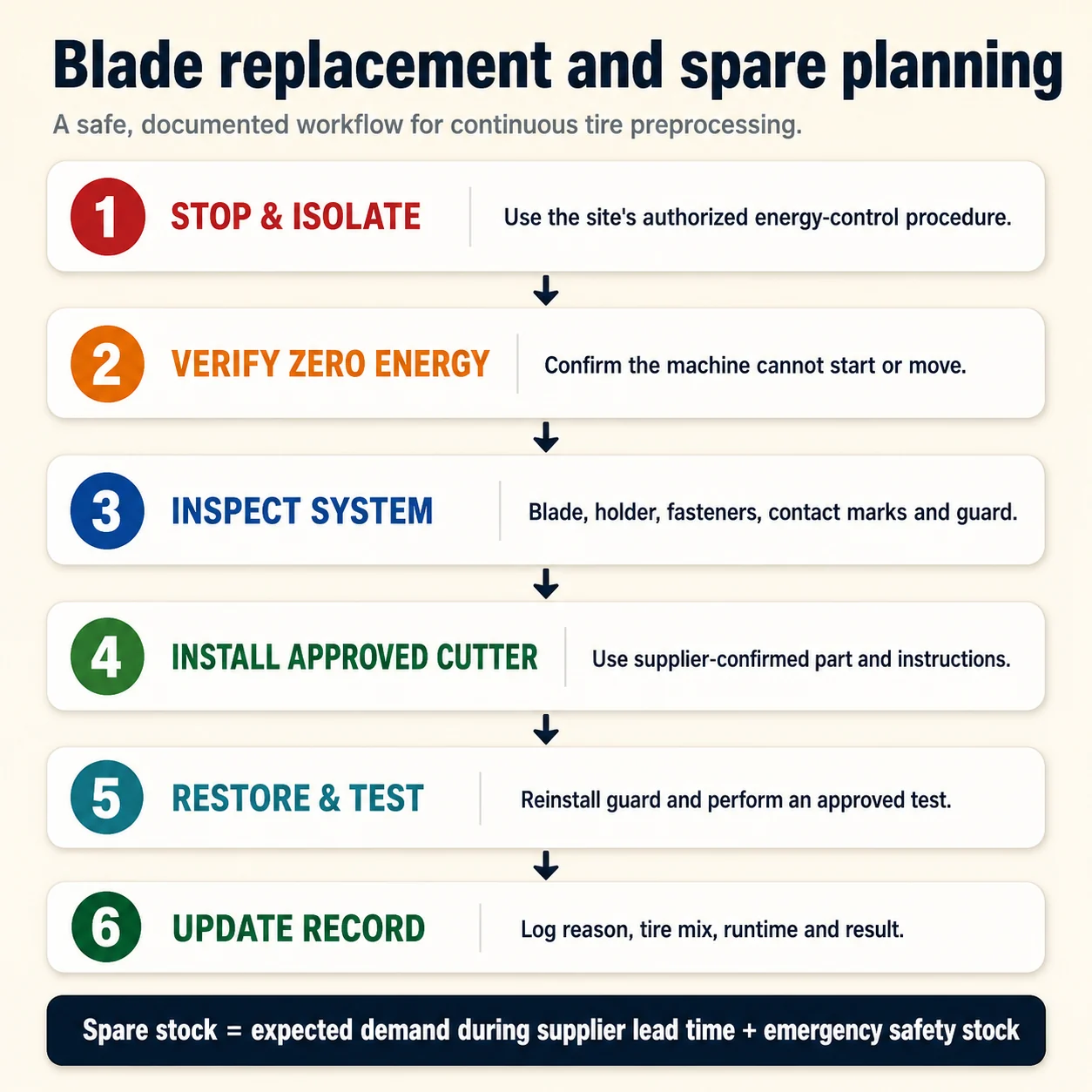
- Stop production and notify affected personnel.
- Identify and isolate every relevant energy source.
- Apply the authorized lockout/tagout procedure and verify isolation.
- Support or secure components that could move.
- Inspect the blade, holder and fasteners before installing a replacement.
- Install only the supplier-confirmed cutter using approved instructions.
- Restore the guard and remove tools or loose materials.
- Return the machine to service using the site’s authorized sequence.
- Perform an approved test with representative material.
- Update the maintenance and cutter-history record.
11. How blade condition affects capacity and cut quality
| Performance metric | Why it matters | Recommended record |
|---|---|---|
| Full cycle time | Shows whether total productivity is changing. | Median by tire category. |
| Incomplete-cut rate | Reveals extra passes and unstable output. | Incomplete cuts per tested batch. |
| Unplanned blade stops | Shows maintenance disruption. | Date, duration and reason. |
| Blade service interval | Builds site-specific replacement planning. | Runtime and tire mix between changes. |
12. Spare cutter inventory planning
Spare-planning inputs
- Operating shifts and annual production days.
- Tire mix and expected heavy-bead percentage.
- Observed cutter service interval.
- Supplier production and transport lead time.
- Whether the removed cutter can be approved for sharpening.
- Cost of unplanned downtime.
- Storage and corrosion-protection requirements supplied with the part.
13. Tire bead cutter blade maintenance log
| Record field | Example entry format |
|---|---|
| Date, shift and operator | YYYY-MM-DD / Shift A / Operator ID |
| Machine and cutter identification | Machine serial / cutter part or trace number |
| Tire mix | Passenger __% / light truck __% / truck __% |
| Operating history | Runtime hours and tires since installation |
| Cycle-time trend | Representative median minutes per tire |
| Cut quality | Complete, incomplete, repeated pass, abnormal surface |
| Visual condition | Serviceable, rounded, chipped, cracked, deformed |
| Holder and fasteners | Normal, movement mark, loose, damaged |
| Action | Continue, inspect, supplier review, sharpen, replace |
| Post-maintenance test | Tire type, result and cycle time |
14. What to send YUXI when ordering a replacement cutter
- Machine name, serial number and original order information.
- Clear photographs of the complete cutter, cutting edge and mounting area.
- Photographs of the holder and any abnormal contact marks.
- Dimensions requested by YUXI—do not guess which dimensions are critical.
- Passenger, light-truck, truck and bus tire proportions.
- Maximum tire diameter and representative tire photos.
- Runtime, estimated tires processed and date installed.
- Reason for replacement: dulling, chip, crack, deformation, loss or planned spare.
- Current cutting symptom and sample output photographs.
- Required delivery date and intended spare quantity.
Need a replacement cutter or blade-condition review?
Send the YUXI machine identification, blade and holder photos, tire mix, operating history and current cut result. Technical review should confirm the correct replacement before the machine returns to production.
FAQ: Tire bead cutter blades
How often should a tire bead cutter blade be replaced?
There is no reliable universal interval. Replacement depends on tire type, bead wire thickness, operating hours, maintenance, cutter condition and cutting performance. Use inspection records and supplier guidance rather than a fixed cut count.
What are the signs of a worn tire bead cutter blade?
Possible signs include a rounded edge, longer cycle time, incomplete cuts, repeated cutting passes, rough cut surfaces or abnormal contact marks. These symptoms should also trigger checks of clamping, alignment, holder condition and tire size.
Can a tire bead cutter blade be sharpened?
Only when the tool supplier confirms that sharpening is allowed and provides allowed geometry and mateial removal restrictions.Unapproved grinding tank can change the cutting angle,gap,strength or fit.
Does a truck tire wear the blade faster than a passenger tire?
It may create a heavier cutting load because bead wire structure, sidewall thickness, tire weight and required settings can differ. The actual wear rate must be established from the buyer’s tire mix and records.
What information should I send when ordering a YUXI replacement cutter?
Send the machine identification, blade photos, holder photos, dimensions taken according to YUXI instructions, tire type mix, operating history, reason for replacement and examples of the current cut result.
References and source notes
- OSHA 29 CFR 1910.147: hazardous-energy control during servicing, inspection, adjustments and tool changes.
- OSHA 29 CFR 1910.212: general machine guarding and point-of-operation protection.
- NIST manufacturing diagnostics and prognostics publications: equipment degradation, condition monitoring and maintenance decision support.