A semi-automatic cutter mechanizes the difficult cutting action, but the cutting action is mechanized, but operators still have to stage, load, position, and remove every tire.
Real output depends on how smoothly the operator and machine share the complete workstation.
A semi-automatic tire bead cutting machine can make a stable circular cut and still underperform as a production cell. The reason is often outside the cutter: tires are stored too far away, mixed sizes require repeated positioning, processed parts have nowhere to land, or one operator is expected to run the controls while also moving bulky material across the workshop.
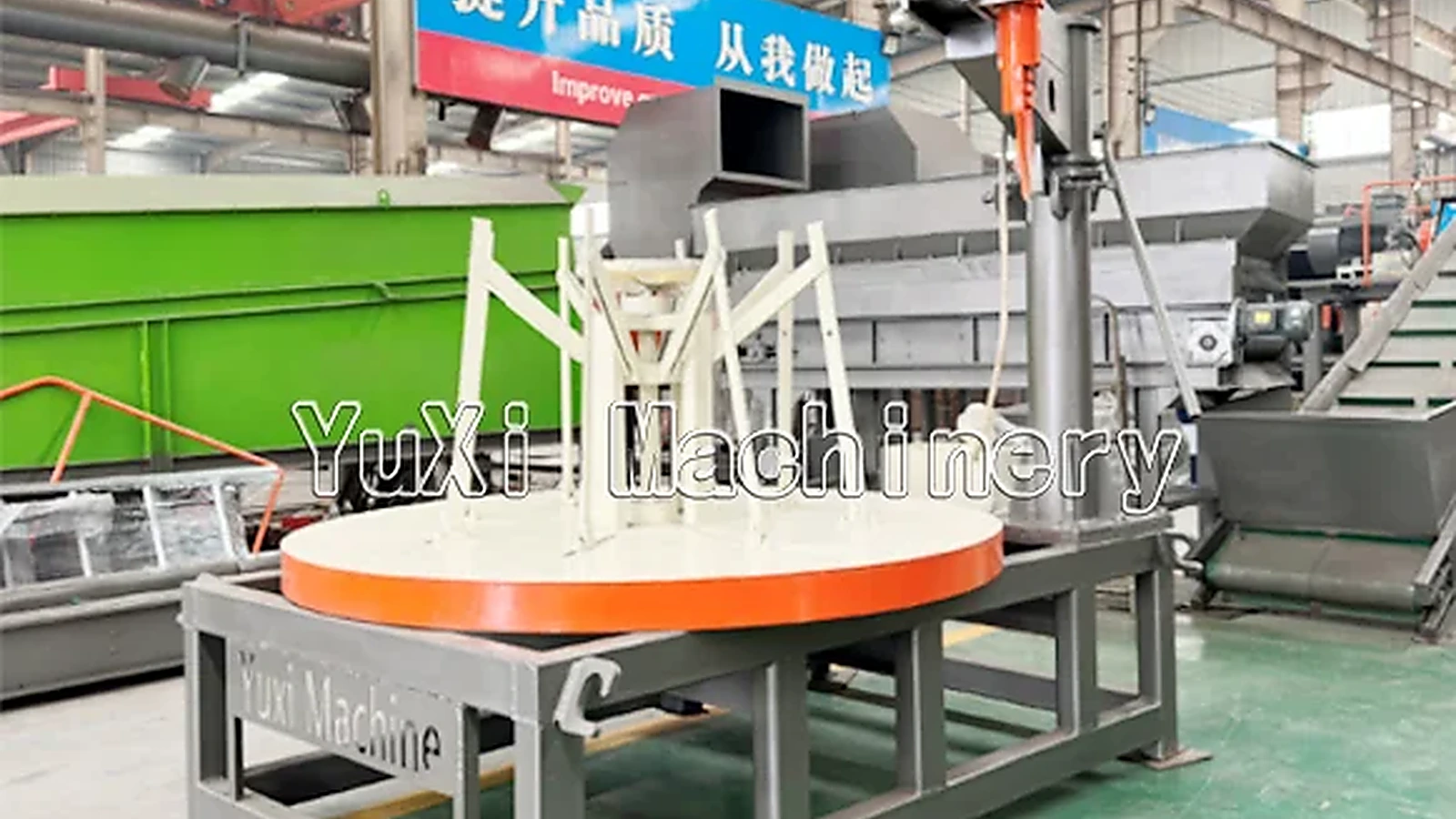
YUXI describes its waste tire bead cutting machine as a semi-automatic pre-processing unit. The operator places and positions the tire. A clamping mechanism holds it during rotation, while the driven worktable and alloy cutter carry out the circumferential cutting action. The product page also states that actual labor needs depend on tire weight, loading method and the production target. Those details make labor planning part of machine selection rather than an issue to solve after installation.
Quick answer: Do not ask only whether one person can operate the controls. Ask how many labor-minutes are required to deliver one correctly processed tire to the next collection point. One operator may be enough for a consistent, manageable tire stream and a compact layout. A helper or mechanical aid becomes more valuable when lifting, turning, carrying or clearing material repeatedly interrupts the operator-machine rhythm.
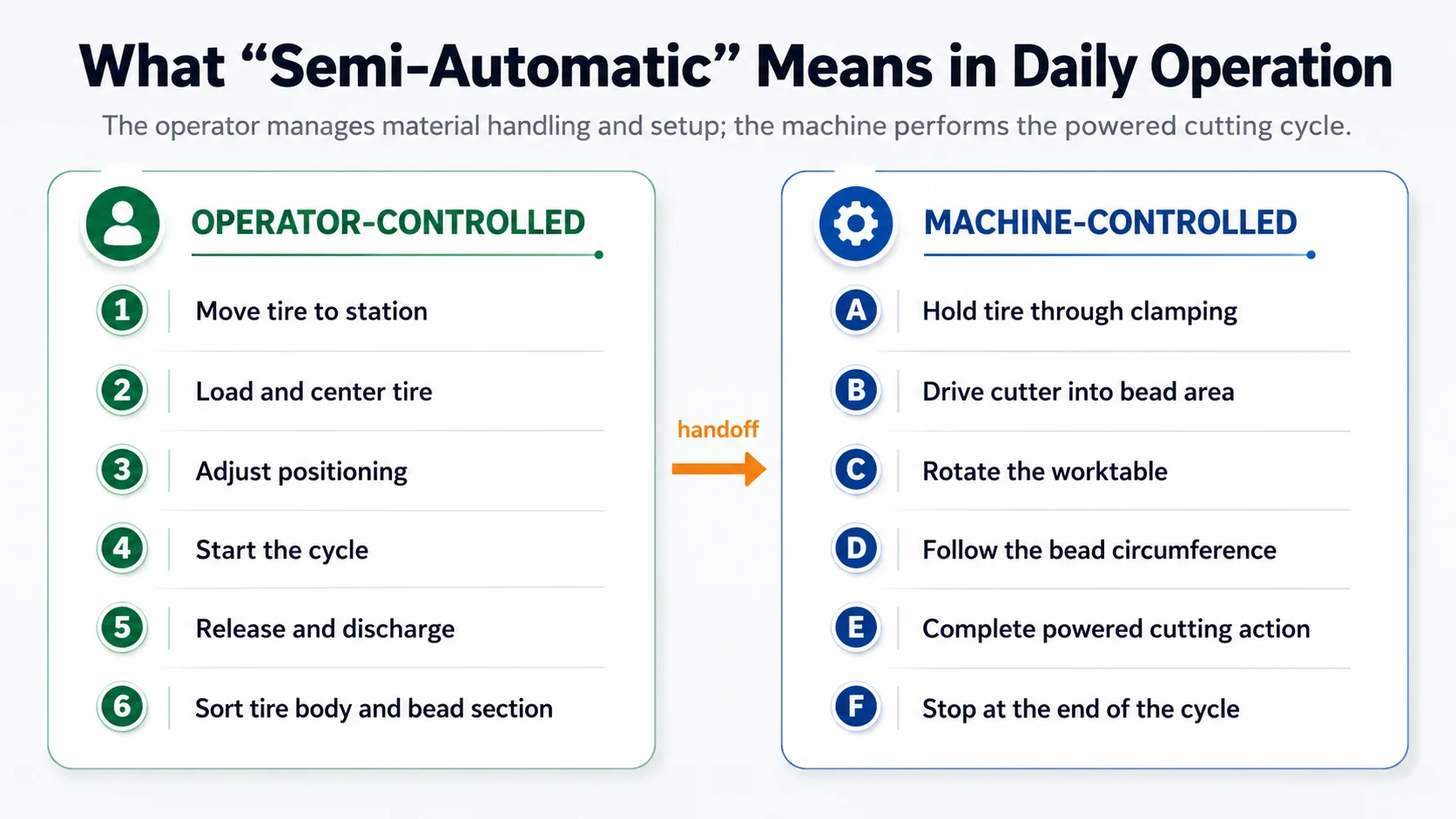
Semi-automatic does not mean the operator cuts the bead wire with a handheld tool. It means that the difficult, powered part of the process is mechanized while important material-handling and setup actions remain operator-controlled. On the YUXI process described publicly, the operator loads and positions the tire. The machine then supports controlled rotation and cutting around the bead circumference.
The exact boundary must still be confirmed during quotation. A supplier may describe a machine as automatic because the cutter advances and the worktable rotates after cycle start, even though the operator still loads, centers, starts, removes and sorts every tire. Clamping and release arrangements can also vary by configuration. Buyers should therefore compare a written task sequence, not just the words “automatic” and “semi-automatic.”
For a detailed explanation of the cutting path and bead-sidewall separation sequence, see How Does a Tire Bead Cutting Machine Work? The focus here is the labor that surrounds that machine action.
Procurement question: For every step, ask who or what moves the tire, secures it, confirms the cutting position, turns it if another side is required, removes the outputs and resets the station.
The machine carries the cutting action; the workshop must still be designed around tire presentation and removal.
Operator and Machine Task Split
A useful labor review begins by assigning every action. When one step is missing from the quotation or layout, it usually becomes unplanned walking, lifting or waiting after commissioning. The table below separates confirmed YUXI process information from configuration-dependent actions that should be clarified before purchase.
Labor planning becomes clearer when each action has an owner and a defined material destination.
Work step
Typical responsibility
Labor question
Quotation detail to confirm
Bring the next tire to the station
Operator, helper or handling aid
How far is the tire moved, and from what height?
Preferred infeed side and buffer position
Load and position the tire
Operator
How many lifts, turns or centering attempts are required?
Worktable height, access and configured tire range
Secure the tire
Configuration-dependent
Does the operator make a manual adjustment before every cycle?
Clamping method and adjustment sequence
Rotate and cut
Machine-driven after cycle start
Must the operator remain fully attended at the controls?
Controls, guarding and normal operating sequence
Release and remove outputs
Configuration-dependent release; operator removal
Can the parts land close to their next destination?
Release method, discharge side and collection arrangement
Reset and prepare the next tire
Operator
Can preparation overlap safely with machine time?
Guarding boundary and permitted operator actions
Can One Operator Run the Machine?
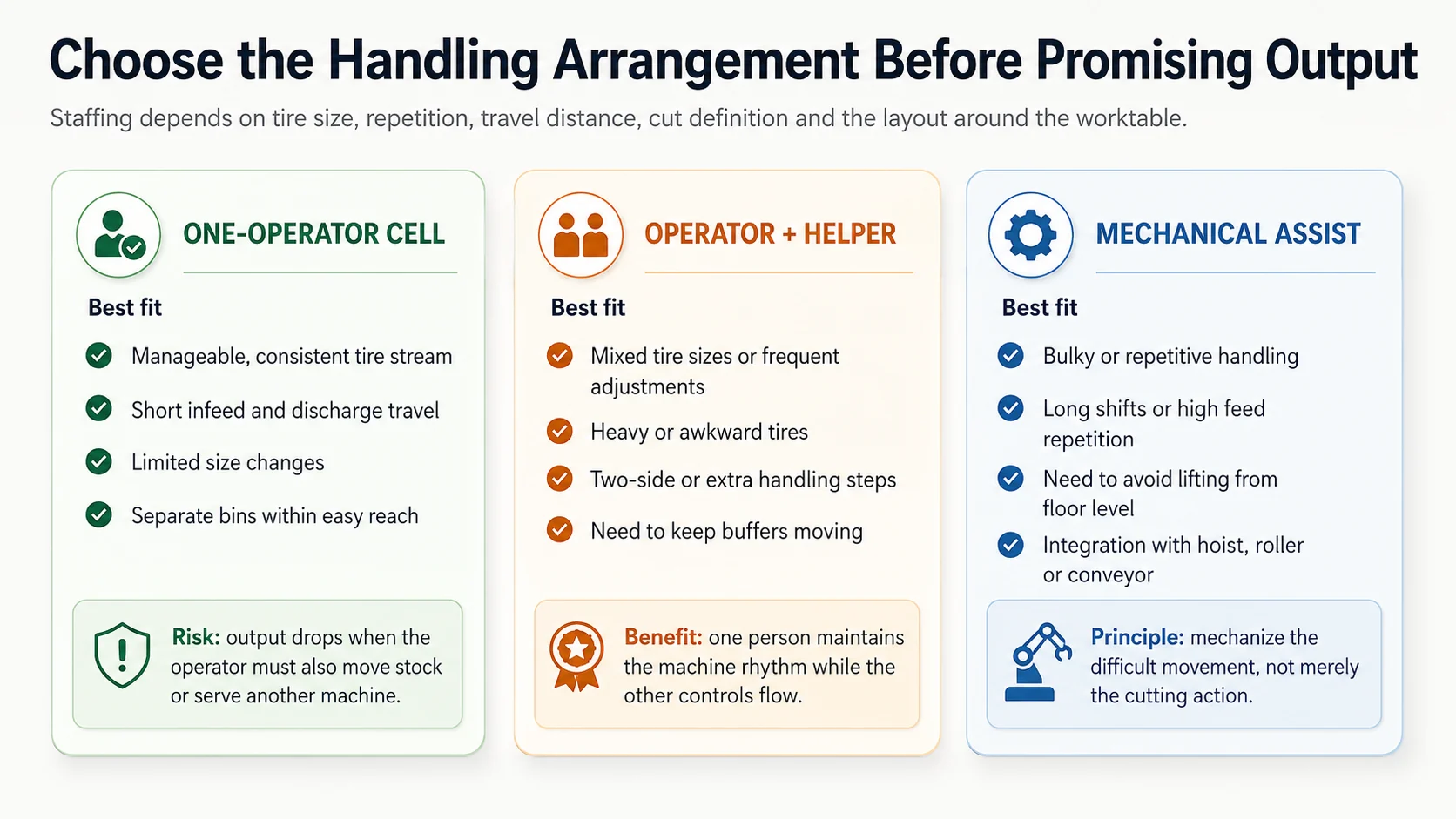
One person may be able to operate the controls, but that is not the same as one person being able to serve the entire cell continuously. A one-operator arrangement is strongest when the tires are reasonably consistent, the operator can move them without repeated awkward handling, the infeed buffer is beside the loading point and both outgoing materials have clearly defined landing areas.
The arrangement becomes weaker when the operator has to leave the controls to find a forklift, pull tires from a tangled pile, carry each bead section to a distant bin or clear a downstream accumulation. Heavy or mixed tires can also change the task from a controlled roll-and-position movement to repeated lifting and turning. The staffing decision should therefore be based on observed tasks, not on a catalog statement that the machine is “one-person operated.”
Good one-operator conditions
Short travel, manageable tires, a consistent batch, accessible controls and immediate discharge space.
Helper may be justified
The operator is repeatedly interrupted by tire staging, two-person handling, output removal or material sorting.
Mechanical aid may be justified
The same heavy or awkward movement is repeated throughout the shift and cannot be removed by layout alone.
The best staffing choice removes the measured handling constraint without creating excess material elsewhere in the line.
Calculate Labor-Minutes per Tire
Headcount alone cannot compare two layouts. A plant may assign one worker to each station, yet one worker spends most of the cycle handling tires while another mainly observes the machine. Labor-minutes per completed tire gives a more useful basis for staffing, labor cost and improvement decisions.
Labor-minutes per completed tire = manual infeed time + loading and positioning + attended setup + manual intervention + output removal and sorting + allocated routine housekeeping.
Measure active human time, not just elapsed machine time. If the operator must remain at the control position throughout the cutting action, that period is attended labor. If the validated guarding and work method allow the operator to prepare the next tire without entering a danger zone, part of the machine time may overlap with useful work. That distinction can improve output per labor-hour even when the machine’s cutting speed does not change.
Record tire families separately. Passenger tires, light-truck tires and common truck tires may require different handling effort and positioning adjustments. Do not merge them into one average until enough observations have been collected to show the real feed mix.
Observation
What to record
Why it matters
Manual infeed
Time, distance and method used to bring the tire to the worktable
Shows whether the buffer or material supply is the labor bottleneck
Loading and positioning
Number of lifts, turns and repositioning attempts
Reveals mismatch between tire stream, access and fixture setup
Attended machine time
Time the operator cannot perform another approved task
Separates machine occupation from transferable labor
Output removal
Time and distance for the tire body and bead-sidewall section
Shows whether discharge layout is consuming labor
Intervention and cleaning
Recutting, fragment removal, adjustments and routine cell cleaning
Identifies avoidable labor that is hidden in average output
Capacity boundary: This article uses labor metrics. Full-cycle capacity formulas, mixed-tire weighting and sustainable shift calculations are covered in the Tire Bead Cutting Machine Capacity Guide.
Five Labor Bottlenecks That Reduce Output
1. Tires arrive in the wrong form
A tangled floor pile may be convenient for storage but poor for production. The operator must pull, separate and turn tires before loading. A smaller, controlled near-machine buffer often reduces labor more effectively than asking the worker to move faster.
2. The operator repeats the same positioning work
Mixed tire sizes can force repeated centering and fixture adjustment. Short campaigns of similar tires, clear setup references and representative tire testing can reduce unnecessary corrections without changing the cutting mechanism.
3. The discharge points are treated as an afterthought
The process creates at least two outgoing material streams: the main tire body and the bead-sidewall section. When both are dropped into the operator’s movement path or carried to distant collection areas, every completed tire adds avoidable handling.
4. One operator serves unrelated equipment
The bead cutter may sit idle while its operator loads another machine, moves a forklift or clears a remote bin. Shared labor can be economical, but only when the tasks can be sequenced without repeatedly starving the bead-cutting station.
5. Awkward handling slows the second half of the shift
A task that looks manageable for a few demonstration tires may become difficult after hours of repetition. Fatigue, grip difficulty, twisting and floor-level handling can reduce pace and increase mistakes. Engineering the movement is more reliable than planning around peak short-duration performance.
When a Helper Improves Productivity
A helper creates value when a second pair of hands removes a specific interruption from the machine operator. Common examples include staging the next tire, helping with an occasional bulky tire, turning a tire for another required cut, moving processed material or keeping the near-machine buffer organized.
The strongest business case is visible in output per direct labor-hour. Suppose the cell produces more tires after adding a helper, but the percentage gain is smaller than the percentage increase in labor. The change may improve total output while reducing labor productivity. That can still be worthwhile when the downstream line needs more prepared tires, but it should be a deliberate capacity decision rather than an assumption that more people always improve efficiency.
Add a helper when: two-person assists are frequent, the operator repeatedly leaves the control position, tire staging is the main delay, or output removal prevents the next loading action.
Do not add a helper when: the real constraint is a worn cutter, incorrect machine configuration, inadequate discharge space or a downstream process that cannot accept more material.
When Mechanical Handling Is Better Than More Labor
Additional labor is flexible, but it does not redesign a poor movement. When the same bulky tire is lifted from the floor, turned at an awkward height or carried over a long path every cycle, mechanical assistance can address both the ergonomic exposure and the time loss at their source.
Handling problem
Possible aid
Selection question
Long rolling or carrying distance
Cart, roller track or short conveyor
Can tires be delivered to the loading side without crossing traffic?
Frequent floor-level lifting
Lift table, tilting table or raised buffer
Can the tire be presented closer to the worktable height?
Bulky truck tire positioning
Hoist, manipulator or guided roller support
Can the aid control the tire without obstructing the cutter or guard?
Processed material carried away each cycle
Chute, roller bed or dedicated collection cart
Can each output move directly toward its next process?
Irregular heavy tires
Shared forklift or lifting device with defined call sequence
Will the equipment be available when needed, or create new waiting?
The aid should match the actual task and tire range. A conveyor that works for passenger tires may not control a larger truck tire safely. A hoist that reduces lifting can still slow production if attachment and release take longer than the original movement. Test the complete handling method with representative tires.
Build a Productive Work Cell
YUXI’s product information notes that line projects should consider conveyor height, operator position, tire storage, collection areas and downstream equipment capacity. For a semi-automatic station, those decisions determine how much of each cycle is valuable processing and how much is avoidable movement.
Design the infeed side
Place a controlled buffer close to the normal loading position.
Present tires in an orientation that reduces lifting and turning.
Group similar tire families when practical.
Keep forklift routes separate from the operator’s working path.
Design the discharge side
Give the tire body and bead-sidewall section separate destinations.
Keep collection close without blocking access or guarding.
Provide enough buffer to avoid immediate downstream blockage.
Retain maintenance access around the cutter, worktable and securing mechanism.
The ideal cell follows the natural sequence: take the next tire, load and position it, start the process, remove the outputs and return to the next tire without crossing paths or carrying material around the machine. The downstream tire shredder machine should receive prepared tires through a controlled buffer rather than by allowing cut tires to accumulate beside the operator.
Safety and Ergonomic Planning
A tire bead cutting station includes a point of operation, rotating components and a bulky workpiece. OSHA’s general machine protection rules require the prevention of hazards such as operating points,feeding points and rotating parts.It requires operation point protection to prevent body parts from entering dangerous areas during the operation cycle1
Manual processing should be evaluated according to tasks,loads,frequencies,postures,working capabilities.NIOSH identifies intense fatigue,repetitive and awkward postures as important musculoskeletal risk factors.It suggests redesigning manual material handling tasks and using mechanical assistance when appropriate.23 HSE also recommends avoiding dangerous manual handling when reasonable and feasible,and considering conveyors,cranes, forklifts and other handling aids before relying on training alone.456
Cutter changes, jam clearing and other servicing tasks need a separate safe state from normal production. OSHA’s control-of-hazardous-energy standard addresses procedures intended to prevent unexpected energization, startup or release of stored energy during servicing and maintenance.7 The site’s risk assessment, local law, machine documentation and isolation procedure should define the actual controls.
Work-cell questions: Can the tire be loaded without reaching into a danger zone? Is it stable before rotation starts? Can each output be removed without reaching across moving parts? Are emergency controls accessible? Can maintenance be completed without using the production posture or bypassing the guard?
Labor KPIs to Record
A short daily sheet is enough to reveal whether the machine, handling method or labor arrangement is limiting the cell. Record the figures by tire family when the feed changes substantially.
KPI
Definition
Decision supported
Labor-minutes per completed tire
Direct active labor assigned to one accepted output
Compare staffing and layout alternatives
Output per direct labor-hour
Completed tires divided by direct labor-hours assigned to the cell
Judge whether a helper produces a real productivity gain
Handling distance per tire
Total infeed and discharge travel attributable to one tire
Identify opportunities for buffer or bin relocation
Lifts or major turns per tire
Number of substantial manual handling actions
Assess whether presentation or mechanical assistance should change
Repositioning attempts
Extra adjustments before an acceptable cutting position
Improve batching, setup references and configured tire range
Two-person assists
Number of cycles requiring help
Choose between scheduled help and mechanical handling
Operator-away minutes
Time the assigned operator is serving unrelated material or equipment
Review shared-labor assumptions
First-pass completion
Share completed without recutting or major correction
Separate handling problems from cutter or securing problems
Information to Send YUXI
A useful quotation request should describe the machine cell rather than sending only voltage and an hourly target. The supplier needs enough information to review the tire, operator, handling method and downstream route together.
Tire categories, representative photos and expected mix
Minimum and maximum tire diameter, width and approximate weight
Whether one or both bead-sidewall areas must be cut
Current tire presentation: floor pile, rack, cart, forklift, hoist or conveyor
Available operators and other tasks assigned to them
Infeed distance, worktable access and available lifting aids
Planned destinations for the tire body and bead-sidewall section
Next process, such as tire cutting, shredding, granulation or pyrolysis pre-treatment
Workshop plan, traffic routes, voltage and access constraints
Representative tires available for a video or acceptance test
Configure the Labor Around the Tire
Send YUXI the tire range, handling method, operator plan and downstream process. The machine and workstation can then be reviewed as one practical pre-processing cell.
What does semi-automatic mean for a tire bead cutting machine?
The operator normally handles tire movement, loading, positioning, cycle start and material removal. The machine provides the driven worktable rotation and cutting action. The exact clamping and release method should be confirmed for the selected configuration.
Can one operator run a semi-automatic tire bead cutter?
One operator may be practical when tires are manageable, the buffer is close and both discharge streams are arranged within a short movement path. Mixed, heavy or awkward tires may justify a helper or mechanical handling aid after a task-specific assessment.
What is the best labor metric for this machine?
Record labor-minutes per completed tire. Include manual infeed, loading, positioning, intervention, discharge, sorting and allocated housekeeping. Also track output per direct labor-hour so additional labor can be judged by measured productivity rather than headcount alone.
When does a second worker improve output?
A helper is useful when staging, lifting, turning or removing tires repeatedly keeps the machine operator away from the controls. The additional worker should remove a measured bottleneck and should not simply create a larger downstream pile.
When is mechanical handling better than adding labor?
A roller table, cart, hoist, lift or conveyor is often the better choice when the same bulky movement is repeated throughout the shift, handling distance is long, floor-level lifting is frequent or two-person assists are becoming routine.
Does the YUXI bead cutter produce clean steel bead wire?
YUXI describes the machine as cutting and separating the bead ring or bead-sidewall section from the main tire body. Rubber normally remains around the embedded steel wire, so a separate bead-wire separation step may be needed when cleaner steel recovery is required.
Marie has 8+ years of experience in tire shredding and recycling equipment,with a focus on tire shredders,rubber recycling machines,TDF production,rubber crumb processing,and complete tire recycling systems.