




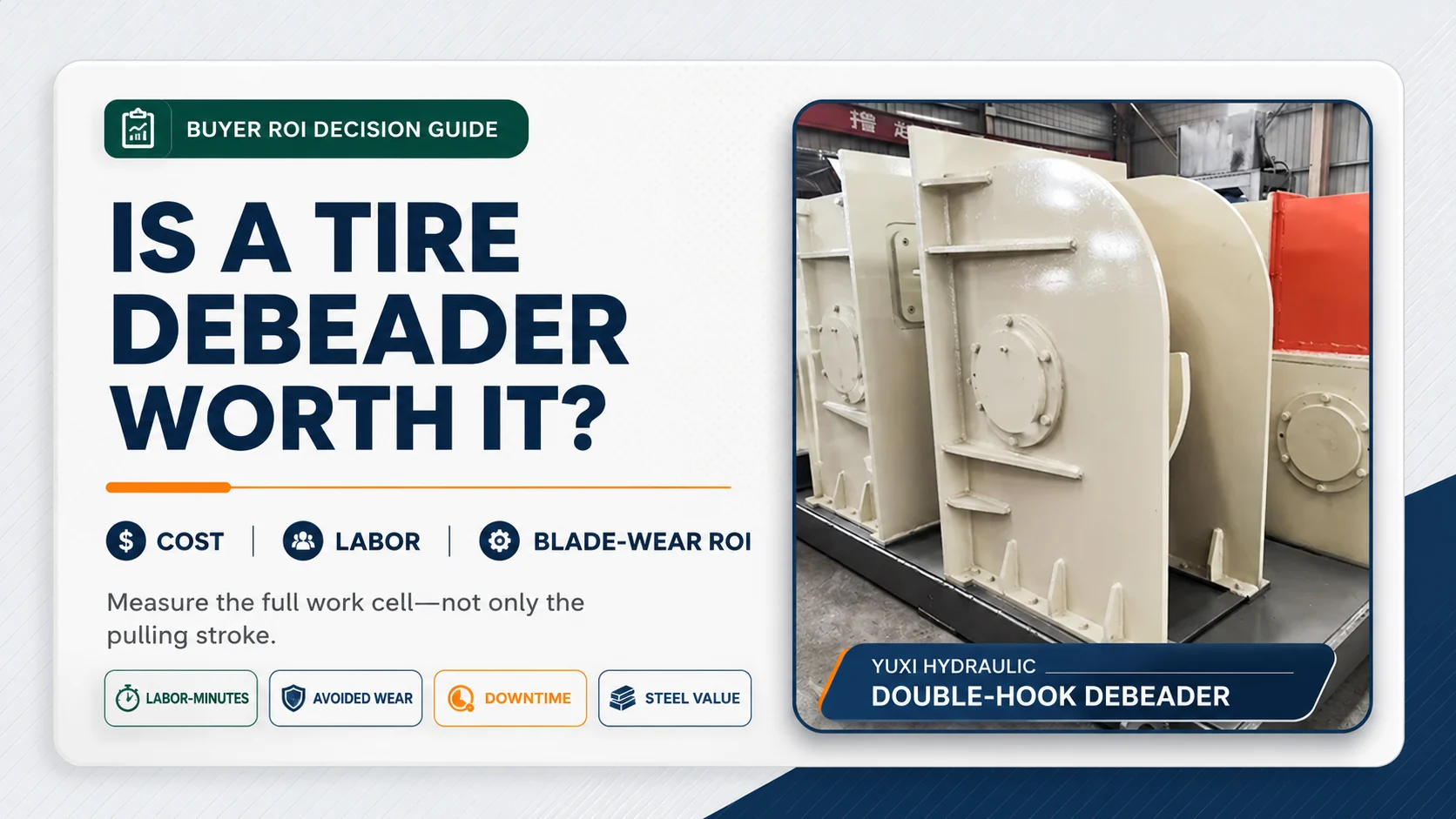
In This Guide
- When the answer is usually yes
- Five ROI value streams
- Build the current-route baseline
- Calculate installed project cost
- Measure labor correctly
- Value blade wear and downtime
- Steel and output-quality value
- ROI, payback and break-even formulas
- Illustrative payback example
- When it may not be worth it
- Run a representative-tire trial
- Where the YUXI machine fits
- Safety and cost boundaries
- Final decision matrix
- FAQ
1. When Is a Tire Debeader Usually Worth Considering?
Downstream cutters are expensive to stop
The current front-end method is labor-heavy
Truck or bus rings dominate the mix
Cleaner feed has commercial value
2. The Five Value Streams Behind Tire Debeader ROI
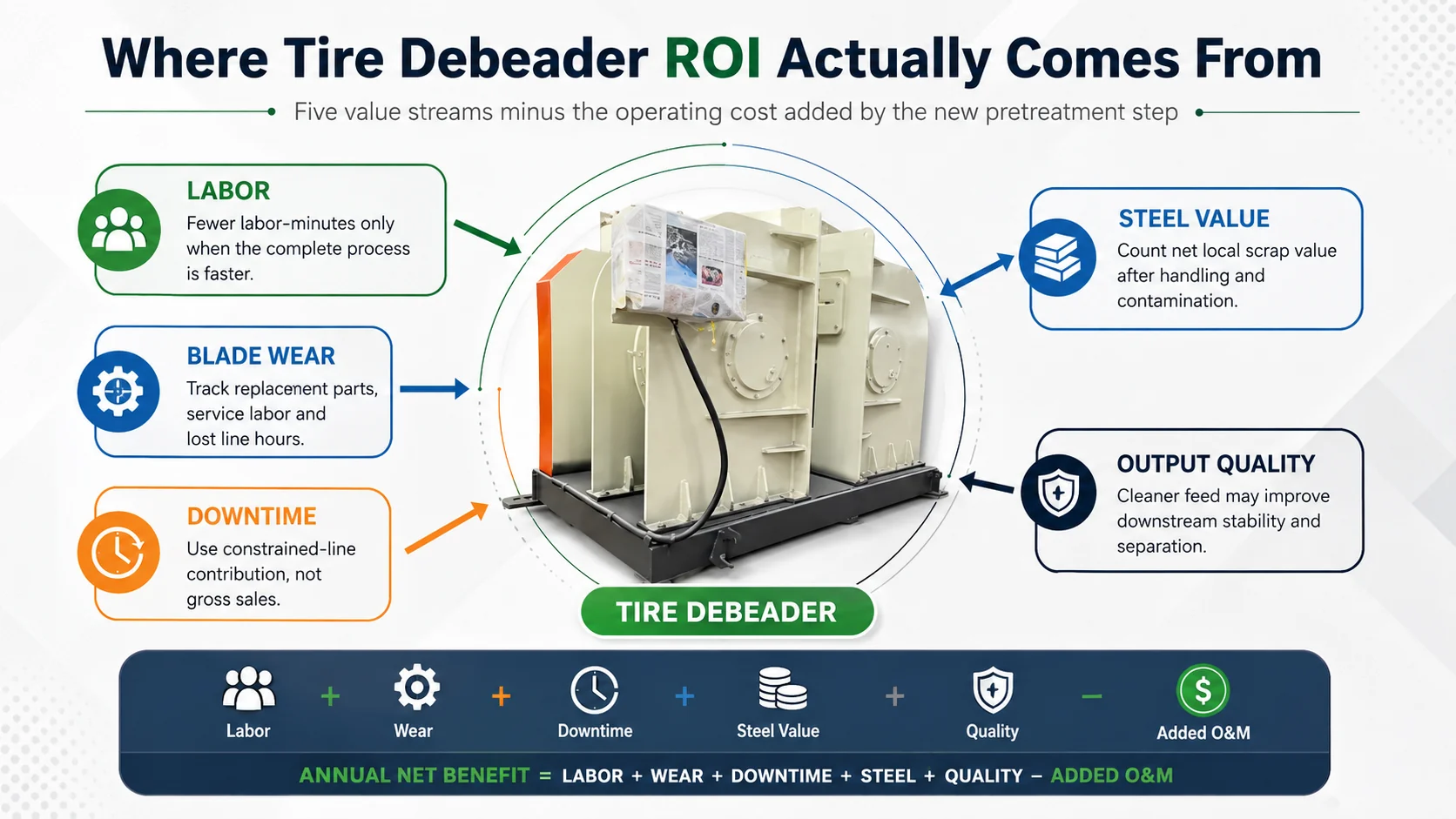
| Value stream | What to measure | Common overstatement |
|---|---|---|
| Labor change | Operator count × complete-process labor-minutes × loaded labor rate. | Timing only the hydraulic pull and ignoring ring preparation, staging, release and wire collection. |
| Avoided blade or cutter wear | Parts, sharpening, service labor and normalized life across comparable tire mix and tonnage. | Assuming every blade replacement was caused by bead wire. |
| Avoided downtime | Bead-related stops × average duration × defensible value of a constrained production hour. | Multiplying downtime by gross annual sales. |
| Recovered bead steel | Net saleable mass × local realized price, less contamination and handling. | Using a headline scrap price without deductions or assuming all tire steel is removed. |
| Output or throughput contribution | Accepted output, rework, downstream separation load or additional saleable production. | Counting rated capacity that the rest of the line cannot use. |
Annual net benefit = labor benefit + avoided wear + avoided downtime + net steel contribution + usable throughput/quality contribution − added operating and maintenance cost3. Build the Current-Route Baseline Before Pricing the Machine
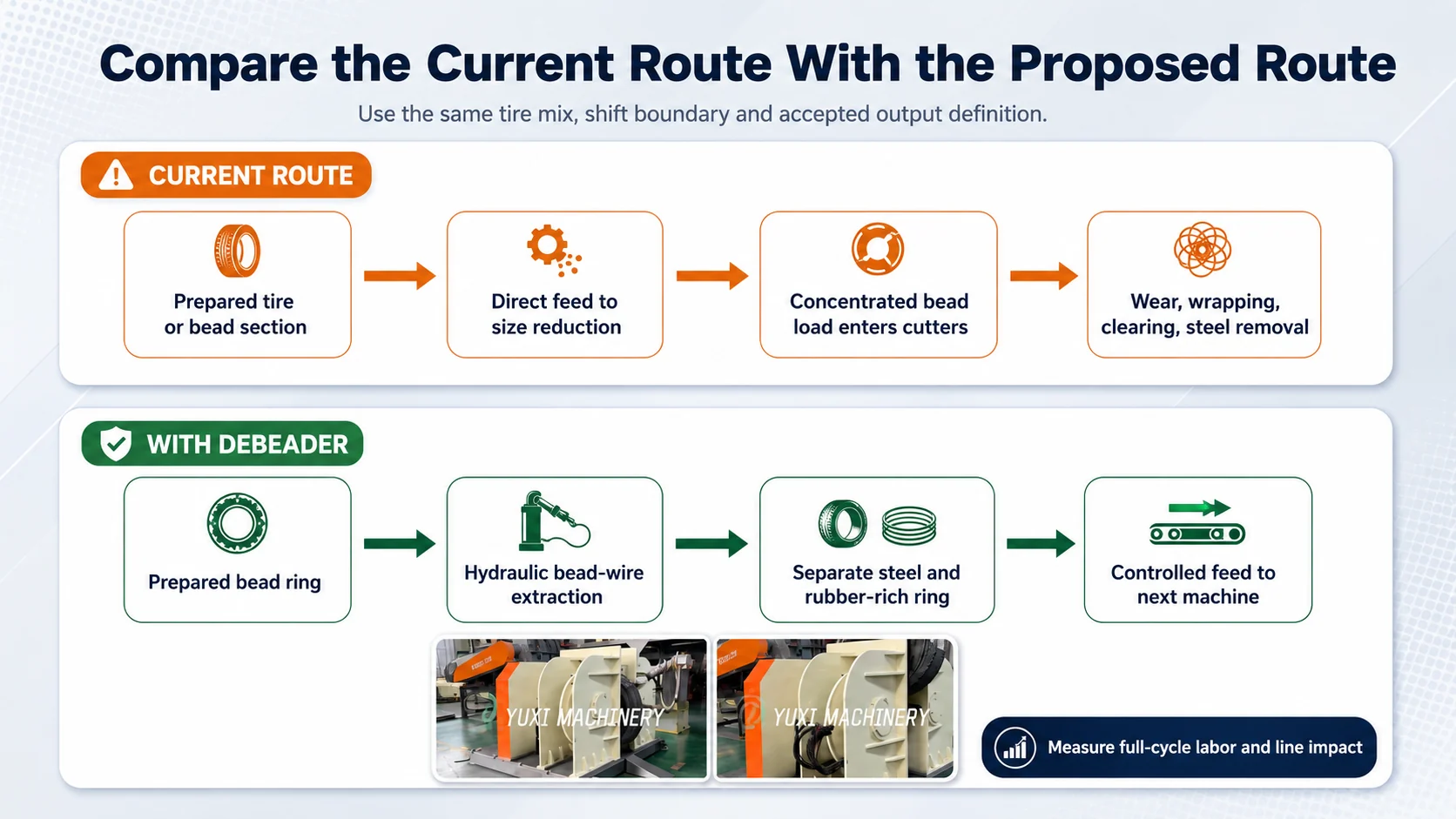
Baseline A: the plant already removes bead wire
Baseline B: the plant sends the bead section into the shredder
Baseline C: the plant outsources or sells tires in a different form
4. Calculate Total Installed Cost, Not the Catalog Number
| Cost group | Possible items | ROI treatment |
|---|---|---|
| Equipment | Machine, approved hook configuration, guards, controls, hydraulic unit, tools and initial spares. | One-time capital cost unless an item is expected to repeat frequently. |
| Logistics | Packing, freight, insurance, duties, customs, inland delivery and unloading. | Include in installed project cost, not as an afterthought. |
| Site readiness | Foundation or anchors, electrical work, lighting, barriers, oil, access and material staging. | Include one-time implementation cost. |
| Handling | Lift table, hoist, roller support, bins or carts for rings and spring-like wire bundles. | Include when required to achieve the proposed labor and safety method. |
| Start-up | Commissioning, training, trial material, production interruption and acceptance testing. | Include actual cash cost and planned lost time where material. |
| Working capital | Recommended hooks, seals, filters, hoses and local inventory. | Include initial stock in capital; replenishment belongs in annual O&M. |
5. Measure Labor by the Complete Process, Not by Cylinder Time
Labor cost per accepted ring = operator count × full-cycle minutes ÷ 60 × loaded labor cost per hourStart and stop the timer in the same place
| Timing boundary | Include | Why it matters |
|---|---|---|
| Start | Operator begins handling the next unprocessed ring from the defined staging point. | Pre-positioning tires off-camera can hide substantial labor. |
| Active cycle | Loading, restraint, hook engagement, pulling, return and approved control sequence. | Shows the machine-dependent portion. |
| Output clearing | Remove and place the rubber ring and steel bundle in their defined destinations. | Wire release and bin condition can dominate the cycle. |
| Stop | Cell is ready to receive the next ring. | Prevents the test from ending before housekeeping and reset. |
Separate machine time from labor time
6. Turn Blade-Wear and Downtime Claims Into Evidence
Build a wear ledger
- date and operating hours at each inspection, rotation, sharpening or replacement;
- tire family and approximate tonnage or ring count processed in the period;
- failed component and observed wear mode—normal edge rounding, chipping, fracture, wrapping damage or another cause;
- parts cost, service labor and external machining cost;
- line downtime from safe shutdown through restart;
- whether concentrated bead wire was found at the event;
- other variables such as foreign metal, feeding shock, alignment or poor maintenance.
Avoided annual wear cost = normalized baseline blade/cutter cost − normalized post-installation blade/cutter costValue downtime conservatively
Avoided downtime value = avoided bead-related stop hours × contribution value of the constrained line hour7. Count Recovered Steel and Output Quality Without Double Counting
Net bead-steel contribution = saleable bead-wire mass × realized net price − extra sorting, storage and transport costOutput quality can be valuable even when throughput does not change
8. Tire Debeader ROI, Payback and Break-Even Formulas
Annual net benefit
Annual net benefit = labor change + avoided wear + avoided downtime + net steel contribution + usable throughput/quality contribution − added annual O&MSimple payback period
Payback years = total installed project cost ÷ annual net benefitSimple annual return
Simple annual return = annual net benefit ÷ total installed project cost × 100%Break-even production volume
Break-even accepted rings per year = annual fixed ownership cost ÷ net benefit per accepted ring9. Illustrative Payback Example—Not a YUXI Quote or Guarantee
| Input | Illustrative value | Calculation note |
|---|---|---|
| Total installed project cost | US$38,000 | Machine, logistics, site work, guarding interface, handling aid and start-up spares. |
| Accepted prepared rings per year | 25,000 | Normal production volume, not supplier rated capacity. |
| Current labor cost per ring | US$1.46 | Two people × 1.25 minutes ÷ 60 × US$35 loaded labor rate. |
| Proposed labor cost per ring | US$0.63 | One person × 1.08 minutes ÷ 60 × US$35; must be proven with the proposed handling aid. |
| Annual labor benefit | US$20,750 | (1.46 − 0.63) × 25,000 rings. |
| Avoided wear and service | US$5,000 | Plant estimate supported by normalized maintenance records. |
| Avoided bead-related downtime | US$3,000 | Plant-approved constrained-hour contribution. |
| Net bead-steel contribution | US$1,500 | Realized price after handling and contamination deductions. |
| Added power, hooks and maintenance | −US$4,500 | Annual operating cost of the new step. |
| Annual net benefit | US$25,750 | 20,750 + 5,000 + 3,000 + 1,500 − 4,500. |
| Simple payback | 1.48 years / 17.7 months | 38,000 ÷ 25,750. |
10. When a Tire Debeader May Not Be Worth It
| Condition | Why the ROI may be weak | Better next step |
|---|---|---|
| Low annual compatible volume | Fixed cost is spread over too few accepted rings. | Calculate break-even volume and consider batch processing or outside service. |
| Feed state is not defined | The plant may need an additional cutter or preparation process before the debeader can work. | Map the actual incoming tire and confirm the approved prepared ring. |
| No measured wear problem | Blade savings are speculative, so the project may rely on a benefit that does not exist. | Start maintenance and stop-cause logging before purchase. |
| Downstream output is already capped by demand | Higher machine availability may not create additional saleable product. | Value only avoided cost, not unused production capacity. |
| Mixed truck and OTR tires are treated as one class | Handling and equipment scope can change substantially. | Separate standard truck evidence from OTR engineering and testing. |
| Layout creates extra travel and wire handling | The new cell adds labor and cross-traffic that erase the mechanical advantage. | Redesign staging, lifting, discharge and buffer positions before ordering. |
| The plant expects all steel to disappear | Steel belts remain and downstream separation is still required. | Define the output of every stage and the final steel specification. |
11. Prove the Business Case With a Representative-Tire Trial
Trial sample plan
- common passenger or light-truck ring, if it is a meaningful part of the mix;
- common bus or truck ring;
- largest normal ring;
- most difficult normal bead construction or preparation condition;
- damaged or deformed examples only when they are ordinary production, not rare exceptions;
- separate OTR samples when OTR is an explicit, engineered requirement.
Record more than accepted rings per hour
| Trial field | Record | Use in ROI |
|---|---|---|
| Full-cycle elapsed time | Pickup, load, position, extract, clear and reset. | Capacity and line-balance model. |
| Labor-seconds | Every operator’s active time, including overlapping tasks. | Labor cost per accepted ring. |
| First-pass acceptance | Complete acceptable extraction without re-engagement. | Rework and sustainable-output assumption. |
| Output handling | Wire shape, rubber attachment, bin fill and clearing method. | Steel value, housekeeping and labor. |
| Abnormal events | Slip, incomplete pull, wire release problem, leakage or stop. | Maintenance and production risk. |
| Downstream comparison | Shredder load, stop causes, cutter inspection and separation result. | Wear, downtime and quality benefits. |
12. Where the YUXI Tire Debeader Fits in the ROI Study
Data to send for an ROI-based configuration review
- whole-tire and prepared-ring photos, video and sidewall markings;
- minimum, typical and maximum ring dimensions and approximate weight;
- annual volume, shift pattern and tire-mix percentages;
- current preparation, loading, pulling, shredding and steel-separation route;
- current operator count, labor-minutes and loaded labor cost;
- twelve months of blade, hook, cutter, service and downtime records where available;
- downstream machine, output target and any exposed-wire or cleanliness requirement;
- power supply, workshop layout, staging and handling aids;
- destination and required commercial delivery scope;
- request for a complete-cycle test using representative rings.
13. Safety Is a Project Requirement, Not an ROI Credit
14. Final Decision Matrix: Buy, Test or Postpone
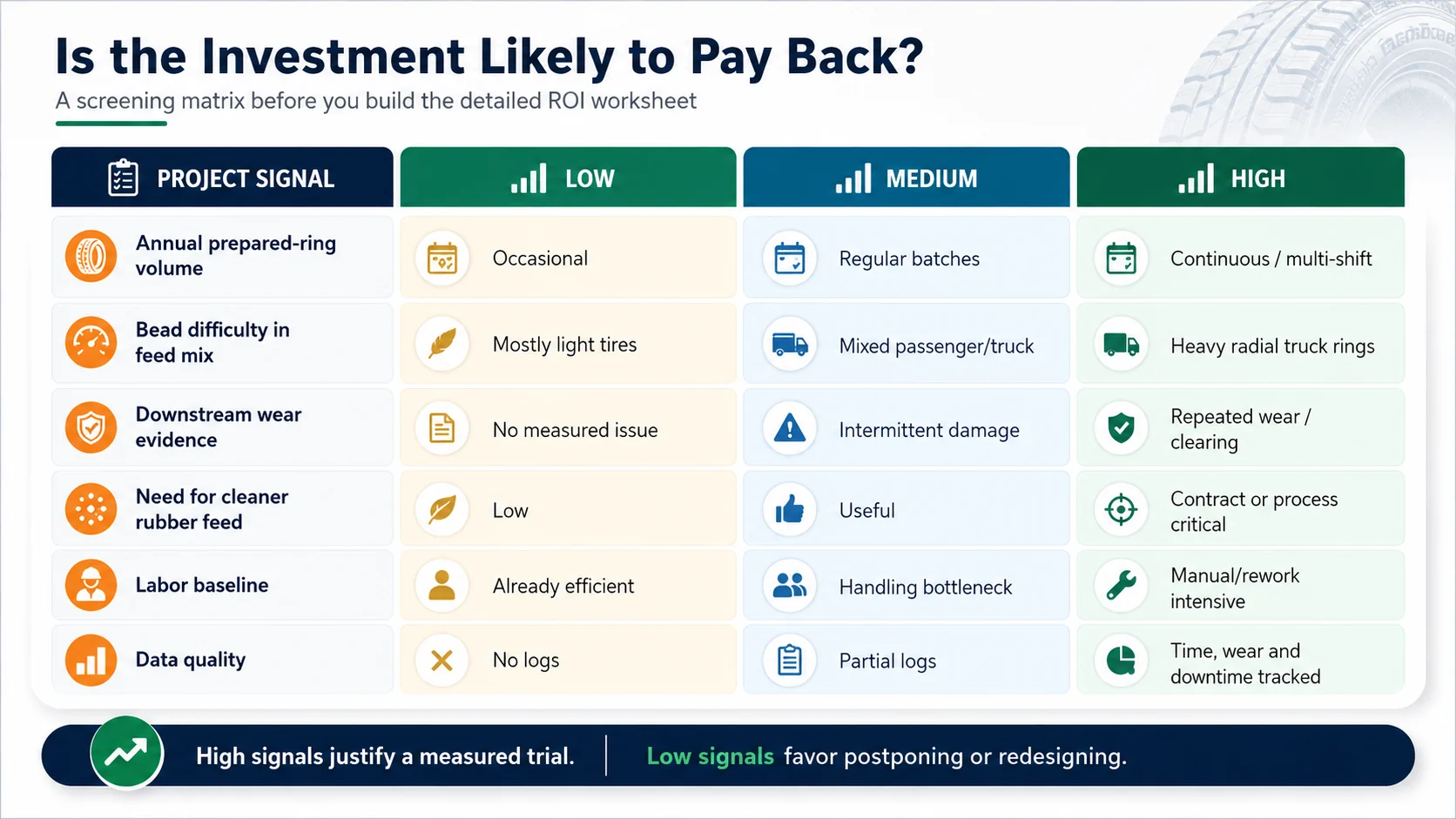
| Decision | Typical evidence | Action |
|---|---|---|
| Buy after validation | Representative feed confirmed; positive conservative payback; layout and safety method defined; benefits remain positive in sensitivity analysis. | Finalize scope, FAT, installed-cost budget, baseline and post-installation measurement plan. |
| Test first | Volume is adequate but wear attribution, labor method, output handling or truck-tire performance is uncertain. | Run a representative consecutive-cycle test and short downstream comparison. |
| Measure first | No reliable maintenance, downtime or labor records. | Collect baseline data before using a guessed benefit in the purchase case. |
| Postpone or redesign | Low volume, incompatible feed, negative payback, no downstream need or poor work-cell layout. | Change preparation, handling, line design, market route or outsourcing strategy. |
Build the Quotation Around Your Baseline
Frequently Asked Questions
Is a tire debeader always worth the investment?
No. It is most likely to justify itself when the plant processes enough compatible prepared bead rings and can document labor, blade wear, downtime, recovered-steel or output-quality benefits. Low-volume plants or lines with no measured bead-related problem may not recover the installed cost.
How do I calculate tire debeader payback?
Calculate annual net benefit from labor change, avoided wear, avoided downtime, net steel contribution and throughput or quality gains, then subtract added power, maintenance, hooks, handling and other operating costs. Divide total installed project cost by annual net benefit to estimate simple payback.
Does a tire debeader always reduce labor?
Not always. It can reduce labor when it replaces a slower front-end method, but it can add labor when a plant previously fed bead-containing material directly to the shredder. Measure the complete route, including ring preparation, loading, extraction, unloading and wire handling.
How should blade-wear savings be measured?
Use maintenance records for blades or cutters, replacement labor and downtime. Compare normalized periods with similar tire mix and throughput. Do not convert a supplier statement such as “less wear” into a dollar value without a plant baseline or controlled trial.
Does a tire debeader remove all steel from a tire?
No. A hook-type tire debeader removes the concentrated bead-wire bundle from a compatible prepared ring. Steel belts and other reinforcement can remain and require downstream liberation and magnetic separation.
When is a tire debeader probably not worth it?
It may not be justified when annual volume is low, the feed is incompatible or inconsistent, the current shredder has no measured bead-related wear or downtime, the recovered material does not need cleaner front-end separation, or the plant cannot support safe handling and guarding.
What data should I send YUXI for an ROI-based quotation?
Send tire photos and markings, prepared feed condition, annual and shift volume, tire-mix percentages, current labor and cycle time, blade and maintenance records, bead-related downtime, downstream equipment, local power, site layout and destination. Ask for a complete-cycle test using representative rings.
References and Source Notes
- U.S. EPA / U.S. Tire Manufacturers Association — Scrap Tires: Handbook on Recycling Applications and Management. Glossary definition states that bead-wire removal before shredding allows a cleaner end product and less wear on moving shredder parts.
- U.S. EPA — Tire Crumb Questions and Answers. Used to explain that tire-crumb production removes steel and fabric through multiple reduction and separation stages, including magnets.
- U.S. Bureau of Labor Statistics — Employer Costs for Employee Compensation by Industry, March 2026. Used only as a U.S. loaded-labor benchmark; each plant should use its own cost.
- OSHA — 29 CFR 1910.212, General Requirements for All Machines. Used for the general machine-guarding boundary.
- OSHA — 29 CFR 1910.147, Control of Hazardous Energy. Used for stored-energy and servicing boundary.