




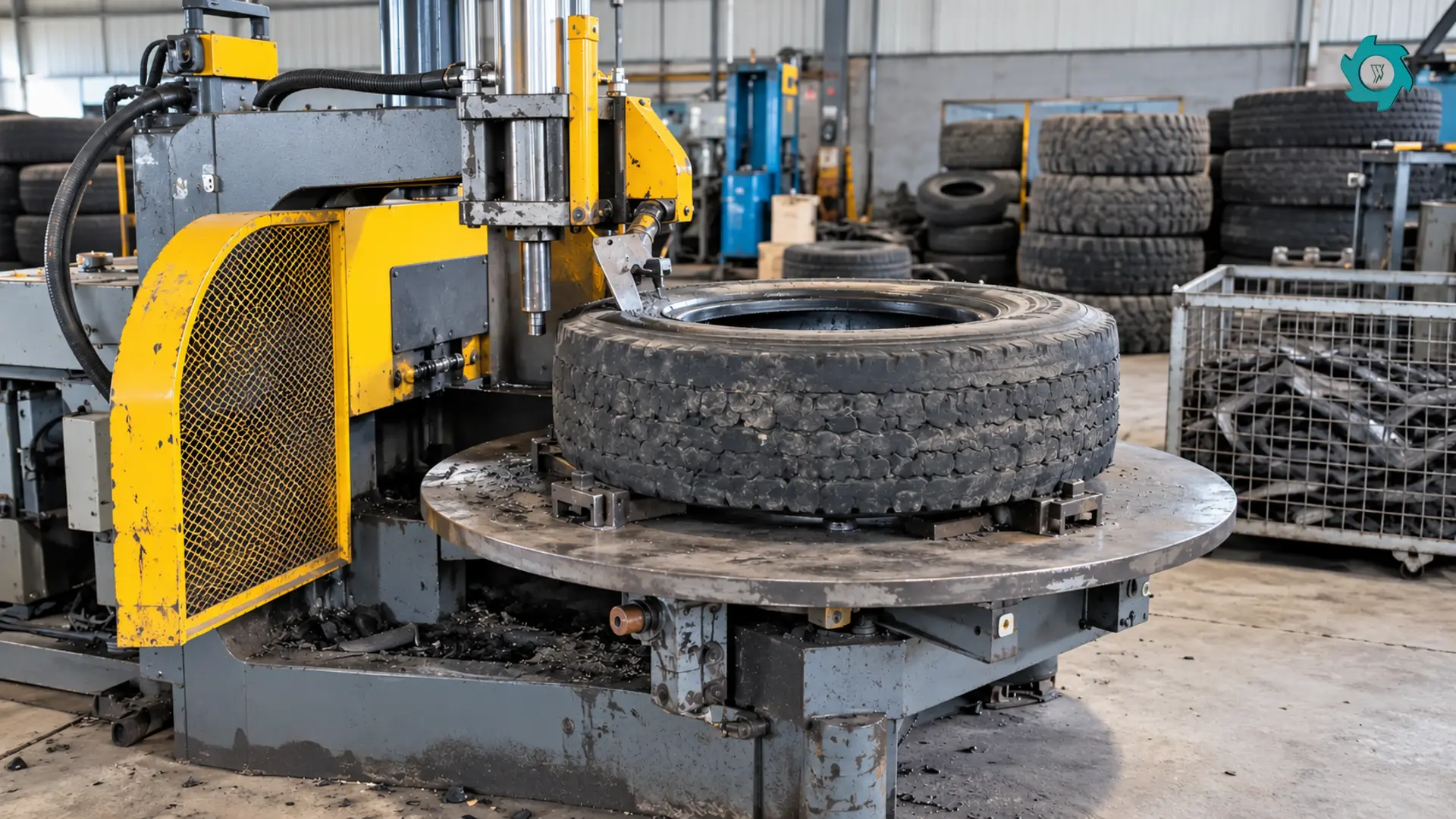
A bead cutter can look inexpensive to run because the motor is small compared with a shredder. That conclusion is often wrong. The costly part is usually the minutes around the cut: receiving tires that do not sit consistently, positioning them, checking the cut, handling the removed bead section, changing a worn cutter, and recovering after an avoidable stop.
Why nameplate capacity produces the wrong cost number
Suppliers commonly describe this equipment in tires per hour or minutes per tire. Those figures are useful for selecting a line, but not for reporting operating cost. They usually assume a reasonable tire mix, a ready operator, a prepared work area, a usable cutter and no waiting for a forklift or downstream conveyor. A monthly electricity invoice divided by this nameplate output is even less useful: it mixes idle energy, lighting, other equipment and calendar time with the cutting station.
Use a short, repeatable test boundary instead. For example: a measured shift begins when the first tire is placed at the station and ends after the last accepted tire is discharged; planned meal breaks are excluded; all unplanned stops are coded. Keep the same definition for every comparison. If a mixed stream includes passenger, light-truck and all-steel truck tires, count and report them separately. A heavier tire does not automatically cost more per piece, and a one-number average can hide a serious issue with one bead construction. The station layout, tire range and normal operating sequence should match the selected tire bead cutting machine configuration before its unit cost is compared with another setup.
In many semi-automatic stations, labor and lost productive minutes dominate; in a difficult truck-tire stream, premature cutter changes can outrun electricity. The calculation should make that distinction.
Set a cost boundary before you collect data
The boundary should include the work needed to make the bead cutter productive: loading the tire to the machine, normal positioning adjustment, the cutting cycle, release, discharge, routine visual inspection and ordinary recordkeeping. It should also include a fair share of scheduled checks required to keep the station available. Do not include the cost of a downstream shredder merely because it benefits from bead preparation; report that benefit separately as a line-level effect.
The station view answers, “What does this bead-cutting operation cost?” The route view answers, “What does the whole pre-processing route cost before the next size-reduction step?” Keep them separate. If pre-cutting removes a recurring overload problem from a tire shredder, the reduced shredder reversals and blade damage are real economic benefits, but they must be measured downstream rather than quietly credited to the bead cutter.
| Boundary item | Include in station cost? | How to record it |
|---|---|---|
| Load, position, cut and discharge | Yes | Observed labor minutes and accepted count |
| Routine lubrication and inspection | Yes | Planned maintenance minutes and materials |
| Forklift waits or lack of tire supply | Yes, as availability loss | Stop code; do not hide in “idle” |
| Downstream shredder blade benefit | No, report separately | Matched before/after line evidence |
| Plant lighting and unrelated utilities | No unless allocation is defined | Keep outside the submeter boundary |
Measure labor as work content, not headcount
Record the fully burdened hourly labor rate used by your plant, then measure the work content. A useful observation sheet divides time into loading, positioning, active cutting, bead-body removal, inspection, routine housekeeping and waiting. Time that is necessary for the accepted result is not waste; it is the baseline. Time that is repeated because a tire slips, a locator is set incorrectly, a tool is dull or material flow is missing is the improvement opportunity.
Do not compare an experienced operator handling mostly passenger tires with a new operator handling all-steel truck tires and call the difference an operator result. Segment the report by tire class and, if the trial is long enough, by shift. A 30-tire sample may expose gross friction, but it is too small to establish a stable rate in a diverse tire stream. Practical tests often use enough material to include normal variation in tire condition, then repeat the same test after a controlled change.
Be explicit about loading method. Manual lifting, a tire dolly, forklift presentation and integrated conveyor feed have different labor content and different safety controls. The cost model may include the material-handling person if that person is dedicated to the station; if a shared forklift serves several stations, allocate its time visibly.
Calculate energy from the meter, not the motor nameplate
Rated power tells you the maximum design demand under defined conditions; it does not tell you consumed kWh per tire. Install a submeter that covers the bead cutter and any dedicated station controls. Record starting and ending meter values over the same test boundary used for tire counts. If the machine includes a hydraulic or rotating worktable cycle, record active time and idle time too. Long idle periods can be a material-flow issue, not an electrical-efficiency issue.
For each test, calculate kWh per accepted tire and multiply by the applicable electricity tariff. If demand charges matter at your site, show them as a separate site-level allocation. Avoid a false precision such as reporting four decimal places when the meter or sample size cannot support it. A range based on repeated shifts is more honest and more useful for budgeting.
Tooling cost: track useful life and change disruption
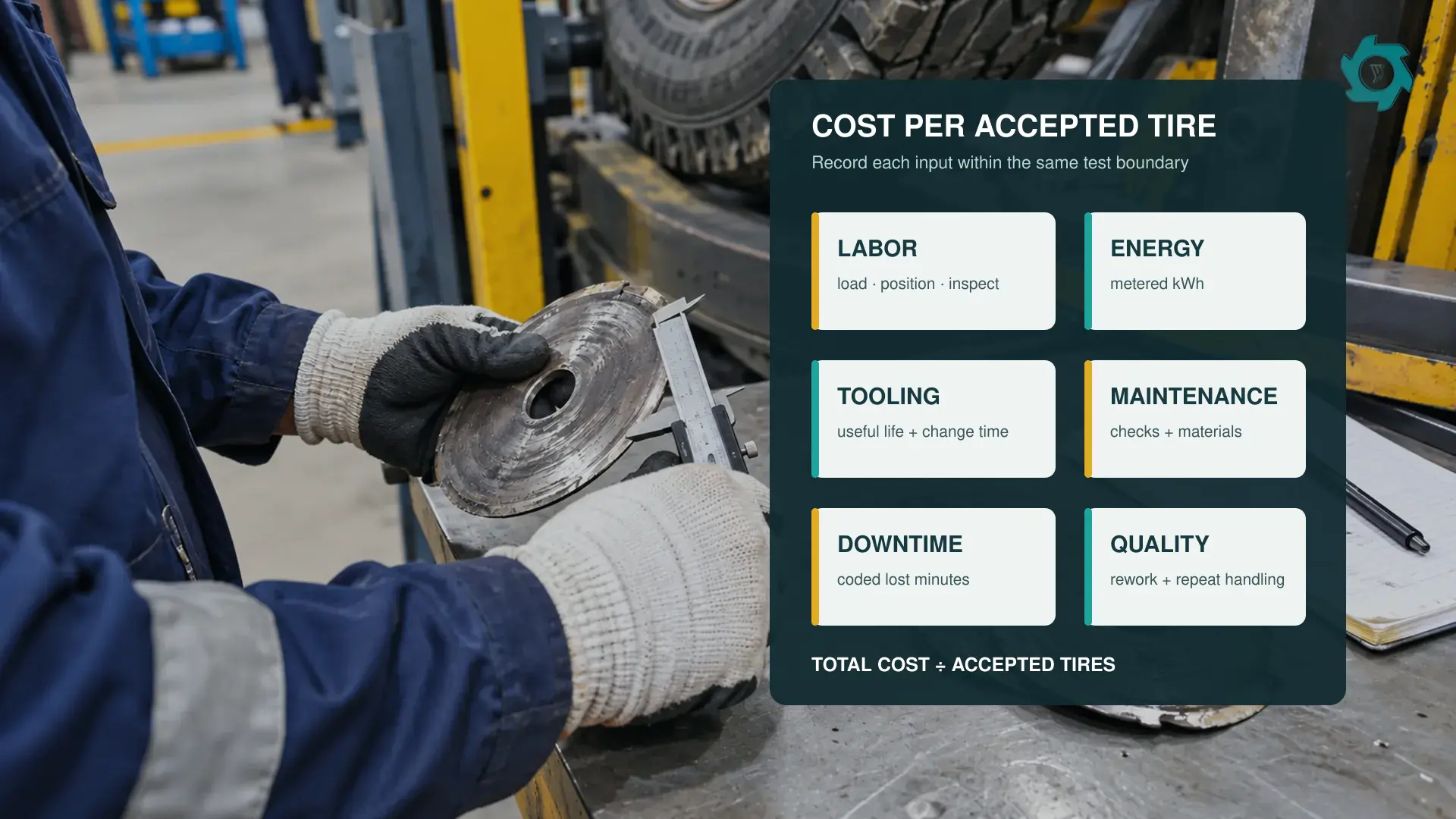
The cutter meets steel-reinforced bead material repeatedly, so its cost is more than the price of a replacement part. The unit-cost numerator should include the cutter or cutter set, planned change labor, setup verification and the production time lost during the change. Unplanned replacement deserves its own code because it may indicate a mismatch between the tool, tire mix, positioning or maintenance practice.
Count useful life from installation to removal and tag the tire class processed during that period. If a tool is removed before its expected condition window, photograph the wear and note what the cut looked like. A blunt “blade cost per month” does not reveal whether the cause is truck-tire bead volume, repeated rubbing, poor alignment, contaminated tires or a simple recordkeeping gap. The separate tire bead cutter blade guide can help operators define the inspection points; the operating-cost report should convert those observations into downtime and replacement evidence.
Do not extend a cutter change merely to improve a spreadsheet number. A deteriorating cut may create a downstream handling penalty, an unstable tire body, or a stoppage that costs more than the saved tool. The right economic trigger is the lowest total route cost at the agreed quality condition.
Put downtime into reason codes that lead to action
A station can show low kWh per tire while losing money through unavailable minutes. Record every stop longer than a chosen threshold, such as two minutes, with one primary code: no tire available, loading delay, positioning/readjustment, cutter change, cutter inspection, mechanical adjustment, electrical/control issue, guard/interlock issue, cleanup, downstream blockage or operator break. Planned breaks should not be mixed with failures.
Then multiply lost productive time by the appropriate cost consequence. In a standalone workshop this may be labor paid during an unproductive interval. In a constrained line it can be more important: a bead-cutter stop may starve a cutter or shredder, interrupt a crew, or push material handling into overtime. Record the route consequence separately, but do not guess it. If the downstream unit still had sufficient buffer inventory, report the bead-cutter availability loss without adding speculative line loss.
Recurring stops should be investigated through the approved maintenance and safety process, not bypassed. For basic reliability discipline, use the bead cutter maintenance checklist as a fixed inspection record. For abnormal cutting behavior, capture the tire class, cut result and stop code before seeking a correction; the tire bead cutting troubleshooting guide provides a useful diagnostic reference.
Quality loss is an operating cost, even when the cut looks acceptable
Define the cut acceptance condition before testing. It may specify a separated bead-sidewall section, a tire body that can feed the next machine without repeat handling, no unacceptable wire exposure for the next operation and no material that requires manual rework. The definition must fit the route. A plant preparing tires for a tire cutting machine may need a different condition from one preparing truck tires for direct shredding.
Track rejected cuts and rework separately. “Rejected” does not mean scrapped tire; it means the first pass failed the agreed condition and needed an additional action. Record the minutes and material handling that follow. Review a small sample of accepted cuts at a fixed interval as well. Otherwise the quality standard may drift when production pressure rises.
Run a one-shift baseline that can survive review
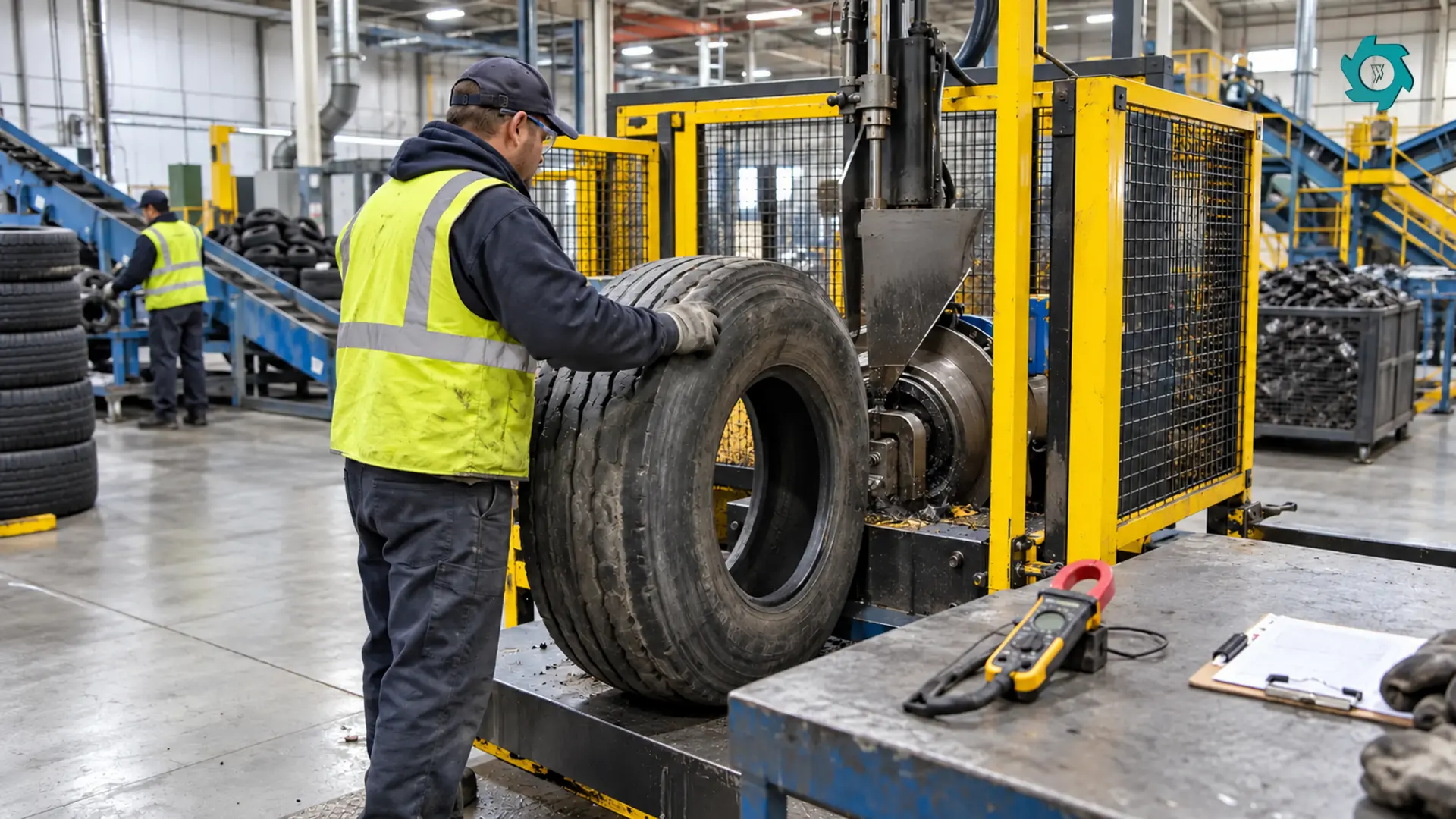
Before changing anything, run a representative shift and assign one person to own the log. The observer does not need to slow production; timestamps, a counter, a simple stop code and start/end energy readings are usually enough. If the raw tire stream changes through the day, mark the boundary between batches. The purpose is not surveillance; it is to prevent anecdote from becoming a capital or maintenance decision.
| Field | Example use | Common mistake avoided |
|---|---|---|
| Tire class and quantity | Separate passenger, light-truck and truck results | Averages that conceal difficult beads |
| Accepted count and rework count | Establishes the denominator and quality cost | Counting every start as output |
| Start/end meter values | Calculates kWh per accepted tire | Using rated motor power |
| Tool condition and change time | Links cost to useful life | Only recording part purchases |
| Stop code and minutes | Prioritizes the largest lost-time cause | Calling all time “operator delay” |
Use controlled tests to reduce cost without moving the problem
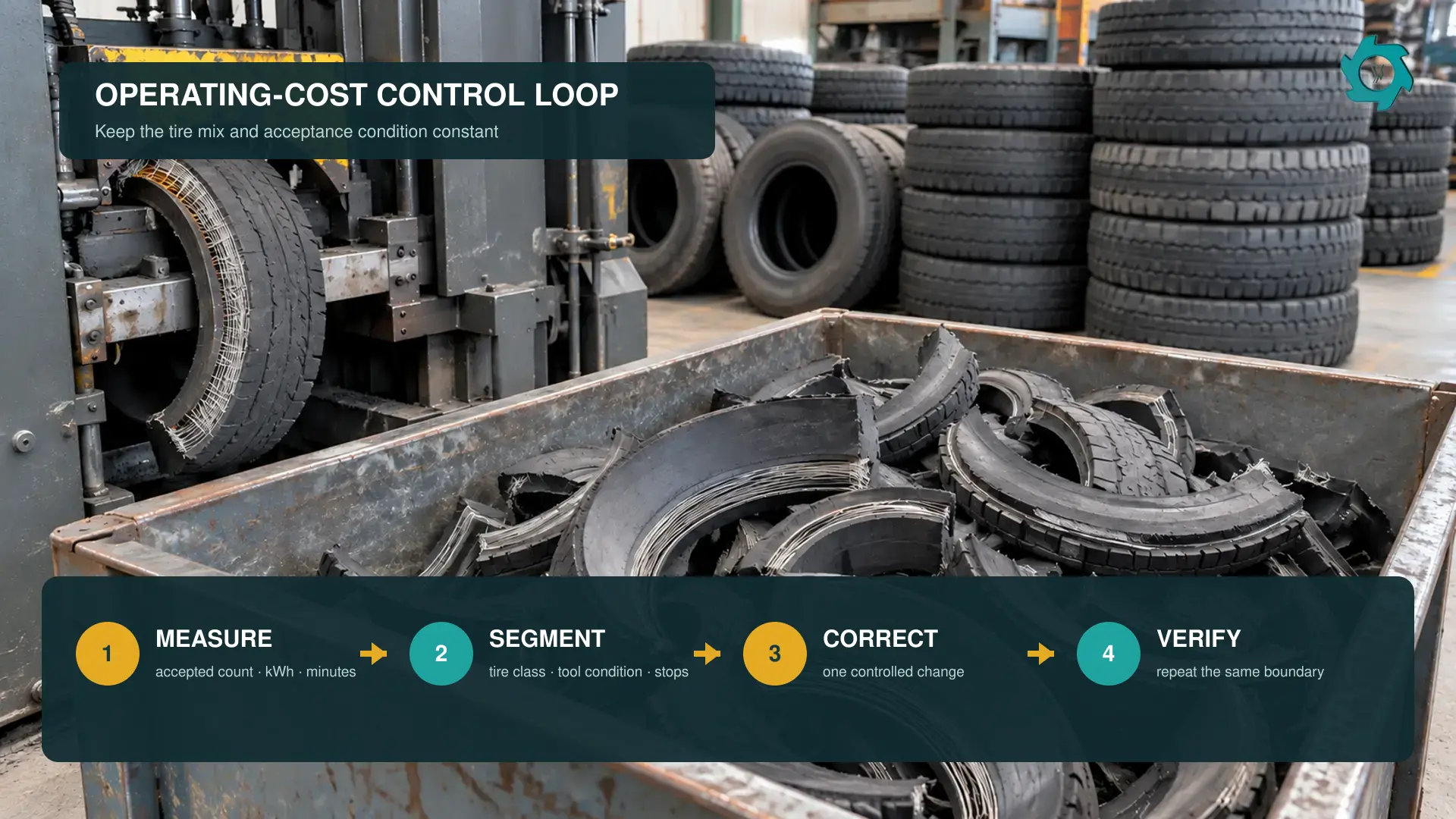
Once a baseline exists, change one thing at a time: a positioning setup, tire presentation method, planned inspection interval, tool-change preparation, or staging arrangement. Keep the tire class, acceptance definition, work boundary and downstream route as constant as reasonably possible. Compare cost per accepted tire, but also compare rework, stop minutes and the next process.
Good improvements tend to remove repeatable friction. Examples include staging tires by diameter range before the shift, preparing the next cutter and tools before a planned change, restoring a worn locator before it creates repeat positioning, or using a simple visual standard for the correct cut line. Avoid crediting a short run with an unusually easy tire mix as a process improvement.
Use a break-even test before adding labor or automation
When the cost per accepted tire is high, the immediate reaction is often to add another operator or buy more handling equipment. That can be correct, but only after identifying the constrained minute. If the operator is waiting for tire presentation, an additional person at the cutter does not solve the constraint. If the cutter is active for only a small share of the shift because tire sizes are mixed and staged poorly, a better receiving rule may cost far less than a feeding system.
First calculate accepted tires per productive labor hour. Then calculate the additional accepted tires that a proposed change can realistically create under the same tire mix. The financial test is simple: the hourly cost of the added labor, attachment or service divided by the additional accepted tires. Compare it with the current unit cost and with the downstream value of the extra prepared tires. Include a conservative allowance for training, adjustment and the fact that some lost time will remain.
| Observed constraint | Low-capital response to test first | Evidence before spending |
|---|---|---|
| Tires arrive in random sizes | Stage by diameter or tire class for one trial shift | Positioning minutes and accepted tires by class |
| Tool change interrupts the shift | Prepare a verified spare and change kit at the station | Planned versus unplanned change duration |
| Machine waits for material handling | Set a tire buffer and a defined replenishment signal | Minutes coded as no-tire or forklift wait |
| Frequent re-positioning | Inspect locator condition and standardize the starting position | Repeat-adjustment count and rework rate |
Separate cash cost from capacity loss in the monthly report
A monthly report becomes much more useful when it shows two numbers together. Cash cost is the amount paid for labor, electricity, tools and maintenance materials. Capacity loss is the accepted output that could not be produced because the station was unavailable or unnecessarily slow. A low spare-parts bill can coexist with high capacity loss when an operator spends time waiting for a part, a tire supply or an instruction.
For each major stop category, report stop minutes, number of events, accepted tires foregone at the established baseline rate, and the corrective owner. Do not convert every lost tire into revenue unless it actually constrained sales or the next process. Instead, use the foregone-output figure as an operational signal. It tells the supervisor where a maintenance intervention, material-flow rule or spare-parts decision is likely to pay back.
Make the trial data comparable across suppliers and shifts
Operating-cost comparisons fail when each trial uses a different tire stream. A fair supplier or machine comparison needs a feed passport: tire class, maximum diameter, approximate condition, bead type where known, wet or dry condition, tire count, loading method, required cut condition and downstream receiving step. It also needs a declared time basis: elapsed test time, active cutting time, planned pauses and unplanned stops.
Ask every supplier to state what is included in the tested configuration—worktable, locating method, cutter arrangement, guarding, controls, spare tooling and any material-handling aid. Record the same cost fields for each result. This does not turn a factory test into a lifetime-cost guarantee; it gives buyers a cleaner starting point and avoids comparing an equipped station with a bare machine.
What to request from a supplier before you budget the operating cost
Ask for the machine configuration, tire-size range, cutter arrangement, normal operator workflow, maintenance-access points, recommended spare cutter quantity and a representative test video using a tire similar to your own. Ask what the test does and does not prove. A video can confirm positioning, cut path and discharge behavior, but it does not establish your local labor rate, electricity tariff, tire mix or plant waiting time.
For a new line, give the supplier your tire photographs, diameter range, truck versus passenger proportion, target daily schedule, loading method and next process. That information makes it possible to compare a bead cutter with alternatives such as bead extraction or different front-end preparation. It also prevents a low equipment price from becoming a high operating-cost route because the workstation does not fit the real tire stream.
Frequently Asked Questions
What is the best unit for tire bead cutter operating cost?
Use cost per accepted tire, then segment the result by tire class. Tons alone can obscure cycle-time and bead-construction differences.
Does motor power show electricity cost?
No. Rated motor power is a design value. Use a submeter over a defined operating boundary and divide measured kWh by accepted tires.
How should cutter cost be calculated?
Include the cutter purchase cost, planned change labor, inspection labor and any premature replacement, then divide by the accepted tire count attributable to that tool.
Should downtime be charged to the bead cutter if a forklift is late?
Record it as station availability loss with a material-supply code. If the forklift is shared, keep the allocation visible so the root cause can be addressed.
Build a cost model around your actual tire stream
Send tire photos, diameter range, tire mix, target schedule and the next processing step. The right configuration is the one that delivers a stable cut and a measured cost per accepted tire.