




The useful price question is not “What does a crumb rubber machine cost?” It is “What will it cost to produce the specified crumb, at the accepted finished rate, with the plant actually installed and ready to run?”
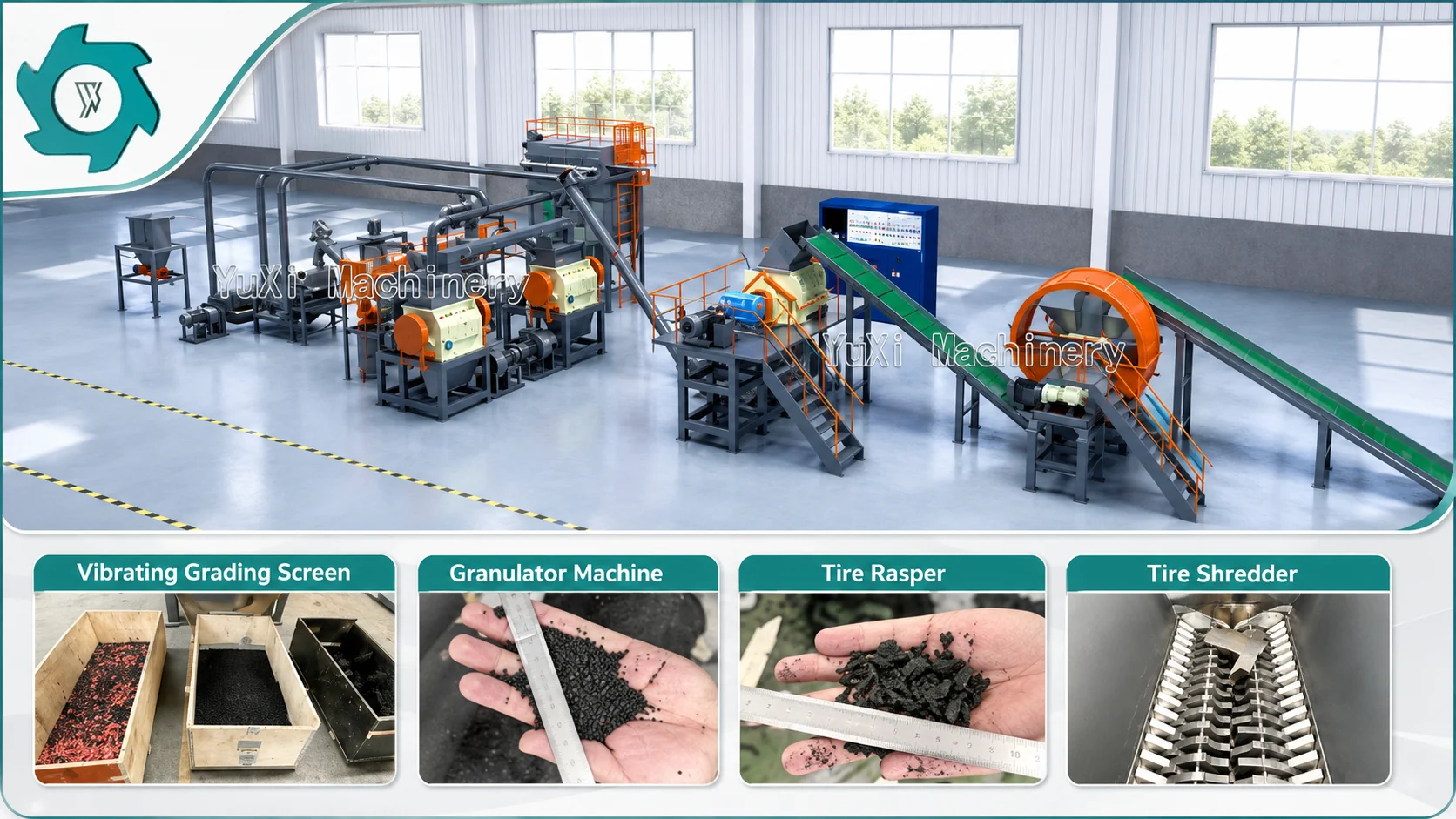
This guide treats crumb rubber plant cost as a project-budget problem rather than a public price-list problem. YUXI’s Tire Rubber Crumb Plant provides the technical boundary for that discussion: the project can begin with whole tires or with prepared wire-free chips, while the final equipment scope depends on the required crumb grade and accepted finished capacity.
One supplier may start at whole tires. Another may assume that 10–20 mm wire-free chips are already arriving at the granulator. One price may include conveyors, grading, fiber removal and a dust system; another may stop at the core machines. Freight, foundations, local electrical work and commissioning may be missing from both. The lower number is not automatically the lower project cost.
What a Crumb Rubber Plant Budget Must Include
Start with five definitions: feed boundary, finished product, accepted capacity, supply boundary and site boundary. Only then should a price be compared.
For budgeting, separate the supplier’s process-equipment price from conveying and storage, controls and electrical distribution, dust collection, freight and import costs, civil works, mechanical and electrical installation, commissioning, initial wear parts and contingency. Keep working capital—tire inventory, packaging inventory, receivables and finished-goods stock—outside the installed-plant figure so the investment model stays readable.
Define the Cost Boundary Before Asking for a Number
The phrase plant cost is dangerously elastic. It can mean the factory price of one granulator, an FOB line package, a landed equipment cost, or a commissioned facility with local utilities and foundations.
Feed boundary
Whole passenger and truck tires? Pre-cut sections? 50 mm chips? Or 10–20 mm wire-free rubber? Moving the feed boundary upstream adds machines, drives, conveyors and wear parts.
Product boundary
“Crumb rubber” is not enough. Define the saleable size range, oversize and fines rules, steel and fiber limits, moisture expectations and packaging point.
Project boundary
State whether the quote stops at factory supply, arrives at the port or site, or includes installation, commissioning, training and performance testing.
This is also the cleanest way to avoid confusing crumb rubber with coarser mulch or with fine powder. If that product boundary is still open, the comparison of rubber mulch vs crumb rubber helps decide whether the project should stop at a coarse, wire-free product or continue into granulation and tighter classification.
Three Project Scopes Can Sit Behind the Same “Crumb Rubber Plant” Search
For a real RFQ, separate the scope first.
| Budget scope | Starting material | Main equipment depth | What changes the budget most |
|---|---|---|---|
| Downstream crumb module | Prepared 10–20 mm wire-free chips | Granulation, secondary magnetic recovery, grading, oversize return, fiber separation, connecting conveyors and controls | Target crumb grade, accepted t/h, number of saleable fractions, fiber limit, dust collection and storage/packing interface |
| Complete whole-tire-to-crumb line | Whole tires or mixed approved tire feed | Adds tire preparation where required, primary shredding, rasper processing, first magnetic recovery and upstream handling before the crumb module | Tire mix and maximum size, preprocessing, primary chip control, steel liberation, extra conveyors, installed power and workshop footprint |
| Crumb plus fine-powder expansion | Clean crumb rubber | Adds another grinding and fine-classification stage beyond the crumb route | Mesh target, heat and dust management, energy, fine separation and lower practical throughput at finer grades |
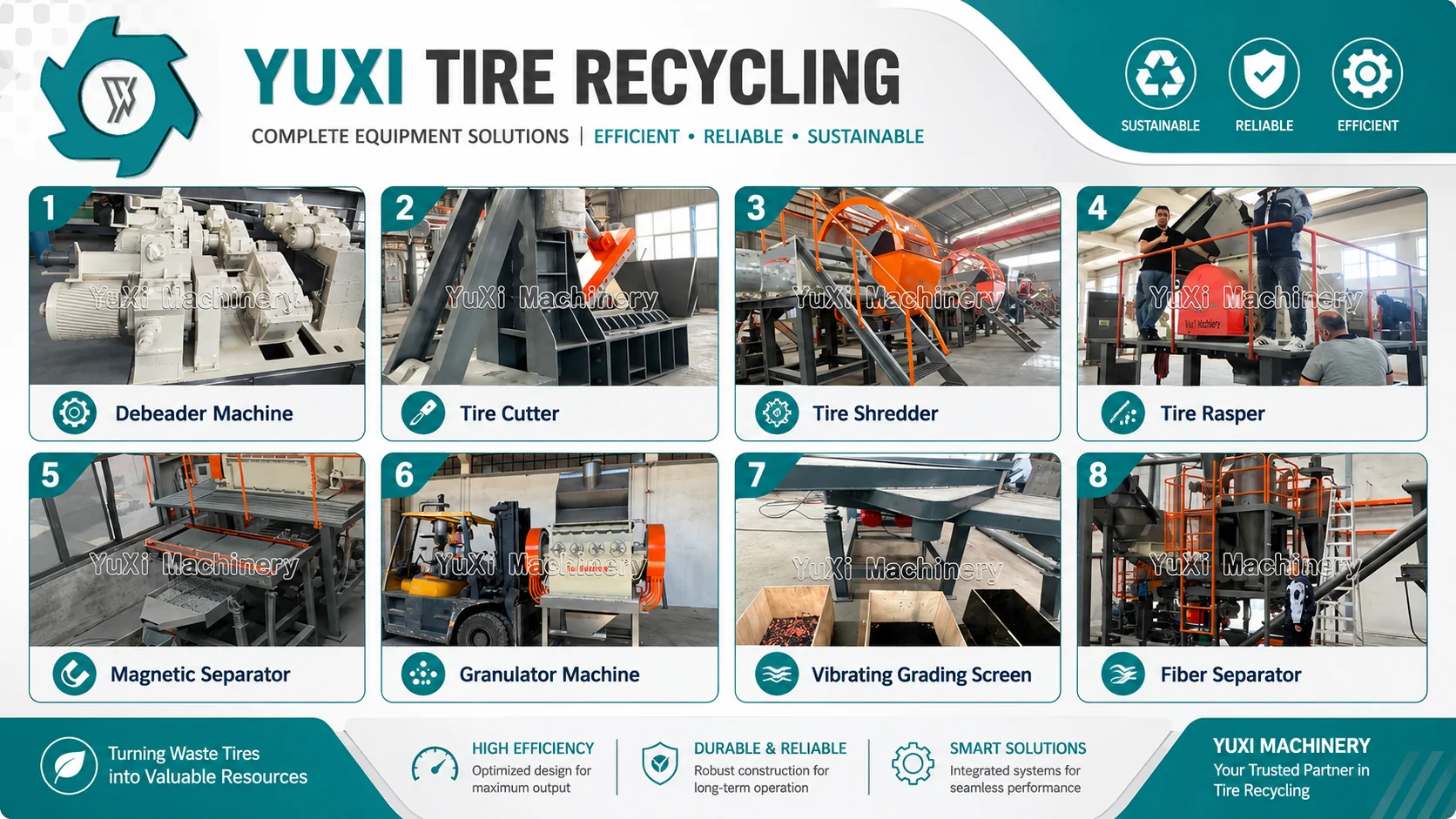
Which Equipment Actually Creates the Crumb Rubber Plant Cost?
A useful cost breakdown follows the material rather than the supplier’s quotation headings. That makes missing stages easier to spot.
1. Feed preparation and primary reduction
If the line begins with whole tires, the budget may include tire handling, bead or sidewall preparation for particular tire categories, primary shredding, screening or return routing, and the conveyors between those machines. Large or heavily reinforced tires can change the upstream scope substantially. A standalone shredder price is therefore not a proxy for a crumb plant; our guide to tire shredder machine price explains why machine-only and system quotations need separate boundaries.
2. Steel liberation and magnetic recovery
The rasper is doing more than making smaller pieces. It has to expose steel so the magnet can actually recover it. A whole-tire line therefore carries both the cutting duty and the steel-recovery duty. If the project buys clean 10–20 mm chips, much of this cost has already been transferred to the upstream supplier.
3. Granulation
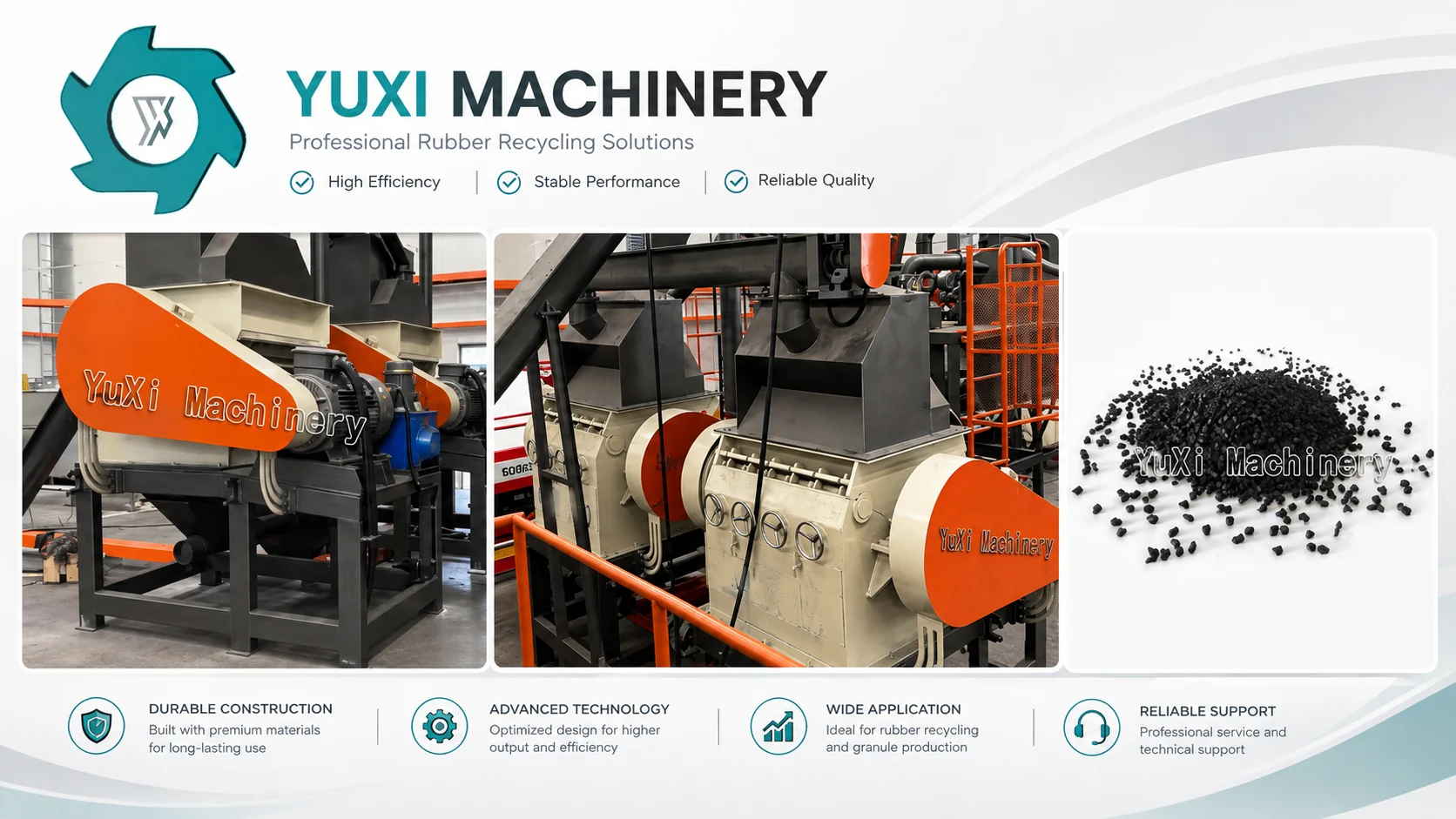
The granulator takes the clean, coarser rubber toward the saleable crumb range. Its size, motor and knife duty must be matched to accepted output—not just to the easiest material shown in a short test. Finer targets usually increase specific cutting work and recirculation.
4. Grading screen and oversize return
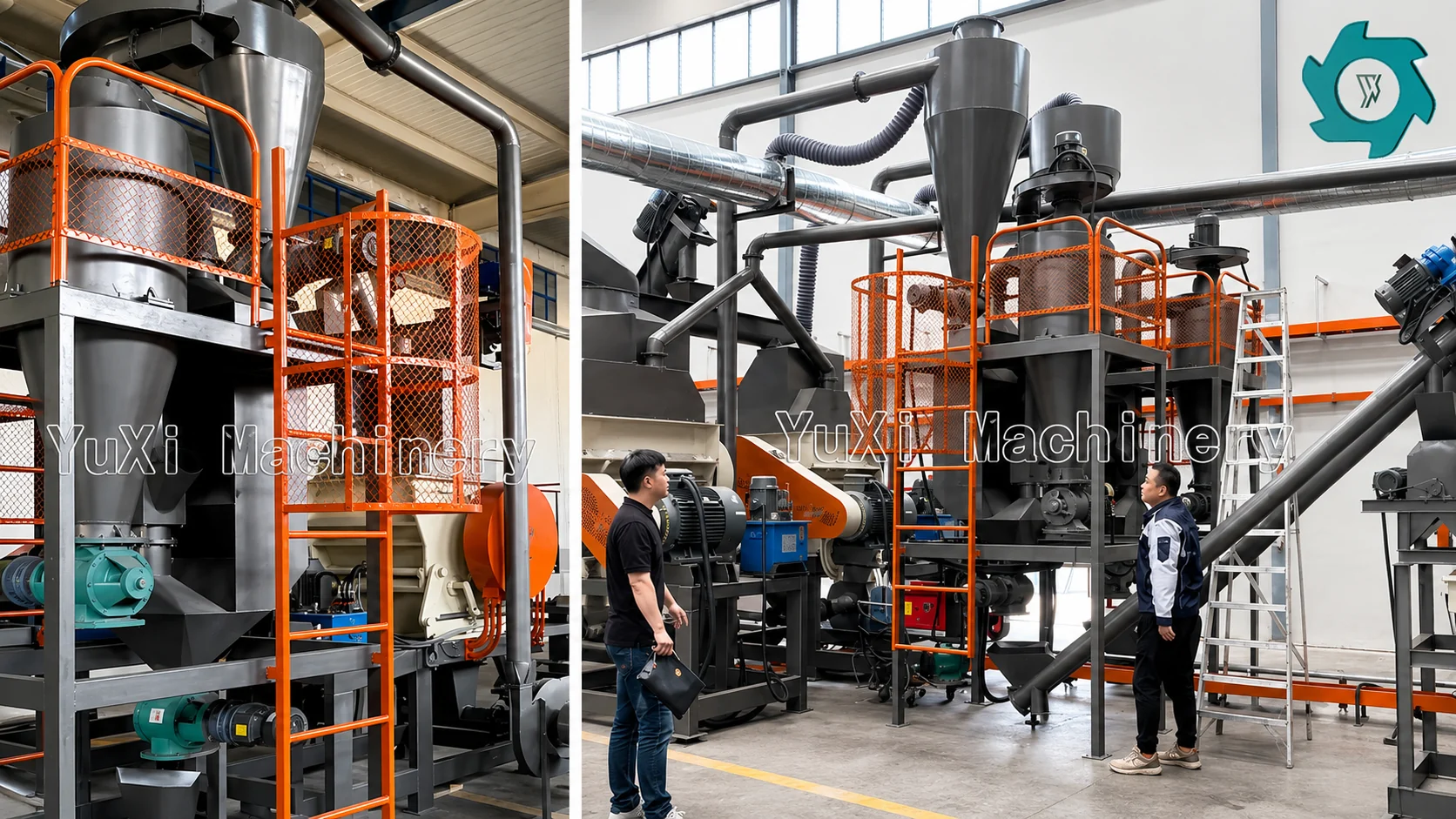
Screens do not simply “check” the product. They define which material becomes saleable and which material goes back for more work. A return conveyor, transfer points and controls are part of the production loop, not optional decoration. When a buyer asks for a narrow fraction, return load can become one of the hidden limits on accepted t/h.
5. Secondary magnet and fiber separation
EPA describes tire crumb production as staged size reduction with sifting screens that return oversize, magnets that remove wire and air separators that remove fabric.1 That is why a low-cost line that deletes or undersizes separation stages may create a higher rejection cost later. If your market needs a written cleanliness target, use the tire rubber granule plant purity guide to define how steel, fiber, screening and sampling will be checked instead of relying on a single percentage in a brochure.
How 0.5–10 t/h Capacity Changes the Budget
The YUXI pillar publishes a configurable 0.5–10 t/h reference feed range. That is a useful project envelope, but it is not a promise that every 10 t/h feed condition will make 10 t/h of accepted 0–5 mm crumb. Tire construction, screen cut, return load and separation duty all affect the finished rate.
This is where many cost comparisons break. A supplier can size a shredder for a high feed rate while a downstream granulator, screen or fiber separator sets the saleable output. The plant is only as productive as its slowest stage after the system reaches steady state.
| Capacity decision | What tends to change physically | Budget implication |
|---|---|---|
| Higher accepted t/h | Larger or additional process duty, wider conveyors, stronger drives, more separation and handling capacity | Core machinery rises, but not in a perfectly linear ratio |
| More operating hours | Wear-part consumption, maintenance windows, spare strategy and storage turnover become more important | Initial spares and service planning deserve more budget even if nameplate capacity is unchanged |
| Tighter product fraction | More screening selectivity and oversize return | Installed equipment may look similar while accepted output falls; cost per saleable ton can rise |
| Mixed truck/passenger feed | Variable steel, rubber mass, stiffness and chip behavior | Needs representative testing and capacity margin rather than a single ideal-feed figure |
| Future expansion | Reserved floor space, electrical capacity, conveyor interfaces and bin locations | Small design cost now can avoid expensive layout changes later |
Required accepted crumb t/h ≠ nominal upstream feed t/h
The Finished Crumb Specification Can Change Cost More Than Buyers Expect
YUXI’s crumb line is positioned around a primary 0–5 mm product direction, with exact distributions set by the screen and grading arrangement. Buyers may instead need 1–3 mm, 3–5 mm, a broader 1–8 mm fraction or a market-specific sieve curve. Those are different production contracts.
The deeper lesson is that size and cleanliness belong in the budget together. A road-material buyer, a molded-rubber producer and a sports-surface buyer may all purchase “crumb rubber” while applying different gradation, wire and fiber limits. FHWA’s asphalt-rubber guidance, for example, reproduces state specifications with defined sieve curves and very low wire and fabric limits for certain crumb-rubber modifier applications.2 A plant should not be priced for “0–5 mm” and then discover that the actual buyer needs a narrower, cleaner grade.
Coarser or broader grade
Usually allows a larger share of material to leave the line after fewer reduction passes. That can reduce return duty, but only if the buyer accepts the distribution and cleanliness.
Finer or narrower grade
Usually increases cutting, classification and recirculation duty. More transfer points and finer material also make dust control and housekeeping more important.
Lower residual steel
May require stronger staged liberation, multiple magnetic recovery points and better burden control rather than one oversized magnet at the end.
Lower visible fiber
Requires airflow control, stable feed presentation and collection equipment. Excess airflow can remove useful rubber with the textile stream, so capacity and yield need testing together.
Equipment Price Is Not the Total Installed Budget
For early feasibility work, we use a simple equation. It does not create a fake universal multiplier; it forces every cost category to appear somewhere.
Total Installed Budget = Process Equipment + Plant Interfaces + Landed Logistics + Site Works + Installation + Startup + Initial Spares + Contingency
| Budget line | What belongs here | What to ask for |
|---|---|---|
| Process equipment | Shredder/rasper where needed, granulator, magnets, screen, return system, fiber separator, local machine controls | Detailed equipment list, motors, major wear parts, battery limits |
| Plant interfaces | Connecting conveyors, feed hoppers, bins, discharge interfaces, packing points, central controls and guarding | Layout, elevations, conveyor list, included steelwork and access platforms |
| Dust and housekeeping systems | Extraction points, ducting, collectors and project-specific protection measures | Dust-generation assumptions, collection scope, local code responsibility |
| Landed logistics | Export packing, inland transport, ocean/land freight, insurance, port handling, customs and duties where applicable | Incoterm, container plan, dimensions/weights, destination assumptions |
| Site works | Building modifications, foundations, pits, floor loading, drainage, compressed air, lighting and utilities | Foundation loads, anchor plans, utility list and site exclusions |
| Electrical | Transformer where required, MCCs, cables, trays, local panels, field wiring and power-quality work | Total connected load, voltage/frequency, starting method, cable boundary |
| Installation | Mechanical erection, electrical termination, lifting equipment, alignment and site supervision | Who supplies labor, cranes, tools, accommodation, permits and consumables |
| Startup and acceptance | Commissioning, training, test material, sampling, performance test and punch-list closure | Test duration, feed lot, product acceptance rule and responsible parties |
| Initial spares | Knives, screens, belts, bearings, filters and other recommended startup inventory | One-year or agreed operating-hours spare recommendation with unit quantities |
| Contingency | Unresolved site interfaces and design maturity—not a substitute for missing scope | List known unknowns; reduce contingency as engineering is completed |
Keep land, permits, tax and working capital visible but separate. They may be material to the business case, yet they are highly location-specific. Combining them into a generic “machine price” makes both supplier comparison and financial modeling worse.
Site Costs Are Where a Cheap Machine Quote Often Stops Being Cheap
A crumb line has more interfaces than a single shredder. Every transfer point needs physical support, access, guarding, electrical connections and a housekeeping plan. The finer the product becomes, the less acceptable it is to treat dust management as an afterthought.
Electrical supply and transformer capacity
Confirm voltage, frequency, available transformer capacity, starting current strategy and the distance from the power room to the machines. A factory quotation may show installed motor power without including the transformer’s cost, local cabling, cable trays or electrical inspection.
Foundations, floor loading and maintenance space
The lowest-footprint layout is not always the lowest installed cost. If a granulator cannot be opened without dismantling a conveyor, or a screen has no space for mesh replacement, maintenance will consume the savings later. Ask for service envelopes, lifting points and foundation loads before the building is finalized.
Dust collection and fire-risk engineering
Rubber size reduction can create fines, and OSHA identifies tire and rubber manufacturing among industries where combustible-dust hazards can occur.3 The correct protection concept depends on the actual dust characteristics, equipment, ducting and local rules, so a cost article should not prescribe one universal system. It should insist that collection, housekeeping, ignition control and local code responsibility are defined before the plant budget is frozen.
Freight, customs and unloading
Container count and oversize pieces matter. So do destination port, inland haulage, crane access and import duties.Ask the supplier to provide the packing list and loading plan as early as possible. Otherwise, logistics can remain a rough allowance until late in the project instead of becoming part of a realistic installed-cost estimate.
CAPEX Alone Does Not Tell You the Cost per Saleable Ton
A plant with a lower purchase price can be more expensive to own if it consumes more knives, loses rubber into the fiber stream, runs a large oversize loop or needs frequent manual cleaning. We therefore keep a small operating-cost model beside the capital budget during supplier comparison.
| Operating-cost driver | What to measure | Why it changes the decision |
|---|---|---|
| Electricity | kWh per accepted ton, not only total installed kW | Utilization and recirculation change actual consumption |
| Knife and screen wear | Cost per operating hour or accepted ton under the real tire mix | Truck-heavy or contaminated feed can change replacement frequency |
| Labor | Operators per shift plus maintenance and material handling | Automation may move labor rather than eliminate it |
| Rubber yield | Accepted crumb, steel, textile, fines and rejects by weight | Losing saleable rubber to a side stream can erase a small CAPEX saving |
| Dust filters and housekeeping | Filter consumption, cleaning time and waste handling | Fine material creates a recurring service duty |
| Downtime | Productive hours versus scheduled hours | Annual economics depend on availability, not brochure t/h |
Ground rubber already serves established end markets such as rubber-modified asphalt, athletic surfaces, automotive parts and industrial materials. USTMA reported that ground-rubber markets consumed about 28% of U.S. end-of-life tires in 2023.4
How to Compare Three Crumb Rubber Plant Quotations Without Being Misled
Do not start with the total. Start with a compliance sheet. Put the same project basis at the top of all three columns and force every supplier to answer included, excluded or deviation.
| Comparison field | Supplier A | Supplier B | Supplier C |
|---|---|---|---|
| Approved tire mix and maximum size | Included / deviation | Included / deviation | Included / deviation |
| Starting material condition | Whole tire / chip size | Whole tire / chip size | Whole tire / chip size |
| Accepted crumb grade | Written sieve rule | Written sieve rule | Written sieve rule |
| Accepted finished t/h | Test basis | Test basis | Test basis |
| Steel and fiber acceptance | Method + limit | Method + limit | Method + limit |
| Screen-return loop | Included? | Included? | Included? |
| Dust system | Included / battery limit | Included / battery limit | Included / battery limit |
| Conveyors, bins and platforms | Complete list | Complete list | Complete list |
| Controls and electrical boundary | Scope | Scope | Scope |
| Recommended initial spares | Quantity + price | Quantity + price | Quantity + price |
| Freight / Incoterm | Basis | Basis | Basis |
| Installation and commissioning | Scope | Scope | Scope |
| Performance test | Feed, duration, sampling | Feed, duration, sampling | Feed, duration, sampling |
Practical check: If one quotation is dramatically cheaper, first look for a moved boundary—not a miraculous machine. Common differences are prepared-chip feed instead of whole tires, no automatic oversize return, reduced fiber cleanup, fewer conveyors, no dust collection, a different capacity measurement point or installation excluded.
A Budget Worksheet That Can Survive the RFQ Stage
Before asking for a final quotation, put the project into one page. The exercise often exposes missing commercial decisions earlier than another round of supplier emails.
- Feed: passenger/truck/other tire mix, maximum dimensions, contamination rule and whether beads or sidewalls are pretreated.
- Starting boundary: whole tires, primary chips or purchased 10–20 mm wire-free material.
- Product: required crumb fraction(s), sieve distribution, oversize/fines rule, residual steel, textile fiber, moisture and packaging.
- Capacity: accepted finished t/h, annual saleable tons, shifts, scheduled hours and required availability.
- Site: workshop plan, clear height, floor/foundation condition, ambient conditions and maintenance access.
- Utilities: voltage, frequency, transformer capacity, compressed air if needed and available extraction/ventilation infrastructure.
- Automation: manual loading points, central controls, interlocks, level sensing, return automation and packaging interface.
- Destination: Incoterm, port/site, local duties and unloading restrictions.
- Services: layout engineering, installation supervision, commissioning, training, acceptance test and documentation language.
- Spares: agreed operating-hours or one-year package for knives, screens, belts, bearings and filters.
For whole-tire projects, it also helps to map the upstream material route before the RFQ. The guide on how waste tires are reduced into controlled wire-free rubber shows why the shredder, rasper and magnetic stages must deliver a stable feed before granulation cost and capacity can be judged properly.
Cost-Estimating Mistakes That Distort a Crumb Rubber Project
Comparing FOB machinery with an installed plant
These are different financial numbers. Rebuild every quote to the same boundary before comparing totals.
Using input tons instead of accepted crumb tons
A line can accept a high mass flow and still miss the finished-output target because of return load, separation limits or downtime. Put the accepted product at the measurement point.
Choosing capacity before validating the buyer’s product
A 0–5 mm request is still incomplete if the buyer actually pays for a narrow 1–3 mm grade with strict steel and fiber limits. Market specification comes before final machine sizing.
Leaving dust, electrical and civil scope to “later”
Those items are precisely where site geography creates the largest variation. Getting them into the first budget produces a less attractive number—but a more useful one.
Buying the lowest machine price without a wear and test basis
Knives, screens, belts and bearings are not small details in a size-reduction plant. Ask what feed was used for the performance claim, what wear state was present and which spare package supports the planned annual hours.
FAQ
How much does a crumb rubber plant cost?
There is no dependable universal number because the scope may start with whole tires or with prepared 10–20 mm wire-free chips, and quotations may include very different amounts of conveying, separation, dust collection, controls, freight, installation and commissioning. Compare the same feed boundary, finished product specification and installed scope before comparing price.
What is included in a complete crumb rubber plant budget?
A total installed budget can include core processing equipment, magnets and fiber separation, screens and return conveyors, material handling, controls and electrical distribution, dust collection, freight and import costs, foundations, mechanical and electrical installation, commissioning, initial wear parts and contingency. Local taxes and working capital should be shown separately.
Does a 10 t/h crumb rubber plant cost ten times as much as a 1 t/h plant?
Not necessarily. Capacity does not scale linearly with price. Larger projects need heavier machines, conveying, electrical distribution, dust handling, storage and service access, but many fixed engineering and control costs do not multiply directly with hourly capacity. Finished-size requirements and recirculation can also change the relationship.
Why does finer crumb rubber increase project cost?
Finer or tighter product grades usually require more size-reduction work, more screening and recirculation, tighter steel and fiber control, and more dust handling. The accepted finished throughput can therefore fall even when the upstream feed rate is unchanged.
What should I send a supplier for an accurate crumb rubber plant quote?
Send representative tire photos and size range, tire mix, starting material condition, target crumb grades and tolerances, accepted finished tons per hour, steel and fiber limits, operating hours, local voltage and frequency, workshop dimensions, destination, automation preference and the installation and commissioning scope you expect.
Is equipment price the same as total installed cost?
No. Equipment price may stop at an EXW or FOB machinery package. Total installed cost adds the project-specific items required to make that machinery operate at the site, such as freight, unloading, foundations, electrical work, dust systems, installation, commissioning, spares and local compliance work.
Build the Quote Around Accepted Crumb, Not a Machine List
Send YUXI your tire mix, starting material, target crumb fraction, accepted finished t/h, steel and fiber limits, operating hours, workshop plan, local power and destination. The proposal can then separate the process-equipment price from the items that belong in your total installed budget.
External References
- U.S. Environmental Protection Agency — Tire Crumb Questions and Answers. Used for the staged crumb-rubber process: size reduction, screening and oversize return, magnetic wire recovery, air separation of fabric, and ASTM particle-size references.
- Federal Highway Administration — Asphalt Rubber Gap-Graded Mixtures How-To Document. Used to show that real crumb-rubber end markets can apply explicit gradation, wire and fabric requirements rather than a generic “crumb” label.
- Occupational Safety and Health Administration — Hazard Alert: Combustible Dust Explosions. Used for the site-planning point that tire/rubber operations can fall within industries exposed to combustible-dust hazards.
- U.S. Tire Manufacturers Association — 2023 End-of-Life Tire Management Report page. Used for U.S. ground-rubber market context.