




Rubber mulch can serve landscaping, playground and equestrian markets, but “10–20 mm wire-free mulch” is not a universal end-use specification. Each application changes what the buyer must approve and which finishing stages matter.
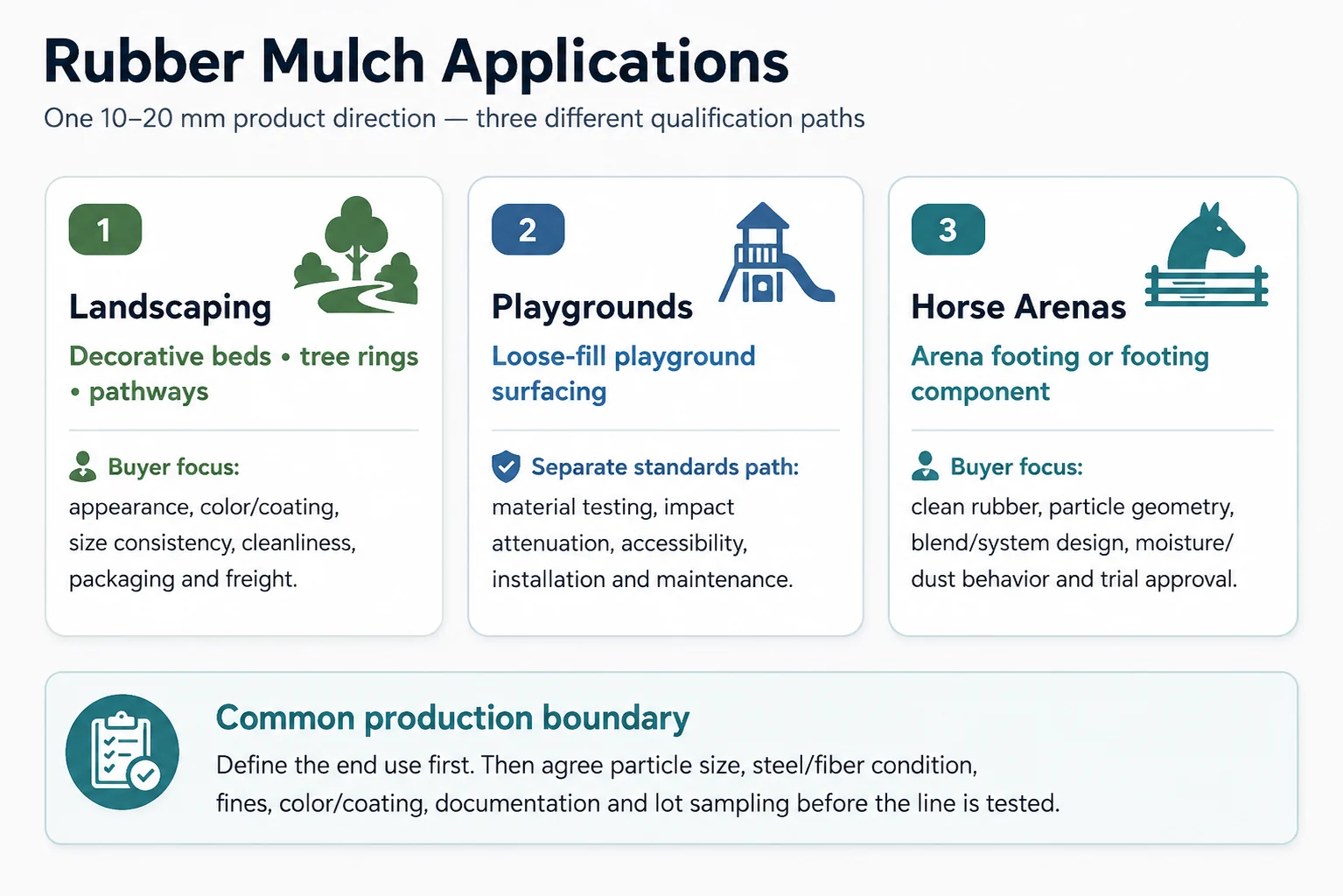
Three customers can stand beside the same pile of black rubber chips and be looking at three different products.
The landscape distributor may ask whether the color is consistent, whether loose fiber is visible and whether a full truckload can be delivered before spring demand peaks. A playground contractor may ask for test reports, the intended installation system and evidence that the loose-fill product meets the project’s surfacing requirements. An arena owner may care about chip geometry, sharp metal, dust, drainage and how the material behaves when blended into an existing footing.
That is why a useful guide to rubber mulch applications should not simply list ten places to dump recycled tire rubber. The commercial question is whether the material leaving the recycling line can be qualified for the buyer’s actual use.
How the End Use Changes the Rubber Mulch Specification
For YUXI’s wire-free mulch process, 10–20 mm is a practical coarse product direction. Whether that material is suitable for landscaping, playground surfacing or horse-arena footing depends on the buyer or project specification. For playground use in particular, particle size alone does not establish suitability; material testing and installed-surface requirements must also be addressed.
Landscaping normally emphasizes appearance, cleanliness, color/coating, consistency, packaging and delivered cost. Playground loose-fill rubber has a separate standards and installed-system path; landscaping mulch should not be assumed to qualify. Horse-arena footing is project-specific and may use rubber as one component in a broader sand/fiber/mineral system, so a representative material trial and written buyer specification are more useful than a universal blend ratio.
Landscaping, Playgrounds and Horse Arenas Need Different Answers
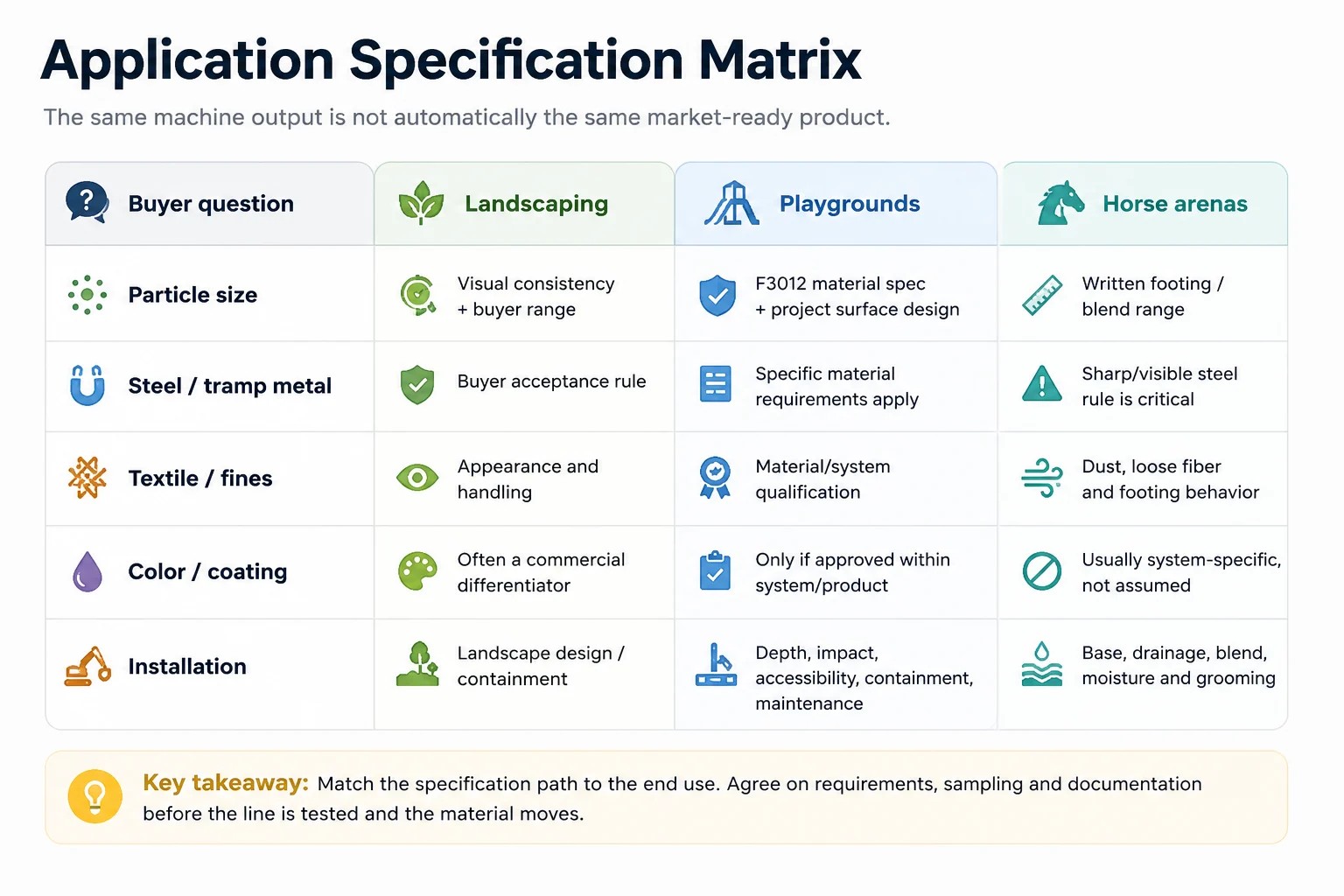
| Application | Typical commercial role | Product questions to resolve | Extra qualification beyond line output |
|---|---|---|---|
| Landscaping | Decorative beds, tree rings, weed-abatement coverings, selected pathways and landscape-material distribution. | Size appearance, color/coating, visible steel, loose textile, fines, foreign material, bulk or bagged form. | Buyer sample approval, packaging/labeling requirements, color durability expectations, local landscape or project requirements. |
| Playgrounds | Loose-fill rubber surfacing when the material and installed system are specifically qualified for playground use. | Particle size, sharp/tramp metal, regulated material properties, consistency and documentation. | Applicable playground material, impact-attenuation, accessibility, installation and maintenance requirements. |
| Horse arenas | Rubber footing or a component blended into an equestrian surface system. | Chip geometry, sharp metal, loose fiber, fines/dust, blend compatibility, drainage and handling. | Representative trial, footing-system design, moisture/grooming plan and buyer or consultant approval. |
CalRecycle’s Tire-Derived Product program lists mulch, bark, weed-abatement coverings, tree-care products, horse-stall mats, tracks and related products among recognized uses for recycled tire material.1 That confirms a broad application landscape. It does not turn one generic rubber specification into an approved product for every one of those markets.
Rubber Mulch for Landscaping: The Most Direct 10–20 mm Market
Landscaping is usually the simplest application to understand because the recycled rubber remains a coarse loose-fill product. It can be distributed as black material or as colored/coated mulch and used around planting beds, trees and other landscape areas where the project accepts tire-derived material.
Those questions should become a written acceptance sheet. The term wire-free rubber mulch is especially important here: “wire-free” should describe an agreed finished-product condition and inspection method, not be treated as a guarantee of mathematically zero detectable metal.
Black mulch and colored mulch are different finished-goods operations
The same core rubber can enter two commercial paths after separation. Black bulk mulch can move directly to storage and truck loading. Colored product adds coating materials, mixing, curing or drying, batch control and additional handling. Retail packaging can then add bags, labels, pallets, warehouse space and order picking.
That downstream work matters because the landscape application is often sold on appearance as much as on particle size. If the buyer wants a narrow color range, one sample produced immediately after coating is not enough; the agreed process should cover batch-to-batch consistency and the buyer’s durability expectation.
Landscape use still needs containment and site judgment
Rubber pieces do not decompose like wood mulch, which changes how a landscape owner manages the installed material. Edging, drainage, wind exposure, slopes, adjacent hardscape and local project requirements can all affect whether a loose-fill rubber product is appropriate. A recycling-equipment supplier should define the material it produces and avoid turning that into a universal landscape-design guarantee.
Playground Rubber Mulch Is Not Just “Cleaner Landscaping Mulch”
This is the application where the product boundary matters most. The U.S. Consumer Product Safety Commission describes loose-fill rubber as rubber nuggets or buffings, sometimes called rubber mulch, but says rubber mulch intended or marketed for landscaping or gardening may not be appropriate for playground surfacing. CPSC tells users to verify that the product is intended for playground use.2
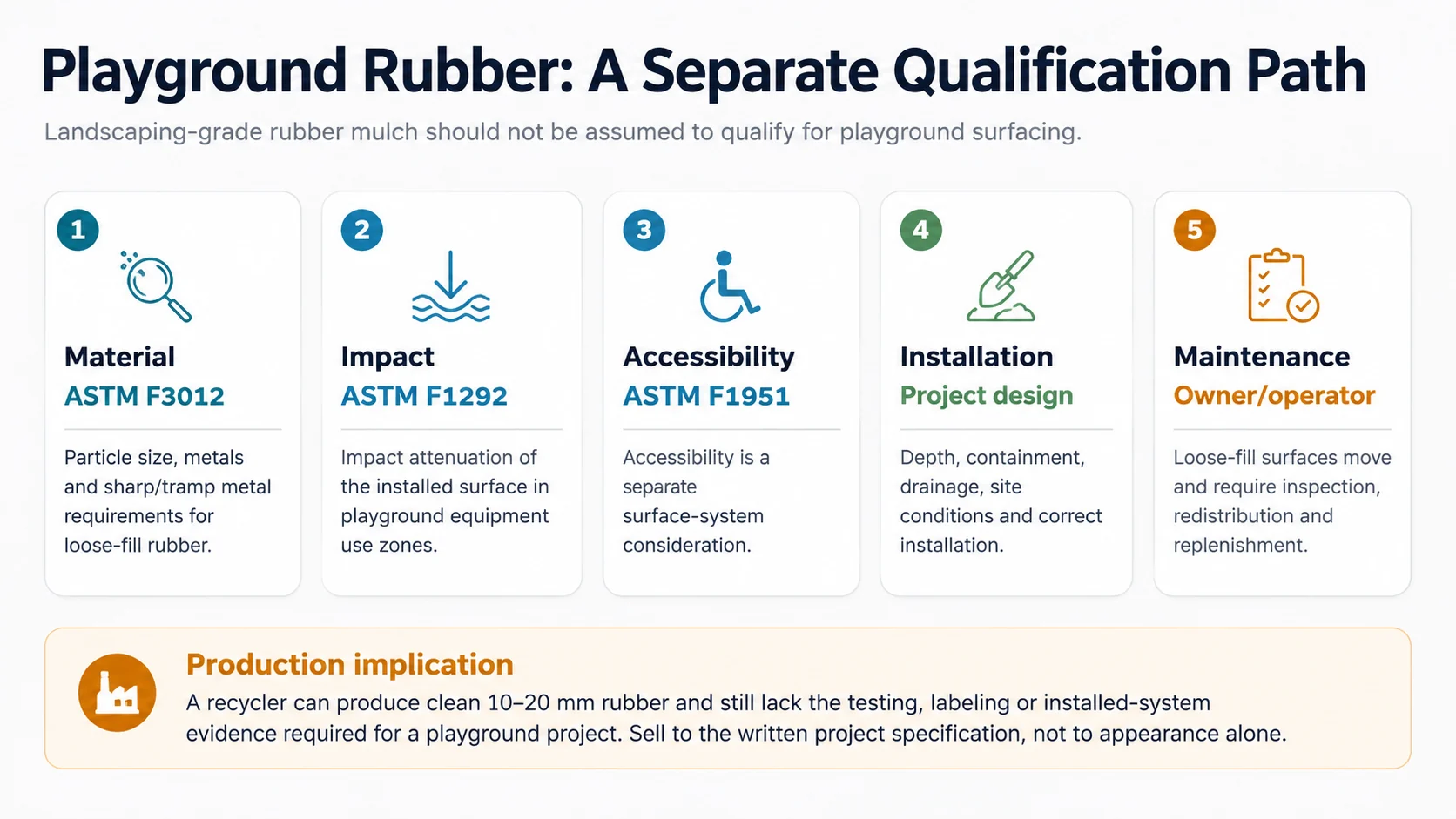
ASTM F3012 addresses the loose-fill rubber material
ASTM F3012-22 establishes test methods and performance requirements for loose-fill rubber intended as playground surfacing. Its published scope covers particle-size distribution, extractable hazardous metal content, total lead, tramp metal and sharp tramp metal.3
That is a much more specific product definition than “10–20 mm and looks clean.” The standard also says that if compliant loose-fill rubber is installed within a playground equipment use zone, it must also comply with ASTM F1292.3
Impact and accessibility are separate surface-system questions
CPSC’s playground-surfacing standards page lists ASTM F1292 for impact attenuation and ASTM F1951 for accessibility, along with F3012 for loose-fill rubber and other surfacing standards.4 In other words, passing a material check does not automatically prove the installed playground surface satisfies every project requirement.
Installation and maintenance cannot be manufactured at the recycling plant
Loose-fill material can migrate, compact or be displaced during use. The installed depth, containment, drainage, site preparation and maintenance routine therefore sit outside the tire-recycling line’s factory acceptance test. The recycler can supply a qualified material and documents; the playground designer, installer and owner/operator still have responsibilities at the site.
Rubber Mulch for Horse Arenas: Specify the Footing System, Not Just the Chip
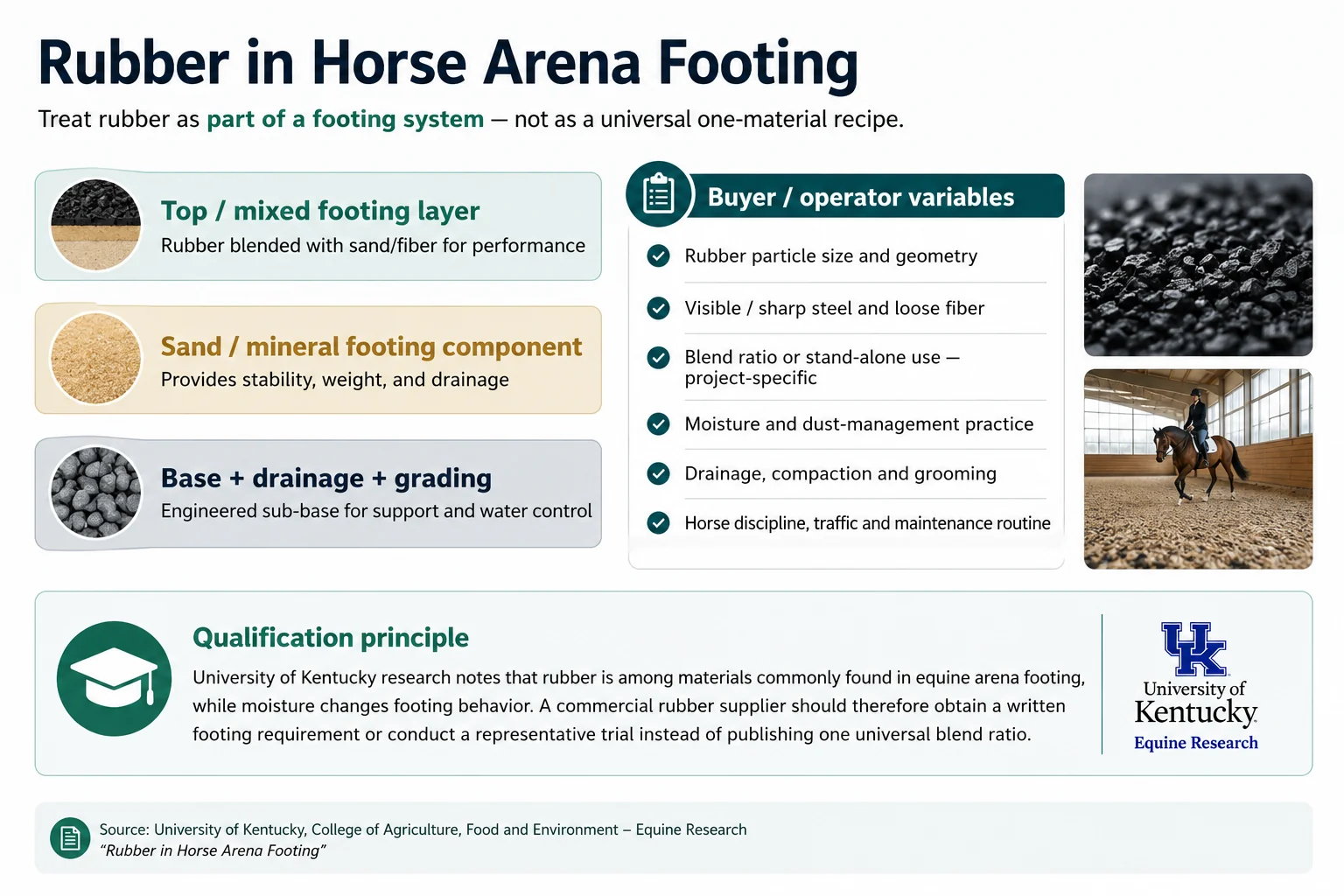
Horse-arena buyers create a different engineering problem. The surface is not simply a decorative layer. It is a working footing that changes with the mineral base, sand grading, fibers or additives, moisture, compaction, grooming and traffic.
Sharp steel and loose contamination deserve a strict acceptance rule
Arena material receives repeated hoof contact and mechanical grooming. A buyer may therefore place particular emphasis on visible or sharp steel, foreign objects and loose fiber. The exact limit is project-specific, but the inspection rule should be written before production. One clean top layer in a sample bag does not represent a truckload.
Do not publish a universal rubber-to-sand ratio
The correct blend depends on the existing surface and the performance target. Rubber particle size and shape also change how the blend behaves. A better commercial workflow is to agree a sample range, run a small representative trial and let the arena owner or footing consultant approve the material before a large-volume order.
The Same Mulch Plant Can Serve Different Markets—Only If the Specification Changes With the Buyer
The production machinery does not need to be reinvented for every application. What changes is the accepted product boundary and, in some cases, the finishing equipment after the core mulch process.
| Specification item | Why it matters to applications | What the recycler should define |
|---|---|---|
| Particle-size distribution | Influences appearance, spreading, surface behavior and qualification. | Target range, oversize, fines, sampling and measurement method—not only screen aperture. |
| Steel / tramp metal | Sharp or exposed metal can cause product rejection and may be specifically controlled by an end-use standard. | Visual rule and any quantitative test required by the buyer or standard. |
| Textile fiber | Changes visual cleanliness, dust/handling behavior and some buyer specifications. | Loose-fiber condition, fines and the agreed inspection or mass-based method. |
| Color / coating | Often important in landscaping; project-specific elsewhere. | Black vs colored, coating process, approved color, batch consistency and packaging. |
| Documentation | Higher-specification buyers may need more than a supplier description. | Lot identity, sample/test reports, material label, traceability and project-specific documents. |
| Delivery form | Bulk landscape delivery, playground installer supply and arena projects may use different logistics. | Loose bulk, supersack, retail bag, pallet, truckload and delivered/ex-works boundary. |
For size control, the existing 10–20 mm rubber mulch guide explains why screen opening is not identical to finished particle distribution. That distinction becomes more important as the application specification becomes tighter.
Which Markets Can Use Coarse Mulch Directly—and Which Usually Need Further Processing?
The wire-free mulch pillar correctly separates direct-use loose-fill applications from markets that usually require finer rubber. That distinction prevents a common sales mistake: treating every recycled-rubber market as if it buys the same particle size.
Direct-use mulch direction
- Landscaping, subject to buyer and local project requirements.
- Playground loose-fill surfacing, only when specifically qualified for that use.
- Horse-arena footing or footing component, when approved for the specific system.
- Other coarse loose-fill uses with a written buyer specification.
Usually needs finer processing
- Many molded rubber products.
- Rubber tiles and some sports-surface systems.
- Fine crumb or granule markets.
- Applications with narrow mesh or small-particle specifications.
If the verified buyer wants a finer material, compare the additional processing path before adding screens and finishing stages to a mulch line. The rubber mulch vs crumb rubber comparison explains where the process and market boundary changes.
How Application Choice Changes the Production Line Without Rewriting the Whole Process
A broader landscaping specification can favor simpler finishing
If a landscape distributor accepts black 10–20 mm material with a defined oversize, visible-steel and textile condition, the core line may stop after the agreed screening and separation duties. Adding stronger fiber polishing or retail coloring without a buyer requirement can increase cost without creating value.
A tighter application increases return load and quality-control work
When the buyer narrows the size band or tightens the fines limit, more material may return to the rasper or leave as a separate fine fraction. When the steel/fiber rule tightens, magnetic polishing, better burden control or fiber separation may be justified. The line should be evaluated on accepted product, not gross rasper discharge.
Colored landscape product is a finishing module, not a different tire-recycling principle
The tire still needs the same core liberation and separation work. Coloring comes later. This is useful for phased investment: a recycler can validate demand for clean black mulch first, then add a coating and packaging operation when the buyer mix supports it.
The application should be represented in the acceptance test
A tire rasper demonstration that produces attractive rubber does not prove that the final application is qualified. The tire rasper machine guide explains the secondary-cutting boundary; the application test must continue beyond the machine to the finished material and any external standard or project requirement.
Buyer Qualification Checklist Before You Sell “Rubber Mulch for X”
We would rather receive an incomplete buyer specification early than discover a hidden requirement after the equipment list is frozen. For each target application, ask the buyer or project team for the following:
- Exact end use: landscaping bed, retail mulch, loose-fill playground surfacing, arena blend, top dressing or another defined use.
- Particle-size rule: nominal range, upper and lower cut, permitted oversize/fines and test method.
- Steel rule: visible/exposed/sharp metal definition and any required quantitative test.
- Textile/fines rule: allowed loose fiber, dust or fines and how they will be inspected.
- Color and coating: black, colored, approved color standard, coating durability and batch expectations.
- Required standards/tests: especially for playground projects or other regulated/engineered applications.
- Installation boundary: who designs and installs the final surface; required depth, blend, base or drainage information.
- Sample approval: sample mass, trial quantity, lab testing, documentation and approval authority.
Common Mistakes When Matching Rubber Mulch to an Application
Calling every coarse tire chip “mulch”
Coarse size does not prove acceptable steel, fiber, fines or consistency. Define the finished lot after separation and screening.
Using one sample for three markets
A landscape sample can look excellent and still lack the documentation or installed-system qualification required for playground use.
Confusing “wire-free” with end-use certification
Steel reduction is one product-quality attribute. It does not certify playground impact performance or validate an equestrian footing system.
Assuming playground compliance from particle size
ASTM F3012 covers more than particle size, and the installed playground surface has additional impact/accessibility considerations.
Publishing a universal horse-arena blend ratio
Arena surfaces differ. Use the existing footing, drainage, moisture, discipline and buyer trial to determine the project-specific material plan.
Adding finishing equipment before confirming buyers
Coloring, extra fiber polishing or tighter screening should be linked to a market requirement, not included simply because the technology is available.
FAQ
What are the main applications for rubber mulch?
Common direct-use applications include landscaping and selected loose-fill surfacing or footing projects. For the YUXI wire-free mulch route, a typical product direction is 10–20 mm.
Can landscaping rubber mulch be used on playgrounds?
Not automatically. CPSC states that rubber mulch intended or marketed for landscaping or gardening may not be appropriate for playground surfacing. Loose-fill playground rubber has a separate qualification path that can include ASTM F3012 material requirements, ASTM F1292 impact attenuation and accessibility considerations.
What should playground rubber mulch be tested for?
ASTM F3012 covers test methods and performance requirements for loose-fill rubber including particle-size distribution, extractable hazardous metals, total lead, tramp metal and sharp tramp metal. Where installed in an equipment use zone, F3012 also points to compliance with ASTM F1292.
Can rubber mulch be used in horse arenas?
Rubber is one material commonly found in equine arena footing systems, often together with sand or other components. There is no universal rubber size or blend ratio for every arena. The supplier and buyer should agree the footing design, particle condition, steel/fiber limits, drainage, moisture and trial criteria.
Does 10–20 mm rubber mulch fit every end market?
No. A nominal 10–20 mm range is only one part of the product definition. Buyers may also specify oversize and fines, visible or residual steel, textile fiber, color or coating, documentation, packaging and lot sampling.
Do sports flooring and molded rubber products use the same mulch?
Usually they require finer or more tightly graded rubber than a coarse loose-fill mulch product. If the target market needs crumb or granules, the process normally continues beyond the mulch stage into additional granulation, screening and separation.
Define the End Use Before You Configure the Mulch Line
Send your target market, tire mix, required mulch size, steel and fiber condition, color or coating needs, buyer test method and expected accepted output. YUXI can separate the core 10–20 mm mulch process from the application-specific finishing and acceptance requirements.
External Sources and Standards
- CalRecycle — Tire-Derived Product Grant Program. Used to map recognized tire-derived product categories such as mulch, weed-abatement coverings, tree-care products, horse-stall mats and tracks; it is not treated as a universal product specification.
- U.S. Consumer Product Safety Commission — Tire Crumb Rubber Questions and Answers. Used for the distinction between landscaping/gardening rubber mulch and rubber intended for playground surfacing.
- ASTM International — ASTM F3012-22. Active standard specification for loose-fill rubber used as playground safety surfacing; the public scope identifies material-property tests and the F1292 relationship.
- U.S. Consumer Product Safety Commission — Playground Surfacing Standards. Lists the voluntary standards used for impact attenuation, accessibility, loose-fill rubber and related playground-surface testing.