




The rasper is the machine between rough tire shredding and fine granulation. Its real job is not simply to make smaller chips—it must open the rubber around embedded steel so the next separator can remove it.
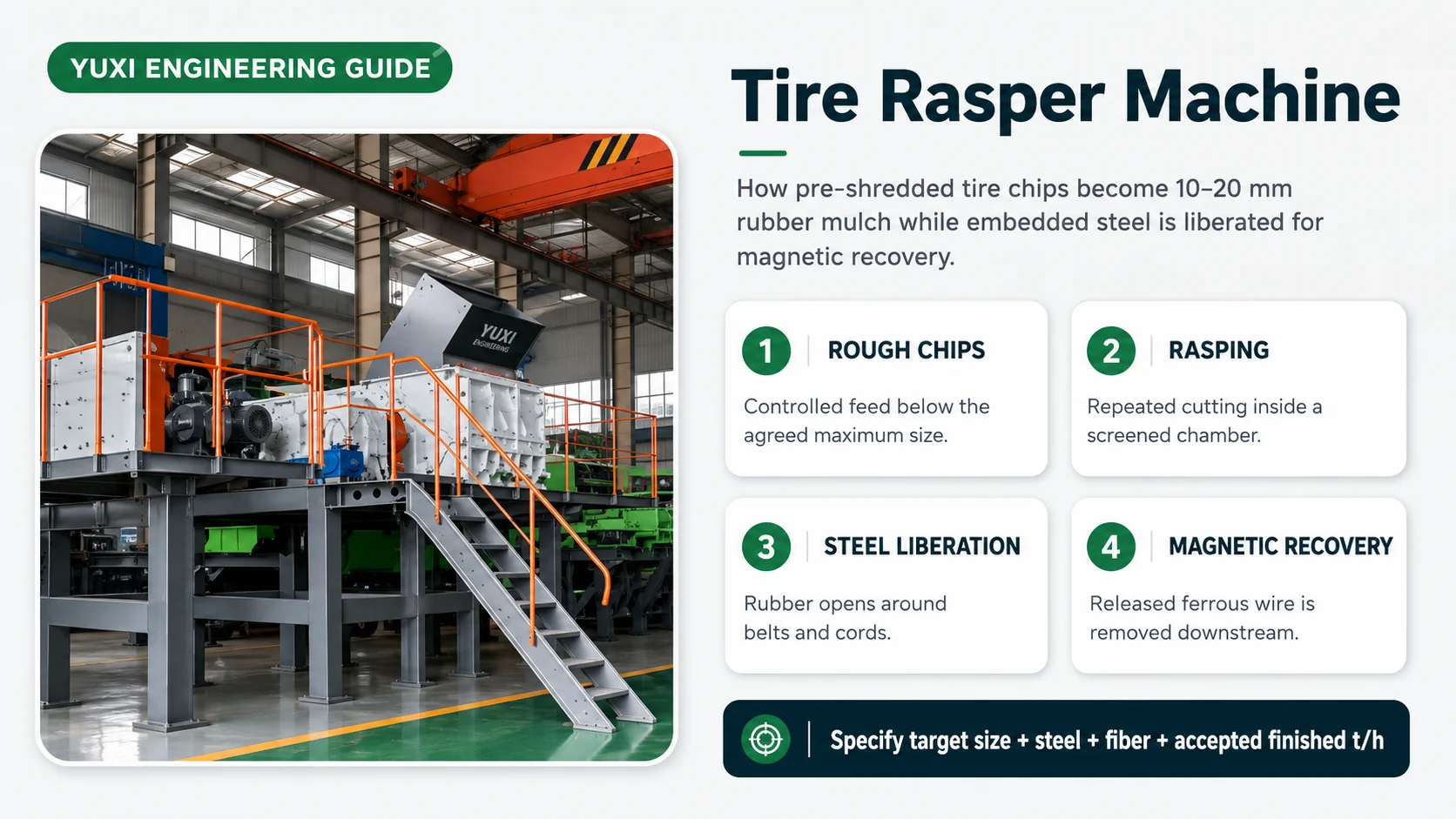
During a line test, buyers often point to the magnet and ask, “Is that the machine making the rubber wire-free?” The magnet is important, but it can only collect steel that has already been released. The difficult work happens one stage earlier, inside the tire rasper machine.
A tire chip is not a clean piece of rubber with loose wire lying on top. Steel cords remain locked inside a tough, elastic structure. The rasper repeatedly cuts and opens that structure until much of the steel is no longer bonded to the rubber. The discharged stream still contains rubber, steel and textile fiber. Magnetic and air-separation equipment then finish the job.
Quick Answer
A tire rasper machine is a secondary size-reduction and steel-liberation machine. It receives pre-shredded tire chips—typically within an agreed maximum size—cuts them against rotor and stationary knives, retains oversize material behind a screen and discharges smaller rubber chips with liberated steel.
In the YUXI wire-free mulch process, the typical target is 10–20 mm rubber mulch. A downstream magnetic separator removes the released ferrous wire. “Wire-free” should therefore be judged by final visible-steel and sampling criteria, not by treating the rasper, magnet and finished product as one undefined purity percentage.
On This Page
What Is a Tire Rasper Machine?
A tire rasper—also called a rubber rasper or, in some markets, a secondary tire shredder—is installed after primary size reduction. Its feed is not normally a whole tire. It is rough tire shreds that are small and consistent enough to enter the cutting chamber without bridging or shock-loading the rotor.
The machine owns two connected duties:
Secondary size reduction
It reduces rough chips toward the mulch range. In the YUXI process, the normal product direction is 10–20 mm, although the accepted distribution must be written together with the screen and oversize rule.
Steel liberation
It cuts rubber away from belts and cords so the steel becomes magnetically recoverable. Liberation occurs inside the rasper; physical recovery occurs after discharge.
That combination is why the rasper is not just a smaller shredder. A primary shredder can produce rough chips efficiently, but those chips may still hold long steel cords and dense rubber-steel interfaces. A granulator can make finer particles, but it works better when the incoming material has already passed through the main steel-liberation stage.
The U.S. EPA notes that the flexibility of rubber and the strength and abrasiveness of reinforcing steel make scrap tires difficult to process. It also describes tire processing as a sequence selected around the target market rather than one universal machine route.1 That is exactly the engineering reason for placing a rasper between rough shredding and finer processing.
Where the Rasper Sits: Shredder, Rasper and Granulator Are Not Interchangeable
We normally draw the process boundary before discussing equipment. It prevents a common purchasing mistake: expecting one machine to do three stages of work.
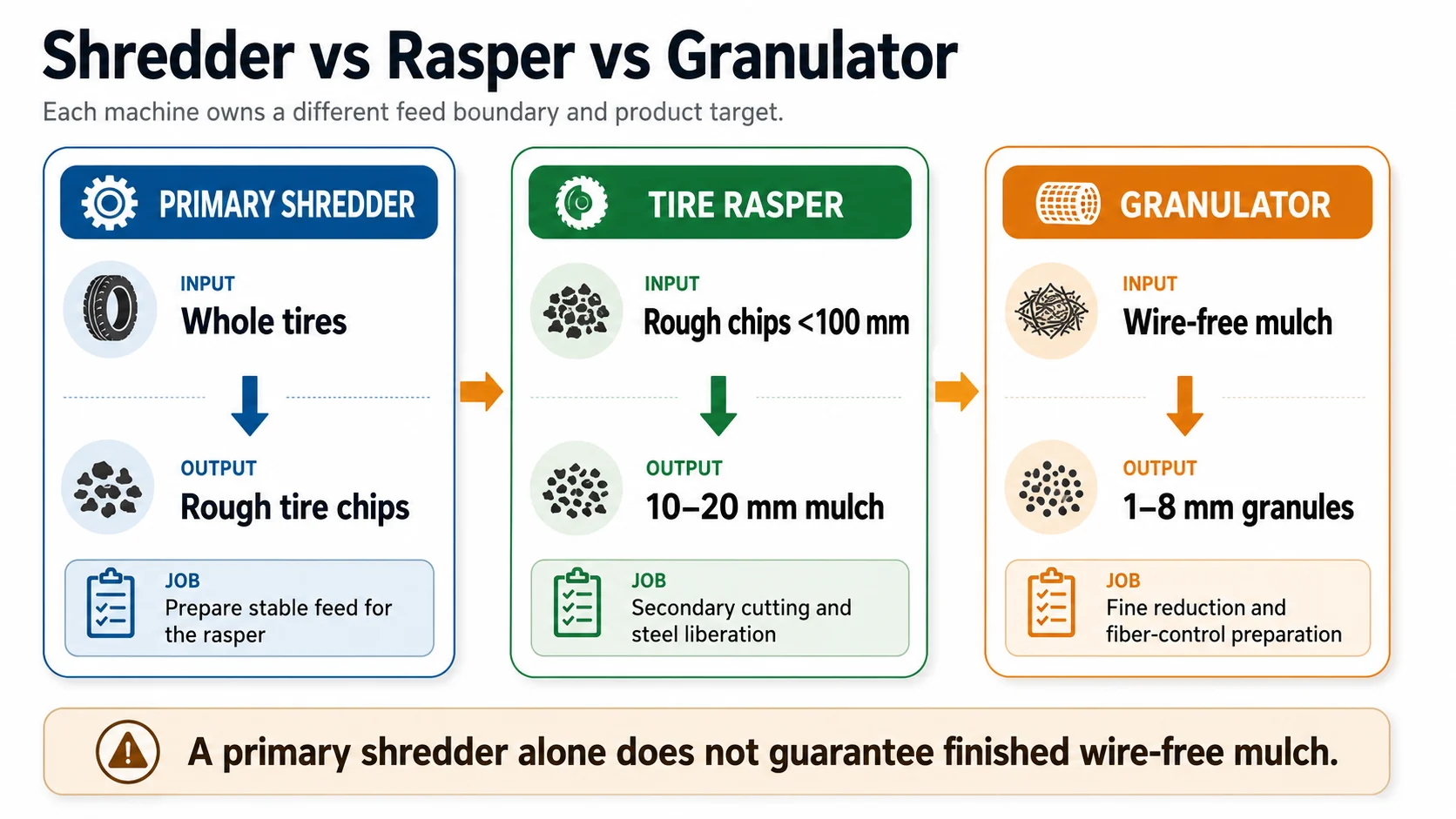
| Machine | Typical feed | Main output direction | Primary responsibility |
|---|---|---|---|
| Primary tire shredder | Whole passenger or truck tires, or prepared sections | Rough tire chips | Volume reduction and stable feed preparation |
| Tire rasper machine | Pre-shredded chips within the accepted maximum | Mulch-size rubber plus liberated steel and fiber | Secondary cutting and steel liberation |
| Magnetic separator | Rasper discharge | Recovered steel plus rubber-and-fiber stream | Ferrous recovery from a controlled material layer |
| Rubber granulator | Wire-free mulch feed | Finer rubber granules | Fine reduction and preparation for additional fiber/size control |
A complete plant that starts from whole tires therefore needs a suitable primary tire shredder before the rasper. A plant that already produces consistent sub-100 mm chips may begin at the rasper module, but the actual feed envelope must be confirmed from representative material rather than a single average dimension.
After the mulch stage, projects that need smaller granules can continue into a tire rubber crumb plant. That route adds finer granulation, classification, further magnetic protection and more intensive textile-fiber removal. The rasper remains the bridge between rough, steel-rich chips and that finer process.
How a Tire Rasper Machine Works, Step by Step
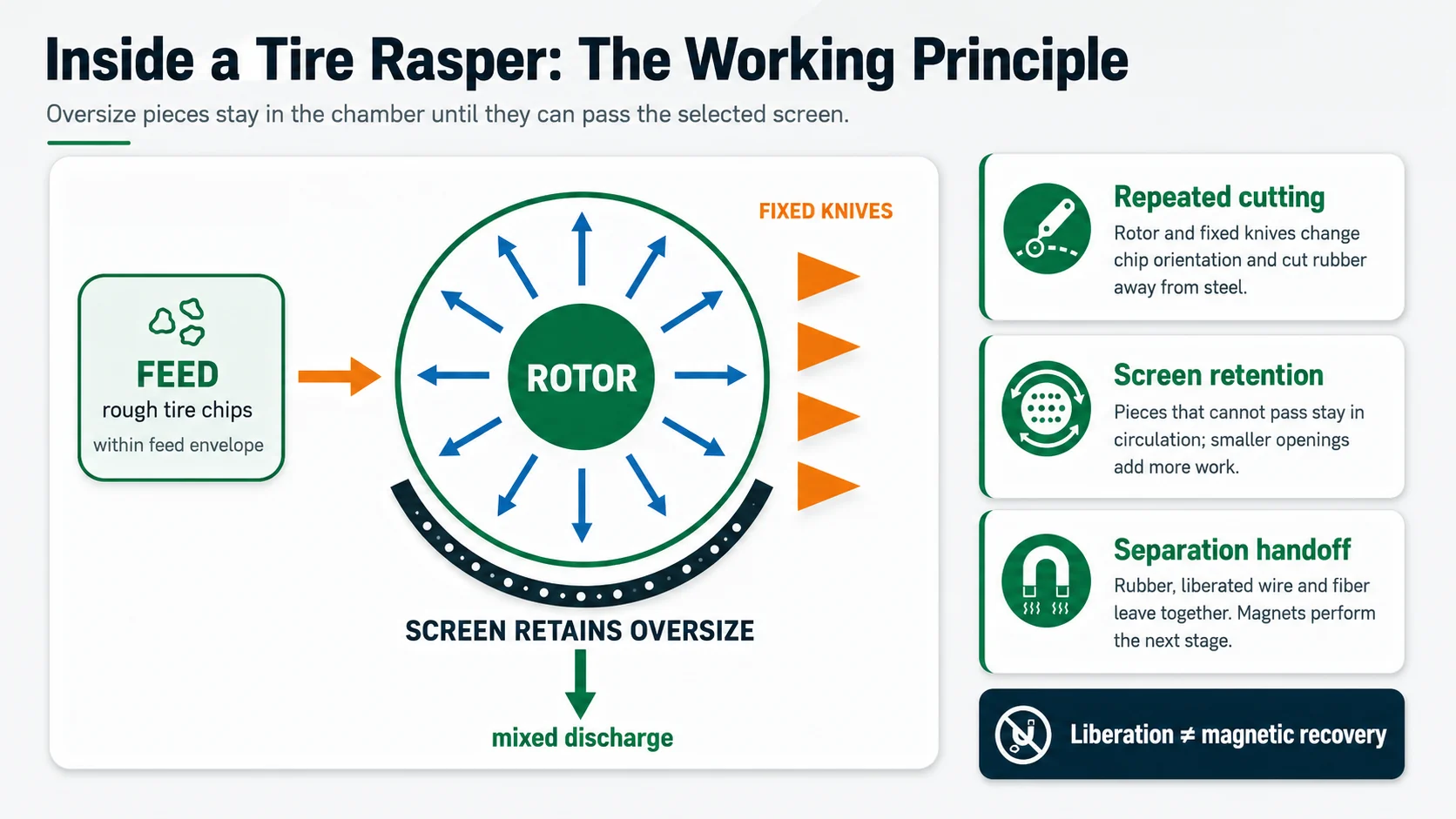
The outside of a rasper can look simple: hopper, cutting chamber, drive and discharge. Inside, stable production depends on the relationship between feed rate, rotor cutting, fixed knives, screen area and the amount of material circulating in the chamber.
Step 1: The line meters rough chips into the chamber
The feed conveyor should present a controlled layer rather than dumping irregular batches. Chips that are too large, too long or heavily wrapped with wire can enter badly, bridge above the chamber or create sudden load peaks. The YUXI line information uses rough chips below approximately 100 mm as the reference rasper feed, but shape and tire construction matter as much as one dimension.
In practice, the least consistent chips decide whether the feed is acceptable. A handful of clean passenger-tire pieces can make any test look easy. A representative trial should include the truck-tire percentage, long strips, exposed wire and normal contamination level expected at the plant.
Step 2: Rotor and stationary knives create repeated shear and tearing
The rotor carries replaceable cutting elements around the chamber. As it turns, tire pieces are pulled across a controlled gap against stationary knives or counter-cutting surfaces. The rubber deforms, rotates and is cut again from a different direction.
That repeated presentation is important. One pass may reduce a chip but leave steel cords embedded. More cutting opens the rubber around belts and cords. The objective is not to turn every steel strand into a short metal fragment. It is to detach steel from rubber in a form that a magnetic separator can collect without dragging excessive rubber with it.
Step 3: The screen keeps oversize material inside
A perforated screen or sizing grid controls what can leave the cutting chamber. Pieces that pass through are discharged. Pieces that cannot pass remain in circulation and encounter the rotor again.
A smaller opening does not create a free improvement in product quality. It usually raises the circulating load, increases the number of cutting events per accepted ton and can reduce finished throughput. The screen must also offer enough open area to discharge material without creating a packed bed under the rotor.
Net rasper duty = fresh chip feed + material retained for additional cutting.
This is why two lines with the same incoming tons per hour can have different accepted mulch output. One may allow broad chips to leave quickly. The other may keep more material inside to meet a tighter 10–20 mm distribution.
Step 4: Steel is liberated from the rubber matrix
As rubber is cut away, steel belts and cords become exposed, loosened and detached. The YUXI process data uses a 99% steel-liberation figure at the rasper stage as a reference. That number should be read only as a stage-level liberation claim under the supplier’s test conditions—not as a statement that the final rubber is 99% pure.
A liberation test asks whether steel is still bonded inside rubber. A final product test asks what contaminants remain in the mulch after all separation stages. They are related, but they are not the same measurement.
Step 5: Rubber, wire and textile fiber leave as a mixed stream
The rasper discharge normally contains mulch-size rubber, liberated ferrous wire, textile fiber and some off-size pieces. This mixed discharge is expected. It should move quickly onto the next conveyor without deep piles, uncontrolled bouncing or wire wrapping around transfer points.
Step 6: Magnetic separation recovers the liberated wire
A magnetic separator attracts ferrous steel from the moving burden. Recovery depends on magnet strength and configuration, but also on the depth and speed of the material layer. A strong magnet cannot reach steel hidden under an excessively thick rubber bed as effectively as it can process a thin, controlled presentation.
The EPA’s description of crumb-rubber production follows the same staged logic: tires are reduced to the required size, screens classify material and return oversize, magnets remove wire and air separators remove fabric.2 A rasper line producing mulch stops at a coarser product, but the separation principles are similar.
Step 7: Screening and fiber handling finish the product
Some mulch buyers accept a broad particle range and limited visible textile. Others require a tighter distribution and lower fiber content. The finishing configuration can therefore include a product screen, oversize return, air separation and dust collection.
Screening verifies size; it does not remove steel. Magnetic separation removes ferrous metal; it does not control particle distribution. Fiber separation reduces textile content; it does not prove the material meets an end-use standard. Each stage needs its own acceptance criterion.
Main Tire Rasper Components and What Buyers Should Verify
Exact construction varies by model, so the final data sheet should identify the supplied components rather than relying on generic words such as “heavy duty.” The following items are the practical inspection points for an industrial rasper.
Feed hopper and chute
Check maximum chip dimensions, anti-bridging geometry, access for clearing and how the upstream conveyor prevents sudden batch feeding.
Rotor assembly
Review rotor construction, balance, bearing arrangement, cutting-element mounting and how operators can inspect wear without dismantling unrelated equipment.
Rotor and fixed knives
Confirm material, number of usable edges, gap-setting procedure, sharpening or replacement method, fastener access and recommended spare quantity.
Screen and screen support
Confirm opening size, open area, thickness, change method and whether another screen can be installed for a different product range.
Wear liners
Rubber and steel are abrasive. Replaceable liners can protect the chamber, but buyers should verify liner locations, fastening and field replacement time.
Drive and protection
Review motor, transmission, overload logic, rotor reversal strategy, bearing monitoring and interlocks with upstream and downstream conveyors.
Why maintenance access belongs in the specification
A rasper is a wear machine. Knife inspection, gap adjustment and screen changes are normal production work, not rare emergencies. A low machine price can become expensive if operators need a crane, remove long conveyor sections or spend most of a shift opening the chamber.
Ask the supplier to demonstrate the maintenance sequence during factory acceptance: isolate energy, open the housing, access knives, remove a screen section, inspect liners and close the machine. Time the process. This produces better evidence than a brochure statement saying maintenance is “easy.”
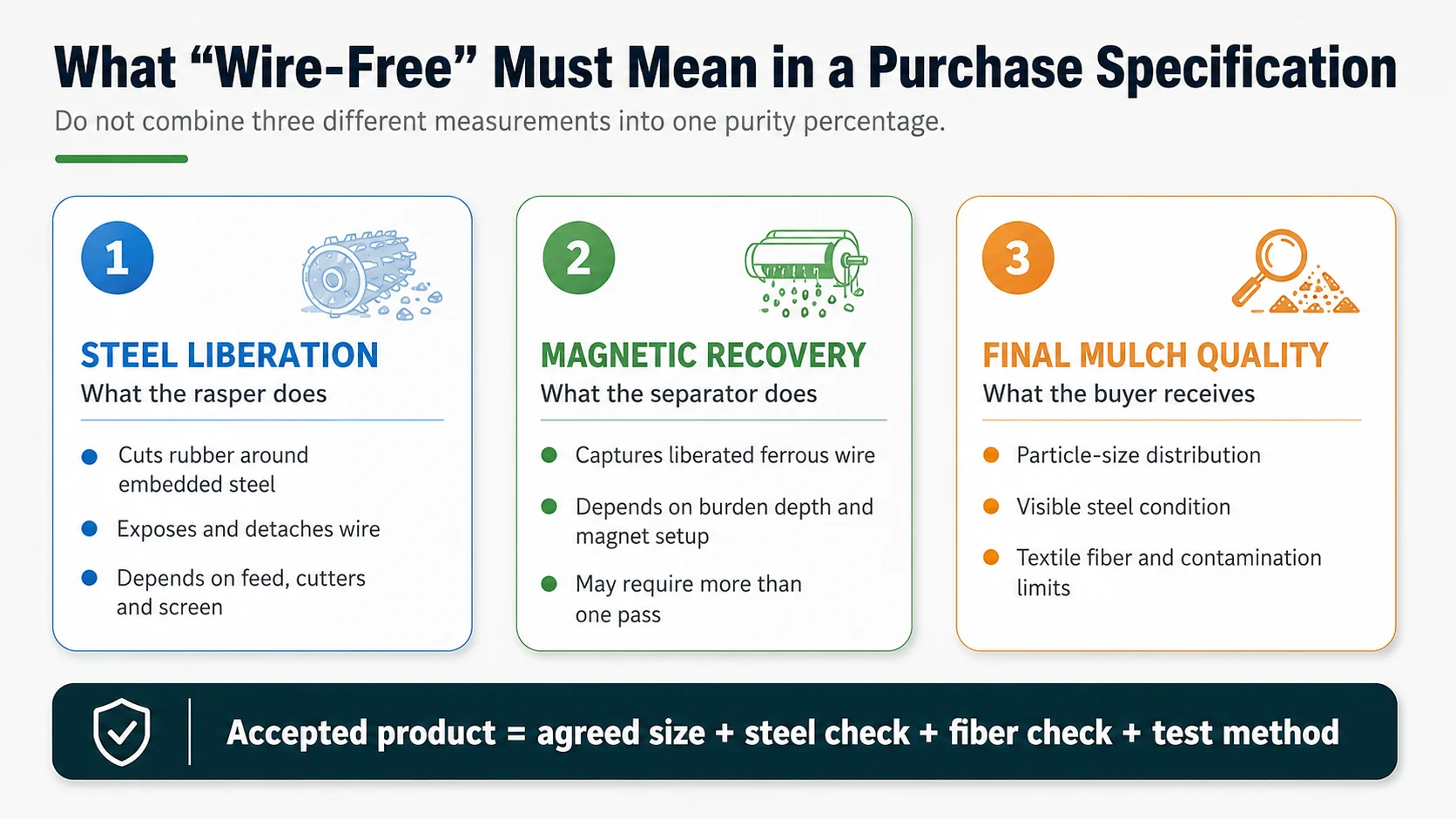
What “Wire-Free Rubber Mulch” Should Mean
In a real purchase specification, it needs three separate definitions. Combining them creates misleading purity claims and makes acceptance disputes almost inevitable.
1. Steel liberation
This is the percentage or condition of steel detached from rubber by the rasper. Inspect the recovered steel stream for rubber still bonded to wire, and inspect rubber pieces for steel that remains embedded.
2. Magnetic steel recovery
This is the separator’s ability to collect liberated ferrous material. The YUXI process data lists 97–98% steel-wire recovery as a stage reference. It should not be added to or multiplied by the liberation figure to create a final purity number.
3. Final mulch quality
This is what the customer buys. It should include the accepted particle-size distribution, maximum oversize, visible-steel rule, textile-fiber condition, moisture or contamination limits where relevant, sampling frequency and non-conformance procedure.
For particle-size verification, ASTM D5644 describes methods for determining the average particle-size distribution of recycled vulcanizate particulate rubber.3 A commercial mulch buyer may use a different agreed sieve or dimensional method, but the principle remains: write the method before testing the line.
End-use caution: machine output quality is not the same as regulatory or application approval. The current U.S. CPSC playground handbook says rubber mulch for playground use should meet the relevant loose-fill rubber standard and includes additional cautions for young children.4 A supplier should configure the line around the buyer’s written end-use specification rather than claim one mulch product is automatically suitable everywhere.
What Controls Tire Rasper Capacity and Mulch Size?
The YUXI pillar gives a reference complete-line range of 0.5–10 t/h. That range is useful for initial project classification, but the rasper’s practical output cannot be selected from one number. Capacity changes with the accepted product boundary.
| Variable | What changes inside the rasper | Likely effect on accepted output |
|---|---|---|
| Incoming chip size and shape | Large or long pieces require more cutting and may feed unevenly | Lower stability and more peak load |
| Passenger vs truck tire mix | Rubber mass and reinforcement change cutting resistance | Different energy and wear per ton |
| Target screen opening | Smaller openings retain more material | Higher recirculation and usually lower net output |
| Knife sharpness and gap | Worn edges deform or rub material instead of cutting cleanly | More heat, fines and power for the same product |
| Material layer after discharge | Deep burden reduces magnetic presentation quality | More residual steel or need for another separation pass |
| Allowed oversize | Tighter rejection keeps more chips in circulation | Lower accepted tons even when feed tons stay high |
| Downtime basis | Knife checks, clearing and screen cleaning reduce net runtime | Shift output below instantaneous test rate |
Feed rate is not accepted mulch capacity
A test can weigh material entering the rasper, material leaving before screening or saleable mulch after separation. Those values are not interchangeable. For a purchase guarantee, use the last boundary.
Accepted mulch capacity = product passing the agreed size, visible-steel and fiber checks ÷ measured net production time.
Also record the return load. If 25% of the material is circulating for another pass, the rasper is processing more internal tonnage than the fresh feed scale shows. That extra work appears in energy use, knife wear and chamber loading.
Operating and Maintenance Checks That Protect Output Quality
Most rasper problems give warning before the line stops. Operators can often see the change in chip shape, wire condition, motor load or discharge flow. A short, consistent inspection routine is more useful than waiting for a dramatic jam.
At the start of each shift
- Confirm guards, interlocks and emergency stops are functional.
- Inspect the feed path for rims, stones, tools and oversized tire sections.
- Check knife condition, visible fasteners, screen condition and abnormal chamber contact.
- Run conveyors and separators empty to verify direction and clear discharge.
- Confirm magnet belt or discharge route is clean and ready to receive wire.
During production
- Watch motor load for repeated spikes rather than only the average value.
- Keep a stable feed layer; do not use the hopper as a storage bin.
- Sample mulch size and visible steel at a fixed interval.
- Inspect recovered wire for excessive attached rubber.
- Listen for new impact, scraping or bearing noise and investigate before restarting at full load.
Common symptoms and likely checks
| Symptom | Likely process causes | First checks |
|---|---|---|
| More oversize mulch | Worn knives, larger feed, damaged screen or excessive throughput | Knife edge and gap, screen integrity, feed rate, sample method |
| Steel remains bonded to rubber | Insufficient cutting, worn edges, wrong feed shape or too-large discharge opening | Recovered-wire sample, embedded-steel sample, knife condition, screen setup |
| Wire remains in finished mulch | Poor liberation or ineffective magnetic presentation | Separate rasper-discharge test from magnet-recovery test |
| Motor load rises gradually | Dull knives, packed screen, accumulated material or bearing issue | Product temperature, screen blockage, chamber inspection, bearing data |
| Frequent load spikes | Batch feeding, oversize chips, concentrated truck-tire pieces or foreign metal | Upstream conveyor, chip size distribution, feed segregation |
| Excessive fines and heat | Rubbing instead of shearing, over-retention or incorrect knife gap | Knife sharpness, screen opening, internal return load |
Field note: when visible wire increases, do not immediately move the magnet closer and assume the problem is solved. First separate the two stages. Inspect material directly after the rasper. If steel is still locked in rubber, the problem is liberation. If steel is loose but reaches the product belt, the problem is recovery or material presentation.
How to Select and Test a Tire Rasper Machine
A useful request for quotation begins with samples and acceptance criteria, not only “we need 5 t/h.” Send the material that will actually enter the rasper and define the product that must leave the complete module.
Information to send before machine selection
- Whether the project begins from whole tires or pre-shredded chips.
- Passenger, truck, agricultural or OTR tire percentages.
- Maximum chip length, width and thickness, plus photographs of irregular pieces.
- Target mulch range and allowed oversize percentage.
- Visible-steel, embedded-steel and textile-fiber requirements.
- Required accepted finished tons per hour and operating shifts.
- Power supply, building dimensions, dust-control expectations and product handling route.
- Whether 10–20 mm mulch is the final product or feed for later granulation.
Factory acceptance test
The test should use a declared lot of representative chips. Record the total input, net runtime, screen installed, motor load, stoppages, mulch output, return material, recovered steel and rejected material. Then sample the finished mulch using the agreed method.
A defensible pass condition
The line produces the agreed accepted mulch tons per hour from the declared tire mix while meeting the written particle-size, visible-steel and textile checks for the required test duration.
An incomplete pass condition
The feed conveyor carries the headline tons per hour for a short run, but no one weighs accepted mulch or records screen return, steel condition, downtime and representative feed composition.
Finally, request the maintenance demonstration, recommended commissioning spares, knife and screen replacement procedure, bearing list, electrical drawings and normal wear-inspection intervals. A rasper is valuable because it performs hard mechanical work. The purchase decision should include how that work will be maintained after the first test run.
Frequently Asked Questions
What does a tire rasper machine do?
It receives pre-shredded tire chips, performs secondary cutting, reduces them toward the mulch range and liberates embedded steel. The following magnetic separator recovers the released ferrous wire.
Can a tire rasper process whole tires directly?
Normally no. Whole tires first need primary shredding or suitable preprocessing. The rasper should receive chips within its confirmed feed envelope, including shape and reinforcement condition—not only an average dimension.
Does a rasper remove all steel wire by itself?
The rasper’s main steel-related job is liberation. It opens rubber around the steel. Magnetic separation then performs recovery. Final mulch quality is checked after both stages and any required screening or fiber separation.
What size rubber mulch does a tire rasper produce?
The YUXI wire-free mulch process is organized around a typical 10–20 mm product. Actual distribution depends on feed, knife condition, screen, open area, throughput and the permitted oversize percentage.
Is a tire rasper the same as a granulator?
No. The rasper is a mid-stream steel-liberation and mulch-size machine. A granulator normally receives wire-free mulch and reduces it into finer rubber granules with additional classification and fiber-control stages.
What is the best screen size for a tire rasper?
There is no universal best opening. Select it around the buyer’s accepted particle distribution, required throughput, feed shape and return-load limit. A smaller opening can improve size control but usually increases recirculation and cutting work.
How is tire rasper capacity measured correctly?
Measure accepted finished mulch after the agreed size, steel and fiber checks over a stated net runtime. Record the feed mix, screen, return load and downtime so the result can be repeated.
What wear parts should be included with a rasper?
The project-specific list normally considers rotor knives, stationary knives, screens, wear liners, bearings, belts or transmission parts and critical fasteners. Quantities should follow the declared feed and commissioning plan rather than a generic package.
Sources and Engineering References
- U.S. EPA, Scrap Tires: Handbook on Recycling Applications and Management for the U.S. and Mexico. Tire-processing challenges and general processing framework.
- U.S. EPA, Tire Crumb Questions and Answers. Size reduction, screening return, magnetic wire removal and air separation.
- ASTM D5644, Determination of Particle Size Distribution of Recycled Vulcanizate Particulate. Particle-size test-method scope.
- U.S. Consumer Product Safety Commission, Public Playground Safety Handbook. Current cautions and standards considerations for recycled rubber loose-fill surfacing.
- U.S. Tire Manufacturers Association, 2023 End-of-Life Tire Management Report. Market context for U.S. end-of-life tire material recovery.
Configure the Rasper Around Your Actual Tire Chips
Send YUXI your chip dimensions, tire mix, target 10–20 mm distribution, accepted finished capacity, visible-steel rule, textile requirement, power supply and expansion plan. The proposal can then define the rasper, magnetic recovery, screening and fiber stages on one test boundary.