A practical guide for tire recyclers and cement-plant procurement teams who need a deliverable fuel specification, a defensible capacity test and a cost comparison based on accepted energy—not vague “tons of TDF.”
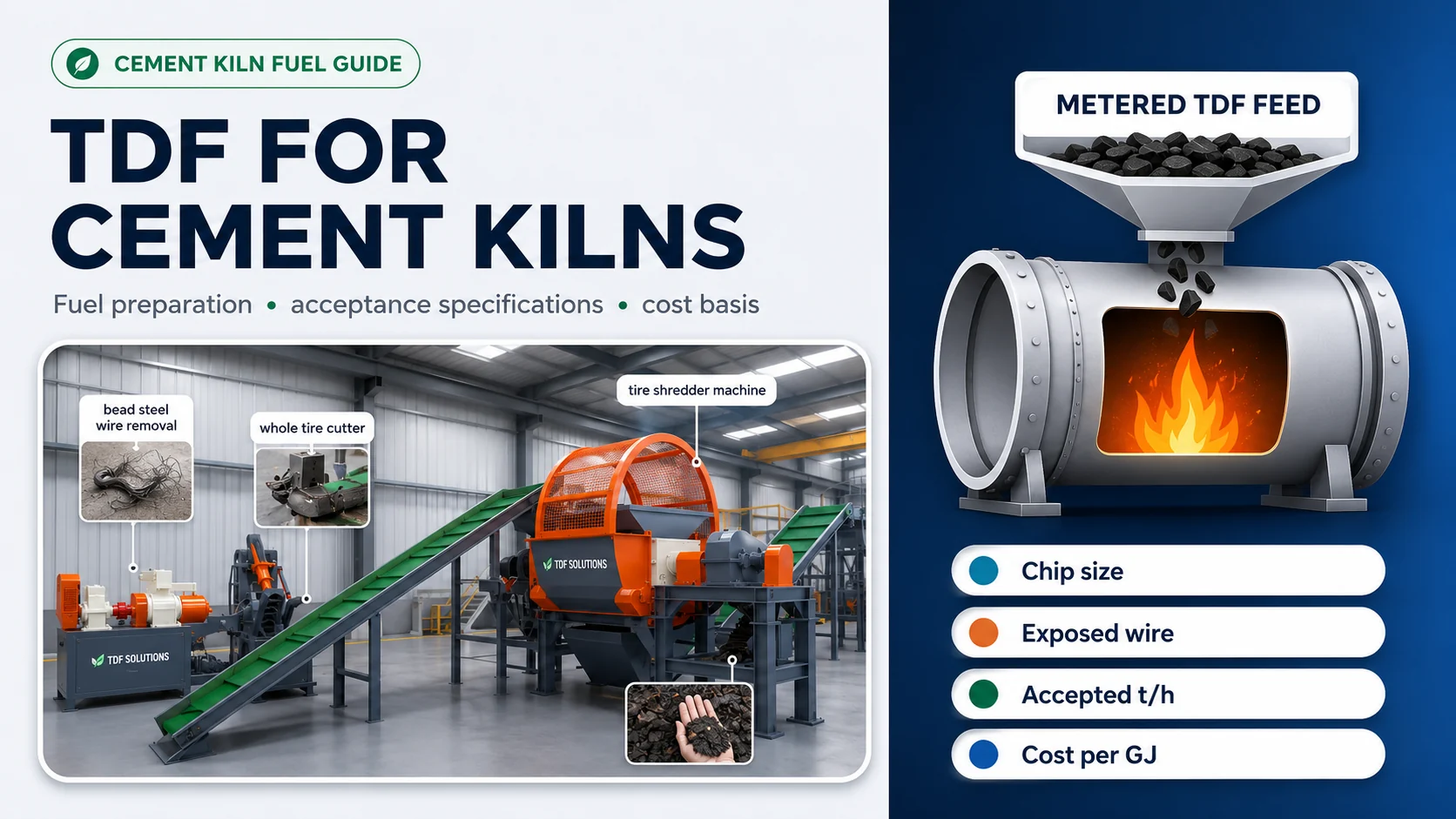
TDF becomes a commercial fuel only when its preparation and test basis match the receiving cement plant.YUXI equipment source image from the public Tire TDF Plant page; kiln graphic created for this guide.
A cement plant may say it can use tire-derived fuel, but that sentence does not tell a recycler what to manufacture. We still need to know where the material enters the kiln system, what the receiving hopper and metering equipment can handle, whether embedded steel is useful or troublesome, how the plant samples a delivery, and which cost it is actually comparing with coal or petcoke.
We have seen projects start with a photo of tire chips and a single line—“around 80 mm, five tons per hour.” It sounds workable. Then the questions arrive: Is 80 mm a nominal target or a hard maximum? Are long wires allowed? Does five tons mean raw shredder discharge or accepted finished product? Who pays if the truck is rejected? Those details decide the line.
Quick Answer
Prepare TDF for cement kilns by working backward from the kiln operator’s written fuel-acceptance sheet. At minimum, define chip dimensions and oversize, exposed wire and loose metal, moisture and net calorific value, chemical or contaminant limits, delivery method, sampling procedure and accepted finished capacity. Configure tire inspection, optional debeading or pre-cutting, shredding, screening and return, steel control, quality checks and storage around that document.
Cost should be compared per unit of accepted net energy, not only per input tonne. Include preparation, recirculation, wear, testing, storage, loading, transport, compliance and rejection risk. Deduct only credits that are real for the project, such as recovered steel value or a verified service payment.
A Cement Kiln Buys a Controlled Fuel Delivery, Not “Shredded Tires”
TDF for cement kilns is usually a supplemental fuel rather than a standalone answer to every thermal requirement. ASTM D6700 frames the decision around combustion characteristics, handling and feeding logistics, environmental concerns and ash-residue considerations.1 That is useful because it prevents a narrow purchasing mistake: judging the fuel only by heating value.
A cement plant has to move the fuel from the truck through storage, extraction, conveyors, weighing or metering equipment, gates and a selected feed point. A chip that burns well in theory can still be commercially unusable if it bridges above a screw, hangs from exposed steel, contains unexpected rims, or varies so much that the feeder cannot hold a stable rate.
The kiln operator also protects clinker quality and permit compliance. The WBCSD Cement Sustainability Initiative guidelines state that some waste streams are not suitable and that co-processing should preserve safe operation, the environment and product quality.2 GCCA guidance likewise stresses permits, monitoring and close quality control.3 A machine supplier can prepare material to an agreed specification; it cannot replace the cement producer’s process review or regulatory responsibility.
Commercial definition: the product is the quantity of TDF that passes the receiver’s physical, fuel-quality and delivery requirements under an agreed sampling method. Everything else is raw material, rework, by-product or reject.
Whole Tires and Shredded TDF Are Different Supply Routes
Some cement kilns are equipped to feed whole tires. Others use shredded tires, and some can use both. Industry presentations describe whole- and shredded-tire use at mid-kiln, back-end or other engineered feed locations, depending on kiln design.4 The U.S. EPA has also described whole-tire feeding as a valid route for certain kilns, with the advantage that the supplier avoids chip-production cost.5
That does not make whole tires automatically cheaper for the cement plant. Whole-tire systems need their own storage, singulation, weighing, conveying, gates and kiln interface. Their feed rate may be constrained by how the tire is introduced. Shredded TDF costs more to prepare, but it can support a different metering strategy and may be supplied from an off-site processor.
Supply route
Potential advantage
Main constraint to verify
Who carries preparation cost?
Whole tires
No off-site shredding and less size-reduction wear.
The kiln operator invests in the whole-tire receiving and feeding system.
Coarse shredded TDF
Can be transported and metered as a bulk solid where the receiving system is designed for it.
Chip maximum, oversize, exposed wire, flow behavior, sampling and consistency.
The TDF processor carries collection and preparation costs, reflected in the delivered contract.
More finely processed TDF
May suit a tighter feeder or injection requirement.
Higher recirculation, more steel reduction, increased energy and wear, and possibly more fines.
Usually the processor, unless the cement plant owns on-site preparation.
Before buying equipment, however, confirm that the cement plant actually wants off-site prepared chips. A recycler should not build a fine TDF line for a buyer whose kiln is engineered and permitted for whole tires.
Specifications Cement-Kiln TDF Buyers Should Put in Writing
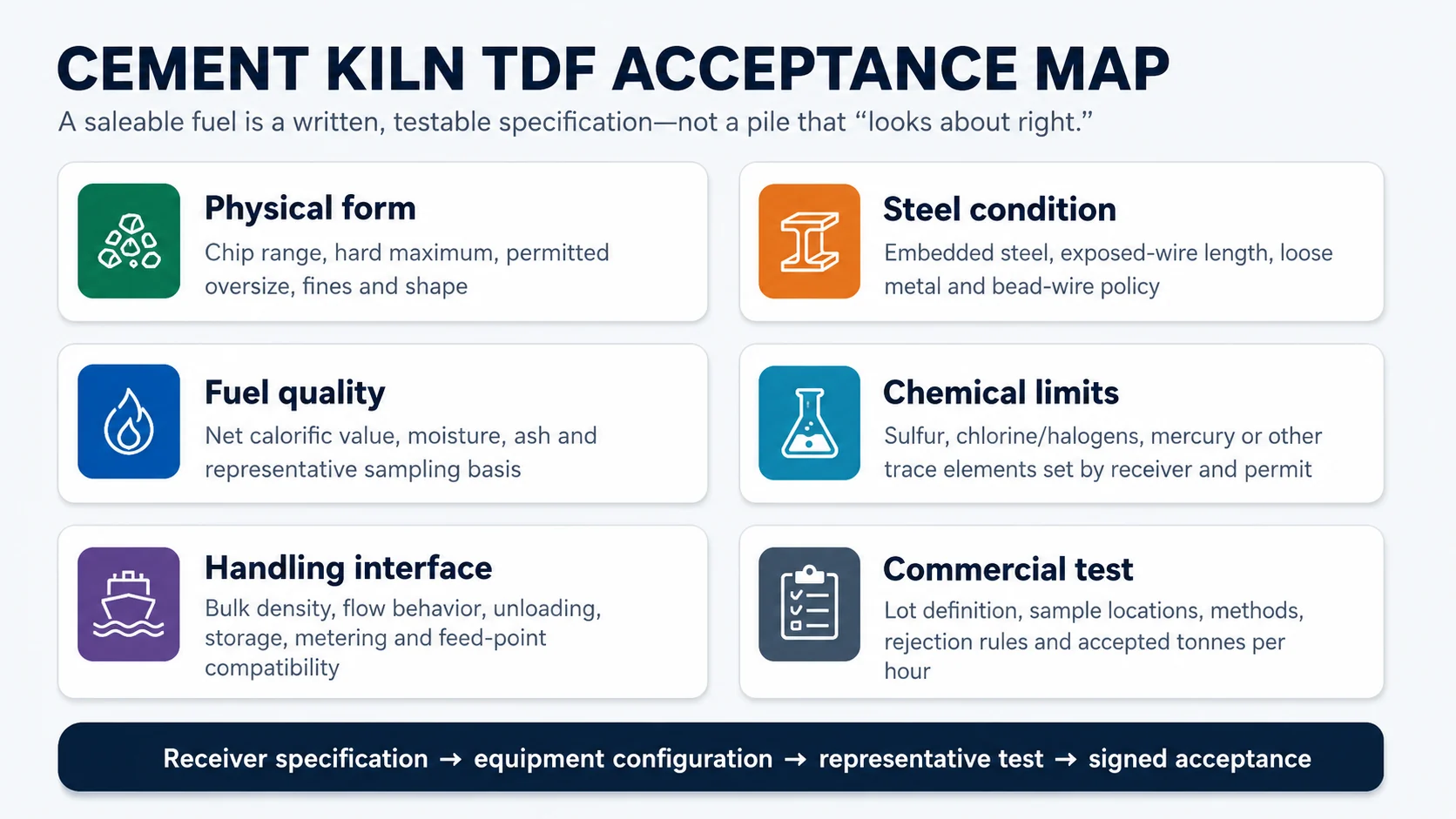
Each specification field needs a limit, a method and a responsibility. A number without a test basis is not yet a contract requirement.
There is no universal cement-kiln TDF specification. Liberty Tire Recycling, for example, describes TDF as customized by size and wire content to meet the customer’s fuel specification.6 That wording matches what we see in equipment discussions: the receiving plant defines the saleable product.
Specification field
What to define
Why it changes preparation or cost
Chip dimensions
Target range, measurement method, hard maximum and whether folded pieces are straightened for measurement.
A lower maximum generally increases cutting work, screening duty and oversize return.
Permitted oversize and fines
Percentage by mass or count, lot size and sample method.
A zero-oversize promise is very different from a target range with a stated tolerance.
Exposed wire
Maximum protruding length, permitted frequency or mass basis, and whether embedded steel is accepted.
Long wire can snag, bridge or damage handling equipment; tighter control may require more preparation.
Loose metal and non-tire contamination
Rims, tools, rocks, dirt, wood, plastics, free wire and other prohibited materials.
Foreign metal affects shredders and may fail the receiving inspection even when the chip size is correct.
Moisture and condition
As-received or dry basis, sample preparation, maximum moisture, free water, snow or mud policy.
Moisture changes delivered mass, net energy, handling and the fairness of price comparisons.
Net calorific value
Required range, test standard, as-received or dry basis and laboratory frequency.
Energy value is the denominator in a fair coal or petcoke comparison.
Ash and steel contribution
Whether steel-in material is acceptable and how ash or metal is reported.
Some cement plants can incorporate mineral or iron contribution, but plant chemistry and handling determine acceptance.
Sulfur, chlorine and trace elements
Receiver-specific limits and approved analytical methods, including any mercury or other permit-sensitive fields.
These fields can affect kiln cycles, emissions control, product quality and substitution rate.
Bulk handling
Loose bulk density range if needed, unloading method, maximum clump, truck type and storage expectations.
The same chips can behave differently after compaction, rain exposure or long transport.
Acceptance procedure
Lot definition, sampling points, retained samples, laboratory turnaround, rejection, rework and dispute rules.
The cost of a rejected truck can exceed the saving from a cheaper preparation route.
Chemical limits deserve particular care. Do not copy an RDF or solid-recovered-fuel table and assume it applies to tires. Ask the cement producer which parameters it controls for this kiln, feed point, fuel blend and permit. Then send those limits to the equipment and quality teams before the line is frozen.
A Practical Fuel-Preparation Route for Cement-Kiln TDF
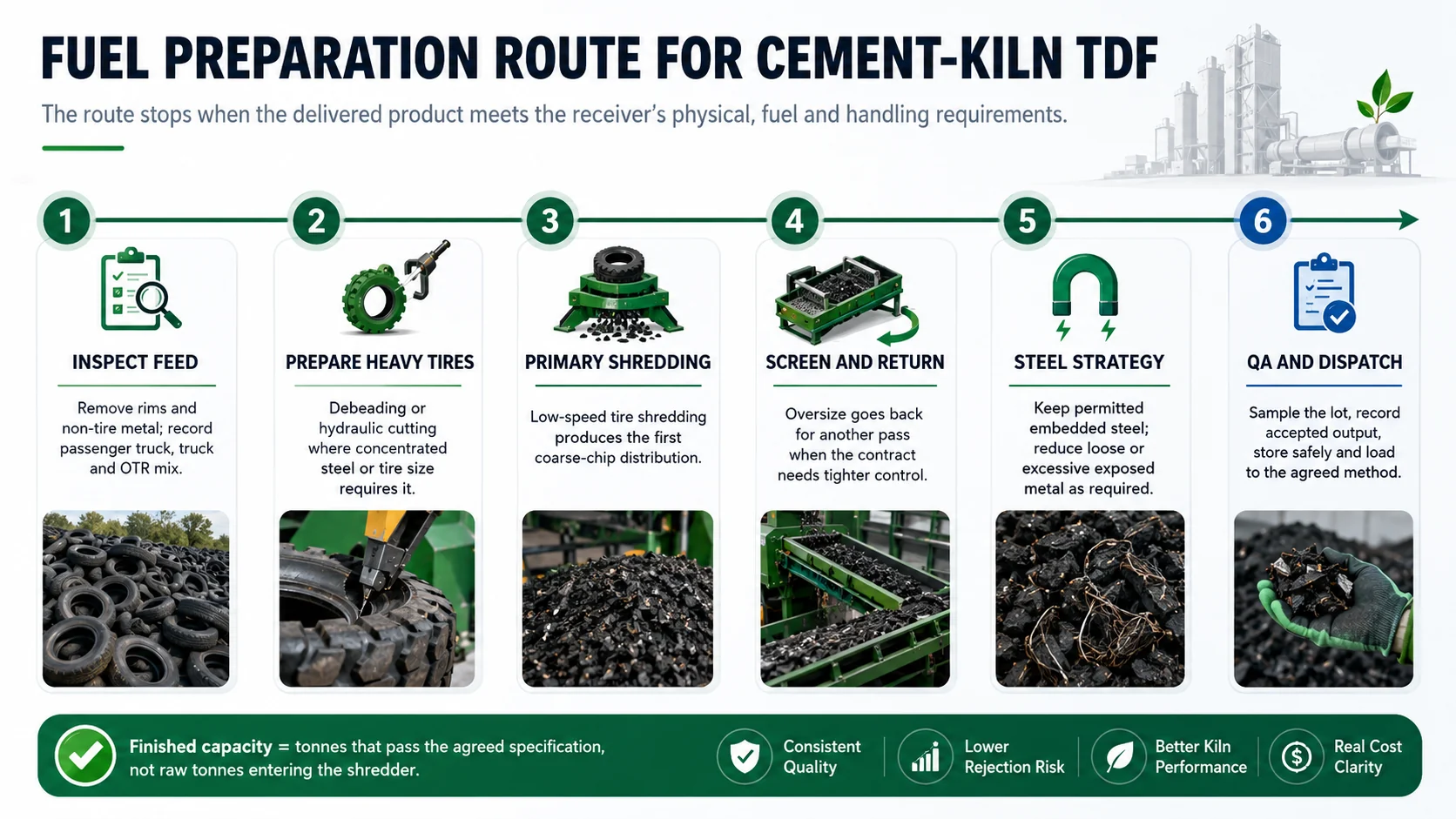
The route is specification-led. Optional stages are added because the feedstock or receiver requires them, not because every TDF line must look identical.
1. Inspect and classify the incoming tires
Remove mounted rims and obvious non-tire material. Record the passenger, truck, agricultural, OTR or mining-tire share, maximum dimensions and whether the supply changes by season. A capacity test on passenger tires does not prove the same accepted output on a steel-heavy truck mix.
YUXI’s tire wire drawing machine is relevant where concentrated bead bundles should be removed before shredding. A hydraulic tire cutting machine can prepare large, stiff or difficult-to-feed tires. Neither stage should be added by habit; both should be justified by tire construction, handling, wear or the final steel requirement.
3. Produce the first coarse-chip distribution
The YUXI tire shredder performs the main size reduction with a double-shaft cutting chamber. A first pass produces a distribution rather than identical pieces. The receiver’s largest acceptable chip and the plant’s stable feed rate matter more than an attractive handful selected from the discharge belt.
4. Screen and return oversize only to the degree required
A screen-and-return loop helps control the upper tail of the distribution. It also increases internal circulation. The raw feed may remain five tons per hour while only four tons per hour leave as accepted product; the missing ton is not necessarily lost, but it is consuming conveyor and shredder capacity again. That is why return percentage belongs in the capacity basis.
5. Apply the agreed steel strategy
Some cement kilns accept steel-in TDF. ASTM guidance notes that cement and lime kilns can oxidize wire and may use its contribution in the process.1 Still, “steel-in” does not mean “any wire condition.” Long protruding strands and loose metal can remain a receiving and handling problem. Bead removal, magnetic separation or additional processing should be selected against the written limit.
6. Sample, release, store and dispatch the lot
Quality control should represent the truckload or production lot, not the cleanest material on top of the pile. Record the tire mix, blade condition, screen arrangement, net runtime, accepted output, sample points and test results. Store the material under the site’s approved fire, housekeeping and stormwater controls. EPA guidance supports responsible TDF use where facilities have storage and handling plans, permits and compliance systems in place.5
Steel-In, Steel-Reduced or Wire-Free: Do Not Use the Terms Loosely
“Wire-free” is often used in sales conversations when the actual product still contains small embedded steel cords. For a cement-kiln contract, use measurable language instead. State what may remain embedded, the longest permitted exposed strand, the allowed loose-metal level and the sample basis.
Steel-in TDF
Embedded tire steel remains. This may be acceptable to a kiln that can handle it, but exposed-wire and loose-metal limits still apply.
Steel-reduced TDF
Bead bundles or part of the liberated steel are removed to reduce wear, improve flow or meet a tighter receiver requirement.
Highly de-wired material
Additional reduction and separation aim for very low metal. This is a different cost and equipment depth from ordinary coarse cement-kiln TDF.
One common mistake is paying for aggressive de-wiring when the cement plant accepts embedded steel and values its iron contribution. The opposite mistake is selling rough, long-wire chips into a feed system designed for a cleaner bulk solid. The receiver’s handling trial and written specification settle the argument.
Specify Accepted-Output Capacity and a Representative Test Basis
YUXI’s Tire TDF Plant page publishes a broad reference range of 0.5–20 t/h across different tire types and configurations, with approximately 50–80 mm shown as a common TDF target and 50–150 mm as a flexible rough-shred range. Those are product-family references, not a guarantee that every project will make every size at the same output.
Accepted TDF output = product mass that passes the agreed size, steel, contamination and quality criteria during the defined test period
A useful factory acceptance test or commissioning run should state:
Feed and operating conditions
Tire categories and percentages, maximum dimensions, bead status, contaminants, batch weight, operator arrangement, blade condition, screen and return configuration, power supply and continuous test duration.
Product and measurement conditions
Sampling location, chip measurement rule, permitted oversize and fines, exposed-wire inspection, loose-metal rule, accepted mass, rejects, recirculation, net runtime, stops and laboratory fields where applicable.
Report at least three rates: whole-tire input, gross first-pass discharge and accepted finished TDF. They answer different questions. The cement buyer normally cares about the last one; the recycler needs all three to understand the bottleneck.
What Determines the Cost of TDF for Cement Kilns?
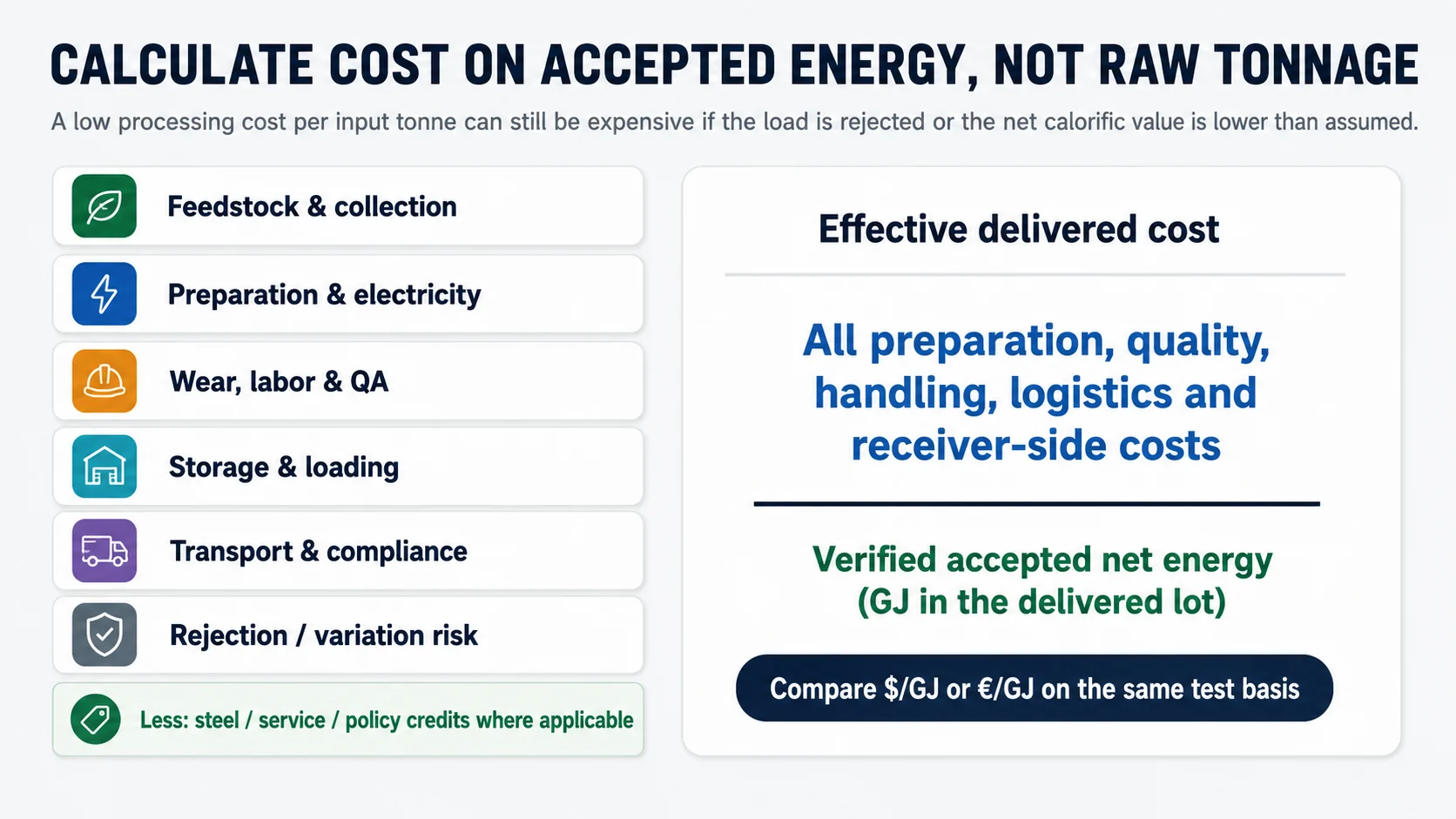
There is no responsible universal TDF price. Local tire-collection economics, landfill or stewardship policy, transport distance, power price, labor, steel value and the cement plant’s specification can move the result in opposite directions. The useful task is to build a transparent cost stack.
Cost factor
What increases cost
What should be documented
Feedstock acquisition and collection
Long collection routes, mixed prohibited material, difficult loading, irregular supply or paying for tires instead of receiving a service fee.
Source mix, inbound freight, inspection labor, rejected tires and any tipping or stewardship revenue.
Preprocessing
Truck or OTR tires, bead removal, hydraulic cutting, rim removal and manual sorting.
Labor-minutes, equipment rate, accepted tire range and why the stage is required.
Size reduction
Tighter maximum chip, hard zero-oversize promises, heavy steel reinforcement and unstable feeding.
kWh per accepted tonne, blade condition, input rate, first-pass yield and recirculation.
Steel control
Lower exposed-wire limits, loose-metal removal, repeated magnets or deeper de-wiring.
Steel definition, recovered mass, sale value, disposal cost and receiver limit.
Wear and maintenance
Foreign metal, OTR construction, poor inspection, low-quality feed control or inaccessible service layout.
Knife and screen life by actual feed, change time, spare set, lubrication and planned downtime.
Contract term, change-control clause, rejection liability and alternative outlet.
The most dangerous omitted cost is rejection risk. A line that saves a few dollars per tonne by removing the screen or reducing inspection can become more expensive after one returned truck, emergency rework and a missed fuel-delivery slot.
Compare TDF and Conventional Fuel on Accepted Energy
Normalize price to the same delivered condition and verified energy basis before comparing TDF with coal, petcoke or another alternative fuel.
Processor cost per accepted tonne = total attributable production cost ÷ tonnes released as conforming TDF
Delivered cost per accepted GJ = delivered and receiver-side attributable cost ÷ verified net energy in the accepted lot
The second formula is the better comparison for the cement plant. Use net calorific value on the contract basis—normally as received or another explicitly defined condition. Do not compare a dry-basis laboratory value with a coal invoice quoted on an as-received basis.
The calculation can also include a plant-specific handling or conditioning cost. For example, one fuel may be cheaper at the gate but require a separate storage bay, a lower feeder rate or more cleaning. Another may carry a higher delivered price but reduce conventional-fuel purchases reliably. These are project economics, not universal TDF claims.
EPA material has long noted that TDF has a high heating value relative to coal and can be a viable supplemental fuel when responsibly managed.5 That is a reason to perform the energy comparison, not permission to assume a fixed percentage saving. Actual substitution and cost depend on the kiln, fuel mix, operating constraints, permits and contract.
When a Standalone Tire Shredder Is Insufficient
A standalone shredder can be enough when clean, suitable tires arrive in a stable size range and the cement buyer accepts a broad one-pass chip with the resulting steel condition. That scenario exists. It is not the default for every project.
Move from a standalone machine to a complete preparation line when one or more of these conditions apply:
The feed includes truck, agricultural, OTR or mining tires that require controlled handling or pre-cutting.
The receiver sets a tight maximum chip and low oversize tolerance, requiring a screen and automatic return.
Accepted output must be demonstrated continuously rather than inferred from raw shredder input.
The project needs conveyors, controlled feeding, steel collection, product storage and truck loading as one balanced system.
The recycler has no alternative outlet for off-spec or oversize material.
YUXI’s complete Tire TDF Plant combines the relevant preparation, cutting, shredding and material-transfer stages around the tire mix and finished-chip requirement. The line should still be configured from the cement plant’s acceptance sheet; the product page is the plant-level quotation destination, not a substitute for that document.
RFQ Checklist for a Cement-Kiln TDF Preparation Project
Send YUXI the following information before requesting capacity, equipment and budget. A short video of the representative tire supply and the cement plant’s acceptance sheet are more useful than a generic request for “a 10 t/h TDF machine.”
Feedstock and site
Passenger, truck, agricultural, OTR and mining-tire percentages.
Maximum diameter, width and approximate weight.
Rim and foreign-metal control.
Whether bead removal or tire cutting is already available.
Required working hours, power supply, floor area and loading method.
Inbound and finished-product storage plan.
Fuel and contract
Target chip range, hard maximum, oversize and fines allowance.
Embedded steel, exposed wire and loose-metal limits.
Moisture, net calorific value and chemical test requirements.
Required accepted finished tonnes per hour.
Sampling, test duration and rejection procedure.
Truck type, payload, unloading and transport distance.
Where information is missing, mark it as “to be confirmed by the cement plant.” Do not silently turn a website reference range into a contract guarantee.
Common Mistakes We Would Correct Before Equipment Selection
Using “80 mm” without a measurement rule
It might mean a screen opening, a target, a longest dimension or a sales shorthand. Define the hard maximum and permitted oversize.
Comparing machine prices before comparing accepted output
A cheaper line with high recirculation or rejection risk may cost more per saleable tonne. Ask every supplier for the same tire mix, product definition and continuous-test boundary.
Assuming cement kilns need completely wire-free chips
Some accept embedded steel; others have strict handling limits. Specify the condition, not the slogan.
Ignoring logistics in the fuel comparison
TDF is bulky. Payload, distance, trailer type, loading time and stock management can erase an apparent preparation advantage.
Building for one buyer without a change-control clause
A later reduction in maximum chip size or exposed-wire tolerance can change recirculation, wear and line capacity. The supply contract should explain how specification changes affect price and volume.
Configure TDF Around the Cement Plant’s Acceptance Sheet
Send the representative tire mix, required chip and wire limits, accepted output target, test basis and local power supply. YUXI can separate the essential preparation stages from options that only add cost without improving acceptance.
FAQ: TDF for Cement Kilns
What chip size is best for a cement kiln?
There is no universal best size. Use the kiln operator’s written maximum, oversize tolerance and measurement method. YUXI publishes approximately 50–80 mm as a common TDF target and 50–150 mm as a flexible rough-shred range, but the receiver’s specification controls the project.
Do cement kilns require wire-free TDF?
Not always. Some kilns accept embedded tire steel, but long exposed wire and loose metal may still be restricted because of handling and feeding. Define measurable limits instead of relying on “steel-in” or “wire-free” labels.
Can a cement kiln burn whole tires instead of shredded TDF?
Some kilns have engineered and permitted whole-tire feeding systems. Others require shredded fuel. Confirm the kiln design and purchasing route before investing in off-site shredding.
How should TDF capacity be stated?
State accepted finished tonnes per hour under a representative tire mix, defined chip and wire criteria, known screen-return arrangement and continuous test period. Report raw input and recirculation separately.
How is TDF cost compared with coal or petcoke?
Compare delivered cost per verified net energy on the same moisture and test basis. Include preparation, quality, storage, transport, receiver handling and rejection risk rather than comparing invoice price per tonne alone.
Does lower moisture always mean no moisture specification is needed?
No. Outdoor storage, rain, snow, mud and test basis can change the delivered condition. The contract should state the moisture method and whether energy values are reported as received or dry.
Can a standalone shredder make cement-kiln TDF?
It can where the feedstock is suitable and the receiver accepts the one-pass product. A complete line becomes necessary when tires need debeading or cutting, the output needs screening and return, steel must be controlled, or accepted output and dispatch require integrated handling.
What should the cement plant provide before a quotation?
Provide the fuel-acceptance sheet, feed-point and handling constraints, chip and wire limits, sampling method, required delivery volume, laboratory fields, unloading method and any permit-specific restrictions relevant to the supplier.
Marie has 8+ years of experience in tire shredding and recycling equipment,with a focus on tire shredders,rubber recycling machines,TDF production,rubber crumb processing,and complete tire recycling systems.