A practical definition is useful only when it leads to an acceptable product. Tire-derived fuel is not defined by one universal chip size. It is a processed tire fuel whose dimensions, exposed-steel condition, contamination limits and delivery form must match the receiving combustion system.
ASTM D6700 describes tire-derived fuel as the product created when whole scrap tires are converted into a chipped form for fuel recovery.2 EPA material uses the term more broadly when discussing whole or processed tires used as supplemental fuel in suitable industrial systems.1 Those two descriptions are not contradictory. They show why the first project question should be about the receiver rather than the shredder.
Some combustion systems can accept whole tires. Others need flowable chips that can pass through a bunker, conveyor, metering device and feed chute. A recycler therefore does not create a useful specification by writing only “TDF 50 mm” on a quotation. The specification needs to describe the actual acceptance window and the way it will be checked.
What TDF is not
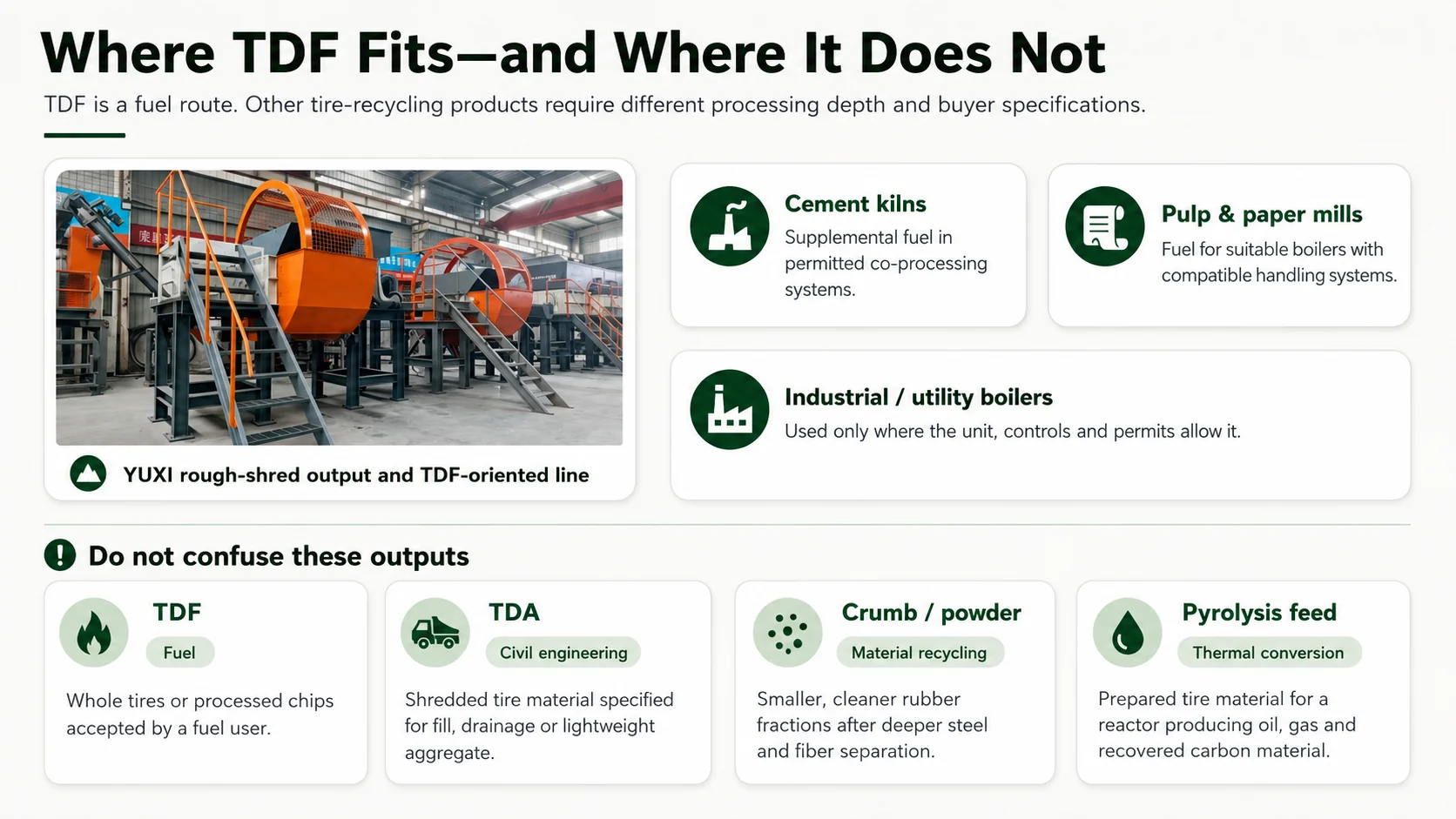
TDF is not the same as tire-derived aggregate (TDA). TDA is a civil-engineering material used under a different set of size, shape and construction specifications. TDF is also not crumb rubber or rubber powder; those products require deeper size reduction and usually more complete steel and textile separation. It is not pyrolysis oil either. A pyrolysis plant thermally converts tire feed into oil, gas and recovered carbon material, while a TDF line remains a mechanical preparation route.
TDF is a fuel route; TDA, crumb rubber and pyrolysis feed are specified for different downstream processes.
Why are tires used as fuel?
The direct answer is fuel value. EPA’s archived TDF FAQ states that scrap-tire fuel has a higher heating value than coal and wood on the comparison basis used in that guidance, and it identifies cement kilns, pulp and paper mills and utility boilers as common users.1 That does not mean every tire load automatically performs better than every coal or biomass supply. Fuel value, moisture, ash, steel, operating conditions and local fuel prices all affect the commercial result.
There is also a waste-management reason. End-of-life tires are bulky, resilient and difficult to compact. A legitimate fuel market can consume material at industrial scale. USTMA reported that TDF represented 33% of U.S. end-of-life tire use in its 2023 market summary and that TDF consumption increased between 2021 and 2023.3 These figures show market relevance, not a promise that a new plant will have a buyer.
In practice, we would not begin a TDF project by calculating theoretical fuel savings. We would first ask for the receiver’s written fuel-acceptance sheet, test-load procedure and likely monthly demand. A line without an accepted outlet is still only a tire-shredding line.
How is tire-derived fuel made?
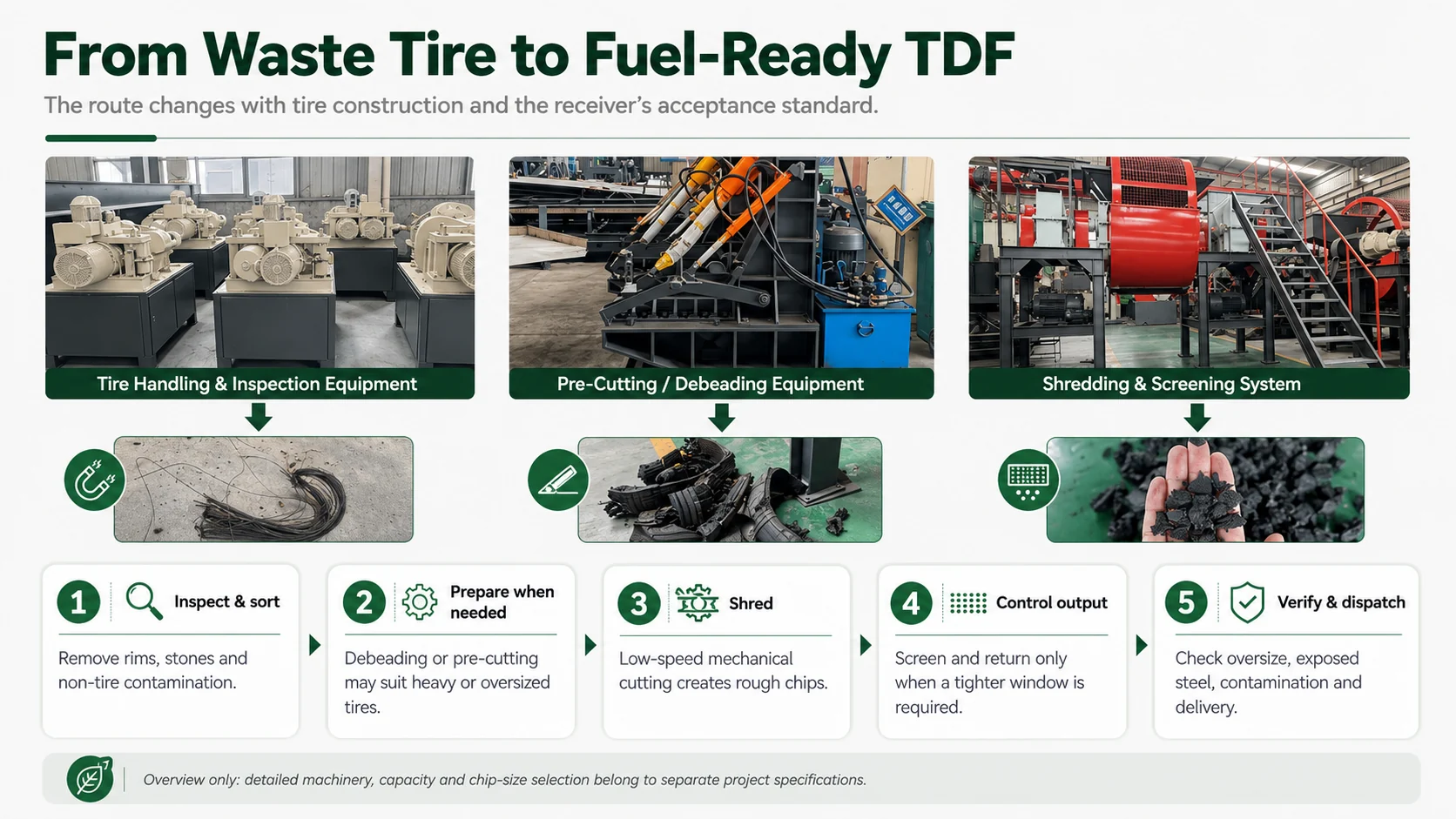
The simple explanation is: inspect the tire stream, prepare difficult tires where necessary, shred to an accepted form, control oversize and steel as required, verify the product and dispatch it. The real line can be shorter or longer.
Passenger tires that enter a suitable whole-tire shredder may need little front-end preparation. Heavy truck, OTR or mining tires can change the handling plan because of their diameter, weight, bead construction and steel reinforcement. Bead-wire removal or cutting may be used before shredding when it improves feeding, protects the cutting chamber or helps meet the buyer’s metal limits. It should not be presented as a mandatory step for every tire.
A high-level TDF route. The detailed machine sequence depends on tire construction and the receiving specification.
1. Inspect and sort the feed
Remove rims, loose metal, stones, soil and non-tire waste. Record the approximate mix of passenger, truck and oversized tires. This is not housekeeping around the process; it is process control. A clean, defined tire stream gives the supplier and operator a better basis for capacity, wear and output checks.
2. Prepare large or steel-heavy tires where needed
Some tires can be fed whole. Others are easier to handle after bead work or hydraulic cutting. The decision belongs to the project, not to a universal flowchart.Detailed shredder selection depends on tire construction, required chip size, exposed-wire limits and the receiving system’s feeding requirements.
3. Shred the tire mechanically
A low-speed, high-torque shredder grips the tire and cuts it into rough pieces. Chip shape is influenced by cutter geometry, tire construction, blade condition, feeding rhythm and whether the line recirculates oversized material. This is why a catalog opening size cannot be treated as the finished product distribution.
4. Screen and return oversize only when the product requires it
A screen separates material that fits the agreed limit from pieces that need another pass. Tighter size control usually increases recirculation and can reduce accepted output per hour. Smaller and more consistent output normally requires tighter screening, more recirculation and a corresponding reduction in accepted throughput.
5. Control steel, contamination and delivery quality
Bead removal takes out concentrated bead steel, but it does not guarantee that every steel belt or cord disappears from the finished chip. Some fuel users accept embedded steel; others set limits on long exposed wire or require additional magnetic separation. The final test should follow the receiver’s method rather than an improvised visual judgment at the discharge conveyor.
What specifications matter for TDF?
ASTM D6700 notes that size, fuel analysis, combustion characteristics and environmental concerns need to be evaluated for the intended unit.2 GCCA’s co-processing guidance makes the same receiver-first point: alternative-fuel use is tied to licensing, waste characterization, laboratory testing, feeding position, energy content and limits set by the permit or plant.4
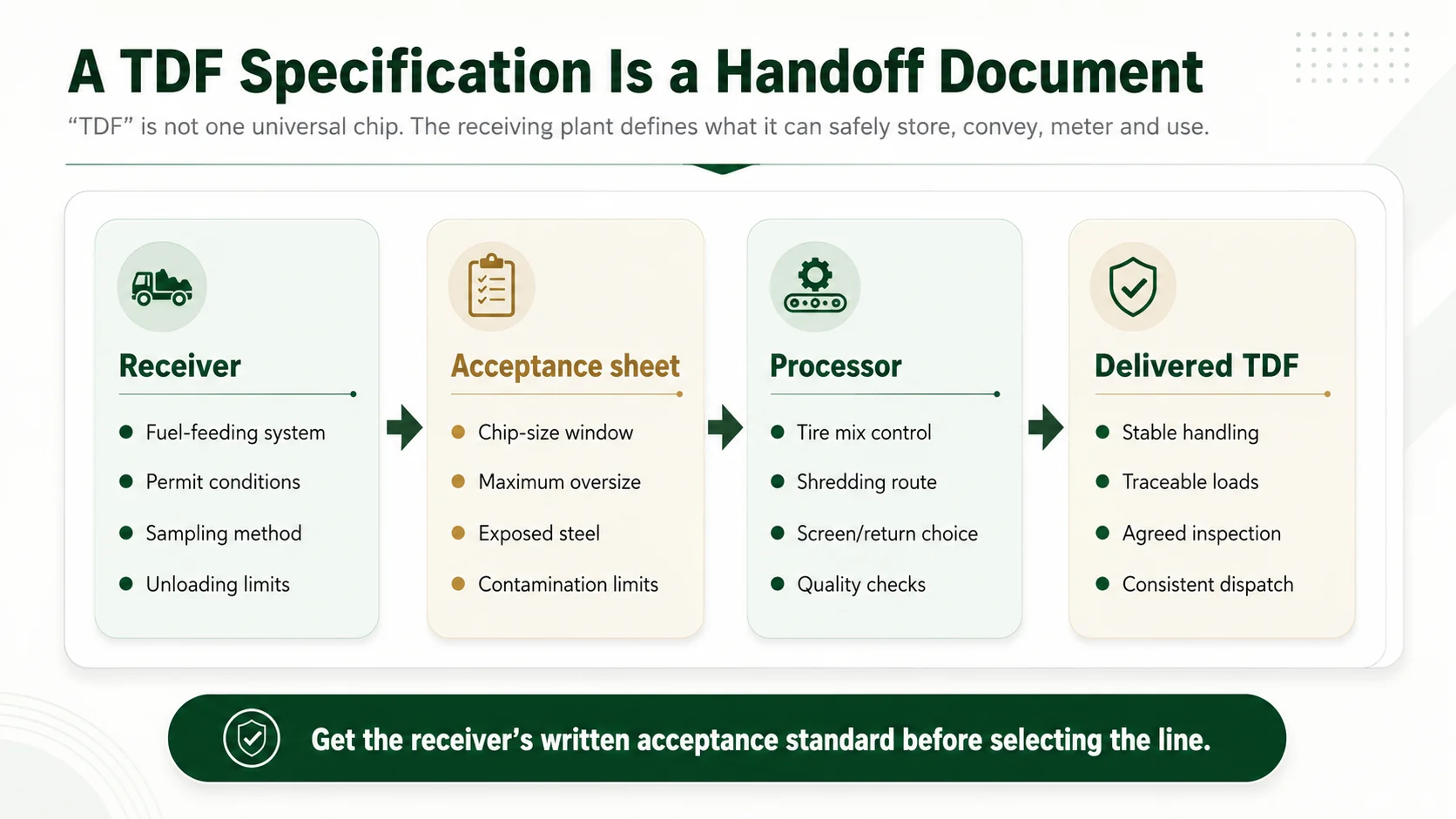
For a tire processor, that becomes a practical handoff document. The fuel user writes what can be received. The processor explains how the plant will control and verify it.
The receiving plant’s written standard should drive the processor’s machine configuration and quality checks.
Specification item
What should be written
Why it changes the project
Accepted form
Whole tire, rough shred, controlled chip or another defined form.
Determines whether shredding and screening are required at all.
Chip-size window
Minimum/target range and the dimensional method used.
Affects cutter setup, screen choice and recirculation.
Maximum oversize
Largest accepted piece and permitted oversize percentage.
Controls return load and finished throughput.
Steel condition
Embedded steel, exposed-wire limit, long-wire rejection and magnetic-separation need.
Changes front-end preparation, wear and separation depth.
Contamination
Limits for rims, stones, soil, water, plastics and non-tire material.
Protects equipment and keeps the delivered fuel within the receiver’s permit and handling rules.
Moisture and storage
Delivery condition, covered storage and wet-load rejection rules.
Influences handling, mass accounting and fuel consistency.
Fuel analysis
Required calorific, ash, sulfur, chlorine or other laboratory values.
Confirms whether the material fits the combustion unit; values should be tested, not copied from a generic web table.
Sampling and records
Sample frequency, lot definition, weighbridge records and non-conformance procedure.
Makes acceptance repeatable and helps resolve disputes.
Delivery method
Loose bulk, trailer/container type, unloading time and maximum piece behavior.
A fuel that meets a lab value can still fail if it bridges or cannot be unloaded safely.
Is there a standard TDF chip size?
No single dimension works for every user. YUXI’s published Tire TDF Plant information identifies approximately 50–80 mm as a common TDF target and 50–150 mm as a flexible rough-shred range. Those numbers are useful starting points for a discussion, not an international acceptance standard. The receiving plant’s written limit takes priority.
Does TDF have to be wire-free?
Again, there is no universal answer. Whole-tire users obviously accept the tire’s steel construction. Chip users may tolerate embedded steel while rejecting long exposed wire that catches on conveyors or feeding equipment. U.S. regulatory classification can also depend on how tires were managed and processed; EPA’s current NHSM FAQ distinguishes tires from established collection programs from some discarded tire-pile material and discusses processing conditions for non-waste fuel status.5 Local legal advice and regulator guidance are still required for the actual project.
Avoid this common shortcut: do not publish one fixed calorific value, moisture limit, ash limit, sulfur limit or coal-substitution rate as though it applies to every tire mix and every facility. Use representative testing and the receiver’s contract values.
Where is tire-derived fuel used?
The familiar applications are cement kilns, pulp and paper mills, utility boilers and industrial boilers. EPA lists these as established users of supplemental tire fuel.1 The technical reason differs from one facility to another, so “TDF use” should not be treated as one identical combustion scenario.
Cement kilns
Used tires can serve as an alternative fuel in the clinker-burning process where the kiln, feeding point, permit and control system are suitable. GCCA notes that used tires are among the wastes used as alternative fuels and that licensing, characterization and technical limits are part of the decision.4
Pulp and paper mills
Some mills use TDF in boilers alongside other solid fuels. The chip must match the mill’s receiving, conveying and combustion system. A paper mill that accepts one rough chip specification does not create a default specification for a cement plant.
Utility and industrial boilers
Suitable boilers may use TDF as supplemental fuel, subject to their design, permits, emission controls and operating practices. The facility remains responsible for deciding whether the material is acceptable. The tire processor’s responsibility is to produce and document the contracted fuel form consistently.
Is TDF always the best recycling route?
No. TDF can be a practical route where there is a permitted industrial user, stable demand and a workable delivered specification. Material recycling may be preferable where clean rubber-chip, crumb or powder markets are stronger. Civil-engineering markets may use TDA. Project owners should compare local outlets before selecting the processing depth.
Where the YUXI Tire TDF Plant fits
YUXI positions its Tire TDF Plant as a mechanical line for passenger, truck, OTR and mining tires. The published route combines bead-wire removal, tire cutting and double-shaft shredding as required by the feed. It lists approximately 50–80 mm as a common TDF target and 50–150 mm as a flexible rough-shred or rubber-chip range.
The useful part of that product information is not the impression that every project needs three identical stages. It is the sequence of decisions behind the line:
Start with the tire streamPassenger, truck, OTR or mining; dimensions, steel construction and contamination.
Select only the required stagesDirect shredding, preparation, screening, return or additional steel control.
Test accepted outputCompare finished-product tonnage and quality under the agreed tire mix.
What to send before discussing a TDF project
A short RFQ can be precise without pretending the engineering is already finished. Send the tire categories and maximum dimensions, several clear feed photos, the expected proportion of truck or OTR tires, the receiver’s written acceptance sheet, required finished output per hour, power supply, available floor area and delivery method.
One detail is especially helpful: state whether the hourly target means incoming whole tires or accepted finished TDF after screening and return. Those are not automatically the same number.
Common misunderstandings
“TDF means 50 mm chips.”
No. A size can be a project target, but TDF remains receiver-specific. Confirm the measurement method and oversize allowance.
“Every line must remove every wire.”
No. Steel tolerance varies. Bead removal reduces concentrated steel but does not automatically create wire-free material.
“A high heating value guarantees savings.”
No. Delivered price, substitution rate, handling modifications, permits and plant operation determine the economic result.
“Any tire shred is TDF.”
No. A random rough shred becomes a marketable fuel only when a qualified receiver accepts its form and quality.
Frequently asked questions
What is tire-derived fuel?
Tire-derived fuel, or TDF, is fuel made from end-of-life tires. It may be supplied as whole tires or processed tire chips, depending on the receiving facility.
How is TDF produced?
A typical mechanical route includes tire inspection, preparation where required, shredding, optional screening and oversize return, steel control where required, final checking and dispatch.
What size is TDF?
There is no universal size. YUXI publishes approximately 50–80 mm as a common TDF target and 50–150 mm as a flexible rough-shred range, but the fuel user’s written specification takes priority.
Does TDF have to be free of steel wire?
Not always. Some users accept embedded steel and set only limits on long exposed wire or loose metal. Other users require more steel reduction. The requirement should be written before the line is selected.
What industries use TDF?
Common users include cement kilns, pulp and paper mills, utility boilers and industrial boilers that are permitted and equipped to receive tire fuel.
Is TDF the same as crumb rubber?
No. TDF is a fuel product. Crumb rubber is a smaller material-recycling product made through additional size reduction, steel separation, fiber separation and screening.
Ask the fuel user for the acceptance sheet first
Define the product before the machine Send YUXI the tire mix, maximum tire dimensions, written chip and steel limits, required accepted output and plant layout. The proposal can then separate the core TDF route from options needed for tighter control.
Marie has 8+ years of experience in tire shredding and recycling equipment,with a focus on tire shredders,rubber recycling machines,TDF production,rubber crumb processing,and complete tire recycling systems.