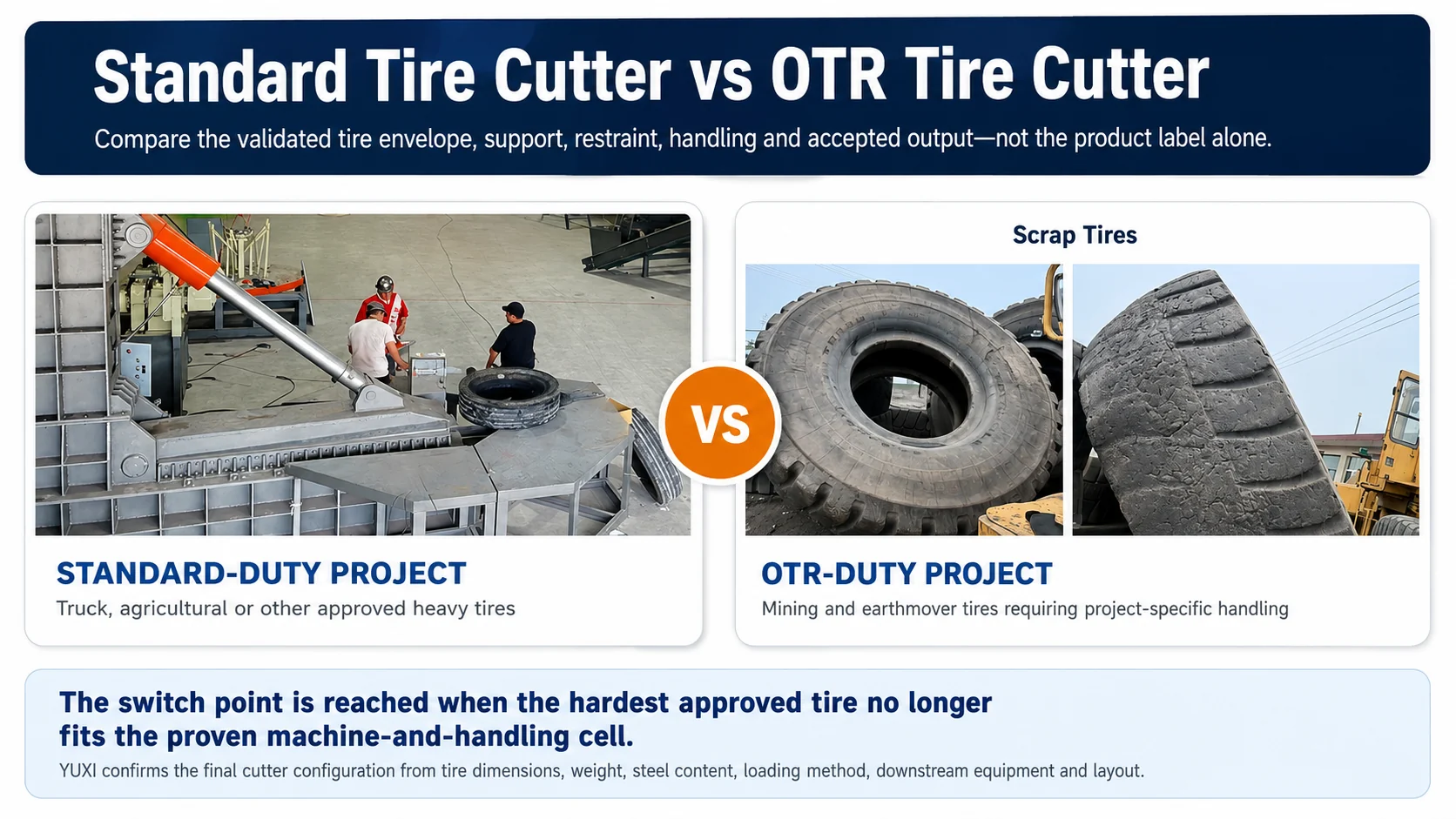
The visible blade stroke may look similar. The engineering boundary is not. Compare the approved tire envelope, support, restraint, handling and accepted output before treating two cutters as interchangeable.
A standard-duty route and an OTR-duty route should be separated by evidence, not by an undefined product name.
Two demonstrations can create the wrong impression. In the first, a hydraulic cutter opens a commercial truck tire in a few controlled cuts. In the second, a much larger tire is positioned under a similar-looking blade. A buyer may conclude that the only difference is scale—or that the larger machine is simply the safer choice for every project.
In practice, neither conclusion is reliable. We have found that the decision changes when the tire stops behaving like a stable workpiece. It may no longer sit fully on the table, the clamp may not control the body after the first cut, the loader may occupy the operator zone, or the finished section may still be too wide for the next machine. At that point the project has moved beyond a standard-duty cutter comparison and into OTR work-cell engineering.
Quick Answer
A standard tire cutter is appropriate when the complete machine-and-handling cell has been proven for the largest intended tire and required cut result. An OTR tire cutter is not defined by one universal diameter or force value. It is an OTR-duty configuration approved for specific mining, earthmover, construction or other off-the-road tires whose dimensions, mass, construction and handling needs exceed the validated standard-duty envelope.
YUXI positions its hydraulic tire cutting machine for truck, all-steel radial, agricultural and OTR/mining tire pre-cutting. The public product information does not publish one universal standard-versus-OTR model boundary. Instead, it states that final configuration depends on tire diameter, width, weight, steel content, downstream equipment, loading method and plant layout.1
Standard tire cutter means a hydraulic whole-tire sectioning machine with a validated application envelope for the project’s normal heavy tires. Depending on the supplier and test evidence, that envelope may include truck, bus, agricultural or selected machinery tires. “Standard” does not mean passenger-tire-only, small or low quality.
OTR tire cutter means a cutter or multi-stage cutting system configured and proven for off-the-road tires used in mining, quarrying, earthmoving, construction, ports and related heavy applications. OTR is an application family, not one fixed workpiece. A loader tire, wide flotation tire and giant haul-truck tire may all require different approaches.
Important terminology: OTR here means off-the-road, not over-the-road trucking. A commercial truck tire is not automatically an OTR tire, although both can contain substantial steel reinforcement.
USTMA explains that steel wire is used in tire belts and beads and in the plies of truck tires. Its truck-tire service material also describes steel belts and steel-cord body plies in common radial truck construction.2 That structure is why visual size alone is not enough. The supplier needs to know where the cutter will pass through the tire and how the remaining carcass will behave after separation.
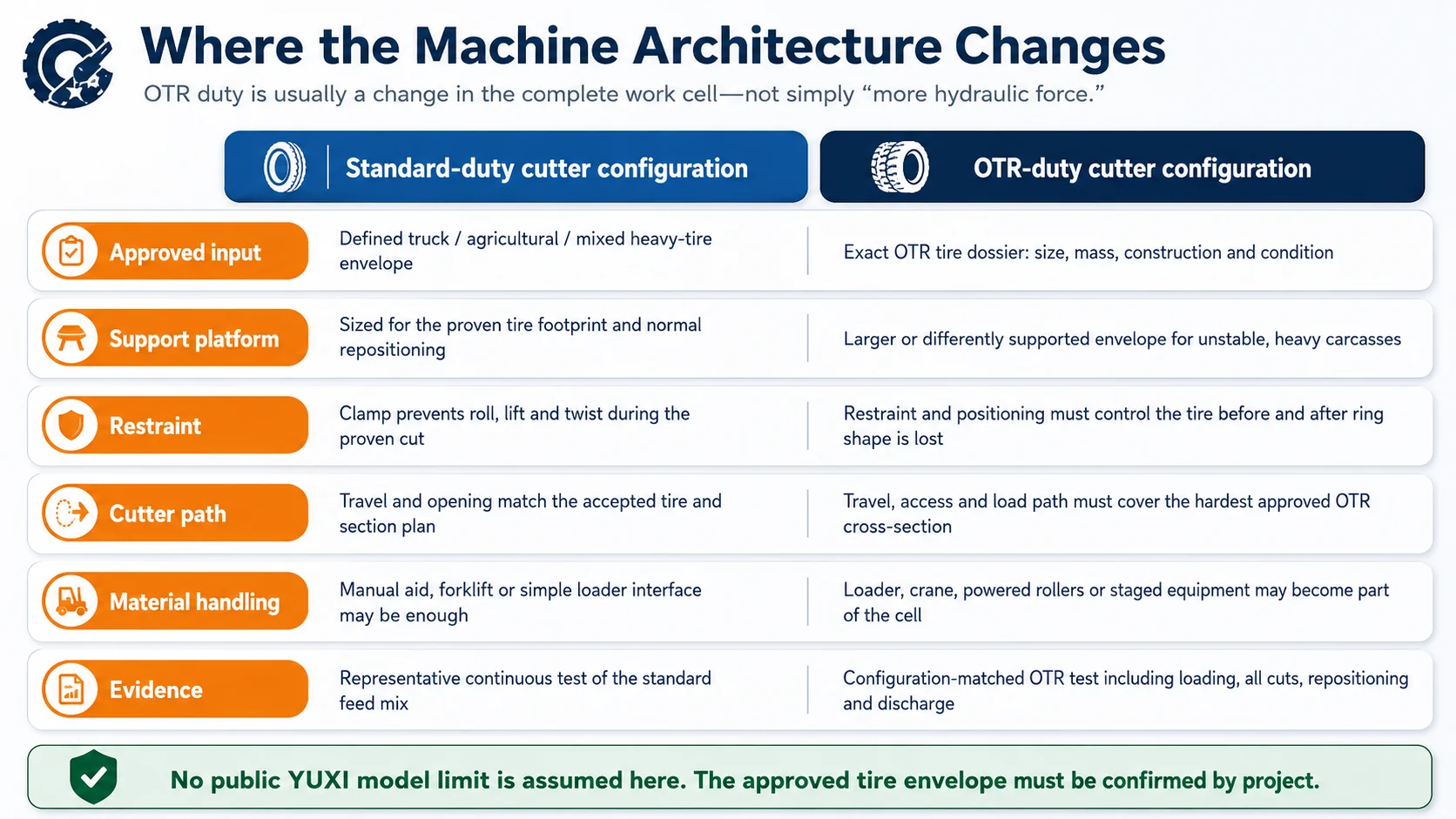
Standard Tire Cutter vs OTR Tire Cutter: Side-by-Side
Decision factor
Validated standard-duty cutter
OTR-duty cutter or cutting system
Approved feed
A defined range of truck, agricultural or other heavy tires proven on the quoted configuration.
Exact OTR tire classes documented by size, approximate mass, construction, condition and preparation state.
Project trigger
The hardest tire remains within the proven support, restraint, cutter travel and handling envelope.
One or more tires exceed that proven envelope or need a different staged cutting route.
Support platform
Supports the tire through the planned cuts and allows repeatable repositioning.
May require a larger platform, powered positioning, different contact geometry or multiple machines.
Restraint
Controls rolling, lifting and twisting for the approved tire body.
Must control a heavier, wider or unstable carcass before and after the ring shape is opened.
Cutter path
Opening, travel and load path match the approved cross-sections.
Must cover the hardest OTR cross-section or a defined pre-treated section without overreach or improvised positioning.
Material handling
May use a forklift, loader or simple aid matched to the normal tire stream.
Handling equipment, approach, clear height, exclusion zone and discharge route commonly become part of the supplied cell.
Cut plan
Usually fewer or more repeatable cuts to create a section accepted by the next machine.
May involve splitting, sidewall removal, “bagel” preparation or multiple staged shearing steps, depending on the tire and output.
Capacity basis
Completed approved tires or accepted sections over a defined full cycle.
Complete OTR cycles including heavy loading, every repositioning step and controlled discharge—not blade strokes alone.
Installation scope
Machine footprint plus practical service and handling clearances.
Often a larger engineered cell with floor loading, lifting access, guarding, hydraulic service and section storage requirements.
Proof required
Representative continuous test of the normal and hardest standard-duty tires.
Configuration-matched test using the actual OTR dossier or a contractually equivalent tire and cut route.
The engineering differences spread across the whole load path and material-handling cell.
The Real Boundary Is the Validated Tire Envelope
A useful tire envelope is more than maximum diameter. It records the dimensions and conditions that determine whether the tire can be loaded, supported, restrained, cut and discharged. We normally ask for at least the following:
measured outer diameter and maximum width;
approximate mass and the method used to estimate or verify it;
tire family, sidewall marking and representative photographs;
radial or bias construction where known, plus all-steel or mixed reinforcement information;
bead condition and whether any sidewall, bead or tread preparation occurs first;
the required cut positions and maximum accepted finished section.
One customer may process a narrow, repeatable stream of commercial truck tires. Another may receive a stockpile with a small number of unusually wide agricultural tires. A third may work at a mine where every casing requires loader handling. The machine decision can change even when the requested hourly tonnage sounds similar.
Practical rule: the standard-duty route remains valid only while the hardest approved tire stays inside every proven boundary—support, restraint, cutter travel, handling, accepted output and sustainable duty. Passing five boundaries and failing one is still a failed application.
Why OTR Usually Changes Handling Before It Changes the Blade
Buyers often start with cutting force because it is easy to compare on a quotation. On an OTR project, the first visible problem is frequently elsewhere. The tire cannot be presented to the cutter in a controlled orientation, or the remaining carcass becomes unstable after the first cut.
Public OTR equipment examples show how much design effort can go into positioning. Eagle International’s Titan II uses hydraulically powered bed rollers, extension rollers and a hydraulic probe arm to move and hold large tires. Gradeall describes a three-machine OTR sequence—splitter, sidewall cutter and shear—for its stated tire range.34 These are supplier-specific architectures, not universal prescriptions, but they demonstrate the same point: OTR processing may require dedicated handling and staged preparation rather than a larger number on one hydraulic datasheet.
Before the first cut
The tire needs a defined approach and landing method. A loader bucket, crane hook, forklift attachment or manipulator changes the machine orientation, floor markings, guard openings and operator position. A machine can fit the building while the lifting equipment cannot align the tire safely.
After the first cut
A whole tire is a ring. An opened tire may lean, spread, spring or expose wire. The remaining mass can be more awkward than the original tire because it has lost its stable geometry. This is where improvised chains and manual pushing tend to appear unless the process has been designed in advance.
At discharge
The section needs somewhere to land without blocking the next cut. It also needs a route to the shredder, container, stockpile or pyrolysis loading area. Exposed wire can snag on a bin edge or conveyor. The “cutter capacity” may therefore be limited by section removal rather than by the hydraulic stroke.
NIOSH manual-material-handling guidance recommends mechanical devices for heavy or unstable loads and emphasizes reducing movement distance and physical demands through engineering controls.5 An opened OTR section is exactly the type of bulky, unstable load that should not be represented by a generic one-operator claim.
Machine Architecture: What Can Change for OTR Duty?
The detailed support–clamp–shear–retract sequence is already covered in the tire cutting machine working-principle guide. For this comparison, the useful question is how the architecture must change when the tire envelope changes.
Support and frame load path
The platform must carry the tire where it is actually supported, not where a clean catalog illustration suggests it will sit. A wider or partly collapsed OTR tire can place load outside the expected contact area. Frame stiffness and joint design must maintain cutter alignment under the approved load path.
Clamp geometry
A stronger clamp is not automatically a better clamp. Its contact position, travel and direction must prevent rolling, lifting and twisting without crushing the wrong area or forcing the operator to reach into the danger zone. The clamp should be demonstrated on the widest and most irregular approved tire.
Cutter opening, travel and access
The cutter needs enough opening and travel for the planned cross-section. It also needs a clear path that does not require the tire to be balanced on an edge. Service access matters because the cutting edge is a wear item; safe removal can become more difficult as parts become larger.
Hydraulic system and duty
Hydraulic pressure by itself does not describe usable cutting capability. Cylinder geometry, stroke, pump flow, motor, valve control, reservoir, cooling, hose routing, frame stiffness and cutter condition work together. OTR duty may also create longer cycles and more heat because repositioning and repeated cuts extend the operating period.
Controls, guarding and isolation
For U.S. workplaces, OSHA 29 CFR 1910.212 requires guarding for points of operation that expose employees to injury and lists shears among machines that usually require point-of-operation guarding. OSHA 29 CFR 1910.147 covers servicing where unexpected energization, start-up or release of stored energy could injure employees.67 Destination-specific requirements must be reviewed separately, but guarding and energy isolation should be part of the comparison—not an option added after machine selection.
The Cut Result Must Fit the Next Process
A standard cutter can complete a clean cut and still be the wrong machine if the section is too large, too heavy or too curved for the next step. The correct output definition is a maximum accepted section envelope, not “two pieces,” “four pieces” or “manageable size.”
For a tire shredder, confirm the feed opening, preferred orientation, gripping behavior and tolerance for exposed wire. For selected pyrolysis systems, the relevant boundaries may be the loading door, basket or batch-handling method. For transport, the priority may be stackability and safe lifting rather than shredder engagement.
Accepted-output statement: “The approved tire shall be converted into fully separated sections no larger than the agreed length × width × height, suitable for loading into the named downstream equipment by the stated handling method. The allowed exposed-wire condition shall be defined by photographs or a written acceptance criterion.”
The article on whether to remove tire beads before cutting owns the bead-first versus cut-first sequence. In this comparison, bead preparation matters only because it can change the cross-section presented to the cutter and therefore change which machine envelope remains valid.
When a Standard-Duty Tire Cutter Is Usually Enough
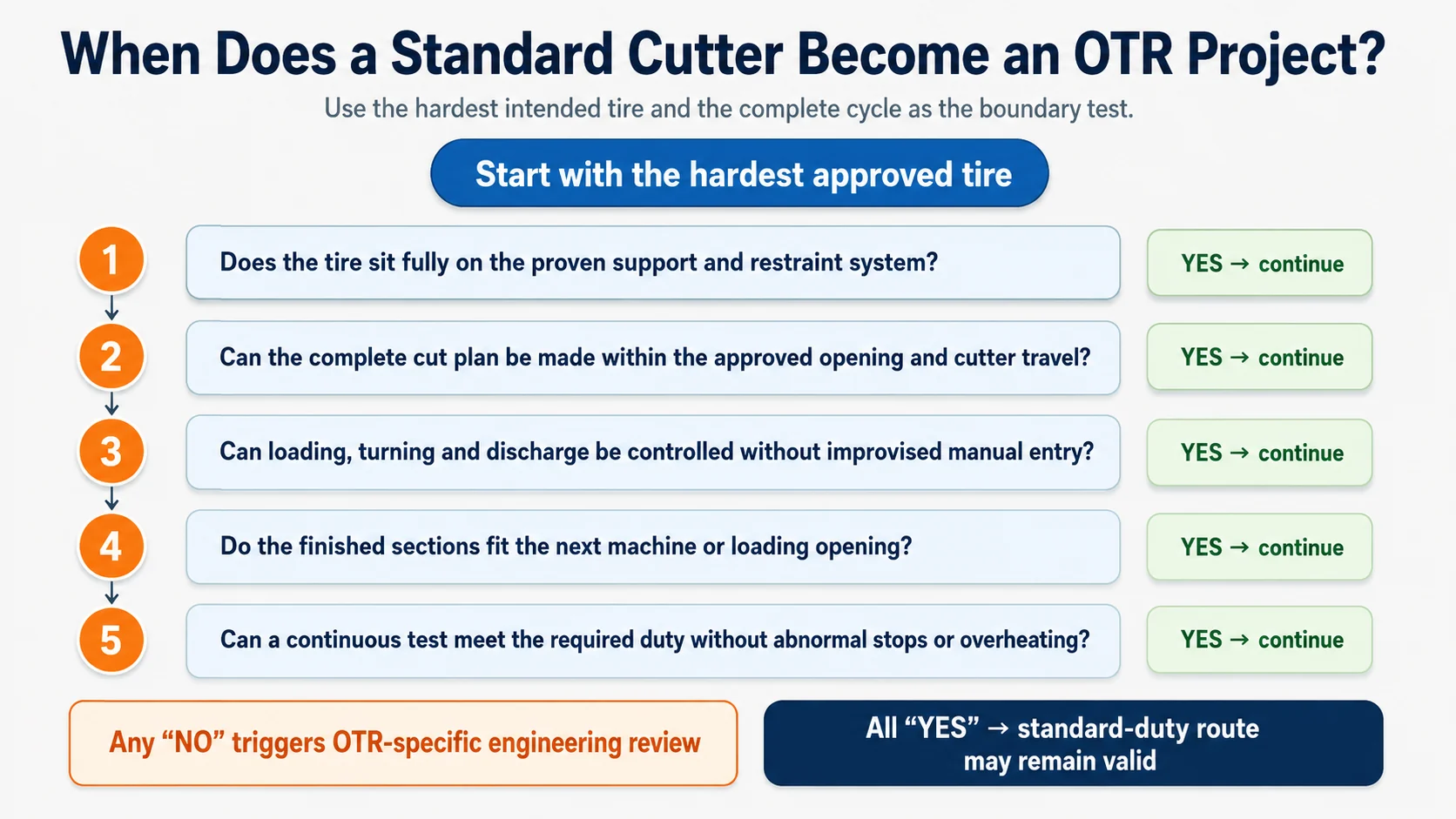
The largest and widest intended tire sits fully on the proven support and can be clamped without improvisation.
The cutter opening, travel and cut plan have been demonstrated on the hardest approved tire.
The planned forklift, loader or handling aid can approach, position and remove sections without entering the hazard zone.
The finished sections fit the next machine and do not require repeated unplanned trimming.
A continuous test shows stable full-cycle output with the agreed operator count and no abnormal second passes.
The standard configuration leaves practical margin for normal tire variation, wear and maintenance access.
Surprisingly, “standard” can be the more robust decision for a plant dominated by repeatable truck or agricultural tires. It can reduce floor space, handling complexity, capital scope and idle time compared with a giant-tire cell that is rarely used. Oversizing the machine is not automatically a productivity improvement.
When the Project Needs OTR-Specific Review
Any failed boundary should trigger engineering review rather than an operator workaround.
The following observations are stronger upgrade signals than the OTR label alone:
part of the tire hangs outside the validated support or prevents stable restraint;
the required cut crosses a section that the quoted opening, travel or frame has not been tested to handle;
the tire must be lifted, balanced or manually held in an improvised orientation;
after the first cut, the carcass cannot be repositioned without a new handling method;
the accepted downstream section requires extra cuts that push the standard machine outside its stable duty cycle;
repeated second passes, stalled cuts, excessive deformation or abnormal oil-temperature rise appear during representative testing;
the material stream contains giant tires whose low frequency still creates long stoppages or unsafe exceptions.
An OTR review does not always lead to one larger shear. It may lead to staged dismantling, a dedicated sidewall step, pre-splitting, a different loading system or separate processing days. The best architecture is the one that removes the actual bottleneck.
Three Strategies for a Mixed Standard-and-OTR Tire Stream
1. One cutter, one validated broad envelope
This can work when the largest tire is still manageable and the supplier proves the complete range on the same machine configuration. The advantage is a simple flow. The risk is that the machine and handling cell are sized around rare tires, while common tires inherit longer cycles or a less efficient operator layout.
2. Standard-duty route plus an OTR exception cell
Common truck and agricultural tires stay on the faster, proven standard route. Large OTR tires move to a separate cell or processing schedule. This is often easier to manage when OTR tires are a small share but have disproportionate handling and cycle requirements.
3. Outsourced or staged OTR preparation
A plant may receive OTR tires already split, sidewall-removed or otherwise reduced before the standard cutter or shredder sees them. The machine must then be approved for the prepared section, not for the original whole tire. This route can reduce on-site capital but adds supplier dependence, transport interfaces and incoming-quality controls.
For capacity planning, do not compare cuts per hour with completed tires per hour. The dedicated tire cutter capacity guide explains how count, mass and full-cycle timing should be normalized. Here the main point is that even a small OTR count share can dominate scheduled hours.
Compare Both Machines With the Same Proof Test
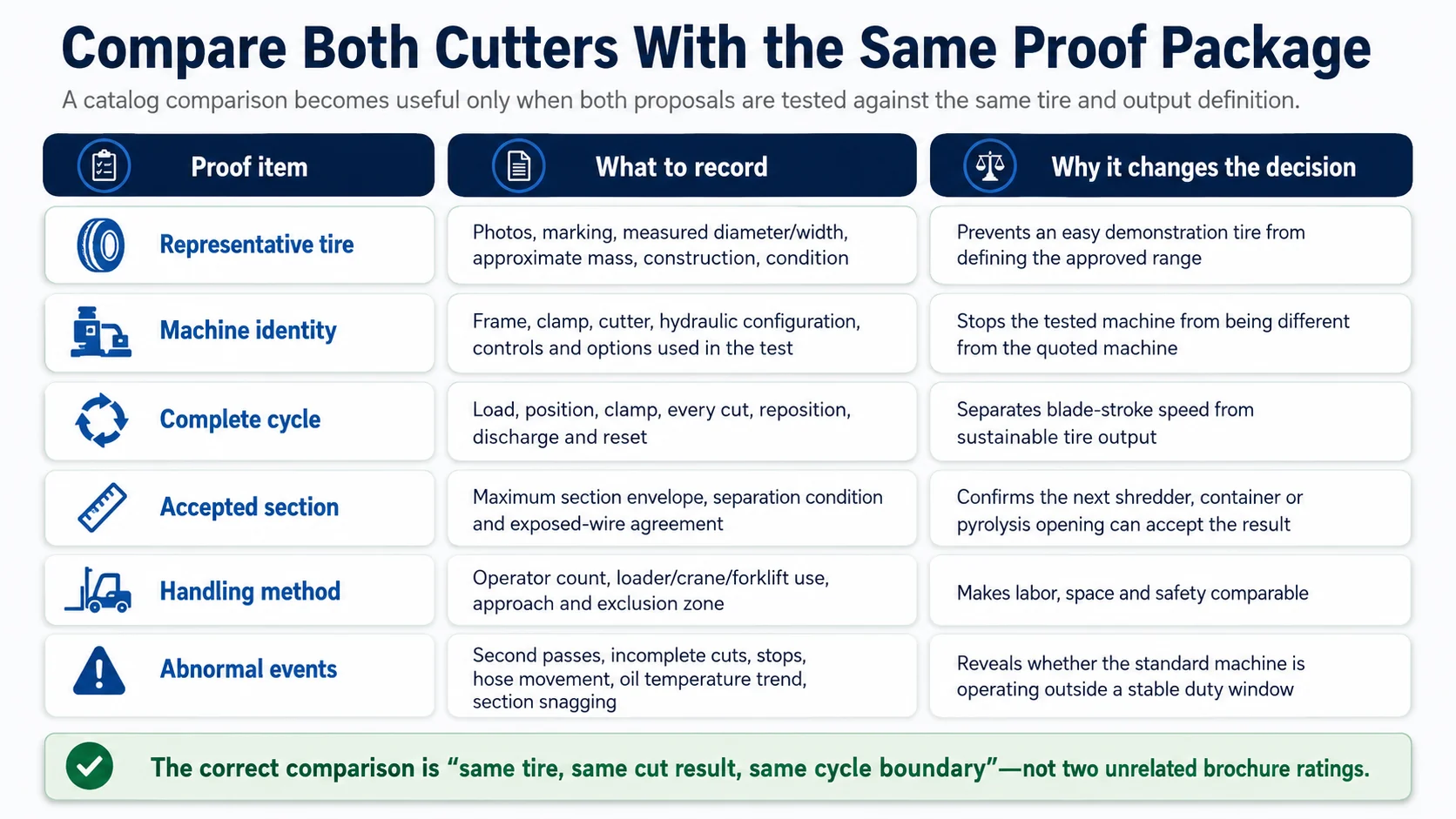
A standard cutter and an OTR cutter cannot be compared fairly when one is tested on a clean truck tire and the other on a giant worn casing. Use one proof package and require each supplier to state whether the proposed machine passes, needs a changed cut plan or excludes the tire.
The same tire, cut result and cycle boundary make two proposals comparable.
Define the test before the order
Tire set: hardest approved tire plus a representative normal mix.
Machine identity: frame, clamp, cutter, hydraulics, controls and options must match the quoted scope.
Cycle start: agreed point when the next tire begins loading.
Cycle stop: all accepted sections discharged and station reset.
Output acceptance: measured section envelope and defined exposed-wire condition.
Handling: operator count, loader/crane/forklift, approach direction and section-removal method.
Exceptions: how second passes, pauses, abnormal noise, incomplete separation or manual intervention are recorded.
We normally recommend retaining an uncut reference tire, measurements, time-stamped continuous video and the accepted output sections or clear measurement photographs. A short close-up of the cutter entering rubber is useful for marketing. It is weak acceptance evidence.
How YUXI Should Confirm the Final Choice
YUXI’s public product page supports a project-based decision. It identifies hydraulic clamping and cutting, an alloy steel cutter, factory testing and custom layout support. It also explains that truck tires and OTR tires can require different table size, clamping structure and cutting force.1
That means the correct YUXI inquiry should not be “send the standard model” or “send the OTR model” without material data. A useful sequence is:
review photographs and markings for the largest and typical tires;
record measured diameter, width and approximate mass;
define whether the tire is whole, debeaded, sidewall-cut or otherwise prepared;
identify the next machine and maximum accepted section;
confirm loader, crane, forklift or other handling method;
review power supply, workshop dimensions, floor and service access;
agree on a representative factory test and evidence package.
The result may be a standard-duty configuration, an OTR-specific cutter, staged equipment or a recommendation to feed a proven whole-tire shredder directly. The article on whether tires need cutting before shredding owns that upstream process decision.
Common Comparison Mistakes
Creating a universal diameter cutoff
A diameter threshold looks simple, but it ignores width, mass, construction, tire condition, cut position and handling. Use the supplier’s approved envelope for the quoted configuration.
Comparing only hydraulic force
A high force claim cannot correct poor tire support, unsuitable clamp geometry, insufficient travel or an unstable section-removal method.
Assuming the largest cutter is safest
A larger cell can introduce longer reach distances, more suspended handling, larger sections and different guarding challenges. Safety comes from the complete task design.
Ignoring rare OTR tires
A tire that appears once per week can still cause the longest stoppage, require the most loader time and create the highest-risk workaround. Record exception tires separately.
Using different test tires for each supplier
The comparison then measures tire difficulty as much as machine capability. Use a common dossier and output criterion.
Letting a product label replace the contract boundary
“OTR capable” should be converted into named tire classes, dimensions, preparation state, cut result and an acceptance test.
RFQ Snapshot: Standard or OTR Cutter?
RFQ field
Information to provide
Typical and maximum tires
Photos, markings, measured diameter/width, approximate mass, construction and condition.
Mix and schedule
Count or mass share by tire family, working hours, batch or continuous operation.
Preparation state
Whole, bead-treated, sidewall-cut, split or other pre-processing.
Required output
Maximum accepted section dimensions, exposed-wire condition and next equipment.
Handling
Available loader, crane, forklift, manipulator, conveyor and preferred approach direction.
Site conditions
Workshop plan, clear height, floor information, local voltage/frequency and service access.
Share the largest and typical tire photographs, dimensions, approximate mass, preparation state, required section, handling method and workshop plan. YUXI can then determine whether a standard-duty cutter, OTR-specific configuration or staged route is the better fit.
What is the main difference between a standard tire cutter and an OTR tire cutter?
The main difference is the approved application envelope and complete work cell. An OTR-duty configuration may require different support, restraint, cutter travel, frame load path, loading equipment, repositioning method and proof test for large mining or earthmover tires.
Can a standard tire cutter process small OTR tires?
Possibly, but the OTR label is not enough. The supplier must approve and test the exact tire dimensions, approximate mass, construction, condition, cut plan, loading method and accepted section. A standard machine should not be assumed suitable because one OTR tire appears visually small.
Is an OTR cutter simply a standard cutter with more hydraulic force?
No. Hydraulic force is only one part of the design. Tire support, restraint, cutter opening and travel, frame stiffness, access, material handling, controls and safe maintenance all change the usable application.
When should a mixed-tire plant use separate cutter routes?
Separate routes become useful when common truck or agricultural tires run efficiently on one proven setup but a smaller share of large OTR tires requires different handling, staged preparation, longer cycles or a purpose-built cell that would otherwise slow the whole line.
How should both machines be compared in a factory test?
Use the same representative tire dossier, accepted cut result, complete cycle boundary, handling method and evidence sheet. Record loading, positioning, every cut, repositioning, discharge, reset, abnormal events and the identity of the tested machine configuration.
What information should be sent to YUXI before quotation?
Send photos and markings for the largest and typical tires, measured diameter and width, approximate mass, tire mix, preparation state, desired section size, downstream equipment, required schedule, loading method, local power supply and workshop layout.
References and Source Notes
U.S. Tire Manufacturers Association, Tires 101, How a Tire Is Made, and truck-tire service publications. Used for steel belts, bead wire and truck-tire construction context.
Eagle International, Titan II. Used only as a public manufacturer example of an OTR cutter employing powered rollers and a hydraulic probe for tire positioning; its specifications are not presented as a YUXI benchmark.
Gradeall International, OTR Tyre Cutting Equipment Range. Used only as a public manufacturer example of a staged splitter–sidewall-cutter–shear architecture.
Marie has 8+ years of experience in tire shredding and recycling equipment,with a focus on tire shredders,rubber recycling machines,TDF production,rubber crumb processing,and complete tire recycling systems.