A useful capacity figure must identify the tire, the number of cuts, the full-cycle boundary and the weight unit. Without those four details, pieces per hour and tons per hour can describe entirely different workloads.
Capacity becomes comparable only after the tire mass and complete operating cycle are defined.
During a factory test, a buyer may hear “60 pieces per hour” and immediately ask for the equivalent tons per hour. The conversion looks easy. Multiply by tire weight. In practice, the difficult part is not the arithmetic. It is deciding what the supplier counted as one piece, whether the timing covered a complete tire, and which tire weight represents the project.
We have seen capacity discussions become confused because one quotation counts hydraulic strokes, another counts completed tires, and a third reports the throughput of the downstream shredder. Each number can be internally correct. They are still not directly comparable.
Quick Answer
Use pieces per hour when the machine processes countable tires or produces a fixed number of accepted sections. Use tons per hour only after those completed pieces are connected to a measured average tire mass.
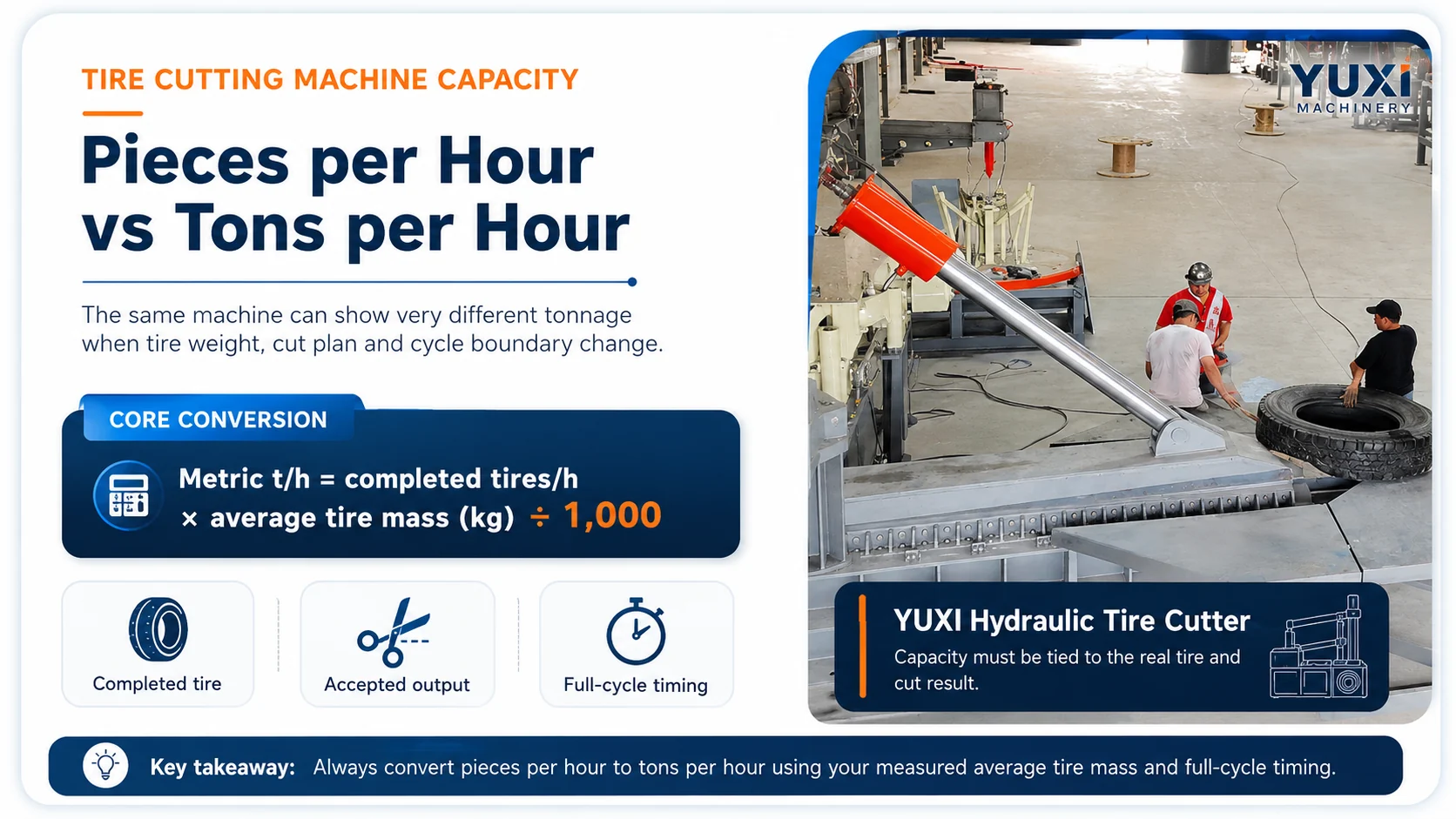
Metric t/h = completed tires/h × average tire mass in kg ÷ 1,000
US short tons/h = completed tires/h × average tire mass in lb ÷ 2,000
For the YUXI tire cutting machine, the public product page does not publish one universal capacity. It states that final configuration depends on tire diameter, width, weight, steel content, downstream process, loading method and plant layout. That is the correct boundary for a machine intended for truck, agricultural and OTR tires: capacity should be confirmed from the actual tire dossier and cut plan, not copied from a different tire class.1
“Pieces per hour” sounds precise, but the word piece can refer to three different things. A capacity sheet should replace it with a named output.
Published unit
What it may mean
Usefulness
Required clarification
Completed tires/hour
Whole tires fully processed to the agreed cut plan.
Best count-based unit for a batch tire cutter.
Approved tire class, cuts per tire, loading and discharge boundary.
Accepted sections/hour
Discharged pieces meeting the maximum section envelope.
Useful when every tire has a repeatable number of sections.
Sections per tire and reject/rework rule.
Cuts/hour or strokes/hour
Hydraulic cutting actions.
Useful for diagnosing machine rhythm.
Average strokes per completed tire and handling time.
kg/h or metric t/h
Mass processed per hour.
Useful for line balance and production planning.
Average measured tire mass and whether output is gross input or accepted discharge.
US short tons/hour
Mass based on 2,000 lb per short ton.
Useful for U.S. plant reporting.
The quote must say “short ton,” not simply “ton.”
Recommended wording: “Completed approved tires per operating hour” is clearer than “pieces per hour.” “Accepted tire-section mass per operating hour” is clearer than a bare tons-per-hour claim.
How to Convert Pieces per Hour to Tons per Hour
The arithmetic is straightforward once the input data is clean.
Metric t/h = P × Mkg ÷ 1,000
US short tons/h = P × Mlb ÷ 2,000
Here, P is completed tires per hour and M is the measured average mass of the tires represented by that capacity test. Do not use the catalog shipping weight of a new tire, the machine’s maximum tire capacity, or the mass of only one convenient sample.
For a fixed cut plan, accepted sections/hour can also be converted:
Completed tires/h = accepted sections/h ÷ accepted sections per tire
That second formula is valid only when the section count is consistent. If some tires need four sections and others need six, the calculation must use the real mix.
Why the Same Pieces per Hour Can Produce Very Different Tonnage
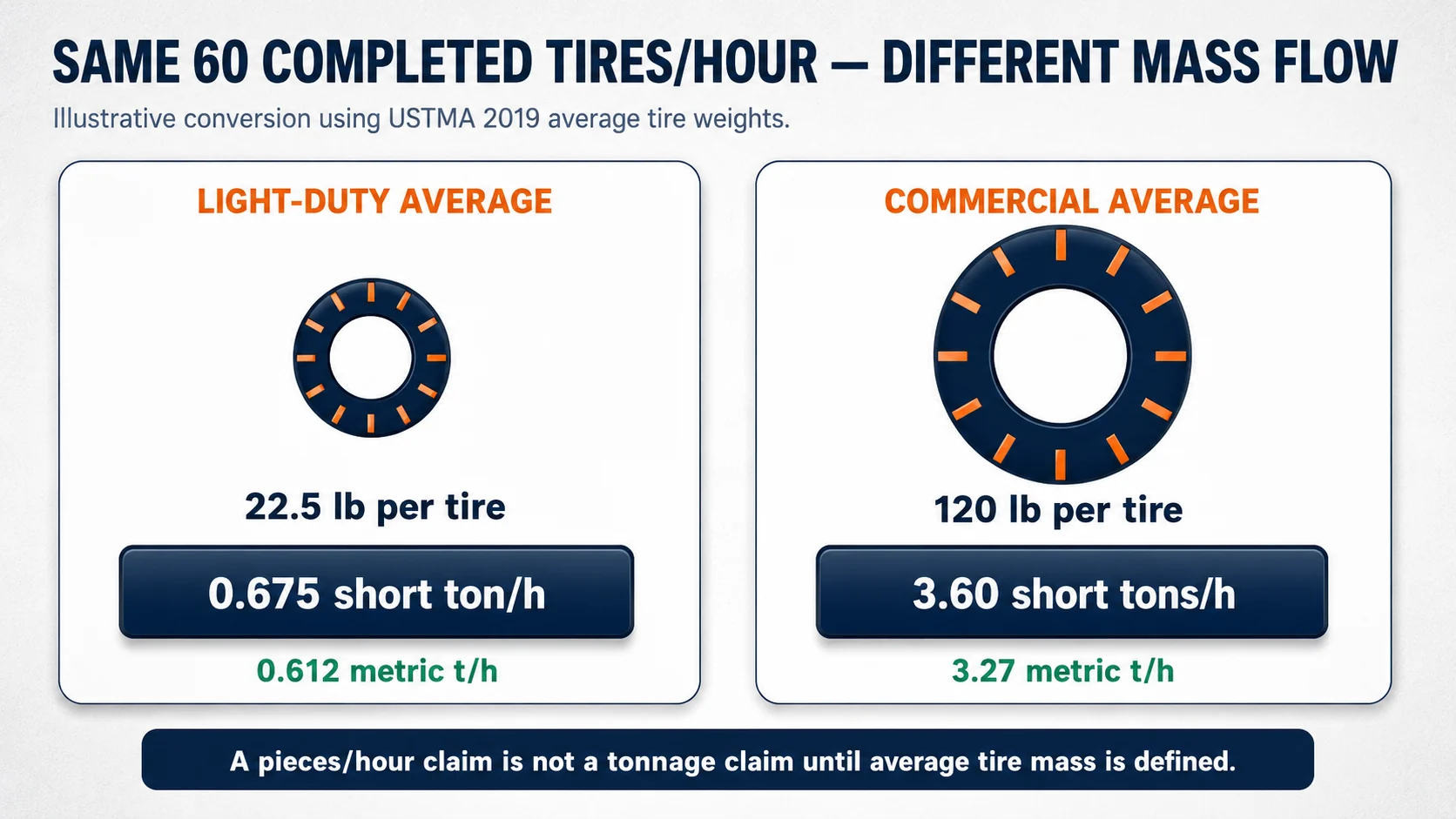
The U.S. Tire Manufacturers Association’s 2019 scrap-tire summary used average weights of 22.5 lb for light-duty tires and 120 lb for commercial tires.2 These are market-level averages, not YUXI machine test values, but they make the conversion problem visible.
Illustrative count rate
Average tire mass
US short tons/hour
Metric tonnes/hour
60 completed tires/h
22.5 lb (10.21 kg)
0.675 short ton/h
0.612 t/h
60 completed tires/h
120 lb (54.43 kg)
3.60 short tons/h
3.27 t/h
The same completed-tire count can differ by more than five times in mass flow because the average tire weight changes.
OTR and agricultural tires widen the spread further. There is no responsible universal “average OTR tire weight” for capacity conversion. Rim size, tread pattern, casing construction, remaining tread and damage condition all matter. For those projects, weigh representative tires or use traceable manufacturer data for the exact size, then confirm the scrap condition.
The U.S. EPA’s passenger-tire-equivalent method also illustrates why count conversions must be explicit: it treats one average passenger tire as 20 lb and gives an 80 lb truck tire as four passenger-tire equivalents.3 PTE is useful for inventory and regulatory comparisons, but a production test should still use the actual project tire mass.
Cuts per Hour Are Not Completed Tires per Hour
A hydraulic stroke is the most visible action in a tire-cutting video. It is not the finished product. A tire may need several strokes, and each stroke can require repositioning, clamping and checking.
Theoretical completed tires/h = cuts/h ÷ average cuts per completed tire
Suppose a supplier reports 120 cuts/hour. At two cuts per tire, the theoretical result is 60 tires/hour. At five cuts per tire, it is 24 tires/hour. That still excludes loading, difficult repositioning, section removal, blade checks and normal interruption.
This is why the detailed cutting motion belongs in the existing working-principle article, while the capacity page uses only the operational consequence: every additional cut adds more than blade travel. It adds handling around the stroke.
Do not divide a one-stroke cycle time directly into 3,600 seconds and call the result tires per hour. That calculation produces strokes per hour unless one stroke completes the entire agreed tire.
Define the Complete Capacity Cycle
For a buyer-facing capacity test, we normally recommend a simple boundary:
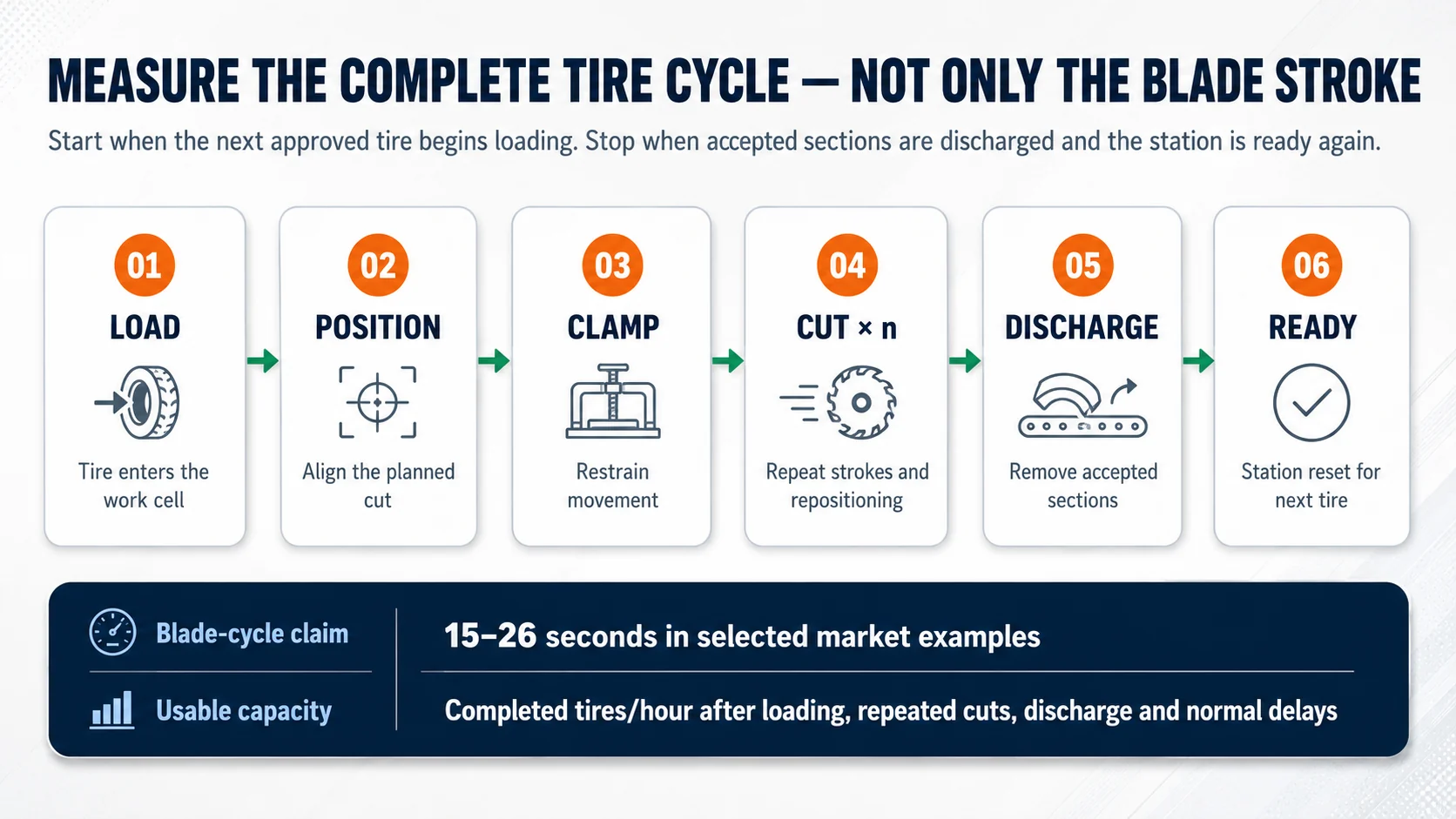
Start: the next approved tire begins loading into the work cell.Stop: all accepted sections are discharged to the agreed point and the station is ready to receive the next tire.
That boundary includes the work that the machine needs in real production: loading, positioning, clamping, the required number of cuts, cutter retraction, tire rotation or movement, discharge and reset. It also forces the supplier to identify the operator count and handling equipment.
A blade-cycle number can help diagnose the hydraulic action, but the complete tire cycle is the basis for production capacity.
Selected market examples publish average cycle times of 15 or 26 seconds for particular tire shears and approved tire limits.7 Those figures are useful only inside the stated machine and tire context. A YUXI project handling a large steel-reinforced tire with several sectioning cuts should not inherit a cycle time from a smaller shear.
What Changes Sustainable Tire Cutting Machine Output?
A catalog figure is usually a test result or a target under defined conditions. Sustainable production changes when the real project moves away from those conditions.
Tire geometry and construction
Diameter, width, tread thickness, steel reinforcement, bead condition and deformation affect positioning and cutting resistance. Two tires with similar weight can still behave differently.
Required section envelope
A coarse two-piece split is faster than a cut plan that must create several feedable sections. The downstream hopper often determines the number of cuts.
Loading and repositioning method
Forklift, loader, crane, powered rollers, support table and manual assistance change the time outside the hydraulic stroke. For large tires, handling can become the true bottleneck.
Operator task split
One operator may control the cutter while another handles sections or mobile equipment. Capacity claims must state the crew rather than hiding labor inside the number.
Blade and hydraulic condition
Edge wear, incomplete separation, oil temperature, leaks and slower movement increase cycle time. A short cold test may not represent an extended shift.
Discharge and buffer space
Even a fast cut can be followed by a long wait if sections block the table, the loader is occupied or the downstream machine cannot receive material.
The OTR tire cutting machine buying guide covers the heavy-tire handling cell in more detail. For general cutter selection, keep capacity as one evidence-backed specification among several rather than choosing the highest number in isolation.
How to Calculate Capacity for a Mixed Tire Stream
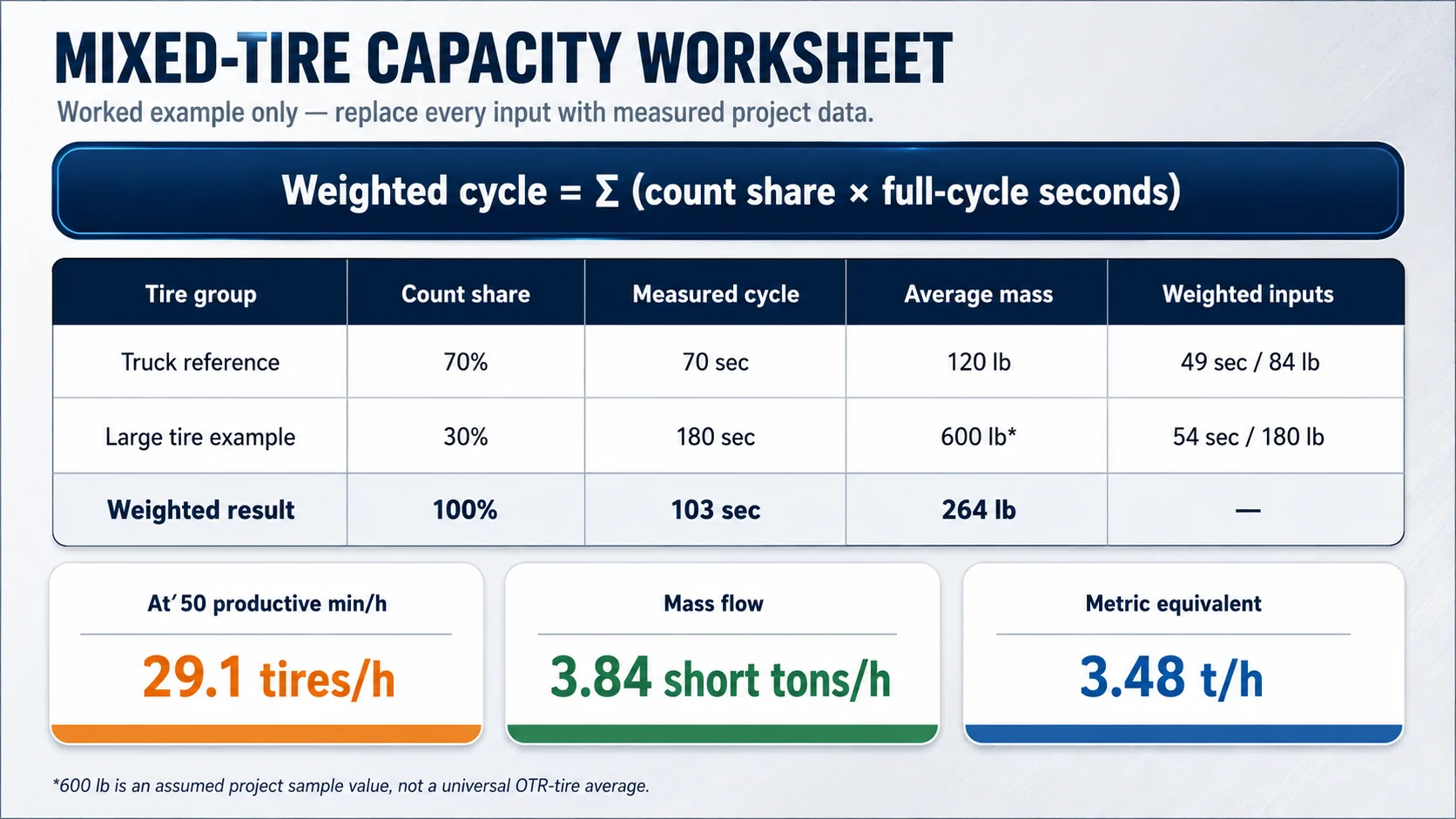
Mixed tires should not be represented by the fastest or most common tire alone. Measure a complete cycle for each meaningful group, then weight the cycle by the expected count share.
Mass flow = sustainable tires/h × weighted average tire mass
Use count share for the cycle calculation because the machine completes individual tires. Use the same count shares to calculate weighted average mass. If the plant forecast is available only in tons, convert it into an estimated tire count by category before applying the cycle model.
Worked example
Assume a project has 70% commercial truck tires measured at 70 seconds per complete cycle and 30% large tires measured at 180 seconds. Use 120 lb for the truck reference and an assumed project-sample average of 600 lb for the large tires. The latter is not a universal OTR average.
Mass flow = 29.1 × 264 ÷ 2,000 = 3.84 US short tons/hour, or about 3.48 metric t/h.
A mixed-tire result is a model built from measured categories. It is not a universal machine rating.
Surprisingly, a heavier mix can show a higher tonnage even while completed tires/hour falls. That is not automatically better. The plant must still accept the section size, crew requirement and operating rhythm.
Match Cutter Capacity With the Downstream Machine
A tire cutter produces batches of large sections. A shredder usually consumes a more continuous stream. Their capacity numbers therefore need a common mass and time basis.
The cutter-vs-shredder comparison explains the different process roles. For line balance, convert the cutter’s accepted output into mass per operating hour, then compare it with the YUXI tire shredder under the same tire preparation, output size and uptime assumptions.
Line-balance check: cutter accepted t/h × cutter operating factor should be close to or slightly above the shredder’s required prepared-feed rate, with a safe buffer for batch surges. A much faster cutter needs storage and handling. A slower cutter becomes the front-end bottleneck.
Also confirm whether cutting is required at all. The dedicated article on whether tires need pre-cutting before shredding owns that route decision. This capacity guide assumes the project has already justified the cutter.
How to Verify Capacity During a Factory Acceptance Test
A useful FAT produces raw data that can be recalculated in either pieces/hour or tons/hour. It should not be limited to one edited video or one easy tire.
Test field
What to record
Why it matters
Representative tires
Photos, sidewall markings, diameter, width, individual weight, construction and condition.
Connects the result to the approved project feed.
Cut plan
Required cuts, final section count and maximum accepted envelope.
Prevents a faster but unusable result.
Cycle boundary
Exact start and stop points.
Separates strokes/hour from completed tires/hour.
Resources
Operator count, loader/forklift/crane, support tools and controls used.
Shows the labor and handling hidden inside the result.
Continuous log
Start time, finish time, every completed tire, intervention, idle event and rejected section.
Preserves the real operating rhythm.
Condition data
Blade condition, hydraulic leaks, abnormal movement and available oil-temperature indication.
Helps distinguish a stable test from a short cold run.
Capacity report
Completed tires/h, accepted sections/h, cuts/h, input mass and accepted mass.
Allows all units to be reconciled from one test.
For U.S. workplaces, OSHA 29 CFR 1910.212 requires guarding against point-of-operation and other machine hazards, and specifically identifies guillotine cutters and shears among machines that usually need point-of-operation guarding.4 Servicing or clearing work must also address hazardous energy; OSHA 29 CFR 1910.147 covers unexpected energization, start-up and release of stored energy during servicing and maintenance.5 Capacity testing must not bypass the guarding or isolation method used in real operation.
Capacity Fields to Put in the RFQ
The RFQ should make every supplier calculate the same requirement. A useful capacity section can be written in one page.
Approved tire dossier: tire families, size markings, maximum diameter and width, individual weights, construction and expected mix.
Accepted output: maximum section dimensions, section count or cut drawing, complete-separation rule and discharge point.
Named units: completed tires/hour, accepted sections/hour, cuts/hour, metric t/h and/or US short tons/hour.
Cycle boundary: loading start through accepted discharge and ready-for-next-tire condition.
Operating resources: operators, forklift/loader/crane, powered handling, table and buffer.
Proof method: representative continuous test, raw timing log, tire weights and retained video.
The tire cutting machine price guide covers the commercial scope that should accompany these technical fields. A low machine price and a high capacity claim are both incomplete when loading, safety, cooling, testing and discharge responsibilities are excluded.
How YUXI Should Confirm the Final Capacity Figure
YUXI’s public page asks buyers to provide tire type, maximum tire size, approximate capacity, downstream process and workshop layout.1 For a defensible pieces-per-hour and tons-per-hour result, add three items: representative individual tire weights, the intended cut plan and the complete-cycle test boundary.
A practical inquiry package includes photos of the largest and most common tires, sidewall markings, a weight sample for each category, the next machine’s feed opening, target tires per shift, available loading equipment and local working hours. With that information, the supplier can state a project-specific count rate and convert it to mass flow without guessing.
Request a Capacity Test Around Your Tire Mix
Send the real tire range, weight sample, required section size, downstream machine and target shift output. Ask for one report showing completed tires/hour, accepted sections/hour and mass flow from the same test log.
Neither unit is universally better. Completed tires/hour is usually clearer for a batch tire cutter. Tons/hour is better for line balance, but only after average tire mass and the time boundary are defined. A strong specification reports both from the same raw test.
How many tons per hour is 60 tires per hour?
It depends on average tire weight and the ton definition. At 22.5 lb per tire, 60 tires/hour equals 0.675 US short ton/hour,while at 120 lb per tire, it equals 3.60 US short tons/hour. For metric tonnes, multiply the rate by average kilograms and divide by 1,000.
Are cuts per hour the same as tires per hour?
No. Divide cuts/hour by the average required cuts per completed tire to obtain a theoretical tire count, then account for loading, repositioning, discharge and normal delays. A multi-cut tire can reduce completed tires/hour substantially.
Should capacity use input weight or output weight?
State both where practical. Input mass is useful for receiving and inventory. Accepted output mass is better for downstream balance because it excludes rejected, unfinished or retained material. The test report should define the measurement point.
How should mixed truck and OTR tires be calculated?
Group representative tires, measure the full cycle and average mass for each group, weight cycle time by expected count share, calculate completed tires/hour, then multiply by the weighted average mass. Do not use one universal OTR weight.
Does YUXI publish one fixed tire cutter capacity?
The public product page does not give one universal figure. It states that configuration depends on tire size, weight, steel content, downstream process, loading method and layout. Final capacity should therefore be confirmed from representative project tires and a defined cut plan.
Authority Sources and Market Examples
U.S. Tire Manufacturers Association.2019 U.S. Scrap Tire Management Summary. Reports average weights of 22.5 lb for light-duty tires and 120 lb for commercial tires.
Eagle International.Tuf-Cut II and related tire-shear pages, reviewed July 27, 2026. Used as market examples of average cycle-time reporting under defined machine limits.
Marie has 8+ years of experience in tire shredding and recycling equipment,with a focus on tire shredders,rubber recycling machines,TDF production,rubber crumb processing,and complete tire recycling systems.