




A useful tire cutting machine price comparison starts by making every quotation describe the same tire, cut result, handling method, safety scope and delivery basis.
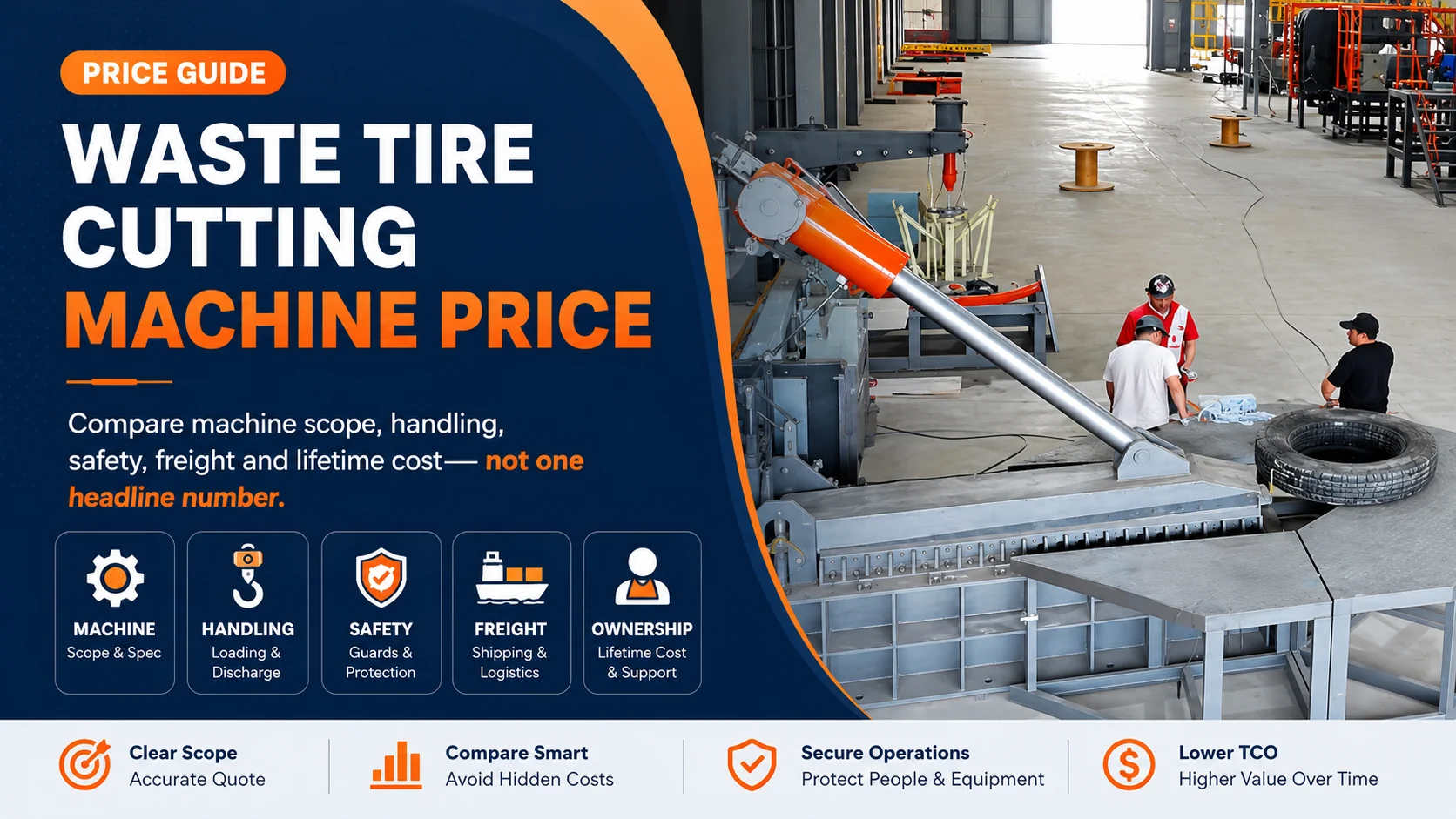
A buyer can receive three quotations for a “tire cutting machine” and see three completely different numbers. The usual reaction is to assume that one supplier is expensive. Sometimes that is true. More often, the quotations are describing different machines, different tires or different commercial scopes.
One quote may cover a workshop sidewall cutter. Another may cover a block cutter for passenger or truck tires. A third may include a heavy hydraulic cell for steel-reinforced agricultural or OTR tires, with a larger working table, restraint, loading interface and export package. All three may use the same English product name. That is why this price guide starts with classification and scope rather than with a single headline figure.
Quick Answer
Selected public marketplace pages reviewed in July 2026 show examples from about US$3,500–5,000 for a sidewall cutter to about US$31,000–37,000 for a larger tire block-cutting or shredding system.25 Semi-automatic strip and block cutters and heavier automatic cutters appear between those examples.34 These figures are individual listing signals, not a YUXI quotation, a market average or a universal price range for one machine class.
For the YUXI tire cutting machine, a project quote is the more reliable route. YUXI positions the machine for truck, all-steel radial, agricultural and OTR tires and states that final configuration depends on tire diameter, width, weight, steel content, downstream equipment and layout.1 Those variables directly change the table, clamp, hydraulic system, structure, handling and proof test.
Contents
Indicative Tire Cutting Machine Price Ranges
Public listing examples checked: July 25, 2026. Prices, availability and listing categories can change.
The first content gap in many search results is classification. Marketplace pages often group sidewall cutters, tread strip cutters, tire block cutters, shredders and whole-tire hydraulic cutters under related search terms. A low price can be real and still be irrelevant to the project.
| Machine category | Public listing signal | Typical interpretation | Critical comparison limit |
|---|---|---|---|
| Sidewall cutter | About US$3,500–5,000 in one selected listing2 | Splits the tread and sidewall on a defined workshop tire range. | Not equivalent to sectioning a complete steel-reinforced OTR tire. |
| Semi-automatic strip / block cutter | About US$5,500–11,000 across selected category listings3 | Turns prepared tread or tire sections into strips or blocks, with substantial variation in configuration. | The price may refer to a set, a single machine or a prepared-feed process rather than whole-tire sectioning. |
| Heavy automatic cutter | About US$8,600–9,200 in one selected listing4 | A higher-duty automatic sidewall or block-cutting machine. | Handling, safety package, approved tire range and line integration still need confirmation. |
| Larger block-cutting / shredding system | About US$31,000–37,000 in one related marketplace result5 | A larger commercial size-reduction system rather than a simple workshop cutter. | It is not directly comparable with a standalone hydraulic OTR sectioning cell. |
| Custom hydraulic OTR / mining tire cutter | Project quotation | Configured from the actual tire dossier, cut plan, work cell and downstream interface. | Compare approved tires and complete scope, not only hydraulic force or motor power. |
Budgeting rule: never use a sidewall-cutter listing to budget a whole-tire hydraulic sectioning cell. Confirm the input, cutting action and output before using any price as a benchmark.
Why “Tire Cutting Machine” Can Mean Different Equipment
The U.S. EPA handbook uses “size reduction” as a broad term that includes cutting, shredding and other methods of reducing a whole scrap tire.6 Search engines and marketplaces are even less strict. The same keyword can return machines that perform very different jobs.
Lower-cost cutter categories may:
- cut one or both sidewalls from a passenger or truck tire;
- remove a bead-sidewall ring;
- slice prepared tread into strips or blocks;
- process smaller tires with manual loading and limited restraint.
A hydraulic whole-tire cutter may need to:
- support a heavy truck, agricultural or OTR tire;
- hold an irregular tire body during a high-force stroke;
- cut rubber, belts, cords and bead-area reinforcement;
- create sections accepted by a shredder, granulator route or selected pyrolysis feed system.
The dedicated tire cutter vs tire shredder comparison explains the process boundary in detail. For price work, the important point is simple: a cutter that creates large sections and a shredder that creates smaller chips are different capital items.
Nine Factors That Change Tire Cutting Machine Price
1. The hardest approved tire
A price quote should be based on the most difficult tire the machine must process, not the easiest sample available for a sales video. Maximum diameter is only one variable. Width, mass, construction, steel reinforcement, condition and bead geometry can change the cutting path and the loads applied to the table, clamp and frame.
Michelin’s earthmover technical data treats OTR tires as a large family with major differences in size and weight, rather than one standard product.7 This is why an “OTR capable” label cannot replace a tire dossier. For giant mining tires, use the separate OTR tire cutting machine buying guide to qualify the complete work cell without duplicating that technical discussion here.
2. Required section size and cut plan
The buyer is not purchasing one blade stroke. The buyer is purchasing a repeatable output that the next machine can accept. A tire quartered into four pieces may still create sections that are too curved, too heavy or too wide for the shredder hopper. More cuts increase cycle time, oil heating, blade work and handling.
Define the maximum accepted section length, width, height and approximate mass. Also state whether the tire ring must be completely opened, how much exposed wire is acceptable and how the finished section will be lifted or conveyed.
3. Hydraulic system, frame and table
Hydraulic pressure on a quotation does not describe the whole machine. Cylinder size and stroke, pump and motor selection, valve control, oil tank, cooling, hose protection, frame stiffness, cutter travel, table support and restraint geometry work together. A larger number can hide a weak work cell; a well-designed machine can also appear expensive because the structural scope is visible.
The hydraulic tire cutting machine working-principle guide owns the detailed force path. In a price comparison, ask each supplier to identify what is included in the hydraulic and structural package and which tire was used to prove it.
4. Practical duty cycle
Many quotes show a capacity figure without defining the cycle. A common comparison mistake is to treat “cuts per hour” and “completed tires per hour” as the same unit. They are not. A complete cycle can include pickup, loading, positioning, clamping, cutting, retraction, multiple repositioning steps, discharge and reset.
A higher-duty machine may need more oil capacity, cooling, structural margin, access space and automation. It can cost more but produce a lower cost per accepted tire if the complete cycle is stable. Conversely, a high catalog output can be cheap and still be unachievable with the buyer’s tire mix and handling method.
5. Loading and discharge equipment
For large tires, handling can cost as much attention as cutting. The quote may cover only the cutter, leaving the buyer to provide a forklift, loader, crane, manipulator, transfer table or discharge method. A complete cell can include support platforms, guides, powered positioning or interfaces for existing plant equipment.
That difference matters in both capital cost and labor. A bare machine may appear cheaper, then require more operators and repeated loader intervention. The correct comparison is the number of people and machines needed from tire pickup to accepted section discharge.
6. Controls and machine safety
Guards, interlocked access, emergency stops, protected control positions, hose routing, pressure release, isolation points and warning systems are not decorative options. OSHA’s general machine-guarding rule requires methods that protect operators and employees from point-of-operation and other machine hazards.8 OSHA’s lockout/tagout standard covers servicing and maintenance where unexpected energization or release of stored energy could injure workers.9
The exact legal and technical requirements depend on the destination, plant and employer. Still, a quote that excludes safety scope is not directly comparable with a quote that includes it. Ask the supplier to identify every safety device, the control logic, the isolation method and what remains the buyer’s responsibility.
7. Blade, wear parts and maintenance access
The first machine price can be reduced by supplying one blade, limited service tooling and no initial spares. That saving may disappear during the first maintenance stop. A better quotation states cutter material and treatment only when verified, sharpening or replacement method, expected inspection points, access procedure, recommended spare set and lead time.
Do not ask for an unsupported universal blade-life promise. Tire construction, contamination, cut position, operator technique and duty cycle can change wear. Ask for a maintenance plan and a representative test instead.
8. Electrical, climate and utility configuration
Voltage, frequency, control-component preference, enclosure rating, ambient temperature, hydraulic cooling, oil specification and site altitude can change the electrical and hydraulic package. Export projects also need clear cable, connector, grounding and documentation scope. A quote prepared for the supplier’s factory power is not finished until it matches the buyer’s site.
9. Downstream integration and project services
A standalone cutter can be less expensive than a machine integrated with conveyors, a tire shredder, a receiving area and central controls. Engineering drawings, foundation data, factory testing, export packing, installation supervision, commissioning, operator training and spare-parts support also change the commercial total.
YUXI’s broader tire-recycling overview separates front-end preparation equipment from primary shredding and deeper recycling routes, with the final line selected from the required product.10 That process context prevents overbuying: a cutter is valuable when it solves a real feed or handling boundary, not because every recycling line needs one.
Machine Price, FOB Price and Landed Cost Are Different
Industrial export quotations often become misleading when the delivery term is missing. Incoterms define how cost, risk and responsibilities are allocated between buyer and seller.11 The named place matters too. “FOB” without a named port, or “CIF” without a precise destination, is incomplete commercial language.
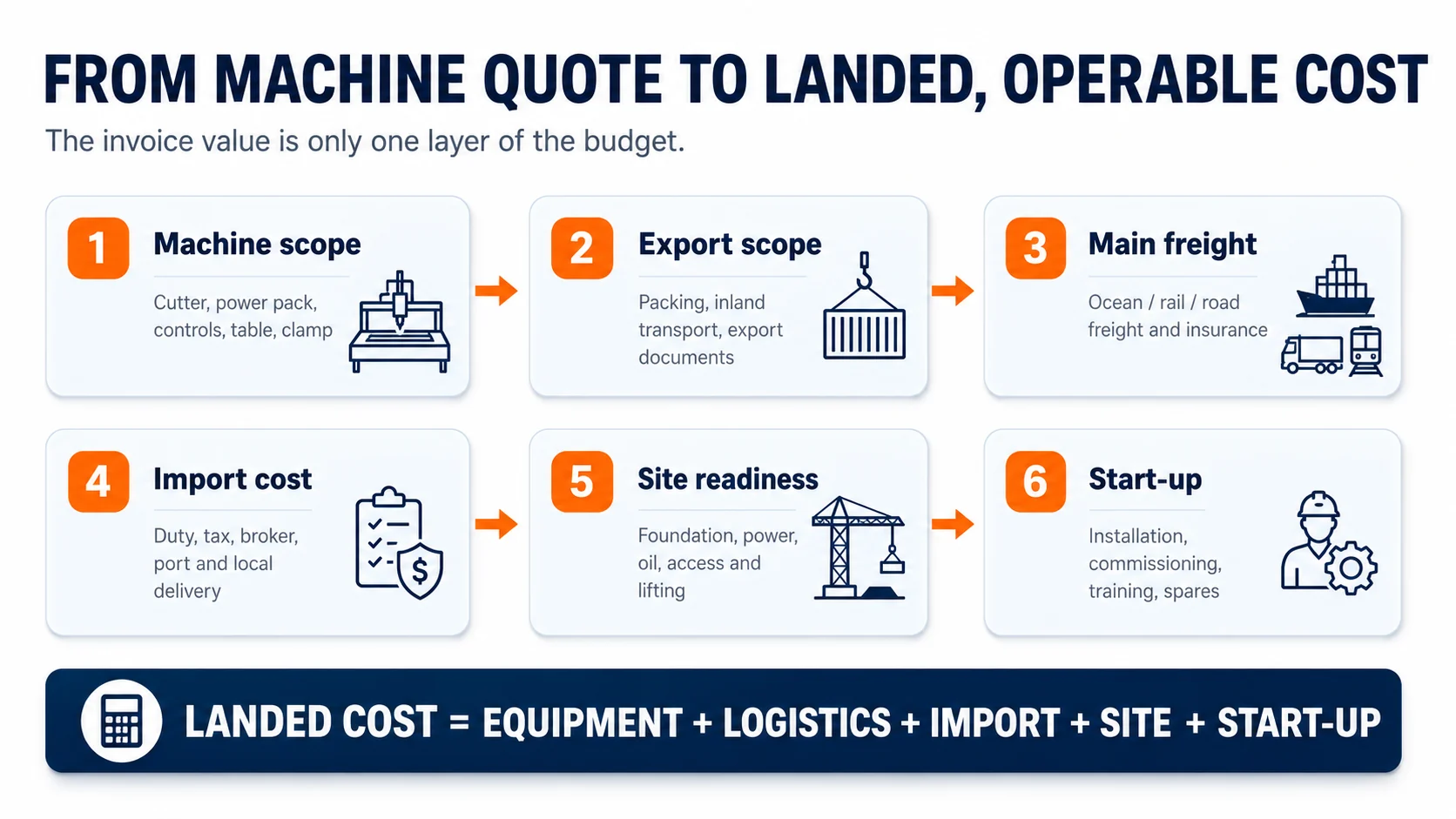
| Cost layer | Possible items | Question to ask |
|---|---|---|
| Equipment | Cutter, hydraulic power pack, controls, table, clamp, guards, standard tools | What exact components and safety functions are included? |
| Export preparation | Disassembly, anti-corrosion protection, packing, loading, inland transport, documents | What is the packed size and weight, and who loads the collecting vehicle or vessel? |
| Main transport | Ocean, rail or road freight; insurance; terminal handling | Which Incoterm and named delivery point apply? |
| Import | Duty, tax, broker, inspection, port charges, demurrage risk, local delivery | Who confirms the HS classification and destination charges? |
| Site readiness | Foundation, electrical works, hydraulic oil, lifting, access, drainage, guarding interface | What must be complete before the machine arrives? |
| Start-up | Installation, commissioning, training, test tires, travel, accommodation, initial spares | Which party supplies people, tools, lifting and consumables? |
The U.S. International Trade Administration defines landed cost as the product price plus insurance, freight, tariffs, taxes and other fees.12 For a tire cutter, an operational budget should go further and include local delivery, foundation, utilities, lifting and start-up. That is the amount the project team must fund before the first accepted tire section is produced.
Bare Machine Price vs Complete Tire-Cutting Cell
A useful quotation labels one of three scopes:
Bare machine
Cutter, hydraulic unit and basic controls. The buyer supplies loading, discharge, foundation, surrounding guarding, lifting and integration.
Operable standalone cell
Machine plus support table, agreed restraint, controls, guarding concept, service access and a defined manual or mobile-equipment workflow.
Integrated preprocessing system
Cutter connected to handling, conveyors or the next machine, with coordinated controls, layout, defined interfaces and project start-up scope.
The cheapest scope can be the correct scope when the buyer already owns suitable loaders, electrical infrastructure and plant controls. In an export project, however, a low machine price can become expensive when no one has assigned responsibility for moving the heavy tire from storage to the cutting table and then from the table to the shredder. The missing scope becomes a site improvisation.
Calculate Total Cost of Ownership, Not Only Purchase Price
For a tire cutter, ownership cost is usually driven by labor and handling, energy, hydraulic and blade maintenance, planned spares, unplanned downtime and the effect on the downstream machine. The cutter can add value when it makes a difficult tire processable or removes a larger bottleneck. It does not create value merely by adding another stage.
TCO = Landed equipment cost + site preparation + labor + energy + maintenance + spares + downtime − avoided external cutting cost − avoided handling delays − verified downstream savings
Do not insert an assumed shredder-life extension or a fixed payback period into this formula unless the project has measured evidence. Instead, compare two real routes: direct feeding and pre-cutting. Record the same tire family, operator count, mobile equipment, intervention time, accepted output and downtime boundary.
The article Do You Need to Cut Tires Before Shredding? covers that route decision in detail. This price guide uses the result: buy a cutter only when the operational benefit can be linked to a defined tire and downstream constraint.
How to Compare Tire Cutter Quotations Line by Line
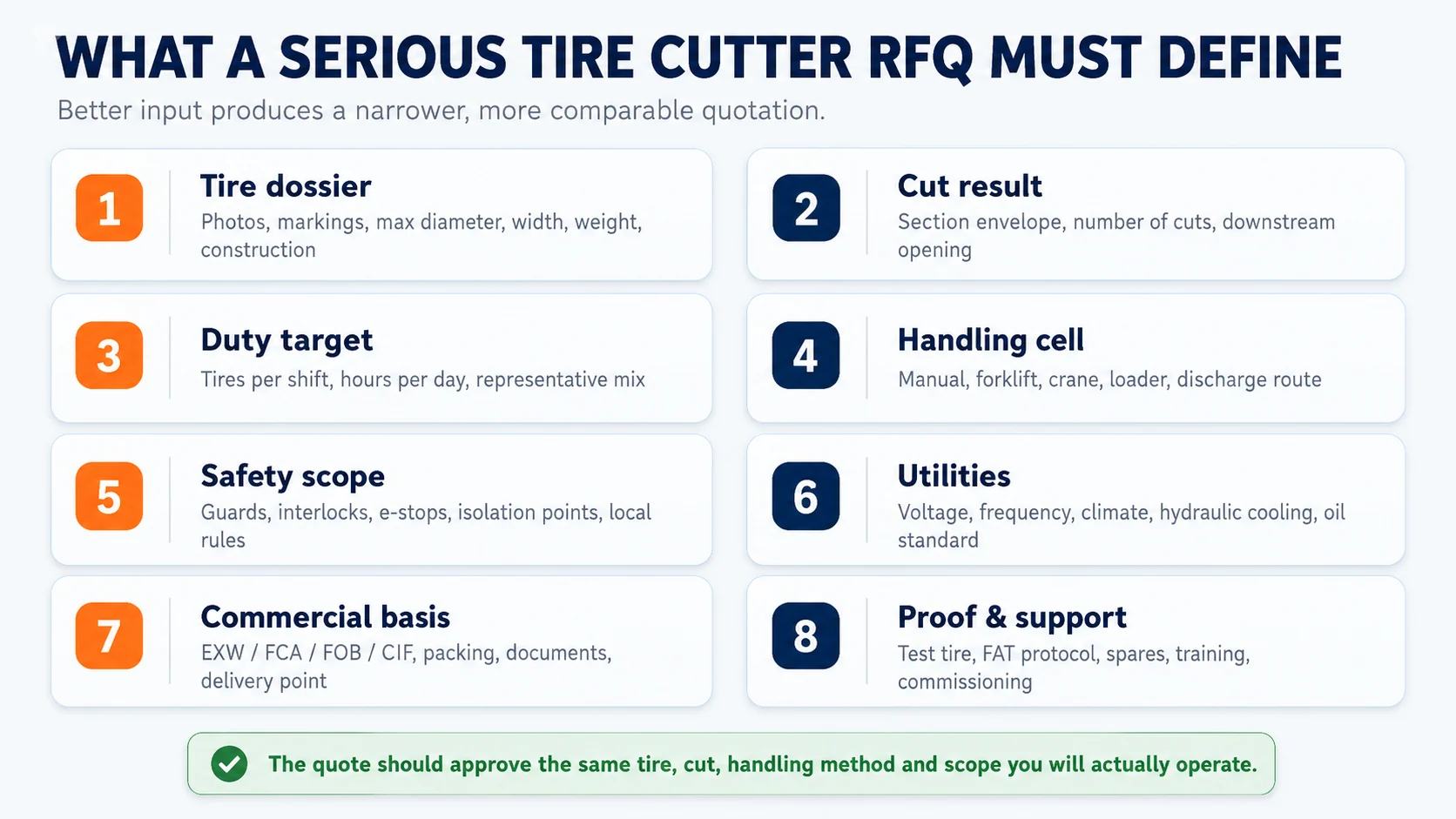
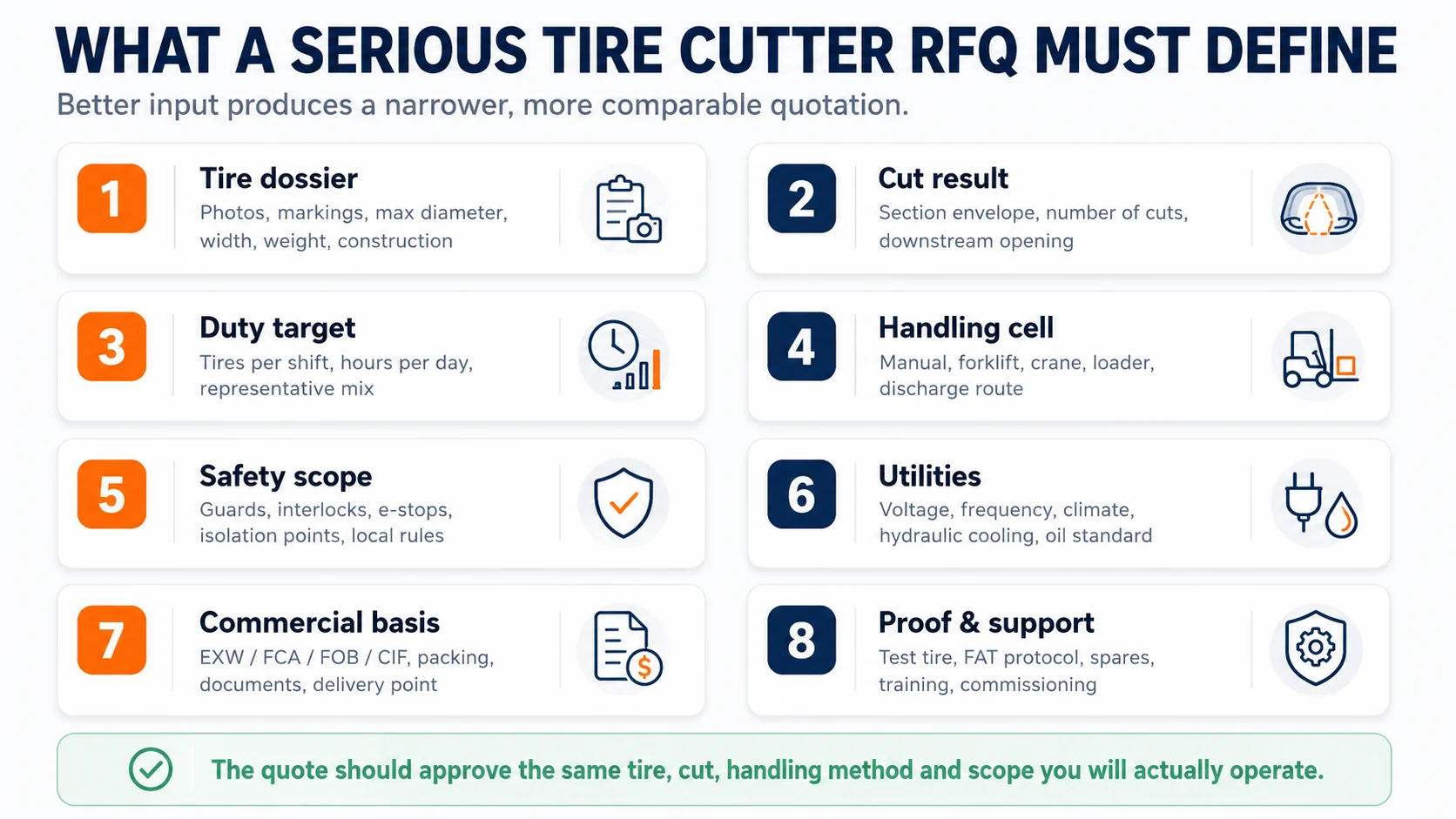
Before comparing price, normalize the project boundary. Every supplier should answer the same document.
- Approved tire set: photographs, markings, maximum diameter, width, approximate mass, construction and percentage mix.
- Required cut result: maximum section envelope, complete separation requirement, exposed-wire acceptance and downstream opening.
- Complete-cycle capacity: start and stop points, operator count, loading method, number of cuts and allowed interruptions.
- Machine scope: frame, table, clamp, cutter, hydraulic unit, cooling, controls, electrical cabinet and standard tools.
- Safety scope: guards, interlocks, e-stops, control position, isolation and stored-energy release.
- Handling scope: loading, tire rotation or repositioning, finished-section discharge and mobile-equipment responsibility.
- Utilities and site: voltage, frequency, ambient conditions, oil, foundation, lifting and access.
- Commercial basis: currency, quote validity, Incoterm, named place, packing, payment milestones and delivery period.
- Proof: representative test tire, FAT protocol, retained video, measurements and acceptance criteria.
- Ownership support: recommended spares, maintenance documents, training, commissioning and service boundaries.
Do not compare totals until every “not included” item has an owner and a budget. A transparent higher quotation may be cheaper than a low quotation that moves essential scope to the buyer.
What YUXI Needs to Prepare a Tire Cutter Price
YUXI’s public product page asks for tire type, maximum tire size, approximate capacity requirement, downstream process and available workshop layout.1 For a more useful quotation, prepare the following information in one message:
- clear photos of the largest and most common tires, including sidewall markings;
- maximum outer diameter, width and approximate weight;
- tire family: truck, all-steel radial, agricultural, OTR/mining or mixed;
- estimated percentage of each tire family;
- desired section size or the next machine’s maximum accepted feed envelope;
- target tires per shift and working hours, not only a vague tons-per-hour request;
- loading method available at the site;
- local voltage, frequency and ambient conditions;
- workshop plan, access doors, lifting limits and intended machine position;
- required Incoterm, destination port or delivery address, and service expectations.
Surprisingly, a short tire video is often more useful than another paragraph of specifications. Show the tire next to a known scale, record markings, turn it to show damage and steel exposure, and show how the plant currently moves it. That gives engineering and logistics teams the same evidence.
Request a Comparable YUXI Quotation
Send the tire dossier, required cut result, downstream machine, operating schedule, handling method and destination. Ask YUXI to separate machine scope, optional work-cell items, freight basis, commissioning and spare parts so the quotation can be compared line by line. Request a Tire Cutting Solution
Price Red Flags to Resolve Before Ordering
| Red flag | Why it matters | Better evidence |
|---|---|---|
| One price for “all tires” | The tire family is too broad for a credible universal approval. | Signed approved-tire schedule and exclusions. |
| Capacity without cycle boundary | Blade strokes may be presented as completed tires. | Continuous full-cycle test with operator and handling method shown. |
| Motor power used as the main proof | Power alone does not prove structure, restraint, cut result or duty. | Representative tire test and machine architecture. |
| Unclear “FOB price” | Named port, export packing, loading and local charges may be missing. | Incoterm 2020 plus named place and packing list. |
| No safety-scope list | Required guarding and isolation may become a site redesign. | Safety-function schedule and responsibility matrix. |
| No blade or spare plan | A small initial saving can create long downtime. | Recommended commissioning and operating spare list. |
| Test on an easy tire only | The price may be based on a material that does not represent the stockpile. | Hardest approved tire plus normal production mix. |
When a Lower-Cost Tire Cutter Can Be the Right Choice
Lower-cost machines are not automatically inferior. For a narrow task, a simpler cutter can be the right answer—for example, passenger-tire sidewall cutting, small batches of prepared tires, workshops that already have suitable guarding and handling equipment, or projects that only need occasional segmentation before another operation.
It becomes the wrong choice when the low price depends on excluding the hardest tires, repeated manual intervention, incomplete cuts, exposed-wire hazards, unavailable spare parts or sections that the downstream machine still cannot accept. In our experience, the best budget is the lowest-cost configuration that proves the complete operating boundary—not the lowest number on the first page of the quotation.
FAQ
How much does a tire cutting machine cost?
Public listings range from smaller sidewall or preparation cutters priced in the low thousands of U.S. dollars to larger tire cutting or size-reduction systems priced in the tens of thousands. A hydraulic cutter for truck, agricultural or OTR tires normally requires a project quotation because tire size, steel content, table, clamp, handling, safety and commercial scope change the design.
Why does YUXI not publish one fixed tire cutting machine price?
YUXI states that final configuration depends on tire diameter, width, weight, steel content, downstream equipment and plant conditions. A fixed public price could therefore describe the wrong machine or exclude required handling and project scope.
What should be included in a tire cutter quotation?
The quotation should identify the approved tire range, required cut result, machine and hydraulic scope, loading and discharge method, controls and safety functions, utilities, packing, Incoterm, delivery point, testing, spares, training and commissioning responsibilities.
Is the cheapest tire cutter suitable for truck or OTR tires?
Not necessarily. Low public prices often refer to sidewall, bead-ring, strip or light-duty block cutters. They should not be treated as equivalent to a heavy hydraulic machine that sections complete steel-reinforced truck or OTR tires.
How do I calculate the landed cost of a tire cutting machine?
Add the equipment price, export packing, inland freight, main freight, insurance, import duties and taxes, broker and port charges, local delivery, site preparation, lifting, utilities, installation, commissioning and initial spares. Confirm the Incoterm and named delivery point before comparing quotations.
What information should I send YUXI for a price?
Send clear tire photographs and markings, maximum diameter and width, approximate weight, tire mix, desired section size, downstream equipment, target shift output, loading method, local power supply and workshop layout.
References
- YUXI Machinery. Tire Cutting Machine for Waste Tire Recycling. Application range, line position and project-configuration factors.
- Made-in-China. Used Tire Sidewall Cutting Machine listing. Public price observed July 25, 2026.
- Made-in-China. Semi-Automatic Strip and Block Cutter category. Public category prices observed July 25, 2026.
- Made-in-China. High-Performance Tire Sidewall Cutter listing. Public price observed July 25, 2026.
- Made-in-China. Waste Car Tyre/Tire Shredder Machinery listing. Related large-system price signal observed July 25, 2026.
- U.S. Environmental Protection Agency. Scrap Tires: Handbook on Recycling Applications and Management for the U.S. and Mexico. Scrap-tire processing and size-reduction terminology.
- Michelin. Technical Data: Earthmover Tires. Earthmover tire size and weight variation.
- U.S. Occupational Safety and Health Administration. 29 CFR 1910.212: General Requirements for All Machines. Machine-guarding requirements.
- U.S. Occupational Safety and Health Administration. 29 CFR 1910.147: The Control of Hazardous Energy. Lockout/tagout requirements.
- YUXI Machinery. Tire Recycling Plants for Chips, Mulch, Crumb and Powder. Front-end equipment and downstream production-route overview.
- International Chamber of Commerce. Incoterms 2020. Allocation of cost, risk and obligations.
- International Trade Administration, U.S. Department of Commerce. Determine Total Export Price. Landed-cost components.