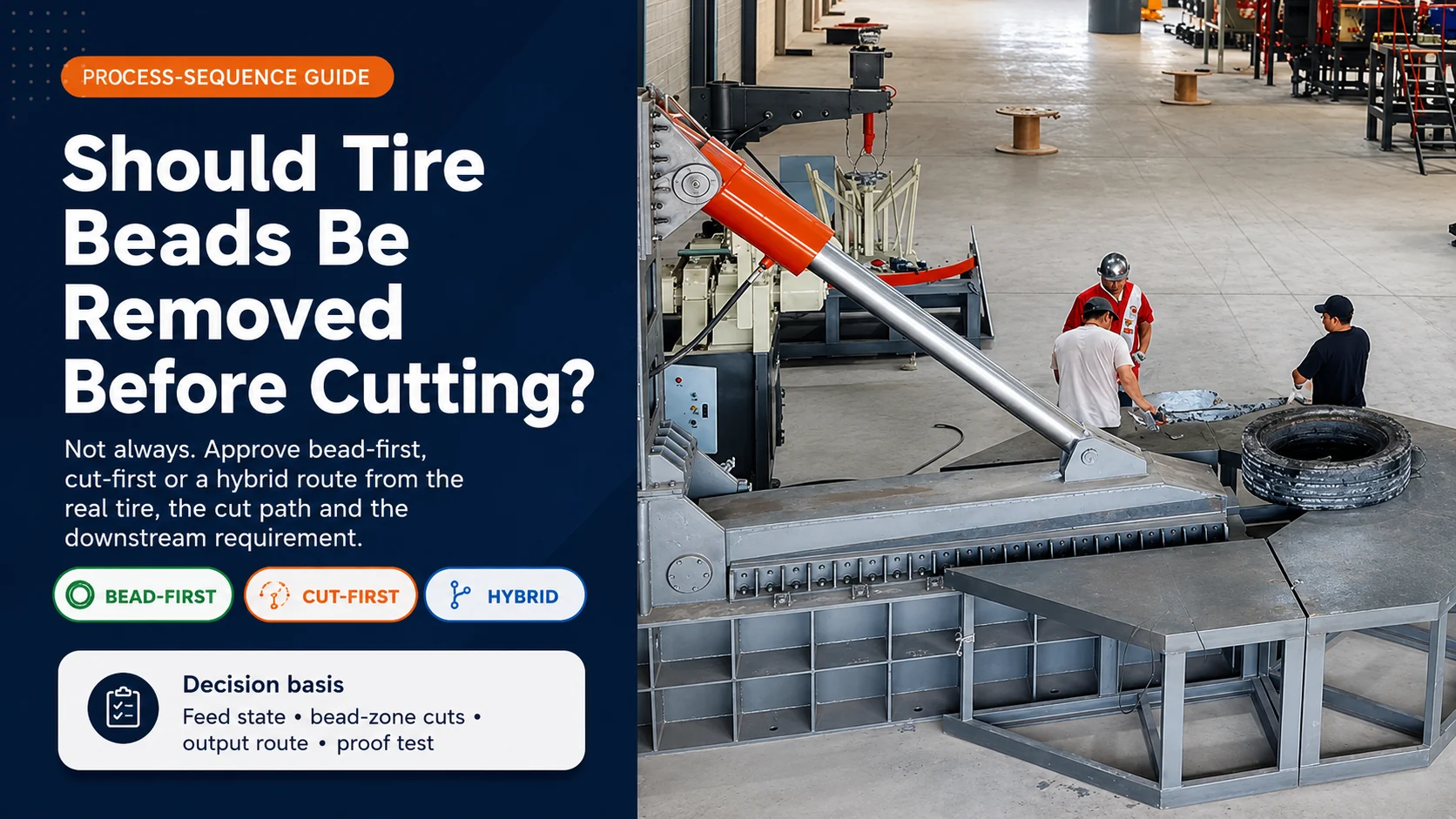
Removing the bead first can reduce concentrated steel in the cutting route. It is not a universal prerequisite. The correct sequence depends on what “bead removal” means, where the planned cuts pass, whether the cutter is approved for intact bead zones, and what the next machine must receive.
Bead-first, cut-first and hybrid routes can all be valid. The tire, cut plan and downstream interface decide which one belongs in the project.
A short demonstration can make the sequence look obvious. One operator removes a bead ring, another places the casing under a cutter, and the process appears to have a fixed order. Then an OTR tire arrives that cannot be handled like the clean truck tire in the video. The bead is still buried in a huge, distorted structure, while the immediate problem is simply opening the tire into controllable sections.
Quick Answer
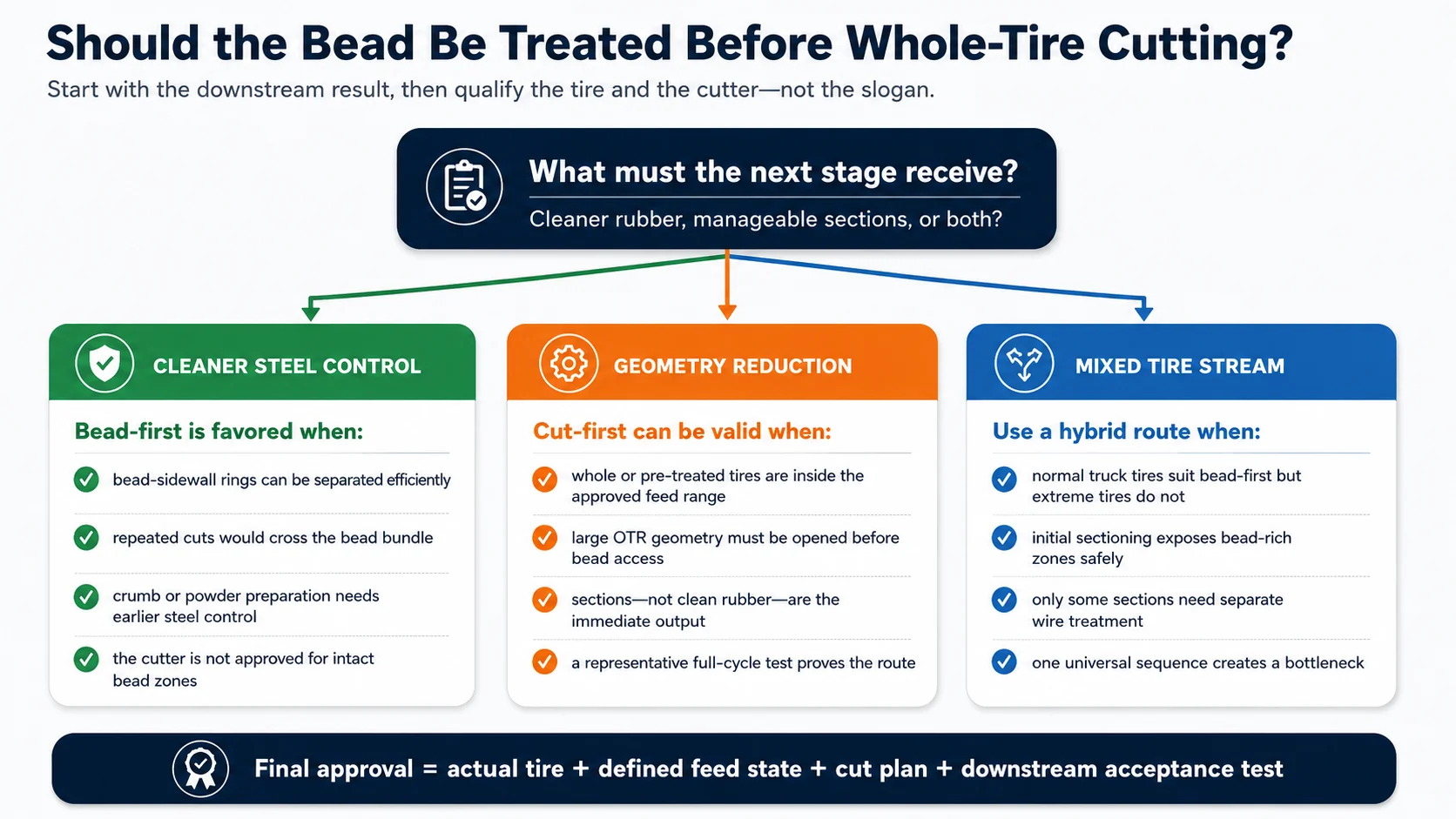
You do not always need to remove tire beads before cutting. Bead-first processing is usually more defensible when the project can separate the bead-rich sidewall ring efficiently, the planned straight cuts would repeatedly cross the bead bundle, the downstream route needs earlier steel control, or the cutting machine is not approved for intact bead zones.
Cut-first processing can be valid when a YUXI hydraulic tire cutting machine is configured and tested for the actual whole or pre-treated tire, including its reinforcement, and the immediate objective is geometry reduction rather than clean wire recovery. Very large or irregular OTR tires may also need initial sectioning before the bead-rich areas become practical to isolate. A mixed plant may use both sequences.
Begin with the required downstream state. Then confirm whether the actual tire and the intended cut path fit the approved machine route.
First Clarify What “Remove the Tire Bead” Means
The bead anchors the tire to the rim. Bekaert describes tire bead wire as high-carbon steel reinforcement that helps secure the tire to the rim, with constructions adapted to passenger, truck and OTR tire families.3 It is a concentrated steel zone, but it is not the only steel in many tires. Belts, plies and cords can remain after bead treatment.
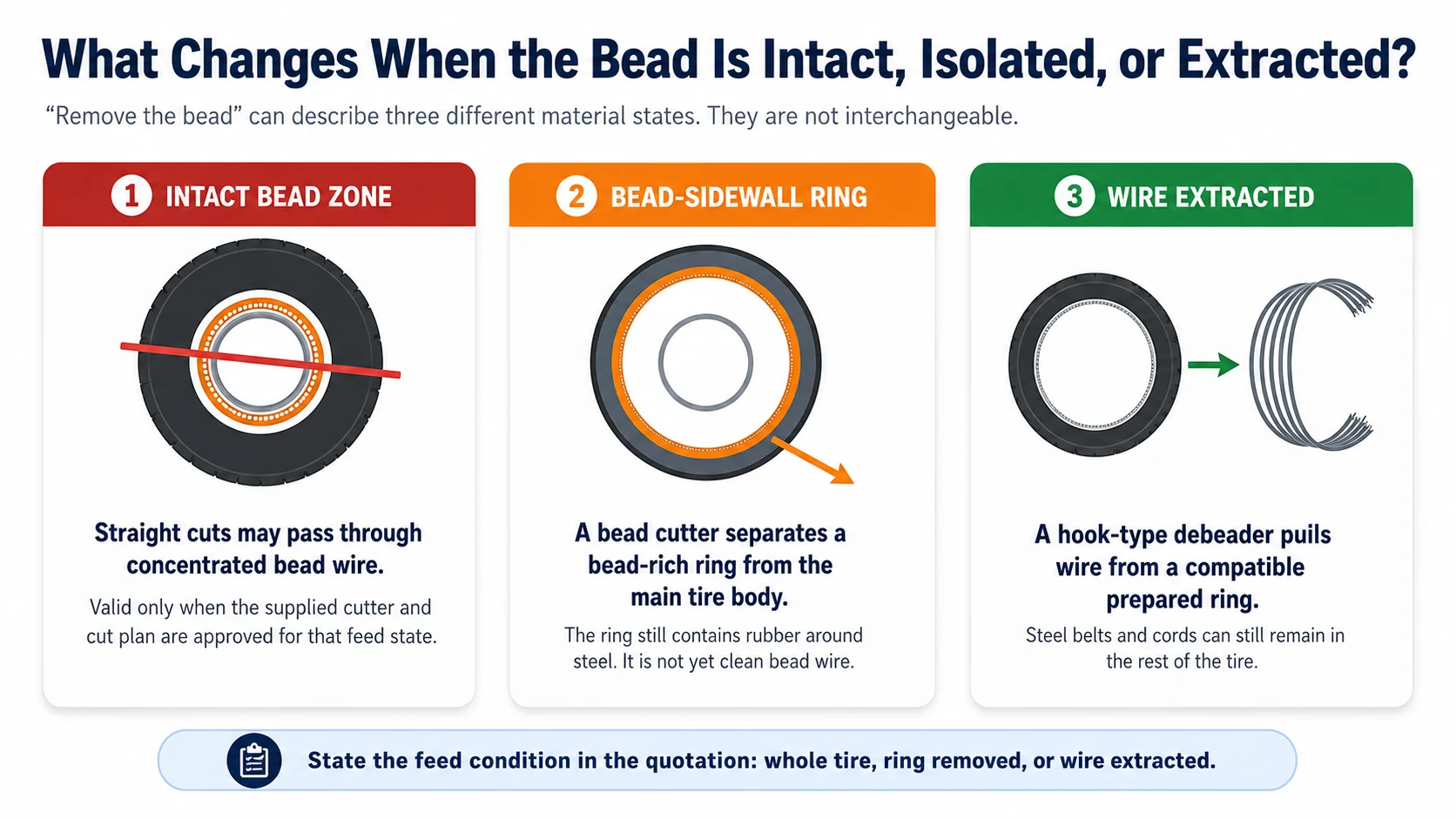
Before choosing a sequence, put the requested output in writing.
Phrase used in an RFQ
What the operation may actually do
Resulting feed state
Why it matters before cutting
Remove the bead ring
Cut around the sidewall near the bead and separate a bead-rich ring from the main casing.
Main tire body plus a rubber-covered bead-sidewall ring.
The main body is easier to section without repeatedly crossing the concentrated ring, but the separated ring still needs a destination.
Open or split the bead zone
Make a cut that breaks the closed ring geometry without extracting the steel bundle.
An opened bead-rich section with exposed reinforcement.
Handling and shredder engagement may improve, but steel has not been recovered as a separate clean fraction.
Extract bead wire
Use a hook-type pulling machine on a compatible prepared ring.
Recovered bead-wire bundle and a rubber-rich prepared ring.
This is a separate material-recovery step. It normally requires suitable ring preparation before pulling.
Cut the whole tire into sections
Drive a straight hydraulic cutter through selected cross-sections.
Large sections that may still contain bead, belts and cords.
This changes geometry. It does not by itself mean that the tire has been debeaded.
The dedicated tire bead cutter versus tire debeader comparison owns the equipment terminology in detail. For this sequence decision, one distinction is enough: separating a bead-sidewall ring and pulling clean wire from that ring are different production stages.
State the material condition precisely. “Bead removed” is too ambiguous for a machine quotation or acceptance test.
The Real Question Is Sequence, Not Necessity
A tire recycling line does not gain value merely by moving one machine earlier. Each stage must create a feed state that the next stage can use more reliably than the state it received. Bead-first processing adds ring cutting, ring discharge and separate handling. Cut-first processing may send the cutter through a harder steel-rich cross-section and can leave exposed wires on heavy pieces. Both routes have a cost.
Approve the sequence that creates the lowest-risk accepted downstream feed—not the sequence with the fewest words in a flowchart.
Four questions usually settle the issue:
Where do the planned cuts pass? A cut through the tread and sidewall is not the same load as a cut through a concentrated bead bundle.
What feed state is the cutter approved to accept? “Suitable for tires” is incomplete. The test record should say whole tire, bead ring removed, sidewall removed, or other preparation.
What must the next process receive? A shredder may need controllable sections; a fine rubber route may justify earlier steel control; a batch process may mainly need a smaller loading envelope.
Can the bead area be handled efficiently before sectioning? On a common truck tire, often yes. On a giant, damaged or collapsed OTR casing, initial opening may be the practical first step.
When Bead-First Processing Is the Better Route
1. The planned sectioning pattern repeatedly crosses the bead bundle
The bead is a compact steel-reinforced ring. If every finished section requires a straight cut through that ring, the cutting route may spend disproportionate time and tool load in one narrow zone. Separating the bead-sidewall ring first can let the main casing be divided along easier, more repeatable paths.
That does not mean a correctly configured hydraulic cutter cannot cut bead-rich areas. YUXI’s public product description states that the cutter can be configured for thick rubber, bead wire and steel-cord layers. The point is different: a machine being capable of a difficult cut does not automatically make repeated difficult cuts the best plant sequence.
2. The downstream product needs earlier steel control
Fine granulation, crumb rubber and powder routes normally require progressive liberation and separation. Removing or isolating the concentrated bead zone early can reduce the amount of heavy bead material entering later size-reduction stages. EPA’s handbook specifically links pre-shred debeading with cleaner product and lower wear on moving shredder parts.1
Keep the claim bounded. Bead removal does not remove every belt or cord. Magnetic separation and additional liberation can still be required downstream.
3. The tire family is uniform enough for a stable ring-removal cell
A plant processing a repeatable stream of truck or bus tires can often build a predictable bead-sidewall cutting station around known diameters, loading methods and operator tasks. Once the main body and bead-rich rings leave as separate streams, the whole-tire cutter can focus on section geometry rather than component separation.
4. The cutter supplier requires a treated feed state
This is the simplest case. If the supplier’s approved range excludes intact bead zones, the quoted input must be prepared accordingly. A sales video showing an intact tire on a different machine cannot override the supplied machine’s documented feed boundary.
Bead-first is strongest when it simplifies more than one later stage: easier sectioning, a defined bead-rich stream, fewer bead-zone crossings and a downstream process that benefits from earlier steel control.
When Cutting Before Bead Removal Is Legitimate
1. The immediate objective is geometry reduction
A whole truck, agricultural or OTR tire may be too large, stiff or irregular for transport, storage, a shredder hopper or a batch loading opening. In that case, the first production requirement is not clean bead wire. It is a section that can be lifted, oriented and presented safely to the next stage.
YUXI positions its hydraulic cutter for whole or pre-treated large tires before shredding, granulation preparation, TDF preparation, selected pyrolysis pretreatment or storage. The output is a large section, not final chips. That product boundary supports cut-first when the supplied configuration and representative test include the actual intact tire.
2. The bead-rich area is not practically accessible on the whole tire
Large OTR tires do not form one standardized feed category. Diameter, width, mass, construction, deformation and repair history can change the work cell. A giant or collapsed casing may need to be opened first so that bead-sidewall sections can be isolated with controlled handling. Insisting on wire extraction before any opening cut can turn the sequence into a handling problem rather than a recovery improvement.
3. The downstream process accepts steel-bearing sections
Some primary shredding routes, TDF preparation routes or selected batch processes are designed around steel-bearing tire material. The relevant question becomes whether the receiving equipment is approved for the section dimensions, exposed-wire condition and reinforcement—not whether the bead has disappeared.
This does not replace the separate decision in Do You Need to Cut Tires Before Shredding? That article qualifies whole-tire versus pre-cut shredder feed. Here, the narrower point is that a valid pre-cut section may still contain bead steel.
4. The cutter has representative evidence for intact bead zones
A catalog phrase such as “cuts steel wire” is only a claim until the test conditions are visible. Strong evidence shows the real tire markings, dimensions and condition; the preparation state at loading; every cut in the agreed plan; section discharge; exposed reinforcement; and the actual downstream transfer.
Watch for an easy demonstration shortcut: the supplier presents a whole tire at the start, but the difficult bead-zone pieces disappear between video cuts. A complete test should account for every output section.
When a Hybrid Route Is More Honest Than One Universal Rule
Many plants do not receive one tire. They receive a mix. A uniform bead-first route can be efficient for standard truck tires and awkward for a small fraction of agricultural or OTR casings. A uniform cut-first route can make the extreme tires manageable while sending hundreds of easier tires through unnecessary bead-zone cuts.
A hybrid route can separate the problem in two ways:
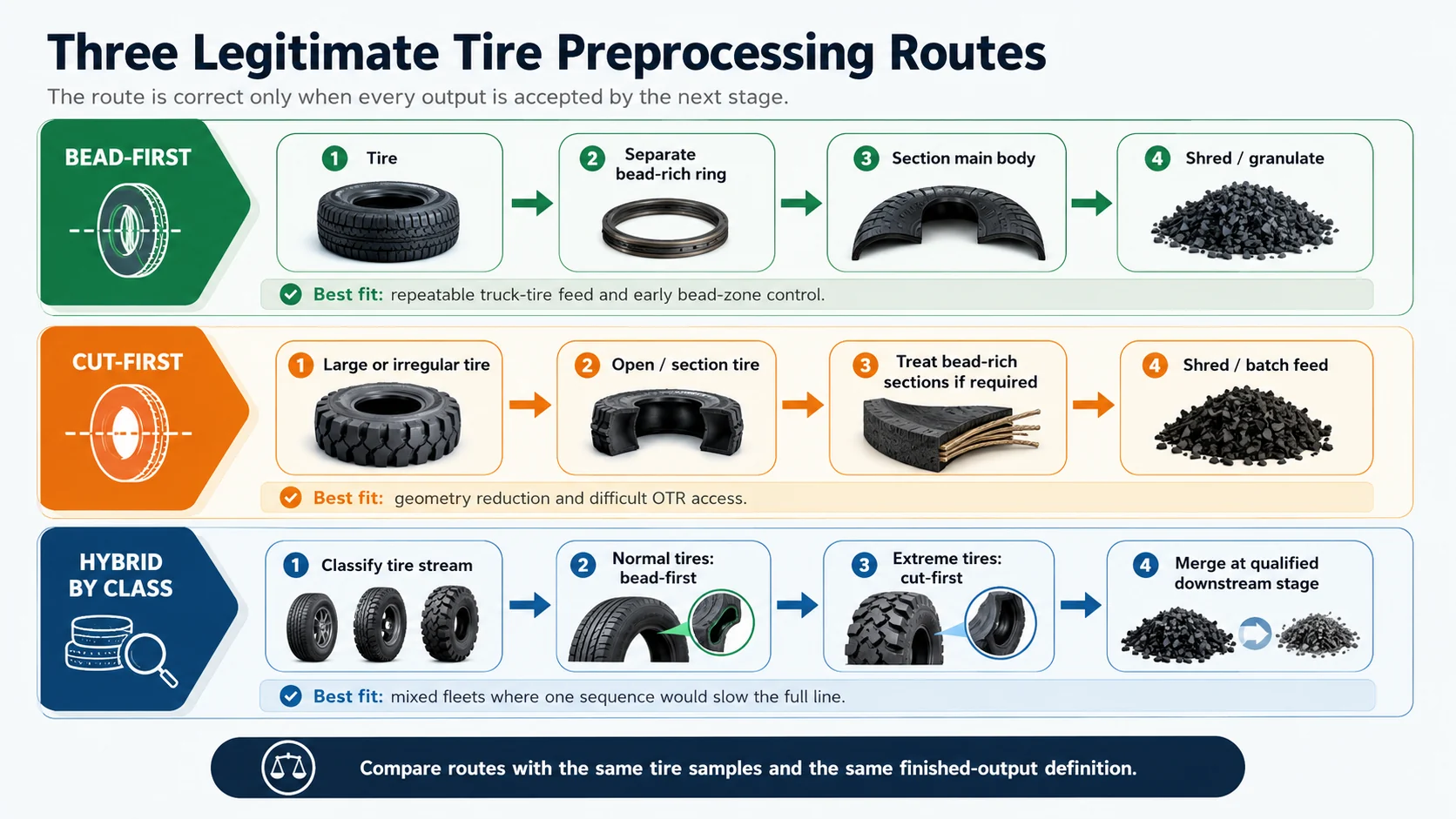
Hybrid by tire class
Normal truck and bus tires follow bead-ring separation before main-body cutting. Oversize, deformed or heavy tires follow a qualified cut-first route. Both streams merge only after they meet a common downstream feed specification.
Hybrid within one tire
Initial sectioning opens an OTR tire. Bead-rich sections are then routed to separate cutting or wire extraction, while tread and sidewall sections move directly to the next approved stage.
The routing rule must be visible to operators and measurable for capacity planning. “Process difficult tires separately” is not enough. Define the classification criteria, destination, handling device, output state and maximum allowed queue.
Every arrow is an interface. The output of one machine must be the tested input of the next machine.
Practical Decision Matrix by Tire and Downstream Goal
Project condition
Starting route to evaluate
Why
Evidence that can change the answer
Uniform passenger or light-truck tires for fine rubber recovery
Bead-first or direct whole-tire shredding, depending on the established line design; a heavy sectioning cutter may not be needed.
The main decision is steel control and shredder compatibility rather than OTR geometry reduction.
Actual tire construction, whole-tire shredder approval, required rubber grade and downstream magnetic separation.
Repeatable truck or bus tires followed by sectioning and shredding
Test bead-sidewall ring separation before main-body cutting.
Uniform tires can support a stable ring-removal cell and fewer repeated bead-zone cuts.
A qualified cutter–shredder route that processes intact tires faster at the same accepted output and wear boundary.
Mixed commercial tires with a small oversize fraction
Hybrid by tire class.
The difficult minority should not dictate unnecessary preparation for the full stream.
Measured routing percentage, work-cell balance and buffer capacity.
Agricultural tires with wide or irregular geometry
Compare bead-first and cut-first with the actual tire family.
Sidewall shape and handling can make either ring removal or initial opening the bottleneck.
Complete-cycle labor, stable restraint, section dimensions and the receiving opening.
Giant OTR or mining tires
Start with a project-specific cut plan; bead-rich sections may be treated after initial opening.
Whole-tire bead access and handling can dominate the route.
Measured tire dossier, lifting plan, cut-path drawing and full material accounting.
Sections for selected pyrolysis or volume reduction
Cut-first may be appropriate when the receiving process accepts the reinforcement state.
The immediate objective is often a loading envelope rather than clean wire recovery.
Written feed specification from the receiving process and confirmation of exposed-wire limits.
Crumb, granules or powder with strict steel-control targets
Bead-first is normally worth serious evaluation.
Early isolation of the concentrated bead zone can simplify later liberation and separation.
Measured product specification, actual recovery route, wear data and full-line testing.
These are starting points, not model guarantees. A final YUXI configuration depends on tire diameter, width, weight, reinforcement, preparation state, downstream equipment and site handling. No one matrix can replace the representative tire.
How the Three YUXI Equipment Roles Fit Together
Sequence problems often begin when equipment names are treated as synonyms. They are easier to resolve when each machine is assigned one material transformation.
1
Bead-sidewall separation
The YUXI waste tire bead cutting machine follows the sidewall near the bead and separates a bead-rich ring or bead-sidewall section from the main tire body. The removed ring still contains rubber around steel. Its normal product is not automatically clean wire.
2
Wire extraction from a prepared ring
The YUXI tire wire drawing machine uses a hydraulic hook-type pulling action on a compatible prepared bead ring, particularly where the sidewall has already been removed. It creates a concentrated wire bundle and a rubber-rich residual ring.
3
Whole-tire or pre-treated tire sectioning
The hydraulic tire cutter supports, restrains and divides a large tire into sections. Its job is geometry reduction. It can be configured around whole or pre-treated tires, but the approved input and cut plan must be confirmed for the project.
A useful line specification names both the machine and the material state. For example: “prepared truck-tire main bodies after bead-sidewall ring separation,” or “whole OTR tire, rim removed, intact bead zones included in the approved cut plan.”
How to Prove the Sequence Before Ordering
A sequence comparison is meaningful only when both routes start with comparable tires and end at the same accepted-output point. Timing one cutter stroke against one bead-ring cut proves almost nothing about production.
Build the tire dossier. Record markings, tire family, outside diameter, width, approximate mass, radial or bias construction where known, visible repairs, deformation, contamination and rim-removal state.
Define both feed states. State exactly what enters each machine: whole tire, bead-sidewall ring removed, opened section, or prepared ring for wire extraction.
Draw the cut plan. Mark which cuts cross tread, sidewall, belt and bead-rich zones. Define the required number of fully separated sections.
Time the complete route. Include loading, restraint, ring removal or wire pulling, repositioning, cutting, unloading, transfer and material sorting—not only hydraulic motion.
Account for every output. Measure main-body sections, bead-rich rings, extracted wire and residual rubber. Record sharp or protruding wire that changes handling.
Feed the actual output downstream. A cutter test and a shredder test using different prepared samples do not prove an interface.
Record intervention and stoppage. Count loader correction, unstable tire movement, incomplete separation, repeated strokes, wire entanglement, reversals and unplanned stops.
Repeat with normal and difficult tires. The hardest tire qualifies the boundary; the normal mix establishes practical line balance.
In our experience, the most revealing number is often not pieces per hour. It is the percentage of completed pieces that the next machine accepts without additional manual preparation.
Compare Labor, Wear and Accepted Output Together
Bead-first can reduce difficult steel-rich cuts and create a separately handled ring, but it adds another loading and discharge cycle. Cut-first can simplify the initial work cell, but intact bead-zone cuts may increase tool demand and can create heavy sections with exposed reinforcement. Wire extraction can add material value or improve downstream control, yet it requires compatible prepared rings and its own cycle.
Measure
Bead-first route
Cut-first route
What to normalize
Labor
Ring positioning, circumference cutting, ring sorting and possible later wire extraction.
Whole-tire loading, restraint, repeated sectioning and handling of steel-bearing pieces.
Same tire mix, same shift boundary and all transfer tasks.
Tool exposure
Main-body cutter may avoid concentrated bead crossings; bead cutter has its own blade wear.
Main cutter may cross bead-rich zones depending on the plan.
Accepted tonnes or completed approved tires, not calendar time alone.
Output control
Creates a separate bead-rich stream earlier.
Keeps components together until later sorting or separation.
Same final product specification and material-accounting point.
Handling
More individual streams, often smaller pieces.
Fewer early stages, potentially heavier or sharper sections.
Loader, crane, conveyor, operator count and buffer area.
Line capacity
Can improve later stability but can become the front-end bottleneck.
Can open difficult tires quickly but may transfer steel-related load downstream.
Accepted downstream output over a sustained run.
Do not monetize an assumed blade-life saving without a plant baseline or controlled trial. Do not declare cut-first cheaper because it uses one fewer named machine while ignoring loader corrections, section rework or downstream stoppage. The cost comparison belongs at the same accepted-output boundary.
Safety Boundary
Bead cutting, wire pulling and whole-tire sectioning create different point-of-operation and stored-energy hazards. Heavy tires can roll, collapse, rebound or shift as their closed structure is opened. Separated sections may expose steel. Hydraulic systems can retain energy after motion stops.
OSHA’s general machine-guarding rule requires guarding against point-of-operation hazards, ingoing nip points, rotating parts and similar hazards.4 Final guarding, control placement, interlocks, emergency stops, material-handling equipment, energy isolation and operator training must follow the supplied machine documentation, the site risk assessment and applicable local law.
The Final Decision Rule
Remove tire beads before cutting when early bead isolation clearly improves the approved cut plan or downstream steel control. Cut first when the actual tire must be opened for geometry or access and the supplied cutter is proven for the intact reinforcement state. Use a hybrid route when the tire mix makes one universal sequence wasteful or impractical.
The answer should therefore never be “always” based only on tire category. It should be a written process decision with four named items: approved tire, preparation state, cut plan and downstream acceptance condition.
What to Send YUXI for a Sequence Evaluation
Tire and production data
Photos of the whole tire, markings, bead opening and typical damage
Maximum and typical diameter, width and approximate weight
Tire-family percentages and expected volume per shift or month
Rim-removal state, contamination and deformation
Any existing bead-cutting or wire-pulling method
Output and site data
Required final material: sections, TDF, chips, granules, powder or batch feed
Receiving machine opening and approved steel condition
Maximum acceptable section dimensions and mass
Available loader, forklift, crane or conveyor
Workshop layout, power supply and required line capacity boundary
Ask for a Route Test, Not a Generic “Yes”
Send representative tires and the intended downstream interface. YUXI can evaluate bead-first, cut-first or combined preparation without assigning an unverified universal sequence to every truck, agricultural or OTR tire.
Do all tire beads have to be removed before a hydraulic tire cutter is used?
No. Some hydraulic cutters are configured for whole or pre-treated tires and can process bead-wire and steel-cord zones. The specific machine, tire and cut plan must be approved and tested. Bead removal is more useful when it simplifies repeated cuts or the downstream steel-control route.
Does removing the bead mean all steel has been removed from the tire?
No. The bead is one concentrated steel-reinforced area. Steel belts, plies or cords may remain in the tire body and require later liberation and separation.
Is cutting off the bead ring the same as extracting bead wire?
No. A bead cutter normally separates a rubber-covered bead-sidewall ring. A wire drawing machine pulls the wire bundle from a compatible prepared ring. These are different inputs and outputs.
Should truck tire beads be removed before cutting the casing into sections?
It is often worth evaluating for a uniform truck-tire stream because ring removal can reduce repeated bead-zone cuts and create a separate bead-rich stream. A representative test may still support intact-bead sectioning when the supplied cutter and downstream route are designed for it.
Should OTR tire beads be removed before the first cut?
Not automatically. Giant or deformed OTR tires may need initial opening or sectioning before bead-rich areas can be handled efficiently. The route should be based on the actual tire dossier, lifting plan and cut-path test.
Will bead removal always increase line capacity?
No. It can stabilize later cutting or shredding, but it adds loading, cutting, discharge and material-handling work. Compare sustained accepted downstream output for both complete routes.
What is the best evidence for choosing bead-first or cut-first?
Use the same representative tire family, document the preparation state and cut plan, time every handling and machine task, account for all output streams, and feed the actual produced sections into the proposed downstream equipment.
U.S. EPA — Scrap Tire Frequently Asked Questions. Background showing that some cut-product uses specify steel bead removal before cutting, reinforcing that sequence depends on the intended product.
Marie has 8+ years of experience in tire shredding and recycling equipment,with a focus on tire shredders,rubber recycling machines,TDF production,rubber crumb processing,and complete tire recycling systems.